

Autocorrelation
Let 👁 {a_i}_(i=0)^(N-1)
be a periodic sequence, then the autocorrelation
of the sequence, sometimes called the periodic autocorrelation (Zwillinger 1995,
p. 223), is the sequence

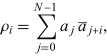
where 👁 a^_
denotes the complex conjugate and the final
subscript is understood to be taken modulo 👁 N
.


Similarly, for a periodic array 👁 a_(ij)
with 👁 0<=i<=M-1
and 👁 0<=j<=N-1
, the autocorrelation is the 👁 (2M)×(2N)
-dimensional matrix given by


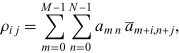
where the final subscripts are understood to be taken modulo 👁 M
and 👁 N
, respectively.


For a complex function 👁 f
, the autocorrelation is defined by

| 👁 f*f | 👁 = | 👁 int_(-infty)^inftyf(tau)f^_(tau-t)dtau |
(3)
|
| 👁 Image | 👁 = | 👁 int_(-infty)^inftyf^_(tau)f(tau+t)dtau, |
(4)
|


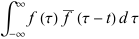


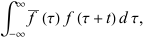
where 👁 *
denotes cross-correlation and 👁 f^_
is the complex conjugate
(Bracewell 1965, pp. 40-41).


Note that the notation 👁 rho_f(t)
is sometimes used for 👁 f*f
and that the quantity



is sometimes also known as the autocorrelation of a continuous real function 👁 f(t)
(Papoulis 1962, p. 241).

The autocorrelation discards phase information, returning only the power, and is therefore an irreversible operation.
There is also a somewhat surprising and extremely important relationship between the autocorrelation and the Fourier transform
known as the Wiener-Khinchin theorem.
Let 👁 F_t[f(t)](omega)=F(omega)
,
and 👁 F^_
denote the complex conjugate of 👁 F
, then the Fourier transform
of the absolute square of 👁 F(omega)
is given by
=F(omega)](https://mathworld.wolfram.com/images/equations/Autocorrelation/Inline22.svg)


=int_(-infty)^inftyf^_(tau)f(tau+t)dtau.](https://mathworld.wolfram.com/images/equations/Autocorrelation/NumberedEquation4.svg)
👁 f*f
is maximum
at the origin; in other words,


To see this, let 👁 epsilon
be a real number. Then

![👁 int_(-infty)^infty[f(tau)+epsilonf(tau+x)]^2dtau>0](https://mathworld.wolfram.com/images/equations/Autocorrelation/NumberedEquation6.svg)


Define


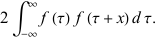
Then plugging into above, we have 👁 aepsilon^2+bepsilon+c>0
. This quadratic
equation does not have any real root,
so 👁 b^2-4ac<=0
,
i.e., 👁 b/2<=a
.
It follows that




with the equality at 👁 x=0
.
This proves that 👁 f*f
is maximum at the origin.


See also
Average Power, Correlation, Convolution, Cross-Correlation, Quantization Efficiency, Recurrence Plot, Wiener-Khinchin TheoremExplore with Wolfram|Alpha

More things to try:
References
Bracewell, R. "The Autocorrelation Function." The Fourier Transform and Its Applications. New York: McGraw-Hill, pp. 40-45, 1965.Papoulis, A. The Fourier Integral and Its Applications. New York: McGraw-Hill, 1962.Press, W. H.; Flannery, B. P.; Teukolsky, S. A.; and Vetterling, W. T. "Correlation and Autocorrelation Using the FFT." §13.2 in Numerical Recipes in FORTRAN: The Art of Scientific Computing, 2nd ed. Cambridge, England: Cambridge University Press, pp. 538-539, 1992.Zwillinger, D. (Ed.). CRC Standard Mathematical Tables and Formulae. Boca Raton, FL: CRC Press, p. 223, 1995.Referenced on Wolfram|Alpha
AutocorrelationCite this as:
Weisstein, Eric W. "Autocorrelation." From MathWorld--A Wolfram Resource. https://mathworld.wolfram.com/Autocorrelation.html