

Equivalent
If 👁 A=>B
and 👁 B=>A
(i.e., 👁 A=>B ^ B=>A
, where 👁 =>
denotes implies), then 👁 A
and 👁 B
are said to be equivalent, a relationship which is written
symbolically in this work as 👁 A=B
. The following table summarizes some notations in common
use.





| symbol | references |
| 👁 = | Moore (1910, p. 150), Whitehead and Russell (1910, pp. 5-38), Carnap (1958, p. 8), Curry (1977, p. 35), Itô (1986, p. 147), Gellert et al. 1989 (p. 333), Cajori (1993, pp. 303 and 307), Church (1996, p. 78), Harris and Stocker (1998, p. 471) |
| 👁 = | Wittgenstein (1922, pp. 46-47), Cajori (1993, p. 313) |
| 👁 A<=>B | Mendelson (1997, p. 13), Råde and Westergren 2004 (p. 9) |
| 👁 A<==>B | Harris and Stocker (1998, back flap), DIN 1302 (1999) |
| 👁 A<->B | Gellert et al. 1989 (p. 333), Harris and Stocker (1998, p. 471), Råde and Westergren 2004 (p. 9) |
| 👁 A<->B |


Equivalence is implemented in the Wolfram Language as [A,
B, ...]. Binary equivalence has the following truth
table (Carnap 1958, p. 10), and is the same as 👁 A
XNOR 👁 B
, and 👁 A
iff 👁 B
.


Similarly, ternary equivalence has the following truth table.


The opposite of being equivalent is being nonequivalent.
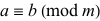
Note that the symbol 👁 =
is confusingly used in at least two other different contexts. If 👁 A
and 👁 B
are "equivalent by definition" (i.e., 👁 A
is defined to be 👁 B
), this is written 👁 A=B
, and "👁 a
is congruent to 👁 b
modulo 👁 m
" is written 👁 a=b (mod m)
.


See also
Biconditional, Connective, Defined, Equivalence Relation, Iff, Implies, Nonequivalent, XNORExplore with Wolfram|Alpha

More things to try:
References
Cajori, F. A History of Mathematical Notations, Vol. 2. New York: Dover, p. 303, 1993.Carnap, R. Introduction to Symbolic Logic and Its Applications. New York: Dover, p. 8, 1958.Church, A. Introduction to Mathematical Logic, Vol. 1. Princeton, NJ: Princeton University Press, 1996.Curry, H. B. Foundations of Mathematical Logic. New York: Dover, 1977.Deutsches Institut für Normung E. V. DIN 1302: "General Mathematical Symbols and Concepts." Dec. 1, 1999.Gellert, W.; Gottwald, S.; Hellwich, M.; Kästner, H.; and Künstner, H. (Eds.). VNR Concise Encyclopedia of Mathematics, 2nd ed. New York: Van Nostrand Reinhold, 1989.Harris, J. W. and Stocker, H. Handbook of Mathematics and Computational Science. New York: Springer-Verlag, 1998.Itô, K. (Ed.). Encyclopedic Dictionary of Mathematics, 2nd ed., Vol. 1. Cambridge, MA: MIT Press, 1986.Mendelson, E. Introduction to Mathematical Logic, 4th ed. London: Chapman & Hall, 1997.Moore, E. H. Introduction to a Form of General Analysis. New Haven, CT: New Haven Math. Colloq., 1910.Råde, L. and Westergren, B. Mathematics Handbook for Science and Engineering. Berlin: Springer, 2004.Whitehead, A. N. and Russell, B. Principia Mathematica, Vol. 1. New York: Cambridge University Press, 1910.Wittgenstein, L. Tractatus Logico-Philosophicus. London, 1922.Referenced on Wolfram|Alpha
EquivalentCite this as:
Weisstein, Eric W. "Equivalent." From MathWorld--A Wolfram Resource. https://mathworld.wolfram.com/Equivalent.html