
The Kauffman Foundation continues to recognize, with urgency, the significance of the role new and existing businesses play in local, regional, and the national economy. This report continues our series of sharing the state of capital access for entrepreneurs highlighting the need for innovative products and models to improve capital delivery systems.

Historically, research on entrepreneurship and innovation has rarely been conducted using community-engaged methodologies – even in work that seeks to address barriers to entrepreneurship in systemically marginalized communities. We believe that including the voices of entrepreneurs in the research process may produce more nuanced and robust findings that, ultimately, can serve as the basis for programs and policies that could truly change the landscape of entrepreneurship in the United States.
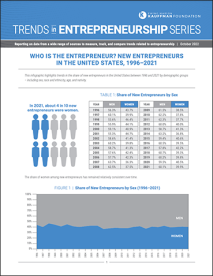
This infographic highlights trends in the share of new entrepreneurs in the United States between 1996 and 2021 by demographic groups – including sex, race and ethnicity, and nativity.
The Entrepreneurial Jobs Indicators provides information on private sector job trends related to entrepreneurship. These indicators reflect complex relationships between firms and jobs over time and across geographic areas.
Entrepreneurship is often heralded as a driver of job creation. Research finds that young firms are responsible for most net new jobs. There is wide variation, however, in the number of jobs that young firms generate. While some new firms never hire employees and others are responsible for only modest job creation, a small share of new firms experiences extraordinarily high growth and creates a significant number of jobs.

This report highlights three key insights that may help inform more equitable design of future relief and recovery policy and programs for small and new businesses, particularly those owned by BIPOC and women entrepreneurs, as well as entrepreneurs in historically under-resourced communities.
The unprecedented rise of business applications during the COVID-19 pandemic has raised a number of questions as to what will become of these businesses – whether they become employers, how long it takes them to do so, and how new employer businesses are shaping the landscape of employer firms across the nation.
In 2020 and 2021, the number of business applications filed each month experienced a great deal of volatility, deviating sharply from historical values. As business applications are often used as an indicator for the general health of the economy, this paper examines these data more closely.
This report presents state trends in early-stage entrepreneurship in all 50 states and the District of Columbia from 1996-2021.
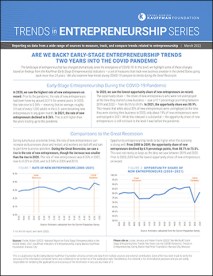
The landscape of entrepreneurship has changed dramatically since the emergence of COVID-19. In this brief, we highlight some of these changes based on findings from the Kauffman Early-Stage Entrepreneurship Indicators – a set of measures that track new business creation in the United States going back more than 25 years. We also examine how trends during COVID-19 compare to trends during the Great Recession.