




Critically Endangered Antelope of the African Desert
The Addax, a beautiful antelope also called the screwhorn or white antelope, once ranged over the Sahara Desert. Now it is on the edge of extinction due to poaching, climate change, overhunting, and habitat destruction. Fortunately, efforts are being made to return its wild population to healthy numbers. Read on for more facts about the addax.
5 Incredible Facts!
Here are five facts about this superb but endangered antelope:
- Unlike other antelopes, the addax has squarish teeth like a cow. Addax also don’t have the facial glands that are found on other antelopes, but they do have scent glands in their feet.
- Both males and females have horns, and each horn has from one and a half to three twists.
- One of the addax’s adaptations to a desert habitat is that it rarely needs to drink water.
- Though they are scarce in the wild, addax are common in zoos such as Germany’s Hanover Zoo and America’s St. Louis Zoo. Conservation efforts include raising zoo-born animals that might one day help bolster the wild population.
- Some historians believe that the addax was at least partly domesticated by the ancient Egyptians.
Scientific Name
The white antelope’s scientific name is Addax nasomaculatus. Addax is believed to come from an Arab word for “crooked horn.” Nasomaculatus comes from the Latin nasus for “nose” and maculatus, which means “spotted.” So the name Addax nasomaculatus probably translates as “animal with crooked horns and spotted nose.”
The Addax is part of the Bovidae family, like bison and buffalo. There is only one species of addax, and there are no subspecies.
Origins
Appearance
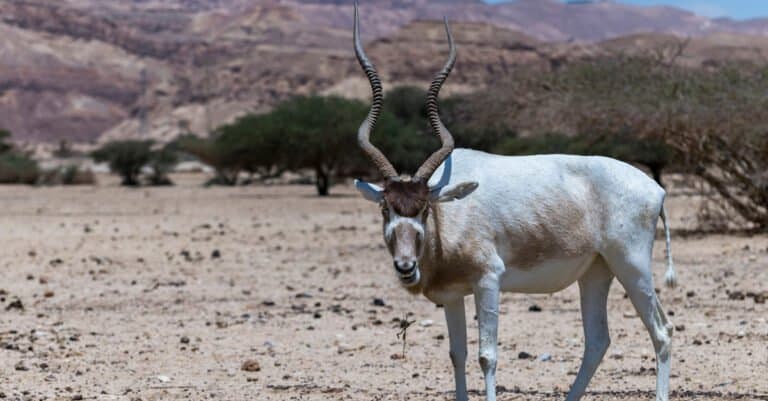
The Addax lives in the desert, so they have an excellent sense of smell and peripheral vision to help them follow the rains.
©Cezary Wojtkowski/Shutterstock.com
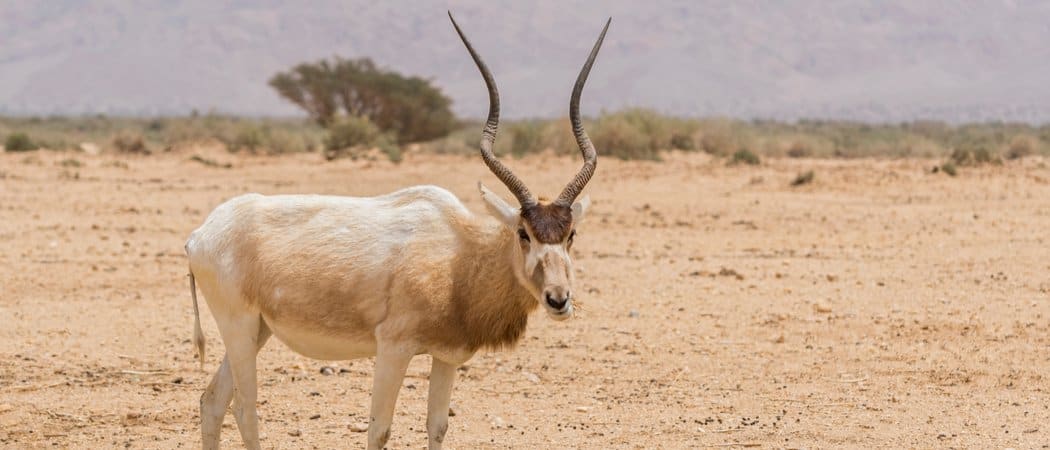
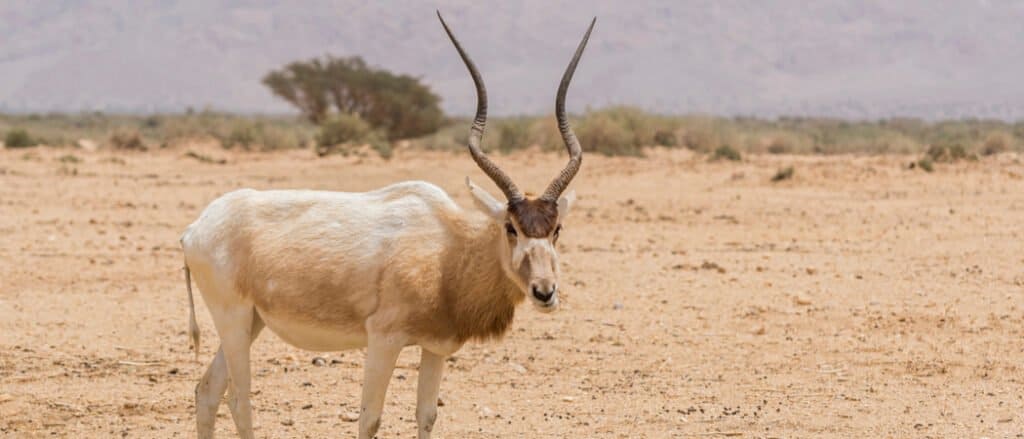
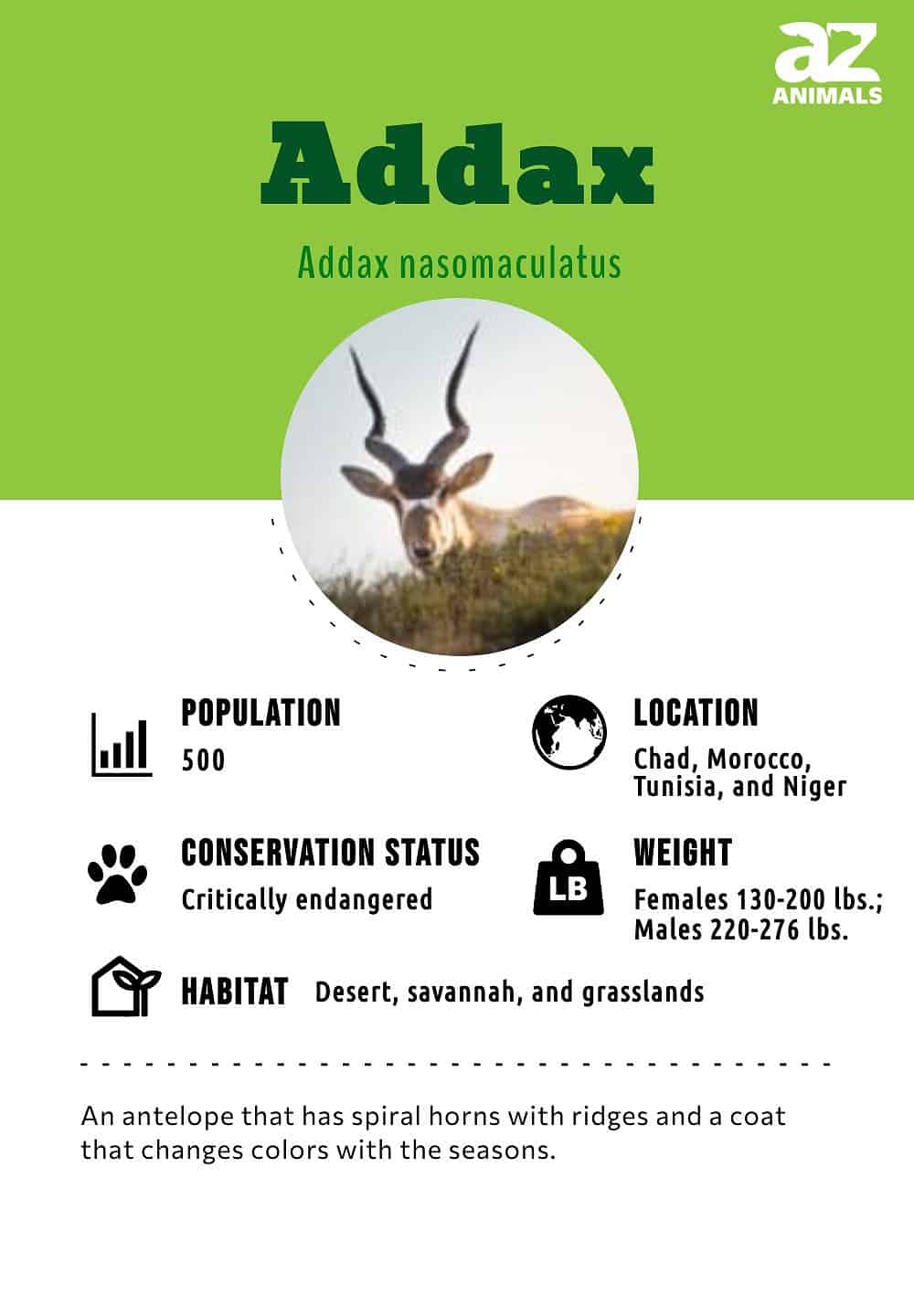
The addax is noted not only for the beautiful color of its coat, but also and especially for its spiral horns. Males are a little bigger than females and stand about 41 to 45 inches at the shoulder compared to females, who stand 37 to 43 inches at the shoulder. Males are also heavier and weigh between 220 and 276 pounds, while females weigh between 130 and 200 pounds.
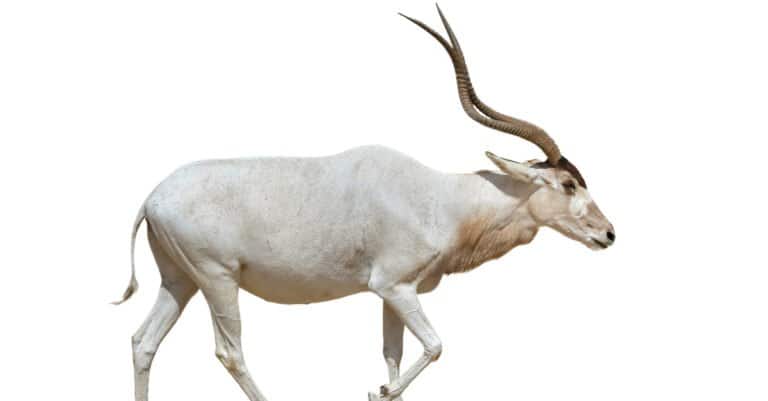
The coat of A. nasomaculatus changes with the seasons. It is mostly gray-brown in winter with white legs and rump. The coat turns almost entirely white or blond in the summer. There is a tuft of brown hair on the head between the horns, and this flows down into a mane.
There are patches on the nose that make an X shape on the face. The animal’s sense of smell and peripheral vision are excellent, two adaptations that help them follow the rains. The animal also has a beard, notably red nostrils, and a short tail that ends in a black tassel.
The addax’s legs are short, and though the legs and feet are built for endurance they are not built for speed. To onlookers, it seems as if the animal’s “knees” hardly bend as it moves. This makes it easy prey for predators such as lions, hyenas, and humans.
The horns can be as long as 33 inches, though the longest horns were 43 inches in length. The horns have 30 to 35 ridges in the center and the bottom. Males use their horns to spar with other males over females.
Behavior
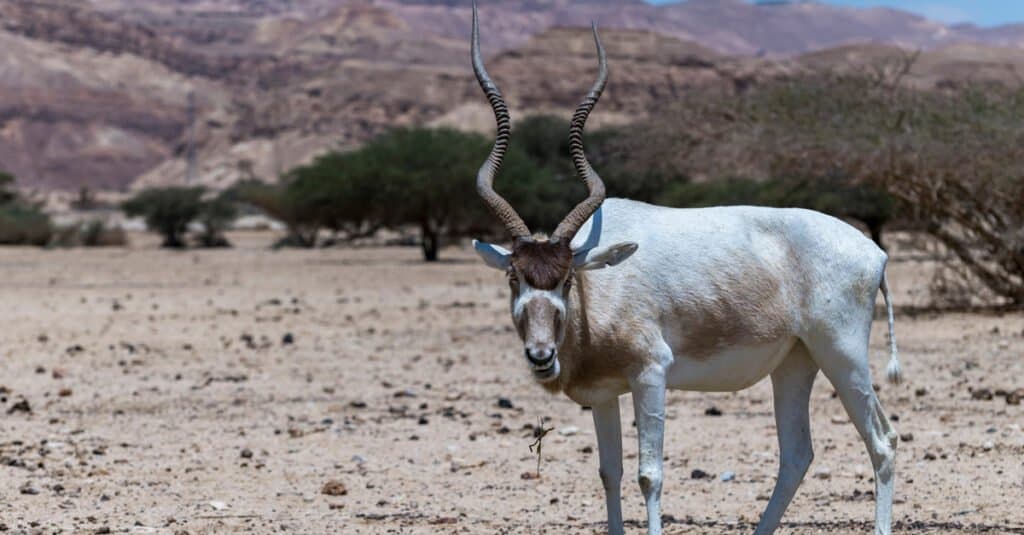
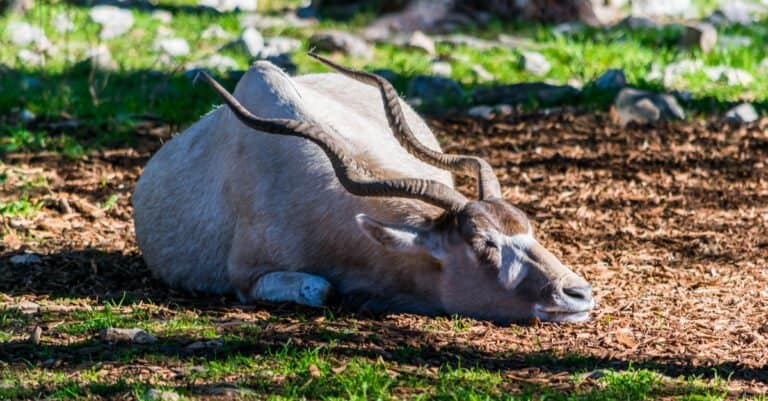
The Addax is largely nocturnal so they can move around in the cooler night temperatures.
©Sergei25/Shutterstock.com
Addax lives in herds, which some biologists claim are headed by the alpha male while others claim are headed by the alpha female. They do know that females sort themselves into a hierarchy, with the oldest females being dominant. The males establish territories and guard the females within them. Though herds used to be large, nowadays they are made up of 5 to 20 individuals. Addax herds travel long distances to find vegetation, following the rains.
Interestingly, Addax is largely nocturnal, as the cooler night temperatures make it easier for them to move around. In the heat of the day, they lie down in shady depressions Their light-colored coats also keep them cool by reflecting the heat.
Habitat
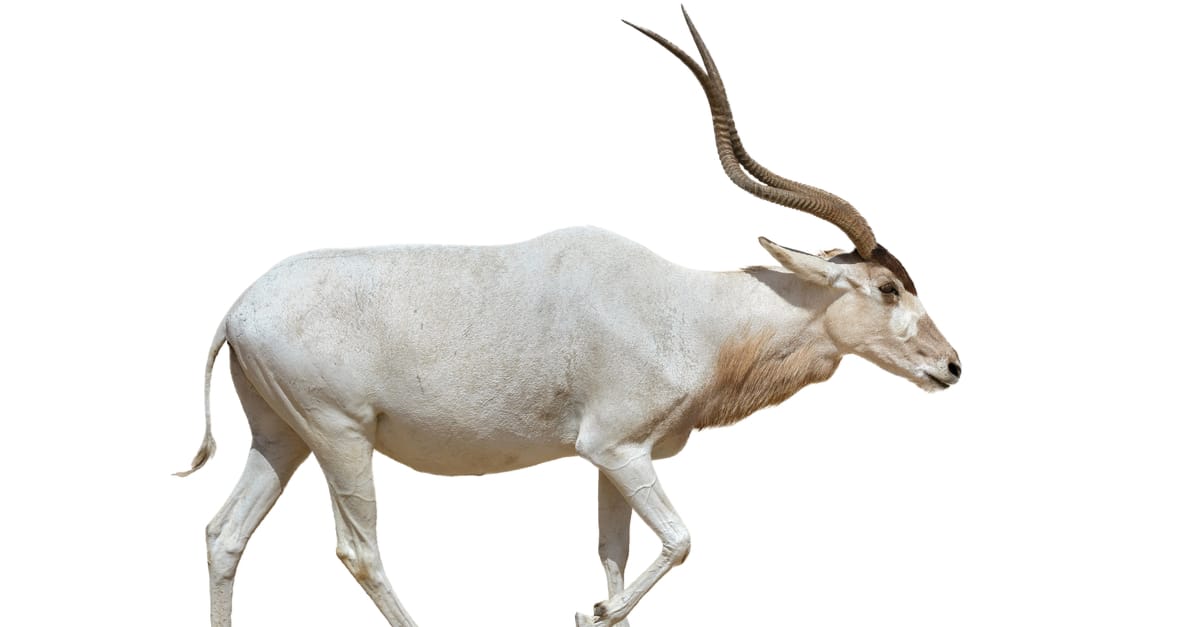
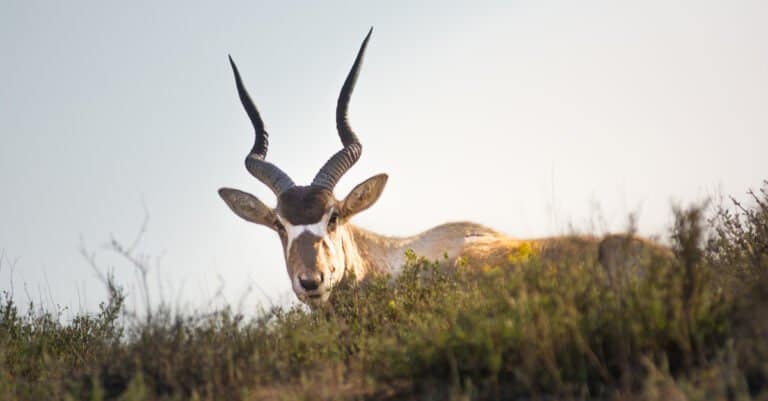
The Addax migrates to savannas and grasslands, but it will eat small trees and shrubs if grass is not availble.
©Oleg Lopatkin/Shutterstock.com
A. nasomaculatus is a creature of the desert, but it also migrates to savannas and grasslands. Unfortunately, it has been extirpated from many of the areas where it used to range freely such as Egypt, Mauritania, Algeria, Libya, Sudan,and Western Sahara. The addax is hanging on in Chad and Niger and has been reintroduced by conservationists to Morocco and Tunisia.
The white antelope eats grasses and the leaves of small trees and shrubs/bushes and leguminous herbs. These plant foods give the animal enough water so that it doesn’t have to drink.
Predators and Threats
Because they can’t outrun their predators, Addax has always been subject to predation by carnivores such as leopards, hyenas, and cheetahs. Even if they could run fast, they are not a match for the humans who value their meat and hides or want a trophy head with those striking horns on the wall. Because of this, the antelope’s population has been shrinking since the middle of the 19th century, and it is now critically endangered. However, there are thousands of addax in zoos and private menageries, and conservation strategies have been adopted in several countries, including Algeria and Morocco.
Addax also tends to harbor parasites when conditions are moist. The most common parasite of the antelope tends to be types of nematodes.
Reproduction and Life Cycle
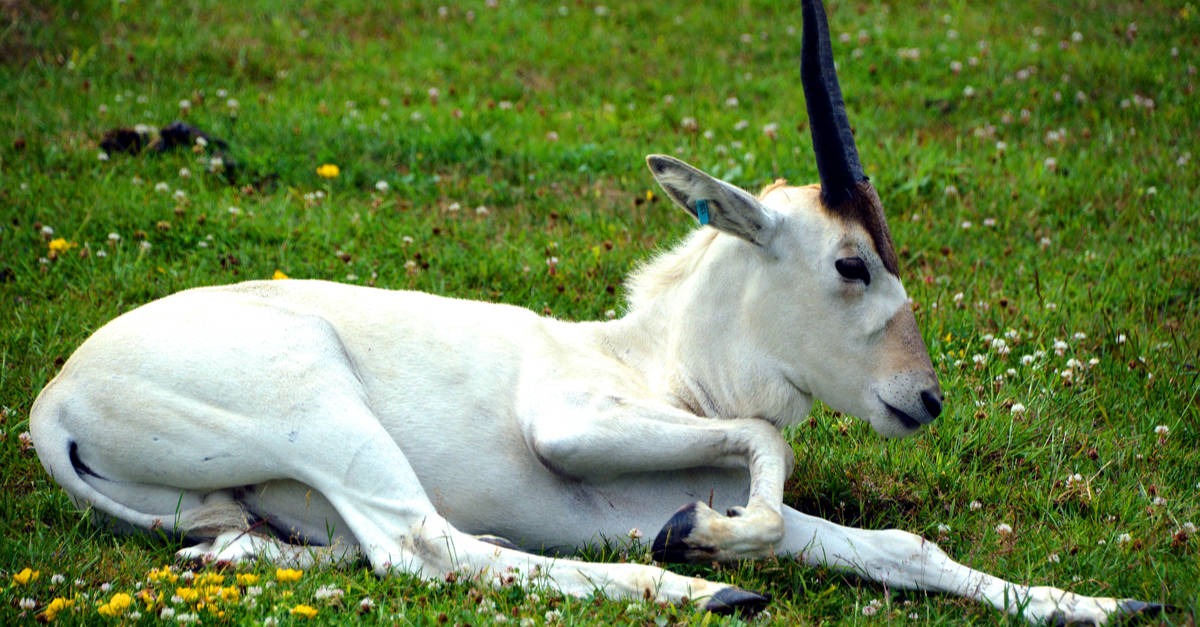
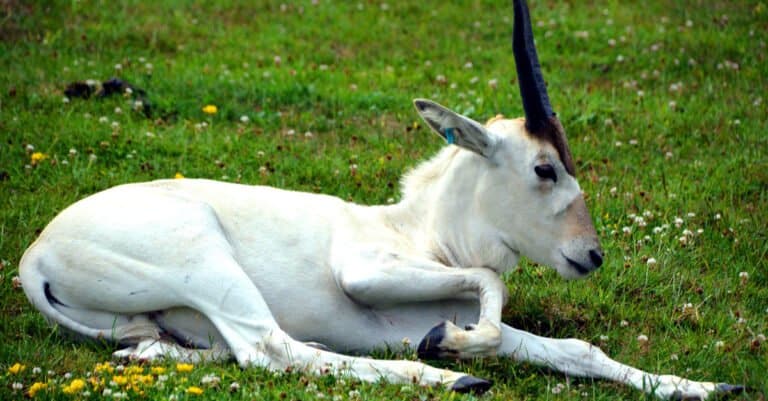
An Addax calf will weigh only about 11 pounds at birth.
©meunierd/Shutterstock.com
The female addax is ready to breed when she’s about one a half years old, and the male is ready when he’s about three. Since males guard females in their territory, the dominant male mates with the fertile females in his herd. Though addax can breed throughout the year, they mostly do so in the earliest spring or late winter. The female gives birth to one calf after a pregnancy that’s a little less than nine months. Calves weigh about 11 pounds at birth and are weaned when they are about seven months old. The female goes back into estrus just a couple of days after giving birth.
The lifespan of the white antelope is about 19 years in the wild, but another six years or so can be added to the lifespan of the animal if it is well cared for in captivity.
Population
There are probably 500 or fewer of these antelopes remaining in the wild, though there are probably thousands in zoos or private menageries. Breeding programs have been established to help the wild populations, and addax has been reintroduced into regions where they were once abundant such as Tunisia’s Bou-Hedma National Park and the Grand Erg Oriental in the Sahara Desert.