A
Species Profile

Amethystine Python (Scrub Python)

Morelia amethistina

Island giant with an amethyst glow
iStock.com/Brooke Ottley

Amethystine Python (Scrub Python) Distribution

Click a location to explore more animals from that region

Loading map...

At a Glance

Wild Species
Also Known As Scrub python, Amethyst python, Australian scrub python
Diet Carnivore
Activity Nocturnal+
Lifespan 15 years
Weight 25 lbs
Status Least Concern
Did You Know?

Common adult length is ~3-5 m; reliably documented giants reach ~5.5 m, with larger lengths sometimes reported but hard to verify.

Scientific Classification

The Amethystine Python (Morelia amethistina) is a large non-venomous constrictor native to parts of Indonesia and nearby regions, known for its impressive length, iridescent sheen, and variable patterning.

Kingdom
Animalia
Phylum
Chordata
Class
Reptilia
Order
Squamata
Family
Pythonidae
Genus
Morelia
Species
Morelia amethistina

Distinguishing Features

  • Very large python with robust body and strong constricting build
  • Variable blotched/banded pattern; often shows an iridescent ‘amethystine’ sheen in certain light
  • Heat-sensing labial pits typical of pythons
  • Non-venomous; kills prey by constriction

Physical Measurements

Males and females differ in size

Length
10 ft 10 in (7 ft 7 in – 14 ft 9 in)
11 ft 6 in (9 ft 10 in – 18 ft 1 in)
Weight
22 lbs (9 lbs – 44 lbs)
40 lbs (22 lbs – 66 lbs)
Tail Length
1 ft 8 in (1 ft 2 in – 2 ft 6 in)
Top Speed
1 mph
About 2 km/h

Appearance

Primary Colors
Secondary Colors
Skin Type Amethystine Python has dry, smooth, glossy overlapping keratin scales; non-venomous. Head scales are small; prominent heat-sensing labial pits on supralabial/infralabial scales; broad ventral scutes for traction; sheds in one inverted skin (ecdysis).
Distinctive Features
  • Very large, heavy-bodied constrictor. Adults are commonly about 3–5 m long, with confirmed individuals over 5 m. Larger size claims exist but lack specimen-backed measurements.
  • Notable iridescent 'amethystine' sheen (often purple/bronze/silver) caused by scale surface structure; sheen is strongest on clean, newly shed individuals and in directional light.
  • Head relatively elongate with a distinct neck; dark facial stripe often present from eye toward jaw angle; labial pits visible as small openings along lip scales (pythonid trait).
  • Semi-arboreal tendency: juveniles are particularly arboreal/slender and use elevated ambush sites; larger adults are more terrestrial but still climb to forage or rest.
  • Camouflage patterning is highly variable among localities in Indonesia and nearby regions; taxonomy frequently noted as Morelia amethistina with many modern sources placing it in Simalia (i.e., Simalia amethistina) (Barker & Barker, 2006).
  • Behavior/ecology (non-venomous): nocturnal/crepuscular ambush predator; kills by constriction; diet includes birds and mammals (including arboreal prey) consistent with large Australasian/Southeast Asian python ecology (general biology summarized in Barker & Barker, 2006; O'Shea, 2007).
  • Amethystine Python often lives about 20+ years in captivity. Exact wild lifespan is poorly known and rarely measured. Major python references, for example Barker and Barker (2006), note this.

Sexual Dimorphism

Sexual dimorphism is present but subtle: females tend to attain greater overall body size/mass, while males typically have proportionally longer tails and more prominent cloacal spurs (pythonid traits; summarized in python family accounts such as Barker & Barker, 2006).

  • Proportionally longer tail (post-cloacal length) relative to total length.
  • Cloacal spurs typically more prominent/used in courtship.
  • Often slightly more slender at equivalent length compared with large adult females.
  • On average, larger/heavier-bodied adults (greater girth) consistent with fecundity selection in pythons.
  • Shorter proportional tail length relative to males.
  • May show greater abdominal distension when gravid (seasonal/temporary).

Did You Know?

Common adult length is ~3-5 m; reliably documented giants reach ~5.5 m, with larger lengths sometimes reported but hard to verify.

Juveniles are notably more arboreal; as they grow heavier, many shift toward more terrestrial hunting while still climbing well.

Their "amethyst" sheen isn't pigment-it comes largely from microscopic scale structure that reflects light (iridescence).

Like other pythonids, they have heat-sensing labial pits that help detect warm-blooded prey in low light.

Females are typically larger and heavier than males, a common pattern in many large constrictors.

Mothers coil around eggs and guard them; brooding pythons can raise egg temperatures slightly via muscle contractions (shivering thermogenesis).

Unique Adaptations

  • Iridescent scales: thin-film-like microstructure in the keratin layers produces a shifting gloss, especially visible on dark blotches.
  • Labial heat pits: infrared sensitivity along the lips helps target endothermic prey in darkness or dense vegetation.
  • Highly kinetic skull: loosely jointed jaw bones and stretchable ligaments allow swallowing large prey relative to head size.
  • Semi-prehensile tail and strong axial muscles: aids climbing and anchoring on branches despite large body mass.
  • Egg brooding: females coil around clutches for protection; in pythonids, rhythmic muscle contractions can modestly elevate egg temperature above ambient.
  • Long fasting tolerance: like many large pythons, they can go extended periods between meals, supported by low metabolic demands and efficient digestion after feeding.

Interesting Behaviors

  • Sit-and-wait ambush hunting: often positions along animal paths, near water edges, or in trees where birds/bats roost.
  • Ontogenetic habitat shift: smaller individuals frequently hunt in trees; large adults may hunt more on the ground but still climb to rest or raid nests.
  • Powerful constriction: typically seizes prey with recurved teeth, then coils to subdue by restricting breathing/circulation before swallowing head-first.
  • Nocturnal/crepuscular activity is common, especially in warm, humid lowland forests and mangrove edges.
  • Defensive displays: may hold a tight S-curve, strike repeatedly, and may bite and hang on when threatened-large adults can be difficult to disengage safely.
  • Seasonal reproduction behaviors: increased roaming and mate searching can occur during breeding periods, with males following scent trails.

Cultural Significance

Amethystine python (Morelia amethistina) in New Guinea and nearby eastern Indonesian islands is a very large snake people treat with caution. It is hunted for food and skins, which enter local use and the reptile-skin trade.

Myths & Legends

In parts of northern Australia where Amethystine Pythons live, Indigenous stories tell of powerful ancient snakes linked to rivers, waterholes, caves and other special places to teach respect for dangerous sites and wildlife.

In parts of Island Southeast Asia, serpent and dragon traditions are linked to water, fertility, and boundary places; large pythons are sometimes locally interpreted through this wider symbolism when encountered near rivers and wetlands.

Melanesian and Papuan stories often call large pythons like the Amethystine Python (Morelia amethistina) guardians of rivers and landforms; people avoid them and follow rules out of respect and fear for sacred or dangerous sites.

Conservation Status

LC Least Concern

Widespread and abundant in the wild.

Population Unknown

Protected Under

  • CITES Appendix II (international trade controlled; many Pythonidae are included under Appendix II listings, requiring permits for legal international commerce).
  • National/subnational wildlife and trade controls in range states (e.g., Indonesia and Papua New Guinea) regulate harvest, internal trade, and export through permitting/quotas where applied; protection and enforcement intensity varies by jurisdiction.

Life Cycle

Birth 12 hatchlings
Lifespan 15 years

Lifespan

In the Wild 10–20 years
In Captivity 15–30 years

Reproduction

Mating System Polygynandry
Social Structure Solitary
Breeding Pattern Transient
Fertilization Internal Fertilization
Birth Type Internal_fertilization

Behavior & Ecology

Social Solitary Group: 1
Activity Nocturnal, Crepuscular
Diet Carnivore Arboreal mammals-particularly cuscuses/possums (Phalangeridae) where available

Temperament

Secretive, ambush-oriented predator; spends long periods motionless in cover or elevated perches, especially when hunting
Defensive when threatened (notably strong striking response in some individuals); juveniles tend to be more reactive than adults in many captive and field observations
Seasonally and context dependent: increased movement and encounter rates during breeding periods; otherwise low daytime activity
Amethystine pythons (Morelia amethistina) are usually solitary and wary, but their mood can change a lot with location, age, recent feeding, and how often they have been handled.
Amethystine python (Morelia amethistina) adults are very large (about 3–5 m, up to ~5.5 m). They tend to scare off or flee rather than fight and can live 20+ years, showing long-term site fidelity.

Communication

Hiss Defensive exhalation
Occasional breathy 'puff' or forceful exhalation during threat display
Chemical communication via pheromones and scent trails detected with tongue-flicking and the vomeronasal (Jacobson's) organ; especially important in mate searching and reproductive timing
Tactile communication during courtship: male aligns and rubs along the female and uses pelvic spurs for stimulation/positioning Pythonid-typical courtship behavior described for Morelia in major references
Threat displays: body inflation, tight S-coil, head elevation, rapid orientation to stimulus; may include striking as a defensive signal
Substrate vibration transmission (indirect signaling/assessment): detects and responds to ground/perch vibrations produced by prey, predators, or nearby conspecific movement

Habitat

Biomes:
Tropical Rainforest Wetland
Terrain:
Island Coastal Riverine Hilly Mountainous
Elevation: Up to 6561 ft 8 in

Ecological Role

Large native mesopredator/apex predator (locally, depending on island community composition) regulating vertebrate prey populations in forest ecosystems

Controls rodent populations (potentially reducing crop/food-store losses and some disease-vector reservoirs) Regulates abundances of arboreal mammals and birds, influencing forest food-web structure Provides prey/food resource indirectly (e.g., eggs/juveniles taken by other predators/scavengers) and contributes to nutrient transfer via infrequent, large feeding events

Diet Details

Main Prey:
Rats and other rodents Arboreal marsupials Small to medium birds Bats Small mammals Lizards

Human Interaction

Domestication Status

Wild

Morelia amethistina is wild, not domesticated, and rarely bred in captivity because adults reach about 3–5 m, are very strong, and often defensive. They are nonvenomous constrictors; young climb while adults hunt on the ground. They may live 20+ years. Human contact ranges from coexistence to hunting, trade, or rare bites and killings.

Danger Level

High
  • Bites: large individuals can deliver deep lacerations; bites commonly occur during feeding/handling errors due to strong feeding response.
  • Constricting injury: as a very large python, it can cause serious injury during restraint/handling; risk increases sharply above ~3 m total length and with single-person handling.
  • Zoonotic risk: salmonellosis risk from reptile contact and contaminated surfaces (standard for reptiles).
  • Conflict near settlements: occasional predation on poultry/small livestock can lead to human-snake conflict, harassment, and risky handling attempts.
  • Rare but plausible severe incidents: while attacks on people in the wild are uncommon, the combination of size and strength makes severe injury possible, especially when the snake is cornered, captured, or handled in captivity.

As a Pet

Not Suitable as Pet

Legality: Laws for Morelia amethistina vary by country, state, and city. International trade is usually regulated by CITES (Appendix II) and needs permits. Many US places limit or require permits, often about 2.4–3.7 m. Check local rules.

Care Level: Expert Only

Purchase Cost: $300 - $1,500
Lifetime Cost: $10,000 - $30,000

Economic Value

Uses:
Exotic pet trade (limited compared with smaller Morelia) Wildlife trade regulation/compliance (permits, inspections, quarantine) Skins/leather in some regions (python skin trade) Local use/harvest (opportunistic meat or pest-control perceptions) Zoos, education, and display animals
Products:
  • Live animals (captive-bred or wild-collected where legal)
  • Shed skins (minor hobby market)
  • Leather/skins (where python skin trade occurs legally/illegally)
  • Meat (localized, not a primary global commodity for this species)

Relationships

Predators 5

Estuarine Crocodile Crocodylus porosus
Mangrove Monitor Varanus indicus
White-bellied Sea Eagle Haliaeetus leucogaster
Brahminy Kite Haliastur indus
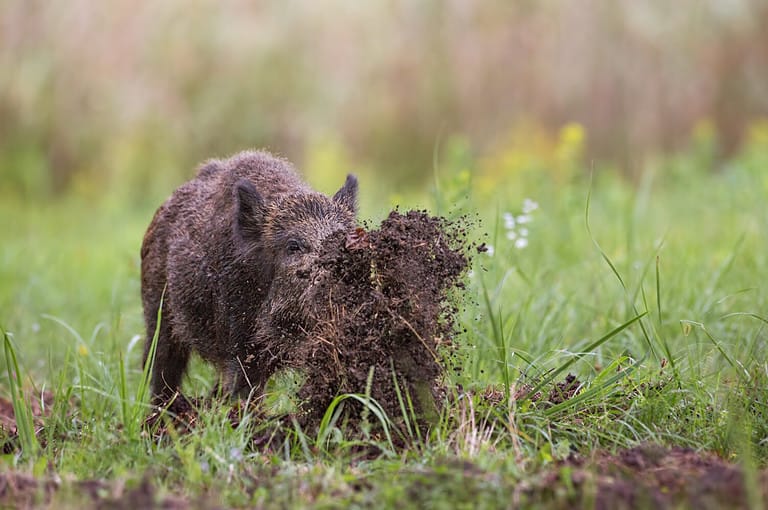
Wild Boar Sus scrofa

Related Species 10

Green Tree Python Morelia viridis Shared Family
Carpet Python Morelia spilota Shared Family
Rough-scaled Python Morelia carinata Shared Family
Boelen's python Simalia boeleni Shared Family
Centralian Carpet Python Morelia bredli Shared Family
Scrub Python Simalia kinghorni Shared Genus
Reticulated python Malayopython reticulatus Shared Family
Burmese Python Python bivittatus Shared Family
African Rock Python Python sebae Shared Family
Moluccan Python Simalia clastolepis Shared Genus

Ecological Equivalents 5

Animals that fill a similar ecological role in their ecosystem

Scrub Python Simalia kinghorni Very large, non-venomous rainforest constrictor native to New Guinea (formerly treated as Morelia amethistina). It ambushes and constricts mammals and birds, acting as a top terrestrial and arboreal predator and is one of the longest Australasian pythons.
Reticulated Python Malayopython reticulatus In parts of Indonesia it co-occurs with other large constrictors, using forest edges, river corridors, and human-modified areas; it preys on rats, birds, bats, and small hoofed mammals (ungulates) such as pigs, and exhibits similar patterns of conflict with people.
Moluccan Python Simalia clastolepis Occurs in the Maluku region and fills a similar ecological role as a large island python predator in forest and forest-edge habitats. Exhibits comparable hunting modes (sit-and-wait and active nocturnal cruising) and a similar prey spectrum (small mammals and birds) typical of large pythons on oceanic and continental-shelf islands.
Mangrove Monitor Varanus indicus Amethystine pythons and mangrove monitors are both large predators that consume birds, eggs, and small mammals; juveniles of each may prey on one another. Both use mangrove and riparian forests as well as village edges.
Estuarine Crocodile Crocodylus porosus Shares riverine, swamp-forest, and estuarine corridors in parts of eastern Indonesia; occupies a higher apex niche but overlaps in use of waterways and forest edges and in targeting medium-sized vertebrates. Large crocodilians are also credible predators of adult pythons where their ranges overlap.

The amethystine python is one of the six biggest snakes in the world when measured by weight or length.

Found in Australia, Indonesia, and Papua New Guinea, this species has a milky-iridescent sheen across its scales, giving it a purplish hue. The scrub python is popular as a pet because of its size and beauty; yet, wild individuals often cause havoc in residential areas.

Amazing Facts About the Amethystine Python

  • Scrub pythons are known troublemakers in Australia, where they sometimes “rampage” through houses, knocking over things as they go.
  • Amethystine pythons are called scrub pythons in Australia, where they are the longest snake on the continent.
  • The longest verified amethystine python measured 23.6 feet long, according to the Guinness Book of World Records.
👁 Image

Where to Find Them

The amethystine python is native to the island of New Guinea and its surrounding islands and northeastern Queensland in Australia. The snake hunts by waiting patiently for its prey, and rapidly striking as the animal passes by, once it has a potential meal in its mouth, it wraps several coils around its prey and constricts it until the heart stops.

This species prefers grasslands, rainforests, and shores near water bodies – they are excellent swimmers and traverse waterways to get where they want to go. However, they are also pretty common in suburban neighborhoods and regularly make the news for being in yet another compromising position. They eat a variety of small animals including bats, rats, birds, possums, and others are part of their diet. Larger individuals frequently wait by water sources for cuscus and wallabies that come for a drink of water.

Reproduction

Mating season begins in July and runs through early September. Snakes come together in groups of one or two females with several males competing for breeding rights. The males wrestle and fight, but there aren’t usually any injuries – it’s all posturing to impress the females.

A few weeks after mating, females lay a clutch of up to 21 eggs. They incubate them by coiling around the eggs until they hatch about three months later. Until the eggs hatch, the mothers only leave to bask and do not eat again until after the eggs hatch.

When they’re young, amethystine pythons climb trees for rest and prey. By the time they grow to about six feet, they’re more likely to be living a terrestrial lifestyle.

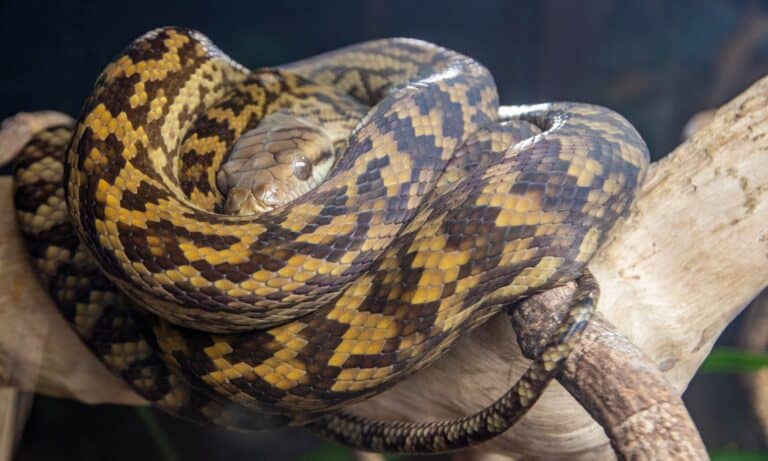
👁 Scrub python on a tree branch

Young scrub pythons spend a lot of time as arboreal snakes.

©iStock.com/Brooke Ottley

Scientific Name and Classification

Amethystine pythons were once the type species for a group of five snakes that scientists believed were subspecies of amethystine pythons. They classified them all under the Morelia genus until a group of biologists delved deeper, using genetic sequencing and morphology.

Their research revealed that they are genetically distinct and deserving of full species status. What they wound up with were five different species, and moved them to the Simalia genus.

Their specific and common names are references to their scales that are reminiscent of an amethyst gemstone in the right light. The Australians call them scrub pythons and in some areas of New Guinea, they’re known as sanca permata.
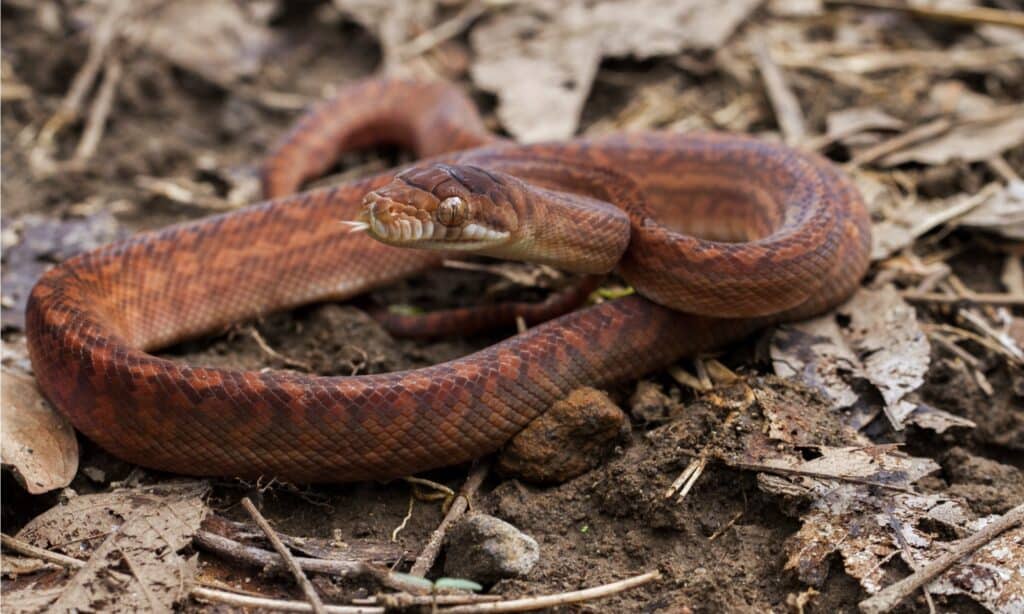
👁 Juvenile amethystine python

Amethystine pythons’ scales are reminiscent of an amethyst gemstone in the right light.

©iStock.com/dwi septiyana

History and Evolution

Like other snakes, pythons’ early ancestors were actually legged reptiles, similar to lizards and even more aquatic-based reptiles. Eventually, they lost their legs or became vestigial, as they became more and more unused. There are benefits of being extremely low to the ground when your prey is on that level!

While pythons were classified with boa snakes in the past, modern research has shown that they are separate due to convergent evolution in different parts of the world. Some of the major differences are that boas give birth to live young, and pythons lay eggs. Pythons also have their heat-sensing pits on their labial scales, and boas have them in between their labial scales.

Population and Conservation Status

Due to its widespread occurrence, the IUCN Redlist of Threatened Species classified the amethystine python as “Least Concern.”

Given that they reproduce easily and don’t have any significant ecological threats, amethystine pythons are in a good position. Papua New Guinea and Australia restrict any export of native animals, yet outside of those countries, they’re collected and exported as part of the pet industry. At the current levels of collection and trade, the snakes appear to be maintaining their population without difficulty.

Appearance and Description

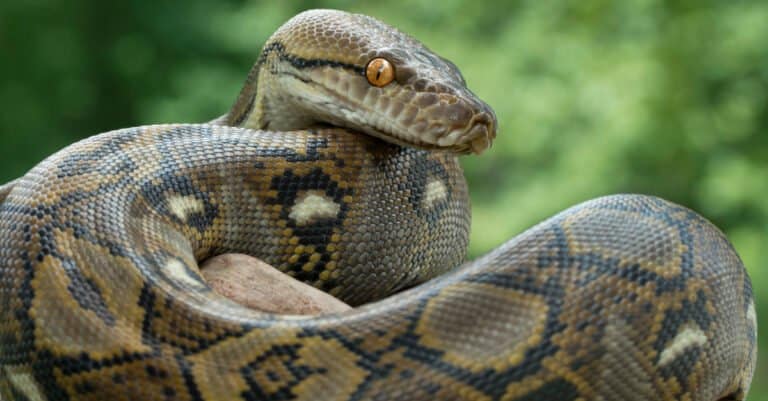
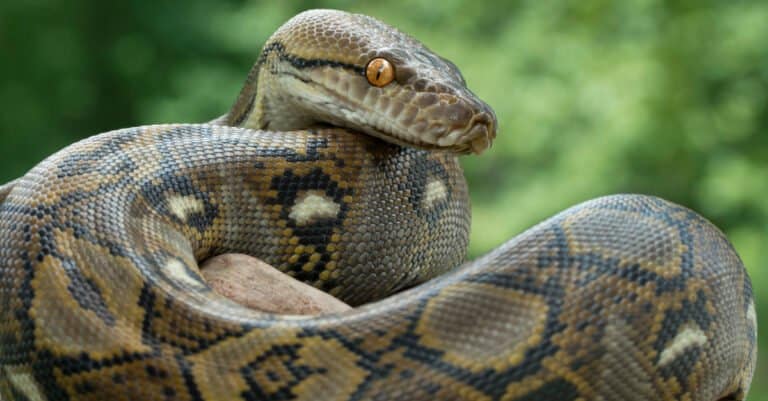
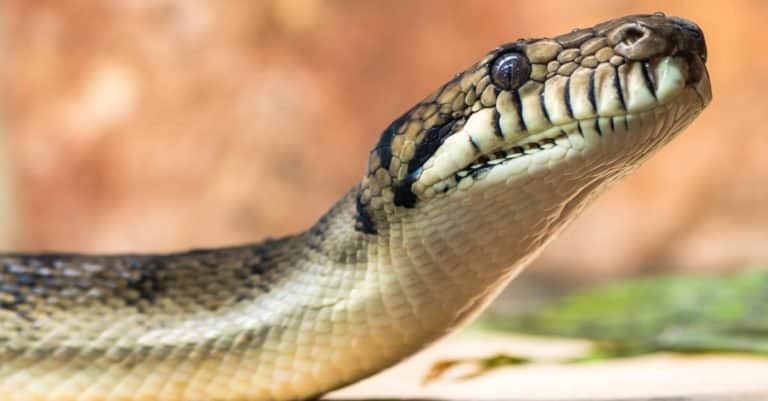
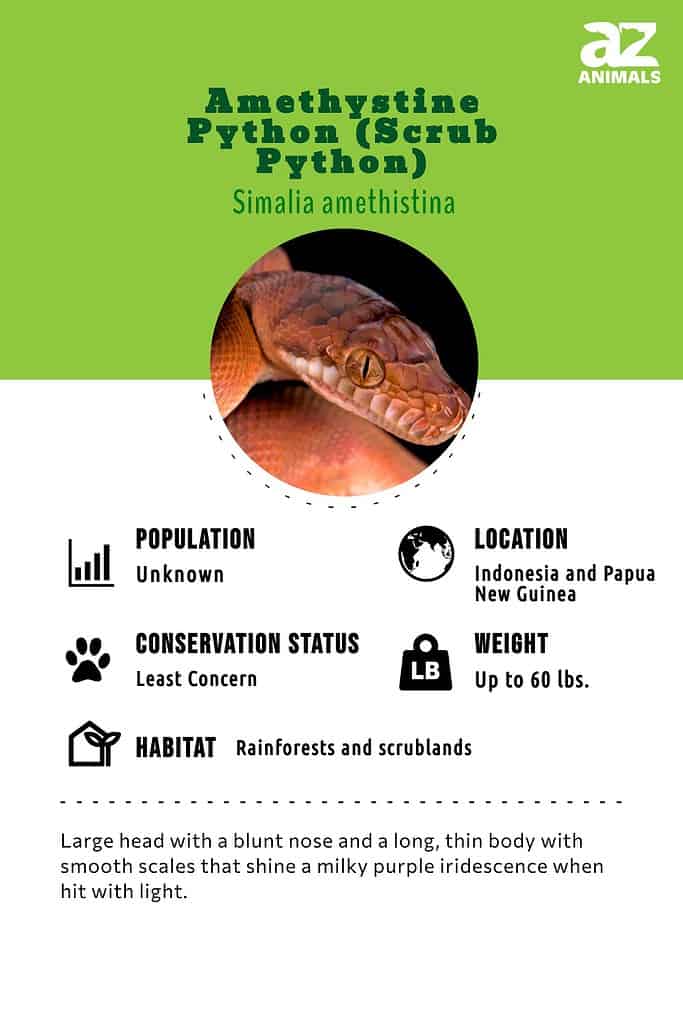
This large constrictor can reach 24 feet long, but most individuals average 8-14 feet long. The amethystine python is a surprisingly thin species for its length and most 12-foot-long snakes only weigh about 10-15 pounds. Its head is large and elongated with a blunt snout, shield-shaped scales on top with elliptical pupils. Like most pythons, it has heat-sensing pits. These are located near its snout and along the lower rear labials.
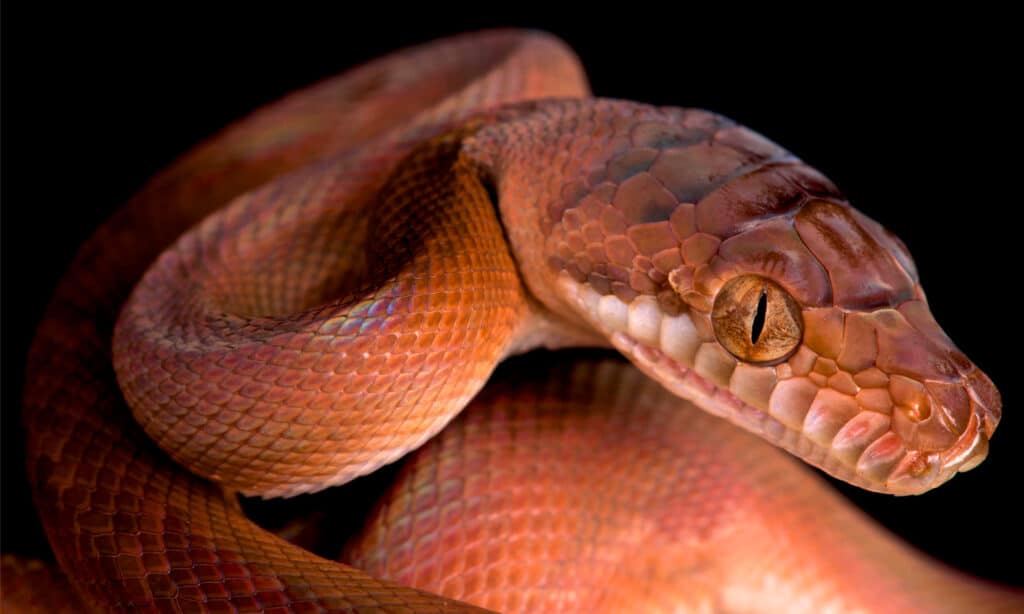
👁 Amethystine python

Amethystine pythons are prized for their size and beautiful colors.

©iStock.com/reptiles4all

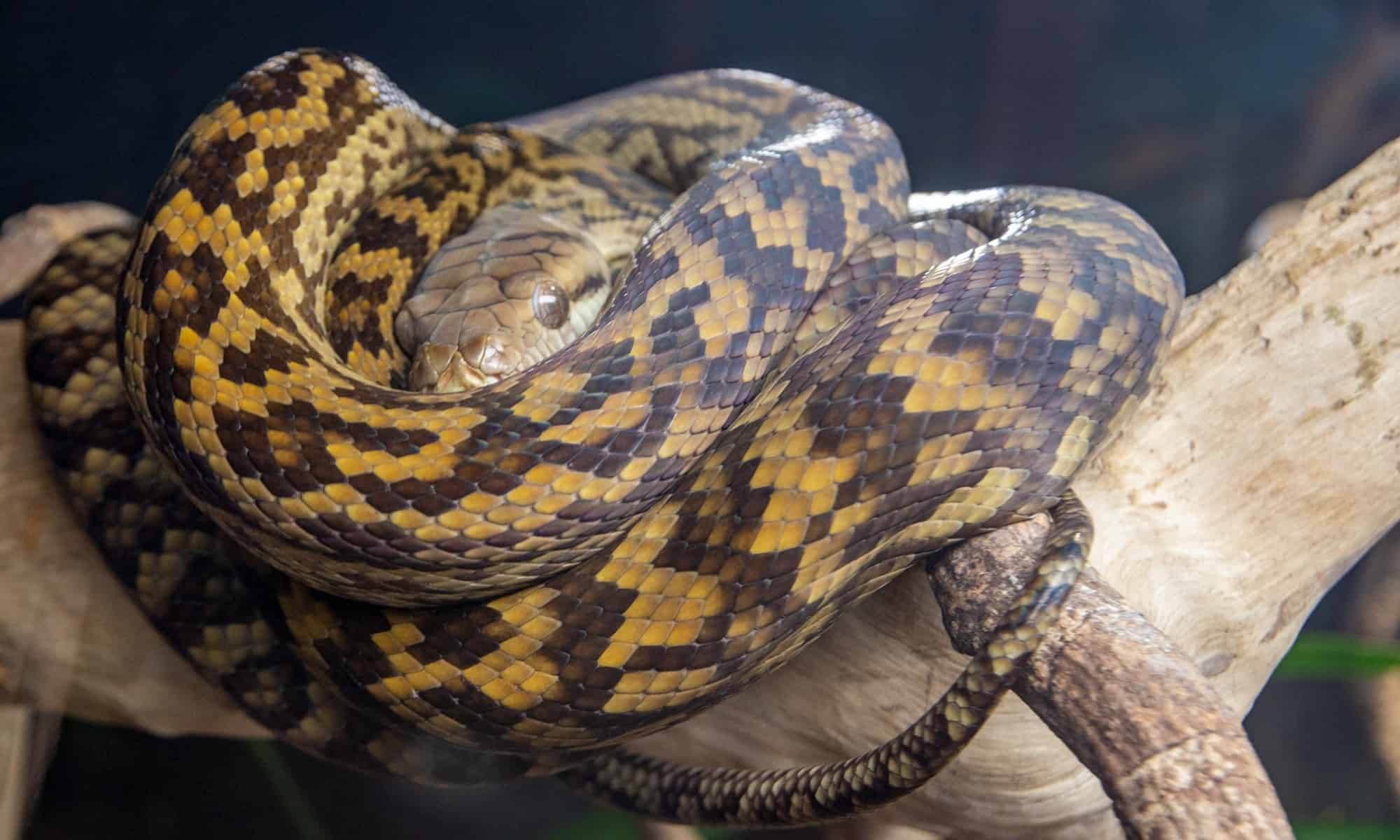
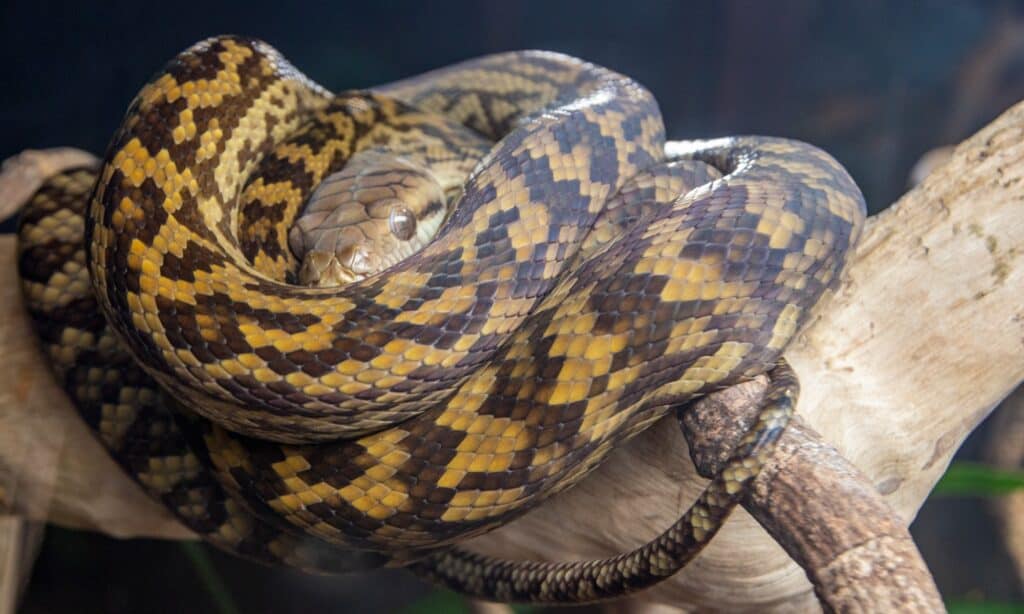
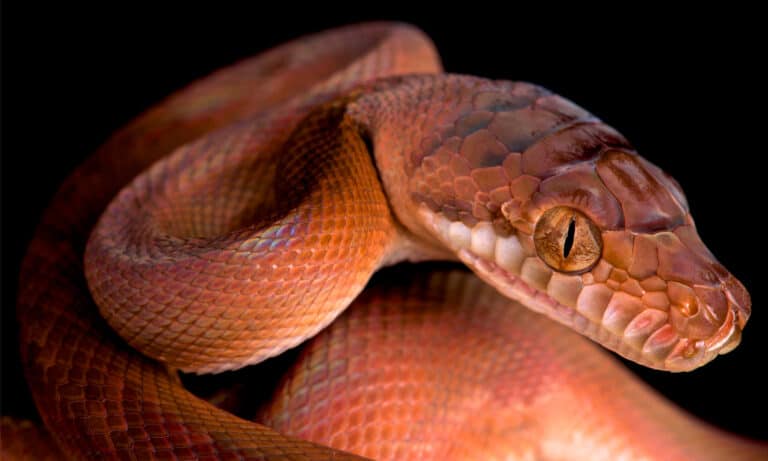
Its base color ranges from olive green to yellowish-brown with dark brown or black splotches, bands, and/or streaks. The most distinctive thing about its coloration is the effect of light on its scales. The amethystine python is stunning, its scales shimmer with a milky purple iridescence.

How Dangerous Are They?

They’re not venomous, so the danger of an envenomation doesn’t exist with this species. However, their size makes them potentially dangerous to pets and small children. Amethystine pythons sometimes attack pets and livestock, and a small enough child could be at risk. However, most encounters of this nature happen away from cities.

The snakes are opportunistic and go where they think food or a mating opportunity is. Confrontations with these snakes are usually because a person has harassed one, but not always. They can be crabby, and Australians say that amethystine pythons are generally “grumpy snakes.”
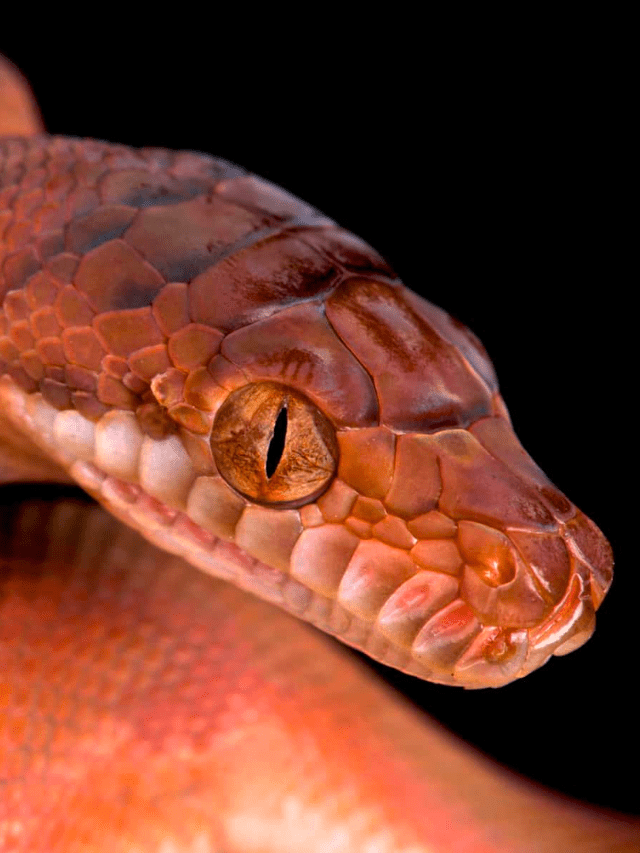
👁 Watch How This Snake Climbs STRAIGHT UP A Tree Cover Image
Young amethystine pythons often have a brick red base color.

Behavior and Humans

This species doesn’t seem to have any problems being near people or suburban areas; there are several news reports about them showing up in houses, pools, and more. The biggest threat these huge snakes face is being in the wrong place at the wrong time. They are either killed by someone out of fear or run over by a car. They are just as likely to visit suburbia as they are to stay in the rainforest or scrubland.

Antics aside, amethystine pythons are beautiful and generally easy to keep, if you have enough room for a 10-foot-long python.
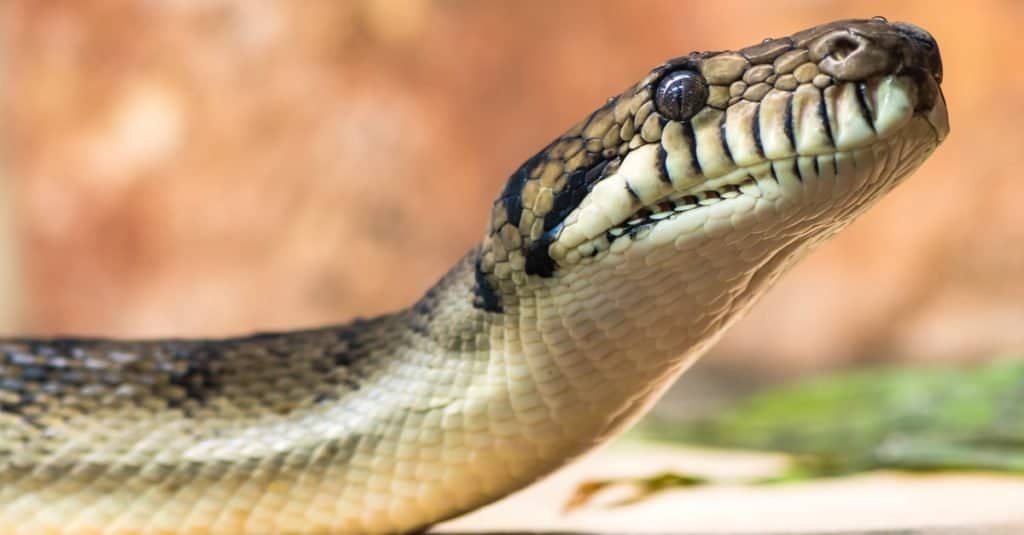
👁 Biggest Snakes: The Amethystine Python

Amethystine Pythons are very good swimmers and will travel by water when it is required.

©IanRedding/Shutterstock.com

View all 325 animals that start with A

Sources

  1. Reptarium / Accessed June 24, 2022
  2. Amethystine Python | Bristol Zoo / Accessed June 25, 2022
  3. Amethystine Python | IUCN Redlist of Threatened Species / Published April 13, 2013 / Accessed June 25, 2022
  4. Wood, Gerald L | The Guinness Book of Animal Facts / Published January 1, 1982 / Accessed June 25, 2022
  5. Harvey, Michael B.; Barker, David G.; Ammerman, Loren K.; Chippindale, Paul T. (2000). "Systematics of Pythons of the Morelia amethistina Complex (Serpentes: Boidae) with the Description of three new Species". Herpetological Monographs. 14: 139–185. / Published January 1, 2000 / Accessed June 25, 2022

About the Author

Gail Baker Nelson

Gail Baker Nelson is a writer at A-Z Animals where she focuses on reptiles and dogs. Gail has been writing for over a decade and uses her experience training her dogs and keeping toads, lizards, and snakes in her work. A resident of Texas, Gail loves working with her three dogs and caring for her cat, and pet ball python.
Connect:

Thank you for reading! Have some feedback for us?

Contact the AZ Animals editorial team

Related Articles You May Find Interesting


Amethystine Python (Scrub Python) FAQs (Frequently Asked Questions)

They’re not venomous, but their size can make them dangerous to children and pets.

These snakes prefer to sit and wait for their food – they’re ambush predators that use their natural camouflage to their advantage.

They can be feisty, especially the wild-caught individuals. As hatchlings, they’re afraid of everything and are more likely to bite. Captive-bred adults can be pretty easy to handle, if properly socialized.

They inhabit areas of northeast Queensland, Australia, Indonesia, Papua New Guinea, and many surrounding islands of New Guinea.

They feast on warm-blooded prey. Anything from bats and rats, to birds, possums, wallabies, and cuscus can be on their menu.