
B
Species Profile

Bat

Chiroptera

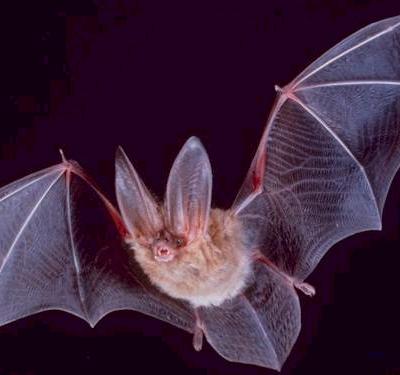
Night pilots of the mammal world
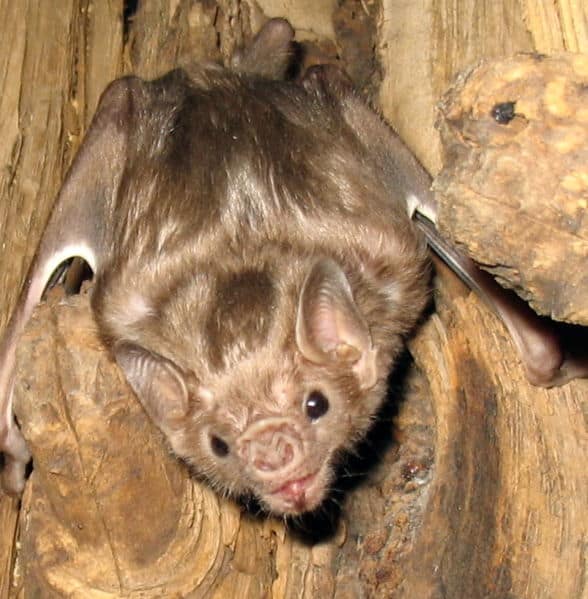
PD-USGov, exact author unknown, Public domain, via Wikimedia Commons

Bat Distribution

Click a location to explore more animals from that region

This map shows coastal regions where Bat are found.

Loading map...

Found in 52 countries

🇦🇷 Argentina 🇦🇺 Australia 🇧🇷 Brazil 🇨🇦 Canada 🇨🇩 Democratic Republic of Congo 🇨🇱 Chile 🇨🇲 Cameroon 🇨🇳 China 🇨🇴 Colombia 🇨🇷 Costa Rica 🇩🇪 Germany 🇩🇿 Algeria 🇪🇬 Egypt 🇪🇸 Spain 🇪🇹 Ethiopia 🇫🇷 France 🇬🇧 United Kingdom 🇬🇷 Greece 🇬🇹 Guatemala 🇮🇩 Indonesia 🇮🇪 Ireland 🇮🇱 Israel 🇮🇳 India 🇮🇷 Iran 🇮🇹 Italy 🇯🇵 Japan 🇰🇪 Kenya 🇰🇷 South Korea 🇱🇰 Sri Lanka 🇲🇦 Morocco 🇲🇬 Madagascar 🇲🇳 Mongolia 🇲🇽 Mexico 🇲🇾 Malaysia 🇳🇬 Nigeria 🇳🇵 Nepal 🇳🇿 New Zealand 🇵🇦 Panama 🇵🇪 Peru 🇵🇬 Papua New Guinea 🇵🇭 Philippines 🇵🇱 Poland 🇵🇹 Portugal 🇷🇺 Russia 🇸🇦 Saudi Arabia 🇸🇪 Sweden 🇹🇭 Thailand 🇹🇷 Turkey 🇺🇸 United States 🇻🇪 Venezuela 🇻🇳 Vietnam 🇿🇦 South Africa

At a Glance

Order Overview This page covers the Bat order as a group. Stats below are general traits shared across the order.
Also Known As Flying fox, Flying mouse, Flying mammal, Winged mammal, Night flyer
Diet Omnivore
Activity Nocturnal+
Lifespan 15 years
Weight 1.6 lbs
Status Not Evaluated
Did You Know?

Chiroptera includes over 1,400 species-about a fifth of all mammal species.

Scientific Classification

Order Overview "Bat" is not a single species but represents an entire order containing multiple species.

Bats are the only mammals capable of true sustained flight and comprise the order Chiroptera. They are globally widespread (except Antarctica) and include both echolocating insectivores and primarily fruit/nectar-feeding groups. Bats play major ecological roles such as insect control, pollination, and seed dispersal.

Kingdom
Animalia
Phylum
Chordata
Class
Mammalia
Order
Chiroptera

Distinguishing Features

  • Forelimbs modified into wings with elongated fingers supporting a skin membrane (patagium)
  • Nocturnal/crepuscular activity common; roosting behavior central to life history
  • Echolocation in most species (especially microbats), using ultrasonic calls for navigation and prey detection
  • Wide dietary diversity across the order: insects, fruit, nectar/pollen, small vertebrates, and (rarely) blood

Physical Measurements

Males and females differ in size

Length
4 in (1 in – 1 ft 6 in)
Weight
0 lbs (0 lbs – 4 lbs)
Tail Length
Up to 8 in
Up to 10 in
Top Speed
99 mph
Up to ~160 km/h

Appearance

Primary Colors
Secondary Colors
Skin Type Dense fur and thin, elastic wing membranes (patagia) of leathery skin stretch from long fingers to the body. Some species have a uropatagium (tail membrane). Wing membranes show blood vessels and are darker than fur.
Distinctive Features
  • Measurements across the order (smallest to largest): adult mass ~0.002 kg to ~1.6 kg; head-body length ~3 cm to ~40 cm; wingspan ~17 cm to ~1.7 m (values vary by source and species).
  • Only mammals with true sustained powered flight; wing supported by greatly elongated digits II-V and multiple patagia (propatagium, dactylopatagium, plagiopatagium), with a free or semi-free thumb bearing a claw.
  • Bat head and ear shapes vary with how they sense the world: many echolocating bats have large ears, a tragus (or antitragus), or noseleaves, while many fruit bats have bigger eyes and simpler ears.
  • Echolocation is widespread but not universal across Chiroptera: most microbat lineages use laryngeal echolocation; many Old World fruit bats primarily use vision and smell (with notable exceptions such as some Rousettus using tongue-click echolocation).
  • Bats' teeth and skulls vary with diet. Many eat insects; others eat fruit or nectar. Some eat meat or fish. Only a few (vampire bats) drink blood.
  • Roosting ecology is diverse: caves, tree hollows, foliage, rock crevices, buildings/bridges, and termite mounds; roosts may be solitary, small groups, or colonies of thousands to millions depending on species and habitat.
  • Thermoregulation strategies vary: many temperate species use torpor and hibernate seasonally; many tropical species remain active year-round with flexible daily torpor in some.
  • Lifespan across the order: typically ~5-25 years for many species, but documented ranges span roughly ~2 years (short-lived small species) to 30-40+ years in some small insectivorous bats (exceptionally long-lived for body size).
  • Most bats are active at night or dusk, but some fly by day. They hunt in forests or open air, take food from surfaces or hover at flowers, and eat insects, pollinate, and spread seeds.
  • Reproduction is generally slow for mammals of their size: many species produce a single pup per year (twins occur in some); timing may be seasonal (temperate) or linked to rainfall/fruiting cycles (tropical).

Sexual Dimorphism

Sexual dimorphism occurs in many bats but is inconsistent across the order. Differences are often subtle (size/shape) rather than strongly color-based, and they vary by lineage, mating system, and ecology.

  • In some fruit bats/flying foxes, males may have more pronounced neck/shoulder manes, brighter or more contrasting mantle coloration, and stronger scent-gland development used in territorial or lekking displays.
  • In some species, males exhibit larger canines or more robust cranial features linked to male-male competition, though this is not universal.
  • External testes may be seasonally conspicuous in some species; mating calls and display behaviors can differ strongly even when appearance differs little.
  • Females are larger in many species (including numerous echolocating bats), a pattern often attributed to pregnancy/flight energetics; degree of size difference varies widely among taxa.
  • Females possess prominent nipples/teats (sometimes enlarged during lactation) and may show ventral fur wear or staining around nursing periods; otherwise external differences may be minimal in many species.

Did You Know?

Chiroptera includes over 1,400 species-about a fifth of all mammal species.

Size spans from the ~0.002 kg Kitti's hog-nosed (bumblebee) bat to flying foxes exceeding 1 kg, with wingspans from ~15 cm to ~1.7 m.

Most bats echolocate, but many fruit bats rely mainly on vision and smell; some fruit bats (e.g., Rousettus) echolocate with tongue clicks.

Bat wings are skin (patagium) stretched over elongated fingers-more like a hand than a bird wing.

Diet diversity is extreme: insects, fruit, nectar, pollen, leaves, fish, frogs, and (in 3 species) blood.

Some bats are remarkably long-lived for their size-recorded lifespans exceed 40 years in certain species.

Large colonies can number in the millions, creating major nutrient inputs via guano and supporting cave ecosystems.

Unique Adaptations

  • True sustained flight powered by a flexible patagium supported by elongated digits; wing shape varies by ecology (fast open-air flyers vs. maneuverable forest species).
  • Echolocation (common but not universal): high-frequency calls and specialized inner-ear processing allow many bats to detect and track small prey; call designs differ by habitat and hunting style.
  • Highly vascular wing membranes help with heat exchange and can aid in hydration/thermoregulation; wings also contain touch receptors for fine control.
  • Specialized limb anatomy for hanging: strong tendons and a "locking" mechanism in many species lets them roost while expending little muscular energy.
  • Diet-linked skull/teeth diversity: shearing molars in insect-eaters, robust canines in predators, elongated snouts/tongues in nectar-feeders, and specialized incisors in vampire bats.
  • Physiological flexibility: frequent torpor/hibernation in many species and unusually long lifespans for body size in several lineages.
  • Advanced immune and inflammatory regulation is an active research area, reflecting bats' distinctive life-history traits and social roosting (with strong variation among species).

Interesting Behaviors

  • Roosting versatility: caves, tree hollows, foliage tents, rock crevices, buildings, bridges-often switching roosts seasonally or nightly.
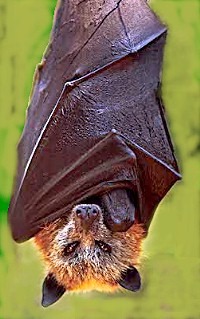
  • Upside-down hanging (head-down roosting) is common, aiding quick takeoff and reducing access for many ground predators; a minority roost differently (e.g., some in foliage).
  • Social complexity ranges from solitary species to vast maternity colonies; many use vocal "contact calls" to find pups and roostmates.
  • Foraging strategies vary: aerial hawking of insects, gleaning prey off leaves, hovering at flowers, long-distance commuting to fruiting trees, and even trawling fish from water surfaces.
  • Seasonal energy tactics: daily torpor is widespread; many temperate species hibernate, while others migrate or track food blooms.
  • Reproduction often shows delayed timing (e.g., sperm storage or delayed implantation) so births align with peak food availability.
  • Navigation and sensing: many species echolocate in cluttered habitats; others depend more on low-light vision and scent, especially among large fruit bats.

Cultural Significance

Bats (Chiroptera) carry fear and respect in many cultures: lucky symbols in China, Mesoamerican religious figures, and links to night, witchcraft, and vampires in Europe. They eat pests, spread seeds, pollinate plants (agave), and provide guano.

Myths & Legends

China: Bat imagery represents blessings and happiness; the "Five Bats" motif symbolizes the Five Blessings-often depicted as bats surrounding auspicious symbols.

Maya tradition: In the Maya underworld, the "House of Bats" is guarded by a fearsome bat spirit associated with night and sacrifice.

Aztec/Mesoamerican lore: Bat deities and bat-associated spirits appear as powerful nocturnal figures linked to the underworld and transformation in regional traditions.

Aesop's fables (Greek tradition): "The Bat and the Weasels" (and related tales) portray the bat as a liminal creature-neither fully bird nor beast-using identity to survive.

European folklore: Bats become companions of witches and omens of night; later traditions blend bat imagery into vampire legends that spread through Eastern and Central European storytelling.

Many folktales about bats (Chiroptera) say bats hang upside down because of a bargain, a punishment, or a clever escape, making bats seem like tricksters of the night in many cultures.

Indigenous Australian oral traditions (varies by nation): some stories describe bats as transformed people or as participants in disputes with birds, reflecting bats' in-between nature (flying yet mammalian).

Conservation Status

NE Not Evaluated

Has not yet been evaluated against the criteria.

Population Unknown

Protected Under

  • Protection varies by country and species; many bats are protected under national wildlife laws and endangered species acts (e.g., U.S. Endangered Species Act listings for some Myotis spp.).
  • EU: all bat species are strictly protected under the EU Habitats Directive; many are also covered by national bat protection laws.
  • International: the Agreement on the Conservation of Populations of European Bats (EUROBATS) under the Convention on Migratory Species supports coordinated protection; some bat species are listed on CITES Appendices (particularly certain flying foxes and other taxa in trade).
  • Large areas of bat habitat/roosts occur within protected areas, but effective protection often depends on roost safeguarding, disturbance management, and enforcement.

Looking for a specific species?

Little brown bat

Myotis lucifugus

In many North American contexts, "bat" most commonly evokes small, insect-eating, echolocating bats like Myotis; this species is one of the most familiar and historically abundant. Order-wide ranges & generalizations (Chiroptera; highly diverse): - Size (smallest → largest): ~2 g (e.g., bumblebee bat) up to ~1.4 kg (largest flying foxes); head-body length roughly ~3-40 cm; wingspan roughly ~15-170 cm. - Lifespan: commonly ~5-20 years across many species, with documented maxima exceeding 30 years in some small bats (exceptionally >40 years recorded in a few species). - Behavior/ecology (with major variation): most are nocturnal and roost by day (caves, trees, foliage, buildings); sociality ranges from solitary roosting to colonies of thousands-millions; temperate species often use torpor/hibernation, while many tropical species remain active year-round; echolocation is widespread but not universal (many fruit bats rely more on vision/olfaction, with some using simpler echolocation); diets span insectivory, frugivory, nectar/pollen feeding (pollination), carnivory (small vertebrates), piscivory, and sanguivory. - Reproduction: usually 1 pup per year (twins occur in some lineages); reproductive timing often synchronized with seasonal food availability, including delayed fertilization/implantation in some taxa.

  • Chiroptera is the only mammalian order capable of true sustained powered flight; wing shape and size vary widely with foraging style (fast open-air pursuit vs. maneuvering in cluttered forests).
  • Dietary diversity across the order supports major ecosystem services: insect population suppression, pollination (notably of night-blooming plants), and seed dispersal in many tropical systems.
  • Echolocation is common among many lineages (especially insectivorous bats), but there is substantial variation in call structure, intensity, and reliance on non-acoustic senses across families.
  • Longevity is unusually high for body size in many bats, with some small species living multiple decades under favorable conditions.
View Little brown bat Profile

You might be looking for:

Little brown bat

18%

Myotis lucifugus

Common insect-eating bat of North America; often roosts in buildings and caves.

View Profile

Egyptian fruit bat

16%

Rousettus aegyptiacus

Old World fruit bat (megabat); feeds on fruit and uses caves for roosting.

Common vampire bat

14%

Desmodus rotundus

Neotropical bat famous for feeding on blood; highly specialized social and feeding behavior.

View Profile

Gray-headed flying fox

12%

Pteropus poliocephalus

Large Australian fruit bat (flying fox); important pollinator/seed disperser.

Greater horseshoe bat

10%

Rhinolophus ferrumequinum

Echolocating bat of Eurasia with distinctive noseleaf; insectivorous.

Life Cycle

Birth 1 pup
Lifespan 15 years

Lifespan

In the Wild 2–41 years
In Captivity 3–45 years

Reproduction

Mating System Polygyny
Social Structure Aggregation Group
Breeding Pattern Seasonal
Fertilization Internal Fertilization
Birth Type Internal_fertilization

Most bats show polygyny where males guard roosts or groups, but many mate with many partners or in swarms. Some are socially monogamous. Mating is internal; many store sperm or delay pregnancy. Bonds are usually seasonal; true cooperative breeding is rare.

Behavior & Ecology

Social Colony Group: 200
Activity Nocturnal, Crepuscular, Cathemeral, Diurnal
Diet Omnivore Varies strongly by family; insects are the most widespread staple across the order, while many tropical lineages specialize on fruit or nectar/pollen.
Seasonal Migratory, Hibernates 1,243 mi

Temperament

Highly variable across the order: ranges from strongly gregarious, tolerant roost-mates to more solitary and territorial roosters
Often cautious and predator-avoidant; many rely on darkness/cover and rapid escape rather than overt aggression
Roost-mate interactions commonly include tolerance and affiliative behaviors (e.g., clustering for warmth, social grooming), but aggressive interactions can occur over space, mates, or food
Maternal behavior is typically strong: females nurse and protect pups, with recognition cues varying by species and colony density
Foraging behavior ranges from opportunistic to highly specialized (insect hawking, gleaning, fruit/nectar feeding), influencing social spacing and competition
Bats show many life paths: many are small but can live very long for mammals. Across Chiroptera, maximum lifespans range from a few years to several decades.

Communication

Echolocation calls in many families (used for navigation and prey detection); call structure and frequency vary widely across species and habitats, from lower-frequency, longer-range calls to very high-frequency calls for cluttered environments
Social calls (contact calls, group cohesion calls, mother-pup reunification calls), often individually distinctive in species with dense colonies
Distress calls that can attract conspecifics or startle predators
Aggressive and threat calls during roost disputes or mating competition
Courtship and mating vocalizations in some species Including complex songs in certain taxa
Scent communication via glands, urine, and feces (marking roosts, territories, or mates); chemical cues can support individual/kin recognition in some species
Tactile communication: social grooming, nuzzling, wing/forearm contact, and huddling/clustering Important for bonding and thermoregulation
Visual signals at close range (posture, wing spreading, facial/ear movements), more relevant in well-lit roosts or for larger-eyed taxa
Roost-site cues and spatial memory: repeated use of roosts and following conspecifics can function as information transfer about safe sites and resources
Vibrational/mechanical cues within roosts (movement and rustling can cue arousal, departure timing, or disturbance), especially in dense colonies

Habitat

Biomes:
Tropical Rainforest Tropical Dry Forest Savanna Desert Hot Desert Cold Mediterranean Temperate Grassland Temperate Forest Temperate Rainforest Boreal Forest (Taiga) Tundra Alpine Freshwater Marine Wetland +9
Terrain:
Mountainous Hilly Plateau Plains Valley Coastal Island Riverine Volcanic Karst Rocky Sandy Muddy +7
Elevation: Up to 18044 ft 8 in

Ecological Role

Highly diverse nocturnal consumers spanning insect predators, pollinators, seed dispersers, and occasional vertebrate predators/parasites; collectively a major regulator of nighttime ecosystem processes.

Suppression of insect populations (including many agricultural/forestry pests) Pollination of night-blooming plants (e.g., agaves, cacti, tropical trees) Seed dispersal and forest regeneration via fruit consumption and defecation of seeds Nutrient transfer and fertilization through guano deposition (notably in caves) Food-web support as prey for owls, raptors, snakes, and carnivores

Diet Details

Main Prey:
Insects Other arthropods Fish Small vertebrates Blood from vertebrates
Other Foods:
Fruits Nectar and pollen Flowers Leaves Plant juices and fermented fruit juices

Human Interaction

Domestication Status

Wild

Danger Level

Moderate
  • Rabies and other lyssaviruses: low probability per encounter but severe consequence; highest risk from handling and bites/scratches
  • Other zoonoses and spillover concerns: risk depends on region/species and exposure pathways; greatest in hunting/handling, wildlife trade, and disturbed roost contexts
  • Histoplasmosis and other respiratory hazards associated with inhaling aerosolized spores from guano in caves/attics
  • Bites/scratches and secondary bacterial infection when bats are handled or trapped
  • Allergy/irritation from guano/urine/ammonia in confined roosts
  • Property nuisance: noise, odor, staining, and occasional structural issues in buildings

As a Pet

Not Suitable as Pet

Legality: Bats are mostly illegal or tightly restricted in many places. Rules include wildlife laws, rabies/disease controls, permits only for licensed wildlife rehabilitators, researchers, or zoos, and CITES trade limits. If allowed, strict permits, enclosures, biosecurity, and vet care are required.

Care Level: Expert Only

Purchase Cost: Up to $10,000
Lifetime Cost: $5,000 - $75,000

Economic Value

Uses:
Ecosystem services (natural pest control) Agricultural support (pollination and seed dispersal) Tourism and recreation (cave/bridge bat watching) Fertilizer and soil amendment (guano) Scientific and biomedical research (echolocation, flight biomechanics, aging, immunology) Cultural/educational value and conservation programs
Products:
  • Guano used as fertilizer (historic and modern use in some regions)
  • Reduced crop damage and pesticide use via insect consumption (service value)
  • Pollination services for wild plants and some crops (region-dependent)
  • Seed dispersal supporting forest regeneration (especially in the tropics)
  • Ecotourism revenue from large roost emergences and protected sites
  • Research outputs/technology inspiration (sonar/biomimetics)

Relationships

Predators 7

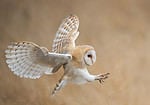
Barn owl Tyto alba
Great horned owl Bubo virginianus
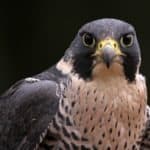
Peregrine falcon Falco peregrinus
Boa constrictor Boa constrictor
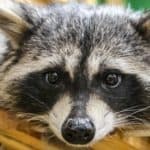
Raccoon Procyon lotor
Domestic cat Felis silvestris catus
Long-tailed weasel Mustela frenata

Related Species 5

Primates Primates Shared Order
Rodents Rodentia Shared Class
Carnivorans Carnivora Shared Order
Shrews, hedgehogs, moles Eulipotyphla Shared Class
Even-toed ungulates Artiodactyla Shared Order

Ecological Equivalents 5

Animals that fill a similar ecological role in their ecosystem

Swifts Apodidae Aerial insectivores that feed on flying insects in open airspace, overlapping with many insect-eating bats' foraging niches, especially high, fast flight over open areas.
Nightjars and allies Caprimulgidae Nocturnal insect hawkers that exploit dusk and nighttime insect peaks; functionally similar to many echolocating insectivorous bats.
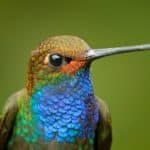
Hummingbirds Trochilidae Nectar feeders that can act as pollinators; ecological parallels to nectar-feeding bats (e.g., glossophagine bats) in plant-pollinator networks, often with different plant guilds.
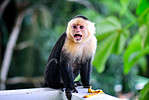
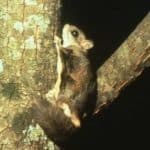
Flying squirrels Pteromyini Arboreal, mostly nocturnal gliders that use forest canopy pathways; occupy similar night-time movement and foraging zones to many fruit- and leaf-roosting bats, though they glide rather than truly fly.
Sugar glider Petaurus breviceps Nocturnal gliding mammal that feeds on nectar, sap, and insects; overlaps with some bat guilds in nighttime resource use and canopy ecology.

Types of Bat

20

Explore 20 recognized types of bat

Little brown bat Myotis lucifugus
Grey-headed flying fox Pteropus poliocephalus
Common vampire bat Desmodus rotundus
Egyptian fruit bat Rousettus aegyptiacus
Greater horseshoe bat Rhinolophus ferrumequinum
Bumblebee bat (Kitti's hog-nosed bat) Craseonycteris thonglongyai
Giant golden-crowned flying fox Acerodon jubatus
Straw-coloured fruit bat Eidolon helvum
Big brown bat Eptesicus fuscus
Common pipistrelle Pipistrellus pipistrellus
Brazilian free-tailed bat Tadarida brasiliensis
Common noctule Nyctalus noctula
Brown long-eared bat Plecotus auritus
Greater bulldog bat (fishing bat) Noctilio leporinus
Greater false vampire bat Megaderma lyra
Spectral bat Vampyrum spectrum
Jamaican fruit bat Artibeus jamaicensis
Pallas's long-tongued bat Glossophaga soricina
Schreiber's bent-winged bat Miniopterus schreibersii
Great Himalayan leaf-nosed bat Hipposideros armiger

“A mother bat gives birth to her babies while hanging upside down.”

There are 47 species of bats living in the United States and 1300 species of bats in total. Bats live in many types of environments except in extremely cold places (polar regions) and extremely hot ones (deserts). Bats are important pollinators and help to control the population of insects. These animals are social and live in groups that can number in the hundreds of thousands! Though vampire bats are the most well-known, there are only three species of bats that use another animal’s blood as food.
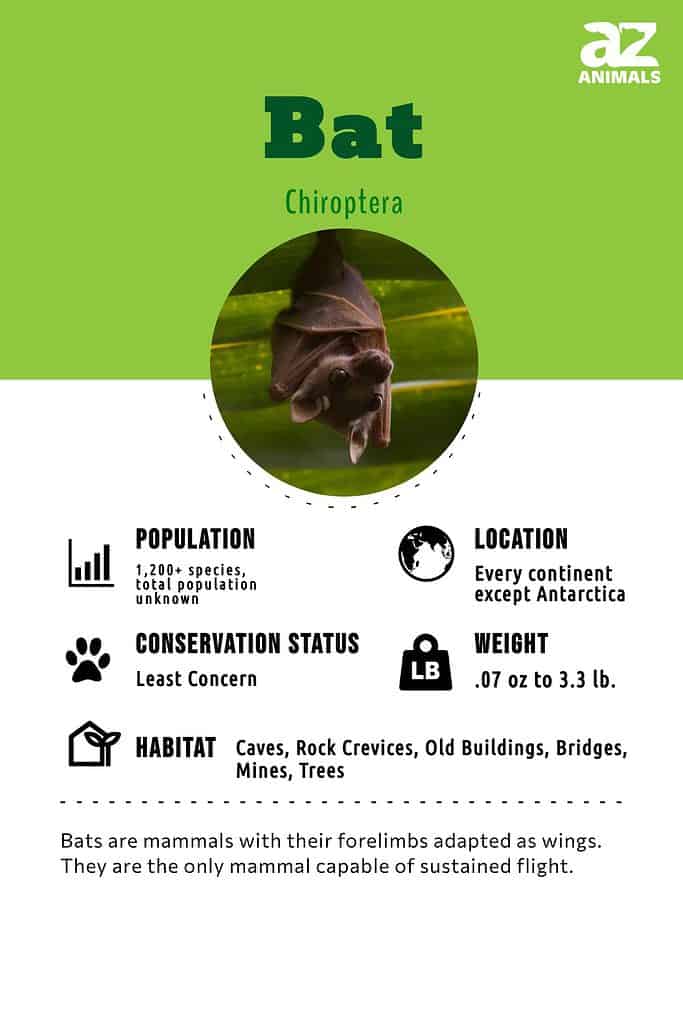
👁 Bat Infographic
Bats are the only mammals capable of sustained flight.

5 Bat Facts

  • Some bats travel up to 2,400 miles each year to spend the winter in a place with a warm climate
  • 70% of all bats feed on beetles, moths, flies, mosquitoes, and other insects
  • The biggest type of bat in the world is known as the Pteropus
  • Bats have been known to survive for over 20 years
  • A bat is a mammal that can fly without ever gliding. Some bats are extremely fast. The Mexican free-tailed bat can reach speeds of more than 100 miles per hour, making it the fastest animal in North America.

Scientific Name

Bat is the common name of this remarkable animal, while Chiroptera is its scientific name. The bat has a classification as Mammalia and is in the Microchiroptera family.

The Brazilian free-tailed bat has a subspecies called the Mexican free-tailed bat that lives in the southern part of the United States. Also, the Virginia big-eared bat is a subspecies of Townsend’s big-eared bat.

A bat’s scientific name is taken from the Greek words cheir, meaning hand, and pteron, meaning wing. This is because the parts of a bat’s wing resemble that of a hand with four ‘fingers’ covered with a thin membrane.
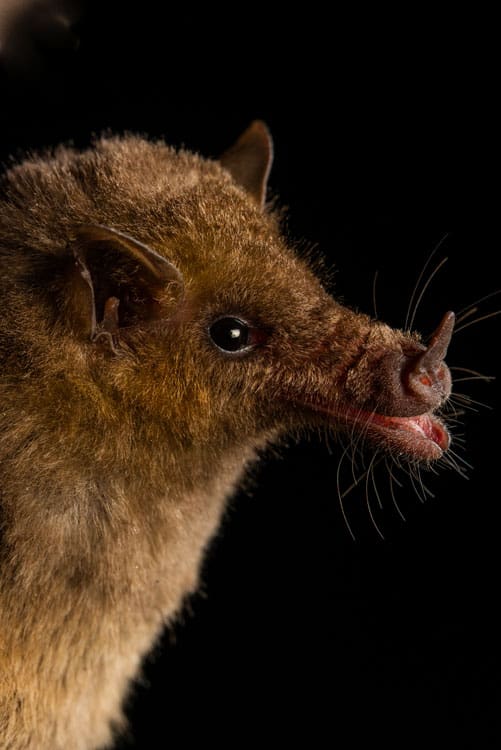
👁 Mexican Long-tongued Bat

A bat’s scientific name is taken from the Greek words cheir, meaning hand, and pteron, meaning wing. This is because the parts of a bat’s wing resemble that of a hand with four ‘fingers’ covered with a thin membrane.

©svaldvard/Shutterstock.com

Evolution and Origins

Most scientists agree that bats must have evolved from mammals, but there is not enough evidence to know which ancestor they came from. Bats first appeared in the fossil record around 50 million years ago, during the Eocene. Scientists have found remains ranging from teeth and bits of the jaw to full skeletons in places like Wyoming, Paris, Australia, and India. They now think that bats evolved from small, rodent-like animals, including animals such as rats.

The first bats were different from their modern relatives in some ways. For example, scientists know from the ear anatomy of better-preserved specimens that the first bats couldn’t echolocate. They used only sight, smell, and touch to find their meals. Today, bats have a claw only on the equivalent of our thumb, but early bats kept some additional finger claws from their ancestors. A bat fossil dating to about 52 million years ago, called Onychonycteris finneryi, had claws on each of its five fingers. New technology is helping fill in a few of the gaps. A recent study of coloration in the fossil record found that two 48 million-year-old bats found in Germany were mostly brown.

Despite the progress made, scientists are still left with some big questions. For example, they are unsure where the 50-million-year-old bat specimens came from. They are also uncertain about when, where, why, and how the first bats became airborne. This information is hidden by the vast amount of time that has passed.
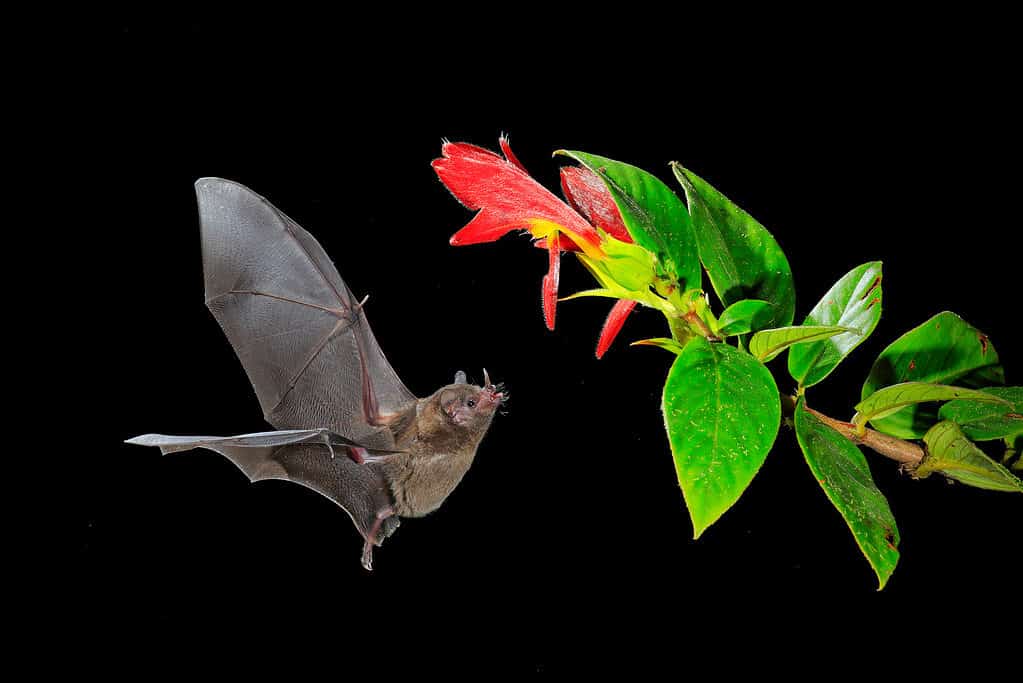
👁 Pallas’s long-tongued bats

Early bats did not have echolocation. They used sight, sound, and smell to locat their food.

©iStock.com/Ondrej Prosicky

Appearance and Behavior

A bat has a thin layer of brown, black, or gray fur. They have small or large ears and small black eyes. Depending on its species, a bat can weigh as little as .07 ounces. Think of a bat that weighs .07 ounces as being lighter than a single penny. The largest species of bat can weigh up to 3.3 pounds. A bat weighing 3.3 pounds is about as heavy as half of an average-sized brick.

The wings of a bat are its most memorable feature. A bat’s wing has four bones that you can think of as its fingers, as well as a bone serving as a thumb. A thin layer of skin called a membrane connects these bones creating a bat’s flexible wing. If you’ve ever watched a bat fly, you know it can change direction in an instant. It’s these flexible finger bones in their wings that give them that skill. A bat’s wings also give it speed. The fastest bat can travel 99 mph.

When it comes to wingspan, the largest species of bat, known as a flying fox, has a wingspan of five feet! When a flying fox stretches its wings to full length, it would be almost as long/tall as a home’s refrigerator. The smallest species of bat, the Kitti-hognosed bat, has a wingspan of a little less than six inches. This is less than half the length of a ruler you may use in school.

Bats are social animals and live in groups called colonies. (Though they like being around other bats, they are shy and will avoid people.) Sometimes a colony of bats can number in the hundreds of thousands. Living together is how a bat protects itself from predators. If an owl invades a colony of bats, most of the bats will be able to escape. The largest colony of bats is located in the Philippines. The Monfort bat colony there has 3 million bats and counting. Safety in numbers!

👁 Bat hanging upside down
The lightest bat weight only 0.07 ounces. The heaviest bat weighs 3.3 pounds.

Habitat

Bats live on many continents, including Asia, North America, South America, Africa, Europe, and Australia. However, there are no bats living in Antarctica because they prefer warm climates.

When you think of a bat’s home, you may imagine a colony of bats hanging from the ceiling of a cave. Bats also live in trees, under bridges, in burrows, and even in manmade bat houses. They choose a place to roost where they’ll be hidden from predators and able to sleep during the day. Bats wrap their flexible wings around them when they sleep.

Some bats migrate to warmer places for the winter months. These flying mammals hibernate from about October or November until spring arrives in March. A bat living in a place where the temperature doesn’t fall below 45 degrees may not migrate to a warmer climate.

Learn more about other animal species that hibernate here.
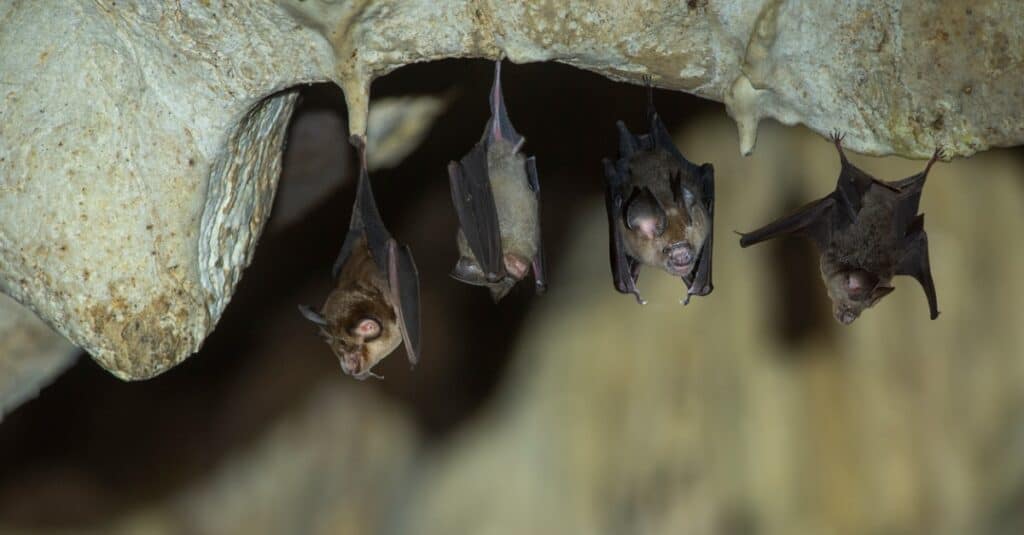
👁 baby bat roosting

Bats live on every continent except Antarctica.

©iStock.com/BirdHunter591

Diet

What do bats eat? Many bats eat insects such as mosquitoes, moths, cockroaches, and beetles. A little brown bat can eat 500 insects in one hour. A colony of bats can consume 500,000 pounds of bugs per night. 500,000 pounds of bugs is equal to the weight of two blue whales!

Bats use echolocation to find their prey. As a bat flies, it lets out high-pitched squeaks and clicks that humans can’t hear. When the sound waves created by a bat’s squeak hit an object, the sound echoes back to the bat. Think of echolocation as a bat’s personal radar system.

Other bats have a diet of nectar. These bats drink nectar from flowers just as hummingbirds do. Some bats eat fruit by sucking the juices of a ripe piece of fruit and spitting out the seeds. In addition, there are bats that eat fish. They fly over the water, grabbing fish with their claws.

You’re probably familiar with the vampire bat. There are three types of these bats that drink blood from mammals such as cows or birds. They are found in South America and Mexico. It’s a myth that vampire bats suck the blood from these animals. Instead, they bite a cow, a sheep, or a bird while it’s sleeping and lick the blood as it seeps out of the animal’s leg or other body parts. This bat only takes in about two teaspoons of an animal’s blood.
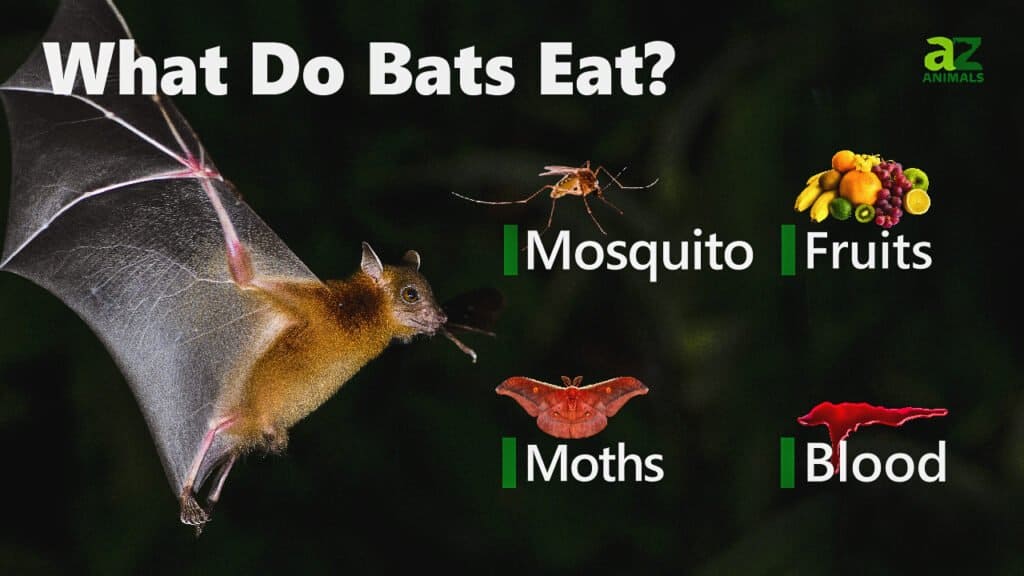
👁 What Do Bats Eat
Bats eat mosquitos, fruit, moths and blood.

Predators and Threats

Bats have a few predators, including owls, falcons, eagles, snakes, raccoons, and cats. An owl may sit on a tree near a cave or bridge where a bat is sleeping and capture it as it flies out to hunt in the evening. Alternatively, a raccoon or snake may pick up a baby bat that’s fallen from its mother’s grasp and landed on the ground.

Bats face the threat of loss of habitat due to people clearing trees to build homes and businesses. If they’re disturbed during the hibernation period, they can starve or die due to exposure to the cold. Also, when land and crops are cleared, it can remove the food source of bats. Some bats are threatened in cultures that use them for food or medicine.

The conservation status of bats is the Least Concerned. Many bat conservation groups offer suggestions to the public on how they can help make sure bats continue to thrive and grow in population. Some of those suggestions include avoiding the use of pesticides in gardens and building a bat house to provide protection for local bats. Also, if you find a bat in hibernation, don’t disturb it.
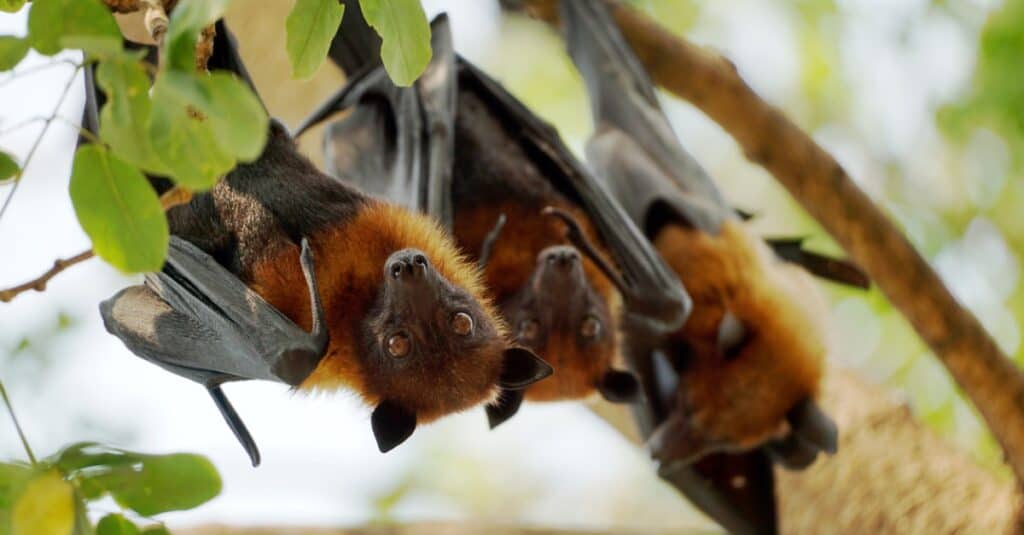
👁 bats hanging upside down

Bats face the threat of loss of habitat due to people clearing trees to build homes and businesses.

©iStock.com/nymphoenix

Reproduction, Babies, and Lifespan

Did you know a bat can sing? Male bats sing and unfold their wings to attract female bats during mating season. Unfortunately, people can’t hear the high-pitched song of bats. A male bat marks its territory during mating time with liquid from its scent glands. Bats swarm during this time, allowing them to find a mate. A female bat can be pregnant for 40 days or six months, depending on its species. Most have one baby once a year.

A mother bat gives birth to her baby or pup while she is hanging upside down. She must catch her pup with her wings after it’s born! A pup weighs about ¼ of the total weight of its mother. So, if a pup’s mom weighs one pound, the baby weighs just ¼ of a pound. A pup of this size is not quite as heavy as a hamster. A pup is born blind and without hair. It drinks milk from its mother for up to six months and clings to her as she flies. After six months, a mother teaches her pup to fly and hunt for food. Once a pup learns these skills, it’s able to survive on its own.

Depending on its species, a bat can live from 5 to 30 years. Scientists have observed that hibernating bats have a tendency to live longer than non-hibernating ones. In many species of bats, females live longer than males. The oldest bat on record lived to be 41 years old!

A disease known as White-nose syndrome is responsible for killing both young and older bats as they hibernate. This disease takes away from a bat’s store of fat as it sleeps. This can cause the bat to wake up and fly out of the cave in search of food. Chances are that the weakened bat will starve because the supply of insects is low in the wintertime.

👁 Cute baby Little Brown Bat sitting on a human hand.

A mother bat gives birth to her baby or pup while she is hanging upside down. She must catch her pup with her wings after it’s born! A pup weighs about ¼ of the total weight of its mother.

©Corina Daniela Obertas/Shutterstock.com

Population

There are 1,300 species of bats throughout the world. The highest concentration of bat species lives near the equator. The conservation status of bats is Least Threatened, and the population is holding fairly steady. However, conservation efforts are always in place for bats because most have just one pup per year.
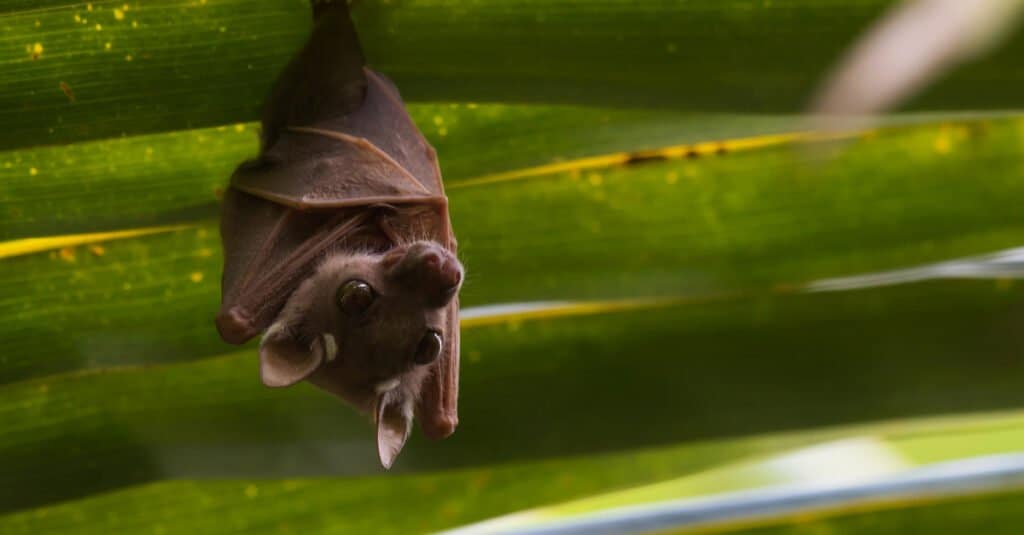
👁 Peters dwarf epauletted fruit bat hanging in fruit tree

There are more than 1,200 species of bats throughout the world

©Dave Montreuil/Shutterstock.com

View all 452 animals that start with B
How to say Bat in ...
Bulgarian
Прилепи
Catalan
Ratapinyada
Czech
Letouni
Danish
Flagermus
German
Fledertiere
English
Bat
Spanish
Murciélago
Esperanto
Ĥiropteroj
Finnish
Lepakot
French
Chauve-souris
Hebrew
עטלפים
Croatian
Netopiri
Indonesian
Kelelawar
Italian
Chiroptera
English
Vliermuis
Dutch
Vleermuis
English
Flaggermus
Japanese
コウモリ
Polish
Nietoperze
Portuguese
Morcego
Swedish
Fladdermöss
Turkish
yarasa
Chinese
蝙蝠

Sources

  1. David Burnie, Dorling Kindersley (2011) Animal, The Definitive Visual Guide To The World's Wildlife / Accessed November 10, 2008
  2. Tom Jackson, Lorenz Books (2007) The World Encyclopedia Of Animals / Accessed November 10, 2008
  3. David Burnie, Kingfisher (2011) The Kingfisher Animal Encyclopedia / Accessed November 10, 2008
  4. Richard Mackay, University of California Press (2009) The Atlas Of Endangered Species / Accessed November 10, 2008
  5. David Burnie, Dorling Kindersley (2008) Illustrated Encyclopedia Of Animals / Accessed November 10, 2008
  6. Dorling Kindersley (2006) Dorling Kindersley Encyclopedia Of Animals / Accessed November 10, 2008
  7. David W. Macdonald, Oxford University Press (2010) The Encyclopedia Of Mammals / Accessed November 10, 2008

About the Author

Heather Hall

Heather Hall is a writer at A-Z Animals, where her primary focus is on plants and animals. Heather has been writing and editing since 2012 and holds a Bachelor of Science in Horticulture. As a resident of the Pacific Northwest, Heather enjoys hiking, gardening, and trail running through the mountains with her dogs.

Thank you for reading! Have some feedback for us?

Contact the AZ Animals editorial team

Related Articles You May Find Interesting

👁 Image
Articles

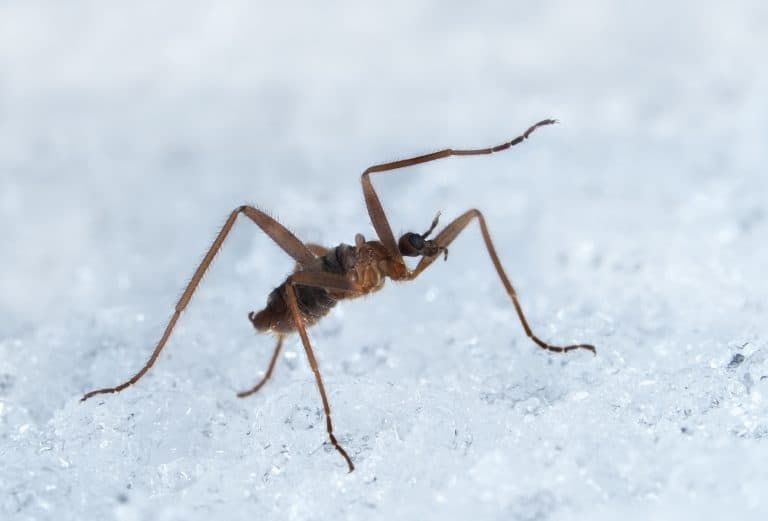
How Snow Flies Survive Subzero Cold with Special Antifreeze Proteins

👁 Bont Tick
Articles

Spring’s Early Guests: Why Ticks, Termites, and Ants Are Beating the Calendar


Bat FAQs (Frequently Asked Questions)

Bats are omnivores. Fruit bats eat avocados, mangoes, bananas, wild dates and more. Three species of vampire bats live on blood from other mammals. Some bats drink nectar from flowers including honey suckle, yucca and evening primrose. Not surprisingly, these bats especially love the nectar of moonflowers! Some species of bats eat fish, mice and frogs.

Yes, bats do bite. Vampire bats usually bite the leg of a cow or goat to get the blood to leak out so it can drink a little of it. A bat would only bite a human if it felt threatened. But, bats are known to keep away from people.

No, bats aren’t blind. This is one of the biggest myths out there. Bats are nocturnal so they look for food when it’s dark. They don’t see well in the dark, but they aren’t blind.

No, bats aren’t dangerous. In fact, just the opposite! Like butterflies and bees, bats are important pollinators that help trees and flowers to grow. They spread seeds that help to grow breadfruit, figs, peaches, dates, bananas, avocados and other fruits. Plus, they eat insects helping to keep the bug population to a manageable number. As a note, bats have a reputation for carrying rabies. In reality, a very small number of bats carry this disease. Still, if you come into contact with a bat it’s good to see medical help. In the United States, five people died from contracting rabies from a bat in 2021, none received a PEP vaccination that could have prevented the spread of rabies if applied shortly after exposure.

When you see a bat you know that the sun has gone down and it’s time to find food. If you see a bat in your backyard, you know the bat has made its home in a nearby tree or has found a cozy place in an attic. Finally, you know the bat has found its food source in your area. Whether it’s nectar, insects or fruit, the bat will stick around just as long as it finds its dinner each night!

Bats belong to the Kingdom Animalia.

Bats belong to the phylum Chordata.

Bats belong to the class Mammalia.

Bats belong to the family Microchiroptera.

Bats belong to the order Chiroptera.

Bats belong to the genus Emballonuridae.

Bats are covered in Fur.

Bats live in woodlands and caves.

Bats prey on mice, frogs, and fruit.

Bats have strong, flexible wings and large ears that detect prey using echolocation.

Predators of Bats include owls, eagles, and snakes.

The average litter size for a Bat is 1.

Bats detect prey using echolocation!

The scientific name for the Bat is Chiroptera.

Bats can live for 10 to 30 years.

A Bat can travel at speeds of up to 25 miles per hour.

The key differences between mouse poop and bat poop are appearance and characteristics.