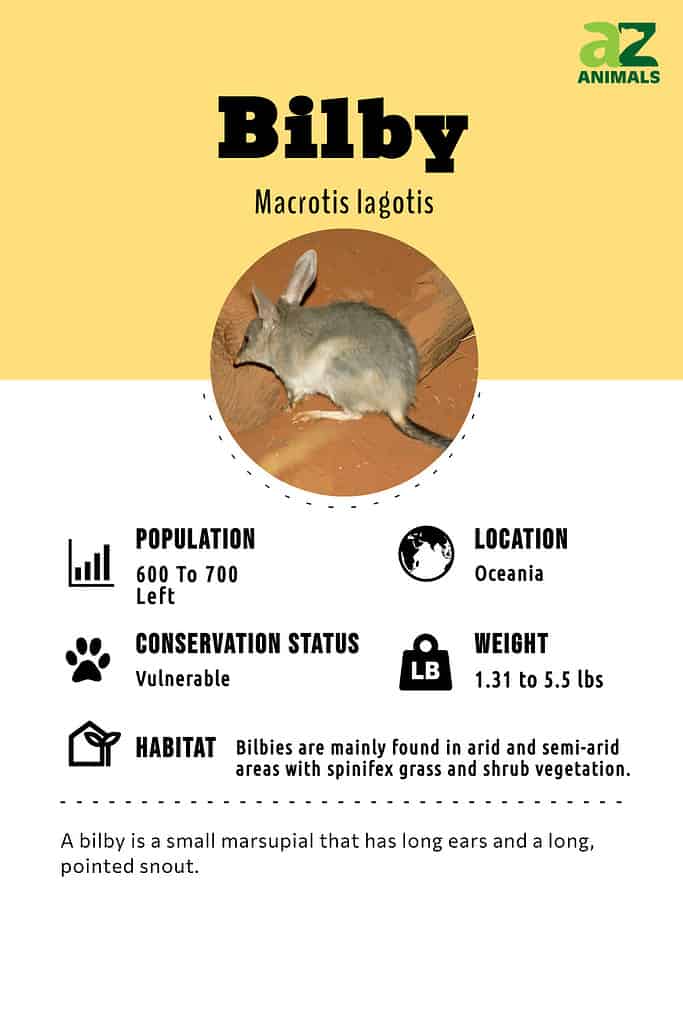
B
Species Profile

Bilby

Macrotis lagotis

Big ears. Big digger. Bilby.
Peter J. Wilson/Shutterstock.com

Bilby Distribution

Click a location to explore more animals from that region

Endemic Species
Loading map...

Found in 1 country

At a Glance

Wild Species
Also Known As Bilby, Rabbit-eared bandicoot, Rabbit-bandicoot, Burrowing bandicoot, Easter Bilby
Diet Omnivore
Activity Nocturnal+
Lifespan 5 years
Weight 2.5 lbs
Status Vulnerable
Did You Know?

Size (adult): head-body 29-55 cm; tail 20-29 cm; mass ~0.8-2.5 kg (males typically larger).

Scientific Classification

The greater bilby is a medium-sized nocturnal marsupial (a bandicoot relative) endemic to Australia, known for its long ears, pointed snout, and burrowing lifestyle.

Kingdom
Animalia
Phylum
Chordata
Class
Mammalia
Order
Peramelemorphia
Family
Thylacomyidae
Genus
Macrotis
Species
lagotis

Distinguishing Features

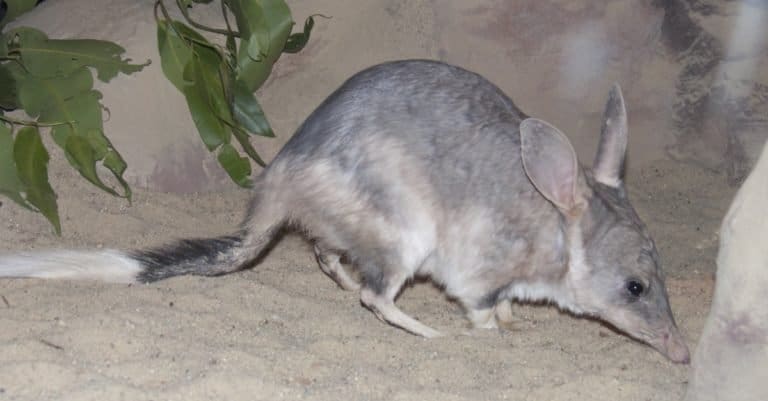
  • Very long ears and a slender, pointed muzzle
  • Long tail with a distinctive black-and-white terminal tuft
  • Powerful forelimbs/claws for digging deep burrows
  • Nocturnal forager, often feeding on insects, bulbs, seeds, and fungi

Physical Measurements

Males and females differ in size

Length
2 ft 5 in (1 ft 12 in – 2 ft 9 in)
1 ft 11 in (1 ft 7 in – 2 ft 4 in)
Weight
4 lbs (2 lbs – 6 lbs)
3 lbs (2 lbs – 4 lbs)
Tail Length
10 in (8 in – 11 in)
9 in (8 in – 11 in)
Top Speed
16 mph
Estimated top speed 25 km/h

Appearance

Primary Colors
Secondary Colors
Skin Type Fur (dense, very soft/silky pelage over mammalian skin); ears are large with thinly furred skin that can show pink tones; feet adapted for digging with strong claws.
Distinctive Features
  • Medium-sized arid-zone Australian marsupial (Peramelemorphia) with a long, narrow, pointed snout and very large, upright ears (key field ID trait).
  • External measurements commonly reported: head-body length ~29-55 cm; tail length ~20-29 cm; ear length often ~7-8+ cm (values summarized across field guides and species accounts; e.g., Strahan (ed.) 2008; Australian Museum species account).
  • Tail is long and relatively sparsely furred proximally, with a conspicuous black distal section and a white terminal tuft ("tail tuft" is a key ID trait; frequently described in diagnostic keys).
  • Strong forelimbs with large claws and powerful shoulders for fast digging; builds long, spiral burrows with many entrances, usually in sandy or loamy soils.
  • Nocturnal and primarily solitary; emerges at night to forage, relying heavily on smell/hearing; day spent in burrows (standard species ecology; IUCN Red List; Australian arid-zone mammal reviews).
  • Backward-opening pouch in females (adaptation to burrowing that helps prevent soil entering the pouch), typical of many digging marsupials; not a rodent/lagomorph trait.
  • Conservation context affecting appearance in the wild: many remaining populations occur in predator-managed refuges; introduced red foxes and feral cats are major drivers of historical range contraction (IUCN Red List; Australian threatened species recovery literature).

Sexual Dimorphism

Sexual dimorphism is mainly size-based: males average larger/heavier with more robust head/shoulders; coat coloration/pattern is broadly similar between sexes.

  • Typically larger body size and mass than females (size dimorphism reported in species accounts; e.g., Strahan 2008; IUCN summaries).
  • More robust forequarters/head associated with digging and intrasexual competition (reported qualitatively in field descriptions).
  • Generally smaller/lighter-bodied than males.
  • Backward-opening pouch is the most obvious sex-specific external feature; pouch development/visibility varies with reproductive state.

Did You Know?

Size (adult): head-body 29-55 cm; tail 20-29 cm; mass ~0.8-2.5 kg (males typically larger).

One of the shortest mammal pregnancies: gestation ~12-14 days; litters usually 1-3 (often 2).

The pouch opens backwards-an adaptation that helps keep sand out while digging.

Bilby burrows can be complex and long (reported up to ~2-3 m), providing cool refuge from extreme arid-zone heat.

They are omnivores that can meet most water needs from food (insects, seeds, bulbs, fungi), an advantage in dry country.

Their digging creates many small pits that trap seeds and water, benefiting plants and other animals-an "ecosystem engineer" effect.

In Australia, the bilby has become a native alternative to the introduced rabbit in Easter campaigns ("Easter Bilby"), supporting conservation funding.

Unique Adaptations

  • Enlarged ears (often ~7-10+ cm): improve hearing and help dump heat (thermoregulation) in hot, still desert nights.
  • Backward-opening pouch: reduces sand/debris entry during digging and protects pouch young.
  • Strong forelimbs and robust claws: specialized for fast excavation of deep refuge burrows and foraging pits in compacted soils.
  • Low free-water dependence: able to persist in arid environments by deriving moisture from diet and selecting cool burrow microclimates.
  • Tail with a black-and-white tuft: a key identification trait; may aid signaling (e.g., following movement in low light) and can be grasped carefully by researchers during handling (not recommended outside trained work).

Interesting Behaviors

  • Nocturnal routine: typically emerges after dusk to forage, returning to a burrow before daylight to avoid heat and predators.
  • Burrow-use strategy: often maintains multiple burrows and may switch shelters frequently, reducing parasite load and predation risk (reported in field studies of bilby sheltering).
  • Spiral/angled burrow digging: uses powerful foreclaws and a pointed snout to excavate rapidly, pushing spoil behind and out of the entrance.
  • Foraging by excavation: makes many shallow "diggings" to locate subterranean prey (insect larvae, termites) and plant foods (bulbs/tubers).
  • Scent communication: uses scent marking (from glandular secretions/urine) and olfaction to navigate and detect conspecifics in low-visibility night conditions.
  • Predator evasion: relies on early detection (acute hearing) and rapid retreat to burrows; predation pressure is highest from introduced red foxes and feral cats (IUCN Red List).

Cultural Significance

The greater bilby (Macrotis lagotis) is an Australian conservation flagship. As the "Easter Bilby" it helps raise money for predator control and reintroductions. Many Aboriginal groups in arid lands include bilbies in Country, totems and teaching stories; some stories are kept private.

Myths & Legends

"Easter Bilby" (modern Australian cultural tradition): a late-20th-century story-and-symbol movement that recasts Easter imagery around a native marsupial, linking the bilby to themes of care for Australian wildlife and habitat.

In many Aboriginal Nations, bilbies (Macrotis lagotis) appear in Dreaming stories and as totem animals tied to places and laws; specific details are kept locally, and some tales need permission.

Naming and identity lore: the common name "bilby" entered English from Aboriginal languages; the animal's large ears and digging lifestyle often anchor it in local descriptive storytelling and children's bush lore in Australia.

Conservation Status

VU Vulnerable

Facing a high risk of extinction in the wild.

Population Decreasing

Protected Under

  • Australia (national): Environment Protection and Biodiversity Conservation Act 1999 (EPBC Act) - listed as Vulnerable.
  • State/Territory protections commonly apply across its range (examples): Western Australia Biodiversity Conservation Act 2016; Northern Territory Territory Parks and Wildlife Conservation Act 1976; Queensland Nature Conservation Act 1992; South Australia National Parks and Wildlife Act 1972; New South Wales Biodiversity Conservation Act 2016; Victoria Flora and Fauna Guarantee Act 1988.
  • Management context: conservation relies heavily on predator control/exclusion (fenced sanctuaries) and reintroductions/translocations; many remaining wild populations are fragmented and managed as metapopulations.
  • HUBS (Peramelemorphia/bandicoots & bilby relatives): conservation statuses span from Least Concern to Endangered/Critically Endangered; the most pervasive threats are introduced predators (cats/foxes), habitat degradation from grazing and altered fire regimes, and climate-driven drought/heat extremes. Notable at-risk taxa include several bandicoot species with restricted ranges and/or high predator susceptibility, and the Greater Bilby remains among the best-known threatened members due to extensive recovery actions.

Life Cycle

Birth 2 joeys
Lifespan 5 years

Lifespan

In the Wild 3–7 years
In Captivity 5–10 years

Reproduction

Mating System Polygynandry
Social Structure Solitary
Breeding Pattern Transient
Fertilization Internal Fertilization
Birth Type Internal_fertilization

Greater bilby (Macrotis lagotis) are solitary, burrow-dwelling mammals with a polygynandrous mating system: males and females may mate with several partners. Breeding can occur year-round after rain. Gestation ~14 days; 1–2 young (to 3); pouch 70–75 days; no male care.

Behavior & Ecology

Social No specific group name (typically solitary) Group: 1
Activity Nocturnal, Crepuscular
Diet Omnivore Subterranean termites and insect larvae (especially beetle larvae/"white grubs")

Temperament

Shy, cryptic, and strongly avoidant of open areas; reliance on burrows for refuge
Generally non-aggressive; agonistic interactions are infrequent because adults usually avoid one another except during breeding
High vigilance and startle response when exposed; rapid retreat to burrows is the typical antipredator behavior (noting modern threats are largely introduced predators)
Greater Bilby (Macrotis lagotis) are mostly solitary, nocturnal foragers that strongly use their burrows. In hot weather they are more active at dusk/dawn, and breeding overlap rises when food is plentiful.

Communication

Soft grunts/snuffles during close contact E.g., at burrow or during handling
Sharp squeals/screams associated with distress or restraint Reported in field handling and captive settings
Olfactory communication via scent cues from urine/feces and scent deposition at/near burrows and along travel paths Common in bandicoot-like marsupials; reported for bilby sign use
Tactile communication during mating and mother-young interactions Pouch/at-burrow contact
Substrate-based cues: digging/burrow construction leaves fresh spoil heaps and trackways that function as indirect signals of recent occupancy/activity to conspecifics Inferred from field sign-based monitoring used for the species

Habitat

Biomes:
Desert Hot Savanna Temperate Grassland
Terrain:
Plains Plateau Sandy
Elevation: Up to 3937 ft

Ecological Role

Omnivorous ecosystem engineer and invertebrate predator in arid/semi-arid Australian systems; important bioturbator via extensive foraging diggings and burrow construction.

Soil turnover/bioturbation (mixing soil layers, increasing infiltration, reducing surface crusting) Creation of microhabitats (diggings and burrows provide refuges and germination sites for other organisms) Regulation of invertebrate populations (predation on termites, ants, beetle larvae) Potential seed and fungal spore dispersal through consumption and movement between patches Nutrient cycling enhancement via disturbance and incorporation of organic matter into soil

Diet Details

Other Foods:
Seeds Bulbs and underground storage organs Fungi Fruit Green shoots/leaves

Human Interaction

Domestication Status

Wild

The greater bilby (Macrotis lagotis) is not a domesticated animal. People have not bred it for pets, work, or farming. Most human contact is through conservation like captive breeding, reintroduction, research, monitoring, and cultural education. European settlement, land clearing, and new predators caused big population drops, not domestication.

Danger Level

Low
  • Bites or scratches if handled (generally mild; risk increases with stress during capture/restraint)
  • Allergic reactions to dander or ectoparasites in rare cases
  • General wildlife-handling zoonotic/parasite hygiene risks (mitigated with standard PPE and biosecurity; bilbies are not considered a high-risk dangerous species to humans)

As a Pet

Not Suitable as Pet

Legality: Greater bilby (Macrotis lagotis) is generally illegal as a private pet. In Australia it is protected; keeping one needs special state/territory permits and is usually allowed only for zoos, sanctuaries, conservation programs, or licensed carers. Export/import is tightly controlled.

Care Level: Expert Only

Purchase Cost:
Lifetime Cost: $20,000 - $60,000

Economic Value

Uses:
Conservation funding and philanthropy (flagship species) Ecotourism and wildlife park visitation (where displayed/managed) Ecosystem services (soil turnover/bioturbation supporting restoration goals) Education and research value
Products:
  • 'Easter Bilby' branded fundraising products (e.g., chocolate bilbies sold to support bilby conservation programs)
  • Conservation-program employment and services (monitoring, fencing, predator control, translocation logistics)
  • Educational programming and zoo/sanctuary exhibits

Relationships

Predators 5

Red Fox Vulpes vulpes
Feral cat Felis catus
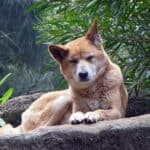
Dingo Canis lupus dingo
Wedge-tailed Eagle Aquila audax
Sand goanna Varanus gouldii

Related Species 1

Lesser Bilby Macrotis leucura Shared Genus

Ecological Equivalents 4

Animals that fill a similar ecological role in their ecosystem

Long-nosed Bandicoot Perameles nasuta Nocturnal marsupials that dig for and eat soil invertebrates and some plant material. The Greater Bilby (Macrotis lagotis) digs more deeply and builds spiral burrows, but both occupy a similar small-to-medium nocturnal ground-forager ecological role.
Southern Brown Bandicoot Isoodon obesulus Ecologically similar ground-dwelling, nocturnal omnivore/insectivore that forages by digging conical holes for fungi and invertebrates, strongly overlapping bilby foraging mode. Bilbies are more arid-adapted and more burrow-dependent; burrow refuge is central to their thermoregulation and predator avoidance.
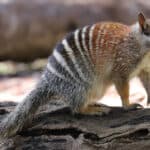
Numbat Myrmecobius fasciatus Shares a strong reliance on social insects, especially termites, as prey in parts of its range; differs by being diurnal and non-burrowing (uses logs and crevices). Included as a functional analogue for termite-focused insectivory.
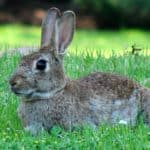
Rabbits Oryctolagus cuniculus Occupies overlapping arid and semi-arid habitats and uses burrows for refuge. Rabbits can modify soils and vegetation and compete indirectly through habitat degradation and altered predator dynamics. Not a close dietary analogue (herbivore versus the omnivorous bilby), but ecologically linked through shared burrowed landscapes and predator subsidies.
👁 Image

The Bilby is Australia’s answer to the rabbit, sort of.”

Of all the charming and unusual creatures found in Australia, the bilby, also called the pinkie, the dalgyte or the rabbit-eared bandicoot is one of the most endearing.

An omnivore that looks somewhat like a rabbit with its huge ears and somewhat like a possum with its long tail and long snout, this nearsighted little animal comes out at night to hunt and forage.

Considered an ecosystem engineer, the bilby digs pits as it looks for food. These pits become fertile areas that help germinate seeds that would have difficulty sprouting anywhere else. Here are some facts about this little creature:

5 Incredible Bilby Facts!
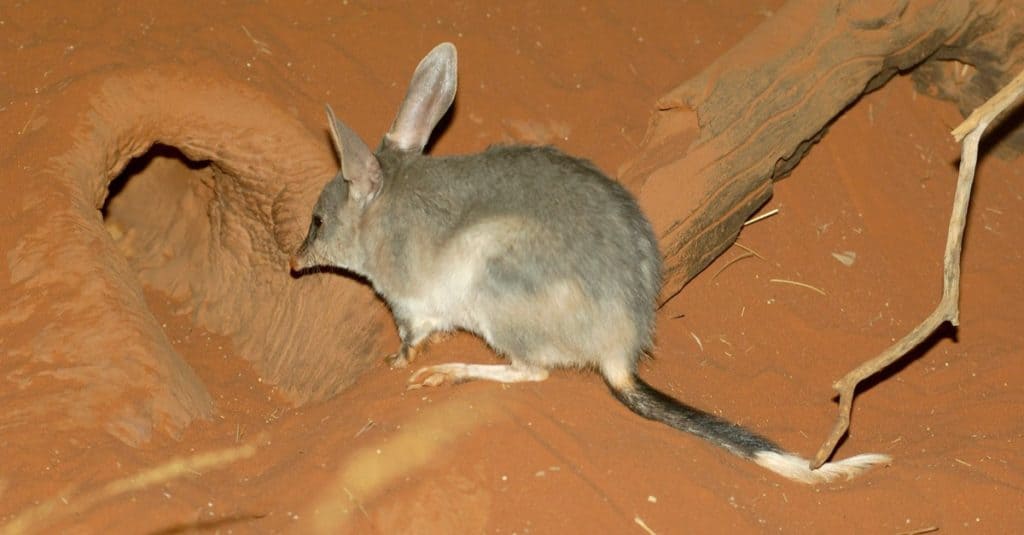
👁 Bilby, or rabbit-bandicoots, is a desert-dwelling marsupial.

Female bilbies have an uncommon trait where their pouches open at the rear.

©John Carnemolla/Shutterstock.com

  • Bilbies are marsupials, which means their babies are born in a very underdeveloped state and do most of what would be fetal development in their mother’s pouch.
  • The pouches of female bilbies open at the back, which is unusual.
  • Bilbies not only dig deep, long, and extensive burrows, but their burrows spiral. This makes it that much harder for predators to find them.
  • Bilbies are a very old species. There are bilby fossils that date back 15 million years.
  • They don’t need to drink. They get all their water from their food.

Scientific name

The bilby’s scientific name is Macrotis lagotis. Macrotis is Greek for “big-eared,” and lagotis is derived from “lagus,” the Greek word for “hare.” There is only one species, the Greater Bilby. The Lesser Bilby is extinct.

Initially, there were two species of bilbies, but nowadays, the Greater Bilby is known as ‘the Bilby’ since the Lesser Bilby (Macrotis leucura) is believed to have become extinct in the early 1950s.

Evolution and Origins

Prior DNA analysis on similar species had suggested that the bilby’s evolutionary separation from its closest relative, the bandicoot, occurred approximately 25 million years ago; however, the oldest known fossil of this endangered species was previously estimated to be only around five million years old.

The Bilby has resided in Australia for about 15 million years and was once present in 70% of the continent, possessing pink ears and smooth blue-grey fur, and is considered Australia’s version of the Easter Bunny, although, unlike rabbits, their population is quickly declining.

Bilbies are active at night and have sturdy forelimbs and sharp claws for burrowing, with a weak sense of vision but a strong sense of smell and hearing, and they typically do not require water very often.

Appearance
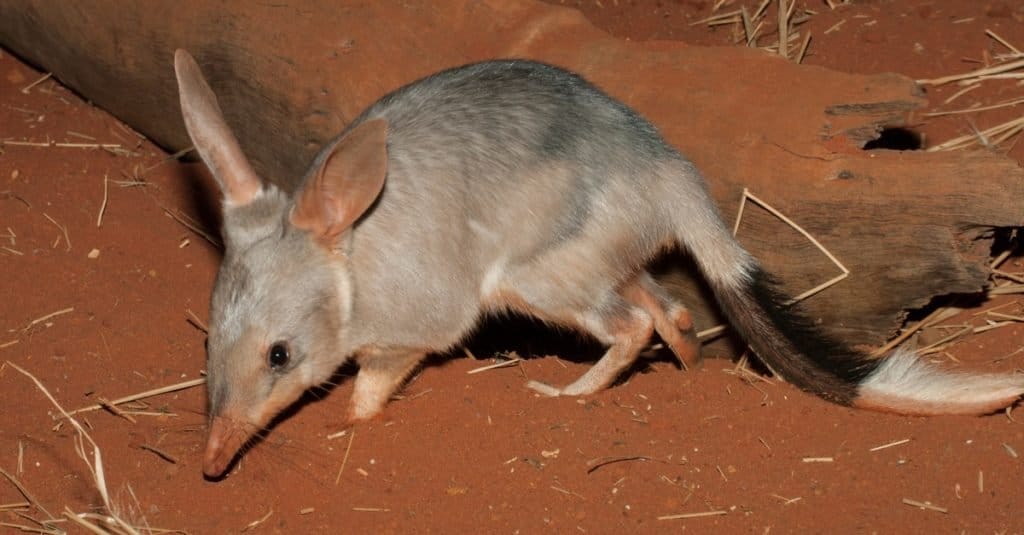
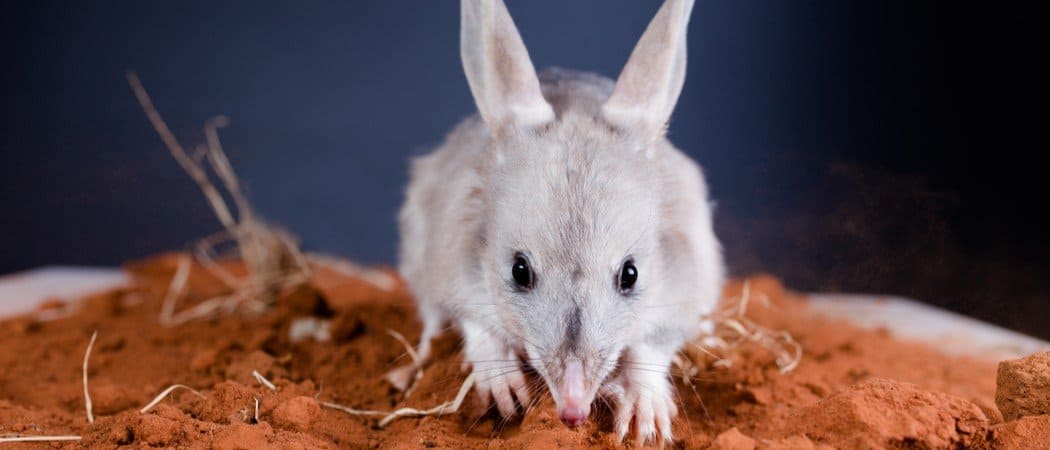
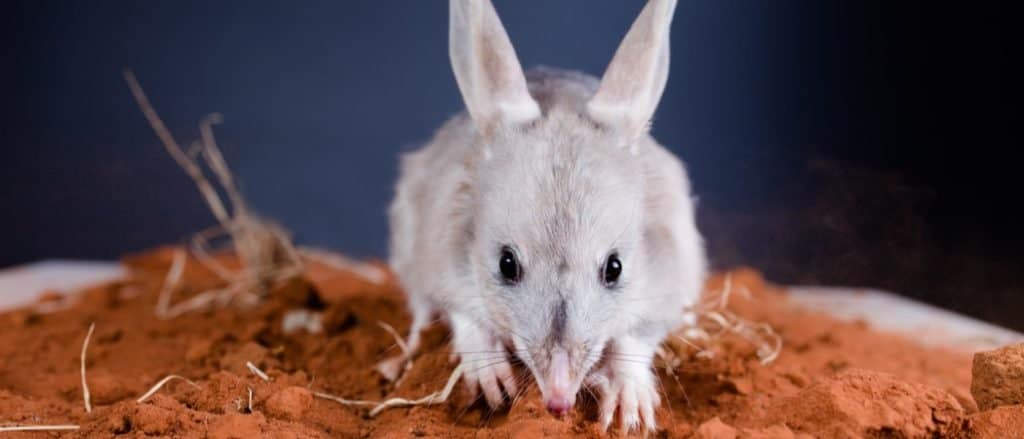
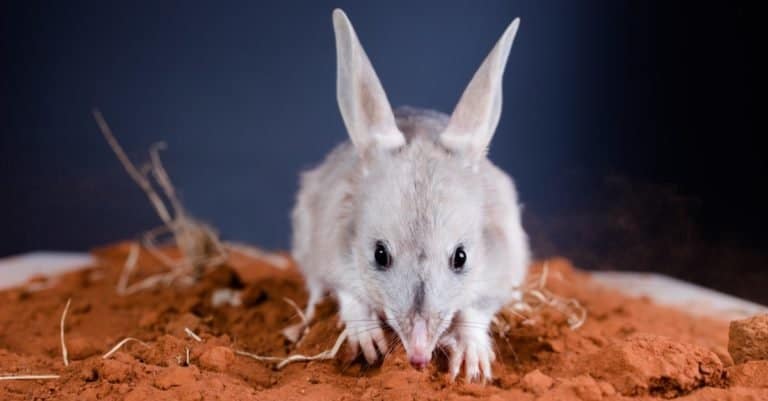
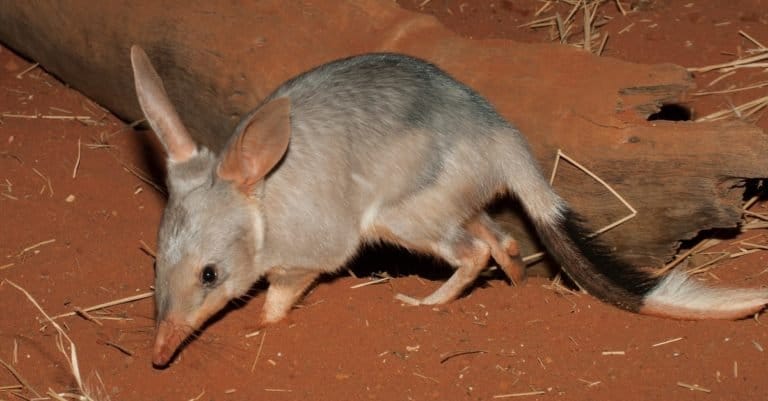
👁 Captive Bilby on red soil.

The pinkie is a creature that measures about 11 to 22 inches in length and has silver-gray fur that is soft and silky to the touch, similar to that of a rabbit.

©iStock.com/Ken Griffiths

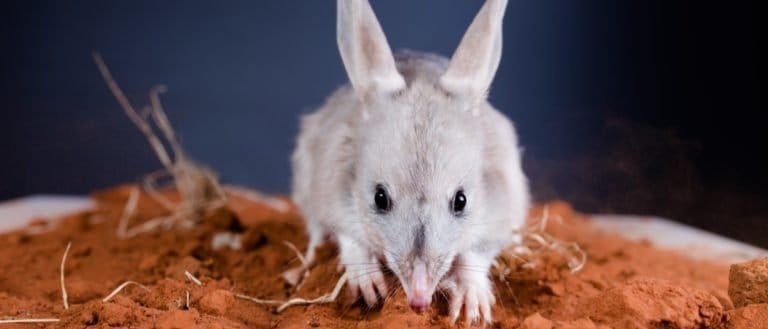
The pinkie is an animal that’s around 11 to 22 inches long with silver-gray fur that has a silken feel, much like a rabbit’s. Their very long ears are one of the first things that a person notices about them. They not only give the animal an excellent sense of hearing but help cool them down in the hot desert climate.

A male bilby is more robust than a female and can weigh twice as much. A large male bilby is about as big as a rabbit. He also has bigger canine teeth and a larger forehead. All bilbies have long snouts with sensitive whiskers.

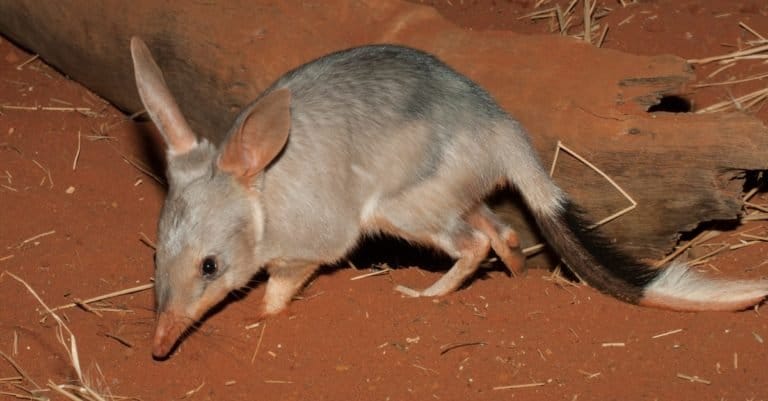
Unlike a rabbit, the bilby has a long, tri-colored tail that’s between 7.9 and 11.4 inches long. The first part of the tail is the same color as the body, then it’s black, and the last 40 percent or so is white. The front legs, which are strong for digging, have five toes each. Three of the toes have claws and the other two don’t. Their hind limbs are also strong and kangaroo-like, but the animal prefers to run as opposed to hop.

Another interesting fact about bilby physiology is its tongue. Like an anteater’s, the bilby’s tongue is long, thin, and sticky. This allows the animal to gather ants and termites without actually tearing apart their colonies and entering them, for the soft fur offers no protection against bites and stings.

The dalgyte also uses its tongue to pick seeds up off the ground. Unfortunately, this also causes bilbies to ingest a good deal of sand and soil, but it doesn’t seem to affect the animal overly much. Bilbies have bad eyesight, but their sense of smell and hearing is acute.

The pouch of the female bilby opens in the back so it doesn’t get filled up with dirt as she digs her burrow. She has eight teats, some are inside her pouch and some are outside. They produce different types of milk.

The inside teats help the nearly embryonic joey to develop, and the outside ones provide nourishment for the joey who has left the pouch. Unlike kangaroos, baby bilbies don’t return to their mother’s pouch once they’ve left it.

Behavior
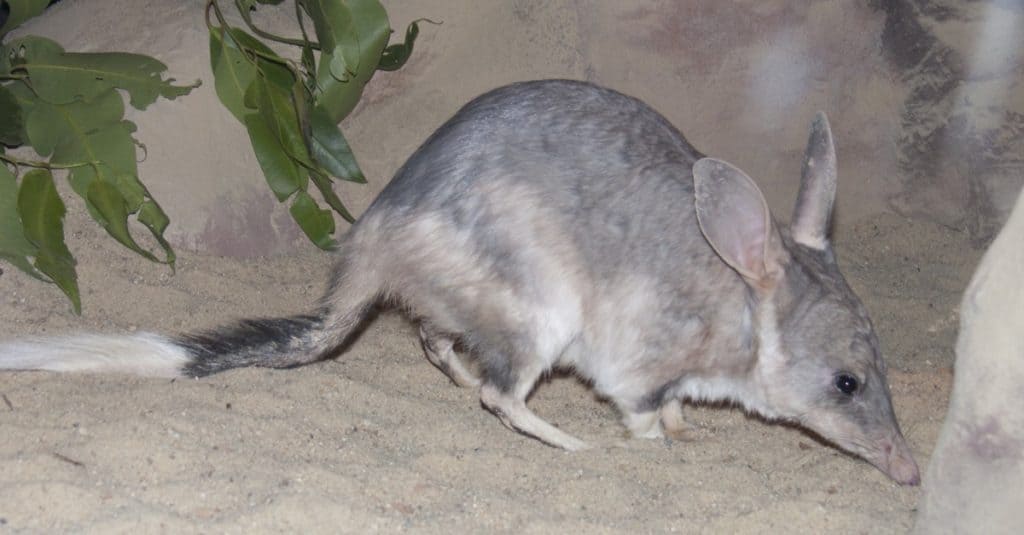
👁 Bilby foraging for food in a field.

Bilbies typically live alone, but occasionally two females may form a group and travel together.

©Susan Flashman/Shutterstock.com

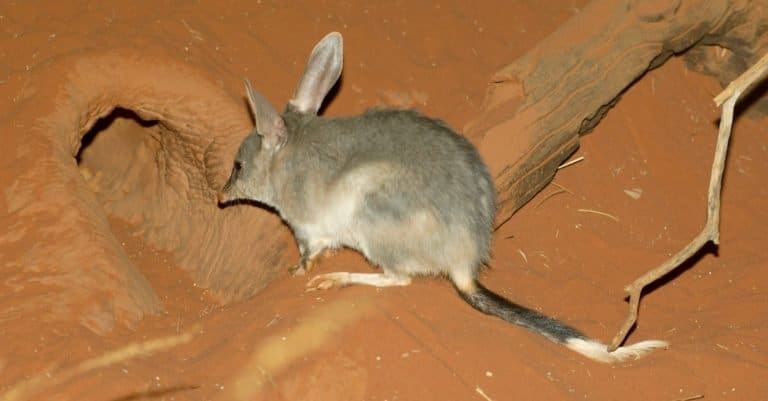
Bilbies are usually solitary, though two females may sometimes travel and live together. They are expert diggers and can dig several burrows with one entrance and a number of exits, again the better to deter predators. These burrows, unusually, spiral down and can be 6.5 feet deep and nearly 10 feet long. Besides protection from predators, burrows protect the bilby from inclement weather, including the harsh desert sun. They also serve as nurseries where female bilbies keep their babies while they forage. Dalgytes move frequently between their burrows.

The home ranges of bilbies tend to overlap, but they are not particularly social save during the breeding season.

Bilbies are nocturnal, so their bad eyesight isn’t an impediment to their hunting and finding food. They leave their burrows at sunset to hunt and come back before the sun rises. Their excellent sense of smell allows them to find caches of buried food and identify other bilbies through the scent markings they leave behind. Their huge ears allow them to hear the movement of underground prey as well as the approach of predators.

Males mark the entrance to their burrows with their scent, and they also leave their scent in the burrow of a female they’ve mated with. This reinforces a dominant hierarchy among male bilbies. Males of lesser status do not mate with females whose burrows have been marked by a dominant male, and dominant males mark over the scent marks left by subordinate males. Females see no need to scent mark their burrows.

Habitat

The rabbit-eared bandicoot used to be found in 70 percent of Australia, including city parks. Now it is restricted to dry and semi-dry areas with rocky or clay soil, shrublands, and grasslands. It has been extirpated in South Australia, though there are efforts to reintroduce it. The animal actually prefers to live not only in dry areas but in places where there are fires from time to time. Fires cause the plants that it likes to eat to germinate.

Diet

The dalgyte is an omnivore, which means its diet includes plants, animals, and fungi. Animals include worms, snails, insects, and other invertebrates and mammals even smaller than themselves. They’ll also take eggs. When it comes to plant material, bilbies eat bulbs, seeds, nuts, grains, grasses, and fruit. They dig up buried food with their front legs and claws. How much animal or plant material they eat depends on what is available. Because their food gives them all the moisture they need, bilbies don’t need to drink water.

Predators and Threats

Normally, bilbies are preyed upon by monitor lizards and birds of prey as well as carpet pythons. However, many of the predators that have helped to decimate the bilby’s numbers were introduced by humans. These include cats, dingos, and red foxes. Dingos were introduced thousands of years ago by the continent’s aborigines, while cats and red foxes were brought over in the 19th century by Europeans.

They spread so rapidly that they destroyed and decimated a variety of native Australian animals, including the rabbit-eared bandicoot. Ironically, cats were brought over to control the other pests brought over by settlers, including rabbits, and red foxes were introduced so the settlers could go fox hunting.

Not only do predators such as cats, foxes, and dingos eat bilbies, they bring diseases to which the dalgyte has no immunity. The bilby picks up these diseases as they dig into the ground contaminated with the waste of these predators.

Bilbies are also pushed out of their habitats by human development and are regularly run over by cars on the road. Because of all this, the pinkie’s IUCN conservation status is listed as vulnerable, and it is listed as endangered under the United States Endangered Species List.

What eats the bilby?

The bilby is eaten by animals such as dingos, pythons, birds of prey, and monitor lizards. Foxes and cats also prey on the bilby.

What does the bilby eat?

The bilby eats mammals smaller than itself, small lizards, insects, snails, termites, ants, and plant material such as seeds, fruit, and bulbs.

Reproduction and Life Cycle

Bilbies can breed year-round, depending on the environment. The peak breeding season is in late summer to mid-autumn. If conditions are too dry and there’s not much food, a female bilby may delay breeding. If conditions are lush, she can give birth to as many as four litters every year. She’ll usually have one or two joeys, though she can have as many as four.

The rabbit-eared bandicoot is polygynous, which means males mate with more than one female. A male mates with a female who’s equal to him in the dominance hierarchy and goes on to mate with females who are lower in the rankings. The male will find a female who is in estrus, follow her around then sniff her. She may sniff him back or reject him if he is of lower status.

Then, they’ll mate underground in her burrow. Mating sessions sometimes take the better part of a day. Afterward, he’ll mark her burrow with his scent as a warning to other males to leave her alone, then go off and find another female.

The female bilby is pregnant for only two weeks or so, then she’ll give birth to a premature baby that climbs through her fur, finds her pouch, and latches on to a teat. It will stay in the pouch for about 75 days.

After the joey leaves the pouch it will not return, but the mother nurses it for about 14 more days. After this, the baby is independent and leaves her burrow for good. It is not unusual for the female to become pregnant again just as her first baby becomes independent.

Female bilbies are ready to breed when they’re about five months old and males when they’re about eight months old.

The oldest captive bilby lived for about 10 years, though if they survive infancy, a bilby usually lives six to seven years. Scientists don’t really know how long bilbies live in the wild.

Population

These animals are endangered in their native Australia, and scientists estimate there are less than 10,000 of them left. Their numbers have plummeted due to predation by invasive species and habitat fragmentation and destruction as humans take up more and more of their land.

View all 452 animals that start with B

Sources

  1. Bush Heritage Australia / Accessed June 20, 2021
  2. Treehugger / Accessed June 20, 2021
  3. Animal Diversity Web / Accessed June 20, 2021
  4. Wikipedia / Accessed June 20, 2021
  5. Australian Museum / Accessed June 20, 2021

About the Author

Rebecca Bales

Rebecca is an experienced Professional Freelancer with nearly a decade of expertise in writing SEO Content, Digital Illustrations, and Graphic Design. When not engrossed in her creative endeavors, Rebecca dedicates her time to cycling and filming her nature adventures. When not focused on her passion for creating and crafting optimized materials, she harbors a deep fascination and love for cats, jumping spiders, and pet rats.
Connect:

Thank you for reading! Have some feedback for us?

Contact the AZ Animals editorial team

Related Articles You May Find Interesting

The Growing Black Bear Population Spreading Across New Hampshire Forests


Bilby FAQs (Frequently Asked Questions)

A bilby is a small, omnivorous marsupial that’s found in Australia. It looks like a mashup of a rabbit, a honey possum, and a rat.

There are probably less than 10,000 bilbies left in the wild.

The Greater Bilby is not extinct, even though it is endangered. The Lesser Bilby is believed to have gone extinct in the 1950s.

Bilbies do not lay eggs like their fellow marsupial, the echidna. It is possible that some people believe they lay eggs because chocolate bilbies are grouped with decorated eggs during Easter.

Bilbies live in the deserts and grasslands of central and northwestern Australia. These deserts include the Gibson Desert, the Great Sandy Desert, and the Tanami Desert. They’re also found in southwest Queensland’s Mitchell grasslands.