

B
Species Profile

Bismarck Ringed Python

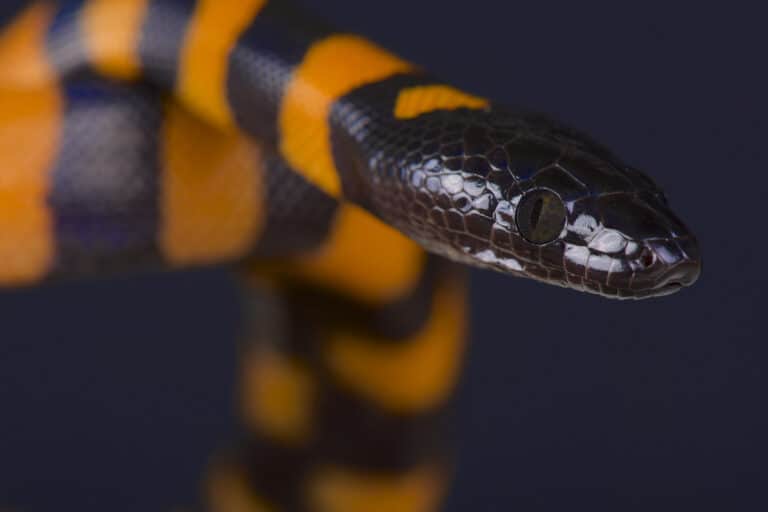
Morelia clastolepis

Ringed hunter of the Bismarck forests
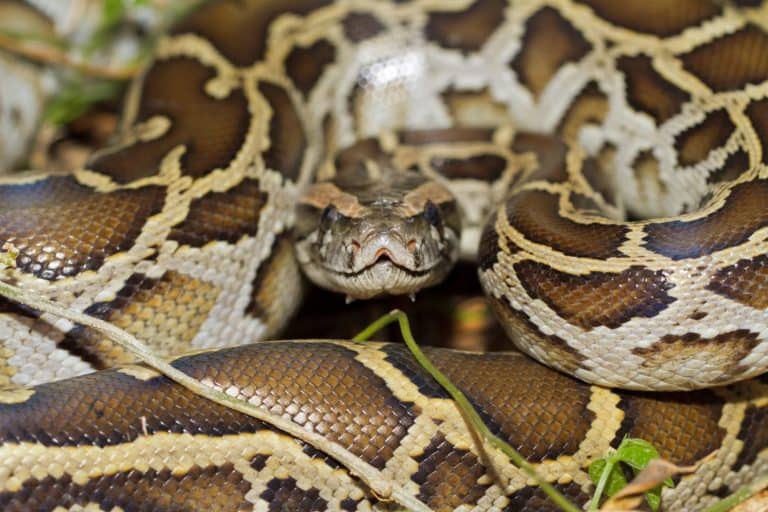
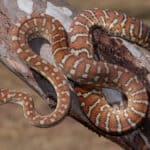
reptiles4all/Shutterstock.com

Bismarck Ringed Python Distribution

Click a location to explore more animals from that region

Endemic Species
Loading map...

Found in 1 country

At a Glance

Wild Species
Diet Carnivore
Activity Nocturnal+
Lifespan 15 years
Weight 8 lbs
Status Least Concern
Did You Know?

Endemic to the Bismarck Archipelago (Papua New Guinea), making it an insular (island-restricted) python with a naturally small geographic range.

Scientific Classification

The Bismarck ringed python (Morelia clastolepis) is a medium-to-large, semi-arboreal python in the genus Morelia, recognized for a banded (“ringed”) pattern and insular distribution.

Kingdom
Animalia
Phylum
Chordata
Class
Reptilia
Order
Squamata
Family
Pythonidae
Genus
Simalia
Species
Morelia clastolepis

Distinguishing Features

  • Banded/ringed patterning compared with many other Morelia
  • Insular endemic to the Bismarck Archipelago (key ID clue)
  • Pythonid head shape with heat-sensing labial pits typical of pythons
  • Semi-arboreal tendencies typical of many Morelia species

Physical Measurements

Length
7 ft 3 in (5 ft 11 in – 8 ft 10 in)
Weight
11 lbs (7 lbs – 18 lbs)
Tail Length
12 in (8 in – 1 ft 6 in)
Top Speed
2 mph
No published max, 3 km/h

Appearance

Primary Colors
Secondary Colors
Skin Type Dry, non-glandular reptile integument with overlapping smooth-to-slightly glossy keratin scales; enlarged ventral scutes for traction; paired labial heat-sensing pits typical of Pythonidae.
Distinctive Features
  • Island-endemic python restricted to the Bismarck Archipelago (Papua New Guinea) with locality-linked variation in band width and contrast reported across islands; not a domesticated 'morph'.
  • Semi-arboreal build: laterally compressed body compared with more terrestrial pythons, and a strongly prehensile tail used for climbing and anchoring in forest vegetation.
  • Head relatively distinct from neck with large symmetrical head shields; thermoreceptive labial pits along upper/lower lips for endotherm prey detection (Pythonidae trait).
  • Banded/'ringed' appearance is most evident in juveniles and subadults; adults often retain the annular motif but may darken overall, reducing contrast (ontogenetic darkening reported in Morelia/Simalia complex).
  • Adults are commonly about 1.8–2.5 meters long, with some reaching the high 2-meter range. Robust but usually not as heavy as the largest mainland pythons; exact biggest sizes vary.
  • Behavior/ecology notes relevant to appearance: typically crepuscular/nocturnal ambush predator in forest habitats; spends time both on the ground and in shrubs/trees, which aligns with its climbing-adapted proportions.

Sexual Dimorphism

Sexual dimorphism is present but subtle in external appearance; as in many pythons, females tend to attain greater overall body size/mass, while males typically have proportionally longer tails and more evident cloacal spurs.

  • Proportionally longer tail (post-cloacal length) relative to total length; tail base may appear slightly thicker due to hemipenes.
  • Cloacal spurs often more prominent/used during courtship (paired pelvic spurs typical of pythons).
  • Overall body often more slender at a given total length compared with females (general python pattern; species-specific quantified datasets are limited).
  • Typically larger/heavier-bodied adults on average; trunk may appear more robust (common in Pythonidae; published sex-specific size statistics for this species are sparse).
  • Shorter tail proportion relative to males.
  • When gravid, pronounced mid-body girth increase; otherwise external color/pattern differences between sexes are not reliably diagnostic.

Did You Know?

Endemic to the Bismarck Archipelago (Papua New Guinea), making it an insular (island-restricted) python with a naturally small geographic range.

Often treated taxonomically as Morelia clastolepis in older literature, but many modern sources place it in genus Simalia (Pythonidae) based on phylogenetic revisions of "Morelia" lineages.

Its common name comes from the frequent "ringed" or banded patterning-useful camouflage in dappled forest light and among lianas.

Like other pythonids, it has labial heat-sensing pits that detect warm-blooded prey in low light-key for nocturnal hunting.

It is semi-arboreal: it uses both trees and the ground, reflecting the mixed structural habitat of island forests.

Scientific knowledge is patchy: compared with many pet-trade pythons, peer-reviewed data on maximum size, clutch size, and longevity for this exact species are limited or not consistently reported.

The species name clastolepis is built from Greek roots meaning roughly "broken scale," reflecting diagnostic scalation noted in its original taxonomic description.

Unique Adaptations

  • Labial heat-sensing pits (pythonid trait): infrared detection that improves hunting success in low light and dense forest.
  • Prehensile climbing ability (semi-arboreal build): muscular body and gripping scales support controlled climbing and branch-to-branch movement.
  • Ringed/banded disruptive coloration: breaks up the body outline against complex forest backgrounds (lianas, shadows, leaf litter).
  • Robust constriction physiology: pythons can rapidly incapacitate prey by restricting blood flow and/or breathing-an efficient strategy for a sit-and-wait predator.
  • Oviparity with brooding potential (family-level trait): many pythonids coil around eggs and can thermoregulate via muscular contractions; species-specific documentation for M. clastolepis is limited, but the capability is widespread in Pythonidae.

Interesting Behaviors

  • Semi-arboreal cruising: commonly uses branches and trunks for ambush positions, then descends to the ground to travel or hunt, a pattern typical of several Simalia/Morelia relatives.
  • Nocturnal/crepuscular activity: as with many pythons, foraging and movement are often concentrated from dusk through night, when prey is active and temperatures are milder.
  • Ambush predation: waits along likely prey paths (branches, fallen logs, forest edges), striking quickly and using constriction to subdue prey.
  • Refuge fidelity: tends to use secure resting sites (tree hollows, dense vegetation tangles, or ground cover) repeatedly when undisturbed-common in forest pythons.
  • Thermosensory targeting: combines tongue-flick chemoreception with heat-pit cues to finalize strike placement in darkness.

Cultural Significance

Little folklore is recorded for the Bismarck ringed python (Morelia clastolepis). In the region, big snakes are often seen as powerful beings linked to places. M. clastolepis was described in 2000 and is a clear example of island endemism among Australo-Papuan pythons.

Myths & Legends

The name clastolepis, Greek for 'broken scale', keeps the note about scale differences used to tell the island python Morelia clastolepis apart from close relatives in its 2000 scientific description.

Across Melanesia and Papua New Guinea, old stories treat large snakes as powerful forest or river beings tied to places and rules. These tales, not always about Morelia clastolepis, shape local views of pythons.

Conservation Status

LC Least Concern

Widespread and abundant in the wild.

Population Unknown

Protected Under

  • CITES Appendix II (international trade in live animals/skins regulated for pythons)
  • Papua New Guinea: Fauna (Protection and Control) Act 1966 (framework governing taking/export of wildlife; permitting applies to regulated taxa)

Life Cycle

Birth 12 hatchlings
Lifespan 15 years

Lifespan

In the Wild 10–20 years
In Captivity 15–30 years

Reproduction

Mating System Data Deficient
Social Structure Solitary
Breeding Pattern Seasonal
Fertilization Internal Fertilization
Birth Type Internal_fertilization

There is little data for the Bismarck ringed python (Morelia clastolepis). Adults are likely solitary and non-monogamous, with internal fertilization. Breeding is seasonal and short; any egg care would be by the female (brooding).

Behavior & Ecology

Social Solitary Group: 1
Activity Nocturnal, Crepuscular
Diet Carnivore Small mammals (rodents)

Temperament

Secretive, primarily avoidance-based threat response; relies on crypsis and stillness when undisturbed (common in arboreal/semi-arboreal pythons).
Defensive when pressured at close range: tight coiling, head-hiding, striking, and persistent hissing are typical pythonid behaviors; intensity varies by individual, temperature, and handling history (Greene, 1997).
Ambush-oriented foraging: prolonged sit-and-wait posture along branches/edges, with short bursts of movement between perches; activity increases at dusk/night consistent with nocturnal/crepuscular hunting typical of many tropical pythons (Shine & Madsen, 1997).
Low social tolerance outside breeding/nesting contexts; repeated close proximity is more likely due to limited refuge sites than affiliation (general snake social structure: Greene, 1997).

Communication

Hissing Expelled-air defensive display; common across Pythonidae and many snakes
Chemical Pheromonal) communication via tongue-flicking/vomeronasal organ for mate tracking and reproductive condition assessment; this is the primary long-range social cue system in snakes (Mason, 1992
Tactile courtship: body alignment, rubbing, and tail positioning; males use cloacal spurs to stimulate females during mating Courtship/tactile signaling in snakes broadly: Carpenter & Ferguson, 1977
Postural/visual signaling at close range: head elevation, S-shaped necking prior to a strike, body inflation/flattening to appear larger; effectiveness depends on light level and distance Greene, 1997
Substrate-borne vibration/jarring (rapid body movement against branch/ground) as a near-field deterrent/alert signal; commonly reported anecdotally in large constrictors, but not quantified for M. clastolepis.

Habitat

Biomes:
Tropical Rainforest Freshwater
Terrain:
Island Coastal Hilly Plains Riverine
Elevation: Up to 4921 ft 3 in

Ecological Role

Mid-to-upper trophic level mesopredator in insular forest systems (Bismarck Archipelago), linking arboreal and terrestrial food webs.

Regulates populations of small mammals (including commensal/introduced rodents), potentially reducing seed/egg predation and crop damage near settlements Predation on birds and lizards helps structure small-vertebrate community composition Transfers nutrients within forest habitats through ingestion and defecation across arboreal-terrestrial microhabitats

Diet Details

Main Prey:
Small mammals Small-to-medium birds Lizards

Human Interaction

Domestication Status

Wild

Danger Level

Moderate
  • Bites and lacerations during handling/feeding responses (risk increases with adult size and stress; semi-arboreal species may strike from perches).
  • Constrictor-related injury potential (generally lower than giant pythons, but any medium-to-large python can cause harm if mishandled).
  • Zoonotic risk typical of reptiles (e.g., Salmonella exposure from fecal contamination).
  • Escaped-animal risks: public alarm, potential minor pet/livestock predation, and welfare issues for the snake.

As a Pet

Not Suitable as Pet

Legality: Legal status of the Bismarck ringed python (Morelia clastolepis) varies by place. In the U.S. it is not on the federal 'injurious' list, but state/local rules may ban or require permits and secure housing. Check CITES and country laws.

Care Level: Expert Only

Purchase Cost: $500 - $2,000
Lifetime Cost: $6,000 - $20,000

Economic Value

Uses:
Pet trade (specialist/rare species market) Zoo/education display value (limited, niche) Local subsistence use (potential but not well-quantified for this insular species) HUBS: broader python economic roles include skins/leather, pest-rodent control perception, and ecotourism/education-though these are much less documented for Bismarck endemics
Products:
  • Live animals for private collections (captive-bred where available)
  • Educational display/interpretation (zoos, reptile programs)

Relationships

Predators 5

Human Homo sapiens
Mangrove monitor Varanus indicus
Gurney's eagle Aquila gurneyi
Cat Felis catus
Domestic pig Sus scrofa domesticus

Related Species 5

Green tree python Morelia viridis Shared Family
Carpet python Morelia spilota Shared Family
Centralian python Morelia bredli Shared Family
Amethystine python Simalia amethistina Shared Family
Boelen's python Simalia boeleni Shared Family

Ecological Equivalents 5

Animals that fill a similar ecological role in their ecosystem

Green tree python Morelia viridis Shares a hunting style—active at night and at dusk/dawn, ambushing from branches—and a habitat (lowland forest and forest edge). Both eat warm-blooded prey (small mammals and birds). Morelia viridis is mostly arboreal; the Bismarck ringed python uses both trees and the ground.
Amethystine python Simalia amethistina In the New Guinea–Bismarck rainforests, the Bismarck ringed python (Morelia clastolepis) and Simalia amethistina occupy similar ecological roles: both are large constrictor snakes that are partly arboreal when young and become more terrestrial as adults, preying on birds and mammals. Simalia amethistina attains a larger adult size.
Papuan python Apodora papuana Bismarck ringed python (Morelia clastolepis) is a large, nocturnal constrictor in Melanesian forests that eats mammals (including rodents near people) and birds. Apodora papuana is more ground-dwelling; both act as mid-to-top predators on islands.
Pacific ground boa Candoia aspera Occurs in the same island region and employs similar ambush-hunting behavior; nocturnal, it hunts along forest edges and in the understory, feeding on small mammals, birds, and lizards. A smaller-bodied boa (not a python) occupying a similar niche.
Brown tree snake Boiga irregularis Shares nocturnal, largely arboreal hunting behavior in island forests and is a major predator of birds, small mammals, and reptiles. It is not a constricting python and is generally smaller, but it occupies a similar arboreal, nocturnal vertebrate-predator role in many Pacific island settings.

The Bismarck ringed python is a medium-sized, nonvenomous snake that lives in the underbrush and leaf litter of its island home.

Its vibrant juvenile color, beautiful adult color with iridescent scales, and active personality make this an interesting snake. This little-known snake is one of the most beautiful python species in the world.

Incredible Bismarck Ringed Python Facts

  • These snakes are bright orange and black when they hatch. Then, over their first year or two of life, change to orange-brown or yellow and black.
  • They only have heat-sensing pits on their lower rear lip, fewer than most python species.
  • The female may incubate the eggs, or she may not. They don’t seem as careful with their eggs as other pythons.
👁 Image

Scientific Name and Classification

A monotypic species, Bothrochilus boa is uniquely beautiful. It’s the only species in the Bothochilus genus, and its specific name is interesting, as boa typically generically refers to large snakes. It’s where scientists got the genus name for the Boa constrictor. However, Bothrochilus is a little harder to track down. It’s a compound word combining Bothros which refers to a pit or hole, and chilus, which means -like.

Its common name is much easier to figure out because the Bismarck ringed python lives on several islands in the Bismarck Archipelago and is a python with ringed markings.

Appearance

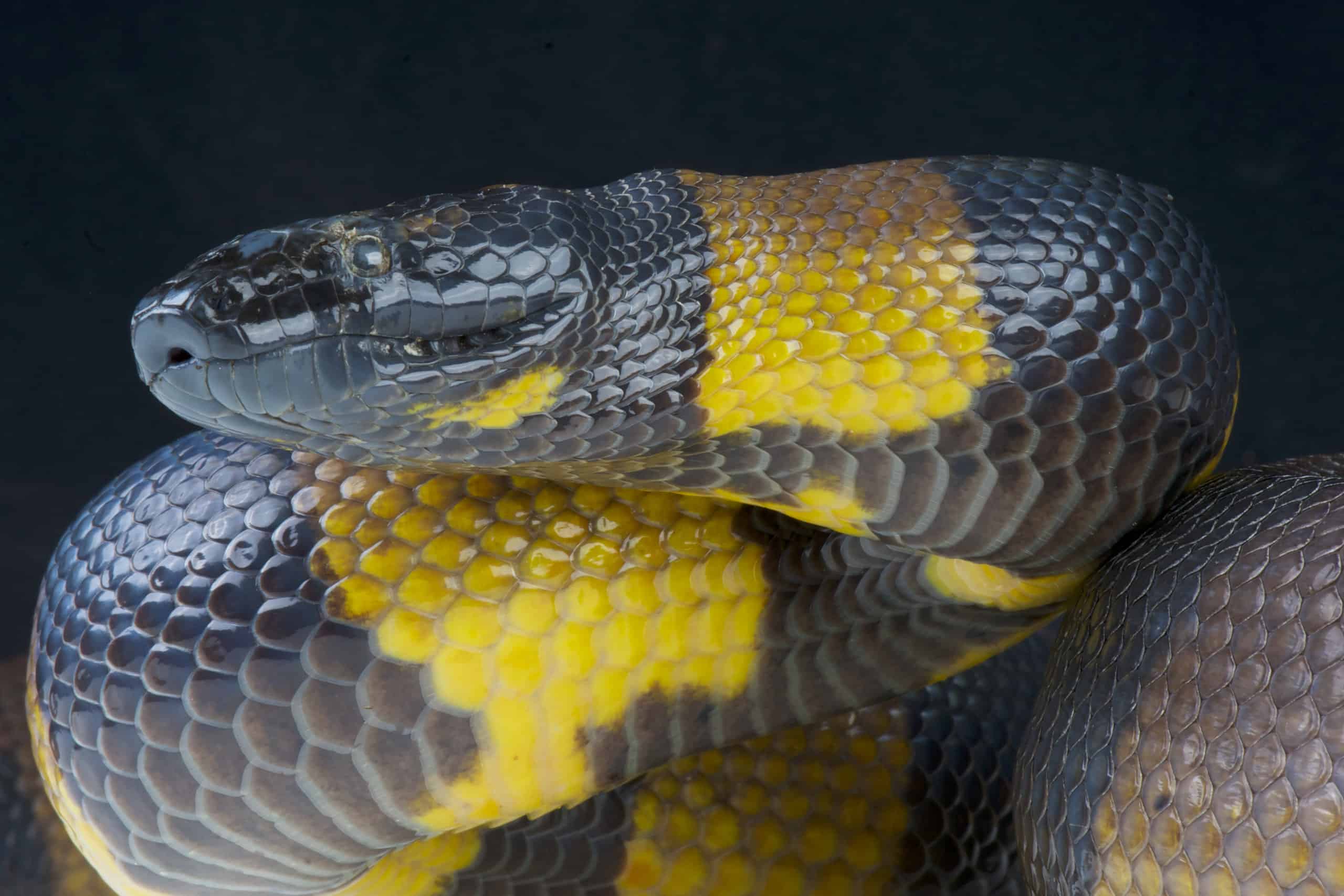
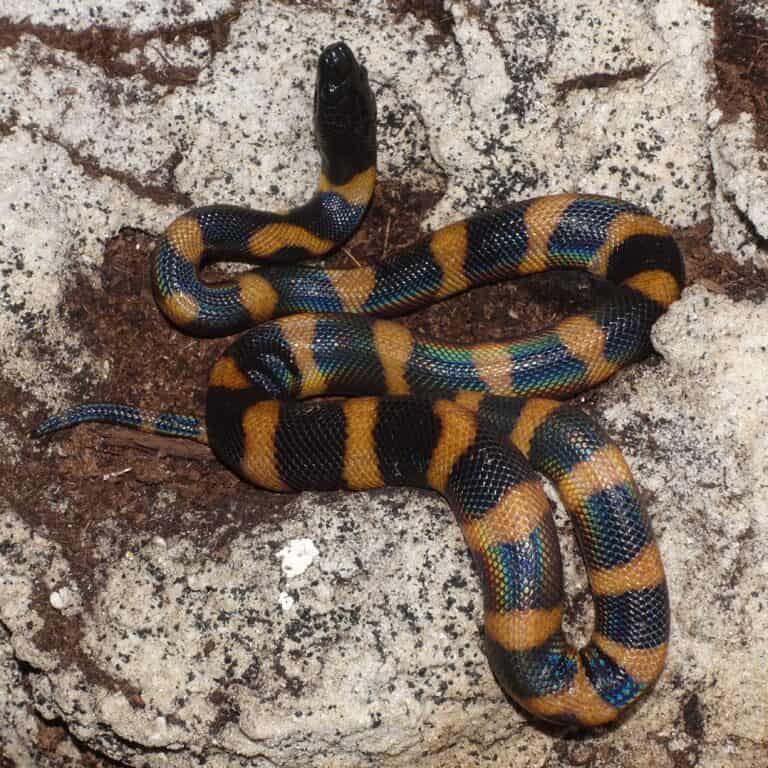
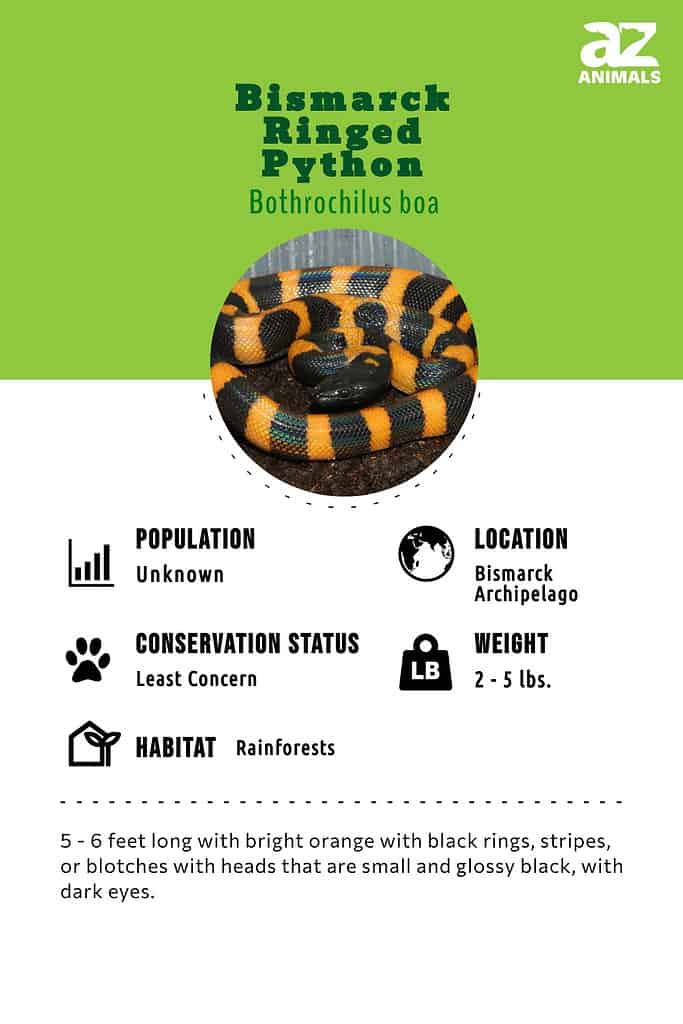
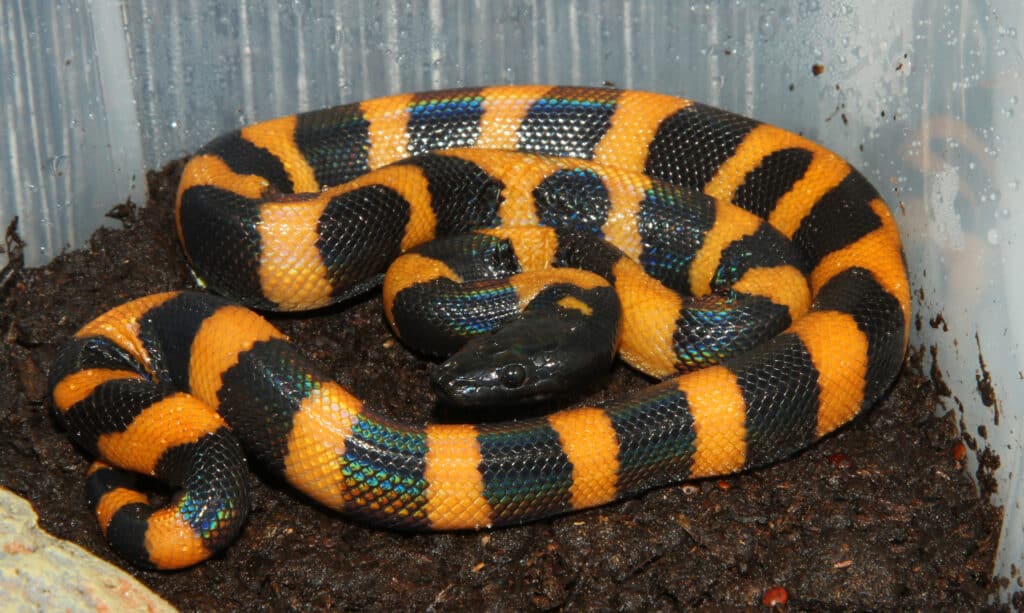
Bismarck ringed pythons are medium-sized snakes; adults grow to about 5-6 feet long. These beautiful snakes have a fantastic color pattern as juveniles that consists of bright orange with black rings, stripes, or blotches. Then, after about a year, they begin an ontogenic change, which is where the change occurs because of their age. When these pythons begin their change, their orange fades to brown. Usually, a light spot behind the eye remains; however, by the time they’re 12-24 months old, they have taken on their adult colors and are orange-brown and black with highly iridescent scales. There’s variation between adults in the depth of the orange-brown, and some are almost black. The black bands can also vary widely, from being very regular bands to being highly irregular and sometimes absent.

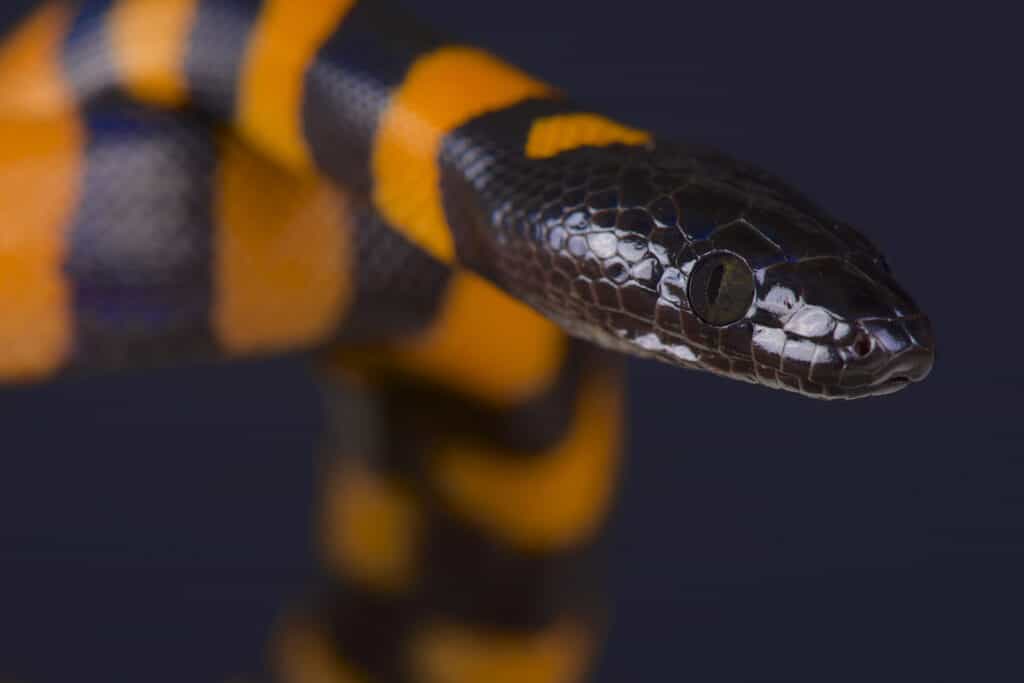
Their heads are small and glossy black, with dark eyes. Ringed pythons have four heat-sensitive pits on the back of their lower jaw but none on the upper. Like other pythons, they have dozens of sharp teeth, but they aren’t very aggressive. Unlike other pythons, this species has a narrow, pointed snout, which may help it burrow. Their bodies are somewhat thick for their length, but they’re not as stocky as other terrestrial pythons.
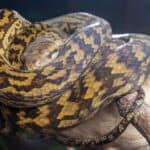
👁 Young Bismarck Ringed Python on black substrate

When Bismarck Ringed Pythons are about a year old, they begin an ontogenic change. At this time, their orange stripes fade to brown. Between the ages of 1 and 2 years old, they will have adopted their adult colors: orange-brown and black with highly iridescent scales.

©Michal Sloviak/Shutterstock.com

Behavior

These snakes’ semi-fossorial lifestyle makes any true population count difficult, and researchers know little about their lifestyle in the wild. Most of what we know about their behavior comes from people who keep them as pets.

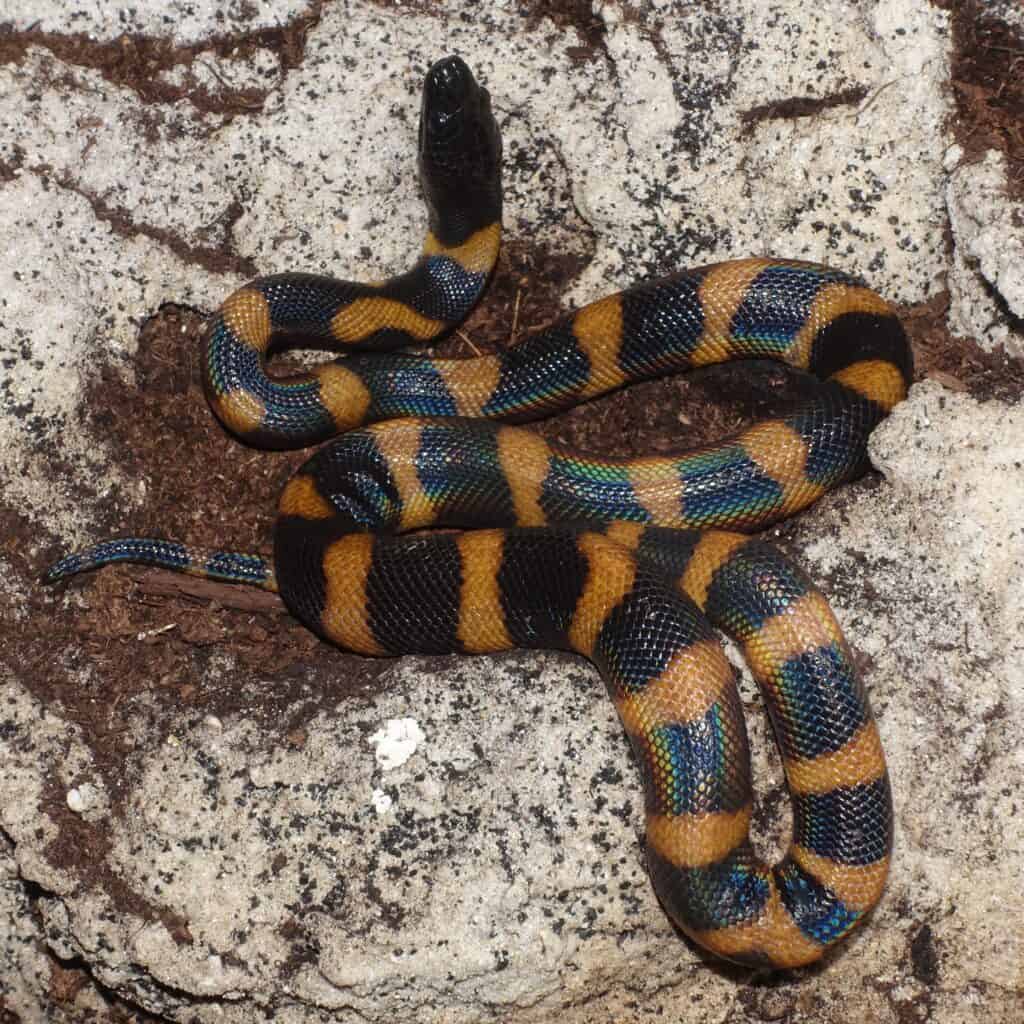
Bismarck ringed pythons are nocturnal and crepuscular, but they’re active snakes and will show themselves at any point during the day. They forage actively, so while they likely try to sneak up on their prey, they’re not going to wait for their food to come to them. Keepers say that their behavior is more like that of a colubrid; they’re not at all lethargic and slow-moving like other pythons.

This species isn’t aggressive, but handling them is more of an activity than a neck decoration. They don’t really stop moving and have high metabolisms that require more frequent feedings.
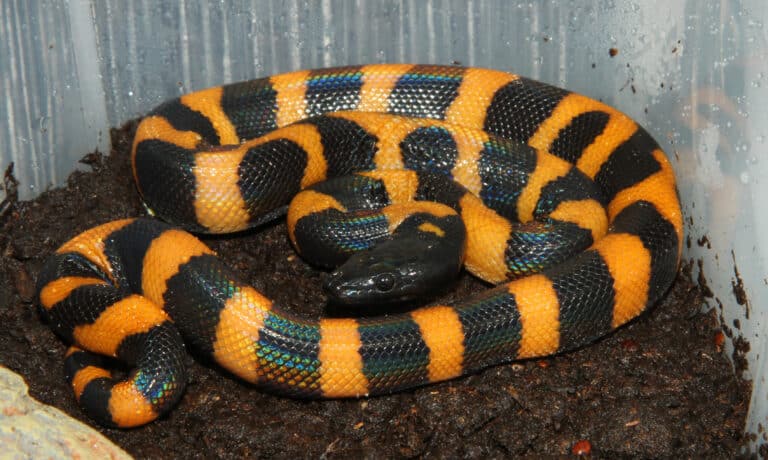
👁 Young Bismarck Ringed Python on a rock

Bismarck ringed pythons are nocturnal and crepuscular.

©Michal Sloviak/Shutterstock.com

History and Evolution

Just like other snake species of snakes, the python’s predecessors were also reptiles but with legs. These animals were more aquatic-based. Snakes either lost their legs or became vestigial, as they became more and more unused. It is interesting to imagine animals evolving to have legs and then evolving to lose them! As these snakes adapted to living as low to the ground as they can to avoid enemies and be closer to their prey.

Pythons were previously classified with boas, but modern research has shown that the pythons and boas are separate species due to convergent evolution in different parts of the world, much like monkeys evolved differently in Africa and South America while having shared ancestors. Some of the major differences are that boas give birth to live young, and pythons lay eggs. Pythons also have their heat-sensing pits on their labial scales, and boas have them in between their labial scales.

In particular, the Bismarck Ringed Python probably took advantage of its own great swimming prowess, much like other pythons, to swim out into ocean waters in search of food and suitable habitats. Finding a home in the Bismarck Archipelago must have provided an ecosystem that allowed this snake to thrive and evolve into its current unique form!

Habitat and Diet

Bismarck ringed pythons are endemic to the Bismarck Archipelago north of New Guinea. They are primarily found in the leaf litter and vegetation of the rainforest but can also be found in coconut plantations. People often find these snakes hiding in piles of coconut husks where they use their small heads to help burrow into the ground.

Their tendency to burrow finds them along river banks with exposed rock and sand, where they actively forage for small animals. These snakes are also known for entering houses and buildings while searching for food.

There’s some evidence that they may eat lizards and other snakes, but they are also likely to eat a variety of small mammals. Juvenile snakes eat small lizards and juvenile rodents. In captivity, they’re happy to take mice and rats and are considered easy to keep fed because they almost never turn down a meal.
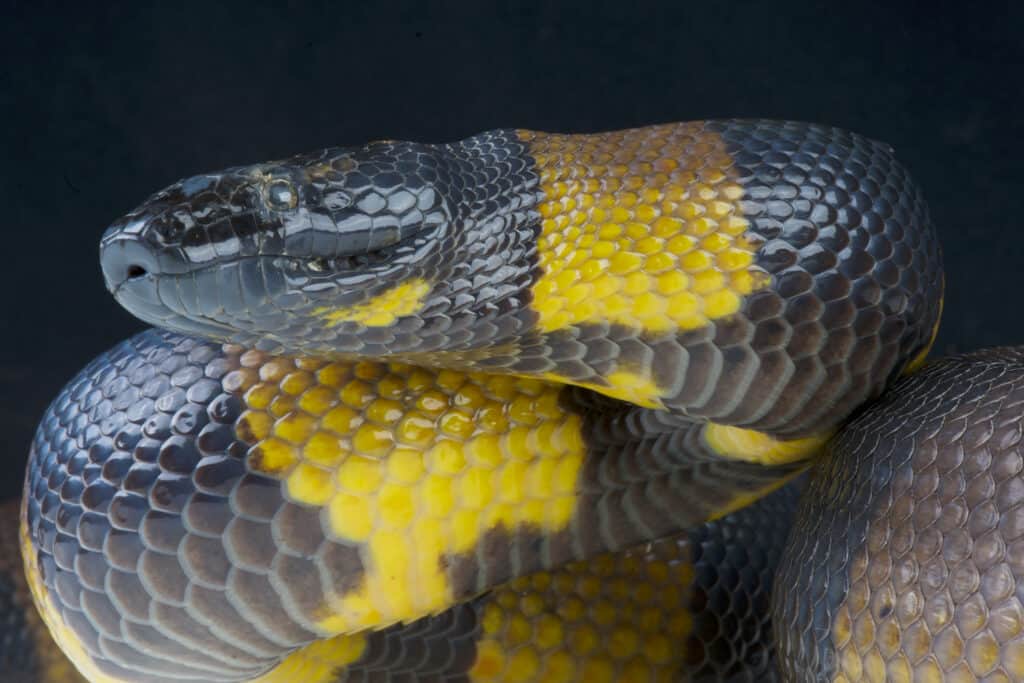
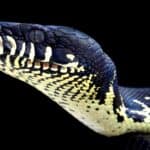
👁 Bismarck Ringed Python headshot on a black background

Bismarck ringed pythons are endemic to the Bismarck Archipelago north of New Guinea.

©reptiles4all/Shutterstock.com

Predators, Threats, Conservation, and Population

Ringed pythons are fairly common in the lowland areas of New Ireland. However, there weren’t any live animals observed in some of the other areas where it was historically present. It’s not clear whether this is due to the fact that those islands aren’t well-studied or that the snakes have been extirpated from the areas.

Many of this python’s current threats are related to the pet-trade collection and possibly habitat destruction. The indigenous people in New Guinea also hunt it for food. Because we don’t know much about its lifestyle in the wild, we also don’t have much information on its natural predators. However, it’s probable that birds of prey and larger carnivores prey on them, especially the younger snakes.

As of 2011, the IUCN considered the Bismarck Ringed python an animal of Least Concern. Its widespread distribution put it at a lower risk. However, it’s been collected pretty heavily for the pet trade, so that may be a negative influence on its population. The IUCN SSC Boa and Python Specialist Group recommend that it be monitored to ensure it doesn’t need to be listed in a threatened category.

It’s listed in CITES Appendix II, and it seems that there’s a pretty active illegal trade in the animal. The concern is that, due to their relative rarity in captivity, the illegal trade will deplete the wild populations. While we haven’t seen that happen yet, it’s certainly a possibility. So, if you’re looking for one of these, check your source carefully. There are a few breeders, so it’s not impossible to find one.

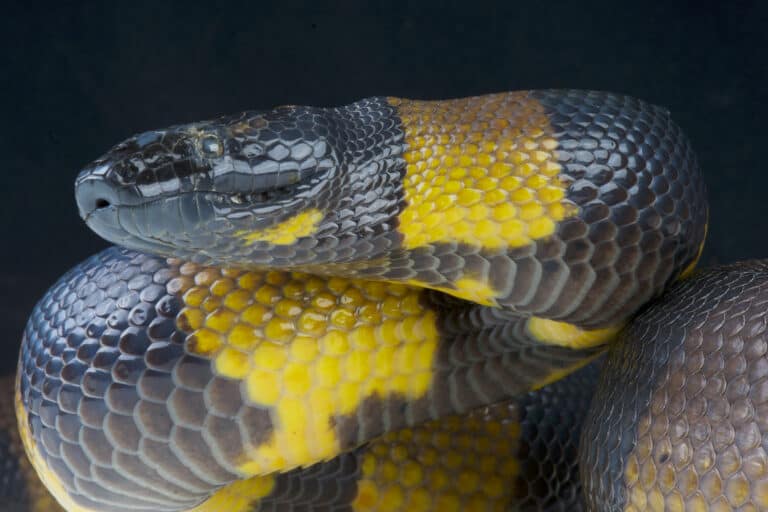
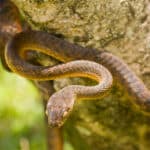
👁 Bismark ringed python -- closeup of head

Bismark ringed pythons is an animal of Least Concern.

©reptiles4all/Shutterstock.com

Reproduction, Babies, and Lifespan

Bismarck ringed pythons mature later than other python species and aren’t sexually mature until about 4-6 years of age. begin to show interest in breeding when the temperature drops in the fall. A couple of months later, the female lays up to a dozen eggs. Some females coil around their eggs to help protect their eggs, but others do not. After about 65 days, the babies hatch and are on their own, and can live over 20 years.

Similar Animals

View all 452 animals that start with B

Sources

  1. Tallowin, O. & Allison, A. 2013. Bothrochilus boa. The IUCN Red List of Threatened Species 2013: e.T196558A2459522. https://dx.doi.org/10.2305/IUCN.UK.2013-1.RLTS.T196558A2459522.en. / Published August 24, 2011 / Accessed August 5, 2022
  2. Bothrochilus boa | Reptarium Reptile Database / Accessed August 5, 2022
  3. Cold Blood Creations Collection / Accessed August 5, 2022
  4. CITES Appendix II / Accessed August 5, 2022
  5. ITIS Taxonomy browser / Accessed August 5, 2022

About the Author

Heather Ross

Heather Ross is a secondary English teacher and mother of 2 humans, 2 tuxedo cats, and a golden doodle. In between taking the kids to soccer practice and grading papers, she enjoys reading and writing about all the animals!

Thank you for reading! Have some feedback for us?

Contact the AZ Animals editorial team

Related Articles You May Find Interesting


Bismarck Ringed Python FAQs (Frequently Asked Questions)

These snakes are native to the Bismarck Archipelago, which is off the coast of New Guinea.

These are really active snakes, and are constantly on the move looking for prey. They’re active foragers and are often observed during the evening and night time, but can also be active during the day.

Primarily, these snakes eat small mammals, but there’s some evidence that they’ll also eat other snakes.

Not really, but they’re likely to bite or musk if you move too fast. They are more timid and need time.

They can, if you’re willing to put in the work. While they’re great feeders when you get them going, they take more time to become stable. They also need higher humidity than some species.