

B
Species Profile

Boas

Boidae

Quiet coils, powerful control
Natalia Kuzmina/Shutterstock.com

Boas Distribution

Click a location to explore more animals from that region

Invasive Species
Loading map...

Found in 48 countries

๐Ÿ‡ฆ๐Ÿ‡ฌ Antigua and Barbuda ๐Ÿ‡ฆ๐Ÿ‡ท Argentina ๐Ÿ‡ง๐Ÿ‡ด Bolivia ๐Ÿ‡ง๐Ÿ‡ท Brazil ๐Ÿ‡ง๐Ÿ‡ธ Bahamas ๐Ÿ‡ง๐Ÿ‡ฟ Belize ๐Ÿ‡จ๐Ÿ‡ฆ Canada ๐Ÿ‡จ๐Ÿ‡ฒ Cameroon ๐Ÿ‡จ๐Ÿ‡ด Colombia ๐Ÿ‡จ๐Ÿ‡ท Costa Rica ๐Ÿ‡จ๐Ÿ‡บ Cuba ๐Ÿ‡ฉ๐Ÿ‡ฒ Dominica ๐Ÿ‡ฉ๐Ÿ‡ด Dominican Republic ๐Ÿ‡ช๐Ÿ‡จ Ecuador ๐Ÿ‡ซ๐Ÿ‡ฏ Fiji ๐Ÿ‡ฌ๐Ÿ‡ฆ Gabon ๐Ÿ‡ฌ๐Ÿ‡ฉ Grenada ๐Ÿ‡ฌ๐Ÿ‡ซ French Guiana ๐Ÿ‡ฌ๐Ÿ‡ถ Equatorial Guinea ๐Ÿ‡ฌ๐Ÿ‡น Guatemala ๐Ÿ‡ฌ๐Ÿ‡พ Guyana ๐Ÿ‡ญ๐Ÿ‡ณ Honduras ๐Ÿ‡ญ๐Ÿ‡น Haiti ๐Ÿ‡ฎ๐Ÿ‡ฉ Indonesia ๐Ÿ‡ฏ๐Ÿ‡ฒ Jamaica ๐Ÿ‡ฐ๐Ÿ‡ณ Saint Kitts and Nevis ๐Ÿ‡ฐ๐Ÿ‡พ Cayman Islands ๐Ÿ‡ฑ๐Ÿ‡จ Saint Lucia ๐Ÿ‡ฒ๐Ÿ‡ฌ Madagascar ๐Ÿ‡ฒ๐Ÿ‡ฝ Mexico ๐Ÿ‡ณ๐Ÿ‡จ New Caledonia ๐Ÿ‡ณ๐Ÿ‡ฌ Nigeria ๐Ÿ‡ณ๐Ÿ‡ฎ Nicaragua ๐Ÿ‡ต๐Ÿ‡ฆ Panama ๐Ÿ‡ต๐Ÿ‡ช Peru ๐Ÿ‡ต๐Ÿ‡ฌ Papua New Guinea ๐Ÿ‡ต๐Ÿ‡ท Puerto Rico ๐Ÿ‡ต๐Ÿ‡พ Paraguay ๐Ÿ‡ธ๐Ÿ‡ง Solomon Islands ๐Ÿ‡ธ๐Ÿ‡ท Suriname ๐Ÿ‡ธ๐Ÿ‡ป El Salvador ๐Ÿ‡น๐Ÿ‡น Trinidad and Tobago ๐Ÿ‡บ๐Ÿ‡ธ United States ๐Ÿ‡ป๐Ÿ‡จ Saint Vincent and the Grenadines ๐Ÿ‡ป๐Ÿ‡ช Venezuela ๐Ÿ‡ป๐Ÿ‡ฌ Virgin Islands (British) ๐Ÿ‡ป๐Ÿ‡ฎ Virgin Islands (U.S.) ๐Ÿ‡ป๐Ÿ‡บ Vanuatu

At a Glance

Family Overview This page covers the Boas family as a group. Stats below are general traits shared across the family.
Also Known As Boa, Boa snake, Boid, Boid snake, Constrictor, Constrictor snake
Diet Carnivore
Activity Nocturnal+
Lifespan 18 years
Weight 200 lbs
Status Not Evaluated
Did You Know?

Boas subdue prey by constriction, cutting off blood flow rather than "crushing bones."

Scientific Classification

Family Overview "Boas" is not a single species but represents an entire family containing multiple species.

Boas (family Boidae) are nonvenomous constricting snakes, mostly from the Americas (with a few lineages elsewhere, depending on classification). They subdue prey by constriction and often have robust bodies and relatively slow metabolisms.

Kingdom
Animalia
Phylum
Chordata
Class
Reptilia
Order
Squamata
Family
Boidae

Distinguishing Features

  • Nonvenomous constrictors that kill prey primarily by constriction
  • Typically robust body and flexible jaws for swallowing large prey
  • Many give live birth (ovoviviparity/viviparity) rather than laying eggs (varies by lineage)
  • Heat-sensing pits may be present in some lineages (not universal across all snakes called 'boas')

Physical Measurements

Males and females differ in size

Length
โ™‚ 8 ft 2 in (1 ft 4 in โ€“ 18 ft 1 in)
โ™€ 8 ft 2 in (1 ft 4 in โ€“ 26 ft 3 in)
Weight
โ™‚ 11 lbs (0 lbs โ€“ 154 lbs)
โ™€ 13 lbs (0 lbs โ€“ 485 lbs)
Tail Length
โ™‚ 114 ft 10 in (16 ft 5 in โ€“ 262 ft 6 in)
โ™€ 1 ft 2 in (2 in โ€“ 2 ft 11 in)
Top Speed
3 mph
Generally slow, a few km/h

Appearance

Primary Colors
Secondary Colors
Skin Type Tough scaly skin with overlapping scales, often smooth or slightly ridged and shiny. They shed skin in large pieces; belly scales are bigger for grip, and skin can stretch for big meals.
Distinctive Features
  • Boidae vary a lot in size. Adults are usually about 0.5 to 6 meters long. Small dwarf or island boas weigh under 1 kg; big semi-aquatic anacondas can exceed 50โ€“100+ kg.
  • Boas (Boidae) often live about 10โ€“30 years, but some large species can reach 30โ€“40 years in captivity; life spans in the wild are usually shorter and vary more.
  • Body build: generally robust, muscular constrictors with relatively large heads and expandable jaws; tail length and thickness vary, with many arboreal species having more prehensile tails.
  • Cranial/face features: heat-sensing labial pits occur in some boids (not universal across the family); many have prominent facial scales and strong jaw musculature.
  • Boas are mostly ambush predators that kill by constriction. They hunt from the ground, trees, or water. They are often active at dawn, dusk, or night, though some are active in daytime.
  • Habitat diversity: includes arboreal forest boas (tree boas), terrestrial boas of forests/scrub, and semi-aquatic giants (anacondas) in wetlands and floodplains; microhabitat use can change with age (juveniles more arboreal in some lineages).
  • Many medium-to-large boas eat warm-blooded prey like birds and mammals; they also take reptiles and amphibians. Small species and young eat lizards, small birds, and rodents; prey varies by habitat and size.
  • Reproduction: predominantly live-bearing (viviparity/ovoviviparity) across Boidae; litter size varies widely with species size and ecology (larger species often producing larger litters).
  • Thermoregulation/metabolism: generally relatively low metabolism compared with many active-foraging snakes; behaviorally thermoregulate via basking/shade/water use (especially pronounced in semi-aquatic species).

Sexual Dimorphism

Sexual dimorphism is common but variable across Boidae. Many species show female-biased size dimorphism (females longer/heavier), while males may show proportionally longer tails and more developed cloacal spurs. Degree of dimorphism differs by lineage (e.g., arboreal vs terrestrial vs semi-aquatic) and can be subtle in some species.

โ™‚
  • Proportionally longer tail (relative to total length) due to hemipenes and associated musculature.
  • Often more prominent cloacal spurs (external vestiges of hindlimbs), used during courtship.
  • In some species/populations, males may be more slender or mature at smaller sizes than females.
โ™€
  • Often larger overall body size and mass, especially in many medium-to-large boids (including semi-aquatic forms).
  • Typically shorter tail proportion relative to total length than males.
  • Greater abdominal girth associated with gestation in live-bearing reproduction; litter size often correlates with female size.

Did You Know?

Boas subdue prey by constriction, cutting off blood flow rather than "crushing bones."

Across Boidae, adults range from ~0.4 m to ~6 m long; the heaviest can exceed 100 kg (large anacondas).

Unlike many other large snakes (e.g., most pythons), boas give birth to live young (viviparous).

Some boas have heat-sensing pits around the lips that help detect warm-blooded prey in low light.

Boas occupy strikingly different habitats: arboreal tree boas, terrestrial forest boas, and semi-aquatic anacondas.

Many boas can go long periods between meals thanks to low resting metabolism and efficient digestion.

The family is best known from the Americas, but also includes lineages in Madagascar and the southwest Pacific region.

Unique Adaptations

  • Constrictor physiology: rapid post-meal boosts in heart and digestive performance allow them to process large prey efficiently, then fast for long intervals.
  • Robust musculoskeletal design supports powerful coiling and prolonged holding without quick exhaustion.
  • Heat detection (in several lineages): labial pit organs enhance detection of warm targets and improve strike accuracy in darkness or cluttered habitats.
  • Live birth (viviparity) across Boidae reduces dependence on external egg incubation sites-useful in cooler or variable environments.
  • Arboreal specializations in some species include strong prehensile tails and body shapes suited for gripping branches.
  • Semi-aquatic specializations in anacondas include buoyancy-assisted hunting and an ability to remain concealed at the water surface with minimal exposure.

Interesting Behaviors

  • Ambush hunting is common: many boas wait motionless along animal trails, branches, or river edges, then strike and coil.
  • Habitat use varies widely: some species are strongly arboreal (resting and hunting in canopy/understory), others are ground-dwelling, and anacondas are often semi-aquatic.
  • Activity patterns often skew crepuscular/nocturnal in hot climates, but some populations are active by day in cooler conditions.
  • Prey choice is broad and size-scaled: rodents and other mammals are frequent, but many boas also take birds, lizards, and occasionally other snakes; the largest species can take large mammals.
  • Many boas use strong site fidelity (returning to favored refuges), while others wander more widely where prey and water shift seasonally.
  • Reproduction typically involves seasonal breeding; females carry embryos internally and give birth to live young, which are independent immediately.
  • Defensive behaviors range from remaining immobile and cryptic to hissing, striking, musking, and tightly balling/anchoring in vegetation or burrows.

Cultural Significance

Boas, especially anacondas and large forest boas, are cultural symbols of power, danger, fertility, rivers, and the wild. In Amazon stories they link to waterways and ancestors. Not venomous, they help control other animals but are often killed or taken for skins and pets.

Myths & Legends

Great Snake (Brazilian Amazon folklore): a colossal, often supernatural river snake said to live in deep waters and sometimes cause whirlpools, storms, or the sinking of canoes.

Mother of the Waters (Peruvian Amazon lore): a giant, anaconda-like serpent often described as ruling rivers and lagoons and said to be able to swallow boats.

Anaconda-canoe origin narratives (Black River region, Northwest Amazon): in several Indigenous traditions, an anaconda is linked with ancestral journeys and the peopling of river corridors, sometimes depicted as a great canoe-serpent carrying the first ancestors.

Madagascar taboo traditions: in parts of Madagascar, boas are treated with local taboos and respect; harming certain snakes can be considered spiritually dangerous, and snakes may be viewed as tied to place and ancestry.

The word "anaconda" in colonial-era storytelling: early European natural histories and travel accounts amplified tales of immense constrictors in the tropics, feeding a long tradition of 'giant snake' stories in literature and exploration narratives.

Conservation Status

NE Not Evaluated (family-level hub). IUCN assessments are primarily at the species level; across Boidae, statuses span from Least Concern (LC) to threatened categories (VU/EN/CR), with some Data Deficient (DD). Diversity note (ranges across the family): body length roughly ~0.5-0.8 m in the smallest dwarf/island boas up to ~5-6+ m in the largest species (with exceptional reports larger); mass ranges from a few hundred grams to tens of kilograms (exceptionally >50 kg in the largest individuals). Lifespan commonly ~10-30+ years in the wild and often 20-40+ years in captivity (occasionally longer). Ecology/behavior generalizations: nonvenomous constricting ambush predators; many are nocturnal/crepuscular; habitat use varies widely (arboreal, terrestrial, and semi-aquatic lineages), and reproductive mode is mostly live-bearing with variation among taxa. Notable at-risk pattern: small-range island endemics (e.g., several Caribbean boas) tend to have higher extinction risk than widespread mainland species.

Has not yet been evaluated against the criteria.

Population Unknown

Protected Under

  • CITES listings apply to many boas in trade (commonly Appendix II for numerous boid taxa; some taxa/populations may have stricter listings depending on current schedules and taxonomy).
  • National/state/provincial wildlife laws frequently protect native boas or regulate take and trade; strength and enforcement vary widely by country and island jurisdiction.
  • Protected areas (national parks/reserves) cover portions of the ranges of multiple species, but coverage may be incomplete for small-range endemics and lowland habitats targeted for development.

Looking for a specific species?

Boa constrictor (common boa)

Boa constrictor

In general usage, the word "boa" most often refers to the common boa/boa constrictor complex kept in captivity and widely encountered in the Neotropics; it strongly shapes the popular image of "boas" as heavy-bodied, nonvenomous constrictors.

  • Family-level identity: Boidae are nonvenomous snakes that subdue prey primarily by constriction; many are robust-bodied, though some are highly arboreal and slenderer.
  • Boidae show large size differences: some boas are about 0.5โ€“0.7 m long, while the largest exceed 5 m (sometimes more), weighing under 1 kg to tens of kg in anacondas.
  • Longevity diversity: many species can live well over a decade; captive lifespans commonly reach ~20-30+ years in several larger boas, while smaller species are often shorter-lived (variation is substantial by species and husbandry).
  • Ecology varies widely: terrestrial, arboreal, and semi-aquatic lifestyles occur within the family; many are ambush predators, with activity ranging from nocturnal to crepuscular depending on species and habitat.
  • Feeding generalization: most are generalist vertebrate predators whose typical prey shifts strongly with size/age (juveniles taking smaller prey such as lizards/frogs, adults focusing more on birds and mammals).
View Boa constrictor (common boa) Profile

You might be looking for:

Boa constrictor (Boa Constrictor)

22%

Boa constrictor

Large New World boa; well-known for constriction and variable coloration; common in the pet trade.

View Profile

Green Anaconda

20%

Eunectes murinus

One of the heaviest snakes; semi-aquatic boa from South America.

View Profile

Yellow Anaconda

12%

Eunectes notaeus

Semi-aquatic anaconda of southern South America; generally smaller than green anaconda.

View Profile

Emerald Tree Boa

12%

Corallus caninus

Arboreal boa with striking green coloration and white markings; Amazon Basin.

View Profile

Amazon Tree Boa

10%

Corallus hortulanus

Highly variable arboreal boa widespread in the Amazon region.

View Profile

Cuban Boa

8%

Chilabothrus angulifer

Large Caribbean boa endemic to Cuba; important predator in island ecosystems.

View Profile

Dumeril's Boa

8%

Acrantophis dumerili

Madagascar boa; stocky, terrestrial, often kept in captivity.

View Profile

Rosy Boa

8%

Lichanura trivirgata

Small, docile boa from the southwestern United States and Baja California.

View Profile

Life Cycle

Birth 20 newborns
Lifespan 18 years

Lifespan

In the Wild 8โ€“30 years
In Captivity 15โ€“40 years

Reproduction

Mating System Polygynandry
Social Structure Solitary
Breeding Pattern Seasonal
Fertilization Internal Fertilization
Birth Type Internal_fertilization

Boas (Boidae) are mostly solitary and show polygynandry: males and females may mate with multiple partners each season. Mating is by internal fertilization, sometimes with sperm storage. Temporary breeding aggregations and male competition occur; patterns vary by species.

Behavior & Ecology

Social Aggregation Group: 1
Activity Nocturnal, Crepuscular, Cathemeral, Diurnal
Diet Carnivore Small mammals (especially rodents), where available
Seasonal Hibernates 3 mi

Temperament

Generally secretive and avoidance-oriented; relies on camouflage, stillness, and retreat when undisturbed
Defensive responses when threatened vary widely across species/individuals and context: hissing, striking, coiling into a defensive posture, and musk release can occur
Predatory behavior is typically ambush-oriented with long inactivity periods; some species are more actively searching, especially in aquatic/edge habitats
Tolerance of conspecifics is usually situational (breeding season or shared refuges) rather than indicating stable social bonds; competition/spacing may occur around mates or prime shelter

Communication

Hissing A common defensive sound produced by forcing air through the glottis
Chemical communication via pheromones and scent trails detected through tongue-flicking and the vomeronasal system Key for mate-finding and reproductive readiness
Tactile communication during courtship/mating (body alignment, wrapping/positioning) and occasional male-male competitive contact in some taxa
Postural/visual signals at close range (body inflation, tight coiling, head orientation, slow movements) that function primarily in threat display rather than social coordination
Substrate vibration/body movement that may incidentally signal presence at close range; not typically used for coordinated group behavior

Habitat

Biomes:
Tropical Rainforest Tropical Dry Forest Savanna Desert Hot Mediterranean Temperate Forest Temperate Rainforest Boreal Forest (Taiga) Wetland Freshwater +4
Terrain:
Mountainous Hilly Plateau Plains Valley Coastal Island Riverine Volcanic Karst Rocky Sandy Muddy +7
Elevation: Up to 10498 ft 8 in

Ecological Role

Mid- to upper-level vertebrate predators (mesopredators; locally apex predators on small islands or in simplified communities) that link small-vertebrate prey populations to higher trophic levels

Regulation of small-mammal (especially rodent) populations, which can reduce crop/storage losses and disease-reservoir abundance in some human-modified landscapes Population control of birds, lizards, and amphibians in natural food webs, helping maintain community balance Energy transfer and nutrient cycling via predation (converting prey biomass into predator biomass and waste that feeds decomposers) Serving as prey for larger predators (raptors, carnivorous mammals, large reptiles) and supporting higher trophic levels Potential indirect effects on prey behavior and habitat use (trophic cascades), varying by ecosystem and boa density

Diet Details

Main Prey:
Small to medium mammals Birds Lizards and other reptiles Amphibians Other snakes

Human Interaction

Domestication Status

Wild

Boidae (boas) are wild, not domesticated, though many are captive-bred for the pet trade. Sizes range from about 0.3โ€“0.6 m to 5โ€“7 m; lifespans commonly 10โ€“30+ years in captivity. Most are nonvenomous constrictors, often nocturnal; they live in trees, on land, or in water and often give live young. Humans keep, breed, hunt, kill, cause habitat loss, and sometimes deal with escaped or invasive boas.

Danger Level

Moderate
  • Bites (usually defensive; can cause lacerations/infection risk)
  • Constricting injury risk increases sharply with large individuals; improper handling can lead to serious harm or (rarely) fatal outcomes
  • Zoonotic pathogens common to reptiles (e.g., Salmonella) and parasite exposure if hygiene/quarantine are poor
  • Allergic reactions/asthma triggers from dander/mites in some settings
  • Escapes leading to public concern, nuisance calls, and (in suitable climates) potential invasive impacts
  • Conflict/persecution in native ranges due to fear or occasional predation on poultry/small livestock/pets

As a Pet

Suitable as Pet

Legality: Rules depend on country, state, species, and adult size. Many small-to-medium boas are legal with standard exotic-pet rules; very large boas may be restricted, need permits or inspections, or be banned. Some places limit ownership for invasive or safety risks.

Care Level: Experienced

Purchase Cost: $50 - $5,000
Lifetime Cost: $2,000 - $30,000

Economic Value

Uses:
Pet trade (captive breeding, retail, supplies) Leather/skins (localized/variable) Ecotourism/wildlife viewing Education and research (zoos, outreach, herpetology) Ecosystem services (rodent control where native)
Products:
  • live animals (pet market; captive-bred and wild-caught in some regions)
  • husbandry equipment (enclosures, heating, thermostats, feeders)
  • skins/leather goods (where harvest occurs and is legal)
  • zoo/education programming and exhibits

Relationships

Predators 9

Harpy eagle Harpia harpyja
Crowned eagle Stephanoaetus coronatus
Jaguar Panthera onca
Puma Puma concolor
Ocelot Leopardus pardalis
Caiman Caiman
American alligator Alligator mississippiensis
Predatory snakes Serpentes
Human Homo sapiens

Related Species 10

Common boa Boa constrictor Shared Family
Green anaconda Eunectes murinus Shared Family
Yellow anaconda Eunectes notaeus Shared Family
Emerald tree boa Corallus caninus Shared Family
Amazon tree boa Corallus hortulanus Shared Family
Cuban boa Chilabothrus angulifer Shared Family
Rosy boa Lichanura trivirgata Shared Family
Rubber boa Charina bottae Shared Family
Dumeril's boa Acrantophis dumerili Shared Family
Madagascar tree boa Sanzinia madagascariensis Shared Family

Ecological Equivalents 4

Animals that fill a similar ecological role in their ecosystem

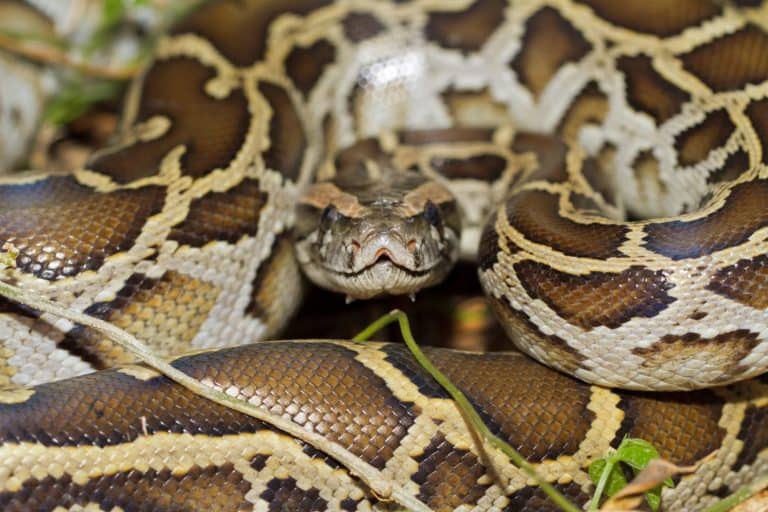
Pythons Pythonidae Large-bodied, primarily ambush-oriented constrictors that take similar prey (mammals, birds, reptiles) and often occupy comparable forest, savanna, and riparian habitats. They differ by geography (many pythons are Old World) and by some skull and heat-sensing traits.
Kingsnakes Lampropeltis spp. Overlap in the terrestrial predatory niche, preying on rodents, birds, and other reptiles (including snakes). Most are slimmer and faster and do not rely on heavy-bodied constriction to the same degree as many boas.
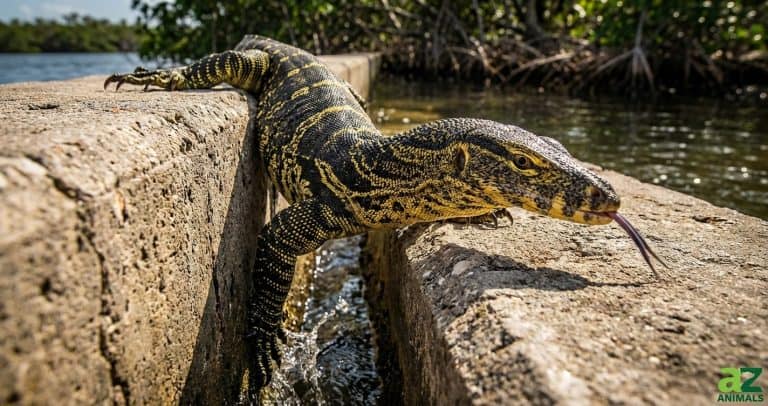
Monitor lizard Varanus spp. In many warm ecosystems, they function as similarly sized generalist predators of vertebrates. Ecological overlap occurs where monitors and boas co-occur (especially around nests, burrows, and riparian edges), though monitors are active foragers rather than classic sit-and-wait constrictors.
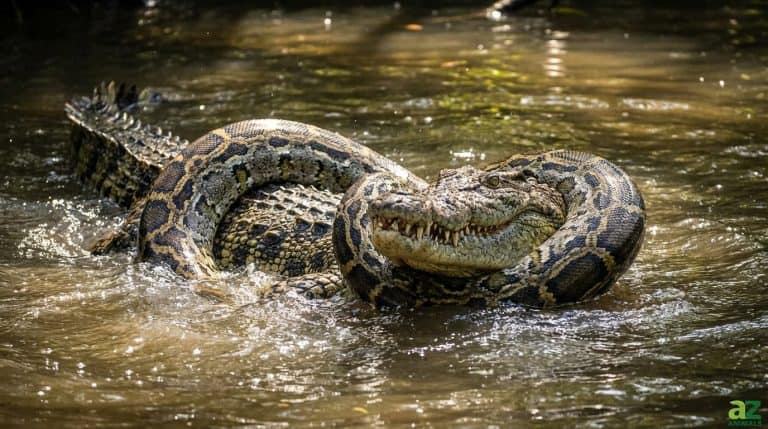
Crocodilians Crocodylia Where sympatric, they share a riparian/aquatic-edge predatory niche with semi-aquatic boas, notably anacondas, by targeting mammals and birds near water. Crocodilians are active aquatic ambush predators and can also be major predators of boas.

Types of Boas

39

Explore 39 recognized types of boas

Common boa Boa constrictor
Boa imperator Boa imperator
Clouded boa Boa nebulosa
Mexican boa Boa sigma
Green anaconda Eunectes murinus
Yellow anaconda Eunectes notaeus
Dark-spotted anaconda Eunectes deschauenseei
Bolivian anaconda Eunectes beniensis
Emerald tree boa Corallus caninus
Amazon tree boa Corallus hortulanus
Annulated tree boa Corallus annulatus
Blomberg's tree boa Corallus blombergii
Ruschenberger's tree boa Corallus ruschenbergerii
Grenada bank tree boa Corallus grenadensis
Cuban boa Chilabothrus angulifer
Puerto Rican boa Chilabothrus inornatus
Jamaican boa Chilabothrus subflavus
Hispaniolan boa Chilabothrus striatus
Cayman Islands boa Chilabothrus chrysogaster
Mona boa Chilabothrus monensis
Virgin Islands boa Chilabothrus granti
Silver boa Chilabothrus argentum
Rainbow boa Epicrates cenchria
Brown rainbow boa Epicrates maurus
Argentine boa Epicrates alvarezi
Caatinga rainbow boa Epicrates assisi
Paraguay rainbow boa Epicrates crassus
Rosy boa Lichanura trivirgata
Rubber boa Charina bottae
Southern rubber boa Charina umbratica
Dumeril's boa Acrantophis dumerili
Madagascar ground boa Acrantophis madagascariensis
Madagascar tree boa Sanzinia madagascariensis
Volontany boa Sanzinia volontany
Pacific ground boa Candoia aspera
Solomons (Bibron's) boa Candoia bibroni
Pacific boa Candoia carinata
Paulson's boa Candoia paulsoni
Palau ground boa Candoia superciliosa

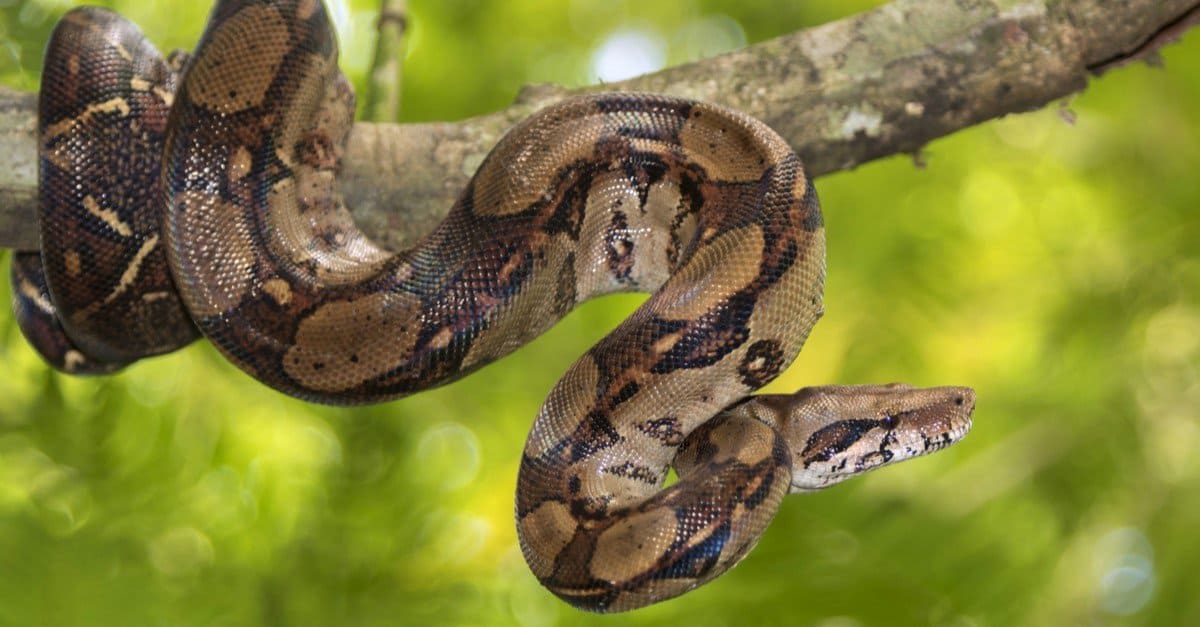
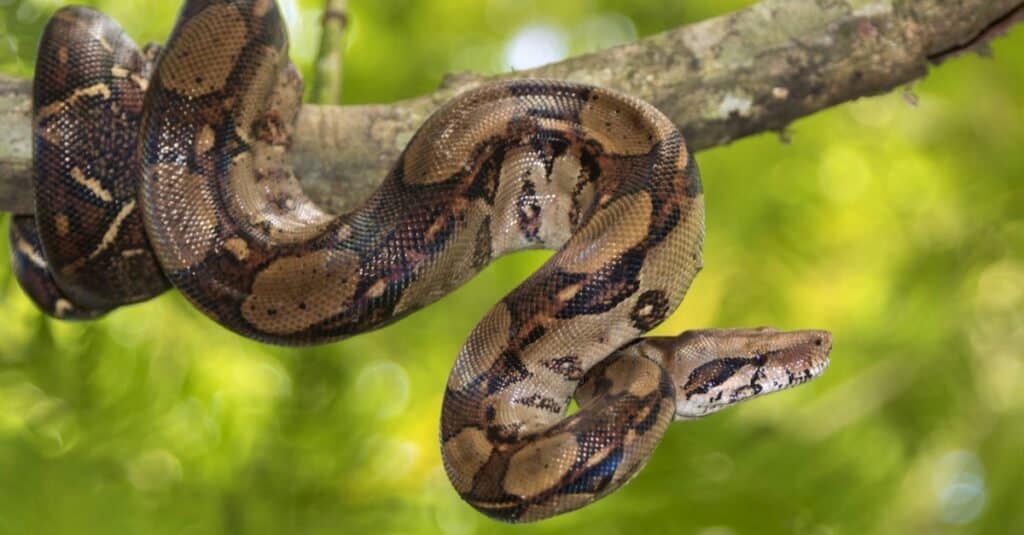
Boa constrictors are large, heavy-bodied snakes that squeeze their prey to death before swallowing it whole.

Itโ€™s true! There are about 49 species of boa spread across 12 genera. Most boas look like โ€œboas,โ€ with the classic boa-shaped head and thick, muscular body. However, some are much smaller and thinner.

Incredible Boa Facts

  • Unlike pythons, boas are ovoviviparous, meaning that they donโ€™t lay their eggs. Instead, the eggs develop inside the mother until the babies are born.
  • Some boas have heat-sensing pits between scales instead of on top of them.
  • Theyโ€™re considered primitive snakes, and boas have spurs that scientists believe are the leftover of the limbs theyโ€™ve evolved away from.
  • They are non-venomous constrictors that squeeze their prey to death.

Boa Scientific Name

Thereโ€™s only one species properly referred to as a boa constrictor, itโ€™s commonly known as the red-tailed boa. It lives in South America, but many people keep them as pets. Everything else is a cousin, but part of the same family.

All boas are part of the Boidae family. So, a snake in the Boidae family would be considered a boid. The word boa stems from the Latin word boa, meaning โ€œlarge snake.โ€ Sometime around the 1600s, it began being applied to nonvenomous constrictor-type snakes from South America.

Within the Boidae family, some scientists recognize five subfamilies โ€“

  • Boinae
  • Candoiinae
  • Calabriinae
  • Erycinae
  • Sanziniinae

Each subfamily has its own species, but most are in the Boinae subfamily. This is where scientists classify all the true boas. They range in size from the slender St. Vincent tree boa to the gargantuan anaconda.

Boa Appearance and Description

In general, boas are thick, muscular snakes with strong jaws and razor-sharp teeth that help hold their prey while they constrict it. Boas often have triangular-shaped heads and some have heat-sensing pits lining their top lip. Many species are nocturnal and have elliptical pupils with bright eyes.

The smallest boas are slender and short; some species only reach 2 feet long. They include some tree boas and sand boas. The biggest include the anaconda and red-tailed boa.

Most have smooth, glossy scales that, in some, are iridescent, shining with various shades of blue, green, and purple. These snakes come in a bewildering array of sizes, beautiful colors, and patterns that make some species popular as pets. However, not all do well with a lot of handling, so people consider them โ€œdisplayโ€ snakes. Theyโ€™re beautiful to observe, but handling them frequently isnโ€™t healthy for the snake.

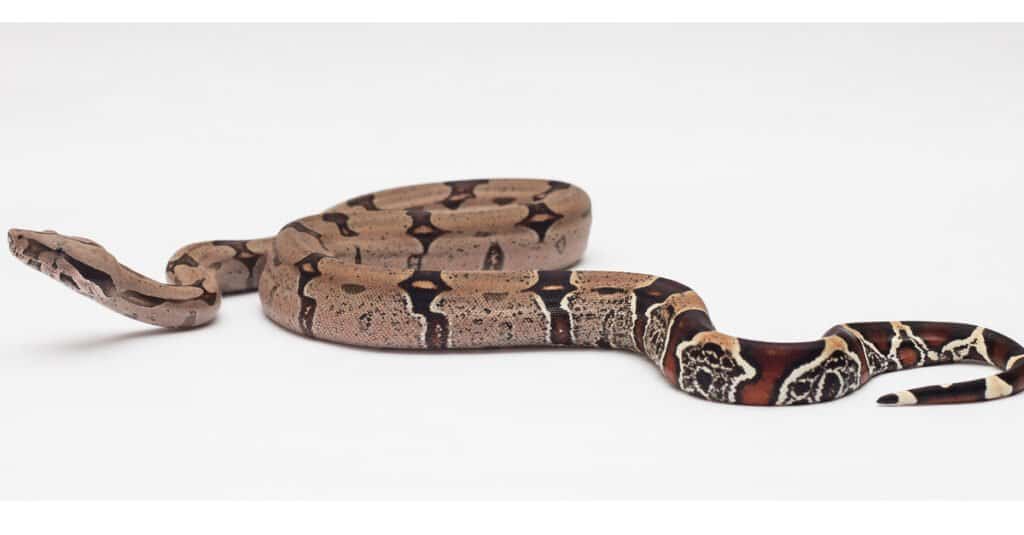
๐Ÿ‘ red tail boa on a white floor

Red tail boas are named for the color of their red tail.

ยฉBaraian Gheorghe Cristian/Shutterstock.com

Boa Behavior

Boas are a diverse group of snakes. They inhabit various types of habitats around the world, from arid deserts to humid rainforests. The habitat where they live determines at least some, if not much, of their behavior.

Some things are true for most boas:

  • These snakes are mostly solitary and only come together during mating season.
  • They constrict their prey by wrapping their coils around it and squeezing tightly to subdue it before swallowing. Scientists discovered that boas donโ€™t always cause asphyxiation; instead, the squeezing pressure causes heart and respiratory failure.

Many boas that live in forested habitats spend a lot of time in the trees, resting, basking, or hunting. Even the giant anaconda spends some time in the trees as a juvenile. As an adult, its size and weight make an aquatic lifestyle much more attractive. One exception to this is Dumerilโ€™s boa in Madagascar. It is almost exclusively terrestrial, living in and amongst human habitats in addition to its native dry forest.

Ground-dwelling boas sometimes climb (and indeed, most species are excellent climbers) but often live where there arenโ€™t as many trees. Sand boas and rosy boas are fossorial and spend all their time on or under the ground.

Tree boas, as their name implies, spend either all or a majority of their time in the trees. Some live high up in the tops of the trees, and others live closer to the ground or even spend most of their lives in the water.

Most of them are ambush predators, spending their time waiting for prey animals to cross their paths. Others, however, actively seek out their prey. These species are found cruising through trees and on the ground looking for their next meal. Some tree boas have prehensile tails that they use to hang from branches and try to catch bats and birds as they fly by.
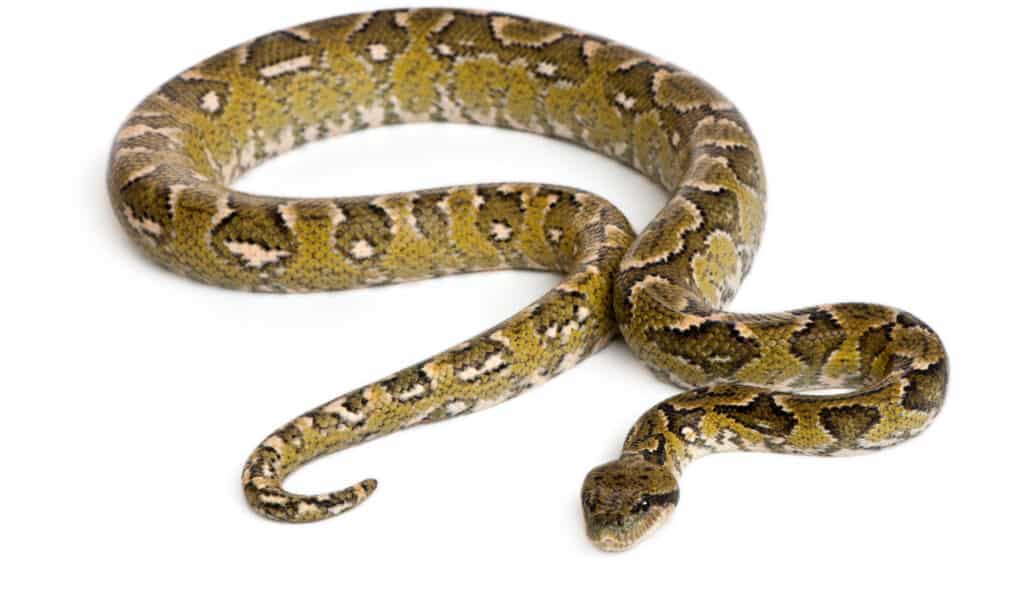
๐Ÿ‘ madagascar tree boa

Madagascar tree boas become green as adults, but start out life bright red!

ยฉEric Isselee/Shutterstock.com

Boa Diet

Boas are true carnivores and eat only other animals. Each species has different preferences, however, they have a lot in common:

  • Their prey animals are generally smaller than the individual snakesโ€™ thickest body point.
  • Many of them prefer warm-blooded prey such as birds, mice, rats, bats, rabbits, etc. Many of the juveniles prefer lizards and other small reptiles until they grow large enough to take warm-blooded prey.
  • The bigger the snake, the bigger the prey it prefers. So, anacondas will take animals as large as peccaries and capybaras. The relatively small rosy boa can only handle small mammals like kangaroo rats.

Boa Reproduction and Life Cycle

Many species live in rainforests, which donโ€™t necessarily have a โ€œwinter.โ€ What they do have is a dry and wet season. During the wet season, which in many areas is monsoon season, boas that inhabit the area search for mates. Those species living in arid or semi-arid habitats mate during spring.

Many females only mate every other year, because carrying babies takes a lot of energy and they need to recover in between mating cycles. Males, however, can mate every year.

Males often compete for mating privileges with a local female. When two males encounter each other they wrestle, with the stronger one winning. In anacondas, however, males often form a mating ball around a female, all trying to get close enough to mate with her.

Boas donโ€™t lay eggs; they give birth. The mother carries the eggs for 4-7 months (depending upon the species), during which some species change colors, becoming darker. This color change allows her to collect more heat, giving the babies (called neonates) a better chance of growing as big as they can before theyโ€™re born.

After theyโ€™re born, the babies and mother go their separate ways. Boas arenโ€™t the most maternal, and the babies are on their own from birth.
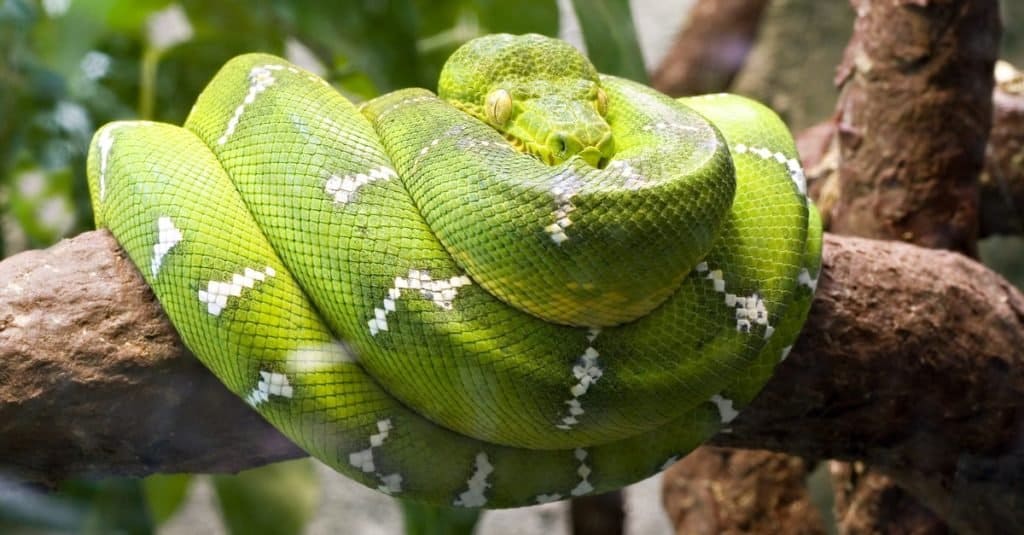
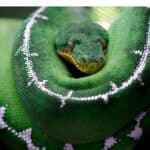
๐Ÿ‘ Amazing Rainforest Animal: Emerald Boa Constrictor

The Emerald tree boa is also known as the green tree boa. They catch most of their prey while they hang from a branch to snatch them off the ground.

ยฉHannamariah/Shutterstock.com

Boa Predators and Threats

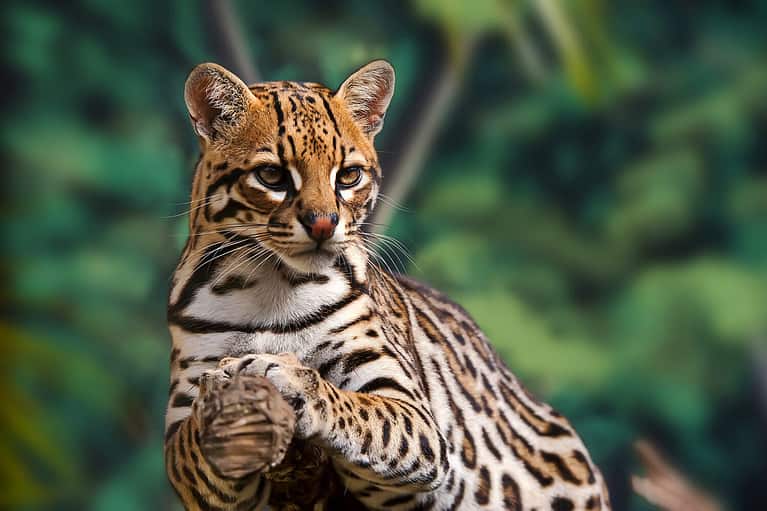
All animals have a natural predator or three at some point in their life cycle. These snakes are no different. Juvenile snakes are preyed upon by larger predators like lynx, bobcats, coyotes, hawks, eagles, jaguars, and ocelots. As they grow, the list of predators shrinks a little, and the largest species have few natural predators.

The biggest threat to most of them is habitat destruction, people killing them out of fear, and poaching for either the pet trade or for their skin.

Some boa species have been poached heavily for the pet trade, resulting in a noticeably smaller wild population. This is true for Boa constrictor and a few others. However, most species have a healthy population even with habitat, hunting, and poaching challenges.

Types of Boa

The boa familyโ€™s variety is astounding and includes over 49 species distributed across 12 genera, so we only list a few here.

Boa

Currently, the Boa genus has five recognized species, with at least eight subspecies. However, youโ€™ll see disagreement on that. Some argue that there isnโ€™t enough difference between Boa Constrictor and Boa Imperator to give full species status to both. Still, others say that some of the subspecies deserve full species status. Thereโ€™s no true consensus on the topic because many factors go into determining whether a snake is unique enough to be considered a species in its own right.

  • Red-Tailed Boa (Boa constrictor)
  • Central American Boa (Boa imperator)
  • Dominican Boa (Boa nebulosa)
  • St. Lucia Boa (Boa orophius)
  • Mexican west coast boa (Boa sigma)

Acrantophis

This genus is endemic to Madagascar, and Acrantophis is Greek for โ€œlazy snake.โ€ These snakes are medium-sized and reach about six feet long.

Corallus

These snakes are native to Central America, South America, and the West Indies. Theyโ€™re all arboreal and have big teeth to snatch prey from the air.

Chilabothrus

This group is endemic to the West Indies, there are about 14 species recognized at this time.

Epicrates

In South America, youโ€™ll find boas with iridescent scales that shine with purple, blue, and green in bright sunlight. These are the rainbow boas. There are five species in the genus, but the most well-known is Epicrates cenchria, and many people keep it as a pet.

Eryx

Even though almost all boa species are in the Americas, there are a couple in other areas, including Africa.

  • Dwarf Boa (E. miliaris)
  • Kenyan Sand Boa (Gongylophis colubrinus or Eryx colubrinus)

Eunectes

Youโ€™ll know these snakes by their common name, anaconda. There are four species, and all live in South America.

  • Yellow anaconda (E. noteaus)
  • Green anaconda (E. murinus)
  • Bolivian anaconda (E. beniensis)
  • Many-spotted anaconda (E. deschauenseei)

Lichanura

North America has a couple of boa species. Theyโ€™re small, fossorial snakes that rarely exceed three feet long.

Sanzinia

Madagascar boasts wildlife as unique as the Galapagos Islands. These boas were once considered subspecies, but new information says that they deserve their own species name.

View all 452 animals that start with B

Sources

  1. Sea World / Accessed May 10, 2022
  2. Smithsonian National Zoo / Accessed May 10, 2022
  3. Reptile Database / Accessed May 10, 2022
  4. Science Direct / Accessed May 10, 2022

About the Author

Gail Baker Nelson

Gail Baker Nelson is a writer at A-Z Animals where she focuses on reptiles and dogs. Gail has been writing for over a decade and uses her experience training her dogs and keeping toads, lizards, and snakes in her work. A resident of Texas, Gail loves working with her three dogs and caring for her cat, and pet ball python.
Connect:

Thank you for reading! Have some feedback for us?

Contact the AZ Animals editorial team

Related Articles You May Find Interesting


Boas FAQs (Frequently Asked Questions)

They can be dangerous, but most of that is because of their size. Some boids are huge, like anacondas, and can kill you. Others are small and harmless, like rosy boas.

Most species are in central and South America. There are a couple in the U.S., and elsewhere.

All boids are carnivores and eat various smaller animals. Different species have their preferences, however, the most common prey items are rats, bats, birds, lizards, eggs, and for aquatic species, fish.

Most of them are ambush predators and wait for their prey to come to them. However, some take a more active role in hunting down their food.

The Madagascar tree boa, emerald tree boa, Pacific tree boa, Cookโ€™s tree boa and Blombergโ€™s tree boa are some examples of tree boas youโ€™ve probably never seen!