


C
Species Profile

Chicken

Gallus gallus domesticus

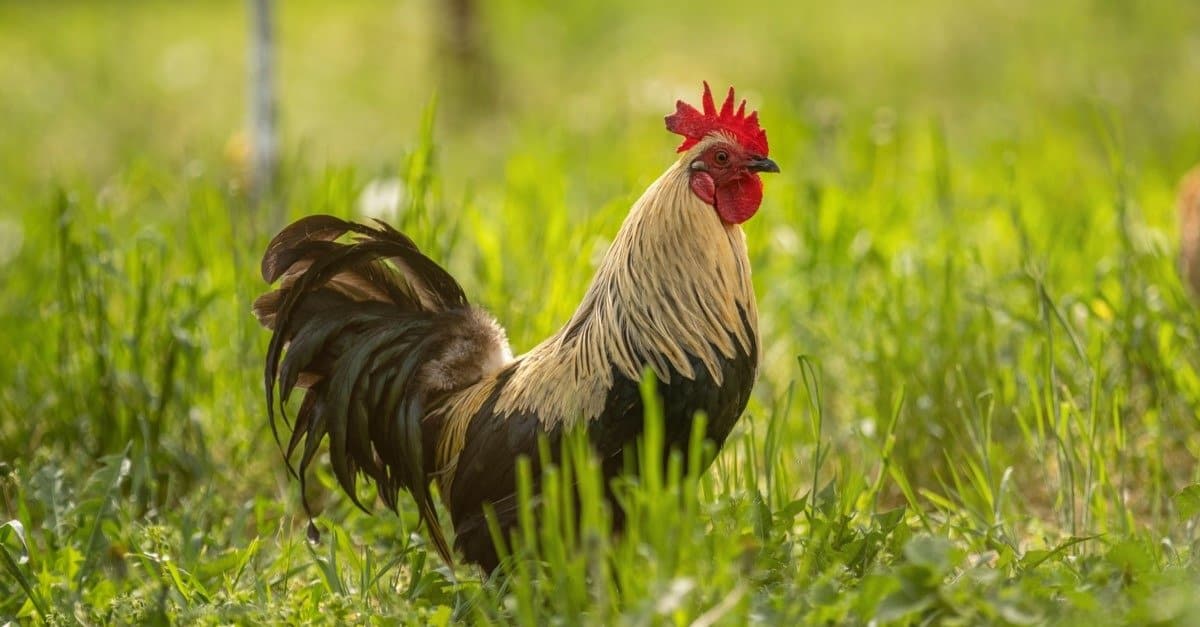
Scratch, roost, repeat.
Pavle Pejic/Shutterstock.com

Chicken Distribution

Click a location to explore more animals from that region

Origin Location

This map shows the native origin of the Chicken. As a domesticated species, they are now found worldwide.

Loading map...

Size Comparison

Human 5'8"
Chicken 1 ft 3 in

Chicken stands at 22% of average human height.

At a Glance

Domesticated
Also Known As chicken, chook, hen, rooster, cock, cockerel, pullet, yardbird
Diet Omnivore
Activity Diurnal+
Lifespan 4 years
Weight 6 lbs
Status Not Evaluated
Did You Know?

Domestic chickens are a subspecies of the red junglefowl (Gallus gallus) and retain junglefowl-style flocking, roosting, and scratch-feeding.

Scientific Classification

The domestic chicken is a domesticated galliform bird widely kept worldwide for meat, eggs, and as a companion/ornamental animal. It derives primarily from the red junglefowl and shows extensive variation among breeds.

Kingdom
Animalia
Phylum
Chordata
Class
Aves
Order
Galliformes
Family
Phasianidae
Genus
Gallus
Species
Gallus gallus

Distinguishing Features

  • Stout-bodied galliform with strong legs and scratch-feeding behavior
  • Sexual dimorphism common: males often with larger comb/wattles, longer sickle tail feathers, and spur development
  • Highly variable plumage coloration and body size due to selective breeding
  • Typically short-distance flight; prefers running and perching/roosting

Physical Measurements

Males and females differ in size

Height
2 ft 2 in (1 ft 10 in – 2 ft 6 in)
1 ft 3 in (12 in – 1 ft 6 in)
Length
2 ft 2 in (1 ft 12 in – 2 ft 6 in)
1 ft 5 in (1 ft 2 in – 1 ft 8 in)
Weight
7 lbs (6 lbs – 9 lbs)
4 lbs (1 lbs – 10 lbs)
Tail Length
11 in (8 in – 1 ft 2 in)
5 in (4 in – 7 in)
Top Speed
9 mph
About 14.5 km/h short burst

Appearance

Skin Type Body covered with keratin feathers; combs and wattles bare and rich in blood vessels; beak keratin; legs and toes scaly with keratin skin. Color varies by breed—often yellow or white/pink, sometimes slate/gray.
Distinctive Features
  • Domestic chicken (Gallus gallus domesticus) comes from the red junglefowl (Gallus gallus). Many breeds look different because people bred them for eggs, meat, or show.
  • Global, human-associated distribution: commonly kept worldwide in agricultural, village/backyard, and companion/ornamental contexts; typically lives in human-managed flocks with access to housing/roosts.
  • Body size of G. g. domesticus varies by breed and sex: bantams about 0.5–1 kg, large and meat breeds often about 3–5 kg or more; no single mass or length fits all.
  • Very social birds that live in flocks and make a pecking order; they keep friendly distance but also peck to fight, scratch and peck for food, dustbathe, preen, and flap wings.
  • Roosting: strong motivation to perch/roost, especially at dusk; preference for elevated roost sites is widely reported in domestic chickens under free-range/backyard conditions.
  • Different chicken lines are bred for eggs, meat, or looks: layers for high yearly egg output; broilers for fast growth and big breasts; ornamentals for colorful plumage, combs, crests, feathered legs, or bantam size.
  • Morphological diversity includes multiple comb forms (single, rose, pea, walnut, etc.), presence/absence of crests and beards/muffs, feathered vs clean legs, and tail carriage variation; these are hallmark domestication/breed traits beyond the ancestral wild phenotype.

Sexual Dimorphism

Sexual dimorphism is typically pronounced in adult domestic chickens, though magnitude varies by breed/line (and is reduced in some autosexing or heavily selected commercial strains). In general, males are larger with more developed ornamental traits and weaponry (spurs), reflecting both ancestral junglefowl biology and selective breeding.

  • On average larger body size and more robust build than females (degree depends on breed/line).
  • Larger, more prominent comb and wattles; comb/wattle size often correlates with sexual maturity and is a common secondary sexual trait.
  • More prominent leg spurs (used in male-male competition); spur size increases with age.
  • More elaborate plumage in many varieties: pointed hackle and saddle feathers, and long curved 'sickle' tail feathers (often black with green sheen in ancestral-type coloration).
  • More frequent crowing and territorial/display behaviors (strutting, wing-dropping, tidbitting in some contexts), consistent with well-documented chicken social and sexual behavior.
  • Typically smaller comb and wattles; reduced or absent spurs (or small spurs in some individuals/breeds).
  • Shorter tail without pronounced sickle feathers; plumage often more cryptic/subdued in ancestral-type and many traditional patterns, though breed selection can override this.
  • Primary reproductive role: oviposition (egg-laying); broodiness and maternal behaviors are strongly breed-dependent (often reduced in high-production layer lines, maintained/enhanced in some heritage and ornamental breeds).

Did You Know?

Domestic chickens are a subspecies of the red junglefowl (Gallus gallus) and retain junglefowl-style flocking, roosting, and scratch-feeding.

Incubation is ~21 days (about 504 hours) from setting to hatch under typical conditions.

A hen's vocal repertoire includes many distinct call types used for food, alarm, and social coordination (reviewed in Marino, 2017).

Chickens can learn socially (e.g., chicks can learn what to peck by watching others) and show strong mother-chick communication before and after hatching.

Commercial egg strains commonly exceed 300 eggs/hen/year, while meat strains (broilers) are selected for extremely rapid growth (industry breeding benchmarks vary by line).

Galliform relatives (turkeys, pheasants, quail) share the same 'scratch-and-peck' foraging style and strong ground-walking legs-traits chickens show especially well.

Record-age anecdotes exist (e.g., the Guinness-recognized hen "Matilda," reported at 16 years), but typical well-kept lifespans are ~5-10+ years depending on breed and management.

Unique Adaptations

  • Comb and wattles as heat exchangers: Highly vascularized bare skin can shed heat; size and shape have been strongly shaped by sexual selection and domestication.
  • Crop + gizzard digestion: Food can be stored in the crop, then mechanically ground in the gizzard (often aided by swallowed grit)-well-suited to variable, coarse diets.
  • Specialized vision for foraging: Chickens have tetrachromatic color vision (including UV sensitivity typical of many birds), aiding food and social cue detection.
  • Rapid, high-output reproduction under selection: Domestication has amplified laying frequency (modern layer lines commonly >300 eggs/year), far beyond wild junglefowl seasonal clutches.
  • Hard-shelled eggs with a protective cuticle: The shell and cuticle reduce microbial entry; turning during incubation helps embryo development and membrane function.
  • Social cognition suited to flock life: Chickens track relationships, use signaling in mating/foraging contexts, and show individual discrimination abilities (summarized in Marino, 2017).

Interesting Behaviors

  • Pecking order (dominance hierarchy): Flocks form stable rank relationships that reduce constant fighting; rank is reinforced by postures, chasing, and pecks, especially around feed and preferred roosts.
  • Scratch-feeding and "tidbitting": Chickens alternate rapid backward scratches with pecks; roosters often 'tidbit' (pick up/drop food while calling) to attract hens.
  • Roosting: Given access, chickens preferentially sleep elevated; perching reduces predation risk and helps them thermoregulate by fluffing feathers and tucking heads.
  • Dust-bathing: Birds dig a shallow bowl, lie on their side, and rake dust through feathers; this helps remove excess oils and may reduce ectoparasites.
  • Alarm calls: Distinct aerial vs. ground predator alarms can trigger different flock responses (freeze/crouch vs. run for cover). Hens also give 'cluck' contact calls to chicks.
  • Broodiness and chick-rearing: Some breeds show strong broodiness-sitting tightly on eggs, turning them regularly, then leading chicks to food while providing warmth and protection.
  • 'Egg song': Many hens vocalize after laying-often a loud, repetitive call that can recruit flockmates or signal nesting-site use.

Cultural Significance

Domestic chicken (Gallus gallus domesticus) feeds people with eggs and meat, shapes many dishes, and is bred for eggs, meat, or looks. Roosters and hens are symbols, and chickens appear in rituals, sport, and science about genes.

Myths & Legends

Ancient Greece: In some stories, Ares made Alectryon watch while he met Aphrodite. When Alectryon failed to warn of Helios, Ares turned him into a rooster that must crow at dawn.

Japan — In Shinto myth, when sun goddess Amaterasu hides in a cave and darkness falls, gods make noise and celebrate, and roosters crow to lure her out and bring back daylight.

In China, the Rooster (Gallus gallus domesticus) is one of 12 zodiac animals, linked to being on time, brave, and to announce the new day; rooster pictures bring luck and protection.

In Iranian Zoroastrian tradition, the rooster's crow is a sacred sign that drives away night and evil spirits, wakes people to pray, and shows the victory of light over darkness.

In many European tales, the rooster (Gallus gallus domesticus) crows at dawn to scare away witches, ghosts, or demons, acting as a home protector and marking the change from night to day.

In Christian tradition, the rooster's crow reminds people of Peter's denial, serving as a warning and a call to repent, so roosters became symbols of being watchful and often stand atop church steeples.

Stories in African, Afro-diasporic, and European traditions often show the chicken/hen (Gallus gallus domesticus) as clever, talkative, small but having big social power, showing real flock dominance and negotiation.

Conservation Status

NE Not Evaluated

Has not yet been evaluated against the criteria.

Population Stable

Life Cycle

Birth 10 chicks
Lifespan 4 years

Lifespan

In the Wild 1–8 years
In Captivity 3–15 years

Reproduction

Mating System Polygyny
Social Structure Managed Domestic
Breeding Pattern Transient
Fertilization Internal Fertilization
Birth Type Internal_fertilization

Domestic chicken (Gallus gallus domesticus) mating is functional polygyny: one rooster mates with many hens; dominance gives some males most matings. Copulation is brief cloacal contact. Hens store sperm (~2–3 weeks). Breeding can be year-round; care is mainly maternal, not cooperative.

Behavior & Ecology

Social Flock Group: 12
Activity Diurnal, Matutinal, Vespertine
Diet Omnivore Cereal grains-especially cracked corn/maize (widely preferred in backyard and free-range settings; commonly used as a high-palatable energy source in poultry feeding)

Temperament

Gregarious; strong social facilitation (feeding/foraging increases when others feed)
Dominance-oriented; frequent ritualized threats (stare, hackle raise, wing display) and pecks establish/maintain rank (Schjelderup-Ebbe 1922)
Generally vigilant but risk-taking varies by breed/strain and prior handling; fearfulness is heritable and selectable in domestic lines (documented widely in poultry behavioral genetics literature)
Sex- and context-dependent aggression: roosters show higher rates of threat display, chasing, and fighting, especially around mating access; hens can be aggressive during hierarchy formation or resource competition
Maternal/broody phenotype (breed-dependent): broody hens show increased nest attendance, defensive behavior, and chick-directed calls; many commercial egg-laying strains show reduced broodiness due to selection

Communication

alarm calls: distinct aerial vs ground-predator alarm calls with context-specific responses; functional reference in domestic chickens demonstrated experimentally E.g., Evans, Evans & Marler 1993, Animal Behaviour 46:23-38
food calls: especially by roosters, often given in conjunction with tidbitting/food presentation to attract hens
contact calls (clucks) used for group cohesion during foraging and movement
maternal calls: broody hens use attraction/brooding calls to assemble and guide chicks; chicks emit distress/peep calls when separated or cold
rooster crow Long-distance advertisement; also used in social spacing and dominance contexts
post-laying cackle (hen) often associated with nest departure
overall vocal repertoire: classic spectrographic work cataloged ~24 distinct vocal signals in domestic fowl Collias & Joos 1953, Behaviour 5:175-188
visual displays: threat postures, feather ruffling/hackle raising, wing spreading/drooping, head and neck movements; comb/wattle coloration and size function as social/sexual signals
tactile interactions: pecking (aggression and rank assertion), allopreening/feather pecking (can be affiliative or maladaptive), mounting during mating
spatial signaling: approach/avoidance, displacement from resources, roost-site choice reflecting rank
mother-chick guidance: leading/following and physical brooding (chicks shelter under hen), reinforcing cohesion without constant vocalization

Habitat

Biomes:
Temperate Grassland Temperate Forest Mediterranean Tropical Dry Forest Tropical Rainforest Savanna Temperate Rainforest Boreal Forest (Taiga) Tundra Alpine +4
Terrain:
Plains Hilly Valley Plateau Coastal Island Riverine +1
Elevation: Up to 13123 ft 4 in

Ecological Role

Generalist omnivorous forager in human-managed ecosystems (barnyards, farms, village landscapes) that links plant and invertebrate food webs and redistributes nutrients via manure.

Invertebrate suppression (consumption of insects/larvae and other arthropods in yards, gardens, and pastures) Nutrient cycling and soil fertilization via manure deposition (notably nitrogen and phosphorus inputs) Organic waste reduction/scavenging of edible scraps and some carrion Soil disturbance and litter turnover through scratching behavior (can aid decomposition but may also damage seedlings depending on context)

Diet Details

Main Prey:
Insect larvae Beetles Grasshoppers and crickets Ants and termites Earthworms Snails and slugs Spiders Small lizards Small rodents Eggs and carrion +4
Other Foods:
Cereal grains Oilseeds and seed meals Grasses and broadleaf greens Legume seeds Fruits and berries Vegetable matter and garden plants Kitchen/household plant scraps Grit +2

Human Interaction

Domestication Status

Domesticated

Domestic chicken (Gallus gallus domesticus) comes mainly from the red junglefowl (Gallus gallus). Domestication began in Asia and was likely complex, happening in multiple places. DNA shows some mixing with other Gallus species. People bred chickens strongly, creating many breeds with big differences in size, growth, and egg output.

Danger Level

Low
  • Zoonotic enteric pathogens from contact with birds, feces, litter, or contaminated surfaces (notably *Salmonella enterica* and *Campylobacter* spp.); highest risk in young children and immunocompromised people
  • Respiratory/allergic reactions to feather dander, dust, and ammonia from poorly ventilated coops
  • Traumatic injury from pecking/scratching; roosters may cause puncture/laceration with spurs during territorial aggression
  • Occupational exposure risks in large flocks (dust, endotoxins)
  • Low-probability but high-impact public-health interface during avian influenza outbreaks (primarily a biosecurity risk; human infection is rare but monitored)

As a Pet

Suitable as Pet

Legality: Domestic chicken (Gallus gallus domesticus): Often legal as pets or backyard livestock in many U.S. areas, but state and local rules vary — may limit flock size, require permits or distance rules, and often ban roosters. Check local codes.

Care Level: Easy

Purchase Cost: Up to $200
Lifetime Cost: $500 - $6,000

Economic Value

Uses:
Food production (animal protein) Agricultural livelihood/smallholder income Industrial livestock commodity Biomedical/vaccine production inputs Ornamental/show and rare-breed conservation Waste-to-resource (manure/compost)
Products:
  • eggs (table eggs, liquid eggs, dried egg products)
  • meat (broiler/capon/soup birds; fresh and processed)
  • byproducts (feathers, rendered fats, pet food ingredients)
  • manure/litter for fertilizer/soil amendment
  • embryonated eggs for vaccine manufacturing and laboratory use
  • breeding stock (hatching eggs, chicks, pullets/cockerels)

Relationships

Predators 12

Red fox Vulpes vulpes
Coyote Canis latrans
Raccoon Procyon lotor
Virginia opossum Didelphis virginiana
Least weasel Mustela nivalis
American mink Neogale vison
Cat Felis catus
Northern goshawk Accipiter gentilis
Red-tailed hawk Buteo jamaicensis
Great horned owl Bubo virginianus
Eastern ratsnake Pantherophis alleghaniensis
Gopher snake Pituophis catenifer

Related Species 8

Red junglefowl Gallus gallus Shared Species
Grey junglefowl Gallus sonneratii Shared Genus
Sri Lanka junglefowl Gallus lafayettii Shared Genus
Green junglefowl Gallus varius Shared Genus
Common pheasant Phasianus colchicus Shared Family
Indian peafowl Pavo cristatus Shared Family
Wild turkey Meleagris gallopavo Shared Family
Japanese quail Coturnix japonica Shared Family

Ecological Equivalents 5

Animals that fill a similar ecological role in their ecosystem

Wild turkey Meleagris gallopavo Ground-dwelling, flock-forming omnivorous galliform that forages by scratching; shares a similar diet (seeds, green plant matter, invertebrates) and similar management in agricultural systems (free-range or penned).
Helmeted guineafowl Numida meleagris Occupies a similar 'barnyard' niche: a terrestrial omnivore that consumes large quantities of insects (including ticks) and seeds, and is often kept in mixed flocks with chickens for pest control.
Japanese quail Coturnix japonica Small-bodied, ground-foraging omnivore occupying similar human-associated niches (meat and egg production). Comparable reproductive biology in captivity, with short incubation periods and high egg output under selection.
Common pheasant Phasianus colchicus Terrestrial edge-habitat forager with similar antipredator behavior (burst flight and cover-seeking) and overlapping diet (seeds/grains, shoots, insects); often shares farmland and field-margin habitats.
Rock dove Columba livia Shares synanthropic, human-provisioned food webs around farms and settlements (e.g., grain spillage and refuse), leading to overlap in resource use and in predator communities such as raptors and mesocarnivores.

The most widely domesticated fowl on earth, the chicken is a gregarious bird that is extensively used for its meat and eggs.

Every year, more than 50 billion chickens are processed for such uses. They vary widely in terms of appearance and other characteristics across hundreds of different breeds. Industrial farms produce the majority of chickens, but some are kept as pets or for other purposes.

An Incredible Bird: 6 Chicken Facts!

  • Prolific Egg Layers: Egg-laying by chickens is stimulated by long periods of daylight in warmer months, but they can produce eggs year-round with artificial lighting.
  • Pecking Orders: Chickens are animals that adhere to strict social hierarchies called pecking orders. These pecking orders dictate access to food and other resources.
  • Eggs Before Meat: Originally, chickens are animals that were primarily used for their eggs; their meat was considered a byproduct. This changed starting around the middle of the 20th century.
  • Factory Farmed: Today, 74% of chicken eggs are produced in factory farms. Such farms originated in Great Britain during the 1920s but didn’t become widespread in the U.S. until after World War II.
  • Flying isn’t Their Strong Suit: Despite being winged birds, chickens are not known for their flying prowess. They can only “fly” short distances and usually only do so when threatened.
  • One big bird: The largest chicken in the world weighs in at 16.5 pounds and is as tall as a toddler!

You can check out more incredible facts about chickens.
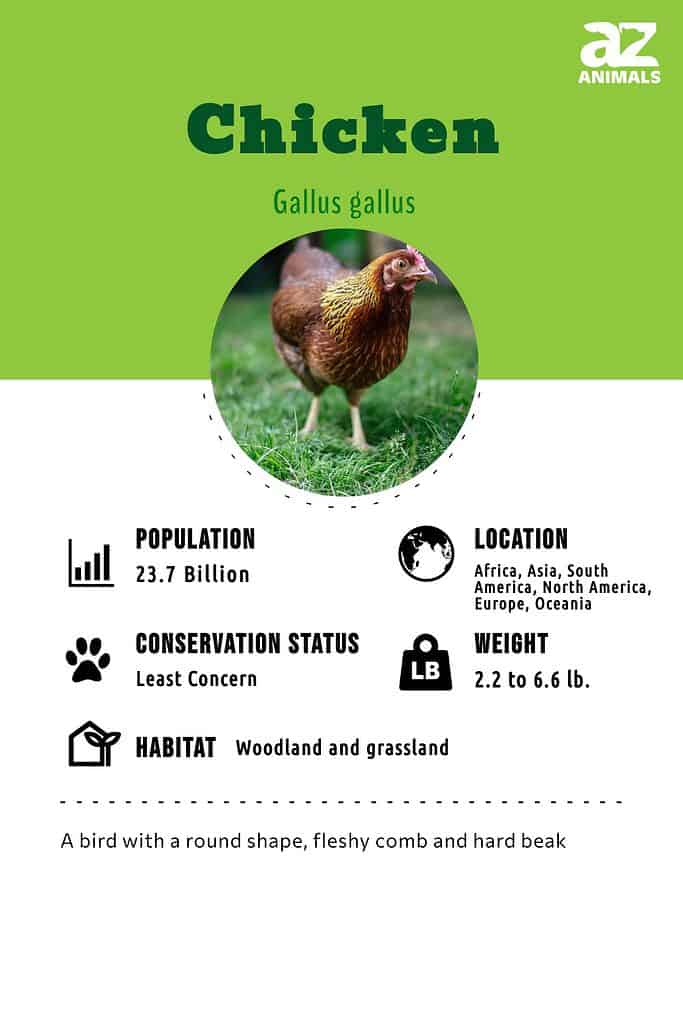
👁 Chicken infographic
Chickens are on every continent except Antarctica.

Scientific Name

The chicken belongs to the kingdom Animalia, the phylum Chordata, the class Aves, the order Galliformes, the family Phasianidae and the genus Gallus. The common chicken that is widespread around the world belongs to that genus. There is a great deal of debate in the scientific community regarding the scientific name of the domesticated chicken, however. Some consider the chicken to be a domesticated type of wild red jungle fowl, Gallus gallus. Others classify the bird as a subspecies of that same fowl, giving it the scientific name G. gallus domesticus. Still others, including the USDA, consider G. domesticus as the scientific name of the domesticated chicken. Either way, all chickens belong to the same phylum, class, order, family and genus.

Originally, the species as a whole was called the domestic fowl, or simply the fowl. Back then, the classification “chicken” referred to a young domesticated fowl. The term “hens and chickens,” a holdover from this period, is still often used today.

Chickens are also called different names, depending on things like age and gender. Mature males are commonly known as cocks in places like the U.K. and Ireland and as roosters in the United States, Australia, Canada, and New Zealand. Immature males are known as cockerels. Meanwhile, immature females are called pullets while mature females are called hens. Chickens that are used for their meat are called capons.

In the Deep South of the U.S., chickens are often referred to as yardbirds.
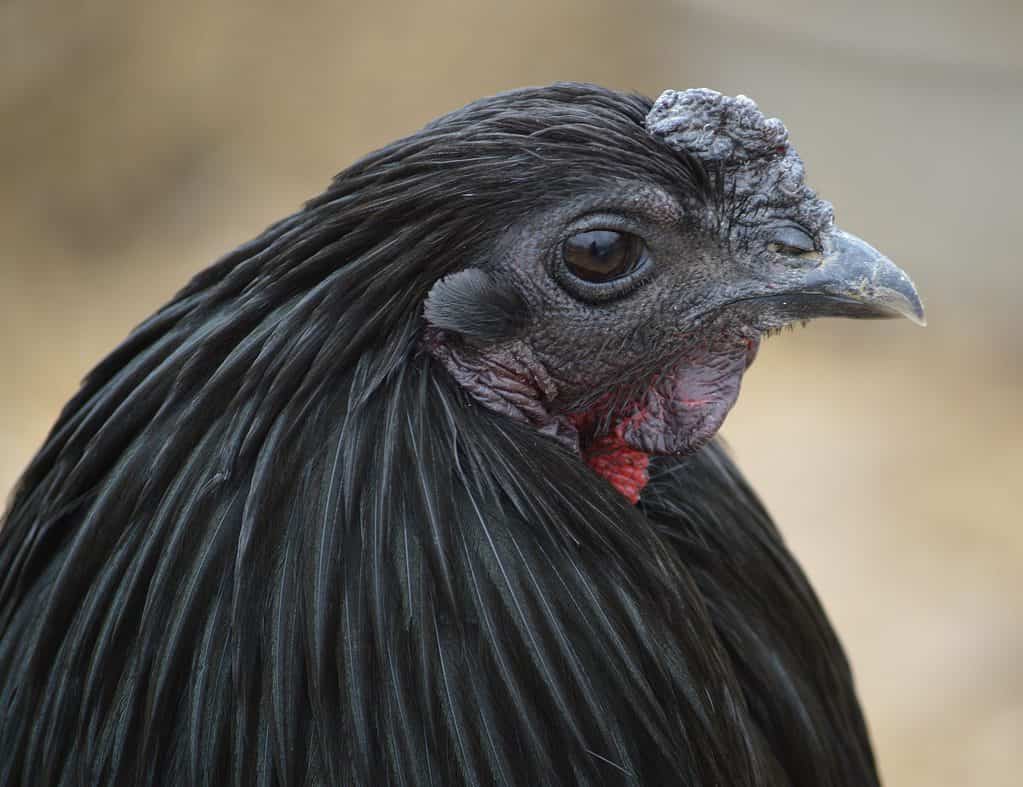
👁 Image

The common name for chickens used to be domesticated fowl.

©jdeesphotos/Shutterstock.com

Appearance and Behavior

There are hundreds of different chicken breeds and classifications. They are distinguished from each other by many characteristics, including the following: the place of origin, skin color, plumage color, size, comb type, number of toes, egg coloring, and amount of feathering. In general, however, the chicken is a squat bird with a rounded appearance. Typically, they stand no more than 27.6 inches tall, and they weigh around 5.7 pounds on average.

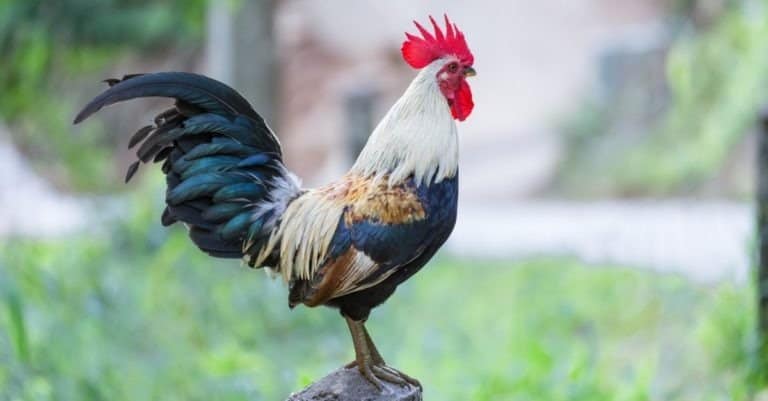
Males and females have fleshy combs atop their heads and lobed wattles below their bills. These and other fleshy protuberances are collectively known as caruncles. Shiny, pointed feathers known as hackles adorn the neck, and more appear along the back and are known as saddles. These birds usually have high, arched tails. In some breeds, the tail can extend up to 12 inches or more in length. Males, known as roosters, typically exhibit bolder, brighter colors than their female counterparts.
👁 Sapphire Olive Egger chick
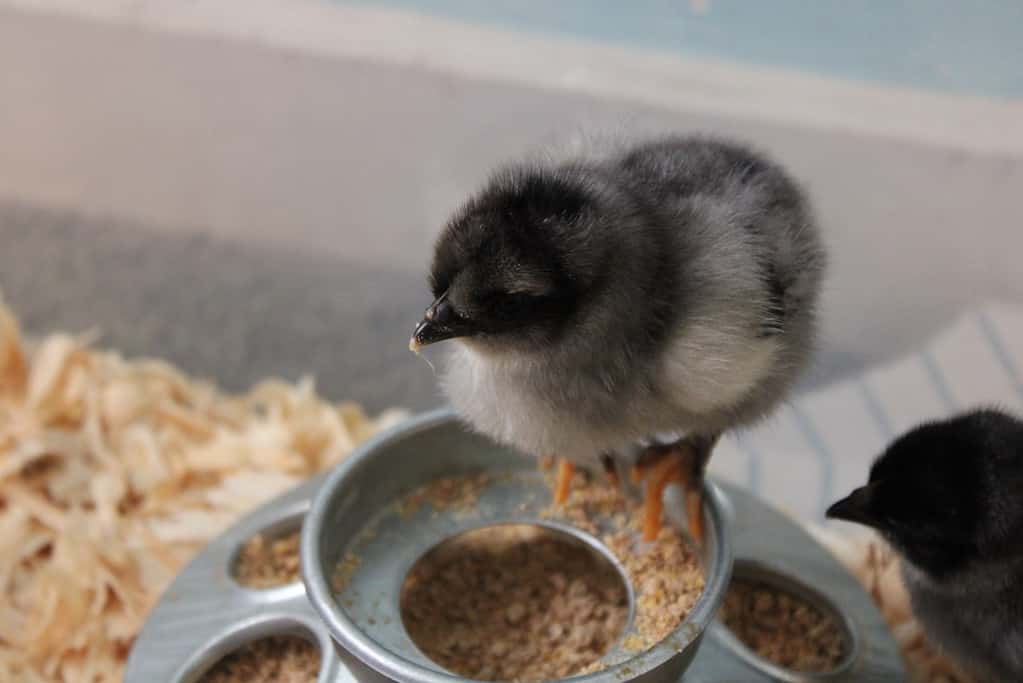
For those wanting to have a small menagerie of chicks in their back yard, you can purchase day-old chicks from hatcheries and raise them indoors until they’re ready to move outside, typically at around six weeks of age.

Chickens are very gregarious creatures, and they live together in flocks. Intelligent and curious by nature, they develop social hierarchies within their flocks. These hierarchies, known as pecking orders, determine access to food, mates, nesting sites, and other resources. They typically consist of one dominant male, a handful of subdominant males, and two or more females that are watched over closely by the dominant male.

A higher-ranking individual may strike out at lower-ranking individuals with their beaks in a pecking order, pecking to drive them away from resources like food. During confrontations, males may also pummel at one another with their wings or scratch each other with their claws.

Chickens use various calls to communicate with each other. For instance, rooster crows are used as territorial signals to other roosters in the area; sometimes, they are prompted by sudden disturbances. After laying eggs, hens cluck. They also cluck to summon their chicks (the name for baby chickens) over to them. Chickens also warn each other of danger using distinct warning calls based on whether the danger is coming from overhead or by land.
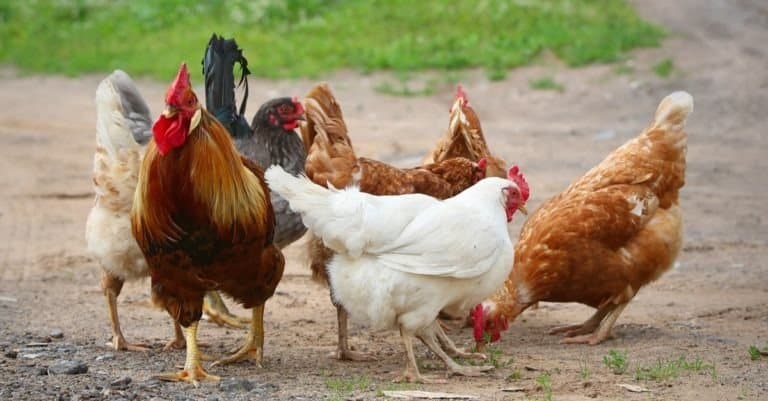
👁 Free range chickens. Rooster and Chickens

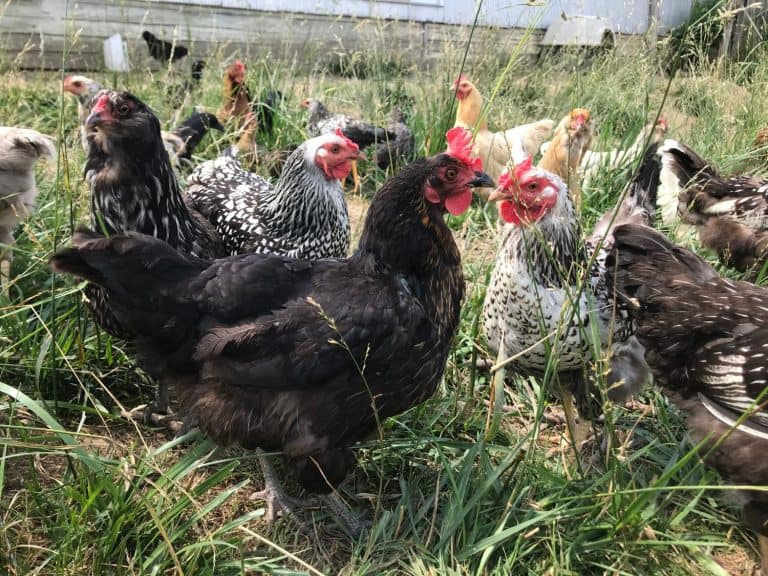
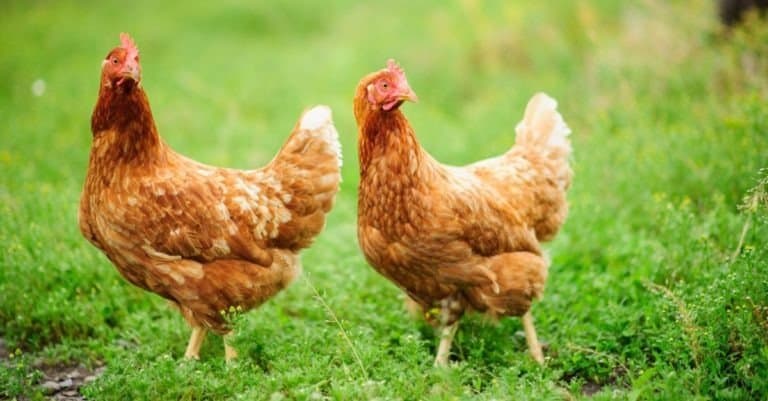
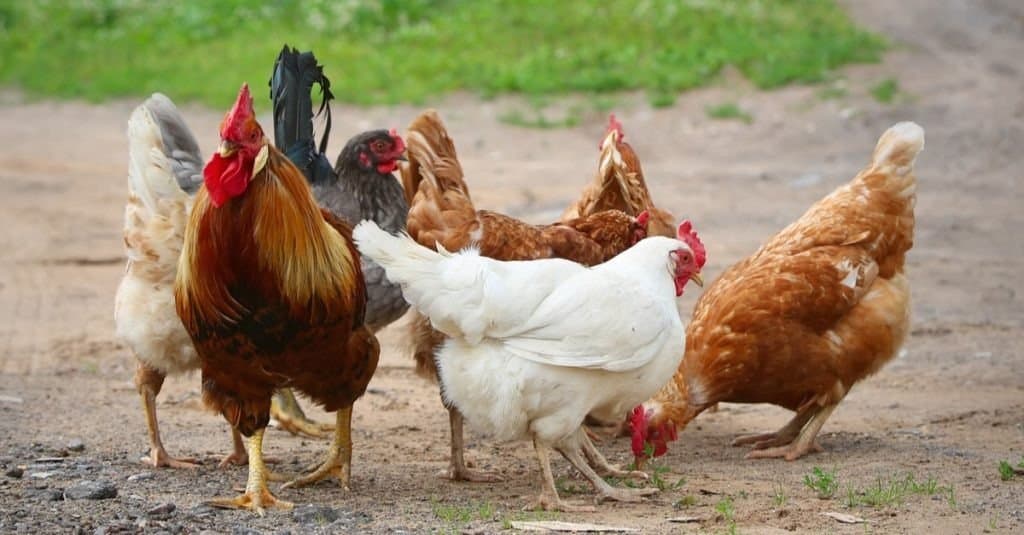
There are hundreds of different breeds of chickens.

©Aksenova Natalya/Shutterstock.com

Evolution

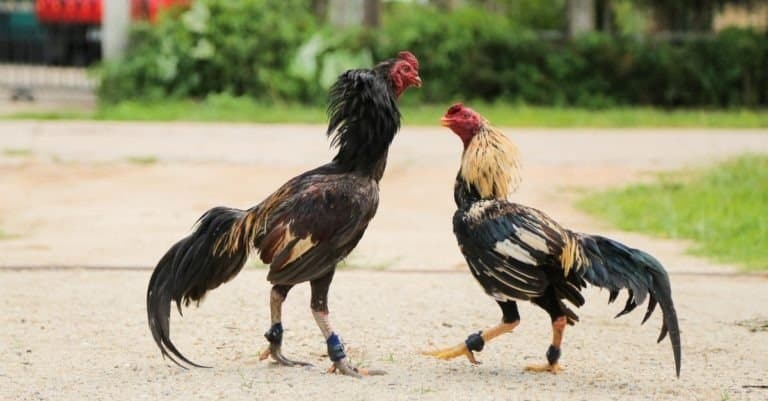
Chickens are believed to originate from the wild red jungle fowl, which can be traced to Southeast Asia and possibly certain parts of India. Domestication of these birds is believed to have happened multiple times, starting approximately 7,500 years ago. They may originally have been domesticated for religious purposes or for entertainment in the form of cockfighting, which is now banned in many parts of the world.
👁 Image

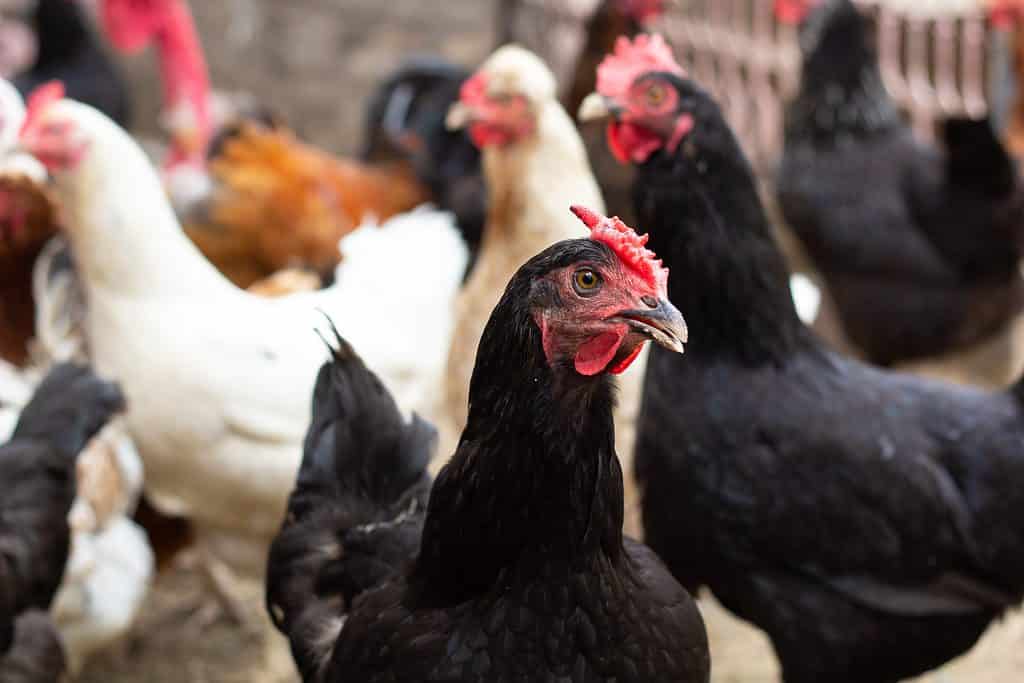
Chickens have been used for human food for thousands of years.

©Jane Nadezhina/Shutterstock.com

Habitat

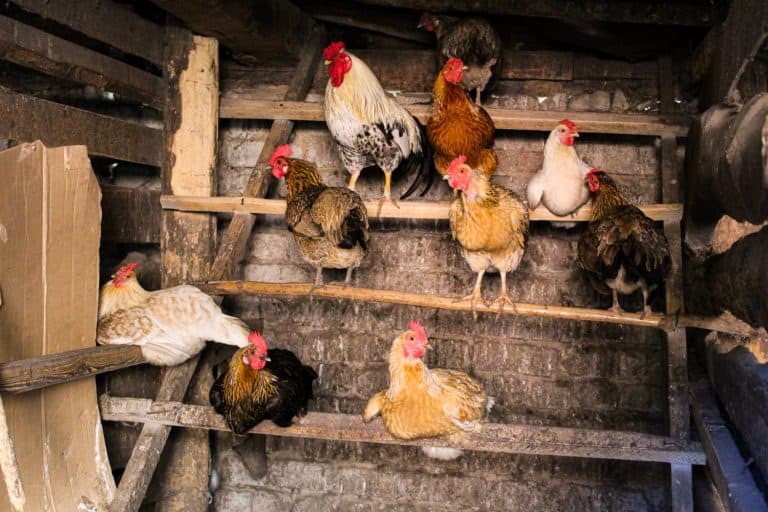
Today, most chickens are raised in captivity. Their habitat often consists of a factory farm setting. In the wild, however, they have two primary habitats. Feeding areas usually consist of open canopies and underlying shrubs, while roosting sites are typically found in lower tree branches and are used at night. In captivity, chickens require the same dual-habitat system. Frequently, this includes a chicken coop and a fenced-in outdoor area.
👁 Image

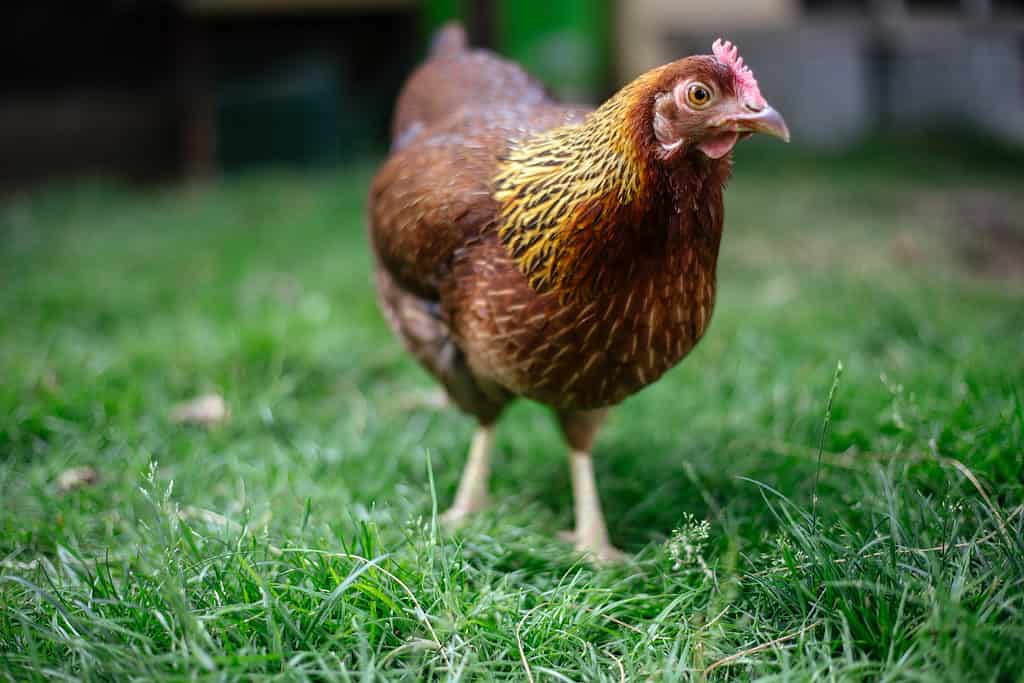
Most chickens today are bred in captivity.

©Katrin Friedl Fotografie/Shutterstock.com

Diet

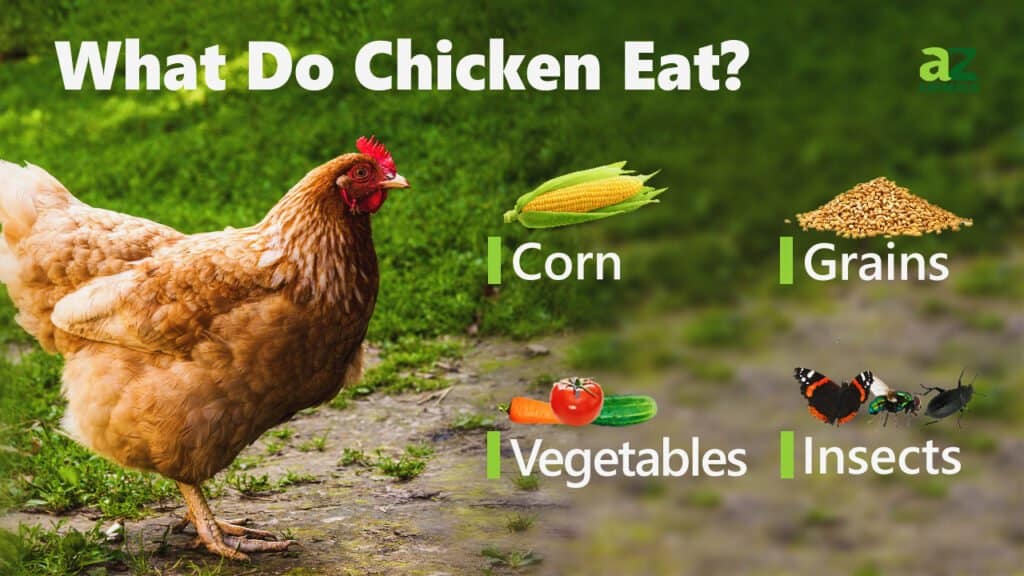
As omnivores, chickens are opportunistic feeders in the wild. They typically forage for food by scratching their beaks on the ground, searching for insects, seeds, fruits, and vegetables. At times, they will consume larger animals, including small snakes, lizards, and mice. In captivity, chickens are primarily fed chicken feed that consists mostly of grains and grain byproducts.

Want to learn more about what chickens eat? Check out our complete guide ‘What Do Chickens Eat?’
👁 What Do Chicken Eat
Chickens eat insects, vegetables, seeds and grains.

Predators and Threats

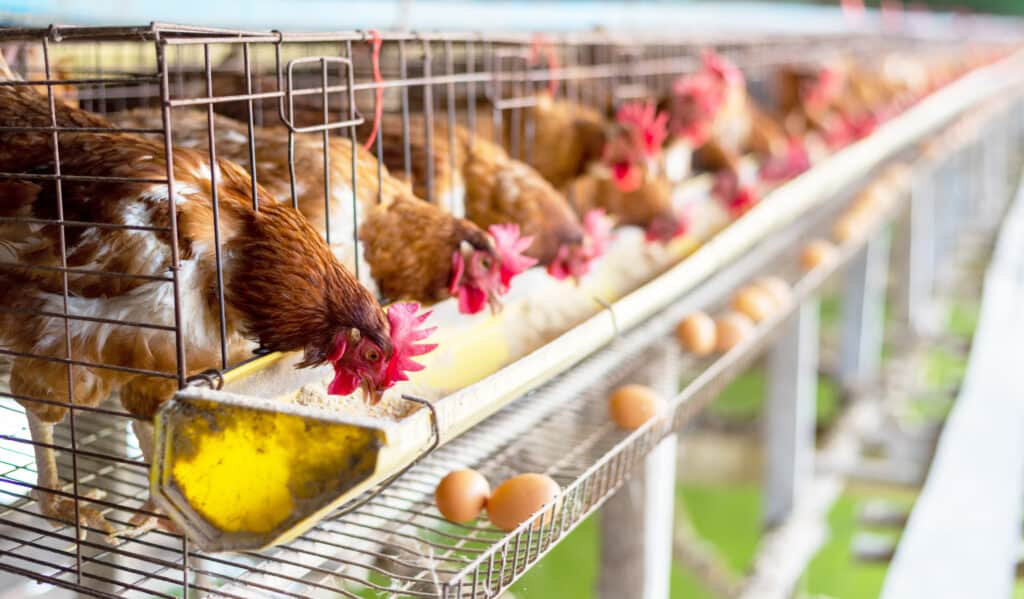
On a global scale, the biggest threat to chickens is industrialized farming. More than 50 billion chickens are processed for their meat and eggs every year through mass farming practices.

Chickens are susceptible to many diseases. Most famously, they often harbor salmonella in their feces and dander. Their meat must be cooked to a temperature of 165 degrees Fahrenheit to kill off the deadly bacteria.

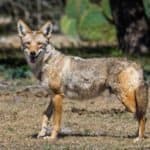
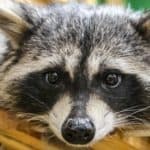
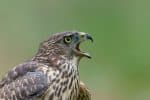
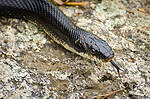
In the wild, common predators of the chicken include bobcats, foxes, coyotes, snakes, skunks, opossums, rodents, raccoons, weasels, and birds of prey.
👁 Hens Lined Up, Laying Eggs

The biggest threat to chickens is industrialized factory farms.

©SasinTipchai/Shutterstock.com

Reproduction, Babies and Lifespan

In Ancient Egypt, the chicken was known as “the bird that gives birth every day,” which relates to the fact that hens can lay upwards of 300 eggs per year. When courting a female – usually during the spring or summer – a rooster may perform a circle dance in which he dances in a circle while keeping a lowered wing pointed in her direction. If the female is receptive, she will crouch down; mating commences from there.

Hens usually try to lay eggs in the same location every time. Sometimes, they seek out existing nests with eggs already in them, and they may even move eggs from a neighboring nest to their own. Hens lay around 12 eggs to complete a clutch; all of the eggs are incubated after the clutch is complete. As a result, eggs laid at different times still hatch around the same time.

Once she stops laying eggs, the hen “goes brooding.” She sits, or sets, on the nest to protect the eggs, rarely leaving them alone and turning them regularly. All of the eggs in the clutch hatch within a day or two of each other. Eventually, the hen hears the chicks peeping inside the eggs, and she clucks back. From there, chicks “pip,” or peck out breathing holes in their eggs with their egg tooths. They rest for a while afterward, absorbing yolk for nourishment. After enlarging the original hole, chicks break out and remain in the nest for roughly two days. Hens care for their chicks for several weeks after that, leading them to food and water but not feeding them directly.

Roughly 23 to 26 hours pass between ovulation and egg-laying. Subsequent ovulations can occur within an hour after the last egg is laid, which is why hens are such prolific egg layers. Some breeds can produce more than 300 eggs in a single year.

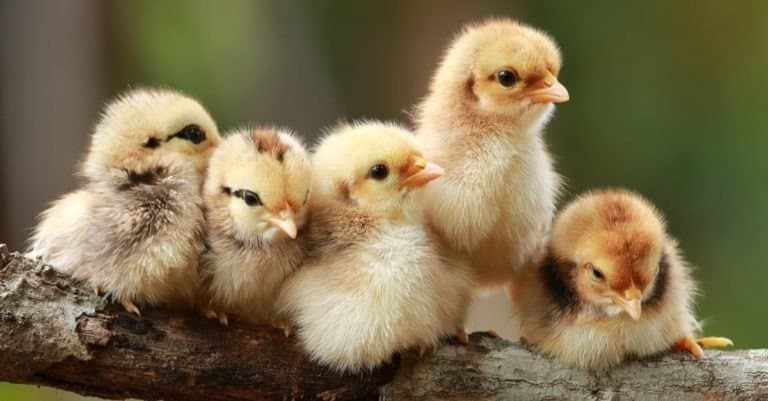
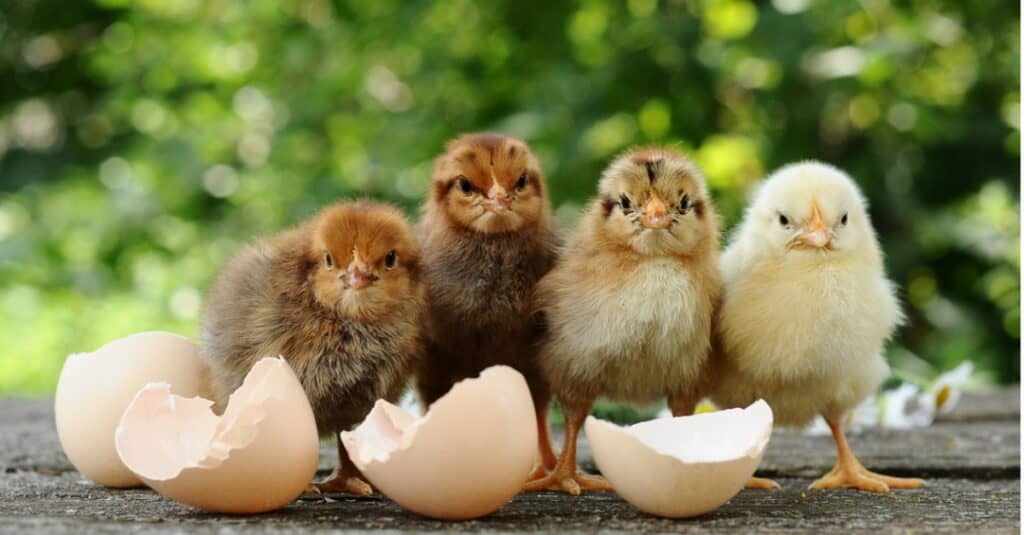
Fertilized chicken embryos develop quickly, with chicks hatching at around 21 days. Baby chicks are covered in down and become fully feathered within four to five weeks. At approximately six months of age, males can produce viable sperm, and females can produce viable eggs.

As far as longevity goes, chickens in free-ranging flocks live for an average of six to eight years. The majority used in the poultry industry lay eggs for two to three years before being slaughtered for their meat. The oldest living chicken on record, a hen named Matilda from Alabama, lived to 16 years of age and is listed in the Guinness Book of World Records.
👁 baby chicken siblings

The majority of chickens are used for egg production for 2 years and then slaughtered for their meat.

©iStock.com/OlgaVolodina

Population and Conservation

In 2018, there were estimated to be approximately 23.7 billion chickens in the world. That represents a significant increase from 2011 when the population stood at 19 billion or so. Every year, more than 50 billion chickens are processed for their eggs and meat.

Chickens are not considered endangered in any way, and they are found throughout the world. Most chickens live and die on factory farms, but some are raised using free-range farming techniques. A small percentage of the world’s chickens are kept as pets.

Types of Chickens

When it comes to chicken breeds, there is a wide variety. Here are a few of the most common varieties below.

  • Rhode Island Red – Red-Orange feathers. Weigh between 6-8 pounds.
  • Orpington – Deep breast, short legs. Often goes broody.
  • Plymouth Rock – Full breast, single comb. Good layers.
  • Australorp – Black feathers with a green sheen. Very active.
  • Wyandotte – Red, Black, or White feathers. Weigh 6-9 pounds.
  • Leghorn – Small and white, good foragers
View all 386 animals that start with C
How to say Chicken in ...
Catalan
Gall
German
Bankivahuhn
English
Chicken
Esperanto
Bankiva koko
French
Coq doré
Croatian
Divlja kokoš
Indonesian
Ayam-hutan Merah
Italian
Gallus gallus
Hungarian
Bankivatyúk
Malay
Ayam Hutan
Dutch
Bankivahoen
Japanese
セキショクヤケイ
Polish
Kur bankiwa
Portuguese
Galo-banquiva
Finnish
Punaviidakkokana
Swedish
Röd djungelhöna
Chinese
原雞

Sources

  1. Britannica / Accessed January 13, 2021
  2. Tractor Supply Company / Accessed January 13, 2021
  3. Wiktionary / Accessed January 13, 2021
  4. Animal Diversity Web / Accessed January 13, 2021

About the Author

Heather Hall

Heather Hall is a writer at A-Z Animals, where her primary focus is on plants and animals. Heather has been writing and editing since 2012 and holds a Bachelor of Science in Horticulture. As a resident of the Pacific Northwest, Heather enjoys hiking, gardening, and trail running through the mountains with her dogs.

Thank you for reading! Have some feedback for us?

Contact the AZ Animals editorial team

Related Articles You May Find Interesting

👁 Image
Articles

3 Million Hens, One Building: The High-Tech “Egg City” Redefining Industrial Farming


Chicken FAQs (Frequently Asked Questions)

Chickens are Omnivores, meaning they eat both plants and other animals.

Chickens belong to the Kingdom Animalia.

Chickens belong to the class Aves.

Chickens belong to the phylum Chordata.

Chickens belong to the family Phasianidae.

Chickens belong to the order Galliformes.

Chickens are covered in Feathers.

Chickens belong to the genus Gallus.

Chickens live in open woodlands and sheltered grasslands.

Chickens eat seeds, fruit, insects, and berries.

Predators of Chickens include humans, foxes, and raccoons.

Chickens have sharp, pointed beaks and make clucking sounds.

Chickens typically lay 2 eggs.

Chickens were first domesticated more than 10,000 years ago!

The scientific name for the Chicken is Gallus gallus.

Chickens can live for 2 to 4 years.

The Chicken has a wingspan of 45cm to 60cm (17.7in to 23.6in).

A Chicken can travel at speeds of up to 6 miles per hour.

Chickens lay eggs.

The primary difference between a hen vs chicken lies in their gender. Hens are always female, while chicken refers to either gender of bird. Chickens are also the overall species name for both hens and chickens, while the title of hen is only bestowed on certain types of chickens.

The main difference between roosters and chickens is their gender. Chicken refers to both hens and roosters, while rooster only refers to male chickens. Check out the differences in the Buff Orpington breed: Buff Orpington roosters vs hens.

The key differences between duck eggs and chicken eggs are in their size, shell, egg white, flavor, and nutrition. Duck eggs are bigger than chicken eggs. While the shells of chicken eggs are unicolour, duck eggshells are usually variegated. for the egg whites, ducks have clearer egg whites than chickens.

The key differences between a pheasant and a chicken are appearance, diet, domestication, and population.

The greatest differences between guinea fowls and chickens lie in their size, domestication, and meat.

Chickens are larger than guinea fowl, weighing up to 6.6 lbs, standing 2.5 ft tall, measuring 17 inches in length, and more orderly while producing lean and healthy meat. Guinea fowls measure up to 3.5 lbs, stand 1.9 ft tall, and grow 30 inches in length while producing gamey, leaner, darker meat than chickens and being notorious for fighting amongst themselves.

The key differences between a male chicken and a female chicken are feathers, legs, wattles and combs, roles, and behavior.

Chickens can develop heat stress when the temperature gets too high and they are also susceptible to frostbite when it’s too low.

Start cooling your chickens when the temperature reaches 80 degrees Fahrenheit. It can be risky when temperatures are nearly 100 degrees Fahrenheit.

Chickens are designed to endure the cold. Although they do best in temperatures between 70 and 75 degrees Fahrenheit, they can tolerate colder temperatures if healthy. Chickens are hardy animals that can survive in temperatures well below zero.