
D
Species Profile

Death Adder

Acanthophis antarcticus

Australia's tail-luring ambush expert
Adam Brice/Shutterstock.com

Death Adder Distribution

Click a location to explore more animals from that region

Endemic Species
Loading map...

Found in 1 country

At a Glance

Wild Species
Also Known As Death adder, Australian death adder
Diet Carnivore
Activity Nocturnal+
Lifespan 10 years
Weight 1.5 lbs
Status Least Concern
Did You Know?

Despite being an elapid (family Elapidae), the Common Death Adder has a viper-like, short-and-thick body built for ambush (Wilson & Swan, field guides to Australian reptiles).

Scientific Classification

The Common Death Adder is a stout, ambush-hunting venomous elapid snake native to Australia. Despite being an elapid (like taipans and brown snakes), it has a viper-like build and relies on camouflage and a caudal lure (tail tip) to attract prey.

Kingdom
Animalia
Phylum
Chordata
Class
Reptilia
Order
Squamata
Family
Elapidae
Genus
Acanthophis
Species
Acanthophis antarcticus

Distinguishing Features

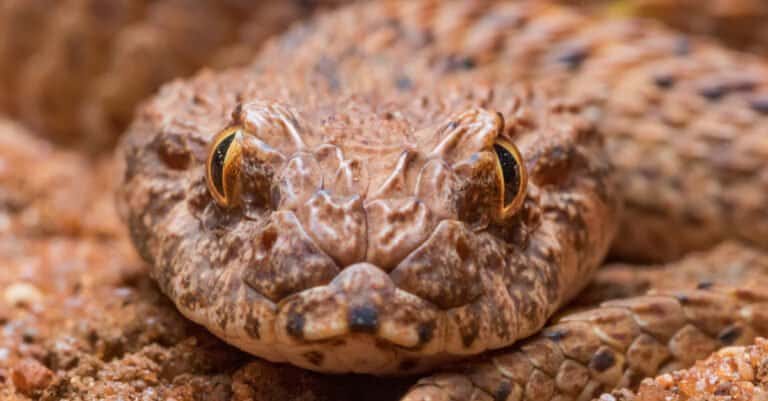
  • Short, very stout body with a relatively broad, triangular-looking head
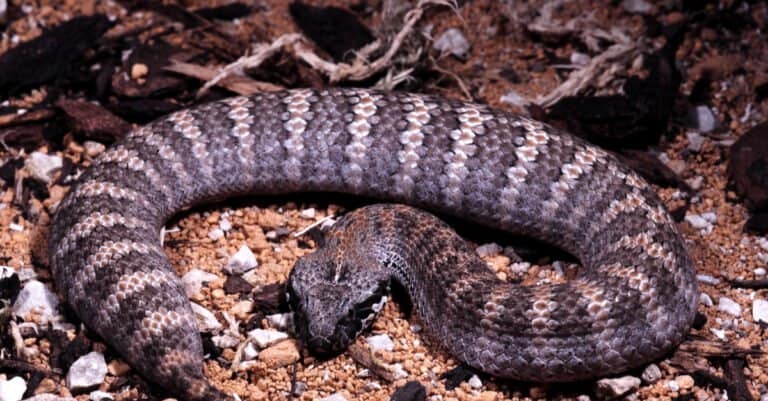
  • Cryptic coloration and strong camouflage; often remains motionless in leaf litter
  • Tail-tip β€˜lure’ used to entice lizards and other prey
  • Venom primarily neurotoxic; medically significant to humans
  • Often described as β€˜viper-like’ in appearance though taxonomically an elapid

Physical Measurements

Males and females differ in size

Length
β™‚ 1 ft 10 in (1 ft 4 in – 2 ft 11 in)
♀ 1 ft 12 in (1 ft 4 in – 3 ft 3 in)
Weight
β™‚ 1 lbs (0 lbs – 1 lbs)
♀ 1 lbs (0 lbs – 2 lbs)
Tail Length
β™‚ 2 in (2 in – 4 in)
♀ 3 in (2 in – 5 in)
Venomous

Appearance

Primary Colors
Secondary Colors
Skin Type Dry, keratinized reptile skin with strongly keeled dorsal scales (matte, non-glossy appearance), contributing to a rough-textured look and reducing glare-useful for ambush camouflage in litter.
Distinctive Features
  • Stout, viper-like body plan despite being an elapid (Family Elapidae): thick torso, relatively short tail, and a broad, distinct head/neck profile (common diagnostic trait in Australian field references such as Cogger 2014).
  • Ambush predator that commonly remains partially buried or concealed under leaf litter; relies on camouflage rather than active pursuit.
  • Caudal luring: The Common Death Adder (Acanthophis antarcticus) uses a special tail tip, often a different color or texture, wriggled like a grub to lure prey, especially young snakes.
  • Venomous, front-fanged elapid with relatively short, fixed fangs; medically significant in Australia. A dedicated death adder antivenom exists in Australian clinical practice (and is also represented in Australian polyvalent antivenom context).
  • Relatively short, robust overall form; commonly cited adult total length is ~0.6-1.0 m, with a reported maximum around ~1.2 m in species accounts (e.g., Cogger 2014; Wilson & Swan 2021).
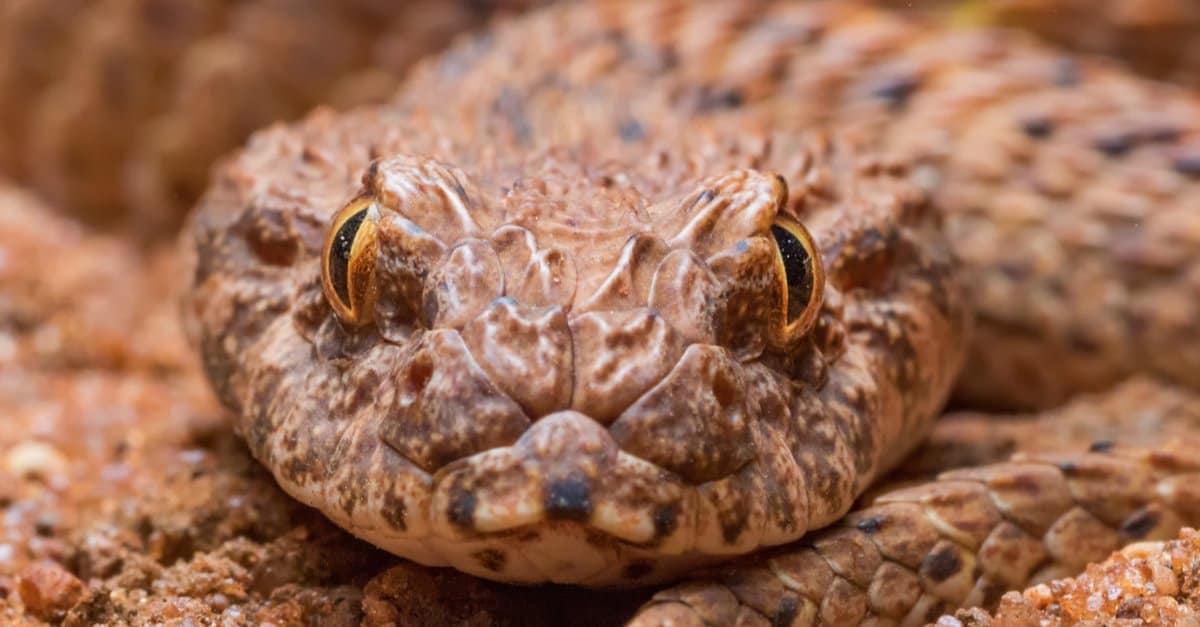
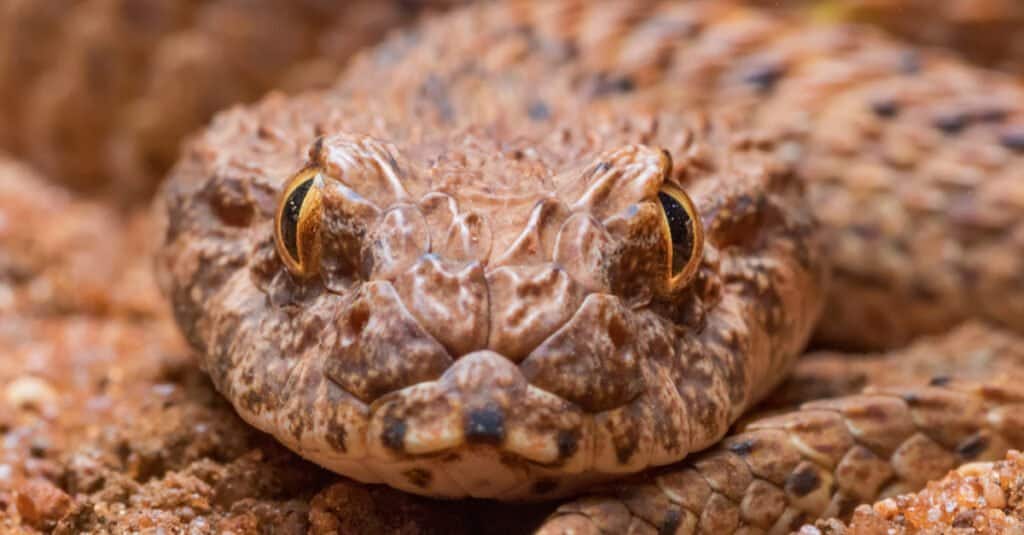
  • Eyes often described as having a more viper-like appearance than many Australian elapids (including a comparatively broad head and prominent eyes), reinforcing the 'viper-mimic' look in the field.
  • Important note on taxonomy: 'death adder' is a common name applied to multiple Acanthophis species in Australia and nearby regions; this appearance profile is intended specifically for the Common Death Adder (Acanthophis antarcticus).

Sexual Dimorphism

Sexual dimorphism is present but generally modest. Females are often the heavier-bodied sex, while males typically have proportionally longer tails (a common snake dimorphism linked to hemipenes). Color/pattern differences between sexes are not reliably diagnostic in the field for this species and vary geographically.

β™‚
  • Proportionally longer tail (post-cloacal length) on average; body often slightly more slender at the same total length.
  • May mature at slightly smaller body size than females in many snake systems; however, field identification by size alone is unreliable.
♀
  • Often attain greater body mass and a more robust mid-body girth than males of similar age; can appear more 'thickset' (useful but not definitive in the field).

Did You Know?

Despite being an elapid (family Elapidae), the Common Death Adder has a viper-like, short-and-thick body built for ambush (Wilson & Swan, field guides to Australian reptiles).

It uses a wriggling tail tip as a caudal lure-prey such as skinks and frogs strike at the "worm," bringing themselves within range (classic caudal-luring observations in Acanthophis spp.; e.g., Heatwole & Davison, 1970s literature).

Adults are commonly ~0.4-0.8 m total length; large individuals can approach ~1.0 m (reported in Australian herpetological references such as Wilson & Swan).

Unlike many egg-laying snakes, death adders are live-bearing (viviparous), producing litters commonly around ~8-20 young (reported for Acanthophis spp. in Australian reproductive ecology summaries, incl. Shine's work on Australian snakes).

Their strike is extremely fast, but they usually remain motionless for long periods, relying on camouflage rather than pursuit.

Medically significant neurotoxic envenoming is treatable with species-group antivenom in Australia (CSL death adder antivenom; clinical toxicology references).

The species name "antarcticus" reflects early naming history (southern distribution in Australia), not an Antarctic range-an enduring quirk of taxonomy.

Unique Adaptations

  • Viper-like body plan in an elapid lineage: short, broad trunk and strongly triangular head improve concealment and ambush positioning compared with the more slender, active-foraging build of many elapids.
  • Caudal lure specialization: a distinct tail tip used as prey-attracting bait, increasing hunting success without revealing the head.
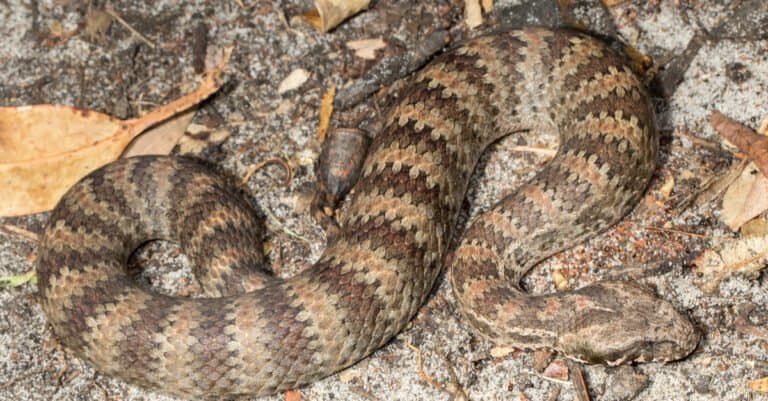
  • Cryptic leaf-litter patterning: highly variable browns/greys with banding and mottling that match forest floor and heathland substrates across its range.
  • Relatively long fangs for an elapid: facilitates efficient venom delivery during a short, explosive strike typical of ambush hunting.
  • Venom geared toward rapid immobilization: predominantly neurotoxic effects are characteristic of death adders and underpin their medical significance (clinical toxinology literature).

Interesting Behaviors

  • Sit-and-wait predation: often lies partially buried or tucked into leaf litter with head poised, conserving energy while waiting for prey to approach.
  • Caudal luring: the tail tip is elevated and wriggled in short, worm-like motions; the snake may keep the rest of the body nearly immobile to maintain camouflage.
  • "Strike-and-hold" venom delivery: delivers a rapid forward strike with relatively long fangs (for an elapid) and typically holds on briefly, consistent with subduing relatively large or struggling prey.
  • Defensive strategy: relies first on stillness and cryptic coloration; when disturbed at close range it can deliver a very rapid defensive strike rather than fleeing far.
  • Activity pattern: often most active in cooler parts of the day/evening depending on local conditions; many encounters occur when individuals are sheltering in litter, grass tussocks, or under debris.

Cultural Significance

In Australia, the Common Death Adder (Acanthophis antarcticus) is a well-known snake. It shaped public views of venomous wildlife, led to making and keeping antivenom, and is used in teaching because it has elapid venom but hunts by ambush.

Myths & Legends

Rainbow Serpent traditions (pan-Australian Aboriginal creator-being): many groups tell of a strong ancestral serpent tied to waterholes, rain, and shaping land; not a death adder story but shows snakes' deep cultural power.

At Uluru, a Dreaming story tells of a python woman and a venomous snake man. It is a common Australian tale about powerful snakes, not just about Acanthophis antarcticus.

Colonial-era bush lore around the "death adder" name: early settler narratives and cautionary tales used the snake as a symbol of hidden danger in leaf litter and scrub-drawing on its ambush habits and cryptic camouflage.

Naming history as cultural anecdote: the epithet "antarcticus" (given in early European taxonomy) became an enduring curiosity in Australian natural history storytelling because it suggests the far south rather than the snake's real Australian range.

Conservation Status

LC Least Concern

Widespread and abundant in the wild.

Population Decreasing

Protected Under

  • Australia (general): Native wildlife protections apply via state/territory legislation; collection/keeping typically requires permits and is regulated.
  • New South Wales: Biodiversity Conservation Act 2016 (native fauna protected; harming/collecting regulated).
  • Victoria: Wildlife Act 1975 (protected wildlife; licensing regulates take/keeping).
  • Queensland: Nature Conservation Act 1992 (protected wildlife; permits regulate take/keeping).
  • South Australia: National Parks and Wildlife Act 1972 (protection and permit controls for native fauna).
  • Australian Capital Territory: Nature Conservation Act 2014 (protected native fauna; licensing/controls).

Life Cycle

Birth 12 newborns
Lifespan 10 years

Lifespan

In the Wild 5–15 years
In Captivity 10–25 years

Reproduction

Mating System Data Deficient
Social Structure Solitary
Breeding Pattern Seasonal
Fertilization Internal Fertilization
Birth Type Internal_fertilization

Common Death Adder (Acanthophis antarcticus) are solitary ambush snakes with brief mating during the breeding season. They fertilize internally and give birth to live young. Few genetic studies exist, so exact mating patterns are unclear.

Behavior & Ecology

Social Solitary Group: 1
Activity Nocturnal, Crepuscular, Cathemeral
Diet Carnivore small mammals (murid rodents)
Seasonal Hibernates

Temperament

Ambush-oriented and relatively sedentary; commonly remains motionless relying on camouflage rather than fleeing when approached
Can be highly defensive at very close range; capable of extremely rapid strike from a coiled posture (a key risk factor in human encounters)
Uses caudal luring (tail-tip wriggling) to attract prey; this is a foraging behavior rather than sociality
Common Death Adder (Acanthophis antarcticus) shows changes with seasons: more daytime basking and activity when cool, but mainly night or dusk activity in warm times, matching Australian field guides.

Communication

Chemical communication via pheromones Tongue-flicking/chemoreception) for mate-finding and reproductive condition assessment; males may follow female scent trails (reported in snake reproductive ecology; noted for death adders in field observations, e.g., Shine 1980
Tactile communication during courtship and mating Body alignment and contact typical of snake copulatory behavior
Visual/body-posture signals in close-range defense (e.g., threat display with coiling/flattening and orientation toward threat), though death adders often minimize conspicuous displays and rely on crypsis
Substrate-borne cues/vibration sensitivity General to snakes; likely relevant for detecting nearby conspecifics/predators at close range, but not known to support structured group coordination in this species

Habitat

Biomes:
Temperate Forest Temperate Grassland Mediterranean
Terrain:
Coastal Hilly Plains Valley Rocky Sandy
Elevation: Up to 3280 ft 10 in

Ecological Role

Ambush mesopredator of small terrestrial vertebrates in Australian woodland, heath, and grassland systems.

Regulates small-vertebrate populations (notably murid rodents and small lizards), potentially dampening rodent irruptions locally Provides prey biomass to higher predators (e.g., raptors, varanid lizards, larger snakes), supporting trophic transfer Selective predation on ground-active fauna can influence local community composition of small vertebrates

Diet Details

Main Prey:
Small mammals Lizards Frogs Small birds Small reptiles

Human Interaction

Domestication Status

Wild

Acanthophis antarcticus (Common Death Adder) is not domesticated. People interact with it via snakebite care and antivenom, wildlife relocation, licensed captive keeping for education and exhibit and for venom, and research. It is a stout ambush elapid with a tail lure, fast strike, 0.6–0.9 m typical, gives live young, and lives ~12–15 years in captivity.

Danger Level

High
  • Medically significant venom: predominantly neurotoxic envenoming can cause progressive paralysis (ptosis/ophthalmoplegia, bulbar weakness, respiratory failure) requiring urgent hospital care and sometimes ventilatory support; antivenom and modern intensive care have greatly reduced fatality risk where promptly available (clinical toxinology references; Australian snakebite guidelines).
  • High-risk encounter pattern: the species' cryptic coloration and ambush posture increases the chance of being stepped on or handled inadvertently, leading to defensive bites at very close range.
  • Potentially rapid onset: neurotoxic signs can develop within hours after significant envenoming; delayed presentation increases risk of severe outcomes (documented in Australian snakebite case series and guideline summaries).
  • Occupational exposure: higher risk for snake handlers, wildlife carers, reptile park staff, and licensed keepers during capture, husbandry, or venom extraction.

As a Pet

Not Suitable as Pet

Legality: Keeping Common Death Adder (Acanthophis antarcticus) is usually illegal without a venomous reptile licence. Australia and many places need strict permits, secure cages, records, and inspections; rules differ by area.

Care Level: Expert Only

Purchase Cost: $200 - $800
Lifetime Cost: $3,000 - $15,000

Economic Value

Uses:
Public health (snakebite treatment systems and antivenom supply chain) Biomedical research (venom neurotoxins and coagulation-active components) Education and tourism (zoos, reptile parks, outreach programs) Licensed captive breeding/keeping (regulated reptile industry in some jurisdictions) Ecosystem services (predation on small mammals/reptiles-indirect pest regulation)
Products:
  • Death adder antivenom (produced using Acanthophis spp. venoms; in Australia historically produced by CSL, now supplied by Seqirus depending on era/provider)
  • research-grade venom and purified toxin fractions (e.g., neurotoxic peptides used in pharmacology/toxinology studies)
  • educational programming and exhibits featuring death adders

Relationships

Predators 8

Laughing Kookaburra Dacelo novaeguineae
Brown Falcon Falco berigora
Wedge-tailed Eagle Aquila audax
Lace Monitor Varanus varius
Mulga Snake Pseudechis australis
Eastern Brown Snake Pseudonaja textilis
Feral Cat Felis silvestris catus
Red Fox Vulpes vulpes

Related Species 8

Northern Death Adder Acanthophis praelongus Shared Genus
Desert Death Adder Acanthophis pyrrhus Shared Genus
Smooth-scaled Death Adder Acanthophis laevis Shared Genus
Barkly Tableland Death Adder Acanthophis hawkei Shared Genus
Coastal Taipan Oxyuranus scutellatus Shared Family
Eastern Brown Snake Pseudonaja textilis Shared Family
Tiger Snake Notechis scutatus Shared Family
Red-bellied Black Snake Pseudechis porphyriacus Shared Family

Ecological Equivalents 5

Animals that fill a similar ecological role in their ecosystem

Northern Death Adder Acanthophis praelongus Shares a very similar sit-and-wait foraging strategy: heavy-bodied and short-tailed, relying on camouflage and caudal luring to capture small vertebrates at close range. Functionally overlaps as a cryptic ambush elapid in different Australian regions.
Carpet Python Morelia spilota Shares a sit-and-wait ambush niche for small mammals, birds, and reptiles in many of the same woodland and forest-edge systems. Differs by being a non-venomous constrictor but occupies a comparable predatory role as a concealed, patient hunter.
Broad-headed Snake Hoplocephalus bungaroides Small-to-medium elapid occupying cool, temperate sandstone habitats and preying heavily on lizards. While more of a nocturnal shelter-site hunter than a classic death-adder ambusher, it overlaps in prey type (skinks and geckos) and microhabitat use (ground and rock cover) across parts of southeastern Australia.
Eastern Brown Snake Pseudonaja textilis Both occupy terrestrial habitats and feed on small mammals and reptiles. Pseudonaja textilis actively searches for prey, while Acanthophis antarcticus hides and ambushes using tail lures; both are key small-vertebrate predators in many habitats.
Puff Adder Bitis arietans Global niche analogue (not Australian): a stout-bodied, heavily camouflaged, sit-and-wait ambush predator with extremely fast strikes. Included because A. antarcticus is often described as 'viper-like' among elapids in both form and ambush ecology.

β€œThe Death Adder is more closely related to the Cobra than other Australian snakes.”


Also known as the Common Death Adder, this species is native to eastern and southern Australia, as well as Papua New Guinea. The species avoids desert areas but is plentiful in wooded or grassy areas. These reptiles are quite adept at blending into their surroundings, enabling them to hunt by stealth. One female Death Adder can produce three to over thirty live offspring.

Death Adder Amazing Facts

Boasts the longest fangs of any Australian snake
Hunts by ambushing its prey through the use of camouflage
Strikes faster than any other snake in Australia

Where To Find the Death Adder

Seldom found in desert areas, the Death Adder is most at home in heath, woodland, forest, and grassland areas. Because the coloring found from head to tail is a type of camouflage, it is common for people to stumble upon these snakes accidentally. As with most snake species, the adder is less likely to be active during the hottest part of the day.

Death Adders have been found in every Australian state and territory besides Tasmania, showing the species’ adaptability. Sydney is the only urban area that has been known to have a population of these snakes. People who encounter these snakes are most likely to do so while engaging in hiking or similar activities.

Death Adder Scientific Name

The Death Adder, often known as the Common Adder, has the scientific or Latin name of Acanthophis antarcticus. This snake belongs to the Reptilia class and is part of the Elapidae family.

Death Adder Population & Conservation Status

The exact Death Adder population size is unknown; however, the reptile is widespread within its habitat. This snake is an IUCN Red List Least Concern status species. Despite the exact population size being unknown, there is evidence of steady, continued, healthy growth.

How To Identify Death Adder: Appearance and Description

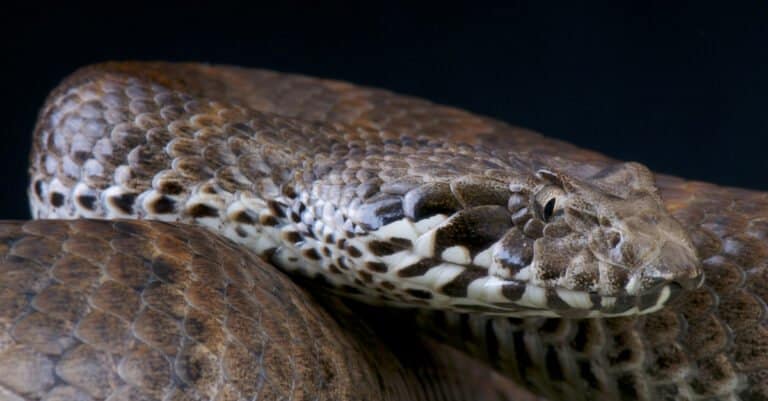
The Death Adder has a triangular-shaped head often likened to an arrow. This snake has long fangs that provide a lethal bite and a stocky-looking body. The tail, however, is thin and has a short spine. This snake has a gray to reddish-brown body with black, brown, or red bands, with a gray to cream belly. The reptile measures 26 to 38 inches.

How to identify a Death Adder:
Triangular head
Stocky body
Thin tail with short spine
Gray to reddish-brown body
Gray to cream-colored belly

Death Adder Venom: How Dangerous Are They?

The Death Adder is one of the most venomous snakes in the world. Before the invention of antivenom, most people bitten by these snakes died, and the bites can still be fatal. Prompt medical attention is necessary if you are bitten, and you should avoid movement as much as possible until you receive treatment.

Death Adder Behavior and Humans

Death Adders are venomous but not openly aggressive. Adder-human conflict is more likely when engaging in outdoor activity and someone manages to disturb one of these snakes. In most circumstances, these snakes prefer to avoid attracting attention.

View all 446 animals that start with D

Sources

  1. Australian Reptile Park
  2. Australian Museum
  3. Untamed Science
  4. Kidadl
  5. Queensland Museum
  6. University of Melbourne

Thank you for reading! Have some feedback for us?

Contact the AZ Animals editorial team

Related Articles You May Find Interesting

πŸ‘ Image
Articles

Steve Irwin’s Legacy: How One Zookeeper Changed Our Relationship with Wildlife Forever


Death Adder FAQs (Frequently Asked Questions)

Death Adders are venomous, using their fangs to inflict a fatal bite on their prey through their neurotoxic venom.

Death Adders lie in wait to strike their prey, blending in with the scenery to avoid detection.

Death Adders will not seek open conflict with non-prey animals but will strike if cornered or otherwise threatened.

Death Adders usually avoid desert areas of Australia but live in woodland, forest, heath, and grassland areas.

Death Adders eat birds and other animals of small size, including Cane Toads, which have sometimes poisoned the snakes.

A Death Adder is a venomous snake species native to Australia and related to Cobras.

Death Adders are highly venomous, killing prey quickly with a bite and capable of killing pets with their bites.

Cane Toads often eat young Death Adders, and Buzzards and Crows prey on Death Adders of all sizes.

Death Adders get their name from their resemblance to vipers, which many people consider the deadliest type of snake.

Despite its viper-like appearance, a Death Adder is more closely related to the Cobra.

An inland taipan would win a fight against a death adder. The inland taipan is the larger snake of the two and it takes longer for the venom to impact them than the smaller adder. Another interesting factor is the strength of the venom of the two snakes. The inland taipan has much more powerful venom than the death adder.