
E
Species Profile

Earwig

Dermaptera

Forceps, night-life, and fierce mothering
iStock.com/Huseyin Selcuk KIRAY

At a Glance

Order Overview This page covers the Earwig order as a group. Stats below are general traits shared across the order.
Also Known As pincher, pincher bug, pincer, pincer bug
Diet Omnivore
Activity Nocturnal+
Lifespan 9 years
Weight 0.005 lbs
Status Not Evaluated
Did You Know?

Size range across the order is roughly ~5-50 mm long (a few exceptional species historically reported larger).

Scientific Classification

Order Overview "Earwig" is not a single species but represents an entire order containing multiple species.

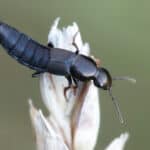
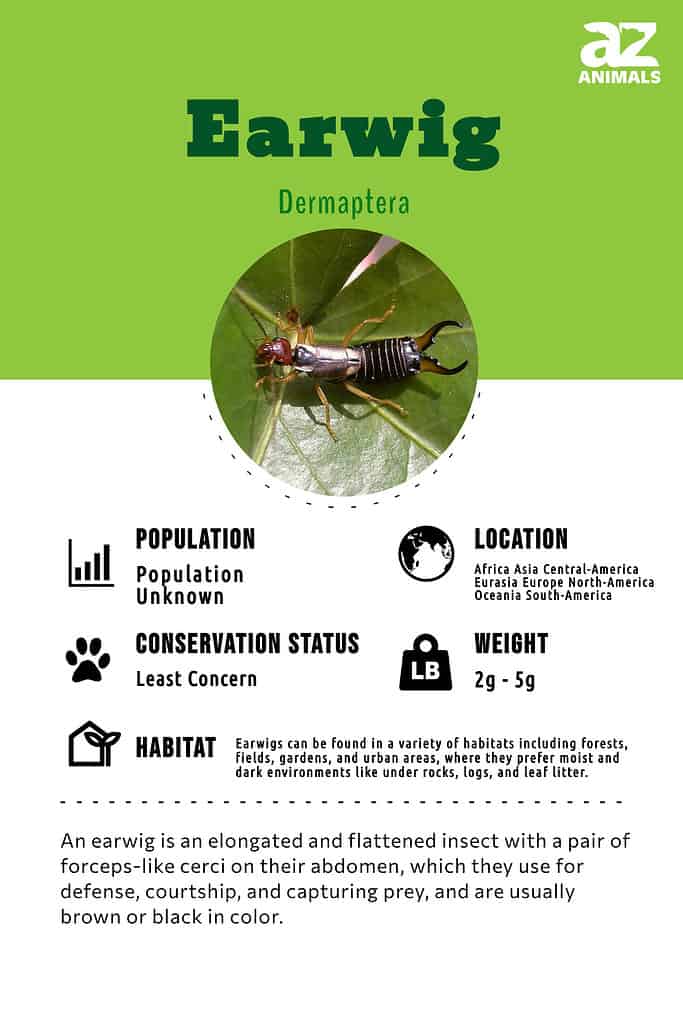
Earwigs (order Dermaptera) are mostly nocturnal insects characterized by elongated bodies and a pair of forceps-like appendages (cerci) at the tip of the abdomen. They are generalist omnivores/scavengers and many provide notable maternal care of eggs and young.

Kingdom
Animalia
Phylum
Arthropoda
Class
Insecta
Order
Dermaptera

Distinguishing Features

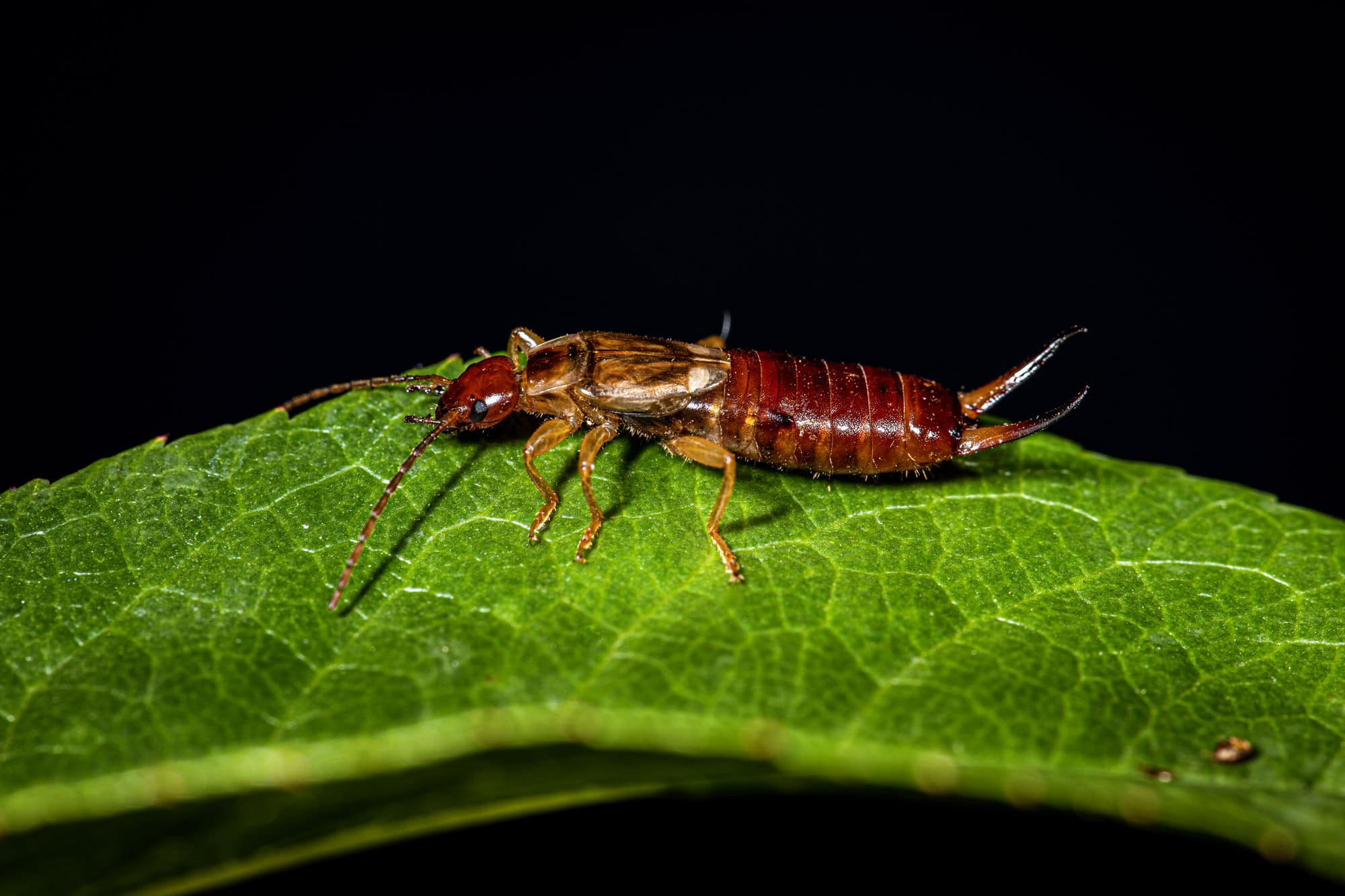
  • Forceps-like cerci at the end of the abdomen (often curved in males, straighter in females)
  • Short, leathery forewings (tegmina) with folded hindwings in many species; some species are wingless
  • Elongate, somewhat flattened body adapted to crevices
  • Nocturnal behavior and preference for humid refuges
  • Maternal care (guarding/cleaning eggs and tending nymphs) in many species

Physical Measurements

Males and females differ in size

Length
1 in (0 in – 4 in)
1 in (0 in – 3 in)
Weight
0 lbs (0 lbs – 0 lbs)
Tail Length
0 in (0 in – 1 in)
0 in (0 in – 1 in)
Top Speed
2 mph
About 1-5 km/h

Appearance

Primary Colors
Secondary Colors
Skin Type Hard, sclerotized chitinous exoskeleton with a flattened, flexible abdomen; short leathery forewings (tegmina/elytra) cover folded hindwings in many species, though wing reduction or winglessness is common in some groups.
Distinctive Features
  • Measurements (order-wide range): adults are typically about 0.5-2.5 cm in body length; some species are substantially larger, with the Saint Helena giant earwig reported at up to about 8 cm.
  • Body plan: elongated, somewhat flattened body; long, threadlike antennae; chewing mouthparts; abdomen often visibly segmented and flexible.
  • Cerci/forceps: hallmark paired forceps-like cerci at the abdominal tip, used in defense, prey handling, mating interactions, and wing-folding (in winged forms); shape varies widely among families and sexes.
  • Wings: many species have short forewings with large membranous hindwings folded beneath; some are capable fliers, but wing reduction/winglessness is frequent depending on lineage and habitat.
  • Most earwigs live about 6–12 months from egg to adult death in many temperate species; some live 1–2 years, and a few up to about 3 years.
  • Activity pattern: predominantly nocturnal or crepuscular; typically avoid light and heat, becoming active at night to forage.
  • Moisture-seeking microhabitats: commonly shelter in humid refuges-leaf litter, under bark, stones, logs, in soil crevices, compost, rotting wood, and around human structures (e.g., mulch, gaps in siding) when conditions are moist.
  • Earwigs are generalist omnivores. Many scavenge and hunt, eating decaying plant and animal matter, fungi, algae, and small arthropods (like aphids). Some nibble plants; others are more predatory.
  • Many earwig species have mothers that guard and groom eggs to cut fungal growth, and protect or guide young; care level varies by species and lineage, and is reduced in some specialized groups.
  • Earwigs (Dermaptera) live in many habitats—forests, grasslands, deserts (in damp spots), and tropical areas. Most are free-living, but some live with mammals (epizoic/commensal), showing great diversity.
  • Human interactions: generally harmless; can deliver a defensive pinch with forceps (more likely from larger individuals), but they are not medically dangerous and are not known for routinely infesting human ears.

Sexual Dimorphism

Sexual dimorphism is common, especially in the cerci (forceps): males often have larger, more robust and more strongly curved forceps used in mating interactions and competition; females typically have straighter, finer forceps. Degree of dimorphism varies widely among families and species, and in some taxa it is subtle.

  • Forceps often thicker, longer relative to body size, and more curved; may show asymmetry or pronounced teeth/ridges in some species.
  • In some species, males are slightly larger or have more developed abdominal/cerci musculature; variability across the order is high.
  • Forceps typically straighter or less curved, often more evenly tapered; generally suited for defense and handling rather than male-male competition.
  • Females often exhibit behaviors tied to egg care (brooding/guarding/grooming), though behavior is not strictly diagnostic and varies among taxa.

Did You Know?

Size range across the order is roughly ~5-50 mm long (a few exceptional species historically reported larger).

Their "forceps" are cerci-modified abdominal appendages that vary by species and often differ between males and females.

Many earwigs can fold their hind wings into tight packets using a fan-like, origami-style folding system; many species are also wingless.

Maternal care is widespread: females commonly guard, clean, and sometimes feed eggs and young nymphs-rare dedication among insects.

Diet is flexible: many are scavengers/omnivores, but numerous species actively hunt soft-bodied pests like aphids and small larvae.

They favor humid microhabitats-under bark, stones, leaf litter, compost, and crevices-so they're often noticed in gardens after watering or rain.

Earwigs use chemical defenses in some groups, releasing strong-smelling secretions to deter predators.

Unique Adaptations

  • Cerci/forceps multifunctionality: used in defense displays, grappling during mating, handling prey, and (in winged species) assisting with wing folding; the exact shape ranges from slender to strongly curved, often with sexual dimorphism.
  • Remarkable wing engineering: When present, hind wings unfold into broad fans for flight yet refold into compact bundles under short forewings (tegmina)-one of the most intricate folding mechanisms among insects.
  • Parental investment: Egg-guarding and egg-cleaning (reducing fungal growth) is a key behavioral adaptation in many earwigs, improving offspring survival in damp microhabitats.
  • Body plan for crevices: Flattened, elongated bodies help many species squeeze into bark cracks, soil spaces, and leaf litter-useful both for avoiding predators and conserving moisture.
  • Chemical defenses: Several earwigs can emit defensive secretions (often from abdominal glands), adding a chemical deterrent to the visual threat of raised forceps.
  • Flexible habitat use: The order includes fully winged, short-winged, and wingless forms, reflecting adaptation to different lifestyles-from mobile foragers to more sedentary, shelter-bound species.

Interesting Behaviors

  • Nocturnal routine: Many species shelter by day in tight, damp refuges and forage at night; however, some live in nests, caves, shore wrack, or other specialized habitats depending on species.
  • Moisture-seeking: Across Dermaptera, humidity strongly shapes where they hide and feed; drought can push them into buildings, greenhouses, or irrigated garden beds.
  • Omnivory with local variation: Diets range from decaying plant/animal matter to living prey (e.g., aphids, mites, small caterpillars). Some species become notable plant nibblers on tender shoots, flowers, or fruit when abundant.
  • Predation tactics: Many use the cerci to help pin or maneuver prey while biting with chewing mouthparts; the relative importance of the forceps varies among families and species.
  • Maternal care (common, not universal): Females in many lineages guard eggs, groom them to reduce mold, and defend the nest; in some species, care extends to early instars, while in others it is shorter or reduced.
  • Social tolerance: Some species show temporary family groups (female with young) and tolerate close contact in shelters; others are more solitary and aggressive, especially around nesting sites.
  • Seasonal life cycles: In temperate regions many species overwinter as adults or nymphs and produce one main generation per year, but tropical species may breed more continuously.

Cultural Significance

Earwigs (Dermaptera) are in gardens as helpers that eat pests and as pests that chew flowers or fruit. European old stories link them to ears; they show up in garden tips and lessons on insect care.

Myths & Legends

Earwigs (Dermaptera) were believed in medieval and early modern Europe to crawl into sleeping people's ears, sometimes laying eggs or causing sickness. The English name comes from Old English words for 'ear' and 'insect.'

In parts of Europe, the earwig's tail forceps were treated in popular imagination as tiny pincers or "devil's tongs," feeding superstitions that the insect could pinch aggressively or harm sleepers, especially children.

Naturalists and household lore in Britain and elsewhere sometimes connected earwigs with "ear" ailments and home remedies-anxieties and stories that circulated alongside the insect's everyday presence in damp sheds, thatch, and gardens.

In Victorian and later children's tales, earwigs (Dermaptera) were shown as sneaky night insects that hide in cracks and folds, using their forceps as signs of mischief or menace in moral stories.

Looking for a specific species?

Common earwig

Forficula auricularia

This is the species most widely encountered and referred to as an "earwig" in everyday contexts (especially across Europe and many introduced regions), making it the most common default reference for the group's common name.

  • Order-level size range: Dermaptera span from very small species around ~0.5 cm to large tropical forms approaching ~7-8 cm (body length), reflecting substantial diversity across families and regions.
  • Order-level lifespan range: many earwigs live roughly ~6-18 months, but some species can persist ~2-3 years depending on climate, overwintering stage, and reproductive strategy (single vs. multiple broods).
  • Behavior/ecology generalizations (with variation): most are nocturnal, shelter by day (under bark, stones, leaf litter, soil crevices, human structures), and are omnivorous/scavenging; the balance of predation vs. plant-feeding varies strongly among species and habitats.
  • Reproduction and care: maternal care of eggs (and often early nymphs) is common across Dermaptera, but the intensity/duration of care and nesting behavior varies among lineages (some provide extended guarding/cleaning; others less so).
  • Distinctive morphology: forceps-like cerci are characteristic of the order; forceps shape and sexual dimorphism vary widely and can be important for defense, courtship, and prey handling.

You might be looking for:

European earwig

55%

Forficula auricularia

Widespread, well-known earwig with prominent forceps-like cerci; common in gardens and homes in many temperate regions.

Seaside earwig

18%

Anisolabis maritima

Coastal earwig found near shorelines; typically dark, robust, and associated with marine debris zones.

Ring-legged earwig

15%

Euborellia annulipes

Common in warmer regions and greenhouses; noted for banded legs and nocturnal habits.

Spotted earwig

12%

Labidura riparia

A larger earwig species often found in sandy or riparian habitats; widely distributed in many regions.

Life Cycle

Birth 40 nymphs
Lifespan 9 years

Lifespan

In the Wild 2–36 years
In Captivity 3–12 years

Reproduction

Mating System Polygynandry
Social Structure Solitary
Breeding Pattern Serial
Fertilization Internal Fertilization
Birth Type Internal_fertilization

Behavior & Ecology

Social Aggregation Group: 10
Activity Nocturnal, Crepuscular, Cathemeral, Diurnal
Diet Omnivore Opportunistic; commonly favor soft-bodied insects (e.g., aphids) when abundant, but readily switch to tender plant/fruit material and fungi depending on availability.
Seasonal Hibernates

Temperament

Generally secretive and refuge-oriented; avoids open exposure
Defensive when handled or threatened; forceps used for grappling/pinching and display (severity varies widely by species and sex)
Male-male aggression and territoriality can occur around mates/refuges in some taxa; others are comparatively tolerant in shelters
Maternal defensiveness is common during egg and early nymph care; tolerance toward offspring is context-dependent
Opportunistic omnivory and scavenging; cannibalism (including egg/nymph cannibalism) occurs in some species, often linked to food scarcity or disturbance

Communication

stridulatory rasping/creaking sounds in some species (produced by rubbing body parts), typically in defensive or disturbance contexts
chemical cues/pheromones Including aggregation cues in some taxa; also cuticular chemicals involved in recognition and reproductive state
tactile signaling via antennae and cerci during courtship, conflict, and brood interactions
substrate-borne vibrations and tapping movements reported/implicated in some lineages
visual postures and forceps displays at close range Not long-distance signaling

Habitat

Biomes:
Tropical Rainforest Tropical Dry Forest Savanna Desert Hot Desert Cold Mediterranean Temperate Grassland Temperate Forest Temperate Rainforest Boreal Forest (Taiga) Tundra Alpine Freshwater Wetland Marine +9
Terrain:
Plains Valley Hilly Mountainous Coastal Island Riverine Rocky Sandy Muddy +4
Elevation: Up to 14763 ft 9 in

Ecological Role

Generalist omnivores that function as both predators and scavenger-grazers in litter, soil-surface, and vegetation microhabitats; their net role ranges from beneficial natural enemies to occasional plant/fruit pests depending on species and context.

biological control of pest arthropods (e.g., aphids, small larvae, eggs) in many ecosystems and agroecosystems nutrient cycling via scavenging and consumption of detritus/fungi food-web support as prey for birds, reptiles/amphibians, small mammals, and other arthropods potential negative service: damage to seedlings, flowers, and soft fruits in some species/conditions

Diet Details

Main Prey:
Aphids and other soft-bodied Hemiptera Caterpillars and moth/butterfly larvae Insect eggs Beetle larvae and other insect larvae Mites Springtails Small spiders Small insects and invertebrates +2
Other Foods:
Tender plant tissues Flowers and petals Pollen Fruits and berries Fungi and mold Detritus Seeds and grains +1

Human Interaction

Domestication Status

Wild

Earwigs (order Dermaptera) are wild insects with no history of domestication or selective breeding. People meet them mainly by chance in homes, gardens, and farms. They can be pests on some crops but also help by eating pests or cleaning up debris. Sometimes they are kept briefly for classroom or hobby observation, not as true pets.

Danger Level

Low
  • Minor pinches from cerci if handled; can startle but typically causes only brief discomfort and rarely breaks skin.
  • Nuisance infestations: can enter homes seeking moisture/shelter; may contaminate stored items or produce droppings/odor in heavy aggregations.
  • Allergic reactions are uncommon but possible (as with many insects) via contact sensitivities or asthma triggers from debris.
  • Myth correction: they do not crawl into ears as a normal behavior and are not known to parasitize humans.

As a Pet

Not Suitable as Pet

Legality: Generally legal to possess for personal/educational use in many jurisdictions, but local rules may restrict collecting native wildlife, transporting live insects across state/provincial/national borders, or keeping/importing non-native species; agricultural/quarantine regulations can apply. Always check local invasive-species and collection permits.

Care Level: Moderate

Purchase Cost: Up to $20
Lifetime Cost: $10 - $100

Economic Value

Uses:
Agriculture and horticulture (mixed: pest and beneficial predator/scavenger) Household nuisance management (pest control services/products) Ecosystem services (decomposition, nutrient cycling, soil/litter food webs) Education and research (behavior, maternal care, development)
Products:
  • Biological control services (predation on soft-bodied pests such as aphids and other small arthropods)
  • Compost/leaf-litter decomposition contribution (ecosystem service, not a market product)
  • Pest management expenditures (traps/insecticides/exclusion materials) in cases of infestation or crop damage

Relationships

Predators 8

European robin Erithacus rubecula
Common starling Sturnus vulgaris
House sparrow Passer domesticus
Wolf spider Lycosidae
Ground beetles Carabidae
Common toad Bufo bufo
Common wall lizard Podarcis muralis
Common shrew Sorex araneus

Related Species 4

Cockroaches and termites Blattodea Shared Order
Grasshoppers, crickets, katydids Orthoptera Shared Order
Praying mantises Mantodea Shared Class
Stick and leaf insects Phasmatodea Shared Order

Ecological Equivalents 4

Animals that fill a similar ecological role in their ecosystem

Rove beetle Staphylinidae Many are nocturnal or crepuscular generalist predators and scavengers in leaf litter, soil, compost, and under-bark microhabitats. They overlap with earwigs in these habitats and in prey use, though rove beetles lack earwigs' forceps-like cerci and have different life histories.
Ground beetles Carabidae Common nocturnal hunters in gardens and in soil surface layers. They overlap with earwigs in feeding on small invertebrates (eggs and larvae) and in occupying shelter sites, but carabids are typically more strictly predatory.
Woodlice Oniscidea Detritus-associated, shelter-seeking members of the decomposer community in moist microhabitats such as leaf litter and under stones or wood. They often share these microhabitats with earwigs and are frequently encountered together in compost and garden refuges.
Cockroaches Blattodea Many are nocturnal omnivores and scavengers, using crevices and debris as daytime refuges. Ecological overlap is strongest in human-modified habitats and in warm, moist micro-sites.

Types of Earwig

12

Explore 12 recognized types of earwig

Common earwig Forficula auricularia
Seaside earwig Anisolabis maritima
Ring-legged earwig Euborellia annulipes
Shore earwig Labidura riparia
Tawny earwig Labidura truncata
Striped earwig Doru taeniatum
Yellow earwig Doru luteipes
Mediterranean earwig Apterygida media
Livid earwig Nala lividipes
Spined earwig Vostox apicedentatus
Seychelles earwig Echinosoma denticulatum
Giant earwig Titanolabis colossea
👁 Image

“No in-ear problems with the Earwig!”

Earwigs are nocturnal insects that can be identified by the large pair of pincers at the end of their bodies. Outside, they’re found under rocks, in rotted tree bark, and in other moist places.

Inside, they can be found in the pantry, where they do eat foods that haven’t been well secured. The earwig also eats crops and garden plants, but it is also a very efficient killer of other garden pests such as thrips, aphids, and snails.

The meaning of the earwig’s name probably doesn’t come from the old wives’ tale that it will enter someone’s ear and lay eggs in their brain while they sleep, but from the unique shape of its hindwing.

It’s possible that an earwig may be found in the ear once in a blue moon but probably no more frequently than any other bug. Female earwigs certainly don’t lay their eggs in people’s brains.

5 Incredible Earwig Facts!
👁 Image

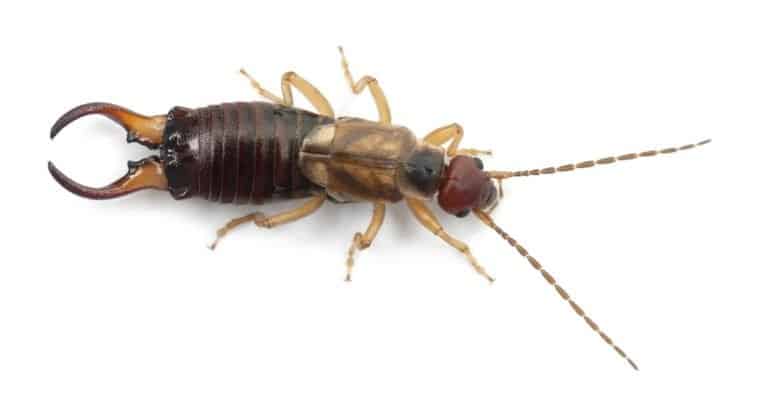
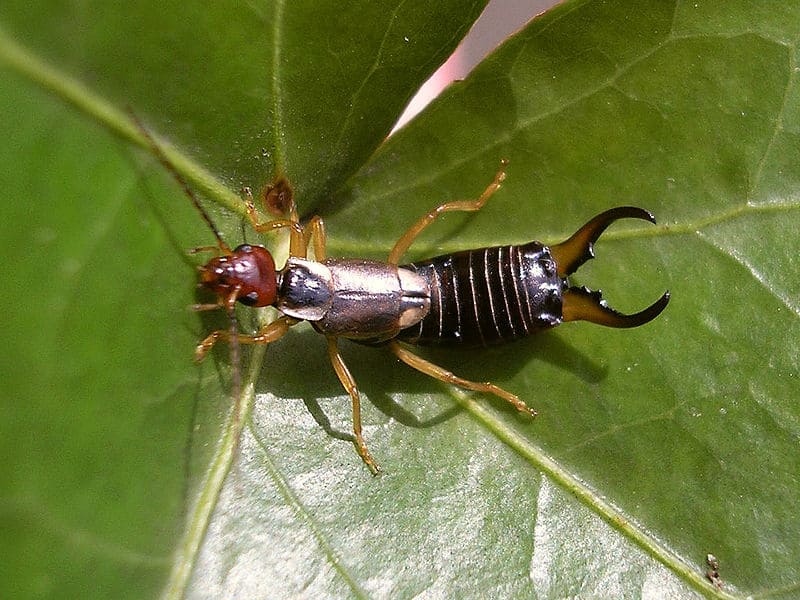
Male Earwig of species Forficula auricularia

©Pudding4brains – Public Domain

  • Earwigs are omnivores, which means they eat both plant and animal material. They prefer scavenging over hunting, however.
  • The earwig can be a pantry-raiding pest or useful in controlling such pests as aphids.
  • The sex of an earwig can be told by the shape of the pincers. Those of the male is large and curved while those of the female are smaller and straighter.
  • Earwigs have wings that are developed enough to allow them to fly, but they rarely fly. They prefer to hitch rides on clothing, plants brought in from the garden center, or lumber.
  • A baby earwig is taken care of by its mother, which is unusual for insects. A baby earwig is called a nymph.

Evolution and Origins

Originally hailing from Europe, this particular species has successfully established itself in the North American region, where it currently thrives. It is distinguishable by its striking dark-red coloration and features distinctive pincer-like appendages known as cerci located at the end of its abdomen.

Furthermore, earwigs, which are classified as insects, have proven to be a highly successful group of creatures as they have managed to survive and thrive for an extensive period of time. Earwigs are believed to have first emerged during the late Triassic era, approximately 208 million years ago, and have continued to exist and evolve up to the present day.

Although earwigs have a reputation for being nocturnal scavengers with a frightening appearance and a tendency to avoid social interaction, they play an essential ecological role as beneficial insects. Earwigs are often referred to as “environmental janitors” as they feed on decaying plant and insect matter, which helps keep gardens clean and preserves the natural beauty and health of green spaces.

Different Types

Here are a few different types of earwigs:

  • European earwig
  • Forficulidae
  • Archidermaptera
  • Anisolabididae
  • Neodermaptera

Species, Types, and Scientific Names

👁 Earwig, Animal, Zoo, Animal Wildlife, Biology

Beautiful Earwig Insect Close Up

©iStock.com/Huseyin Selcuk KIRAY

The earwig is a member of the Dermoptera order. There are a dozen families and 2000 species in this order, which is Greek for “skin wing.” Earwig itself derives from an Old English word meaning “ear insect” or “beetle” and refers to the shape of its wings. Despite the thousands of species, Dermoptera is considered a small order when compared to other insect orders.

The scientific name of the common earwig is Forficula auricularia. Forficula derives from a Latin word for “little shears” or “scissors,” which describes the insect’s pincers. Auricularia describes the human ear shape of the insect’s hind wings when they unfold. This earwig is native to Europe but has spread all around the world in temperate areas. There are 71 genera just in the Forficulidae family.

One earwig that is native to the United States is the spine-tailed earwig, which is found outdoors and drawn to porch lights. Its scientific name is Doru aculeatum. Doru is Greek for “spear” and the meaning of aculeatum is “prickly” in Latin.

Appearance

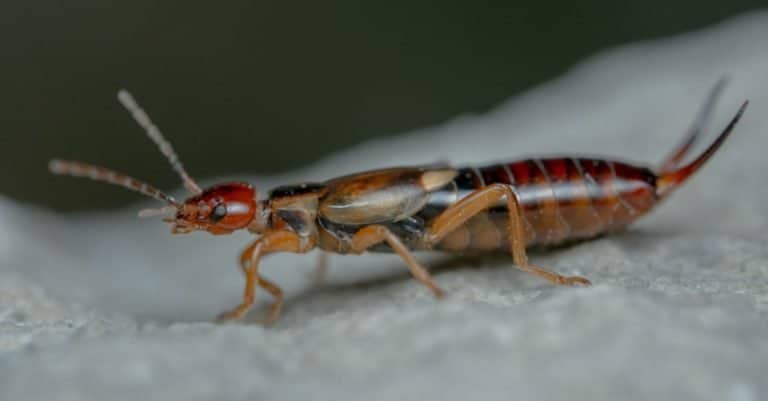
The earwig is about half an inch long when it is mature, though the giant Australian earwig can grow to 2 inches long. Its body is flat, long, hard, and shiny and comes in shades of yellow or brown.

Its upper wings are short and have a leathery texture, and they protect the hindwings, which are delicate and gauzy. The antennae are long, delicate, and beaded. Like most other insects, the earwig has six legs. Its abdomen is segmented, and its mouthparts evolved to bite and chew.

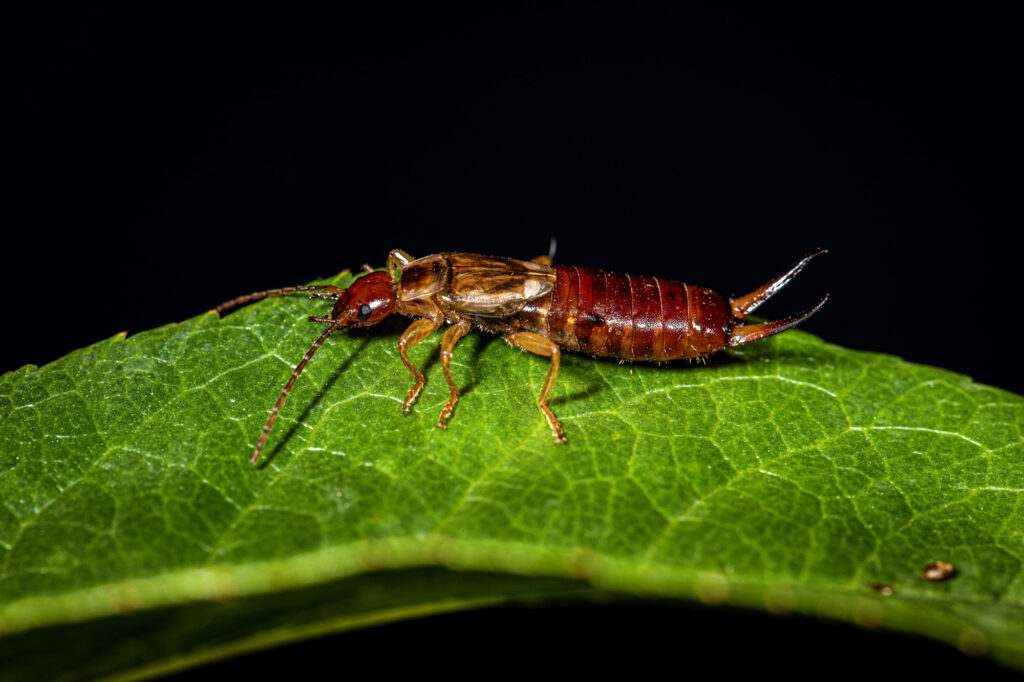
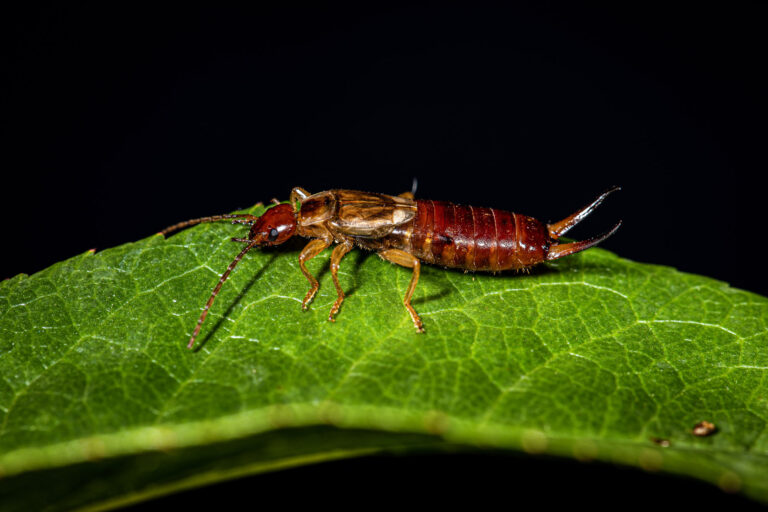
What distinguishes these insects is the forceps or pincer at the end of their body. The scientific name for these pincers is cerci. Those of the male are not only longer than those of the female, but they are curved and have teeth.

The insect uses its cerci while it feeds, and they also come into play when it mates and defends itself. It also uses the cerci to fold its hindwings up and hide them beneath the forewings. A third instar baby earwig, or nymph, can grow part of its cerci back if they lose it, but it will be straight.
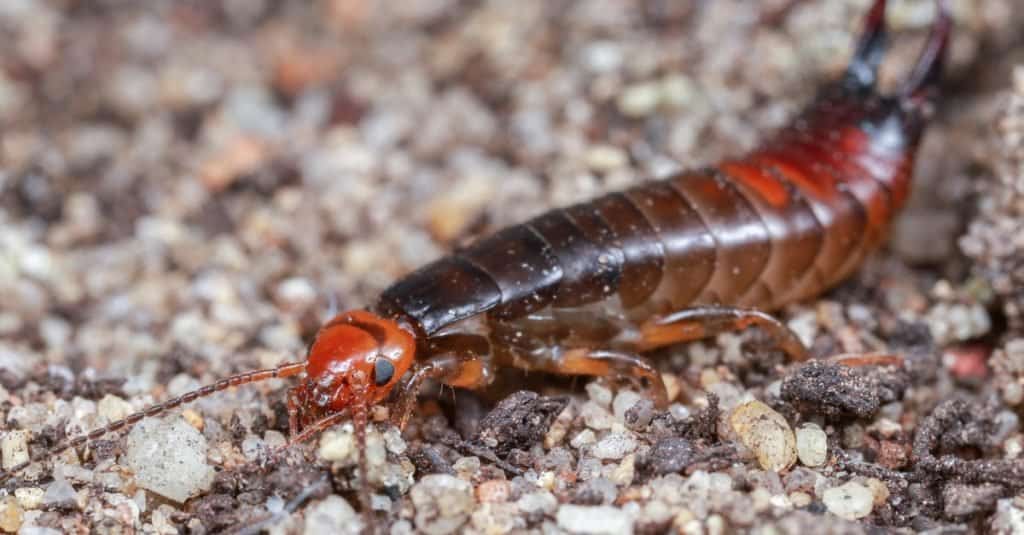
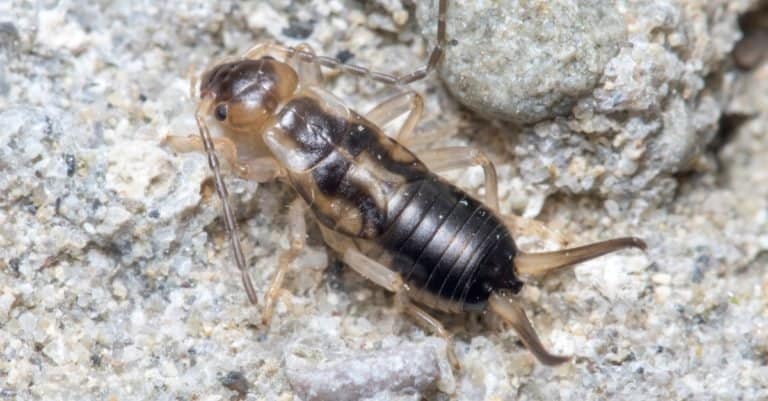
👁 Red headed earwig crawling on sand.
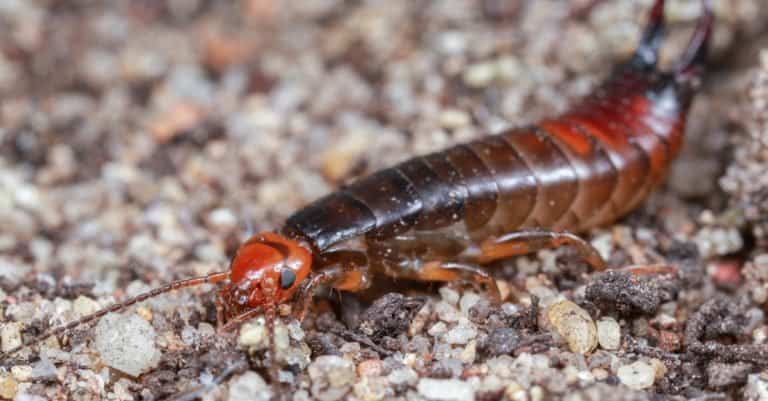
Red-headed earwig crawling on the sand.

©Peter Yeeles/Shutterstock.com

Habitat
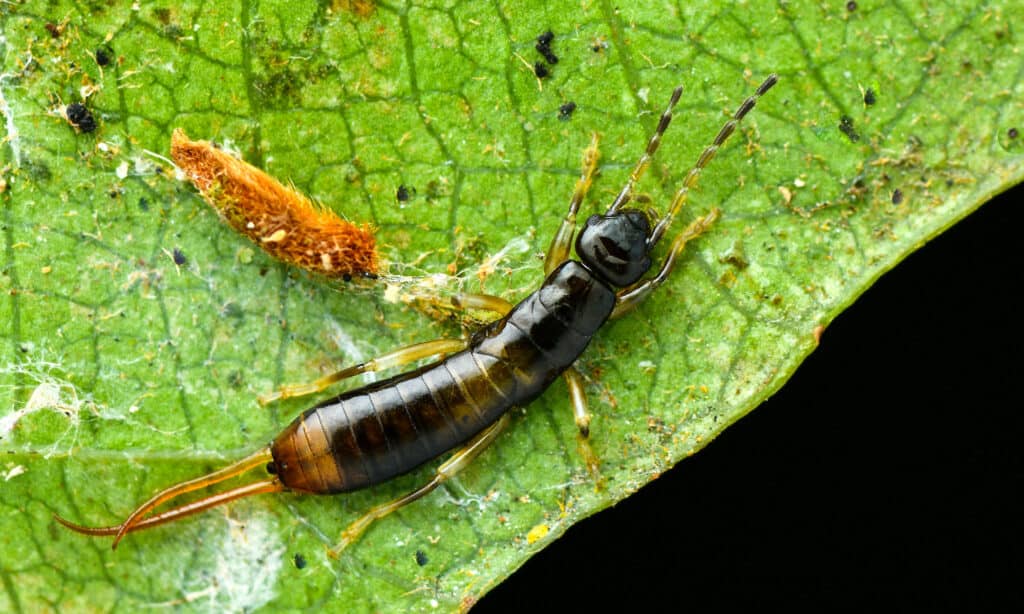
👁 macro image of an earwig

©SIMON SHIM/Shutterstock.com

Earwigs are found just about everywhere on Earth save Antarctica, which is too cold and dry for them. Their ideal habitat is a moist, dark place that’s around 75 degrees Fahrenheit.

They are active at night, and some species are drawn to outdoor lights. During the day, they hide in crevices, trash, under rocks, or in rotting logs. They’re also found in garbage cans, in bathrooms, and on lawn furniture. Some earwigs are blind and live in caves.

A gardener who suspects earwigs is eating their plants can go out at night with a flashlight, and look for them. Earwigs in the home are often seen on the walls or on the ceiling. If they feel threatened, they’ll drop to the floor and scramble away.

Diet

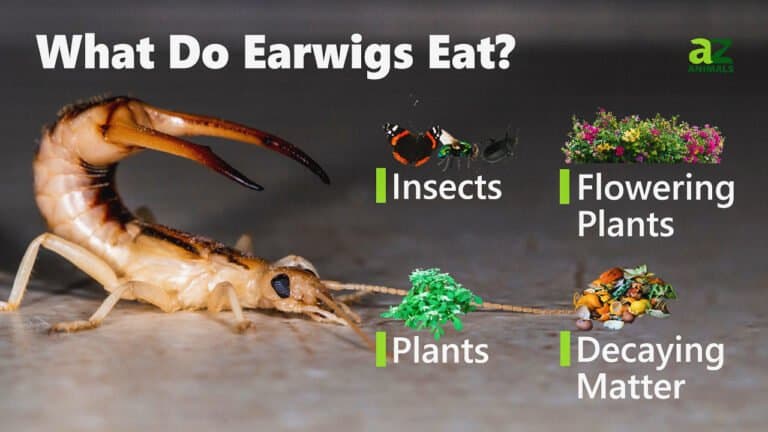
Earwigs are omnivores, which means they eat both plants and animals, living or dead. They prefer to scavenge though others are predators of other insects such as plant lice, maggots, aphids, and flies. Because of this, earwigs may be beneficial to garden plants and crops. There are suborders of earwigs that are mammal parasites. Many of these earwigs feed on the secretions and even the guano of bats. Others are found on rats.

Prevention

These insects are harmless to humans, they don’t spread diseases, and they’re not even as destructive as other insects such as Japanese beetles. Still, an infestation of them can wreak havoc on the pantry or the garden.

Even if they weren’t household or garden pests, their appearance is off-putting to many people, and they smell bad on top of everything else. There are several ways to get rid of an infestation. One way is to expose them to their own predators. These include types of ground beetles, birds, snakes, and toads.

Another way of getting rid of these insects is to trap them. One type of trap is an oil pit trap. Just put 50 percent soy sauce and 50 percent cooking oil in a plastic container, put a lid on, and punch holes in the top near the lid that is big enough for the earwigs to enter. Then, bury the container up to the holes.

Another trap is to put one-foot pieces of garden hose or bamboo between garden plants. The insects enter these pieces, and all the gardener needs to do is collect them every morning and shake out the bugs into a container of soapy water. They also don’t like to walk on petroleum jelly, and a sprinkling of boric acid around a woodpile is also an effective killer of these insects.

Another way to get rid of them is to spray them with pure rubbing or grain alcohol. Mix the alcohol with some water, and spritz the bugs. The alcohol strips off the protective coat on their bodies and kills them.

View all 185 animals that start with E

Sources

  1. The Old Farmer's Almanac / Accessed June 7, 2021
  2. Wikipedia / Accessed June 7, 2021
  3. Animal Diversity Web / Accessed June 7, 2021

About the Author

Rebecca Bales

Rebecca is an experienced Professional Freelancer with nearly a decade of expertise in writing SEO Content, Digital Illustrations, and Graphic Design. When not engrossed in her creative endeavors, Rebecca dedicates her time to cycling and filming her nature adventures. When not focused on her passion for creating and crafting optimized materials, she harbors a deep fascination and love for cats, jumping spiders, and pet rats.
Connect:

Thank you for reading! Have some feedback for us?

Contact the AZ Animals editorial team

Related Articles You May Find Interesting


Earwig FAQs (Frequently Asked Questions)

Earwigs are Omnivores, meaning they eat both plants and other animals.

Earwigs belong to the Kingdom Animalia.

Earwigs belong to the class Insecta.

Earwigs belong to the phylum Arthropoda.

Earwigs belong to the order Dermaptera.

Earwigs are covered in shells.

Earwigs are found worldwide.

Earwigs live in grass and woodlands.

Earwigs eat plants, flowers, and insects.

Predators of Earwigs include toads, birds, and beetles.

Earwigs have sharp pincers and delicate wings.

The average number of babies an Earwig has is 50.

There are nearly 2,000 different species of Earwig!

There are 1,800 species of Earwig.

An earwig is an insect that can be told from other insects by the cerci at the end of its body.

Efficient killers and eaters of earwigs are birds, toads, snakes, and beetles.

Their called earwigs either because of the myth of them crawling into people’s ears or because their hindwings are ear-shaped.

Earwigs do what other insects do. They eat, they hide from predators, and they reproduce. Because they often eat pantry items, flowers, and crops, they are problematic for humans.

Earwigs are omnivores, so they eat plants, animals, and fungi.

An infestation of earwigs can be gotten rid of by spraying them with insecticides including diluted alcohol and by luring them into traps. They can also just be vacuumed up if they’re seen.

Earwigs are not directly harmful to humans. They can bite and pinch, but these are more annoying than harmful.

Earwigs do not go into people’s ears and lay eggs.

Earwigs are attracted to places that are moist and warm, so it is difficult to completely house-proof against earwigs. The best thing to do is to make sure they are not brought into the house in the first place and to eliminate them right away if they are seen.

Earwigs aren’t dangerous. Even the bite and pinch from the toothed pincers of a male won’t do much harm to a human.

An earwig has six legs like other insects.

An earwig can be identified by its brown, flattened body, its long antennae, and, especially, its pincers. Without the pincers, it would look very much like a cockroach.


The key differences between an earwig and a silverfish are their size, physical features, diet, and lifespan.

The earwig and the silverfish are two small insects that normally dwell outside but can get into your house if you’re not careful. If they grow into an infestation, they can cause harm to your goods. However, their diet, lifespan, and outward appearance are each unique.

The key differences between an earwig and a termite are size, color, diet, lifespan, key features, and infestation.

Earwigs and termites are not related in any way at all. They don’t look alike or eat the same things; they also have varied preferences for living arrangements.