
E
Species Profile

Elephant

Elephantidae

One family, many giants
Peter Fodor/Shutterstock.com

Elephant Distribution

Click a location to explore more animals from that region

Loading map...

Found in 50 countries

🇦🇴 Angola 🇧🇩 Bangladesh 🇧🇫 Burkina Faso 🇧🇮 Burundi 🇧🇯 Benin 🇧🇹 Bhutan 🇧🇼 Botswana 🇨🇩 Democratic Republic of Congo 🇨🇫 Central African Republic 🇨🇬 Republic of Congo 🇨🇮 Côte d'Ivoire 🇨🇲 Cameroon 🇨🇳 China 🇪🇹 Ethiopia 🇬🇦 Gabon 🇬🇭 Ghana 🇬🇲 Gambia 🇬🇳 Guinea 🇬🇶 Equatorial Guinea 🇬🇼 Guinea-Bissau 🇮🇳 India 🇰🇪 Kenya 🇰🇭 Cambodia 🇱🇦 Lao People's Democratic Republic 🇱🇰 Sri Lanka 🇱🇷 Liberia 🇲🇱 Mali 🇲🇲 Myanmar 🇲🇼 Malawi 🇲🇾 Malaysia 🇲🇿 Mozambique 🇳🇦 Namibia 🇳🇪 Niger 🇳🇬 Nigeria 🇳🇵 Nepal 🇷🇼 Rwanda 🇸🇩 Sudan 🇸🇱 Sierra Leone 🇸🇳 Senegal 🇸🇸 South Sudan 🇸🇿 Eswatini 🇹🇩 Chad 🇹🇬 Togo 🇹🇭 Thailand 🇹🇿 Tanzania 🇺🇬 Uganda 🇻🇳 Vietnam 🇿🇦 South Africa 🇿🇲 Zambia 🇿🇼 Zimbabwe

Size Comparison

Human 5'8"
Elephant 9 ft 10 in

Elephant is 1.7x the height of an average human.

At a Glance

Family Overview This page covers the Elephant family as a group. Stats below are general traits shared across the family.
Also Known As Pachyderm, Tusker, Jumbo, Elefante, Gajah, Hathi
Diet Herbivore
Activity Cathemeral+
Lifespan 55 years
Weight 7000 lbs
Status Not Evaluated
Did You Know?

An elephant's trunk is a fused nose and upper lip with ~40,000 muscles, used for breathing, smelling, grasping, drinking, dust-bathing, and trumpeting.

Scientific Classification

Family Overview "Elephant" is not a single species but represents an entire family containing multiple species.

Elephants (family Elephantidae) are large proboscideans characterized by a muscular trunk, tusks (elongated incisors), pillar-like limbs, and complex social behavior. The living members comprise African elephants (genus Loxodonta) and the Asian elephant (genus Elephas).

Kingdom
Animalia
Phylum
Chordata
Class
Mammalia
Order
Proboscidea
Family
Elephantidae

Distinguishing Features

  • Long muscular trunk (fused nose and upper lip) used for feeding, drinking, communication, and manipulation
  • Tusks (prominent in many individuals; reduced/absent in some females depending on species/population)
  • Large ears for thermoregulation (generally larger in African elephants than Asian elephants)
  • Highly social, intelligent, long-lived mammals with matriarchal family groups

Physical Measurements

Males and females differ in size

Height
10 ft 2 in (6 ft 7 in – 12 ft 10 in)
7 ft 10 in (6 ft 7 in – 8 ft 10 in)
Length
21 ft 4 in (14 ft 9 in – 26 ft 3 in)
Weight
6.6 tons (2.2 tons – 11.5 tons)
3.0 tons (2.2 tons – 4.0 tons)
Tail Length
4 ft 3 in (3 ft 3 in – 5 ft 3 in)
4 ft 7 in (3 ft 3 in – 5 ft 11 in)
Top Speed
25 mph
Bursts typically 25–35 km/h

Appearance

Primary Colors
Secondary Colors
Skin Type Elephants have very thick, tough, deeply wrinkled skin with sparse bristly hair, more in calves and some Asian elephants. They often cover it with dust or mud; trunk tip and behind ears stay sensitive.
Distinctive Features
  • Elephants range widely: shoulder height about 2.0–4.0+ m, body mass about 2,000–6,000+ kg, head and body length about 5–7.5 m. Size varies by species (African savanna, African forest, Asian), sex, and local conditions.
  • Lifespan across the family: commonly ~40-70 years in natural conditions; longevity varies with habitat quality, human pressure, and access to water/forage, and can differ among species and populations.
  • Elephant trunks are strong, flexible long nose and upper lip used for breathing, smelling, making sounds, grasping, drinking (suck then pour), feeding, touch, and handling objects. African elephants have two 'fingers'; Asian have one.
  • Tusks are long upper front teeth elephants use to dig, strip bark, lift or move things, defend themselves, and for social behavior. Size and presence vary by species, sex, age, population, and poaching.
  • Pillar-like limbs and large feet with cushioned pads that distribute weight and aid quiet locomotion; footprints and gait reflect heavy, energy-efficient movement over long distances.
  • Elephants show skull and ear differences: African elephants have larger ears to cool in hot open habitats, Asian elephants have smaller ears; Asian heads often more rounded, African savanna backs more sloped, with individual variation.
  • Elephants have ever-growing molars that move forward and are replaced in order. They are mostly plant eaters—grasses, leaves, bark, fruit—and reshape vegetation, acting as ecosystem engineers.
  • Many elephants form matriarch-led family groups of females and young; adult males often live alone or in loose bachelor groups. Group size and spacing change by species (forest, savanna, Asian), food/water, and human disturbance.
  • Communication: rich multimodal signaling-low-frequency (including infrasonic) rumbles for long-distance contact, trumpets, roars, and a wide array of postures, tactile behaviors, and chemical cues (temporal gland secretions in males during musth).
  • Ecological breadth and movement: occupy habitats ranging from savannas and woodlands to forests and human-modified mosaics; movements can be highly mobile and seasonally driven by water/forage, but can be constrained by fencing, agriculture, and fragmentation.
  • Threats to Elephantidae include habitat loss and breaking up of habitat, human-elephant conflict (crop raiding, property damage, killing in revenge), and poaching for ivory; threats vary by species and place.

Sexual Dimorphism

Male elephants are usually bigger and often have larger tusks, but size and tusks vary by species, population, and genetics. Some females have small tusks called 'tushes' or none. Males also show musth—periods with fluid from a gland, more roaming and fighting.

  • Typically larger overall body size and mass than females (degree varies among African and Asian elephants and among populations).
  • Tusks on average more developed in many populations, though tuskless males occur in some populations and tusk size varies widely.
  • Musth in sexually mature males: temporal gland secretion, urine dribbling, increased roaming and competitive behavior; important for mating access.
  • Adult males more often solitary or in bachelor groups; tend to range more widely than family groups, especially during reproductive periods.
  • Often form the stable core of matriarchal family groups with strong kin-based bonds; matriarchs can be key repositories of social and ecological knowledge.
  • Generally smaller body size than males; size overlap can occur depending on age and local conditions.
  • Tusks reduced or absent more frequently in females in some lineages/populations (e.g., many Asian elephant females have small or no external tusks), but variation is substantial.
  • Extended calf care and cooperative allomothering behaviors are common in family groups, with intensity varying by habitat and group structure.

Did You Know?

An elephant's trunk is a fused nose and upper lip with ~40,000 muscles, used for breathing, smelling, grasping, drinking, dust-bathing, and trumpeting.

Living Elephantidae span two genera: African elephants (Loxodonta-savanna and forest forms) and the Asian elephant (Elephas).

Ears help shed heat: African elephants generally have larger, more heat-radiating ears than Asian elephants.

Tusks are elongated incisors; in many populations, males are more likely to have prominent tusks, while tusk size and presence vary by species, sex, and genetics (including tusklessness).

Elephants communicate with rumbles and infrasound that can travel kilometers, plus seismic vibrations felt through the ground.

They're ecosystem engineers: feeding can open woodlands, disperse seeds, and create water access by digging-effects vary by habitat and species.

Their brains are among the largest of any land animal, supporting sophisticated learning, memory, and social awareness.

Unique Adaptations

  • Trunk versatility: a muscular hydrostat capable of delicate pinches and powerful lifts; trunk "fingers" differ-African elephants typically have two at the tip, Asian elephants usually one, affecting fine manipulation.
  • Tusks/ivory: modified incisors that grow throughout life; used for digging, debarking, lifting, and display-strongly shaped by sex, age, and selective pressures from ivory hunting (including increased tusklessness in some areas).
  • Pillar-like limbs and cushioned feet: thick pads and a specialized foot structure distribute massive body weight and can dampen sound during movement.
  • High-crowned, ridged molars that replace in sequence: suited to abrasive diets; individuals typically cycle through multiple sets over a lifetime, with species differences reflecting diet and habitat.
  • Exceptional hearing and vibration sensing: low-frequency hearing and sensitivity through feet and trunk support long-distance communication and coordination.
  • Thick, sensitive skin with sparse hair: combined with mud/water bathing and ear vascularization to manage heat and parasites-important across savanna, forest, and monsoon climates.
  • Large body size and flexible foraging: enables long-distance travel between patchy resources; migration and home-range sizes vary greatly by landscape and human barriers.
  • Measurable family-wide ranges (living species): shoulder height roughly ~2.0-4.0 m (smallest adult Asian elephants to largest adult African savanna bulls); mass roughly ~2,000-7,000+ kg; tusk length from none/very small in some females and tuskless individuals to several meters in large males (extremes depend on population).
  • Lifespan range across Elephantidae: commonly ~40-70 years in the wild, with variation by species, sex, environment, and human impacts; exceptional individuals can reach ~60-70+ in well-protected conditions.

Interesting Behaviors

  • Matriarchal societies: many herds are led by an older female; related females and young form family units, while adult males often live alone or in loose bachelor groups (degree of cohesion varies by species and habitat).
  • Fission-fusion dynamics: groups may split and reunite depending on season, food, water, and human pressure-often more fluid in some African populations than in many Asian contexts, but variable across regions.
  • Allomothering: females other than the mother may help guard, guide, and assist calves, especially in tightly bonded family groups.
  • Male musth (especially well-studied in Asian and African elephants): a periodic condition with heightened hormones and distinctive behavior that influences dominance and mating; timing and intensity vary among individuals and species.
  • Thermoregulation routines: ear-flapping, shade-seeking, and mud/dust bathing to cool skin and deter insects.
  • Tool and object use: individuals may use branches for fly-switching or scratching; frequency appears to vary with opportunity and local tradition.
  • Grief- and death-associated behaviors: some elephants show prolonged attention to bones or carcasses and altered behavior after loss, though expressions differ among groups and situations.
  • Crop-raiding and risk-aware movement: in human-dominated landscapes, some elephants adjust travel times, routes, and group composition; patterns vary widely across Africa and Asia.

Cultural Significance

Elephants (Elephantidae) are symbols of power, memory and wisdom in Africa and Asia. Asian elephants take part in ceremonies, festivals and religion; African elephants appear in totems and stories. Habitat loss, ivory poaching, and human-elephant conflict drive conservation like protected corridors, ways to live together, and anti-poaching.

Myths & Legends

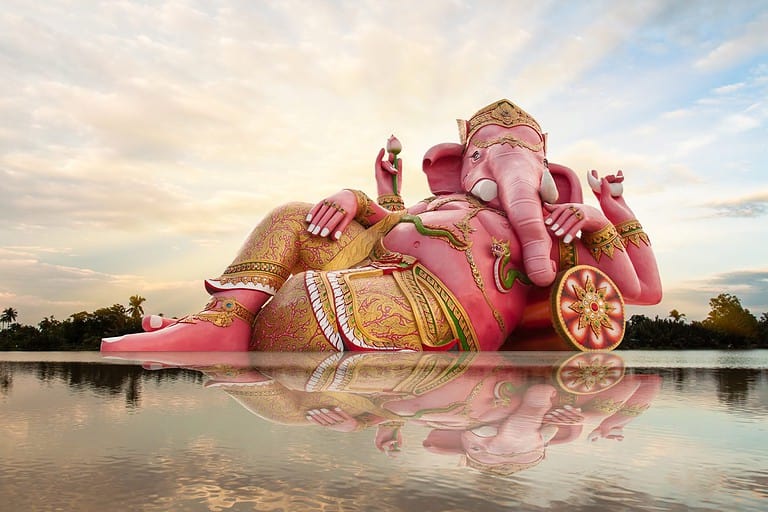
Hindu tradition: Ganesha, the elephant-headed deity, is revered as the remover of obstacles and patron of beginnings; stories describe how he received an elephant head and how his presence blesses endeavors.

Hindu epic imagery: Airavata, the white elephant associated with Indra, appears in myth as a celestial elephant linked to rain and sovereignty, inspiring royal symbolism across South and Southeast Asia.

Buddhist tradition: Queen Maya's dream of a white elephant is a famous legend connected to the conception of the Buddha, making elephants auspicious in many Buddhist cultures.

Thai and Southeast Asian royal lore: white elephants are treated as sacred and tied to legitimacy and prosperity of kingship; historical courts maintained revered white elephants as symbols of divine favor.

African oral traditions (widely told in varied local forms): 'Why the elephant has a trunk' folktales describe an elephant's nose being stretched-often by a crocodile-into the long trunk seen today, explaining anatomy through storytelling.

East African folklore motifs: tales of elephants and humans (or elephants and smaller animals like hares) often emphasize strength tempered by wisdom, or how cleverness can outwit size-reflecting social values and respect for powerful animals.

Swahili coastal and broader African storytelling: elephants sometimes appear as guardians of forests or as embodiments of authority whose paths must be honored, echoing the animal's ecological and cultural impact.

Conservation Status

NE Not Evaluated (family-level hub). Living Elephantidae species span multiple IUCN categories: African forest elephant (Loxodonta cyclotis) is Critically Endangered (CR), African savanna elephant (Loxodonta africana) is Endangered (EN), and Asian elephant (Elephas maximus) is Endangered (EN). Overall conservation condition is therefore heterogeneous across the family rather than representable by a single species status.

Has not yet been evaluated against the criteria.

Population Unknown

Protected Under

  • CITES (international trade controls; African elephant populations listed on Appendix I or II depending on population; Asian elephant on Appendix I)
  • Convention on Migratory Species (CMS) listings for relevant populations
  • Wide coverage under national wildlife protection laws across range states, plus protected areas (national parks/reserves) and transboundary conservation initiatives in parts of Africa and Asia

Looking for a specific species?

African bush elephant

Loxodonta africana

In many general-audience contexts, the unqualified term "elephant" most often refers to the iconic African savanna/bush elephant, widely depicted in media and commonly encountered on African safaris (while recognizing that "elephants" also widely refers to the entire family, including Asian elephants and African forest elephants).

  • Family-wide size range (living Elephantidae): adults commonly span ~2.0-4.0 m at the shoulder and ~2,000-6,500+ kg in mass (smallest generally Asian elephants; largest generally African bush elephants; strong sex-based size differences, with males larger).
  • Family-wide lifespan range: typically ~48-70 years across species, with occasional individuals reaching ~70-80+ years under favorable conditions (especially with reduced human-caused mortality).
  • Behavior/ecology generalization with variation: most populations show matriarch-led female family groups and more solitary or loosely associated adult males; group size, cohesion, and ranging behavior vary with habitat openness, resource seasonality, and human pressure.
  • All elephants are herbivores and switch between grazing and browsing. African bush elephants graze more in open savannas, forest elephants browse in closed-canopy forests, and Asian elephants often mix both feeding types.
  • Ecosystem engineering across the family: elephants can open pathways, fell or debark trees, dig for water, and disperse seeds over long distances-effects that differ by habitat (savanna vs. forest), elephant density, and seasonality.
View African bush elephant Profile

You might be looking for:

African bush elephant

40%

Loxodonta africana

Largest living land animal; widespread across sub-Saharan Africa in savannas and woodlands.

View Profile

Asian elephant

35%

Elephas maximus

Asian species with smaller ears and a single “finger” on the trunk tip; found from India to SE Asia.

View Profile

African forest elephant

25%

Loxodonta cyclotis

Smaller, rounder-eared African elephant adapted to dense rainforest; highly threatened.

View Profile

Life Cycle

Birth 1 calf
Lifespan 55 years

Lifespan

In the Wild 40–70 years
In Captivity 35–75 years

Reproduction

Mating System Polygynandry
Social Structure Transient
Breeding Pattern Transient
Fertilization Internal Fertilization
Birth Type Internal_fertilization

Behavior & Ecology

Social Herd Group: 10
Activity Cathemeral, Diurnal, Nocturnal
Diet Herbivore Seasonally abundant, high-quality vegetation-especially fresh grasses after rains and ripe fruits when available (varies by habitat and species).
Seasonal Migratory 186 mi

Temperament

Highly social and bonded within matrilines; tolerant and affiliative with frequent contact behaviors (especially among females and calves)
Protective and defensive when calves are threatened; group members may coordinate intimidation or mobbing of threats
Generally non-territorial but can be assertive around key resources (water, shade, mineral licks), with dominance mediated by age/size and social context
Adult males show increased aggression and risk-taking during musth; outside musth, males often avoid conflict and use assessment displays
Behavior toward humans ranges from wary/avoidant to habituated; persecution and disturbance increase nocturnality, vigilance, and flight responses

Communication

Low-frequency rumbles (including infrasonic components) used for long-range contact, cohesion, and coordination
Trumpets associated with arousal Alarm, excitement, social escalation
Roars/growls and barks in aggression, distress, or high-intensity interactions
Squeals/screams common in calves and during intense social or conflict events
Snorts/blows associated with alarm, irritation, or dust/water expulsion during arousal
Seismic/ground-borne signaling via footfalls and low-frequency vocal output transmitted through the substrate
Tactile communication: trunk touches, trunk-to-mouth/face contact, body rubbing, pushing, and supportive contact during stress
Chemical cues: urine/feces and temporal gland secretions; musth odor cues strongly affect social and mating behavior
Visual displays: ear spreading/flapping, head-high posture, charging/bluffing, and tusk/trunk positioning
Vibrational and acoustic use of the trunk and body (e.g., drumming/foot stamping) during arousal or threat displays

Habitat

Biomes:
Tropical Rainforest Tropical Dry Forest Savanna Desert Hot Temperate Forest Temperate Grassland Freshwater Wetland +2
Terrain:
Plains Valley Plateau Hilly Mountainous Riverine Coastal Island Rocky Sandy Muddy +5
Elevation: Up to 11482 ft 11 in

Ecological Role

Ecosystem engineers and keystone herbivores across African and Asian ecosystems, with strong but habitat-dependent impacts (from savannas to forests).

Seed dispersal (including long-distance dispersal of large-seeded plants via dung) Vegetation shaping via browsing, debarking, and tree-felling-maintaining mosaics of grassland/woodland/forest structure Creation and maintenance of pathways and openings that other animals use Nutrient cycling and soil enrichment through dung deposition and trampling Facilitating germination and plant recruitment via gut passage and dung microhabitats Water access modification (digging for water; enlarging waterholes in some areas) Providing resources for other species (dung supporting insects and microbes; carcasses supporting scavengers)

Diet Details

Other Foods:
Grasses Sedges and other graminoids Leaves and twigs Bark and cambium Branches and woody stems Fruits Seeds Roots, bulbs, and tubers Aquatic and riparian plants Cultivated crops Mineral soils and salts +5

Human Interaction

Domestication Status

Semi domesticated

Elephantidae (African Loxodonta; Asian Elephas) are not truly domesticated. Asian elephants have long histories of capture, taming, and managed breeding for work, ceremony, and tourism—often called semi-domestication, with many wild-caught. African elephants remain mostly wild. Humans also protect, keep, tour with, fight, and illegally hunt them for ivory.

Danger Level

High
  • Fatal or severe injuries from charges, trampling, or goring (especially from stressed females with calves or males in musth)
  • Human-elephant conflict around crops and settlements leading to aggressive encounters
  • Vehicle/road incidents involving elephants on roads near habitats/corridors
  • Risks to handlers/captive staff from unpredictable behavior, even in managed settings
  • Property destruction that can escalate confrontations (homes, fences, water infrastructure)

As a Pet

Not Suitable as Pet

Legality: Elephants (Elephantidae) are almost never legal pets. Where allowed, strict permits and licenses are needed and care is limited to zoos, sanctuaries, circuses, or special facilities. Trade, transport, and ivory rules add limits.

Care Level: Expert Only

Purchase Cost: $20,000 - $150,000
Lifetime Cost: $1,000,000 - $5,000,000

Economic Value

Uses:
Ecotourism and wildlife viewing Cultural/religious significance and ceremonies (especially in parts of Asia) Working animals (historically and in limited modern contexts: hauling/transport/logging) Conservation funding and protected-area economies Costs from human-elephant conflict (crop loss, property/infrastructure damage) Illegal wildlife trade (primarily ivory; also other parts in some contexts)
Products:
  • Tourism services (safaris, guided viewing, sanctuaries)
  • Labor/services in some regions (transport/hauling; increasingly regulated and contentious)
  • Dung-based products (e.g., dung paper) in some local economies
  • Ivory (historically major; now broadly illegal and a driver of poaching)
  • Meat/hide/byproducts in localized illegal or opportunistic contexts

Relationships

Predators 5

Lion Panthera leo
Spotted hyena Crocuta crocuta
Nile crocodile Crocodylus niloticus
Leopard Panthera pardus
Tiger Panthera tigris

Related Species 7

African bush elephant Loxodonta africana Shared Family
African forest elephant Loxodonta cyclotis Shared Family
Asian elephant Elephas maximus Shared Family
Woolly mammoth Mammuthus primigenius Shared Family
Columbian mammoth Mammuthus columbi Shared Family
Straight-tusked elephant Palaeoloxodon antiquus Shared Family
American mastodon Mammut americanum Shared Order

Ecological Equivalents 5

Animals that fill a similar ecological role in their ecosystem

Rhinoceroses Rhinocerotidae Large-bodied terrestrial megaherbivores that shape vegetation through browsing and grazing, create trails, and influence plant community structure; occur in savanna and woodland habitats in parts of Africa and Asia.
Hippopotamus Hippopotamus amphibius High-biomass herbivore and ecosystem engineer. Like elephants, can strongly modify habitats (creating paths and wallows, transporting nutrients), though hippopotamuses are more aquatic and are primarily grazers.
Giraffe Giraffa camelopardalis Large browser that occupies a similar role in woody-plant use and vegetation shaping but specializes on higher foliage; shares savanna and woodland systems with African elephants.
American bison Bison bison Herd-forming bulk grazer that can restructure grasslands; ecologically analogous in terms of biomass and landscape-level grazing impacts, though far smaller and lacking the same ecosystem-engineering behaviors.
Lowland tapir Tapirus terrestris Forest herbivore and important seed disperser. Analogous to elephants in moving seeds long distances and influencing forest regeneration, but on a smaller scale.

Types of Elephant

3

Explore 3 recognized types of elephant

African bush elephant Loxodonta africana
African forest elephant Loxodonta cyclotis
Asian elephant Elephas maximus

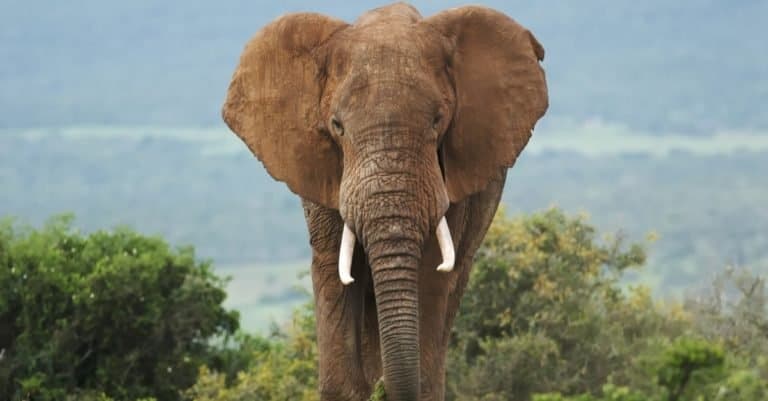
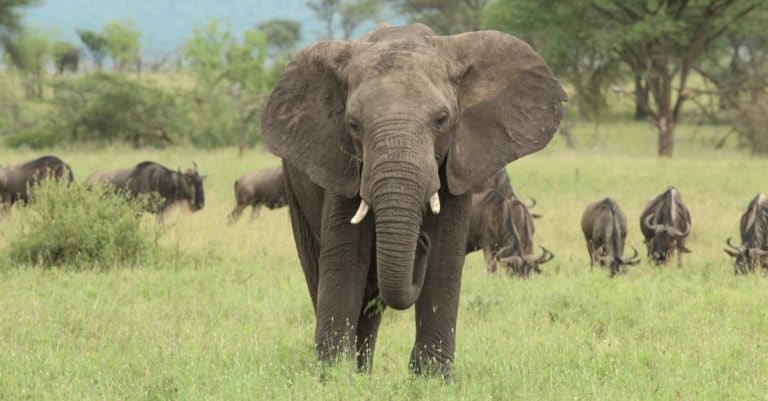
The elephant is the largest land animal in the world.

These massive giants exhibit all kinds of complex behavior that in some ways mirror our own behavior but in other ways are distinct and unique to them. This has made them the subject of rigorous behavioral, anatomical, and cognitive studies, as well as a source of continued fascination in human culture, particularly in Indian, Sumatran, and some African mythologies and tales. But after decades of decline from poaching and habitat loss, the elephant is in a perilous state, and unless more is done to protect them, they may be on a path toward extinction.

5 Incredible Elephant Facts!

  • The elephant is one of the smartest animals on the planet. It is one of the few species that exhibit actual self-awareness and self-recognition. It appears to use tools, for example, as a fly swatter. And it has an excellent ability to learn and remember details. Scientists still debate whether elephants mourn their dead, but these creatures do appear to be capable of experiencing profound emotion.
  • The elephant makes a low, rumbling sound that can be heard up to 5 miles away.
  • The word pachyderm, which derives from the Greek term pachydermos, meaning “thick skinned,” refers to any mammal with a particularly tough hide, including the rhino, elephant, and hippo. None of these animals are closely related to each other, though.
  • An elephant can carry up to 7 tons, making it one of the world’s strongest animals. Learn about the strongest animals in the world here.
  • At one point, scientists believe there were 26 million elephants in Africa alone. Today the world population of elephants is estimated at less than half a million.

Make sure to give our ’10 Incredible Elephant Facts’ page a read if you’re looking for more facts on these amazing animals!
👁 Image

Scientific Name

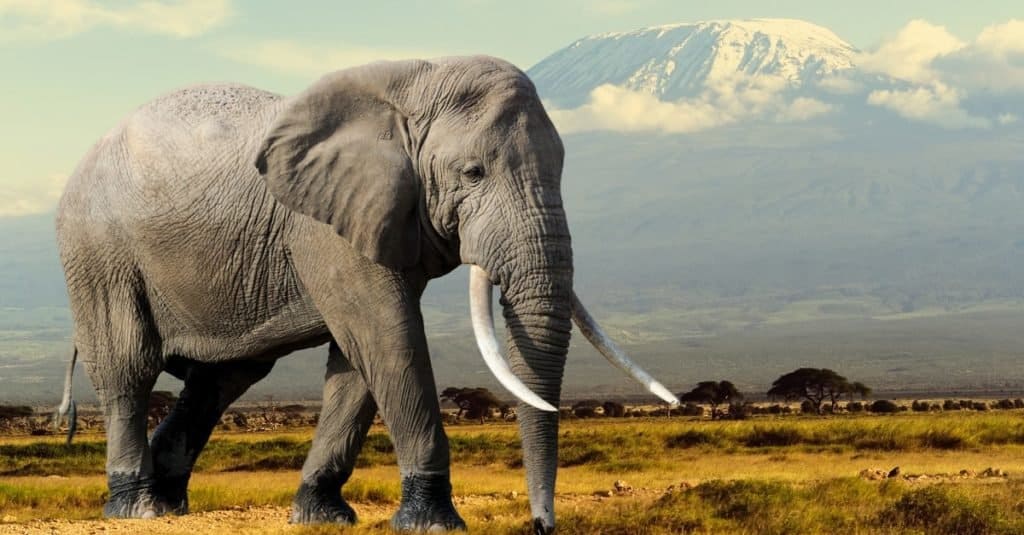
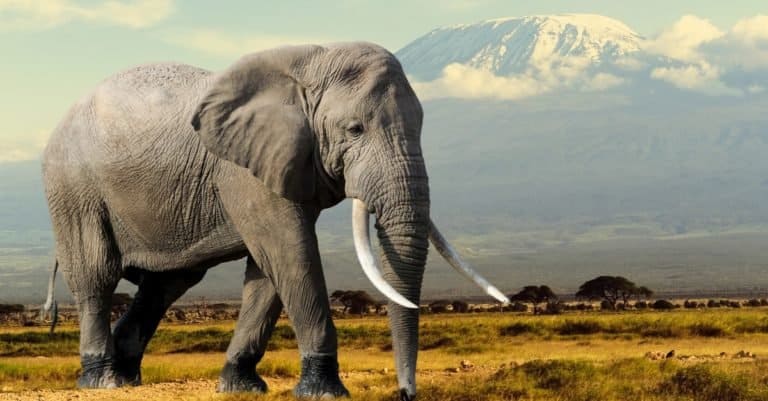
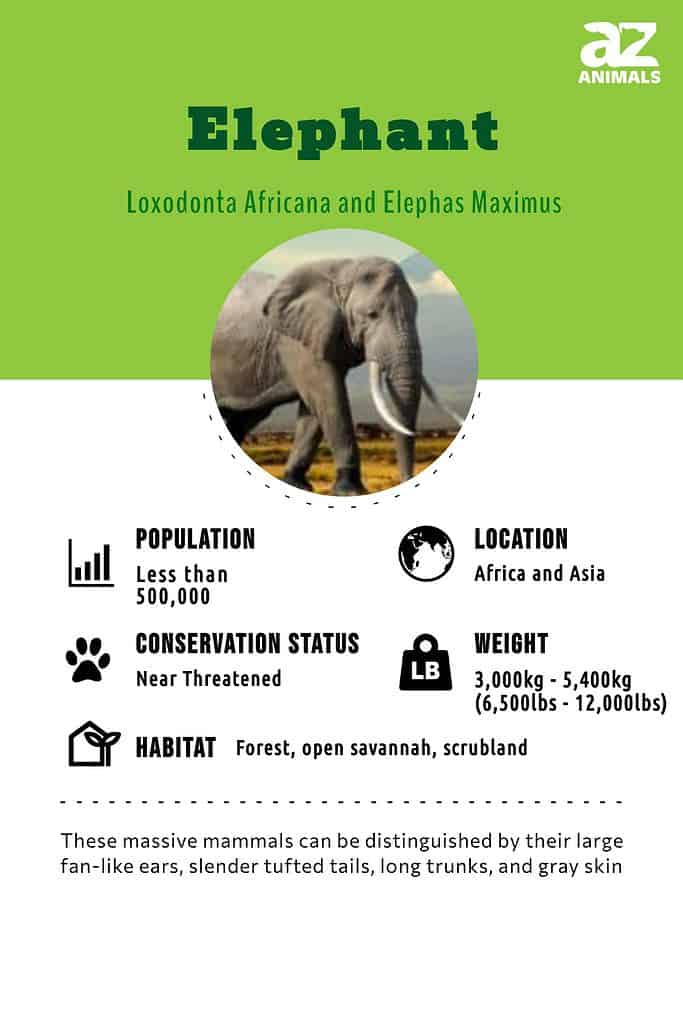
👁 Elephant on Kilimajaro mount background in National park of Kenya, Africa

There are two main species of elephant: the African and the Asian

©Volodymyr Burdiak/Shutterstock.com

The scientific name for the family of elephants is Elephantidae. There are two living genera in this family. The genus of Loxodonta contains two species: the African bush elephant and the African forest elephant. The genus of Elephas contains only a single living species: the Asian elephant, which itself can be divided further into several distinct subspecies, including the Indian, Sumatran, Borneo, and Sri Lankan elephants. The fossil record contains many more species, including the woolly mammoth, which once walked the planet in the last ice age.

Types

  • Borneo elephants (Elephas maximus borneensis): The smallest of all Asian elephants, this mammal evolved separately from all its relatives on Borneo and is known for having tusks which are straighter than usual and a longer tail on average.
  • Indian elephants (Elephas maximus indicus): These elephants’ stomachs are proportionate to their body size and their females may occasionally have small tusks. They are also darker than Sumatran elephants but lighter than their Sri Lankan relatives.

Appearance

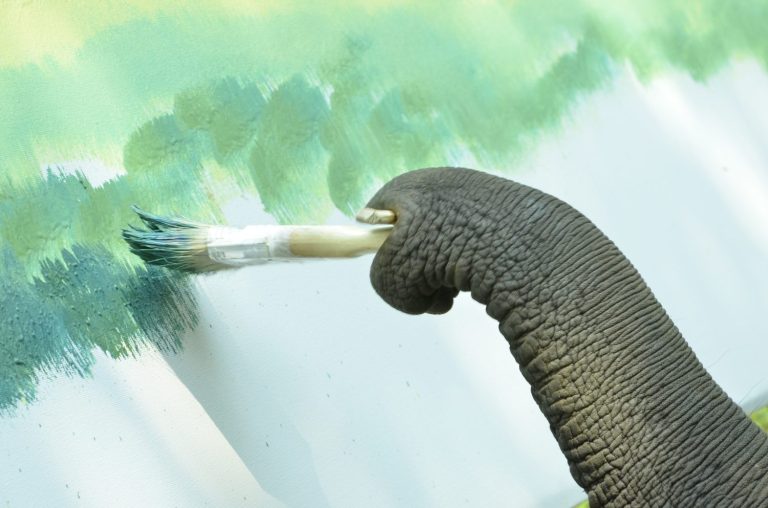
👁 Elephant

An elephant’s trunk is surprisingly nimble and strong and can contain up to 150,000 muscle fibers

©AndyElliott/Shutterstock.com

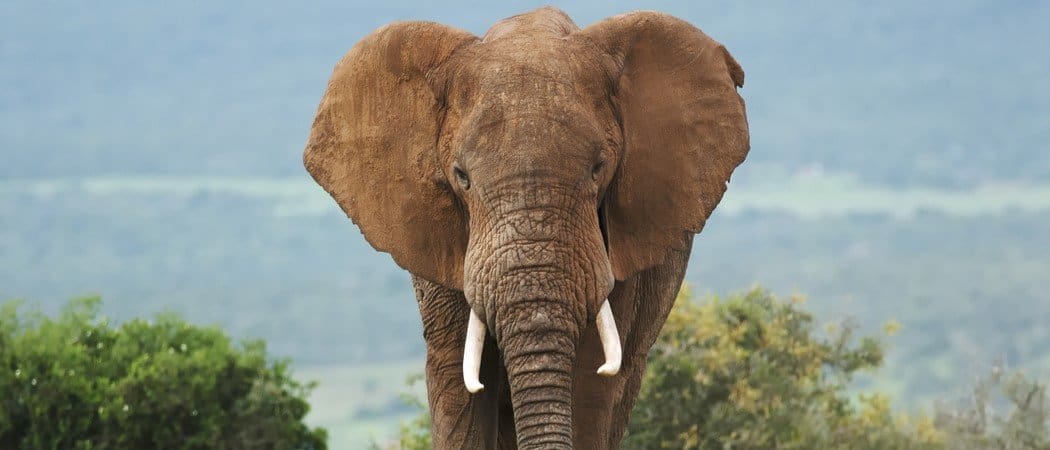
Elephants resemble no other animal on the planet. They are distinguished by the huge bodies, stout legs, thin tails, rounded ears, strong trunks, and in some elephants, the ivory tusks. These long tusks, which grow throughout the elephant’s life, are really just incisor teeth; they allow the elephant to dig for food and water, defend itself, and lift heavy objects with ease. Four molars, each one about the size of a brick, also line the mouth. Another important aspect of the elephant’s anatomy is the thick, wrinkled skin, which can retain about 10 times the amount of water as smooth skin.

Their eats are also a unique adaptation and give elephants some of the best hearing among all animals on Earth. On average, elephants can hear the calls from another elephant as far as 2.5 miles away!

The elephant is defined most of all by its size. These impressive creatures stand about 10 feet tall, reach about 18 to 24 feet long, and weigh between 4 and 8 tons. The largest specimen ever recorded stood 13 feet tall and weighed a massive 12 tons. Much of the skeletal structure is taken up by the huge skull, which supports the large ears, tusks, and trunk. The skull contains big cavities that reduce the weight without diminishing the strength. Apart from several other physical differences, Asian elephants differ from African elephants in their smaller size and the reduced chance of growing tusks. The Borneo elephant is the smallest subspecies of all; it’s sometimes called the pygmy elephant for this exact reason. Meanwhile, the Sri Lankan elephants appear to be the least likely of all species/subspecies to grow tusks from their skull.

Trunk

The elephant trunk, which actually derives from a fusion of the nose and upper lip, is an impressive instrument that has many useful functions related to touch, smell, and communication. The trunk contains finger-like projections on the tip (the Asian elephant has one and the African elephant two), which enable it to grasp objects as small as a piece of straw. The trunk contains around 150,000 separate muscle fibers with no bones or cartilage and very little fat. This enables it to perform very fine movements that somewhat belies the elephant’s rather hulking appearance.

Ears

The large, rounded ears appear to be a very effective organ for keeping the elephant cool. The size of the ears is a function of the number of blood vessels they contain. This allows an enormous amount of warm blood to flow through the capillaries and release excess body heat into the environment. This effect can be amplified when the elephant flaps its ears.

Evolution
👁 Image

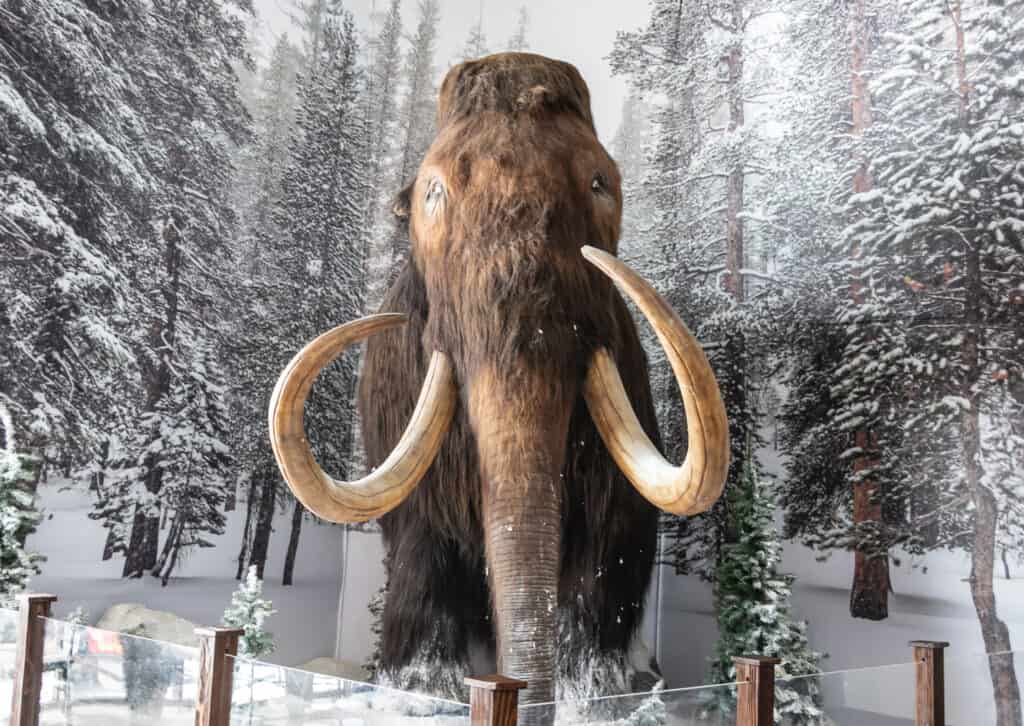
The woolly mammoth actually has a living relative today: the Asian elephant

©PradaBrown/Shutterstock.com

Before there were elephants, there were Gomphotheres, tusked, long-jawed herbivores which munched on vegetation in what is now Africa, Eurasia, and the  Americas, during the Miocene, Pliocene, and Pleistocene.

By the early Pleistocene they were extinct. But they had already given rise to the elephantids. As the Miocene was morphing into the Pliocene about 5 million years ago, the Loxodonta came into being. It would be followed by the Elephas and Mammuthus shortly afterwards.

Of these three lineages, the Loxodonta remained in Africa, while the Mammuthus expanded to Eurasia.The Elephas not only spread to Eurasia, but even went as far as North America.

During the Pleistocene, the Elephas also gave rise to the Elephas platycephus, the ancestor of the Asian elephant, while the Mammuthus gave rise to the Mammuthus primigenius, more commonly known as the woolly mammoth. Fun fact: The Asian elephant is actually the closest living relative of this hairy pachyderm which became extinct 4,000 years ago.

The passage of time saw these creatures develop into the much loved lumbering mammals we know today. As their diets changed, their teeth also changed in size while their upper second incisors morphed into tusks.  

Their necks became shorter to provide greater support to their enlarged heads. Which meant their trunks had to lengthen to make up for their necks. 

And the result? The largest land mammals in Africa and Asia.

Behavior
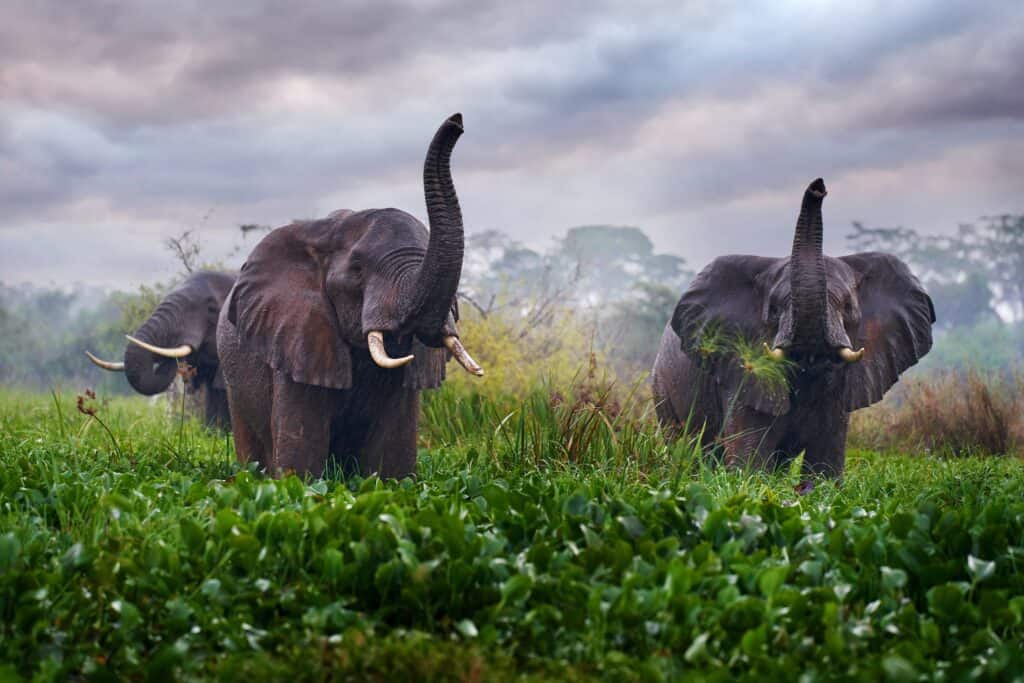
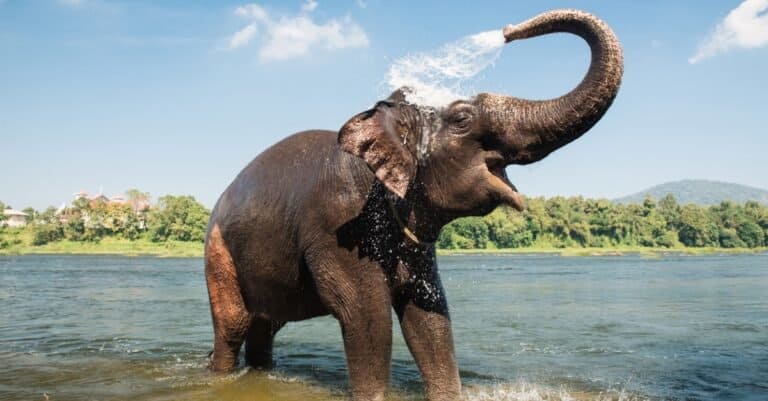
👁 Elephant in Murchison Falls NP

Elephants may use their trunks to communicate with each other

©Ondrej Prosicky/Shutterstock.com

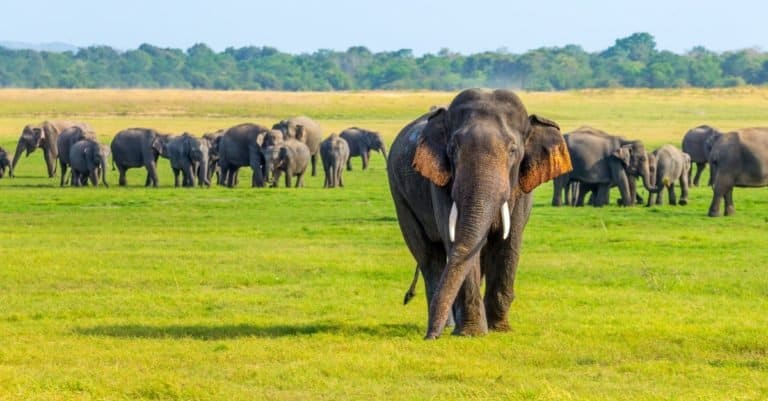
The social life of many elephants revolves around herds and small groups. An elephant herd consists mostly of closely related female cows and their calves, which are led by a single matriarch who helps the entire group find food and water, avoid predators, and locate a shelter. The oldest daughter is almost always poised to inherit the matriarchal position upon the mother’s death. A typical herd consists of around 10 individuals. If the herd grows too large, then some elephants may split off and form a new semi-independent group. The male bulls, on the other hand, either wander alone or form bachelor groups with specific dominance hierarchies. The males are much more likely to gather together during times of scarcity or in the presence of threats. They only come into contact with females when they want to mate.

Elephants have all manner of ways to communicate with each other. The trunk seems to play a critical part in this. A raised trunk seems to indicate a greeting. A lower-ranked member of the herd will also place its tip into the mouth of a higher-ranked individual, perhaps as a conciliatory gesture. Despite the iconic trumpeting sound, many of the noises produced by the elephant to communicate over long distances are actually too low for the human ear to detect. They also produce a growling noise from the stomach that seems to signify to others they are okay.

Depending on the availability of food, the elephant may spend up to 18 hours a day feeding. The rest of the time is occupied by sleeping, bathing, cleaning itself, and bonding with the rest of the group. Playing and fighting are integral parts of their behavior. They tend to spar playfully with other elephants close to their own age.

In the wild elephants only sleep about two hours per day and prefer to sleep while standing up. In captivity, elephants will sleep closer to six hours per night and with no predators to worry about will sleep lying down.

Habitat
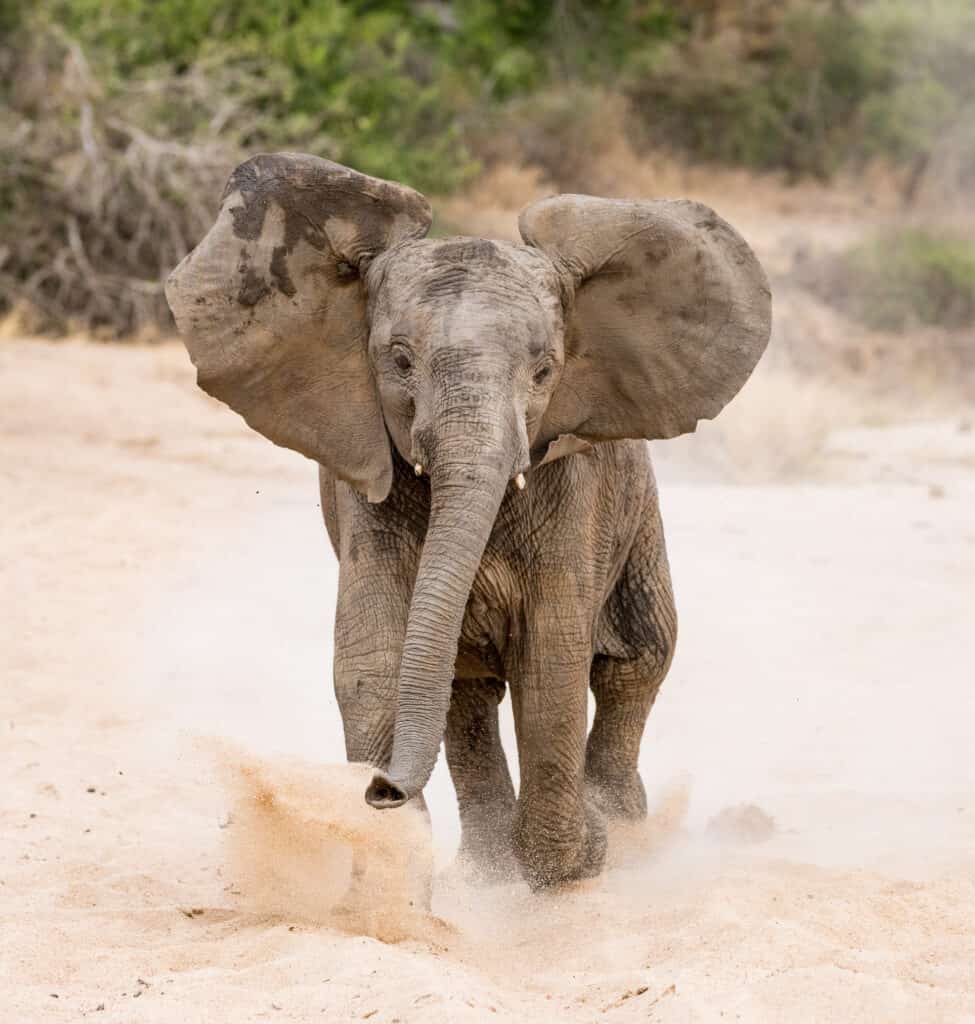
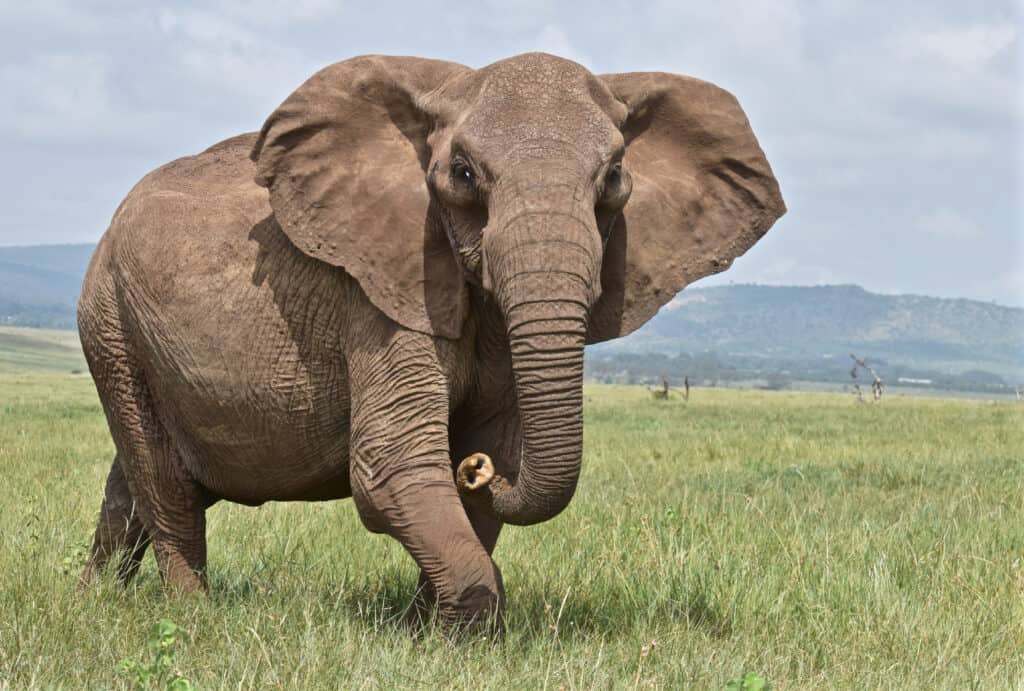
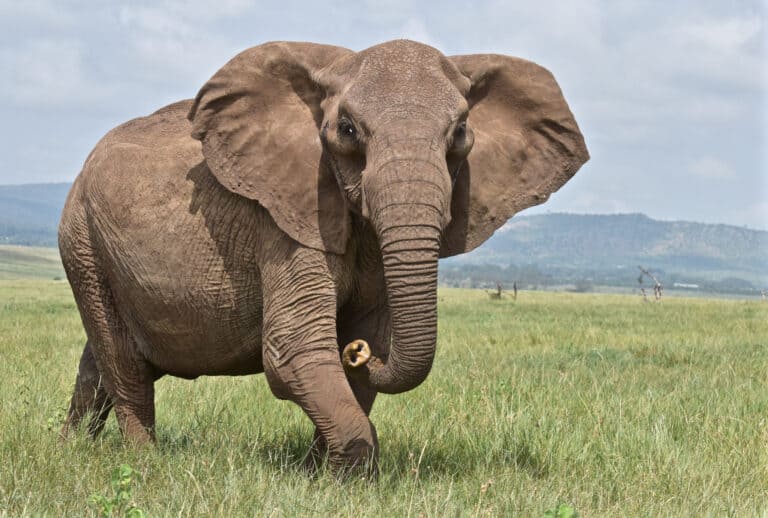
👁 elephant charging

Elephants once lived in the Middle East and East Asia

©Stu Porter/Shutterstock.com

The elephant inhabits the savannas, deserts, marshes, and forests near rivers of sub-Saharan Africa and South Asia. The Indian, Sumatran, Borneo, and Sri Lankan elephants all generally correspond to those particular geographical regions. But this range is actually reduced from its greatest historical extent. The Asian elephant, for example, once had a much larger range stretching between Syria and China. The African forest elephant is now reduced to a small piece of land in the Congo basin of western Africa.

Diet

The elephant is an herbivorous mammal whose only source of nutrients is vegetation. It needs an enormous amount of food to sustain itself. A typical individual consumes up to 330 pounds of food in a single day, although up to half of this may pass through the body without being properly digested.

What does the elephant eat?

Elephants will eat almost any type of vegetation, including grasses, leaves, fruits, twigs, roots, and bark. The exact composition of its diet tends to vary based on location and season. Herbivores generally have two different strategies for obtaining food: browsing, in which they selectively feed on shrubs and trees above the ground, and grazing, in which they lightly feed on vegetation along the ground. Many elephants are both browsers in the dry season and grazers in the wet season. African forest elephants are primarily browsers but also mix in a lot of fruits.

(And no, in case you were wondering, elephants do not eat peanuts!)

Predators and Threats
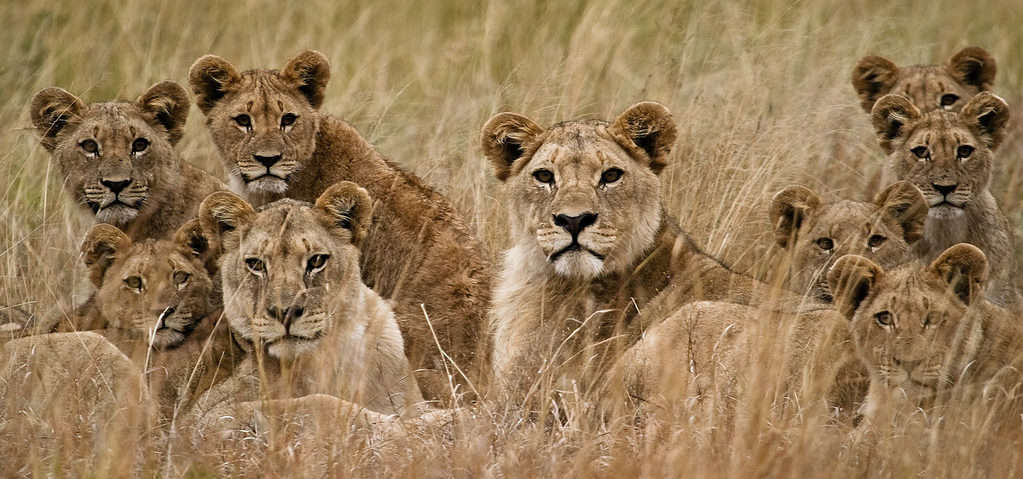
👁 Pride of lions in grass

Lions are one of a young elephant’s greatest threats

©Riaan van den Berg/Shutterstock.com

Aside from natural predators, the animal is under threat from poaching (due to the value of their tusks), habitat loss, and growing conflict with people. Some of these threats are amplifying each other. As the animal’s natural habitat diminishes owing to the encroachment of humans on wild territory, it comes into contact with cultivated farmlands and settlements which can result in trampled crops and damaged properties. This in turn may cause people to retaliate against them.

What eats the elephant?

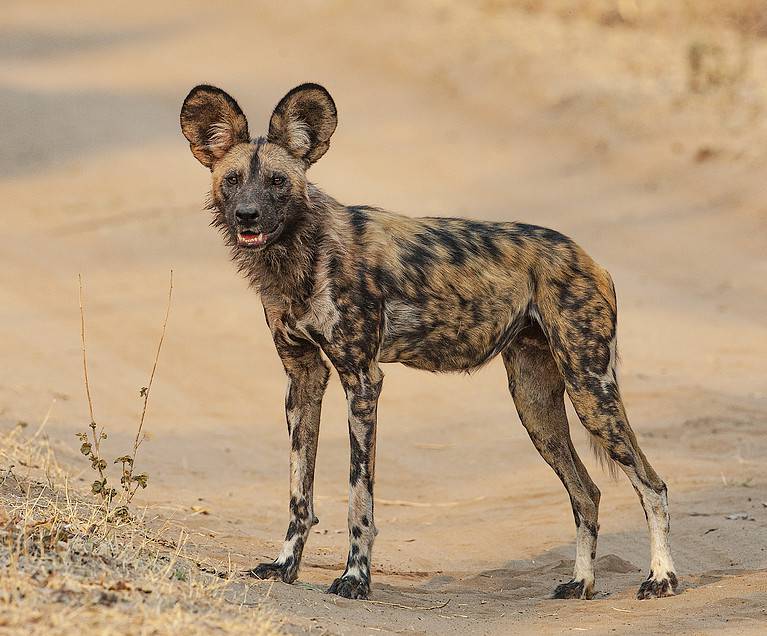
A full-grown adult elephant faces no consistent threats in the wild. Its massive size and thick hide make it almost impervious to attacks. However, a juvenile calf may be vulnerable to hyenas, lions, tigers, leopards, and African wild dogs, so it seeks protection from the group.

Reproduction, Babies, and Lifespan
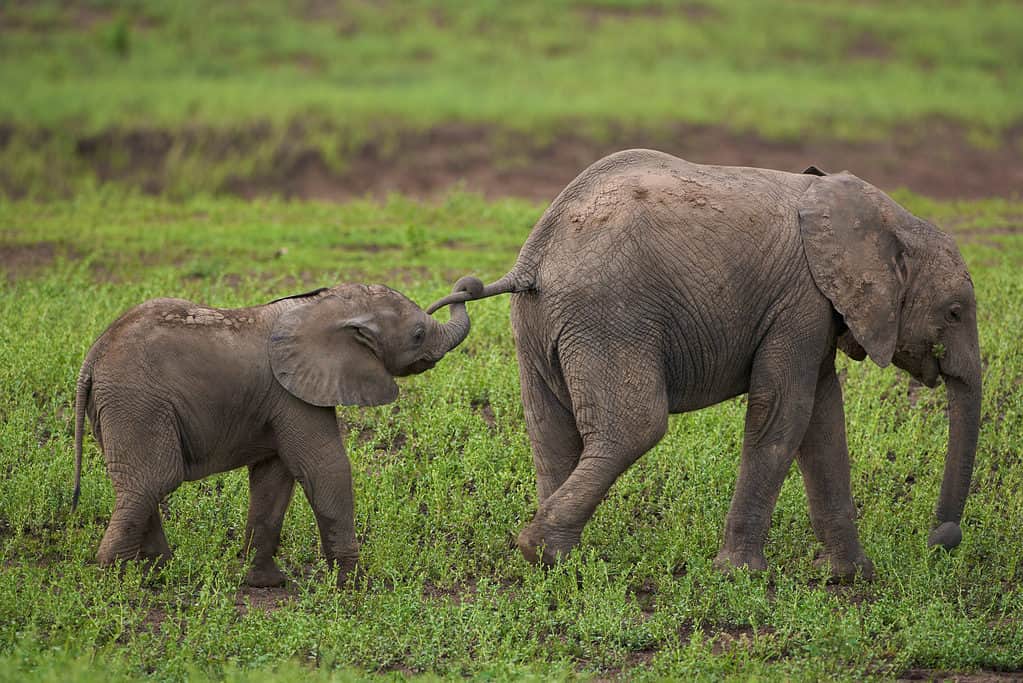
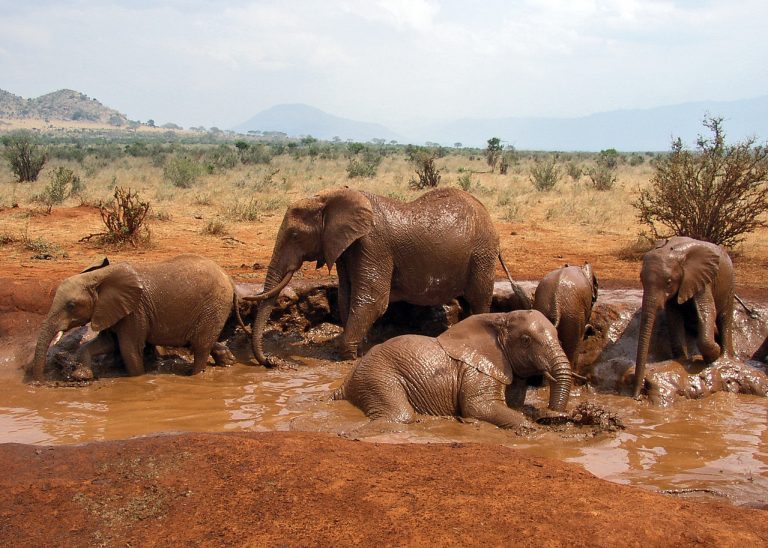
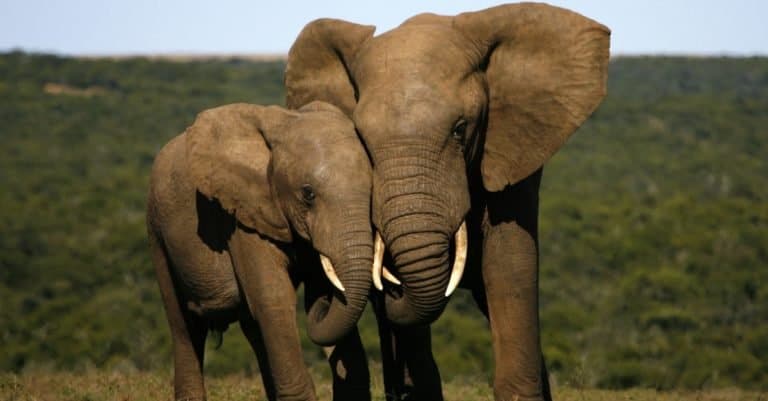
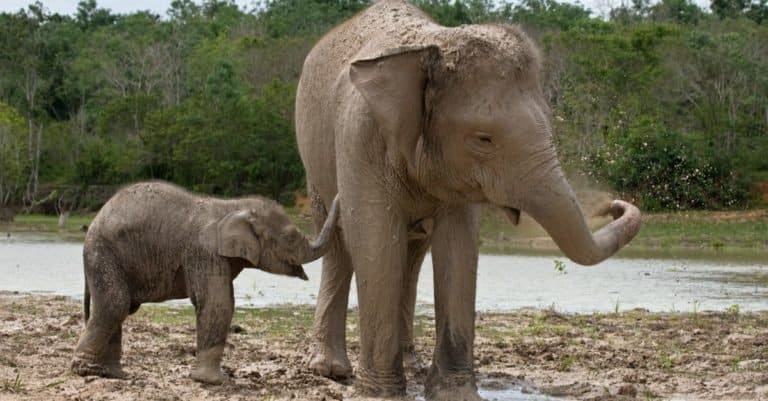
👁 Young elephants playing, the youngest holding the tail of its sibling

Depending on its gender, an elephant may maintain ties with its mother all its life

©Johan W. Elzenga/Shutterstock.com

As they reach sexual maturity, male bulls undergo a periodic transformation called musth in which their testosterone levels surge to 10 times their normal amount. This is characterized by aggressive behavior, enlarged temporal glands behind the eyes, and a continuous dribble of urine as they walk. The musth is intended to advertise the bull’s physical condition and shape, both to the females who may be looking for a mate and to the males who may be looking out for competitors. Males in musth are known to fight with each other, which rarely results in death. Females also release signals about their readiness to mate in various secretions. One male can have multiple female mates in his lifetime.

After mating, the female carries a single calf for about 22 months, longer than any other species of mammal. The baby is able to stand up and walk within an hour of its birth. However, it still requires the protection and care of the entire herd. If an adult senses danger, then it will make a loud trumpeting sound. The herd will then form a protective ring around the calves, facing outward to deter the predator. While the female herd may be doting caretakers, the father plays almost no role in the actual development of the offspring.

It takes a long time for a baby to master the nuances of elephant life. In the 13 to 20 years it takes to reach full maturity, these animals need to develop their coordination, learn social nuances, and develop bonds. It’s been suggested that a poorly-reared elephant may exhibit some anti-social behavior. Meanwhile, it takes a full five or six years before the baby is fully weaned from its mother’s milk. The calf packs on 2 to 3 pounds every day over the first year alone. Upon growing fully, the females tend to stay with the group, while the males tend to leave and forge their own path in life. They can easily live in excess of 50 years in the wild.

The oldest elephant to ever live reached 88 or 89 years old and lived in captivity in India. Indian elephants tend to live longer than their African counterparts.

Population
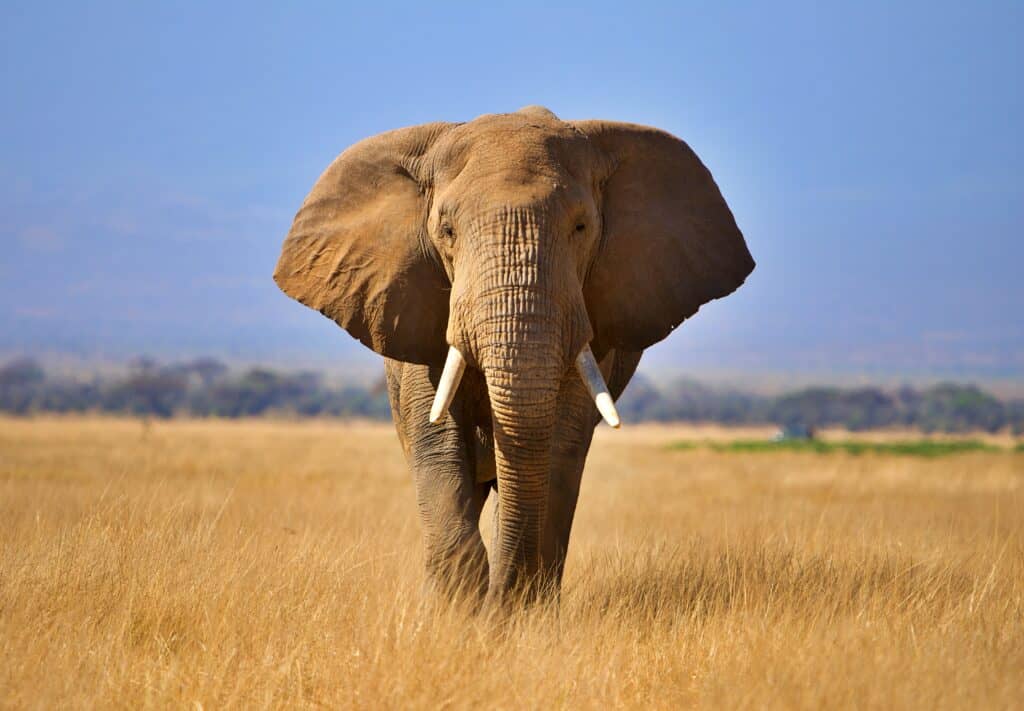
👁 elephant

Less than 500,000 elephants of both species remain in the wild

©Pooja Prasanth/Shutterstock.com

According to the IUCN Red List, which publishes a list of threatened species, both the African bush elephant and forest elephant are considered to be vulnerable species. Only about 415,000 remain in the wild. This is a fall of some 90% since the early 20th century. The Asian elephant is in an even worse state. With only about 45,000 remaining and its population heavily fragmented, it is currently classified as endangered by the IUCN Red List.

Conservationists are focusing their efforts on habitat protection and the end of poaching. Following an international agreement in 1989 that banned the ivory trade, poaching rates did temporarily subside. This was further bolstered by China’s ban on its domestic ivory market in 2018. Conservation groups are also working with local people to reduce negative interactions and create elephant corridors and safe places for them to roam. However, due to low birth rates and long maturation times, it takes a while for elephant populations to replenish.

Elephants in the Zoo

Due to their food and space requirements, only a few zoos are privileged enough to harbor these animals. The San Diego Zoo has a unique area called the Elephant Odyssey habitat that contains both African and Asian elephants. These animals are also present at the Indianapolis Zoo, the Maryland Zoo, the Seneca Park Zoo, the North Carolina Zoo, the Los Angeles Zoo, the Cincinnati Zoo, and Zoo Atlanta.

Similar Animals

  • Asian Elephants: Consisting of different subspecies, these elephants are smaller than their African relatives. Find out who they are truly related to and key differences between them and their cousins an entire ocean away.
  • African Forest Elephants: They roam the dense thick forest with an ease which would be beyond their larger relatives. But what other differences set them apart from their African cousins? Find out here.
  • African Bush Elephants: Extremely gregarious and social, these giant mammals prefer to roam the open savannah. Find out all there is to know about the largest land mammals on the planet.
View all 185 animals that start with E

Sources

  1. San Diego Zoo / Accessed March 14, 2021
  2. WWF / Accessed March 14, 2021
  3. WWF / Accessed March 14, 2021
  4. BBC Earth / Accessed March 14, 2021

About the Author

Dana Mayor

I love good books and the occasional cartoon. I am also endlessly intrigued with the beauty of nature and find hummingbirds, puppies, and marine wildlife to be the most magical creatures of all.
Connect:

Thank you for reading! Have some feedback for us?

Contact the AZ Animals editorial team

Related Articles You May Find Interesting

👁 Image
Articles

The National Zoo Just Welcomed Its First Elephant Calf in 25 Years—and She Needs a Name

👁 Elephant
Articles

Scientists Uncover the Physics of the Elephant’s Long-Distance “Seismic Network”


Elephant FAQs (Frequently Asked Questions)

Elephants are Herbivores, meaning they eat plants.

Elephants belong to the Kingdom Animalia.

Elephants belong to the class Mammalia.

Elephants belong to the phylum Chordata.

Elephants belong to the family Elephantidae.

Elephants belong to the order Proboscidea.

Elephants are covered in Leathery skin.

Elephants live in rainforests and floodplains.

Elephants eat grass, fruit, and roots.

Predators of Elephants include humans, hyenas, and wildcats.

Elephants have large bodies and long trunks.

The average number of babies an Elephant has is 1.

Elephants spend around 22 hours a day eating!

Elephants can live for 55 to 70 years.

An Elephant can travel at speeds of up to 25 miles per hour.

An elephant weighs around 3 to 8 tons, or about the same size as a commercial truck. The females are generally smaller than the males.

There are currently three living species of elephants: the African bush elephant, the African forest elephant, and the Asian elephant.

No, elephants tend to have grayish skin, but some may appear brown or red in certain circumstances.

Apart from their value as intelligent creatures, elephants also play an important role in the ecosystem. They help to prevent vegetation from growing out of control. They disperse undigested seeds around the environment. And they create waterholes for other animals.

An elephant can survive the removal of the tusks, but since the tusks are composed of living tissue, it is very painful and dangerous to the elephant and also reduces its quality of life.

The key differences between a woolly mammoth vs elephant are their appearance, history, species, and habitat.