
E
Species Profile

Enchi Ball Python

Python regius

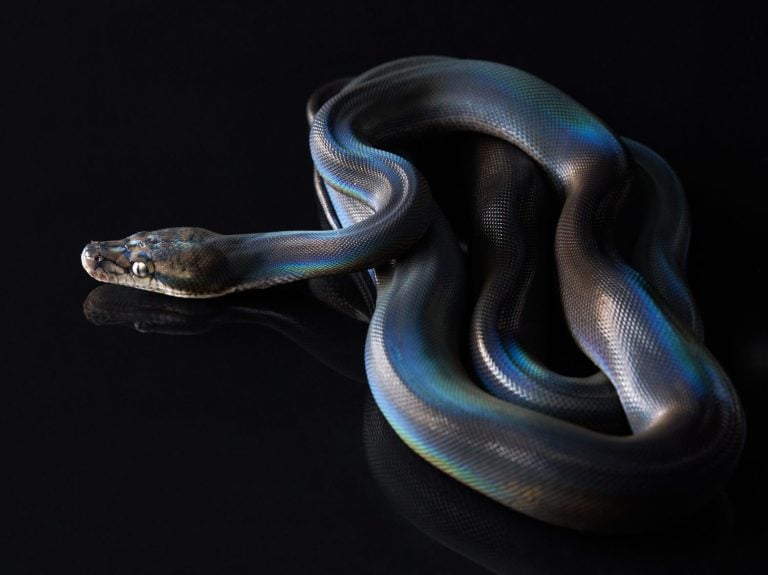
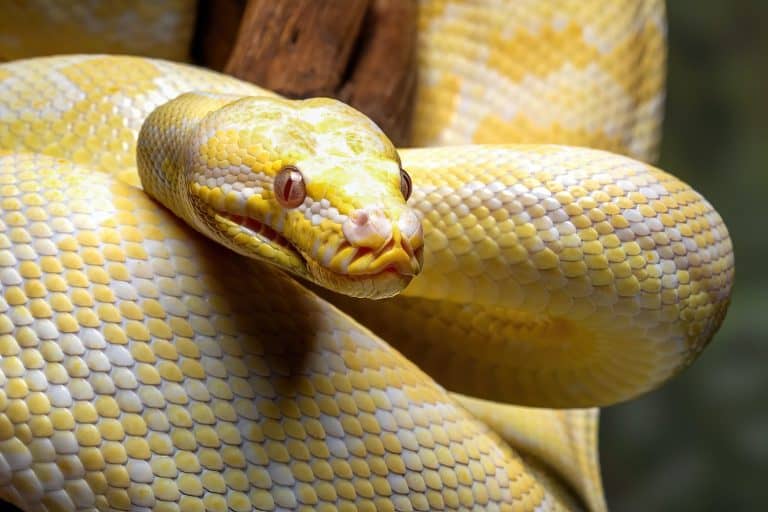
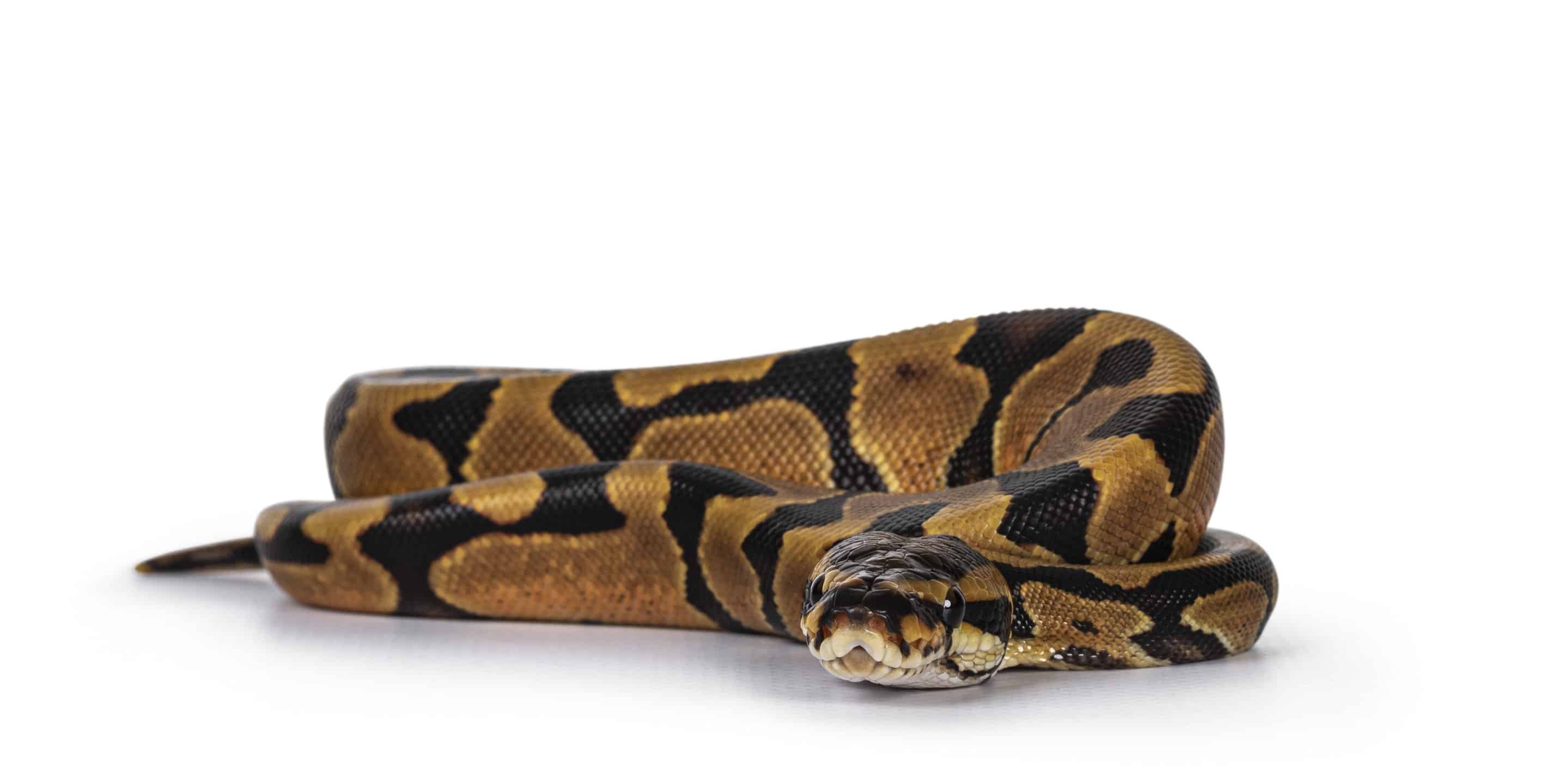
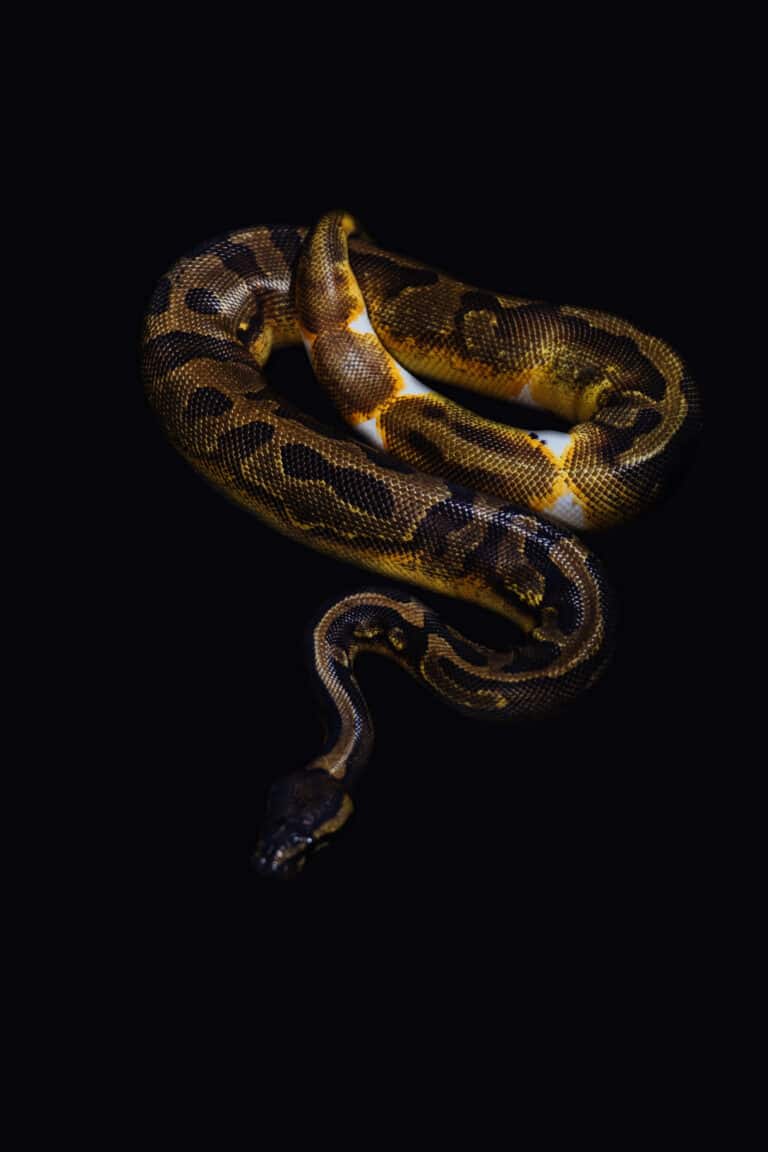
Enchi: Golden glow, cleaner pattern
iStock.com/Nynke van Holten

Enchi Ball Python Distribution

Click a location to explore more animals from that region

Origin Location

This map shows the native origin of the Enchi Ball Python. As a domesticated species, they are now found worldwide.

Loading map...

Found in 1 country

At a Glance

Domesticated
Also Known As Enchi, Enchi BP, Enchi morph, Enchi ball
Diet Carnivore
Activity Nocturnal+
Lifespan 15 years
Weight 2.5 lbs
Status Not Evaluated
Did You Know?

"Enchi" is an incomplete-dominant (often called co-dominant) morph-one copy shows the look; two copies ("Super Enchi") amplify it.

Scientific Classification

A small-to-medium constricting snake species native to West and Central Africa; “Enchi” indicates a heritable captive-bred morph known for enhanced yellow/orange tones and characteristic pattern changes compared with wild-type ball pythons.

Kingdom
Animalia
Phylum
Chordata
Class
Reptilia
Order
Squamata
Family
Pythonidae
Genus
Python
Species
regius

Distinguishing Features

  • Typical ball python build: stout-bodied, relatively short head/neck, strong constrictor
  • Defensive ‘balling up’ behavior characteristic of the species
  • Enchi morph (pet trade): brighter yellows/oranges, cleaner/high-contrast pattern, modified alien-head markings; commonly used in combination with other morph genes

Physical Measurements

Males and females differ in size

Length
3 ft 5 in (2 ft 7 in – 4 ft 11 in)
4 ft 5 in (3 ft 3 in – 5 ft 11 in)
Weight
3 lbs (1 lbs – 4 lbs)
5 lbs (3 lbs – 10 lbs)
Tail Length
6 in (4 in – 9 in)
6 in (4 in – 10 in)
Top Speed
1 mph
Very slow

Appearance

Primary Colors
Secondary Colors
Skin Type Dry, keratinized overlapping scales typical of pythons; usually smooth and glossy when humidity and shedding conditions are correct (not slimy).
Distinctive Features
  • Morph/strain of Ball Python (Python regius), not a separate species or subspecies; differences are heritable captive-bred color/pattern traits rather than wild diagnostic traits.
  • Compared with base-species 'normal' ball pythons, Enchi commonly presents brighter gold/yellow-to-orange tones, a cleaner overall look, and a tendency toward reduced/broken flank 'alien head' markings with more connected or banded dorsal elements.
  • Higher perceived contrast: darker markings can appear more defined because the background coloration is lighter/warmer.
  • Line variability is common: some Enchi individuals look subtly enhanced while others show pronounced pattern reduction and strong orange/yellow saturation; appearance can change dramatically in combination morphs (e.g., increased brightness and pattern simplification).
  • Species context (Python regius): small-to-medium West/Central African constrictor; typically terrestrial to semi-arboreal, crepuscular/nocturnal, and known for defensive balling behavior; captive-bred individuals are generally tractable.
  • For Enchi (Python regius): keep a secure enclosure with snug hides, a warm-to-cool temperature gradient and proper humidity for clean sheds; feed suitably sized rodents and limit handling after feeding and during shedding.
  • Health considerations (not Enchi-specific but relevant): dehydration/poor humidity can cause stuck shed; incorrect temps/humidity can predispose to respiratory issues; ectoparasites (mites) are a common captive concern; monitor weight/body condition to avoid obesity.

Sexual Dimorphism

As in the base species, dimorphism is mostly size/robustness rather than color: females commonly mature larger and heavier; males often have proportionally longer tails and slightly more pronounced spurs. The Enchi morph does not reliably create sex-linked coloration differences.

  • Typically smaller overall adult size and lighter body mass than females of similar age/condition.
  • Proportionally longer tail with a more gradual taper; pelvic spurs often more noticeable.
  • Typically larger overall adult size and heavier body mass; more robust mid-body build.
  • Proportionally shorter tail with a quicker taper; pelvic spurs may appear smaller.

Did You Know?

"Enchi" is an incomplete-dominant (often called co-dominant) morph-one copy shows the look; two copies ("Super Enchi") amplify it.

Enchi commonly "cleans up" pattern: fewer busy markings, more open sides, and high-contrast blotches compared with classic wild-type ball pythons.

Many Enchis show rich golden tones and a lighter, often "washed" or blushed headstamp, making the morph popular for bright combos.

Unlike some well-known pattern morphs associated with neurologic wobble, Enchi is not widely linked to inherent neuro issues when responsibly bred.

Ball pythons earned the nickname "ball" from their signature defensive curl into a tight sphere, hiding the head.

Native wild ball pythons come from West/Central Africa, where they use mammal burrows and termite mounds for shelter and stable humidity/temperatures.

In breeding projects, Enchi is often paired with other morphs to enhance brightness and reduce pattern while preserving a "natural" look.

Unique Adaptations

  • Heat-sensing labial pits: detect warm-blooded prey in darkness, aiding nocturnal hunting.
  • Highly kinetic skull/jaw ligaments: allow swallowing prey wider than the head by "walking" the jaws forward.
  • Powerful constriction: rapid coils restrict blood flow/respiration in prey, an energy-efficient hunting strategy.
  • Glottis extension: the airway can project forward during swallowing so the snake can breathe while ingesting prey.
  • Water-conserving lifestyle: behaviorally adapted to spend long periods in secure refuges, reducing exposure and dehydration risk.
  • Morph-specific (Enchi) adaptation in captivity: heritable pigment/pattern shift increases yellow/orange expression and reduces pattern complexity-valuable for selective breeding but not a wild survival adaptation.

Interesting Behaviors

  • Balling behavior: when stressed, they curl into a tight ball with the head protected in the center.
  • Ambush hunting: typically wait near rodent runs, striking quickly rather than actively chasing prey.
  • Crepuscular/nocturnal activity: most exploration happens at dusk/night, especially in low light.
  • Scent tracking: frequent tongue-flicking to sample airborne chemicals with the Jacobson's organ.
  • Burrow use and "hide fidelity": they often pick a favorite hide and return to it, reflecting their wild use of burrows/termite mounds.
  • Seasonal fasting: many captive ball pythons (including Enchi) may reduce feeding during cooler months or breeding season, even when healthy.
  • Soaking and humidity-seeking: some individuals soak or press against moist substrate when approaching a shed (but persistent soaking can indicate husbandry or parasite issues).

Cultural Significance

Ball pythons (Python regius), called royal pythons, have long interested people. In parts of West Africa they appear in religion and taboos that can protect snakes. The Enchi morph is a key breeding form, valued for brighter, cleaner-looking young and for working well with other morphs.

Myths & Legends

In parts of Benin and nearby areas, people respect a sacred serpent spirit tied to balance, protection, and linking earth and sky; live pythons are often cared for in snake shrines.

In some West African communities, pythons are traditionally regarded as protected or taboo to harm, with stories that misfortune may follow those who kill a revered snake near a home or sacred place.

A common old story says Egyptian royalty—often Cleopatra—wore a royal python as jewelry. Hard to prove, but the tale stays part of the snake’s modern mystery and appeal.

The Enchi name comes from breeder stories: a unique Ball Python (Python regius) was said to be found near Enchi, Ghana, then used in captive breeding, making the place name a morph label.

Conservation Status

NE Not Evaluated

Has not yet been evaluated against the criteria.

Population Stable

Life Cycle

Birth 6 hatchlings
Lifespan 15 years

Lifespan

In the Wild 10–20 years
In Captivity 20–30 years

Reproduction

Mating System Promiscuity
Social Structure Solitary
Breeding Pattern Seasonal
Fertilization Internal Fertilization
Birth Type Internal_fertilization

Enchi Ball Python (morph) (Python regius) are solitary. Males find females by smell; females may mate with several males and can store sperm. They mate with hemipenes, are oviparous, and mothers coil eggs until they hatch.

Behavior & Ecology

Social No established collective noun; typically described as solitary (or a breeding pair when temporarily together). Group: 1
Activity Nocturnal, Crepuscular
Diet Carnivore Appropriately sized rats (e.g., rat pups/weanlings for most adults; matched to the snake's girth)

Temperament

Species context: generally shy, defensive-by-withdrawal (hiding, balling) rather than overtly aggressive; most individuals become tolerant of routine handling with consistent, low-stress husbandry.
Breed (morph) distinction: Enchi is a color/pattern morph (enhanced yellow/orange tones and pattern reduction/reshaping) and does not, by itself, reliably change sociality or baseline temperament compared with wild-type Python regius.
Behavior range from very calm to defensive. Stress signs: tight balling, head tucked, quick retreat, striking at close approach, or refusing food. Some Enchi lines are more likely to strike during feeding.
Care requirements tied to behavior: solitary housing, multiple tight hides (warm/cool), low-traffic placement, and consistent photoperiod reduce defensive behavior; gentle, short sessions are preferred over prolonged handling, especially after feeding or during shed.
Enchi ball python, Python regius, is not known for the wobble. Main risks: respiratory infections from cool, damp conditions; poor sheds/dehydration from low humidity; obesity from overfeeding; burns. Avoid heavy inbreeding; check health and appetite.

Communication

Hissing Defensive warning; more likely when startled, restrained, or overheated/overhandled
Tongue-flicking to sample airborne/ground chemical cues via the vomeronasal organ Mate tracking, prey assessment, environmental exploration
Pheromonal communication Especially during breeding season; males follow female scent trails; males may engage in combat with other males when competing for access to females
Body posture and movement Tight balling, S-shaped neck coil, head hiding vs. relaxed, slow exploratory crawling; these signal stress level and intent
Cloacal musk/defecation as a last-resort defensive deterrent
Tactile cues during courtship (alignment, rubbing, tail positioning) rather than any stable social signaling

Habitat

Biomes:
Savanna Tropical Dry Forest Tropical Rainforest Wetland
Terrain:
Plains Hilly Valley Riverine
Elevation: Up to 4921 ft 3 in

Ecological Role

Mid-level predator of small vertebrates in West/Central African ecosystems (savanna/forest edge), helping regulate small-mammal populations.

Rodent population control (reduces crop/food-store pest pressure) Energy transfer from small mammals/birds to higher trophic levels (as both predator and prey) Supports ecosystem balance by moderating small-vertebrate abundance

Diet Details

Main Prey:
Small rodents Juvenile rodents Other small mammals Small birds

Human Interaction

Domestication Status

Semi domesticated

Enchi Ball Python (Python regius) is a single-gene captive-bred color/pattern morph, not a separate species. It was made by selective breeding of natural genes. Enchi shows cleaner, brighter yellow-orange tones, altered banding and higher contrast. People breed them for pets, handle and show them, give vet care, regulate trade, and sometimes collect wild snakes.

Danger Level

Low
  • minor bites or scratches (usually defensive; typically superficial injuries)
  • constriction risk is very low for this species size but caution is still advised with any constrictor, especially around children
  • zoonotic risk (notably Salmonella) from handling the snake or contaminated surfaces; requires hygiene
  • allergic reactions in sensitive individuals (dander/mites/substrate)

As a Pet

Suitable as Pet

Legality: Enchi Ball Pythons (Python regius) are generally legal in many U.S. places as nonvenomous pets, but state and city rules differ—some need permits, set size limits, ban them, or control breeding and sales.

Care Level: Moderate

Purchase Cost: $80 - $400
Lifetime Cost: $2,500 - $8,000

Economic Value

Uses:
Companion animal trade Captive breeding and genetics (morph market) Education and outreach (zoos, nature centers, breeders) Herpetological supplies (enclosures, heating, feeders)
Products:
  • live animals (Enchi morph and Enchi-combination offspring)
  • breeding services/paired projects
  • reptile husbandry equipment sales driven by demand (thermostats, heat panels/mats, hides, substrate)
  • frozen-thawed feeder rodents

Relationships

Predators 5

Martial Eagle Polemaetus bellicosus
Snake Eagle Circaetus spp.
Monitor Lizards Varanus niloticus
Honey Badger Mellivora capensis
African Mongoose Herpestes spp.

Related Species 5

African Rock Python Python sebae Shared Genus
Burmese Python Python bivittatus Shared Genus
Indian python Python molurus molurus Shared Genus
Reticulated Python Malayopython reticulatus Shared Family
Carpet Python Morelia spilota Shared Family

Ecological Equivalents 4

Animals that fill a similar ecological role in their ecosystem

Ball Python Python regius Enchi is a captive-bred color/pattern morph of Python regius (co-dominant) that enhances yellow/orange coloration and 'cleans' or simplifies patterning. Husbandry matches wild-type ball pythons. Avoid overheating, maintain appropriate humidity for shedding, and monitor for problems related to inbreeding, feeding, respiratory infections, or retained shed.
Brown House Snake Boaedon capensis An African, largely nocturnal, rodent-eating snake that occupies human-adjacent and savanna/woodland habitats; shares a similar prey base (small mammals) and a concealment-driven hunting style, though it is not a python and is typically smaller.
African Egg-eating Snake Dasypeltis scabra West and Central African snake often kept in captivity; it shares a nocturnal, secretive niche. Although it differs strongly in diet (eggs), it overlaps in habitat use and predator pressures.
Corn Snake Pantherophis guttatus Ecological analogue in captivity: a commonly kept, generally docile, small-to-medium rodent-eating snake with similar enclosure and care themes (thermal gradient, hides), though it is from North America and has different humidity and temperature tolerances.

“The Enchi ball python morph is notable for its very golden-orange, coppery coloration and high blushing.”

Enchi Ball Python Summary

Out of the more than 4,000 ball python morphs on the market today, the Enchi variety’s background is among the most unique. It was first developed in 2002 by Sweball (based in Sweden) with a breeding pair of ball pythons imported all the way from Ghana!

The Enchi morph is a rather subtle yet stunning color morph with increased orange, yellow, and coppery tones throughout its patterning. Enchi ball pythons also have a high amount of blushing compared to other morphs, particularly around their head and sides of the face. This blushing around the head is often accented by bright yellow or golden eye stripes. Interestingly, their sunny golden coloration only becomes more vibrant with age, with most individuals typically reaching their full color potential at around a year or two.

Notably, Sweball also developed a super version of the morph in 2003 by breeding two Enchi ball pythons together.

3 Amazing Enchi Ball Python Facts!

  • The Enchi ball python has an incredibly diverse background compared to many other base morphs. Although the morph was officially developed in Sweden in 2002, the breeding pair used in its development was imported from Ghana in 1998.
  • The Enchi morph gets its unique name from Enchi, a town in southwest Ghana. Enchi is the capital of the Aowin Municipality.
  • Breeders developed a super version of the Enchi morph in 2003 after Sweball bred two Enchi ball pythons together.

Where to Find Enchi Ball Pythons

The ball python, alternatively called the royal python, is native to western and central Africa, more specifically the Sub-Saharan region. As a rather small yet hardy snake, it fares well in several different habitats. However, it typically resides in grasslands, savannas, and occasionally more densely forested areas.

All ball python morphs belong to the same species, so they share the same general habitat. As a base morph, Enchi ball pythons can technically occur naturally in the wild. Unfortunately, though, wild Enchi snakes are incredibly rare and poorly documented.

Today, the Enchi morph is fairly abundant and well-understood amongst captive reptile breeders. As a result, it is accessible and inexpensive compared to most other ball python color morphs. On average, a typical Enchi ball python costs around $100 to $250. Keep in mind this price will vary potentially significantly depending on who you purchase the snake from, its exact coloration and patterning, and the overall supply and demand of the Enchi morph where you live.

Enchi Ball Python Scientific Name

The ball python’s scientific name, Python regius, means “royal python.” This name comes from the belief that Egyptian royals like Cleopatra would wear live baby serpents–likely ball pythons–on their arms as jewelry. This was likely a means of flaunting power and wealth.

All ball python morphs share the same scientific name because they belong to the same species.

Population & Conservation Status

According to the IUCN Red List, as of 2012, the ball python is near-threatened. Although the species isn’t currently at any substantial risk of going extinct, this could change in the future.

Overall, the ball python’s populations have been decreasing slightly throughout much of its native range in central and western Africa. The main threat to the species is habitat loss due to the agricultural industry. Additionally, the common practices of hunting, eating, and/or selling ball pythons have caused the species’ numbers to decline.

How to Identify Enchi Ball Python: Appearance and Description
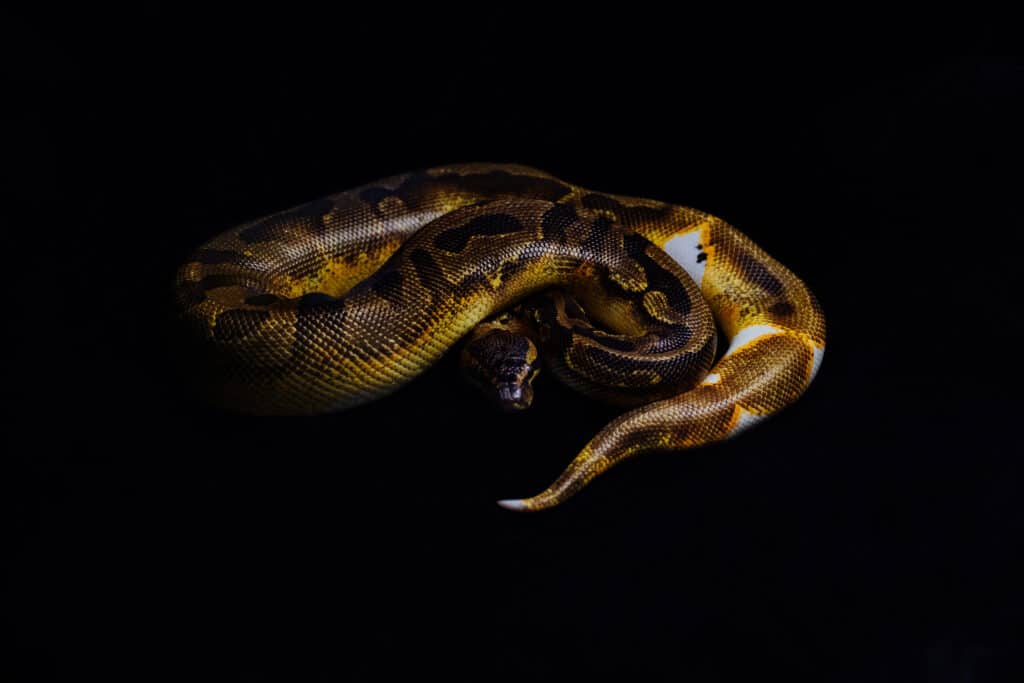
👁 Enchi ball python

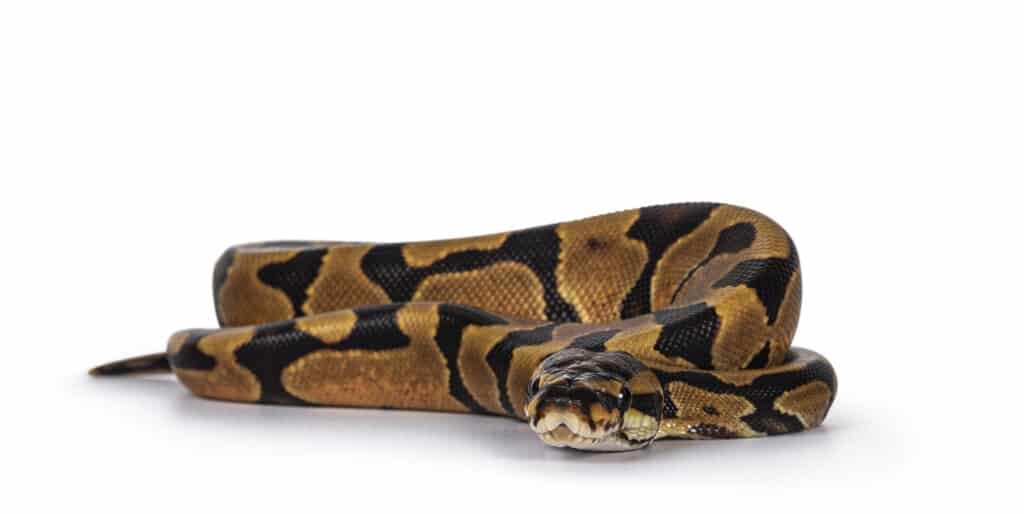
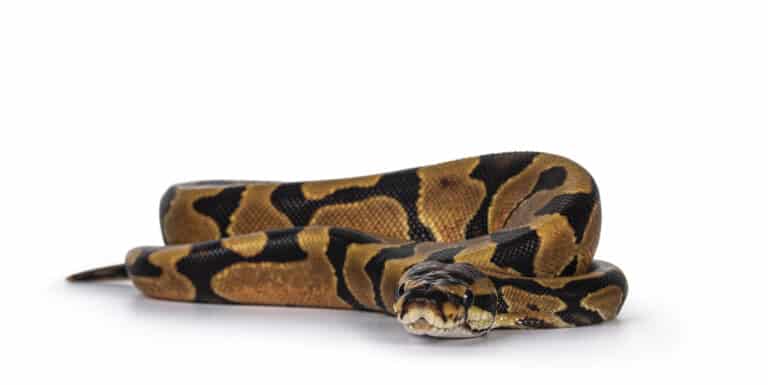
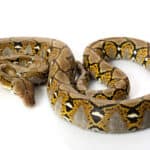
Enchi pied ball pythons have increased golden, yellow, orange, and sometimes coppery tones throughout their patterning.

©iStock.com/Li Chun

The Enchi is a fairly subtle base morph that is similar to many other common color morphs at a glance, but it can still be easily identified by a few key traits if you have a keen eye and know what to look for. 

In particular, Enchi ball pythons have increased golden, yellow, orange, and sometimes coppery tones throughout their patterning. These bright, sunny markings contrast the snake’s chocolaty brown tones more prominently than the markings of a typical wild-type ball python.

In addition to their warm yellow, orange, and gold markings, Enchi ball pythons have a high amount of blushing compared to other morphs. This simply means Enchi snakes tend to have lots of faded patches mainly along the spine, sides of the body, and head, giving them a soft, blushed appearance.

The Enchi morph’s blushing is usually most apparent around the snake’s head, which will usually have a slightly faded patch between the eyes. This is accented beautifully by the morph’s bold yellow or golden eye stripes.

To sum things up, keep these key traits in mind if you’re trying to identify an Enchi ball python:

  • Increased yellow, orange, golden, and coppery tones throughout, contrasting its warm, chocolaty-brown markings
  • High amount of blushing, especially atop the head, with bright yellow or golden eye stripes
  • Blushing extends throughout the body along the spine and sides
  • Yellow and golden tones become much more vibrant with age, making some Enchi snakes challenging to identify until they are one to two years old

Evolution and History

The Enchi morph has one of the most varied backgrounds of any ball python morph today. Although it originated in 2002 in Sweden by Sweball’s Lars Brandell, the breeding pair used in its development hails from Ghana! The morph even gets its name from a town in southwest Ghana, Enchi. Enchi is the capital of Ghana’s Aowin Municipality.

In 1998, Sweball’s breeders received a shipment of juvenile ball pythons with uniquely high amounts of gold and yellow in their patterning. They bred two of the more vibrant and colorful snakes together, resulting in the first documented batch of Enchi ball pythons. By 2003, Sweball also produced a super Enchi variant by breeding two Enchi snakes together.

Today, many reptile breeders have developed their own Enchi lines and variations. Although the Enchi morph is an older, more subtle variety compared to many designer morphs currently on the market, it remains incredibly popular, accessible, and relatively inexpensive worldwide.
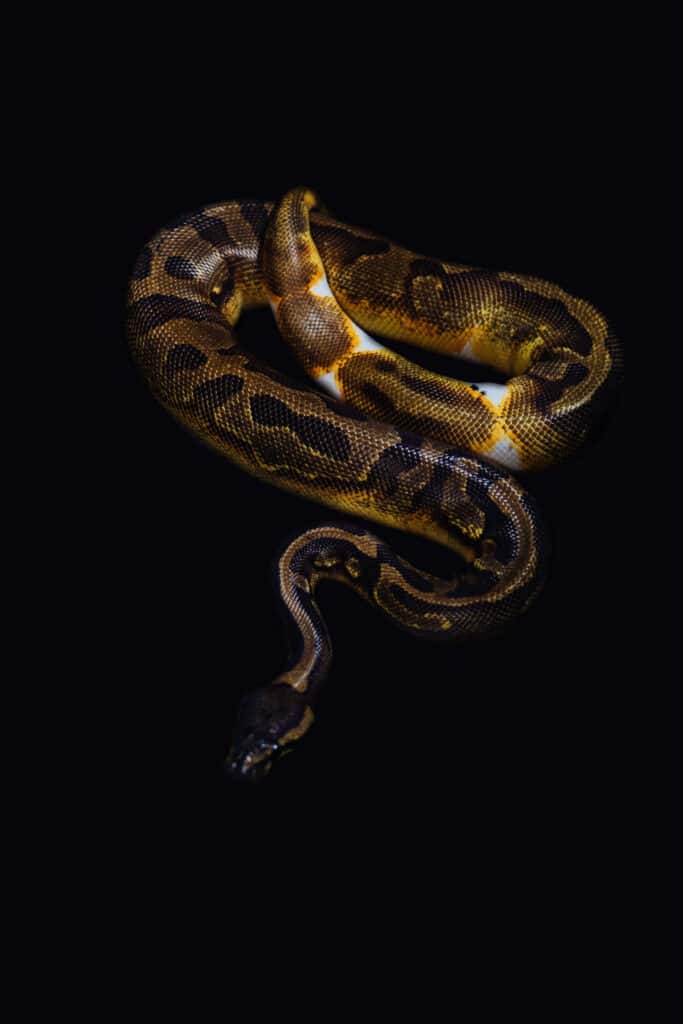
👁 Enchi ball python

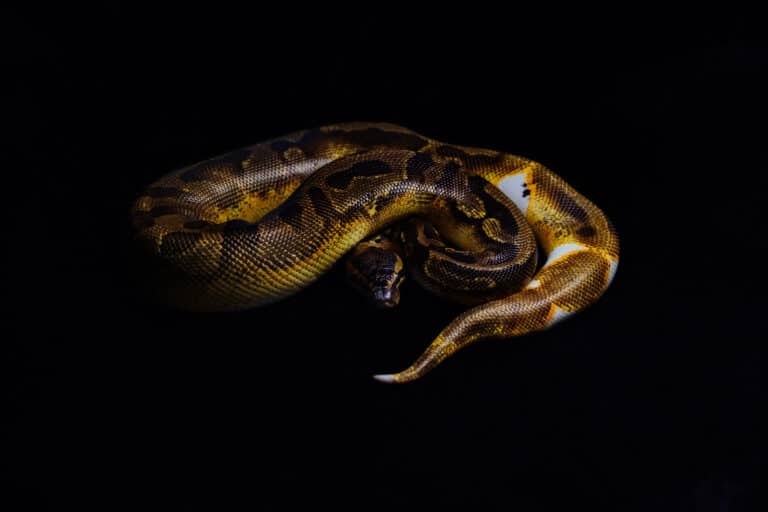
Yellow and golden tones become more vibrant with age, making some Enchi snakes challenging to identify until they are one to two years old.

©iStock.com/Li Chun

How Dangerous Are They?

As one of the smallest python species in the world, the ball python is not venomous or especially dangerous to humans. It is a constrictor snake that mainly hunts small rodents, birds, and occasionally amphibians and fish. It does not have fangs. Instead, it has lots of sharp yet small and fragile teeth that angle slightly backward to help the snake better grip its prey.

On top of having no venom and tiny, weak teeth, the ball python is very timid and generally non-aggressive in nature. It actually gets its common name from its habit of tightly coiling its body into a ball when scared or threatened instead of striking or assuming a threatening posture like many other snake species. They very rarely bite, and their bites tend to be very weak and aren’t particularly painful.

If you are bitten by a ball python, first gently and carefully put the snake back into its proper enclosure. Briefly monitor the snake to ensure it has not sustained any injuries. Next, carefully wash the bite wound with soap and warm water. It may be necessary to bandage the wound afterward to help speed up the healing process and prevent the wound from developing an infection. Fortunately, most ball python bites are only mildly painful and don’t require much, if any, treatment.

Behavior and Humans

Because ball pythons are so well-suited to living in captivity, reptile breeders all around the world have developed thousands of unique color and pattern morphs via captive breeding! The Enchi morph is an excellent example of one of these many morphs. Breeders developed it in Sweden in 2002 and it still remains a very popular choice amongst reptile owners today.

In addition to being very docile and gentle around humans, ball pythons are quite curious, active, and intelligent, making them a delight to observe and interact with in captivity. They can thrive in enclosures as small as 50 to 60 gallons and have very straightforward, manageable care requirements. They are generally solitary animals that prefer not to have any tankmates in their enclosures, though they can be quite sociable with humans.

View all 185 animals that start with E

Sources

  1. Animal Diversity animaldiversity.org/accounts/Python_regius/ / Accessed November 27, 2022
  2. IUCN Redlist iucnredlist.org/species/177562/15340592 / Accessed November 27, 2022
  3. Morphpedia morphmarket.com/morphpedia/ball-pythons/enchi/ / Accessed November 27, 2022
  4. World of Ball Pythons worldofballpythons.com/morphs/enchi/ / Accessed November 27, 2022

About the Author

Hailey Pruett

Hailey "Lex" Pruett is a nonbinary writer at A-Z Animals primarily covering reptiles and amphibians. They have over five years of professional content writing experience. Additionally, they grew up on a hobby farm and have volunteered at animal shelters to gain further experience in animal care. A longtime resident of Knoxville, Tennessee, Hailey has owned and cared extensively for a wide variety of animals in their lifetime, including cats, dogs, lizards, turtles, frogs and toads, fish, chickens, ducks, horses, llamas, rabbits, goats, and more!
Connect:

Thank you for reading! Have some feedback for us?

Contact the AZ Animals editorial team

Related Articles You May Find Interesting


Enchi Ball Python FAQs (Frequently Asked Questions)

Like all other members of the Python family, ball pythons are constrictor snakes and entirely non-venomous. They do not have fangs and instead have many small and sharp (yet also fragile) teeth that are angled backward to help them better grip and swallow their prey.

As fairly small, non-venomous snakes, ball pythons must hunt by simply waiting and ambushing their prey. They wait very quietly, usually while cleverly camouflaged, for a mouse, bird, or perhaps even a frog to come near them, at which point they will quickly strike and grip the prey tightly with their teeth. Next, they rapidly coil their bodies around the prey animal, suffocating it before swallowing it whole!

Fortunately, despite being skilled hunters, they aren’t capable of taking down anything much larger than a rat or a small bird.

Ball pythons are generally very timid and non-aggressive toward humans, no matter the particular morph. Their remarkably gentle nature has contributed to their popularity worldwide within the exotic pet trade.

Ball pythons are native to warm, dry regions in Sub-Saharan Africa. They can live in a wide range of habitats, including grasslands, savannas, and forests. As a base morph, Enchi ball pythons can technically exist naturally in the wild, though this is very rare, and actual instances of unique morphs existing in the wild are unfortunately poorly documented.

Ball pythons, regardless of the particular morph, are carnivorous animals that mainly eat small rodents and birds. Occasionally, they will also feed on small amphibians and fish. Since they lack venom and only reach around 5 feet long, ball pythons aren’t much of a threat to larger animals.

Enchi ball pythons typically cost around $100 to $250. However, this price can vary depending on the breeder you purchase the morph from, the appearance of the snake’s pattern and coloration, and the current supply and demand of the morph in your area. Variations of the morph like the Super Enchi, Pastel Enchi, or Enchi Clown can also be pricier, as they possess multiple traits and require more complicated breeding to reliably produce.

The Enchi morph is fairly common in captivity today and is available for purchase from a wide range of reptile breeders. It was originally developed in 2002, making it among the first base morphs developed and popularized on a large scale. However, many of its variants, like the aforementioned Super Enchi and Enchi Clown, are much rarer because they are designer morphs that are more difficult to breed.