F
Species Profile

Falcon

Falconidae

Speed, smarts, and sky mastery
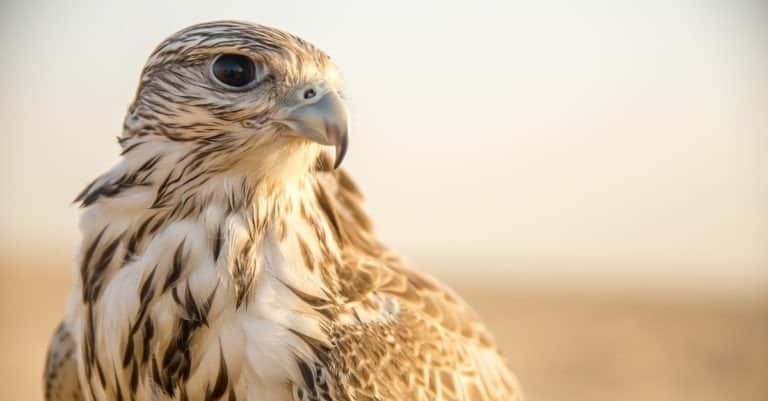
WildlifeWorld/Shutterstock.com

Falcon Distribution

Click a location to explore more animals from that region

Loading map...

Found in 46 countries

๐Ÿ‡ฆ๐Ÿ‡ท Argentina ๐Ÿ‡ฆ๐Ÿ‡บ Australia ๐Ÿ‡ง๐Ÿ‡ท Brazil ๐Ÿ‡จ๐Ÿ‡ฆ Canada ๐Ÿ‡จ๐Ÿ‡ฑ Chile ๐Ÿ‡จ๐Ÿ‡ณ China ๐Ÿ‡จ๐Ÿ‡ด Colombia ๐Ÿ‡ฉ๐Ÿ‡ช Germany ๐Ÿ‡ฉ๐Ÿ‡ฟ Algeria ๐Ÿ‡ช๐Ÿ‡ฌ Egypt ๐Ÿ‡ช๐Ÿ‡ธ Spain ๐Ÿ‡ช๐Ÿ‡น Ethiopia ๐Ÿ‡ซ๐Ÿ‡ท France ๐Ÿ‡ฌ๐Ÿ‡ง United Kingdom ๐Ÿ‡ฌ๐Ÿ‡ฑ Greenland ๐Ÿ‡ฌ๐Ÿ‡ท Greece ๐Ÿ‡ฎ๐Ÿ‡ฉ Indonesia ๐Ÿ‡ฎ๐Ÿ‡ฑ Israel ๐Ÿ‡ฎ๐Ÿ‡ณ India ๐Ÿ‡ฎ๐Ÿ‡ท Iran ๐Ÿ‡ฎ๐Ÿ‡น Italy ๐Ÿ‡ฏ๐Ÿ‡ต Japan ๐Ÿ‡ฐ๐Ÿ‡ช Kenya ๐Ÿ‡ฐ๐Ÿ‡ท South Korea ๐Ÿ‡ฐ๐Ÿ‡ฟ Kazakhstan ๐Ÿ‡ฒ๐Ÿ‡ฆ Morocco ๐Ÿ‡ฒ๐Ÿ‡ณ Mongolia ๐Ÿ‡ฒ๐Ÿ‡ฝ Mexico ๐Ÿ‡ฒ๐Ÿ‡พ Malaysia ๐Ÿ‡ณ๐Ÿ‡ฌ Nigeria ๐Ÿ‡ณ๐Ÿ‡ด Norway ๐Ÿ‡ณ๐Ÿ‡ฟ New Zealand ๐Ÿ‡ต๐Ÿ‡ช Peru ๐Ÿ‡ต๐Ÿ‡ญ Philippines ๐Ÿ‡ต๐Ÿ‡ฐ Pakistan ๐Ÿ‡ต๐Ÿ‡ฑ Poland ๐Ÿ‡ท๐Ÿ‡บ Russia ๐Ÿ‡ธ๐Ÿ‡ฆ Saudi Arabia ๐Ÿ‡ธ๐Ÿ‡ช Sweden ๐Ÿ‡น๐Ÿ‡ญ Thailand ๐Ÿ‡น๐Ÿ‡ท Turkey ๐Ÿ‡น๐Ÿ‡ฟ Tanzania ๐Ÿ‡บ๐Ÿ‡ธ United States ๐Ÿ‡ป๐Ÿ‡ช Venezuela ๐Ÿ‡ป๐Ÿ‡ณ Vietnam ๐Ÿ‡ฟ๐Ÿ‡ฆ South Africa

At a Glance

Family Overview This page covers the Falcon family as a group. Stats below are general traits shared across the family.
Also Known As Raptor, Bird of prey
Diet Omnivore
Activity Diurnal+
Lifespan 12 years
Weight 2.1 lbs
Status Not Evaluated
Did You Know?

Size range across Falconidae: ~20-65 cm long, ~40-160 cm wingspan, ~0.055-2.1 kg (small pygmy falcons to large gyrfalcons).

Scientific Classification

Family Overview "Falcon" is not a single species but represents an entire family containing multiple species.

Falcons (family Falconidae) are medium to small birds of prey known for rapid flight, keen vision, and predation on birds, small mammals, reptiles, and insects. The family includes the classic falcons (genus Falco) and the caracaras, which are often more ground-oriented and opportunistic.

Kingdom
Animalia
Phylum
Chordata
Class
Aves
Order
Falconiformes
Family
Falconidae

Distinguishing Features

  • Long, pointed wings for fast, agile flight (especially in Falco)
  • Strong hooked beak often with a tomial โ€œtoothโ€ used to dispatch prey
  • Predatory behavior with high-speed pursuit/stooping in many species
  • Excellent vision; hunting often in open airspace
  • Caracaras (within Falconidae) tend to have longer legs and more terrestrial foraging than typical falcons

Physical Measurements

Males and females differ in size

Length
โ™‚ 1 ft 2 in (7 in โ€“ 2 ft 2 in)
Weight
โ™‚ 1 lbs (0 lbs โ€“ 3 lbs)
โ™€ 2 lbs (0 lbs โ€“ 5 lbs)
Tail Length
โ™‚ 6 in (3 in โ€“ 12 in)
โ™€ 6 in (2 in โ€“ 12 in)
Top Speed
199 mph
Hunting dives around 300 km/h

Appearance

Primary Colors
Secondary Colors
Skin Type Feathered body with dense contour feathers. Falco have long, pointed wings for fast flight; caracaras have broader wings and more ground habits. Legs and feet have scaly skin; cere and sometimes bright, exposed facial skin.
Distinctive Features
  • Hooked raptor bill with a pronounced tomial "tooth"/notch and corresponding notch on the mandible (a key Falconidae trait).
  • Keen forward-facing vision; large eyes relative to head size.
  • Wing shape and flight style vary: many Falco have long, pointed wings for rapid, agile flight and high-speed stoops; caracaras tend to have broader wings and spend more time walking or soaring.
  • Feet with strong talons; prey handling often includes dispatch using the beak (tomial tooth) rather than only crushing with feet (variation exists).
  • Many species show a distinct dark malar ("moustache") stripe and contrasting cap/cheeks, though this is reduced or different in several kestrels and many caracaras.
  • Tail commonly medium to long with visible barring; used for maneuvering in pursuit or controlled hovering in some kestrels.
  • Plumage and size show substantial ecological and geographic variation (tundra, desert, forest edge, savanna, coasts), including occasional dark/light morphs in some species.

Sexual Dimorphism

Sex differences are common but vary across falcons. Females are usually 10โ€“30% larger than males. Feather color differences range from little to strong: some kestrels have grayer males and browner, more barred females. Caracaras mostly differ only in size.

โ™‚
  • Typically smaller/lighter-bodied than females; more agile appearance in flight in many species.
  • In several kestrels, males often show grayer upperparts/head and/or less heavy streaking/barring compared with females (species-dependent).
โ™€
  • Typically larger/heavier with broader-bodied silhouette; size advantage linked to prey handling and nesting roles (generalization; degree varies).
  • In several kestrels, females often browner and more heavily barred/streaked than males (species-dependent).

Did You Know?

Size range across Falconidae: ~20-65 cm long, ~40-160 cm wingspan, ~0.055-2.1 kg (small pygmy falcons to large gyrfalcons).

Some falcons reach extreme dive ("stoop") speeds-over 300 km/h in the fastest species-making them icons of high-speed flight.

Most "true falcons" have a notched beak (the tomial tooth) that helps dispatch prey quickly-unusual among birds of prey.

Diet is diverse across the family: many specialize on birds in flight, others focus on insects or small mammals; caracaras are often opportunistic and may scavenge.

Falconidae live on every continent except Antarctica, from deserts and grasslands to coasts, cities, and Arctic tundra.

Lifespan varies widely: many small falcons often live ~3-10 years in the wild, while larger species can reach ~15-20+ years; captive birds may live ~20-25+ years.

Caracaras (also Falconidae) often behave more like clever, long-legged "walk-and-grab" foragers than classic high-speed aerial hunters.

Unique Adaptations

  • Tomial tooth + matching notch in the beak: a specialized "cutting" edge used to sever vertebrae or quickly incapacitate prey-especially developed in true falcons.
  • Pointed, stiff wings and streamlined bodies in many species: built for fast flight, efficient pursuit, and high maneuverability (with variation-caracaras generally have broader wings and more terrestrial habits).
  • Nasal baffles (internal tubercles) in many falcons: help manage airflow during high-speed dives, protecting breathing function under extreme wind pressure.
  • Exceptional visual performance typical of diurnal raptors: large eyes and dense retinal receptors support long-distance detection and precise tracking of fast-moving prey.
  • Powerful feet and tendon-locking grip: enables secure prey capture and handling; relative emphasis differs among species (e.g., bird-catching falcons vs. more ground-foraging caracaras).
  • Flexible foraging ecology across the family: from insect-specialists and open-country hoverers to cliff-nesting bird-hunters and scavenging generalists.

Interesting Behaviors

  • High-speed aerial hunting is common in many Falco species: long pursuits, sudden turns, and steep stoops-yet some members (notably caracaras) rely more on walking, probing, and opportunistic feeding.
  • Hover-hunting occurs in several kestrels: they face into the wind and "kite" over fields before dropping onto prey; other falcons rarely hover and instead chase on the wing.
  • Many species use elevated nest sites (cliffs, tall trees, towers, city buildings). Several do little or no nest-building, laying eggs on scrapes or in borrowed nests-though strategies vary by species and habitat.
  • Food handling varies: some falcons pluck prey at regular "plucking posts," some cache surplus food, and caracaras may tear food on the ground and defend it aggressively.
  • Social behavior ranges from strongly territorial pairs to looser associations; some species may hunt in pairs or family groups more often than others, and caracaras can be notably social at roosts or rich food sources.
  • Urban adaptation is widespread in parts of the family: certain falcons thrive around skyscrapers and bridges where abundant pigeons/starlings (or insects) provide reliable prey.

Cultural Significance

Falcons have long stood for speed, focus, and nobility. Falconry, used for over a thousand years across many lands, shaped art and status. Today falcons are key conservation symbols. Caracaras appear in stories as clever, trickster-like birds of open lands.

Myths & Legends

Ancient Egypt: the sky god Horus is depicted as a falcon (or falcon-headed man), with the "Eye of Horus" becoming a protective symbol tied to royal power and cosmic order.

Ancient Egypt: the sun god Ra is often shown as a falcon or falcon-headed deity crowned with the solar disk, embodying the sun's daily journey across the sky.

Norse mythology: Freyja owns a falcon-feather cloak that allows the wearer to fly; Loki borrows it in multiple tales to travel between worlds and carry out quests.

Medieval Europe: falcons in chivalric and courtly tradition appear as emblems of nobility and disciplined power; falconry lore and heraldry treated them as "royal" birds of the hunt.

Arabic and Central Asian falconry tradition: epic poems, proverbs, and court histories praise the hunting falcon as a companion of rulers and desert travelers, a cultural ideal of courage, patience, and precision.

Name lore: "peregrine" (from Latin for "wanderer/foreigner") entered European tradition reflecting the bird's wide-ranging travels-an etymology often echoed in historical writings about far-roaming falcons.

Conservation Status

NE Not Evaluated (family-level taxa like Falconidae are generally not assessed as a single unit by the IUCN; conservation status varies widely among member species, from Least Concern to Endangered/Critically Endangered, with at least one extinct island taxon)

Has not yet been evaluated against the criteria.

Population Unknown

Protected Under

  • CITES Appendices I-II (many Falconidae species are listed; international trade is regulated and stricter for some taxa)
  • Widespread national raptor-protection statutes (varies by country; commonly prohibits killing, possession, and nest destruction)
  • Regional/international bird conservation frameworks in parts of the range (e.g., EU Birds Directive; migratory bird protections where applicable)
  • Protected-area networks can safeguard key breeding and foraging habitats, though coverage and enforcement vary greatly across the family

Looking for a specific species?

Peregrine Falcon

Falco peregrinus

In general English usage, the unqualified common name "falcon" most often evokes the Peregrine Falcon (especially due to its global distribution, cultural prominence in falconry, and reputation for extreme-speed aerial hunting). Family-wide notes (Falconidae is diverse): approximate overall size range spans approximately 20-65 cm length, approximately 50-160 cm wingspan, and approximately 0.06-2.1 kg mass (smallest falconets/kestrels to largest gyrfalcons/caracaras; females usually larger). Lifespan varies widely by species and conditions: often approximately 3-15 years in the wild (many die young), with maxima commonly approximately 20-25+ years; captive records can approach approximately 30 years in some large falcons. Ecology is likewise variable: many Falco species specialize in fast aerial pursuit or hovering/stooping in open habitats, forest-falcons (Micrastur) tend toward woodland ambush and pursuit through cover, and caracaras are more terrestrial and opportunistic (including scavenging).

  • Extremely widespread: occurs on every continent except Antarctica, using habitats from coasts and tundra to cities.
  • Renowned for high-speed stoops during aerial hunting, primarily taking other birds.
  • Often nests on cliffs or tall structures; typically uses a scrape rather than building a large stick nest.
  • A major conservation success story in many regions following pesticide-era declines and subsequent recovery efforts.
View Peregrine Falcon Profile

You might be looking for:

Peregrine Falcon

28%

Falco peregrinus

A widespread, fast-flying falcon famous for high-speed stoops; common global reference for "falcon".

View Profile

Common Kestrel

18%

Falco tinnunculus

A small falcon well-known for hovering while hunting; common in Europe, Africa, and Asia.

American Kestrel

16%

Falco sparverius

Small, colorful North American falcon; frequently encountered and often called a falcon in the Americas.

Gyrfalcon

12%

Falco rusticolus

Largest falcon species; Arctic breeder historically associated with falconry.

Saker Falcon

10%

Falco cherrug

Large Eurasian falcon; notable in falconry and conservation contexts.

Crested Caracara

8%

Caracara plancus

A falconid often more scavenging/terrestrial than typical Falco falcons; illustrates broader Falconidae diversity.

Life Cycle

Birth 3 chicks
Lifespan 12 years

Lifespan

In the Wild 3โ€“25 years
In Captivity 8โ€“35 years

Reproduction

Mating System Monogamy
Social Structure Socially Monogamous
Breeding Pattern Long Term
Fertilization Internal Fertilization
Birth Type Internal_fertilization

Falconidae (falcons and caracaras) mostly pair as one male and one female. Pairs share care and defend nests. Bonds can last years or be seasonal. Extra-pair mating happens sometimes. Eggs are laid and parents sit on eggs; males often feed chicks.

Behavior & Ecology

Social Pair Group: 2
Activity Diurnal, Crepuscular, Matutinal, Vespertine
Diet Omnivore Varies widely across Falconidae: many Falco specialize heavily on other birds (often taken in fast aerial pursuits/stoops), while caracaras more often favor a mixed diet of carrion, insects, and seasonally available fruit.
Seasonal Migratory 10,563 mi

Temperament

Predatory and alert; generally bold, visually oriented hunters with rapid pursuit/stoop behavior in many falcons, contrasted with more terrestrial, opportunistic foraging in many caracaras (substantial ecological variation within the family).
Territoriality is common (especially in breeding season), with aggressive nest defense and aerial chases; intensity varies from very defensive cliff/ledge nesters to more tolerant colonial nesters.
Social tolerance ranges widely: many species are strongly solitary/territorial, while some tolerate close neighbors in colonies or at communal roosts when nesting sites/food concentrate individuals.
Opportunism and flexibility: diets across Falconidae span primarily avian prey to mammals, reptiles, and insects; scavenging and kleptoparasitism are more frequent in caracaras and some falcons, influencing bolder, more gregarious behavior around food.
Measurement diversity across Falconidae (smallest to largest members, general range): body length ~20-65 cm; wingspan ~45-135+ cm; mass ~0.03-1.6+ kg (sexes often dimorphic, females typically larger).
Falcon lifespans vary by species and size. In the wild many small and medium species live about 3 to 10 years (range about 1 to 20+ years). In captivity some reach 20 to 30+ years.

Communication

Sharp alarm calls and scolds (often repeated, high-pitched or harsh notes) used in territorial defense and predator/mob responses.
Courtship and pair-contact calls (softer chatters, kek-kek/kik-kik-like notes in many falcons) used during bonding, food transfers, and nest attendance.
Begging calls by chicks and fledglings Persistent, loud calls that can continue post-fledging
Agitated screams/cackles and threat calls during close encounters at nests, roosts, or carcasses Particularly noticeable in more social or scavenging contexts
Aerial displays (stoops, climbs, dives, looping flights) and flight-posture signaling used in courtship and territorial advertisement; display intensity varies across genera and habitats.
Visual threat and dominance cues: body orientation, head-bobbing (notably in some caracaras), wing-spreading, tail-fanning, and mantling over food.
Food-transfer rituals (male-to-female provisioning, mid-air passes in some species) functioning as pair-bond reinforcement.
Nest-site signaling: repeated visits, scraping, and site guarding; timing and intensity vary with nesting substrate (cliffs, trees, cavities, ground) and colony density.
Spatial signaling via perch/skyline use: conspicuous perching or circling over territory; also communal roosting as a coordination/tolerance mechanism in some species.

Habitat

Biomes:
Tropical Rainforest Tropical Dry Forest Savanna Desert Hot Desert Cold Mediterranean Temperate Grassland Temperate Forest Temperate Rainforest Boreal Forest (Taiga) Tundra Alpine Freshwater Marine Wetland +9
Terrain:
Mountainous Hilly Plateau Plains Valley Coastal Island Riverine Volcanic Rocky Sandy Muddy +6
Elevation: Up to 16404 ft 3 in

Ecological Role

Widely distributed mesopredators/top predators (and, in some genera, facultative scavengers) that regulate prey populations across open habitats, coasts, forests, deserts, and human-modified landscapes.

Population control of small birds, rodents, and large insects (reducing outbreak potential in some systems) Scavenging and carrion removal (particularly by caracaras), contributing to nutrient recycling and sanitation Influence on prey behavior and community structure via predation risk (trophic cascades) Energy/nutrient redistribution across habitats through prey transport and feeding sites

Diet Details

Main Prey:
Small to medium-sized birds Small mammals Reptiles Amphibians Large insects and other arthropods Carrion Fish or aquatic prey +1
Other Foods:
Fruits and berries Seeds, grains and other plant material

Human Interaction

Domestication Status

Wild

Falconidae (falcons, falconets, caracaras) are not domesticated. People have long caught, trained, and bred them in captivity for falconry and rehabilitation. Falconry goes back about 3,000 years in Eurasia and spread worldwide. Captive-breeding helps lower pressure on wild birds. Some birds get very used to people, but that is not domestication.

Danger Level

Low
  • Injury from talons or beak during handling, restraint, or falconry (puncture/laceration risk)
  • Nest/territory defense dives near nests (seasonal, typically minor but can cause cuts or eye risk if very close)
  • Zoonotic pathogens possible in captive settings (e.g., Salmonella/Campylobacter), especially with poor hygiene or raw prey handling
  • Allergies/asthma triggers from dander/feathers in enclosed aviary environments

As a Pet

Not Suitable as Pet

Legality: Laws differ by country and species, but keeping Falconidae as pets is often illegal or tightly restricted. Many places need raptor permits (falconry, rehab, display), inspections, captive-bred birds; wild capture and trade face CITES/local rules.

Care Level: Expert Only

Purchase Cost: Up to $15,000
Lifetime Cost: $10,000 - $150,000

Economic Value

Uses:
Falconry (sport/cultural heritage) Wildlife management and pest control (bird deterrence at airports, landfills, agriculture) Ecotourism and wildlife viewing Education (zoos, raptor centers) Research (aerodynamics, vision, ecology, toxicology) Ecosystem services (predation regulating prey populations) Illegal wildlife trade risk (high-value falconry species in some regions)
Products:
  • Falconry services and trained-bird contracts (e.g., bird control)
  • Captive-bred falconry birds (where legal)
  • Educational programs/raptor shows
  • Tourism value associated with raptor watching

Relationships

Predators 6

Golden Eagle Aquila chrysaetos
Bald Eagle Haliaeetus leucocephalus
Great Horned Owl Bubo virginianus
Eurasian Eagle-Owl Bubo bubo
Northern Goshawk Accipiter gentilis
Common Raven Corvus corax

Related Species 6

True falcons Falco Shared Genus
Caracaras Shared Family
Forest falcons Micrastur Shared Family
Laughing Falcon Herpetotheres cachinnans Shared Family
Spot-winged Falconet Spiziapteryx circumcincta Shared Family
Crested Caracara Caracara plancus Shared Family

Ecological Equivalents 5

Animals that fill a similar ecological role in their ecosystem

Hawks, eagles, kites, and harriers Accipitridae Overlap strongly as diurnal raptors that take birds and small mammals; differ in flight and hunting styleโ€”many accipitrids use soaring and ambush more than the high-speed pursuit/stooping typical of many falcons.
Osprey Pandion haliaetus Specialized diurnal raptor that feeds primarily on fish; serves as an ecological analogue and highlights that Falconidae are generally less fish-specialized but occupy similar top-predator niches.
Owls Strigiformes Often target similar prey (small mammals and birds) but are primarily nocturnal. Large owls can also compete with and prey on falcons.
Shrikes Laniidae Small, predatory passerines that hunt insects and small vertebrates in open habitats, partially paralleling kestrel-like foraging in miniature.
Corvids Corvidae Share opportunistic, omnivorous and scavenging tendencies most closely with caracaras; are also frequent nest predators and competitors of raptors.

Types of Falcon

28

Explore 28 recognized types of falcon

Peregrine Falcon Falco peregrinus
Gyrfalcon Falco rusticolus
Saker Falcon Falco cherrug
Lanner Falcon Falco biarmicus
Laggar Falcon Falco jugger
Prairie Falcon Falco mexicanus
Barbary Falcon Falco pelegrinoides
Eurasian Kestrel Falco tinnunculus
American Kestrel Falco sparverius
Red-footed Falcon Falco vespertinus
Amur Falcon Falco amurensis
Eleonora's Falcon Falco eleonorae
Merlin Falco columbarius
Eurasian Hobby Falco subbuteo
African Hobby Falco cuvierii
Aplomado Falcon Falco femoralis
Bat Falcon Falco rufigularis
New Zealand Falcon Falco novaeseelandiae
Crested Caracara Caracara plancus
Red-throated Caracara Ibycter americanus
Yellow-headed Caracara Milvago chimachima
Chimango Caracara Milvago chimango
Black Caracara Daptrius ater
Southern Caracara (Striated Caracara) Phalcoboenus australis
Laughing Falcon Herpetotheres cachinnans
Spot-winged Falconet Spiziapteryx circumcincta
Collared Forest-Falcon Micrastur semitorquatus
Barred Forest-Falcon Micrastur ruficollis
birds is wholly considered to be the fastest living animal." />

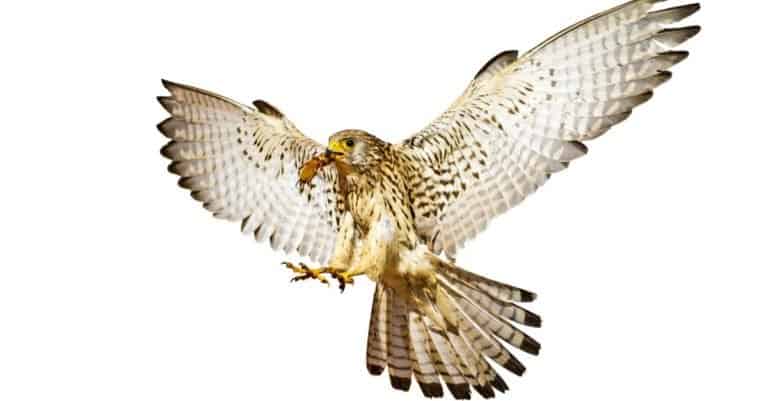
Known for their precision and speed, the falcon bird seeks out food like any bird of prey. Falcons, rather than being one species of bird, actually include 40 different species with specific traits that make each one unique.

Even with many different types of falcons, this family of birds is wholly considered to be the fastest-living animal. Peregrine falcons have been recorded diving at speeds of over 200 miles per hour!

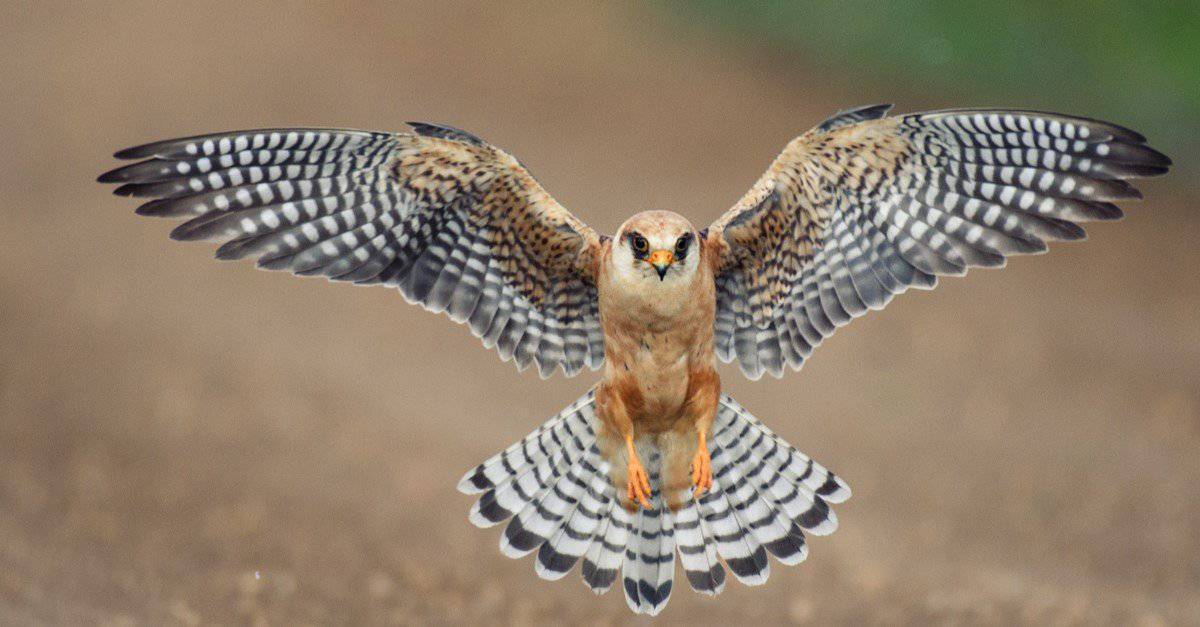
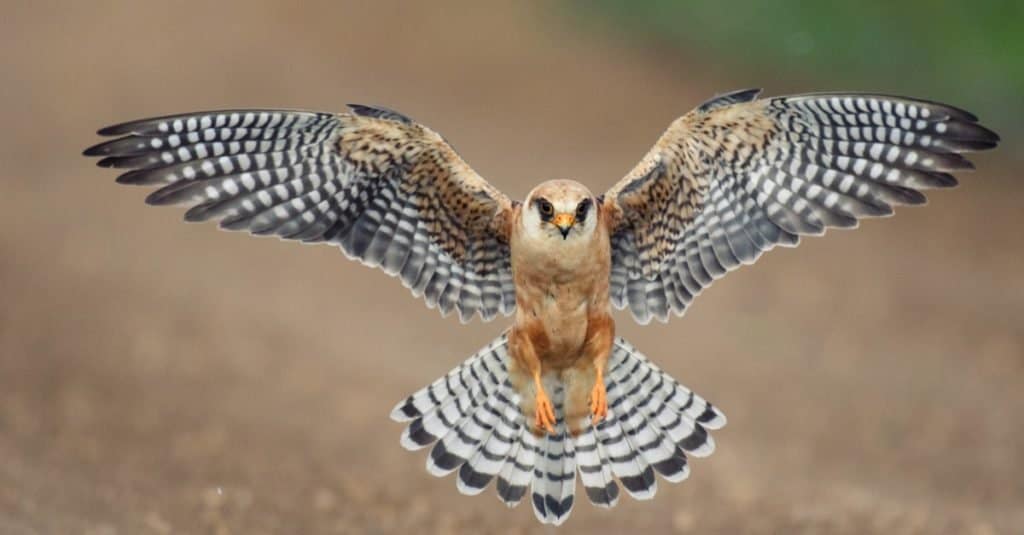
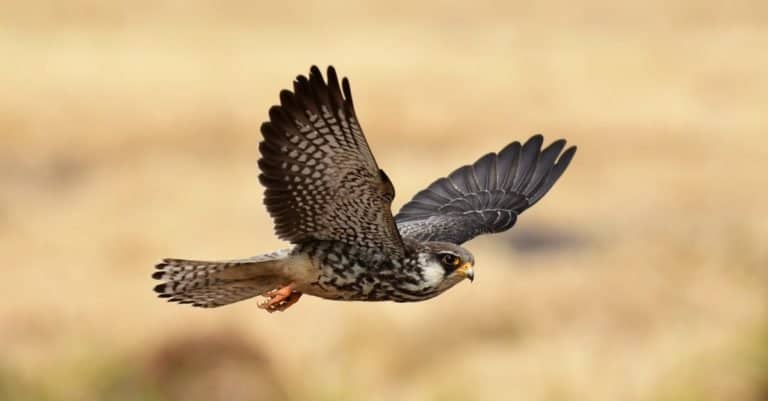
Falcon birds have a close relationship with hawks, possessing the same ferocity and quick reactions. Their streamlined bodies display slender, pointed wings. With their agility, these birds can often snatch their prey while they are in mid-flight.

Evolution and Origins

Falcons evolved about 50 to 35 million years ago during the Eocene Epoch. This possibly took place in South America or Africa, in the southern hemisphere. The modern falcons, genus Falco, began to diversify around 7.5 million years ago. Falcons belong to the family Falconidae.

Amazing Falcon Bird Facts
๐Ÿ‘ Most Dangerous Birds

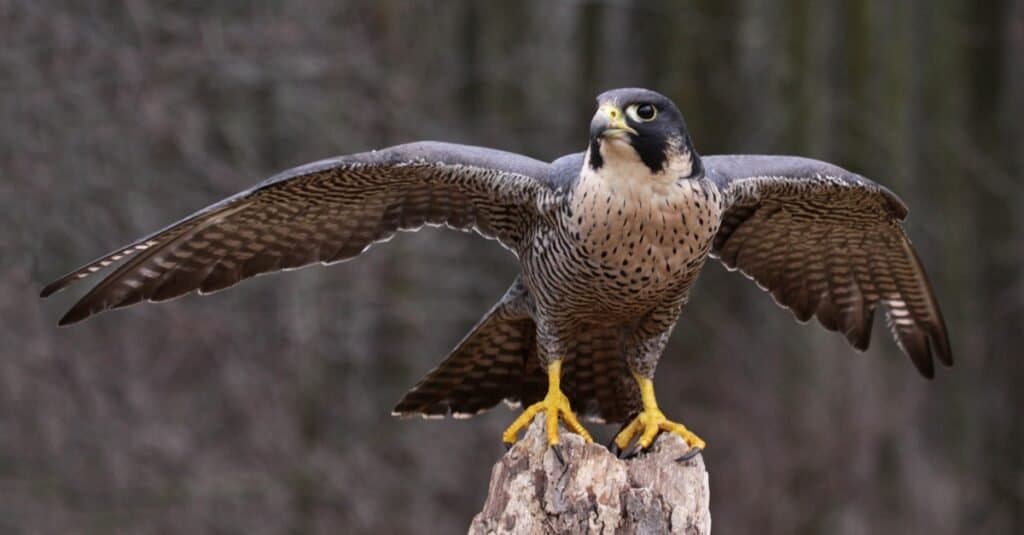
A Peregrine Falcon spreads its wings while perched on a stump. Falcons are the fastest animals in the world.

ยฉChris Hill/Shutterstock.com

  • The fastest animal on earth is the peregrine falcon (Falco peregrinus), which reaches speeds of up to 242 mph. It is nearly four times the speed of the fastest land animal (which is the cheetah).
  • These birds can catch their food with their beaks while they are in mid-flight.
  • Falcons have incredible eyesight, which is why they are able to capture their food so easily. They can see both regular color and ultraviolet color, exceeding the range of humans.
  • The cardiovascular system of the falcon bird allows them to sustain rapid wingbeats, with some species reaching up to 4-5 wingbeats per second during flight.

Where to Find Falcons
๐Ÿ‘ Types of Falcon Birds

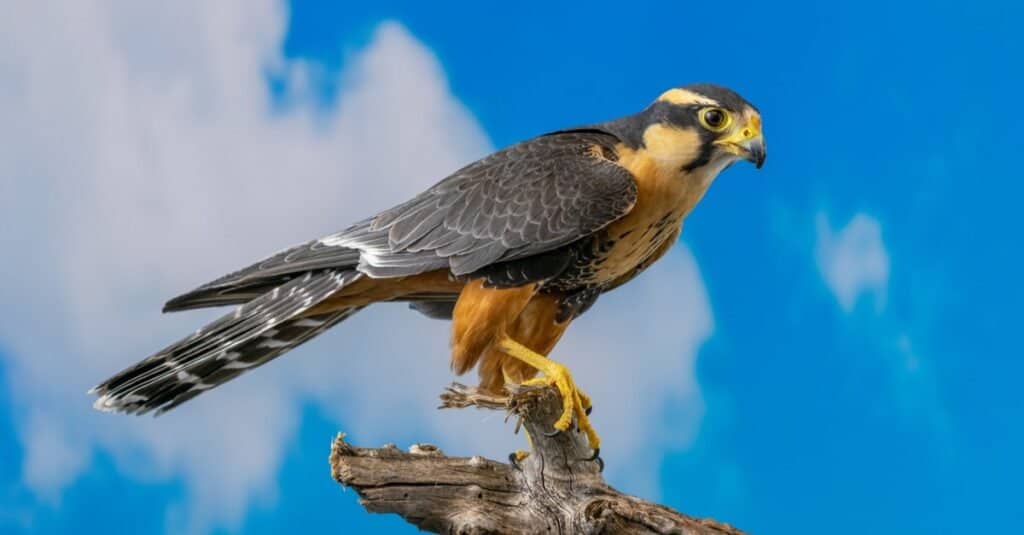
During hunting, Aplomado falcon pairs often pass food to each other in flight.

ยฉJayPierstorff/Shutterstock.com

Falcon birds seem to be spread across the world, including areas from the United States to the Tundra. Each species seems to have its own area that it prefers to reside in. For example, the American kestrel will migrate throughout the contiguous United States, sharing this home with peregrine falcons. They will also travel as far as Alaska and Hawaii.

Peregrine falcons like to travel even further to every continent, and even feel comfortable in the desert. However, as well-accustomed as they are to extreme temperatures, the only area that this bird does not inhabit is Antarctica.

In their habitats, the falcon bird will make their nest in tree holes, as well as on cliffs and natural ledges.

Classification and Scientific Name
๐Ÿ‘ Types of Falcon Birds

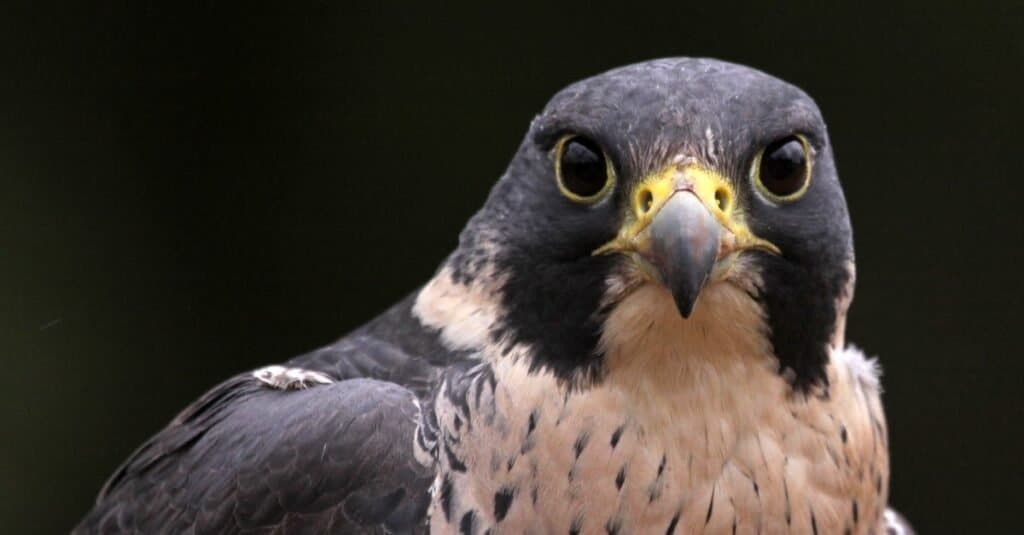
Modern Falcons are classified in the Falconiformes order.

ยฉChris Hill/Shutterstock.com

Falcons belong to the kingdom Animalia and the Phylum Chordata. Their class is called Aves, and the order is called Falconiformes. Their genus is called Falco.

The name โ€œhawkโ€ has French and English origins, coming from the word โ€œfaucon.โ€ The Latin word for the bird, falconem, comes from the word falx, named for the similarity that their physical characteristics, like their talons, beak, and wings, have to a curved blade.

The Birdโ€™s Size, Appearance, and Behavior

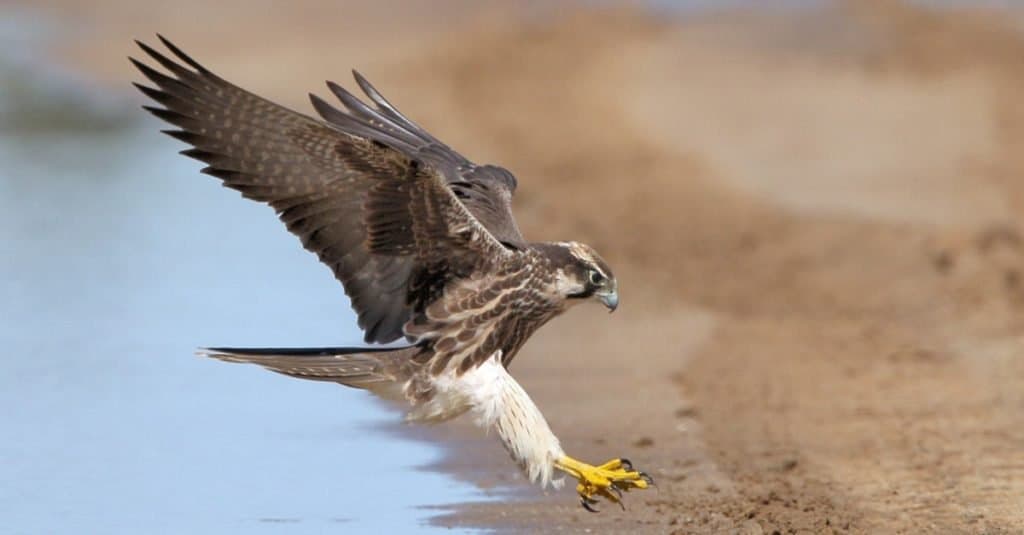
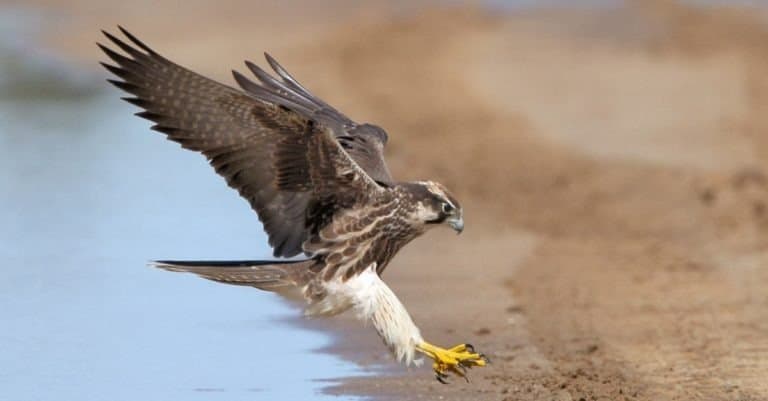
๐Ÿ‘ Lanner Falcon landing next to water in the Kalahari

Lanner Falcon landing next to water in the Kalahari.

ยฉNeal Cooper/Shutterstock.com

Falcon birds can range from 13 to 23 inches, weighing approximately 1.5 to 3.3 pounds. Most of these birds of prey ultimately range from small to medium size, and their head is adorned with a black crown of feathers. This blackness extends to their nape and wedge as well, connecting the colors to look like a helmet over the birdโ€™s head.

With long and pointed wings, these features are typically slate grey, creating a distinct contrast with the head. Along their throat, the feathers are white to nearly cream in color, and the sides of the abdomen feature both brown and black bars.

The falcon bird tends to be solitary, primarily coming together during the mating season and at no other time of the year. During the rest of the time, these birds will spend the days either resting at the tops of tall trees or hunting for food. The majority of species will hunt in the daytime, taking any opportunity with the sunlight (even at dusk and dawn) to hunt.

Falcon birds will migrate seasonally, seeking out a milder region when the weather is increasingly cold during the winter. The migratory species will often go to Central or South America, though some will only journey to the southern United States.

Interestingly, some of them do not migrate at all. When it comes to their home, falcons are incredibly territorial. They will fight and attack to defend their resting place, protecting themselves and their offspring from humans, birds, and other animals.

What do Falcons Eat?
๐Ÿ‘ Image
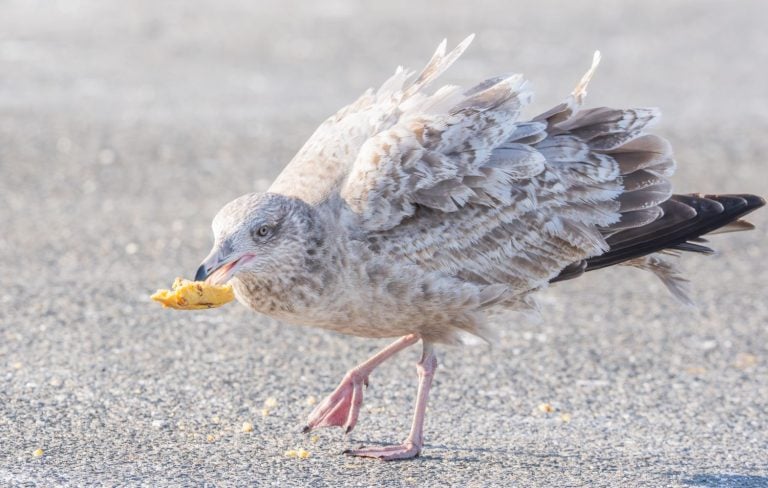
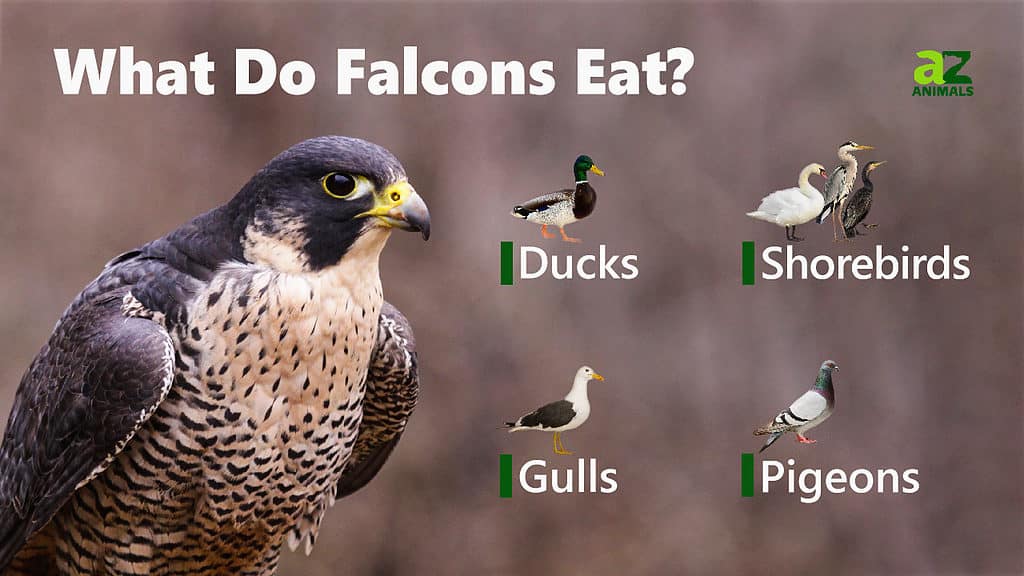
Falcons eat ducks, shorebirds, gulls, and pigeons.

These birds are carnivorous, meaning that they primarily consume meat in their diet. The sources of nutrients that they prefer will vary from species to species, but they are not picky; most often, they will just seek out food that is easy to catch without much work.

The Falcon doesnโ€™t often go after the big games. Rodents, small reptiles, and small amphibians are the most common sources of nutrients.

Predators and Threats

Like many living creatures, these birds tend to have their own slew of predators and other threats to their lives. Though their predatory characteristics keep them rather high on the food chain, humans and wolves are both dangers to the falcon bird population.

Large owls will seek out the birds that are still young and inexperienced in their defenses. However, more often than not, animals that prey on falcons will consume their eggs and young for a smaller challenge, as they cannot protect themselves without the help of their parents yet.

Though these birds are considered to be at โ€œleast concernโ€ on the endangered species list, there are still many laws that protect these birds (along with hawks and eagles) from being hunted as meat.

What Does a Falcon Bird Eat?

The food that these birds eat is entirely dependent on what they can lift and what they can catch. As speedy as most rodents are, falcons will seek out mice, rats, and even rabbits. If another bird is small enough to be caught in the sharp beak of the falcon, these birds will seek them out as well.

Additionally, they consume snakes and frogs, despite the defenses that these animals may have against predators.

What Eats Falcons?

As stated above, wolves and large owls have been known to go after falcons as food. However, they are not often the prey in the wild.

Even though humans are a threat, most sources say that it is not good to eat them. Their bodies do not often have any fat, due to their physical activity, making the meat rather dry. Furthermore, the primary concern with consuming falcon meat is due to the legal issues surrounding hunting the birds.

The Birdโ€™s Reproduction, Babies, and Lifespan

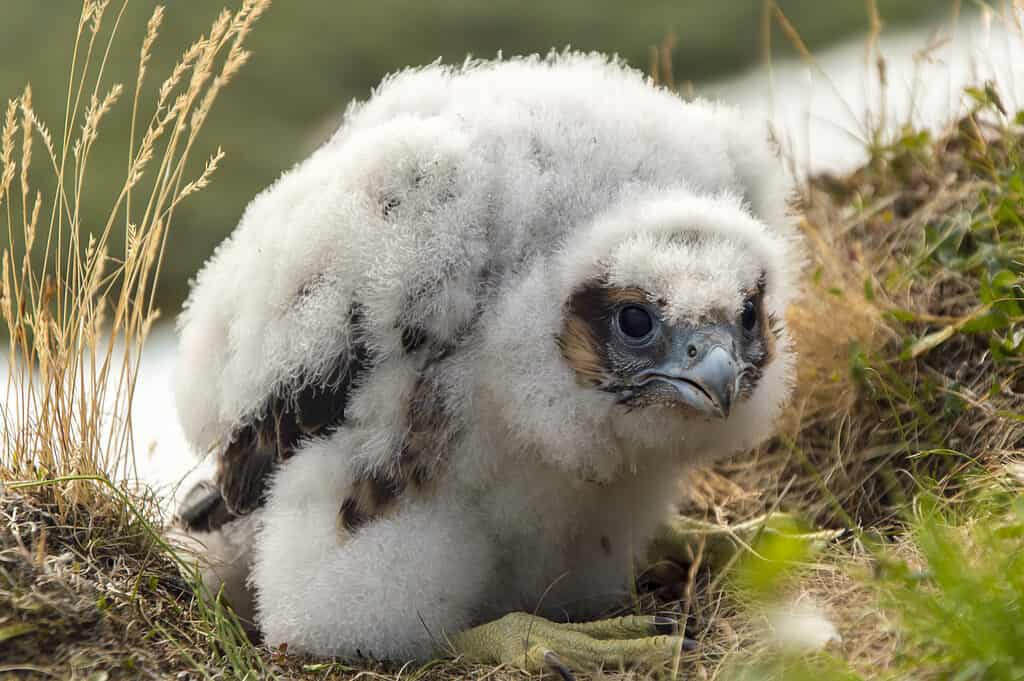
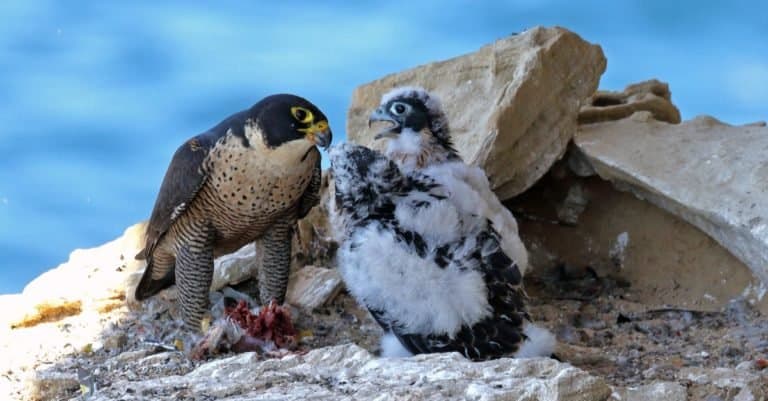
๐Ÿ‘ Chick falco peregrine. Yamal, Russia.

Young Peregrine falcon in the nest.

ยฉFufachew Ivan Andreevich/Shutterstock.com

Most of the falcon bird species are monogamous, which means that they have one mating partner. They usually mark territories around their nesting sites at the time of mating.

Female falcons take full responsibility for the incubation of babies known as chicks. They take care of the babies while the male falcons hunt for food.

Each cluster contains about two to four eggs. The incubation of falcon babies lasts about a month. However, different species of falcon babies take different amounts of time to start flying.

On average, falcons live for about 13 years. At most, they live for about 16 to 20 years.

Population

The total number of falcons around the world is currently unknown, but their conservation status is considered to be โ€œleast concernโ€ overall. The most recent estimates suggest that there are over 140,000 peregrine falcons alone, and the total number of falcons worldwide is much higher, though an exact figure is unknown.

The peregrine falcon was formerly considered endangered when certain pesticides were used over 50 years ago, killing much of the population. Since DDT โ€” one of the deadliest pesticides โ€” was banned, peregrine falcons have flourished, and their nesting areas are now protected.

View all 164 animals that start with F

Sources

  1. Study / Accessed January 3, 2021
  2. Animals / Accessed January 3, 2021
  3. National Geographic / Accessed January 3, 2021
  4. Sciencing / Accessed January 3, 2021
  5. Animals / Accessed January 3, 2021
  6. All About Birds / Accessed January 3, 2021
  7. Wikipedia / Accessed January 3, 2021

About the Author

Rebecca Bales

Rebecca is an experienced Professional Freelancer with nearly a decade of expertise in writing SEO Content, Digital Illustrations, and Graphic Design. When not engrossed in her creative endeavors, Rebecca dedicates her time to cycling and filming her nature adventures. When not focused on her passion for creating and crafting optimized materials, she harbors a deep fascination and love for cats, jumping spiders, and pet rats.
Connect:

Thank you for reading! Have some feedback for us?

Contact the AZ Animals editorial team

Related Articles You May Find Interesting


Falcon FAQs (Frequently Asked Questions)

Falcon is a small to medium-sized prey bird that is known to be very fast in catching its prey.

There are 40 different species of falcons in the world.

While falcons and hawks are closely related, there are some differences between the two.

Falcons attack humans and other birds and animals only when they sense a danger to their nests.

Some species of falcons are known to be seasonal migrators.

Every cluster has about two to four eggs.

Predators of Falcons include humans, eagles, owls, and wolves.

Falcons have sharp, pointed beaks and aerodynamic body shapes.

Falcons are the fastest creatures on the planet!

Falcons can live for 12 to 18 years.