

F
Species Profile

Firefly Ball Python

Python regius

Glow with the Firefly Morph
Master1305/Shutterstock.com

Firefly Ball Python Distribution

Domesticated Species

Found Worldwide

Firefly is a captive-bred morph of Python regius and not a wild form. Wild ball pythons live in West-Central Africa in savanna and forest-edge areas, including Ghana, Togo, Benin and Nigeria. Firefly’s range is wherever people breed or keep ball pythons in captivity.

At a Glance

Domesticated
Also Known As Ball Python, Royal Python, BP
Diet Carnivore
Activity Crepuscular+
Lifespan 12 years
Weight 3 lbs
Status Not Evaluated
Did You Know?

"Firefly" is a captive-bred morph name, not a separate species or subspecies of ball python.

Scientific Classification

A ball python (Python regius) selectively bred in captivity for the ‘Firefly’ morph—most commonly the combination of the Fire and Pastel traits—producing a brighter, higher-contrast yellow/gold appearance compared with wild-type ball pythons. This is not a separate wild taxon; it is a captive morph within the same species.

Kingdom
Animalia
Phylum
Chordata
Class
Reptilia
Order
Squamata
Family
Pythonidae
Genus
Python
Species
Python regius

Distinguishing Features

  • Captive-bred color/pattern morph of Ball Python (Python regius), not a distinct species/subspecies
  • Typically increased brightness and contrast versus wild-type ball pythons; often more vivid yellows/golds due to Pastel + Fire combination
  • Docile, small-to-medium constrictor typical of ball python husbandry in captivity

Physical Measurements

Males and females differ in size

Length
3 ft 5 in (2 ft 7 in – 4 ft 11 in)
3 ft 11 in (2 ft 11 in – 5 ft 11 in)
Weight
2 lbs (1 lbs – 4 lbs)
5 lbs (2 lbs – 9 lbs)
Tail Length
6 in (4 in – 9 in)
6 in (4 in – 8 in)
Top Speed
1 mph
Slow, short bursts

Appearance

Primary Colors
Secondary Colors
Skin Type Dry, keratinized overlapping scales typical of Python regius; smooth/glossy appearance when well-hydrated and during normal shed cycles (single-piece shed ideal).
Distinctive Features
  • Not a separate species or subspecies: 'Firefly' is a captive-bred color/pattern morph within Python regius (commonly Fire + Pastel in hobby genetics).
  • Compared with wild-type ball pythons: generally brighter overall (more yellow/gold/cream), higher contrast, and reduced dark 'muddy' tones; many individuals show a cleaner head stamp and more blushing along the dorsum.
  • Typical species context: medium-bodied, heavy-set python with a small head and relatively short neck; generally calm/handleable temperament with crepuscular/nocturnal activity patterns when kept appropriately.
  • Hatchlings and juveniles often appear especially bright; some Firefly individuals can darken or gain contrast with age-exact changes are variable.
  • Provide a secure enclosure with snug hides, a warm hide and cooler side, and proper humidity for clean sheds; dehydration shows as stuck sheds and dull scales.
  • Ball pythons, Python regius, risk respiratory infections if kept too cool or wet, and incomplete sheds if too dry. Firefly (Fire + Pastel) rarely shows severe nerve problems; some lines vary—buy from trusted breeders.
  • Feeding/conditioning: like most ball pythons, can be a selective feeder; consistent husbandry (security, temperatures, prey size/spacing) helps maintain body condition and reduces stress-related feeding refusals.

Sexual Dimorphism

Sexual dimorphism is modest and similar to typical Python regius: females average heavier-bodied and longer as adults; males tend to have proportionally longer tails and more prominent cloacal spurs. Color/pattern differences between sexes are not reliably consistent in the Firefly morph.

  • Often smaller/lighter-bodied than adult females at maturity (on average).
  • Proportionally longer tail past the cloaca; generally more prominent cloacal spurs.
  • No consistent, reliable Firefly-specific color difference from females.
  • Often larger/heavier-bodied with a broader midsection as adults (on average).
  • Proportionally shorter tail past the cloaca; cloacal spurs typically less prominent.
  • No consistent, reliable Firefly-specific color difference from males.

Did You Know?

"Firefly" is a captive-bred morph name, not a separate species or subspecies of ball python.

Most Firefly ball pythons are the combo of the Fire trait + the Pastel trait, producing cleaner, brighter yellows and higher contrast than wild-type.

Ball pythons get the name "ball" from their signature defense: curling tightly into a ball with the head protected in the center.

Python regius is often called the "royal python," reflecting its scientific name (regius = "royal" in Latin).

Ball pythons are typically crepuscular/nocturnal, relying on scent and heat-sensing to hunt in low light.

When bred "super" (two copies), the Fire trait can produce very pale/white animals in the hobby (often called "Super Fire"), showing how dramatically ball python color genes can interact.

Unique Adaptations

  • Heat-sensing labial pits help detect warm-blooded prey even in darkness.
  • Highly flexible skull and jaw ligaments allow swallowing prey wider than the head.
  • Energy-efficient metabolism: ball pythons can go long periods between meals compared with many other pets (husbandry should still avoid underfeeding/overfeeding).
  • Powerful constriction is a specialized hunting method common to pythons.
  • Firefly coloration is a human-selected trait (Fire + Pastel) that increases brightness/contrast; it's not a distinct wild adaptation or taxon.

Interesting Behaviors

  • Balling response: when stressed, many individuals coil into a tight, protective sphere.
  • Ambush hunting: they often wait motionless for prey to pass, then strike and constrict.
  • Tongue-flick "scent reading": they sample airborne chemicals and deliver them to the Jacobson's organ.
  • Crepuscular activity: many are most active at dusk/night, spending daylight hours hidden.
  • Hide preference and "security checking": they routinely choose tight hides and may switch hides based on temperature.
  • Pre-shed behavior: increased hiding and duller skin/blue eyes before shedding (common to the species, visible in all morphs including Firefly).

Cultural Significance

Firefly Ball Python (Python regius) is a popular pet snake because it is calm and small. The Firefly morph is famous in reptile education and breeding. In parts of West Africa, pythons appear in religion and symbolism.

Myths & Legends

Fon/Vodun traditions in the Dahomey region (Benin) tell of the great serpent Dan (often linked with the rainbow-serpent figure Aido-Hwedo) who supports or encircles the world, embodying cosmic balance and continuity.

In Ouidah, Benin, the Temple of Pythons is associated with reverence for pythons in Vodun practice; stories describe pythons as sacred beings connected with protection and spiritual power.

Across several West African communities, pythons are treated in local tradition as spiritually significant animals-sometimes as guardians or revered beings-leading to customs of respect and avoidance of harm.

In reptile keeping, the "Firefly" morph of the ball python (Python regius) is named for its bright gold colors and is called a 'gateway' morph that sparked many keepers' interest in genetics.

Conservation Status

NE Not Evaluated

Has not yet been evaluated against the criteria.

Population Stable

Life Cycle

Birth 6 hatchlings
Lifespan 12 years

Lifespan

In the Wild 5–20 years
In Captivity 15–40 years

Reproduction

Mating System Polygynandry
Social Structure Managed Domestic
Breeding Pattern Seasonal
Fertilization Internal Fertilization
Birth Type Internal_fertilization

Behavior & Ecology

Social No formal group Group: 1
Activity Crepuscular, Nocturnal
Diet Carnivore Appropriately sized rats (often pre-killed/frozen-thawed in captivity)

Temperament

Generally calm, shy, and secretive; prefers tight hides and minimal disturbance-this is typical for ball pythons and remains true for Firefly morphs.
Firefly morph distinction (Fire + Pastel traits): brighter yellow/gold and higher contrast patterning compared with wild-type; behavioral profile is not reliably different from standard ball pythons, though individuals vary by handling history and husbandry.
Firefly Ball Python (Python regius) usually stay in a hide, then become active at dusk or night to explore and hunt. Some are more curious with enrichment; others hide more when stressed or shedding.
Stress/defensive responses: 'balling' (tight coiling with head protected), freezing, retreating into hides; if pushed, may hiss, strike, or bite-biting is more often a feeding/overstimulation response than aggression.
Handling tolerance is typically good with consistent, gentle sessions; avoid frequent handling after feeding, during pre-shed ("in blue"), or when the animal is refusing meals.
Firefly color doesn't change social needs, but bright morphs do better with dim lighting and lots of cover to feel less exposed; secure hides on warm and cool sides keep their calm.
Common health risks for the species: obesity from overfeeding; breathing infections from cool, damp conditions; stuck shed from low humidity; heat burns from unguarded heaters; mites and mouth infections. Pastel/Fire rarely shows morph-linked 'wobble'.
Feeding/social management: best housed singly; introduce prey with tongs to reduce mistaken feeding bites; monitor for food refusal cycles (common in adult males seasonally) and avoid stressors (excessive enclosure changes, cohabitation).

Communication

Hissing Primary audible defensive signal
Occasional forceful exhalation/'puff' when startled.
Chemical communication via pheromones (especially during breeding); males track females by scent trails.
Tongue-flicking to sample airborne/ground chemicals with the vomeronasal organ.
Defensive postures: balling, head withdrawal, S-curved neck prior to a strike.
Tactile/locomotor signaling: slow deliberate movements when calm vs. rapid retreat/jerky movement when stressed.
Reproductive interactions: male chin-rubbing/spurring stimulation during courtship; increased roaming/restlessness during breeding season Varies by individual and season

Habitat

Biomes:
Savanna Tropical Dry Forest Tropical Rainforest Wetland Freshwater
Elevation: Up to 4921 ft 3 in

Ecological Role

Mesopredator (rodent specialist) in West and Central African savanna/forest-edge ecosystems; in captivity, a feeder-rodent predator with no direct wild ecological function.

Regulates small-mammal (rodent) populations, indirectly supporting crop protection and limiting rodent-borne disease pressure in native habitats Transfers energy up the food web as a predator and as prey for larger carnivores/raptors in native ranges

Diet Details

Main Prey:
Small rodents African soft-furred rats Gerbil Small birds

Human Interaction

Domestication Status

Semi domesticated

Ball pythons (P. regius) are wild African snakes kept in captivity for decades and bred for temper and color, though not truly domesticated like dogs or cats. Firefly is a captive-bred color morph (often Fire × Pastel), with brighter yellow/gold, higher-contrast, cleaner patterning; size, behavior, and husbandry remain typical. Human interactions: pets, breeding/genetics, education, trade, and reptile vet care.

Danger Level

Low
  • minor bites (usually defensive; puncture wounds possible)
  • scratches/abrasions from teeth during feeding response
  • salmonella and other hygiene-related zoonotic risk from reptile handling/enclosures
  • allergic reactions to bedding/rodent feeders in some keepers

As a Pet

Suitable as Pet

Legality: Generally legal in many U.S. jurisdictions as a non-venomous reptile pet, but local/state/city rules can restrict reptile ownership, require permits, or regulate large constrictors. Ball pythons are commonly permitted; always verify local ordinances and housing/transport rules.

Care Level: Moderate

Purchase Cost: $150 - $1,000
Lifetime Cost: $3,000 - $10,000

Economic Value

Uses:
Companion animal trade (pet industry) Captive breeding/genetics (herpetoculture) Education and outreach animals Veterinary services (exotics) Enclosure/heating/lighting supply market
Products:
  • captive-bred Firefly ball pythons (pets and breeding stock)
  • morph breeding services/loans and genetic lineage value
  • terrariums/racks, thermostats, heat mats/heat panels
  • substrates, hides, water bowls, humidity control products
  • frozen/thawed feeder rodents

Relationships

Predators 6

Raptors Accipitridae
Large owls Strigidae
Monitor lizard Varanus
Mongoose Herpestidae
Genet Genetta
Human Homo sapiens

Related Species 5

Burmese Python Python bivittatus Shared Genus
Reticulated Python Malayopython reticulatus Shared Family
African Rock Python Python sebae Shared Genus
Indian Python Python molurus Shared Genus
Timor Python Malayopython timoriensis Shared Family

Ecological Equivalents 5

Animals that fill a similar ecological role in their ecosystem

Corn Snake Pantherophis guttatus Occupies a similar niche as a small-to-medium constrictor that preys primarily on rodents, thrives in human-modified habitats, and is commonly kept and bred in captivity; differs taxonomically by being a colubrid rather than a python.
Boa Constrictor Boa constrictor Similar ambush and constriction predation strategy and captive care themes (thermal gradients, humidity management, feeding frozen-thawed rodents), though typically larger-bodied and from different habitats.
Carpet Python Morelia spilota Plays a comparable role as a nocturnal/crepuscular ambush predator of small mammals and birds; in captivity it has similar enclosure and heat requirements, though it is often more arboreal.
Kingsnakes Lampropeltis spp. Overlaps in prey base (small mammals) and in human-commensal hunting opportunities; also commonly bred into color morphs, making them a close ecological/cultural analog in the pet trade.
Dumeril's Boa Acrantophis dumerili Shares a largely terrestrial, ambush-based lifestyle and a rodent-heavy diet. Often compared in captivity as a calmer terrestrial constrictor with similar husbandry priorities.

Firefly Ball Python Summary

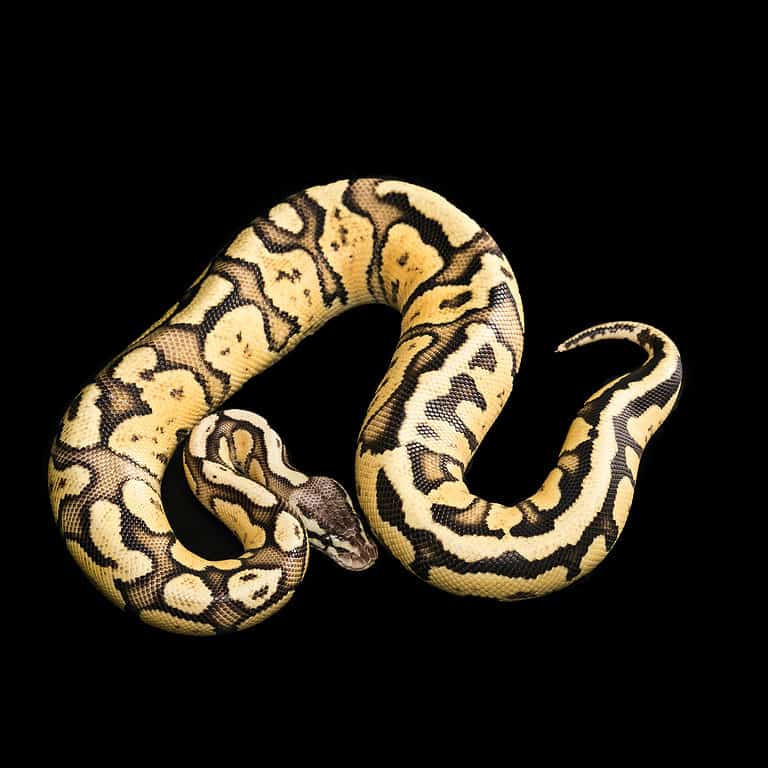
“Mainly electric yellow and almost jet black in color, the firefly ball python morph is stunningly bright and bold with extremely clean, defined markings.”

Even out of thousands of colorful and unique ball python morphs on the market, the firefly morph manages to be one of the boldest and brightest of all. Originally developed in 2006 by breeder Brandon Boeke, this designer morph is a brilliant combination of the popular pastel and fire traits.

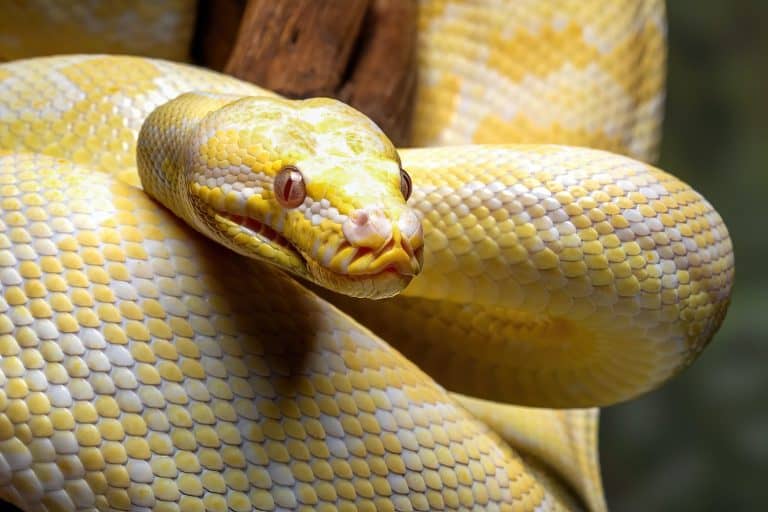
With its bright yellow body accented by dark brown or black banded markings, the firefly ball python retains the pastel morph’s bright coloration and the fire morph’s rich yellows and dark, striking markings. It also has much cleaner patterning with less blushing and faded patches than its pastel and fire parents. What’s more, its bold yellow and golden tones only become more vibrant with age.

In more recent years, reptile breeders have used this morph to develop newer designer morphs, such as the super firefly, firefly clown, and Enchi firefly varieties. This is mainly because the firefly trait tends to brighten and enhance its offspring’s coloration and patterning.

3 Amazing Firefly Ball Python Facts!

  • The firefly morph has very little blushing or faded patches on its skin compared to many other designer morphs, resulting in a very “clean” and bold pattern with heavily contrasting yellow and black tones.
  • Although the base morphs that make up the firefly morph can technically occur naturally in the wild, the firefly morph itself is a designer morph that requires selective breeding in captivity.
  • Baby firefly ball pythons tend to have more muted colors and faded patterning that slowly become more vibrant and defined with age. By around one to two years of age, most firefly ball pythons will have achieved their full color potential.

Where to Find Firefly Ball Pythons

The ball python, or alternatively the royal python, is native to central and western Africa’s savannas, grasslands, and forests. It mainly resides along the continent’s Sub-Saharan region, with large populations in countries like Ghana, Senegal, and Cameroon.

Firefly ball pythons, as briefly touched on above, cannot naturally exist in the wild. This designer morph has two specific traits, the pastel and fire, that require selective breeding. Some base morphs can technically be born in the wild, but this is very rare, with almost no actual documented cases.

In captivity, though, firefly ball pythons are quite common among reptile breeders and hobbyists. The morph has remained popular since its development in 2006, with many breeders worldwide producing their own lines of firefly snakes and selling them online as well as at events like reptile expos.

On average, firefly ball pythons cost around $100 to $300 each. This will vary based on the snake’s coloration and overall genetic expression, the morph’s current supply and demand, and where you purchase the snake.

Firefly Ball Python Scientific Name

Python regius is the ball python’s scientific name. It is a member of the Python family, with its full taxonomic name translating roughly to “royal python.” 

This regal moniker is a nod to the common belief that royalty in ancient Egypt wore actual snakes around their wrists and necks as live jewelry to flaunt their status. These snakes were likely baby ball pythons, since they were non-venomous and non-aggressive!

All ball python morphs have the same scientific name since they are all part of the same species.

Firefly Ball Python Population & Conservation Status

Since 2012, the IUCN Red List has designated the ball python as near threatened. Even though it isn’t anywhere near becoming extinct in the wild for the time being, this status could potentially change in the future for a few key reasons.

The species has been experiencing a slight decline in its overall population within much of its native habitat in Africa. The main culprit is habitat loss caused primarily by the agricultural industry’s rapid expansion throughout many Sub-Saharan African countries. Humans also commonly remove ball pythons from their native habitats while hunting them for food or trapping them to sell in the exotic pet trade.

There is currently no further data on the ball python’s exact numbers in the wild or in captivity. 

How to Identify Firefly Ball Python: Appearance and Description

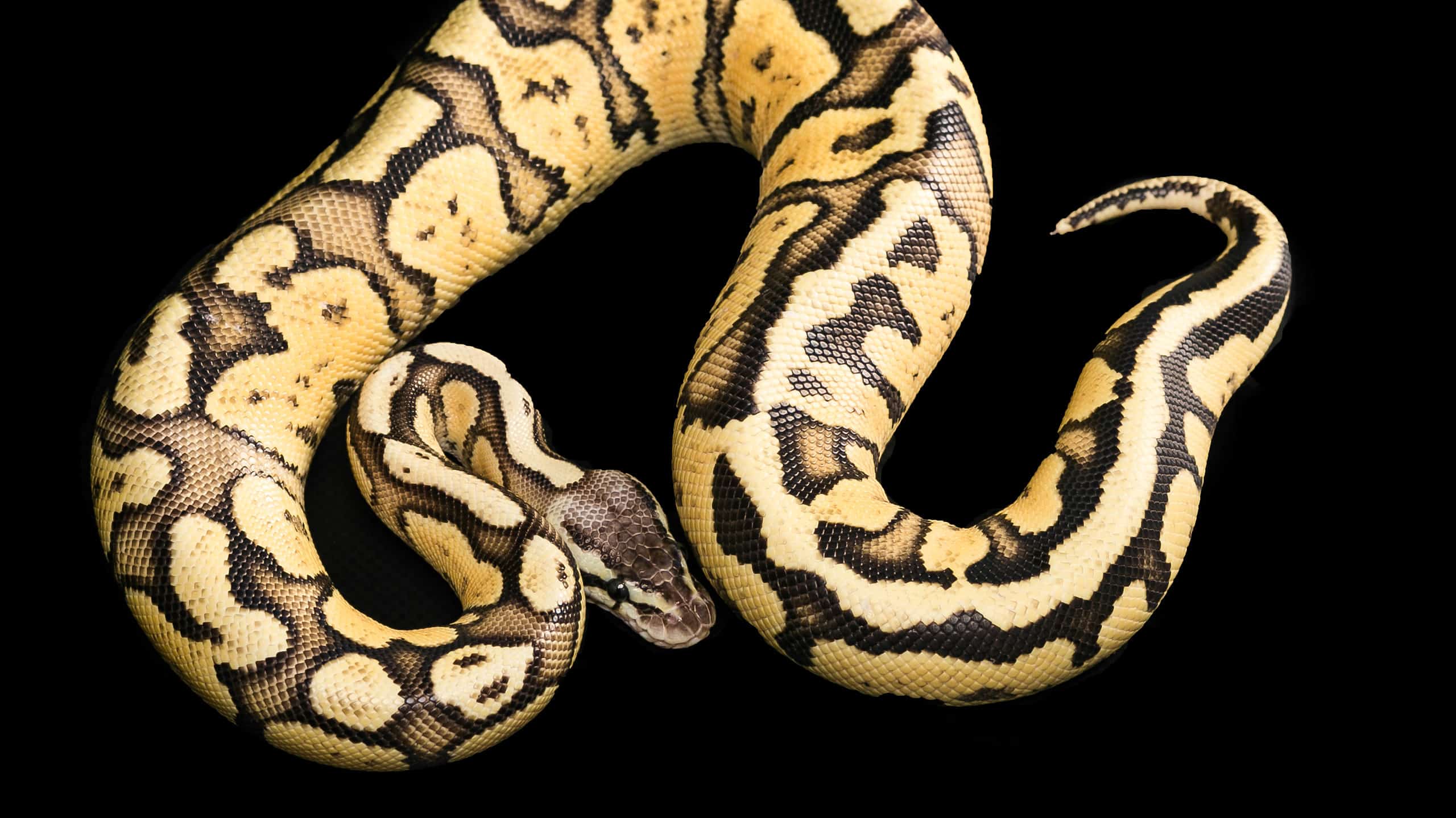
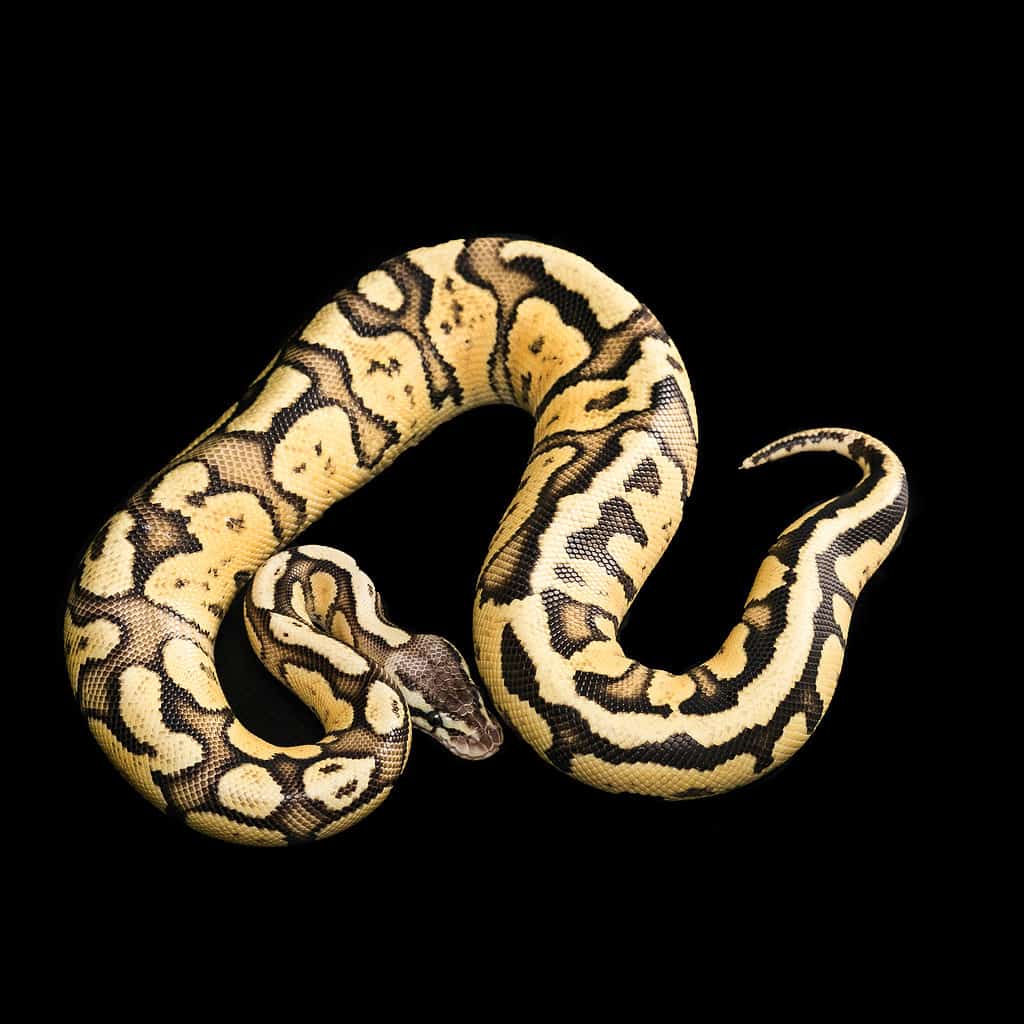
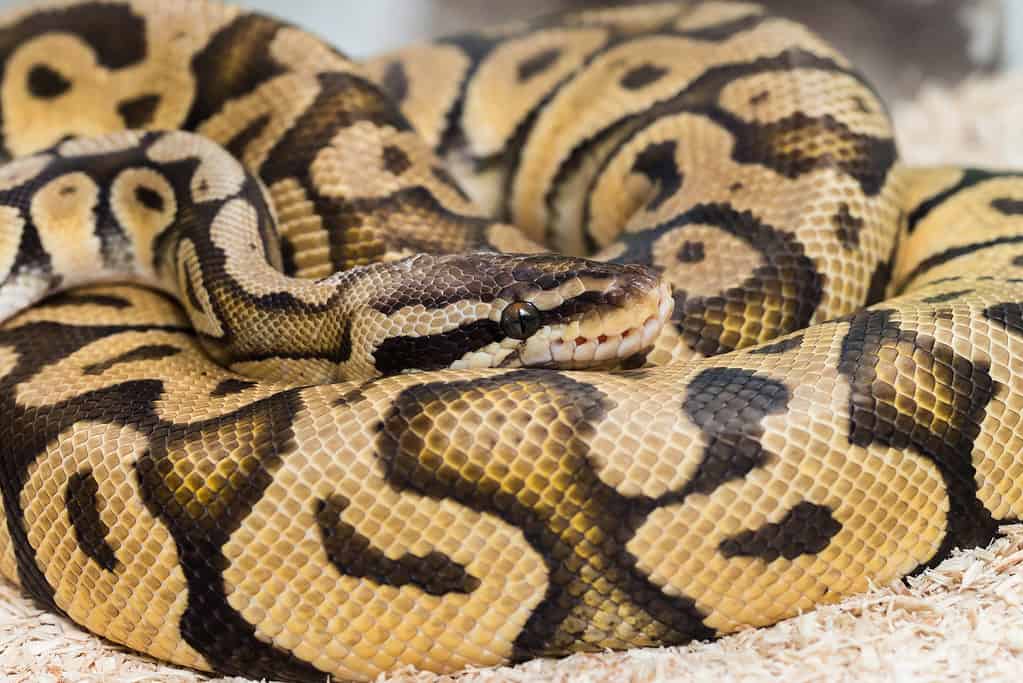
As a combination of the bright and bold fire and pastel traits, it’s no surprise the firefly morph’s name suits it so perfectly. Its neon, almost electric yellow body contrasts with its dark brown to nearly black markings. This gives its color palette a distinctly firefly or lightning bug-like boldness as if its entire body were constantly glowing, making it somewhat similar to the also-popular bumblebee designer morph.

Aside from a single pale spot on top of the snake’s head, it has almost no blushing or fading whatsoever. This morph’s markings are so bold and clearly defined that reptile breeders now commonly combine it with other traits to “clean up” or “enhance” their patterning and brighten their overall coloration.

Look closely for the following traits to properly identify a firefly ball python:

  • Mostly yellow body that can range from a warm, sunny gold to a bright, neon lemony tone
  • Very dark, almost black banded markings
  • Extremely bold, well-defined patterning and very little to no blushing
  • High contrast between its yellow and black patterning

Firefly Ball Python Evolution and History

Even though ball pythons have been prominent in the exotic pet trade since the mid-1990s, the firefly morph in particular has only existed since around 2006. Reptile breeder Brandon Boeke primarily developed it. As a designer morph, it contains two co-dominant traits, or base morphs: the fire and pastel traits. Designer morphs cannot be born in the wild naturally, as very specific, selective breeding conditions are necessary to combine particular genetic traits with one another.

Although the firefly morph is a bit more recent in the overall timeline of designer ball python morphs, the fire and pastel traits it contains were among the first base morphs to become popular within the exotic pet trade. 

The pastel morph was first proven and developed in 1997 by the breeders at New England Reptile Distributors. It is a fairly subtle, basic morph compared to most modern designer varieties. Still, it remains very useful for combining with other traits to brighten the resulting offspring’s overall coloration, particularly its yellow markings.

Meanwhile, the fire morph is a color-enhancing morph that developed around six years later in 2003. Its overall coloration and patterning are similarly lighter and brighter than that of a normal, wild-type ball python. It also has warmer, more golden tones overall.

As we touched on earlier, these two traits finally came together in 2006 to create the firefly morph we know and love today.
👁 Firefly ball python

The firefly morph’s neon, almost electric yellow body contrasts with its dark brown to nearly black markings.

©Natnaphit/Shutterstock.com
👁 Three baby firefly ball pythons

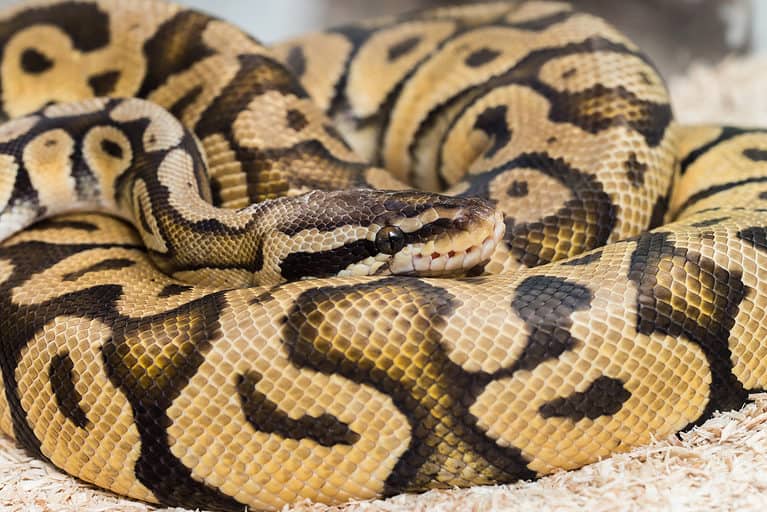
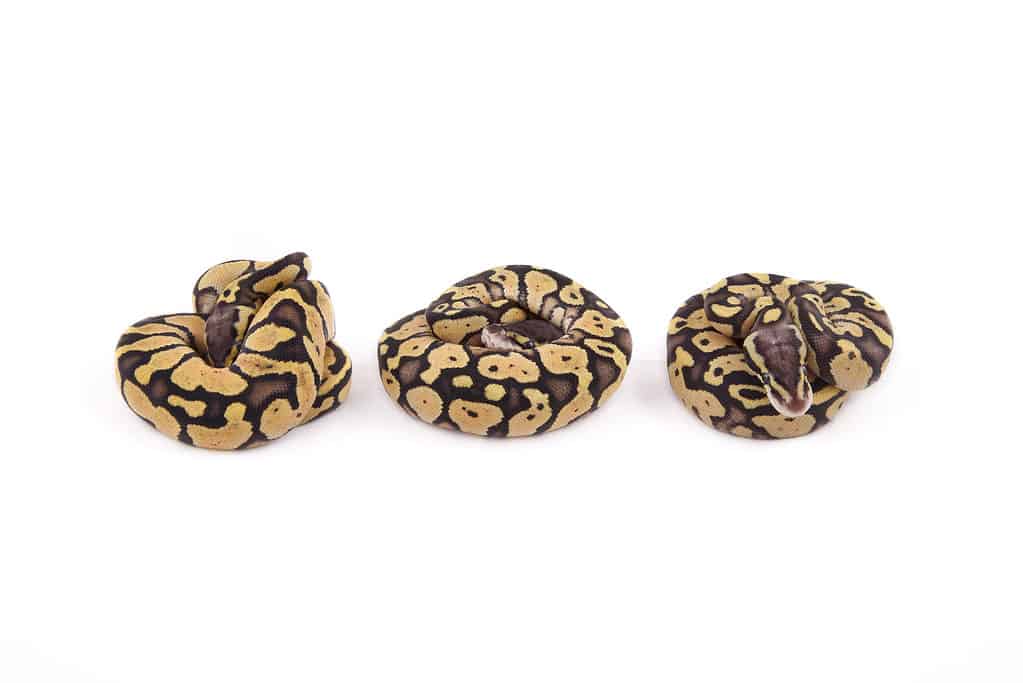
Ball pythons will curl into a submissive position when threatened.

©Sanne Romijn Fotografie/Shutterstock.com

Firefly Ball Python: How Dangerous Are They?

The ball python has become one of the most popular and well-loved pet reptiles in the world mainly thanks to its uniquely tame, friendly, and gentle temperament. Though it can be somewhat timid and prefers a solitary lifestyle with no tankmates, it is remarkably cooperative and docile around humans. Its calm personality along with its small size and non-venomous status make it arguably one of the least dangerous snakes on the planet.

Rather than biting or rearing up into a defensive, cobra-like stance, ball pythons curl their bodies tightly into a tiny ball when they are frightened or threatened. Their bodies are small and their thin, fragile teeth aren’t particularly effective at biting into larger animals, so they prefer to flee or assume their trademark “ball” posture.

Only in rare circumstances will a ball python resort to biting a human. In nearly all cases, ball python bites are minor and need very little medical attention. If one of these snakes bites you, simply gently place the snake back into its enclosure, ensuring it is not injured. Carefully wash the bite wound with soap and warm water. If necessary, bandage the wound to protect it from becoming infected and encourage the healing process.

Ball python morphs generally all share the same overall temperament as they have been selectively bred for their appearance rather than personality traits. 

Firefly Ball Python Behavior and Humans

Ball pythons have become so popular as pets that reptile breeders have managed to produce thousands of unique color and pattern morphs! The ball python, along with the equally popular corn snake, is currently one of the most abundant and widespread pet snakes in the world.

Their massive popularity and long relationship with humans is due to a few main factors: the snake’s small size, its rather cute facial features, its hardiness and success in captivity, and, of course, its timid yet intelligent and gentle personality. As a fairly intelligent and active snake, it can also be entertaining to observe. Maxing out at around 5 feet long, ball pythons are manageable to raise even for beginners. They fare quite well in captivity.

Since ball pythons are mainly selectively bred for their appearance, most morphs have the same overall temperament. This means prospective ball python owners have practically endless color and pattern options to choose from. The firefly morph remains one of the most popular designer morphs on the market, even more than 15 years after its initial introduction to the pet trade.

View all 164 animals that start with F

Sources

  1. Animal Diversity animaldiversity.org/accounts/Python_regius/ / Accessed December 1, 2022
  2. IUCN Redlist iucnredlist.org/species/177562/15340592 / Accessed December 1, 2022
  3. NW Reptiles nwreptiles.com/firefly/ / Accessed December 1, 2022
  4. San Diego Zoo animals.sandiegozoo.org/animals/python / Accessed December 1, 2022
  5. World of ball pythons worldofballpythons.com/morphs/firefly/ / Accessed December 1, 2022

About the Author

Hailey Pruett

Hailey "Lex" Pruett is a nonbinary writer at A-Z Animals primarily covering reptiles and amphibians. They have over five years of professional content writing experience. Additionally, they grew up on a hobby farm and have volunteered at animal shelters to gain further experience in animal care. A longtime resident of Knoxville, Tennessee, Hailey has owned and cared extensively for a wide variety of animals in their lifetime, including cats, dogs, lizards, turtles, frogs and toads, fish, chickens, ducks, horses, llamas, rabbits, goats, and more!
Connect:

Thank you for reading! Have some feedback for us?

Contact the AZ Animals editorial team

Related Articles You May Find Interesting


Firefly Ball Python FAQs (Frequently Asked Questions)

Ball pythons are non-venomous snakes. They do not have fangs and cannot inject or produce venom. This goes for all ball python morphs, as they are all part of the same species.

Ball pythons are ambush hunters that mostly hunt rodents like rats and mice as well as small birds.

To find food, they will sit and wait very quietly, usually while camouflaged amongst dense foliage, for a prey animal to wander within their striking range. At the ideal moment, the snake will strike, gripping the prey animal with its many sharp, small teeth. Next, the ball python will quickly wrap the rest of its body around the animal as tightly as possible, usually suffocating it within minutes. Finally, it will swallow the animal whole and digest it over the following days.

Ball pythons are native to western and central parts of Africa, mainly within the Sub-Saharan region. They are incredibly hardy animals that can live comfortably in various habitats like grasslands, savannas, and even forests.

Notably, designer morphs like the Firefly variety do not exist in the wild. They must be bred in captivity. They are made up of multiple specific genetic traits that can only be reliably combined via selective breeding.

Firefly ball pythons are fairly common within the reptile trade today, as the morph has existed since 2006. Various reptile breeders have also created their own lines of Firefly ball pythons. There are many potential sources to purchase them from both online and in-person. Because they are a designer morph, however, they are virtually non-existent in the wild.

The average Firefly ball python costs around $100 to $300. Many factors can affect this price range, including the breeder selling the snake, the snake’s exact genetic expression and overall appearance, and the current supply and demand for the morph.

Ball pythons are adept hunters, but they are not aggressive toward humans. In fact, they are one of the least aggressive snakes in the world. Their small size renders them unable to hunt prey much larger than a common rat.

Ball pythons are carnivores that feed mainly on small rodents and birds. They will also occasionally hunt amphibians and small fish. In captivity, most pet owners feed their ball pythons captive-bred rats and mice that are frozen and meant to be thawed just prior to feeding.