

Ghost crabs are one of the most populous crab species in the world and are found on beaches from Oman to Polynesia, Australia, Florida, Egypt, and Greece.
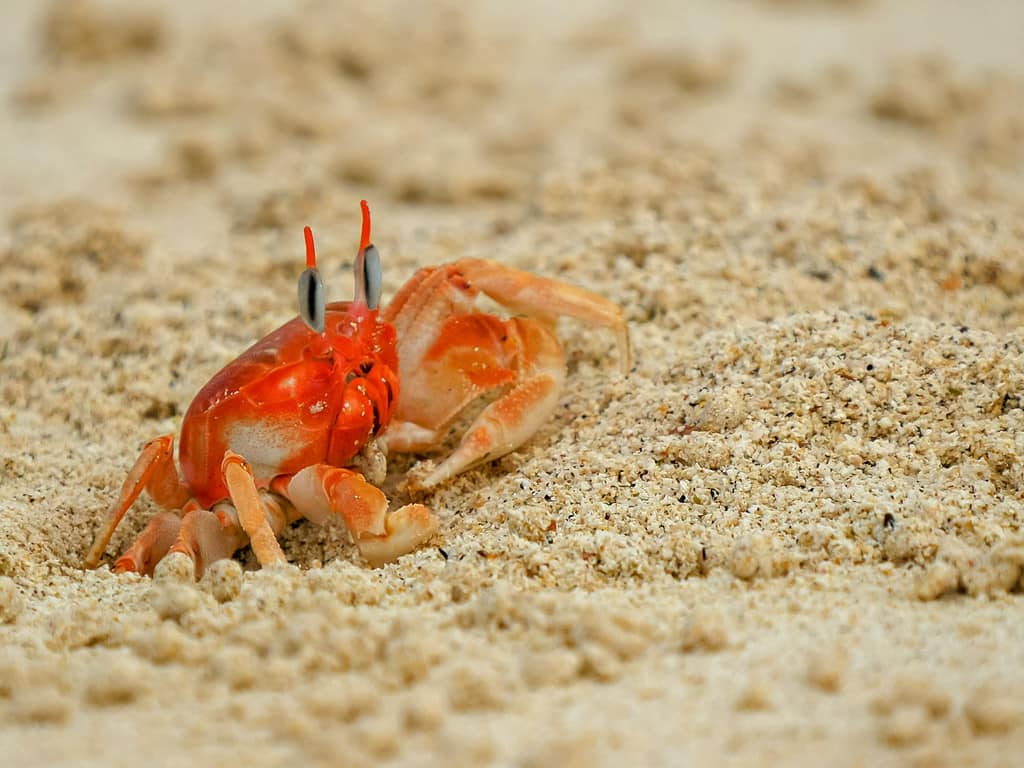
A ghost crab on a beach at Isla San Cristobal in the Galapagos islands, Ecuador.
©crbellette/iStock via Getty Images
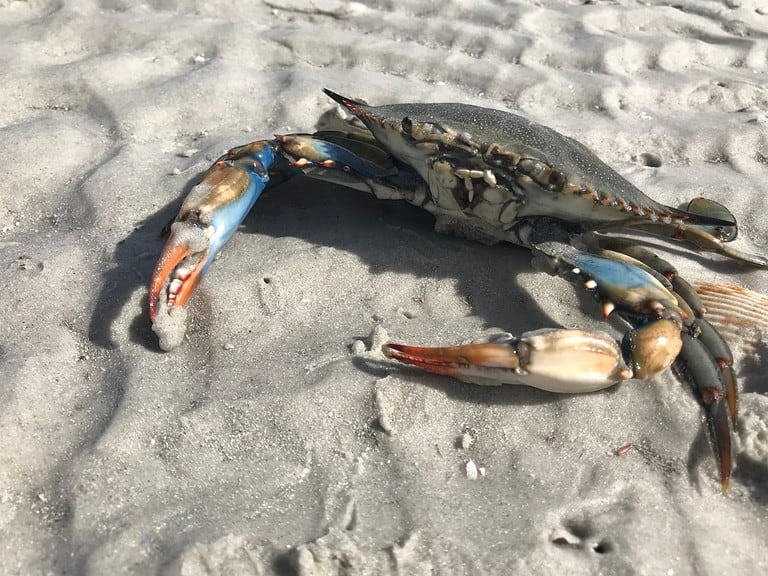
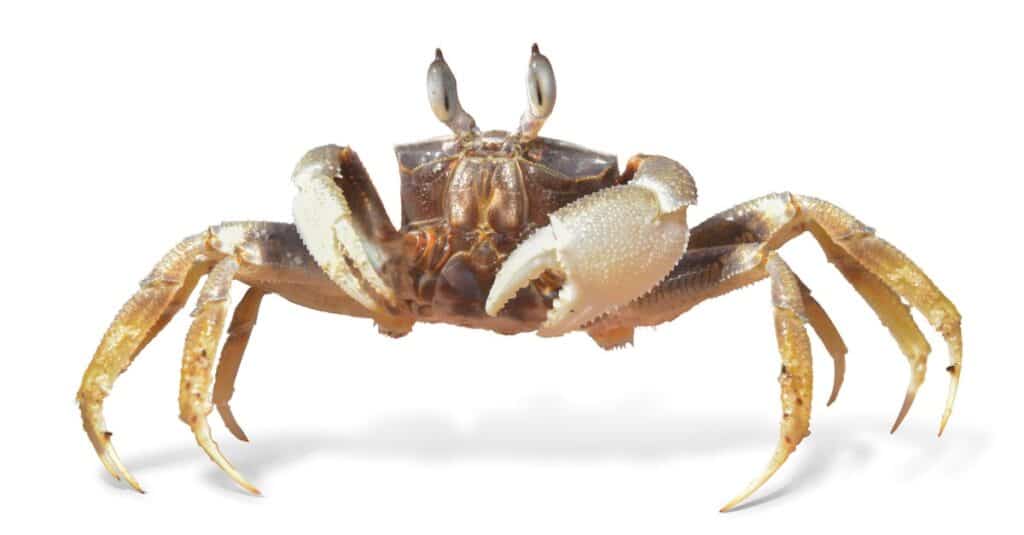
Ghost crabs, also called sand crabs, are known for their boxy shape, sometimes horned eyestalks, and uneven claw size. Although they use eight of their ten legs to walk normally, they only use their first and second pairs of legs when they need to move quickly.
Classification and Scientific Name
Ghost crabs are members of the subfamily Ocypodinae, which is found in the Ocypodidae family. Ocypode comes from Greek and means “swift-footed,” which describes the surprisingly fast way these crabs can scuttle over the sand. There are two genera in this subfamily: Ocypode and Hoplocypode. In the genus Ocypode, there are 20 species, but there’s only one species in Hoplocypode: H. occidentalis.
Species
Besides Hoplocypode occidentalis, the species of this type of crab are:
- Ocypode africana
- Ocypode brevicornis
- Ocypode ceratophthalma
- Ocypode convexa
- Ocypode cordimanus
- Ocypode cursor
- Ocypode fabricii
- Ocypode gaudichaudii (the painted ghost crab)
- Ocypode jousseaumei
- Ocypode kuhlii
- Ocypode macrocera
- Ocypode madagascariensis
- Ocypode mortoni
- Ocypode pallidula
- Ocypode pauliani
- Ocypode quadrata
- Ocypode rotundata
- Ocypode ryderi
- Ocypode saratan
- Ocypode stimpsoni
Appearance
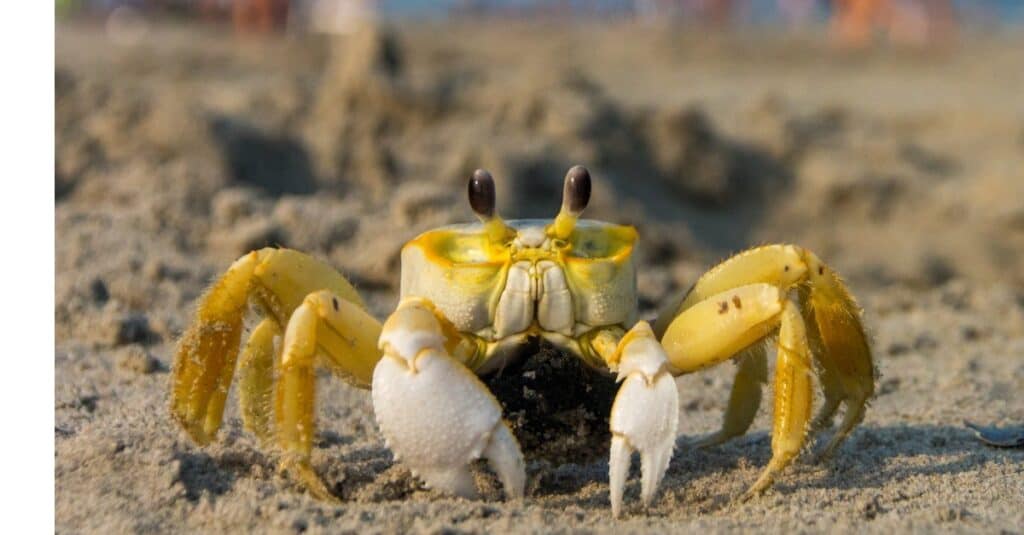
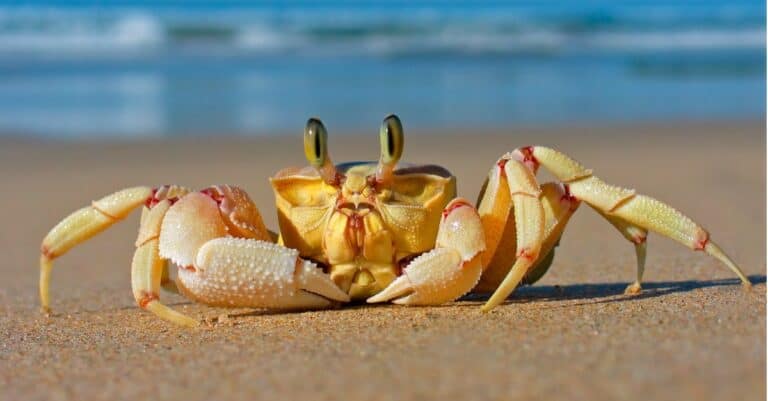
A low angle close up of a ghost crab on a beach in the foreground.
©iStock.com/Jonathan Mauer
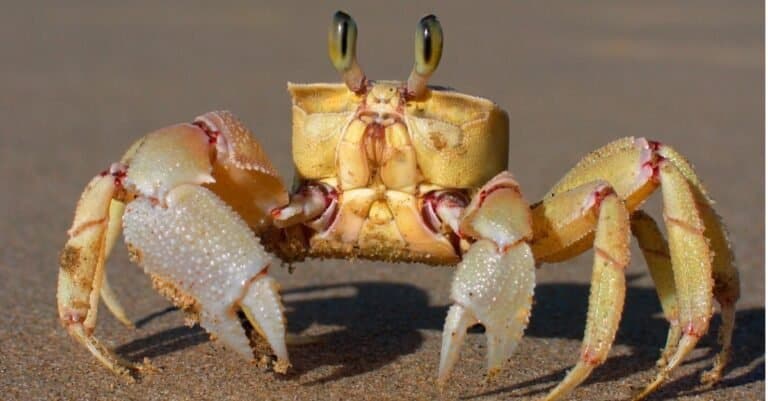
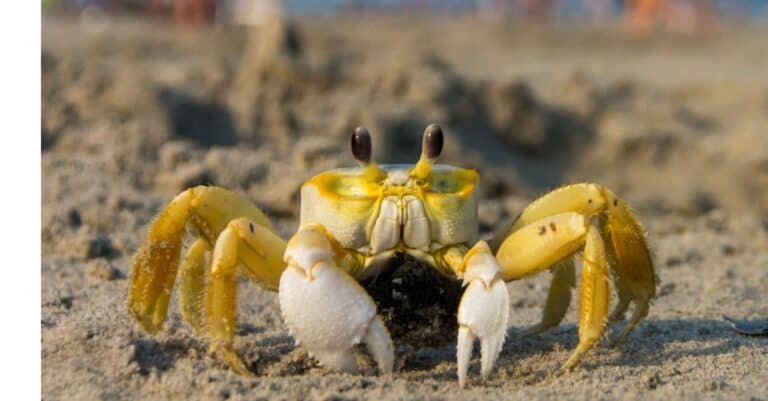
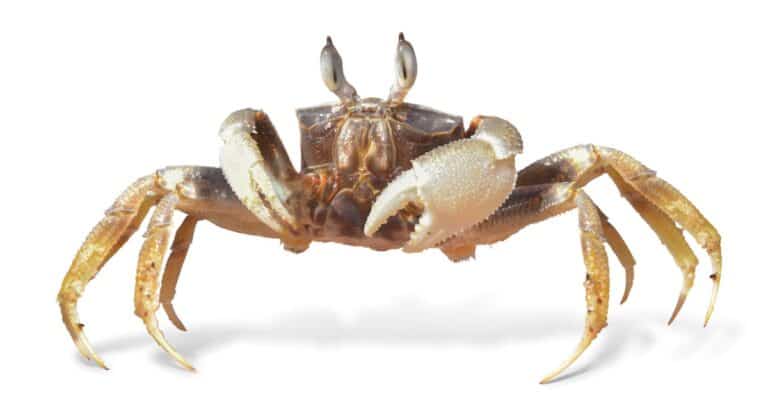
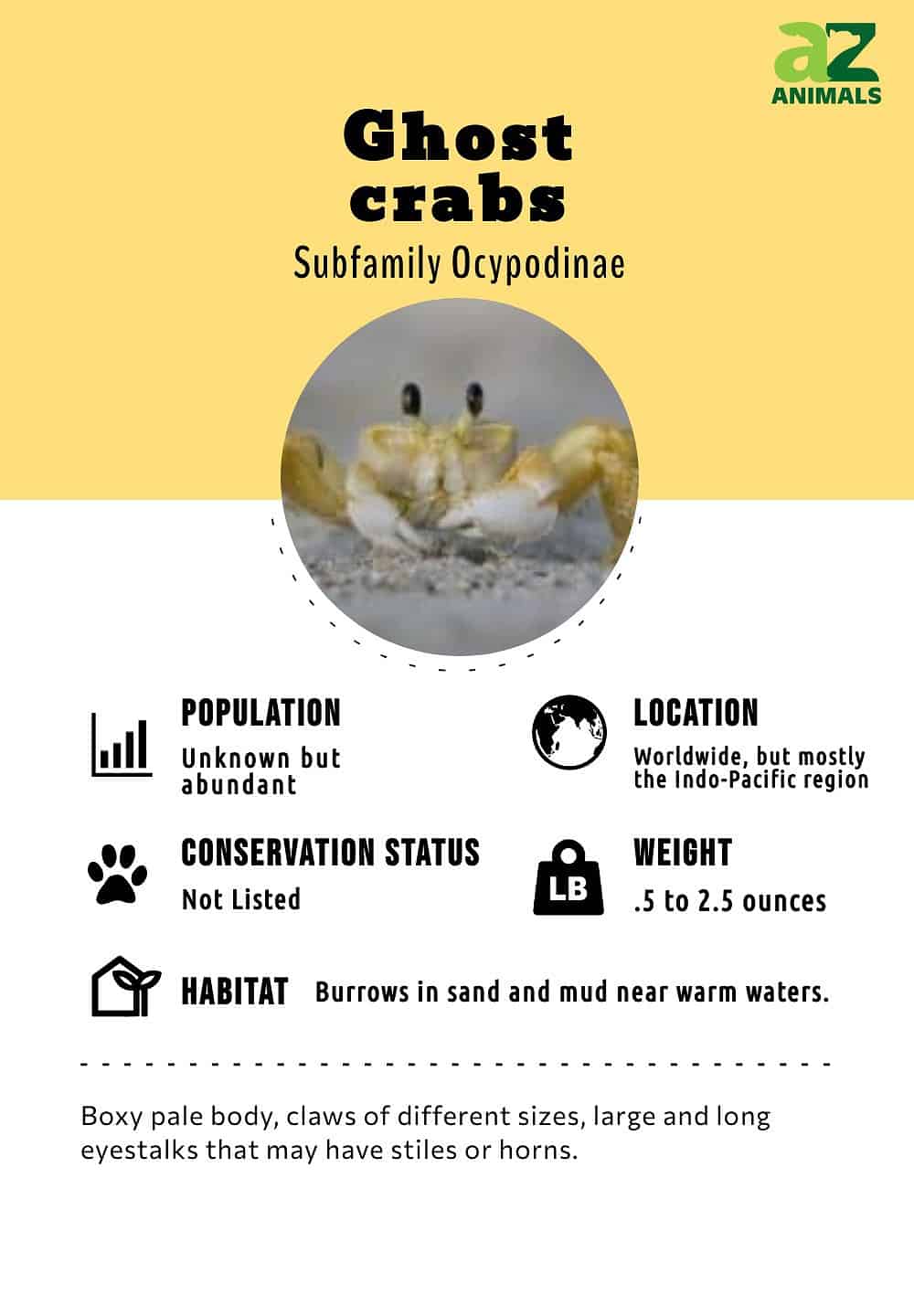
These crabs have a boxy little body, and most species are pale with the exception of species such as O. gaudichaudii, the painted ghost crab. Their name comes not just from their general pallor, but from the fact that they hunt at night.
Two characteristics that identify ghost crabs are that both the males and the females have claws of different sizes. This differentiates them from their cousins the fiddler crabs, where unequal size claws are found only on the males. The claws of most ghost crabs also have ridges that allow the animal to produce sounds that include bubbling, stridulation, and thumping.
Ghost crabs have large and long eyestalks. In some species, the eyestalks are horned or have stiles. They have huge corneas that are found on an eyestalk’s bottom half.
Their walking legs are longer than the claws. This allows them to move quickly and easily over the sandy beaches where they live.
Distribution, Population, and Habitat
©Oleg Kovtun Hydrobio/Shutterstock.com
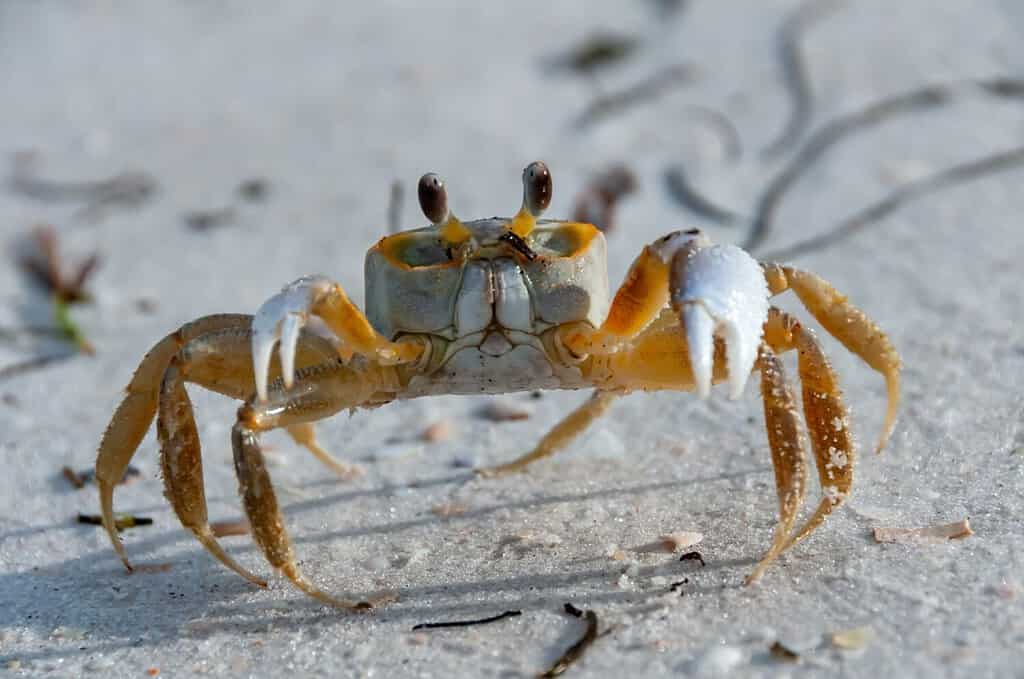
Ghost crabs are found near warmer waters all over the world, like those off the coast of Florida or India. These semi-terrestrial crabs dig burrows in sand and mud found in that zone between the high and low tide on beaches in the oceans or estuaries.
There are 21 species of sand crab. Although their habitat has been disrupted by human activity, their population is fairly healthy. Most sand crabs are found in the Indo-Pacific region, while a handful of species are found in the Mediterranean, the Pacific coast of North America, and along the Atlantic Ocean from Massachusetts down to Florida and further south to Brazil.
Predators and Prey
Despite their small size, ghost crabs have few predators. One reason is that they can change color to blend in with the surrounding sand.
Other adaptations that evolved for both hunting and avoiding predation are their speed and their nocturnal lifestyle. Still, ghost crabs are taken by shorebirds and raccoons. The crabs themselves prey on leatherback turtle eggs and hatchlings, which is problematic since the leatherback turtle is endangered. They also eat smaller crabs, other marine arthropods, and insects. Besides hunting for food, ghost crabs are scavengers and cache food in their burrows.
Reproduction and Lifespan
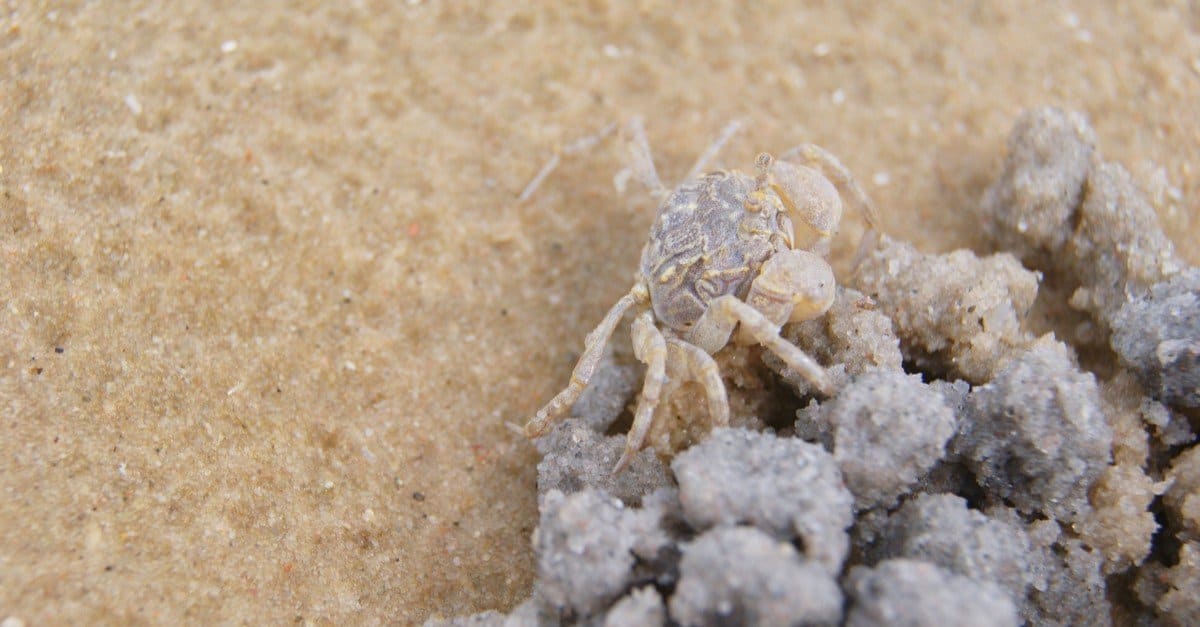
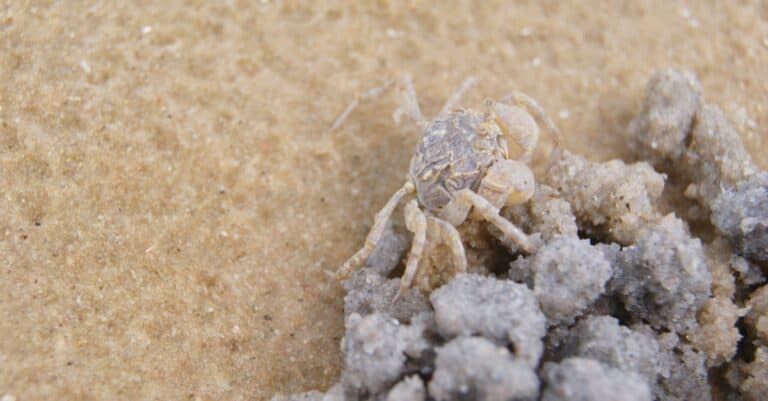
A baby ghost crab that has survived molting stages to go from sea to sand life and is digging a hole to build its house at the beach.
©Salinthip Matra/Shutterstock.com
Ghost crabs can mate all year, though there are some species where the female ovulates only in early spring and again in summer. They are unlike other crabs of their infraorder in that the female can mate when her shell has hardened after a molt. This is one of the adaptations the crabs made when they became semi-terrestrial.
Males posture and make sounds to both attract females and challenge other males. Usually, the male crabs avoid making contact, but if one does not submit, the stronger one shoves him out of the way.
Fertilization is internal and mating usually happens near the male’s burrow. The sperm comes in a fluid that hardens and forms a plug in the female to make sure her eggs are not fertilized by a rival crab. The female can store sperm for a while, but when the eggs are fertilized, they emerge and stick to her abdomen. Since the eggs look like berries, a female carrying her eggs this way is referred to as berried. The female makes sure the eggs are kept hydrated and may sometimes swim upside down for this purpose.
When the crab larvae hatch, the female shakes them off into the water. They are so tiny at this stage that they become part of the zooplankton and are swept along on the ocean currents; however, their larvae are among the largest of the crab larvae during the final larval, or megalopa stage.
The baby ghost crab has five molts before it reaches the megalopa stage. It stays in that stage for a little over a month. If it survives to molt one more time, it leaves the sea for the land. Ghost crabs are ready to mate when they are about a year old and have a lifespan of about three years.
Population, Fishing, and Cooking
The ghost crab population is healthy as of 2021, though it has decreased due to human activity, climate change, and pollution.
Though ghost crabs are edible, they are considered too small in size to be good eating.