


G
Species Profile

Grebe

Podicipedidae

Lobed-toe divers with dance moves
Dani Jara/Shutterstock.com

Grebe Distribution

Click a location to explore more animals from that region

This map shows coastal regions where Grebe are found.

Loading map...

Found in 50 countries

๐Ÿ‡ฆ๐Ÿ‡ท Argentina ๐Ÿ‡ฆ๐Ÿ‡บ Australia ๐Ÿ‡ง๐Ÿ‡ท Brazil ๐Ÿ‡ง๐Ÿ‡ผ Botswana ๐Ÿ‡จ๐Ÿ‡ฆ Canada ๐Ÿ‡จ๐Ÿ‡ฑ Chile ๐Ÿ‡จ๐Ÿ‡ณ China ๐Ÿ‡จ๐Ÿ‡ด Colombia ๐Ÿ‡จ๐Ÿ‡ท Costa Rica ๐Ÿ‡ฉ๐Ÿ‡ช Germany ๐Ÿ‡ฉ๐Ÿ‡ฟ Algeria ๐Ÿ‡ช๐Ÿ‡ฌ Egypt ๐Ÿ‡ช๐Ÿ‡ธ Spain ๐Ÿ‡ช๐Ÿ‡น Ethiopia ๐Ÿ‡ซ๐Ÿ‡ฎ Finland ๐Ÿ‡ซ๐Ÿ‡ท France ๐Ÿ‡ฌ๐Ÿ‡ง United Kingdom ๐Ÿ‡ฌ๐Ÿ‡ท Greece ๐Ÿ‡ฌ๐Ÿ‡น Guatemala ๐Ÿ‡ฎ๐Ÿ‡ฉ Indonesia ๐Ÿ‡ฎ๐Ÿ‡ช Ireland ๐Ÿ‡ฎ๐Ÿ‡ณ India ๐Ÿ‡ฎ๐Ÿ‡น Italy ๐Ÿ‡ฏ๐Ÿ‡ต Japan ๐Ÿ‡ฐ๐Ÿ‡ช Kenya ๐Ÿ‡ฐ๐Ÿ‡ท South Korea ๐Ÿ‡ฐ๐Ÿ‡ฟ Kazakhstan ๐Ÿ‡ฑ๐Ÿ‡ฐ Sri Lanka ๐Ÿ‡ฒ๐Ÿ‡ฆ Morocco ๐Ÿ‡ฒ๐Ÿ‡ฝ Mexico ๐Ÿ‡ฒ๐Ÿ‡พ Malaysia ๐Ÿ‡ณ๐Ÿ‡ฆ Namibia ๐Ÿ‡ณ๐Ÿ‡ฑ Netherlands ๐Ÿ‡ณ๐Ÿ‡ด Norway ๐Ÿ‡ณ๐Ÿ‡ต Nepal ๐Ÿ‡ณ๐Ÿ‡ฟ New Zealand ๐Ÿ‡ต๐Ÿ‡ฆ Panama ๐Ÿ‡ต๐Ÿ‡ช Peru ๐Ÿ‡ต๐Ÿ‡ฑ Poland ๐Ÿ‡ต๐Ÿ‡น Portugal ๐Ÿ‡ท๐Ÿ‡บ Russia ๐Ÿ‡ธ๐Ÿ‡ช Sweden ๐Ÿ‡น๐Ÿ‡ญ Thailand ๐Ÿ‡น๐Ÿ‡ณ Tunisia ๐Ÿ‡น๐Ÿ‡ท Turkey ๐Ÿ‡น๐Ÿ‡ฟ Tanzania ๐Ÿ‡บ๐Ÿ‡ฌ Uganda ๐Ÿ‡บ๐Ÿ‡ธ United States ๐Ÿ‡ป๐Ÿ‡ณ Vietnam ๐Ÿ‡ฟ๐Ÿ‡ฆ South Africa

At a Glance

Family Overview This page covers the Grebe family as a group. Stats below are general traits shared across the family.
Also Known As Dabchick, Waterhen
Diet Carnivore
Activity Diurnal+
Lifespan 8 years
Weight 2 lbs
Status Not Evaluated
Did You Know?

Family size ranges from tiny grebes ~23 cm long to giants ~76 cm; masses span roughly ~0.12-2.0 kg.

Scientific Classification

Family Overview "Grebe" is not a single species but represents an entire family containing multiple species.

Grebes are specialized aquatic diving birds found on freshwater and coastal waters worldwide, noted for excellent underwater propulsion and elaborate courtship displays.

Kingdom
Animalia
Phylum
Chordata
Class
Aves
Order
Podicipediformes
Family
Podicipedidae

Distinguishing Features

  • Lobed toes (not fully webbed feet) adapted for efficient diving
  • Legs set far back on the body, making them awkward on land but powerful swimmers
  • Dense, water-resistant plumage and frequent preening
  • Often perform conspicuous courtship rituals (e.g., synchronized displays, โ€œweed dancesโ€)

Physical Measurements

Males and females differ in size

Length
โ™‚ 1 ft 6 in (9 in โ€“ 2 ft 7 in)
โ™€ 1 ft 6 in (8 in โ€“ 2 ft 7 in)
Weight
โ™‚ 1 lbs (0 lbs โ€“ 4 lbs)
โ™€ 1 lbs (0 lbs โ€“ 4 lbs)
Tail Length
โ™‚ 1 in (1 in โ€“ 2 in)
โ™€ 1 in (0 in โ€“ 2 in)
Top Speed
50 mph
Fastest in flight (~80 km/h)

Appearance

Primary Colors
Secondary Colors
Skin Type Grebes (Podicipedidae) have dense, very waterproof contour feathers and thick underfeathers for cold-water diving. Bare skin is on legs/feet and bill; feet have lobed toes and rear-set legs aid swimming but make land movement awkward.
Distinctive Features
  • Size range across Podicipedidae (smallest to largest members): body length ~23-75 cm; mass ~0.12-2.0 kg; wingspan roughly ~40-90 cm (varies by species and flight style).
  • Lobed toes (not fully webbed like ducks): each toe has side lobes that spread during the kick, helping grebes dive and steer underwater and differing from loons (Gaviidae) and most ducks (Anatidae).
  • Rear-set legs and compact body: legs placed far back provide strong thrust underwater; results in characteristically upright floating posture and very limited agility on land.
  • Bills vary from short and stout to long and dagger-like, reflecting prey differences (invertebrate-focused to fish-focused diets).
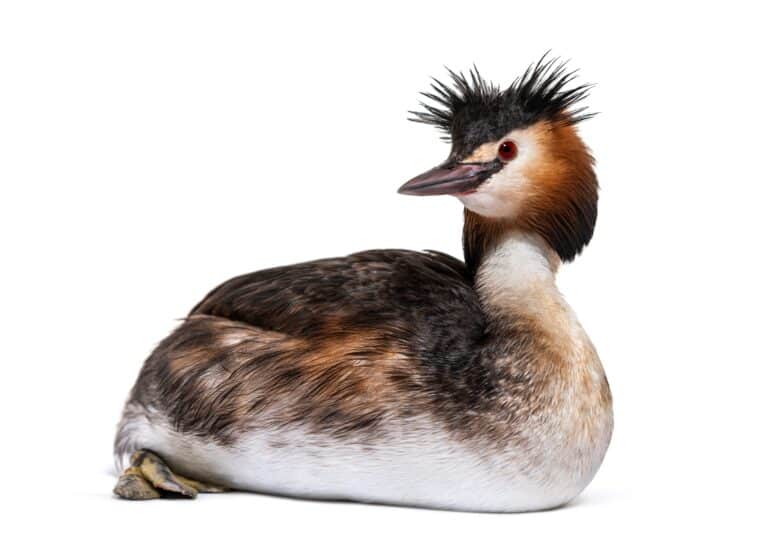
  • Plumage can be seasonally transformative: many species shift from relatively plain non-breeding gray/brown to striking breeding head/neck ornamentation (crests, ear tufts, contrasting cheek patches).
  • Grebes are mainly divers that hunt underwater for fish and aquatic invertebrates. How deep and how long they dive, and what they eat, vary by species and habitat (ponds, lakes, coasts).
  • Grebes mostly move and hunt using their feet; their wings are used less underwater than in alcids. Some fly well and migrate, others stay local, and a few rarely or cannot fly.
  • Grebes make floating nests anchored to emergent plants or built among reeds. Some nest in groups, others alone. Eggs often stain from wet plants. Parents carry striped chicks on their backs.
  • Courtship displays are prominent across the family (e.g., synchronized head-shaking, rushing/"running" across the water, and presentation of vegetation); exact display repertoires differ by species and environment.
  • Lifespan range across the family: commonly ~5-15 years in the wild; maximum reported longevity in some species can reach ~20-25 years (rare, often from banding records/captivity).

Sexual Dimorphism

Sexual dimorphism in grebes is usually subtle. Males and females look alike, especially outside breeding. Differences are mostly average size or breeding decorations (crests, tufts, bill color), and many species overlap so it is hard to tell sexes by sight.

โ™‚
  • On average slightly larger/heavier in many species (not universal; overlap is common).
  • May show marginally more pronounced breeding crests/tufts or slightly brighter bill/soft-part tones in some species (species-dependent).
  • Often more conspicuous in display behaviors during courtship (behavioral cue rather than reliable plumage-only identification).
โ™€
  • On average slightly smaller in many species, with overlapping measurements common.
  • Breeding ornamentation usually present and similar to males; in some species may be slightly reduced in size/contrast (variable and not always diagnostic).
  • Often more reliably distinguished by behavior at the nest or with chicks rather than by plumage alone (varies by species and pair).

Did You Know?

Family size ranges from tiny grebes ~23 cm long to giants ~76 cm; masses span roughly ~0.12-2.0 kg.

Their toes aren't webbed like ducks-each toe has its own flexible lobe that opens on the power stroke and folds on recovery.

Many grebes swallow their own feathers, which can help form a stomach "plug" that protects the gut from sharp fish bones.

Chicks often ride on a parent's back like a living "boat deck," especially when very small or when danger is near.

Grebe courtship can include synchronized "dancing," head-shaking, and sometimes rushing across the water side-by-side.

They're superb underwater hunters, using their feet for propulsion while keeping the head steady to spear or grab prey.

Because their legs sit so far back, grebes are graceful underwater but clumsy on land-some rarely leave the water except to nest.

Unique Adaptations

  • Lobed toes (not full webs): Individual toe lobes increase surface area for powerful kicks and reduce drag on recovery-an efficient design for pursuit diving.
  • Rear-set legs and streamlined body: Legs positioned far back act like propellers and improve underwater thrust and maneuvering, at the cost of awkward walking on land.
  • Dense, water-resistant plumage: Insulating feathers trap air for warmth and buoyancy; grebes can compress plumage to reduce buoyancy when diving.
  • Feather ingestion and pellet formation: Many species regularly ingest feathers, which help bind indigestible material and may shield the stomach from sharp fragments.
  • High-precision head control: Stabilized head and neck allow accurate strikes at slippery prey while the body is propelled by the feet.
  • Nest architecture on water: Floating/anchored platforms keep eggs near safe cover in emergent vegetation; materials can be added continually as water levels change.
  • Flight variation within the family: Most species fly but require a running takeoff across water; a few specialized grebes (notably some Andean forms) evolved reduced flight capability tied to life on large lakes.

Interesting Behaviors

  • Underwater pursuit hunting: Most species dive from the surface to chase fish, aquatic insects, and crustaceans; depth and prey choice vary by habitat (marshes, lakes, reservoirs, coastal bays).
  • Elaborate pair displays: Many grebes use ritualized courtship (mirroring, head-tossing, "weed" presentations, and rapid surface runs) to form and reinforce bonds; display complexity varies among species.
  • Floating or anchored nesting: Nests are usually rafts of plant material moored to emergent vegetation; some colonies form in sheltered wetlands while other species nest more sparsely.
  • Back-brooding and chick transport: Adults commonly carry striped chicks on their backs and may feed them small fish/invertebrates; the duration of back-riding varies among species.
  • Seasonal movements: Some grebes are strongly migratory (moving to coastal waters or ice-free lakes in winter), while others are largely resident, especially in stable tropical or highland waters.
  • Secretive escape tactics: Rather than flying, many grebes prefer to dive or sink low in the water when threatened; flight is used more often during migration or when moving between water bodies.
  • Territoriality vs. coloniality: Breeding can be territorial on small ponds or loosely colonial in extensive marshes; aggression and spacing differ widely across the family.

Cultural Significance

Grebes (Podicipedidae) are named for their odd look; Podicipedidae means 'feet on the rump,' noting rear-set legs. Their feathers were used in fashion, starting early bird-protection groups. Their mating dances make them stars of films and birdwatching.

Myths & Legends

"Water witch" is a long-standing North American folk nickname (especially for the Pied-billed Grebe) inspired by its uncanny ability to vanish by diving without a splash.

In Britain, the Little Grebe's old vernacular name "dabchick" appears in historical writings and local speech, reflecting centuries of familiarity with this small, quick-diving marsh bird.

In the Victorian and Edwardian eras, 'grebe' became a popular name linked to feathered trims. Protests against plume hunting helped shape origin stories of early bird protection groups in the UK and beyond.

Conservation Status

NE Not Evaluated (family-level hub). Species-level IUCN status across Podicipedidae spans from Least Concern (many widespread grebes) through Near Threatened/Vulnerable/Endangered/Critically Endangered, to Extinct (e.g., Atitlรกn Grebe Podilymbus gigas; Alaotra Grebe Tachybaptus rufolavatus). Notable still-extant high-risk species include Junรญn Grebe (Podiceps taczanowskii, EN), Hooded Grebe (Podiceps gallardoi, CR), and Colombian Grebe (Podiceps andinus, CR-possibly extinct). Family-wide ranges/generalizations: Measurements (smallestโ†’largest members) ~21-80 cm body length; ~0.11-1.8 kg mass; ~40-110 cm wingspan (varies by species/sex/season). Lifespan: typically ~5-15 years in the wild, with some larger species occasionally reaching ~20+ years (especially in captivity/under favorable conditions). Behavior/ecology (common patterns with variation): specialized aquatic divers with lobed toes and rear-set legs (excellent underwater propulsion, poor terrestrial mobility); most breed on freshwater (lakes, marshes, slow rivers) with floating/anchored nests in emergent vegetation; many winter on larger lakes/estuaries/coastal waters. Diet is mainly aquatic invertebrates and/or fish, varying strongly by species, size class, and habitat. Sociality varies from solitary/territorial breeders to highly colonial or forming very large nonbreeding flocks (notably in some Podiceps species); migratory behavior ranges from resident to long-distance migrant depending on latitude and waterbody seasonality.

Has not yet been evaluated against the criteria.

Population Unknown

Protected Under

  • Many grebe species are protected under national wild-bird laws (varies by country/state/province).
  • Convention on Migratory Species (CMS/Bonn Convention): some migratory grebe populations/species occur within CMS frameworks.
  • AEWA (African-Eurasian Waterbird Agreement): applies to relevant African-Eurasian grebe populations.
  • EU Birds Directive: protects all wild bird species naturally occurring in the EU, including grebes; requires habitat protection and management of key sites.
  • Ramsar Convention: protection/wise-use framework for wetlands crucial to many grebe breeding and wintering sites (site-based, not taxon-specific).
  • In parts of North America, relevant species are generally protected under broad migratory bird frameworks (e.g., Migratory Bird Treaty Act in the U.S. and associated Canadian legislation).

Looking for a specific species?

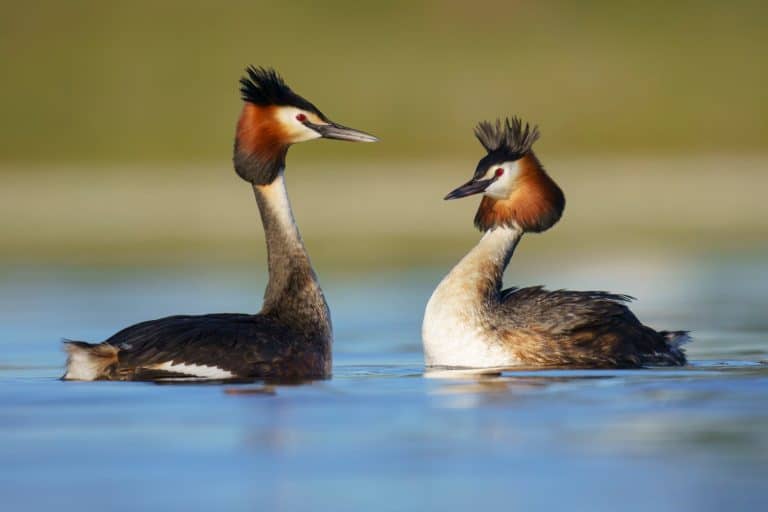
Great Crested Grebe

Podiceps cristatus

Often the best-known and most frequently referenced "grebe" in general-audience contexts (especially across Europe and parts of Asia); widely depicted for its conspicuous breeding plumage and courtship. This does not represent the full diversity of the family.

  • Family-wide size range spans roughly ~23-74 cm in length and ~0.12-1.8 kg in mass, from the smallest dabchicks to the largest Podiceps grebes (substantial variation among species).
  • Lifespan varies widely by species and conditions: many have typical wild lifespans in the mid-single digits to teens, with longest-recorded individuals in some species reaching roughly ~20+ years.
  • Shared family specialization: foot-propelled pursuit diving with legs set far back, making grebes superb underwater but generally awkward on land; takeoff often requires a running start over water.
  • Diet across the family is opportunistic but aquatic: fish and aquatic invertebrates dominate, with strong geographic and habitat-driven variation (freshwater vs coastal, shallow vegetated lakes vs open water).
  • Behavioral/ecological generalizations: elaborate courtship displays are common; nesting is usually on floating or emergent vegetation, but colony size, migration tendency, and salinity tolerance vary markedly among species.

You might be looking for:

Great Crested Grebe

22%

Podiceps cristatus

Large, widespread Old World grebe with ornate head plumes in breeding season.

Pied-billed Grebe

18%

Podilymbus podiceps

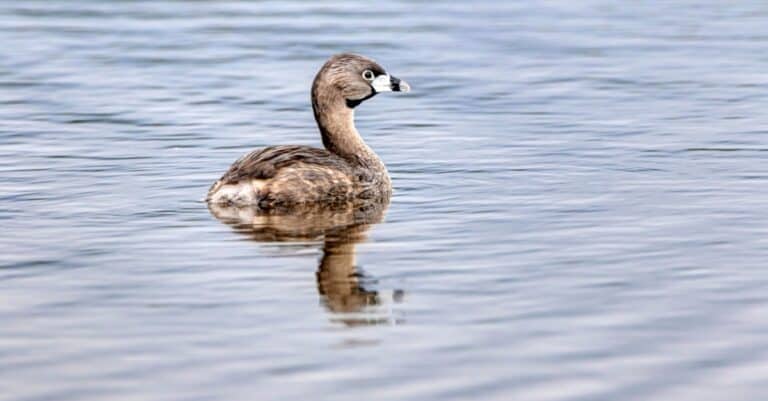
Stocky North/South American grebe with a distinctive thick, banded bill; often dives rather than flies.

View Profile

Horned Grebe

14%

Podiceps auritus

Small grebe with golden โ€œhornโ€ tufts in breeding plumage; Holarctic distribution.

View Profile

Red-necked Grebe

12%

Podiceps grisegena

Medium-sized grebe with chestnut neck in breeding season; northern temperate waters.

Eared (Black-necked) Grebe

11%

Podiceps nigricollis

Slim grebe with striking breeding plumage; often forms large flocks on saline lakes.

View Profile

Clark's Grebe

8%

Aechmophorus clarkii

Tall, long-necked North American grebe; very similar to Western Grebe but with more white on face.

View Profile

Life Cycle

Birth 4 chicks
Lifespan 8 years

Lifespan

In the Wild 2โ€“20 years
In Captivity 5โ€“25 years

Reproduction

Mating System Monogamy
Social Structure Socially Monogamous
Breeding Pattern Seasonal
Fertilization Internal Fertilization
Birth Type Internal_fertilization

Grebes are predominantly socially monogamous, forming pairs for a breeding season and using elaborate mutual courtship displays to form and maintain bonds. Both parents typically build floating nests, incubate, and care for chicks, which are often carried on adults' backs.

Behavior & Ecology

Social Flock Group: 50
Activity Diurnal, Crepuscular
Diet Carnivore Small fish and abundant aquatic invertebrates (varies by species, season, and habitat; larger grebes tend to be more fish-focused, while smaller species often rely more heavily on aquatic insects/crustaceans).
Seasonal Migratory 2,485 mi

Temperament

Generally wary and evasive; strong reliance on diving to avoid threats (flight can be reluctant in some species).
Territorial and often aggressive during breeding near nests and display areas; threat postures and chases are common.
More tolerant and social outside breeding when in rafts/flocks; degree of gregariousness varies widely among species and habitats.
Grebes (Podicipedidae) body size ranges from about 23 cm (0.12 kg) to 71 cm (1.7 kg). Wild lives are usually 5โ€“15 years; some species can reach 20+ years, especially in captivity.

Communication

Advertising/territorial calls Variously trills, whistles, croaks, or rattles depending on species
Pair-contact and coordination calls used during courtship and nest exchanges.
Alarm calls Often harsh, abrupt notes
Chick begging/contact calls; adults may give soft calls to guide or settle young.
Highly visual courtship: synchronized swimming, head-shaking, neck-stretching, rushing/'dance' displays, and presentation of vegetation; display complexity varies across species.
Posture-based aggression: raised crests, bill pointing, wing/shoulder displays, and ritualized chases on water.
Tactile interactions: mutual preening and close-contact positioning in pairs and families.
Acoustic/visual emphasis varies with habitat: some species are more vocal on freshwater breeding territories, while nonbreeding coastal/wintering birds may be quieter and communicate more via proximity and posture.

Habitat

Biomes:
Freshwater Wetland Marine Tropical Rainforest Tropical Dry Forest Savanna Temperate Grassland Temperate Forest Temperate Rainforest Boreal Forest (Taiga) Tundra Alpine Mediterranean Desert Hot Desert Cold +9
Terrain:
Riverine Coastal Island Plains Valley Plateau Mountainous Muddy +2
Elevation: Up to 15091 ft 10 in

Ecological Role

Aquatic mesopredators in freshwater and coastal food webs, linking invertebrate/fish production to higher trophic levels.

Regulation of aquatic prey populations (fish fry and invertebrates) Energy transfer from aquatic systems to predators/scavengers (eggs, chicks, and adults as prey for raptors and mammals) Bioindicators of wetland/lake health due to sensitivity to prey availability and water quality Nutrient redistribution within wetlands via foraging and guano deposition

Diet Details

Main Prey:
Small fish Aquatic insects Crustaceans Mollusks Aquatic invertebrates Amphibians Fish eggs and larvae +1

Human Interaction

Domestication Status

Wild

Grebes (family Podicipedidae) have not been domesticated. They are wild aquatic birds with diving adaptations: rear-set legs, dense plumage, and lobed toes. Human contact has been indirectโ€”wetland use, some hunting or collecting, and feather hunting for hats in the late 1800sโ€“early 1900s. Captive holding is mainly for rescue care, research, or zoo display; breeding is rare and hard.

Danger Level

Low
  • Defensive pecking/scratching if handled (rehabilitation, banding, rescue)
  • Bites can break skin; risk of minor infection without proper hygiene
  • Rare collision/entanglement incidents involving fishing gear or boats primarily pose risk to grebes rather than humans

As a Pet

Not Suitable as Pet

Legality: Grebes (Podicipedidae) are generally illegal to keep as pets. Many countries protect them under wildlife and migratory bird laws. Only rehabilitation, education, research, or accredited zoos get special permits.

Care Level: Expert Only

Purchase Cost: Up to $2,000
Lifetime Cost: $5,000 - $60,000

Economic Value

Uses:
Ecotourism and recreation (birdwatching, wetland reserves) Conservation funding and ecosystem services (wetland value indicators) Scientific research and education (diving biomechanics, behavioral ecology) Historic feather trade impact (localized, now largely illegal/ended)
Products:
  • Non-consumptive value (wildlife viewing experiences)
  • Educational/research specimens and data (museum, banding/telemetry outputs)

Relationships

Predators 10

Bald Eagle Haliaeetus leucocephalus
White-tailed Eagle Haliaeetus albicilla
Osprey Pandion haliaetus
Large gulls Larus spp.
Great Horned Owl Bubo virginianus
Red Fox Vulpes vulpes
American Mink Neogale vison
Raccoon Procyon lotor
Northern Pike Esox lucius
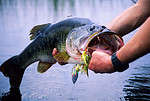
Largemouth Bass Micropterus salmoides

Related Species 6

Typical grebes Podiceps Shared Genus
Western and Clark's grebes Aechmophorus Shared Genus
Dabchicks Tachybaptus Shared Genus
Pied-billed grebe Podilymbus podiceps Shared Family
White-tufted and Titicaca grebes Rollandia Shared Genus
Australasian small grebes Poliocephalus Shared Genus

Ecological Equivalents 5

Animals that fill a similar ecological role in their ecosystem

Loons Gaviidae Occupy a very similar niche as foot-propelled pursuit divers on lakes and coasts; both are excellent underwater hunters but differ in anatomy and in takeoff and landing constraints.
Cormorants and shags Phalacrocoracidae Overlap in role as fish-eating diving birds. Cormorants typically use stronger wing-assisted swimming and often forage in more open or coastal waters.
Diving ducks, geese, and swans Anatidae Share wetlands and some prey types (invertebrates and fish). Diving ducks overlap most strongly, though grebes are generally more specialized pursuit divers and poorer walkers.
Coots and moorhens Rallidae Frequent co-occupants of freshwater marshes and lakes with similar nesting substrates. Coots compete for space and cover and sometimes prey on eggs and chicks.
Auks, murres, and puffins Alcidae Ecological analogue in marine systems as pursuit-diving birds: auks are wing-propelled divers, while grebes are foot-propelled.

Types of Grebe

20

Explore 20 recognized types of grebe

Least Grebe Tachybaptus dominicus
Little Grebe Tachybaptus ruficollis
Australasian Grebe (Australasian Dabchick) Tachybaptus novaehollandiae
Madagascar Grebe Tachybaptus pelzelnii
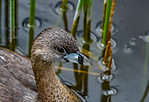
Pied-billed Grebe Podilymbus podiceps
White-tufted Grebe Rollandia rolland
Titicaca Grebe Rollandia microptera
White-headed Grebe Poliocephalus poliocephalus
Hoary-headed Grebe Poliocephalus rufopectus
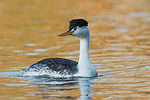
Western Grebe Aechmophorus occidentalis
Clark's Grebe Aechmophorus clarkii
Great Crested Grebe Podiceps cristatus
Red-necked Grebe Podiceps grisegena
Horned Grebe Podiceps auritus
Black-necked Grebe (Eared Grebe) Podiceps nigricollis
Silvery Grebe Podiceps occipitalis
Great Grebe Podiceps major
Brown (Pampa) Grebe Podiceps tricolor
Junรญn Grebe Podiceps taczanowskii
Hooded Grebe Podiceps gallardoi

Grebes are freshwater diving birds native to freshwater and marine habitats. They inhabit every continent except for Antarctica and arid environments. They are excellent swimmers and divers, and while they resemble other diving birds, they are more closely related to flamingos. Learn all about the fascinating grebe, like how they have synchronized dances and floating nests.

5 Amazing Grebe Facts

  • They lay their eggs in floating vegetative nests.
  • About a third of grebe species are threatened or near-threatened.
  • Some grebes are flightless and stay in their habitat year-round.
  • Their feathers are waterproof, and they swim similarly to frogs.
  • Grebes eat their feathers and feed them to their young.

Where to Find Grebes

These widely distributed birds primarily inhabit freshwater lakes, except when they migrate to their winter habitats and occasionally live in coastal areas. Their habitats largely depend on the species. Western grebes stay on prairie lakes in British Columbia and migrate to the Pacific Coast during winter. Great crested grebes in Europe and Asia breed in freshwater lakes and winter in lagoons and estuaries. If youโ€™re a birder looking to find grebes, try searching deep inland lakes during summer and ocean shores in the winter. Spotting scopes come in handy for these birds.

Grebes inhabit every continent except Antarctica and donโ€™t live in arid environments. They even colonized islands like Madagascar and New Zealand. Grebe species like the Junin and Atitlan (recently extinct) are lake endemic, meaning they donโ€™t migrate. 

Grebe Nest

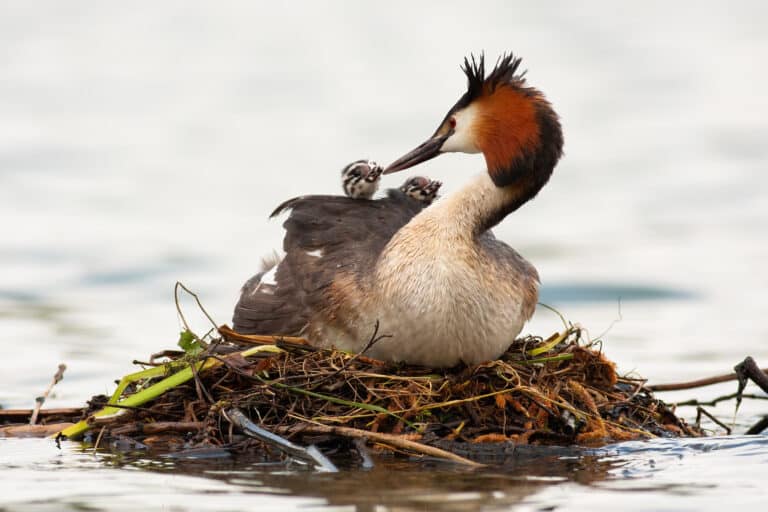
Their nests are plant material platforms that float on water, often hidden by vegetation. Grebes dive to the bottom of the lake, picking up dead plant matter and then piling it up on top of the water until it forms a mass. The decaying plant matter they use gives off some heat that helps the incubation process.
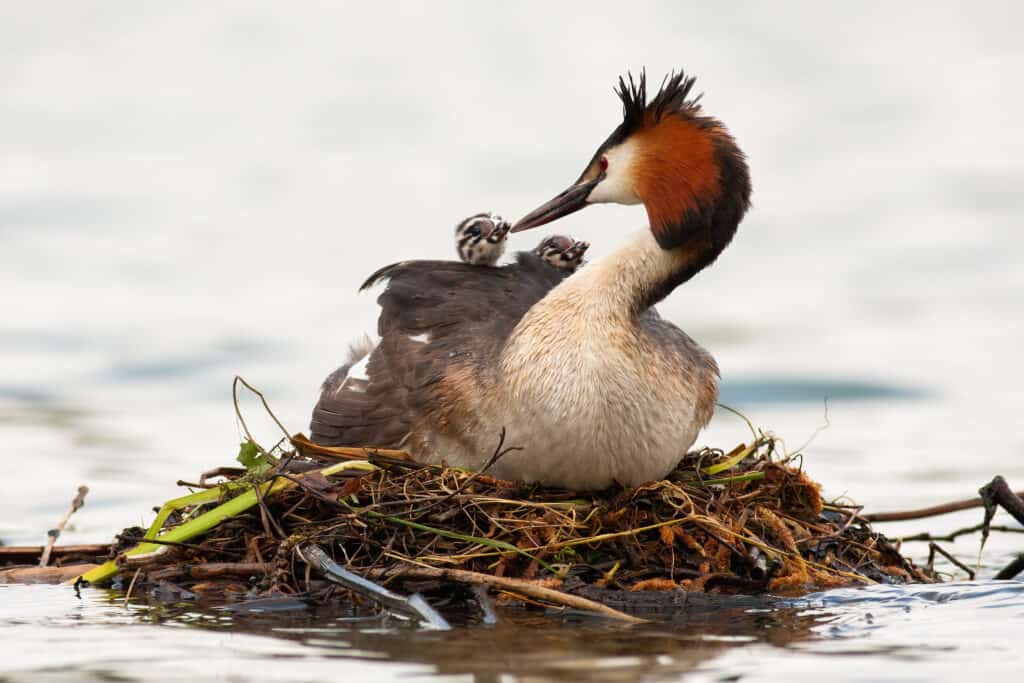
๐Ÿ‘ Great crested grebe on floating nest feeding babies that are on its back

Baby grebes spend time on their parentsโ€™ backs. They reach independence when theyโ€™re between 10 and 16 weeks old.

ยฉWildMedia/Shutterstock.com

Scientific Name

Grebes are a single family (Podicipedidae) of the order Podicipediformes. There are five genera and 22 species overall. The genera groups include Aechmophorus, Podiceps, Podilymbus, Rollandia, and Tachybaptus. 

The 22 grebe species include:

  • Pied-billed grebe
  • Little grebe
  • Tricolored grebe
  • Australasian grebe
  • Madagascar grebe
  • Least grebe
  • Hoary-headed grebe
  • New Zealand grebe
  • Western grebe
  • Clarkโ€™s grebe
  • Great grebe
  • White-tufted grebe
  • Titicaca grebe
  • Red-necked grebe
  • Great-crested grebe
  • Horned grebe
  • Black-necked grebe
  • Silvery grebe
  • Junin grebe
  • Hooded grebe
  • North American eared grebe

Size, Appearance, and Behavior

Grebes are small to medium-sized aquatic birds built for the water. They range in size from the least grebe, at 4 ounces and 9 inches, to the great grebe, at 3.8 pounds and 28 inches. They have narrow wings, large feet, and lobed toes that work like the blades of a propeller. Their dense plumage is waterproof and features undecided feathers that stick out at right angles. They can adjust their buoyancy by pressing these feathers against their body. Non-breeding grebes are plain dark brown and white. In the breeding season, they develop chestnut markings on their head. Their young often have striped plumage and may keep some when they grow to full size. 

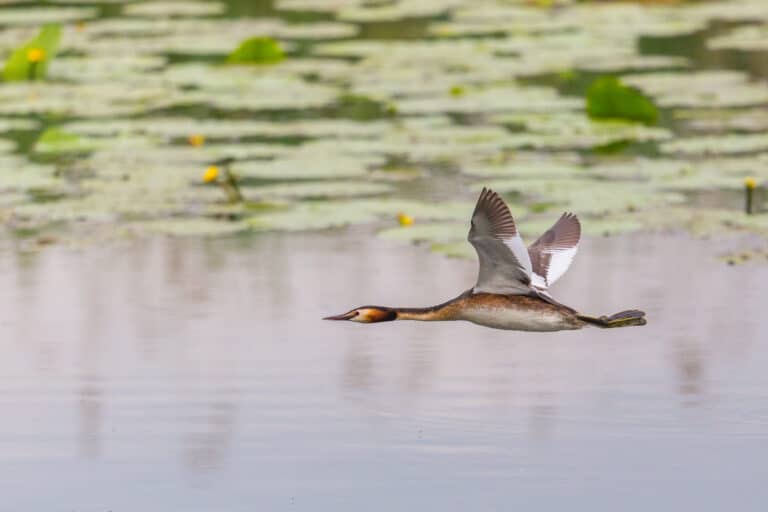
Due to their excellent swimming and diving skills, many are reluctant to fly. Instead, they dive under the water when predators get close. They prefer to swim low in the water, with just their head exposed. These birds resemble frogs when they swim, spreading their feet, bringing them inward, and thrusting forward. They can also run for short distances, but may fall over due to the placement of their back feet. 

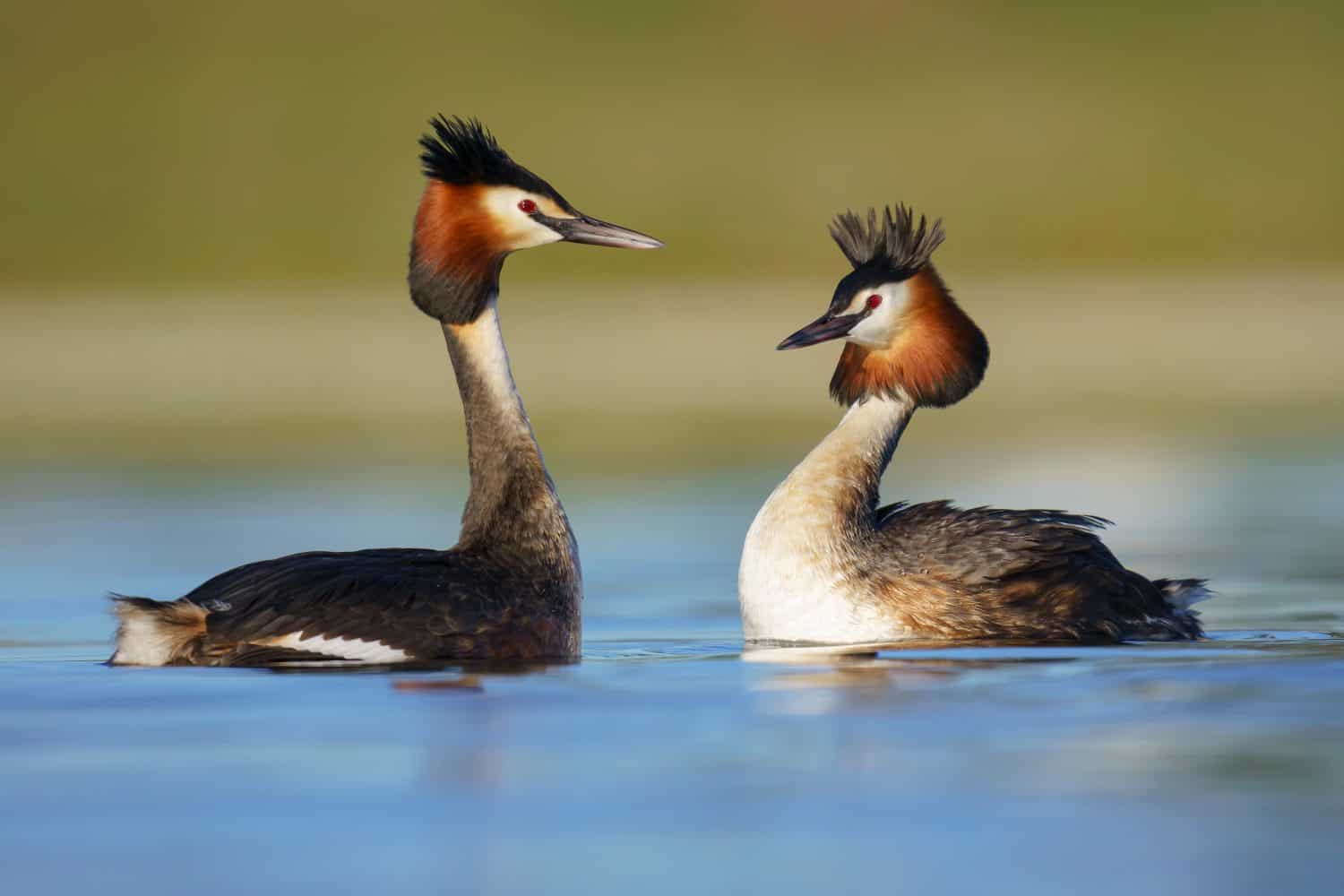
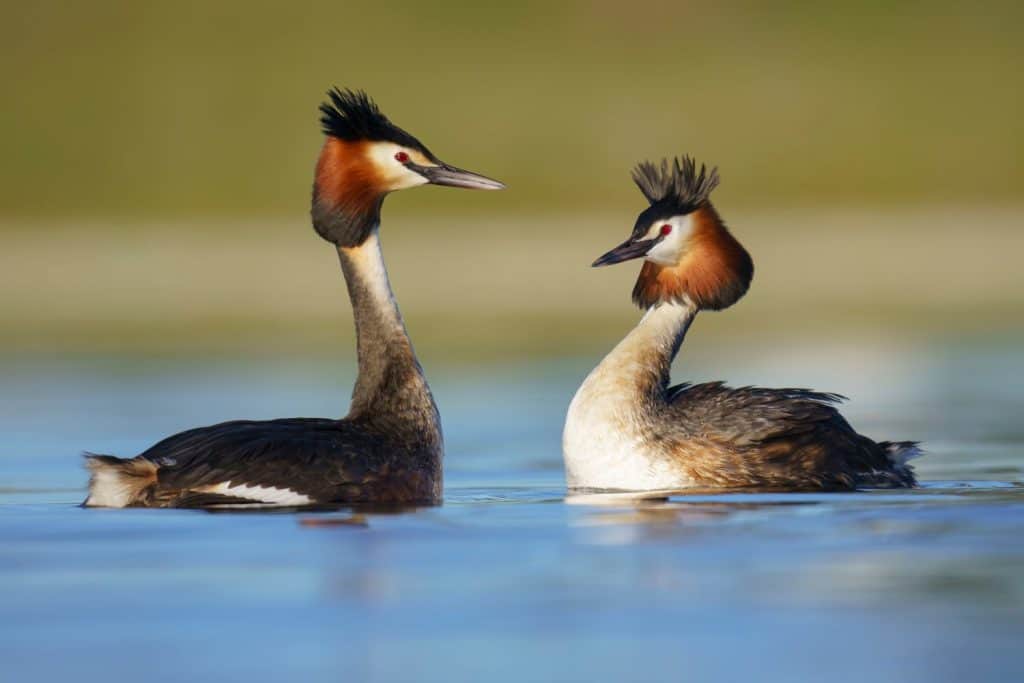
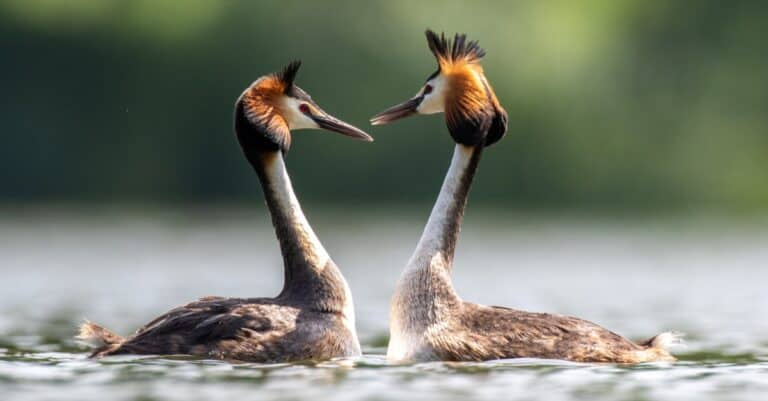
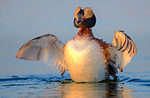
Once they develop their ornate breeding markings, they perform display rituals to win over their mates. In fact, these birds are known for their fascinating courtship displays, which may include preening, head shaking, diving, and treading water in a vertical position. Grebes are monogamous for at least one breeding season. Once their young have hatched, they feed them their feathers after grooming, which filters material passing through the intestine. Researchers believe this behavior may reduce parasites and assist in pellet formation.

Migration Pattern and Timing

While not all grebes migrate, many move to warmer areas after breeding. Species like the Western grebe first fly to lakes in the fall, where they molt their wing feathers. Once their flight feathers grow, they migrate to salty water areas like coastlines, bays, and estuaries. By spring, they are back to their breeding grounds.

Diet

Grebes are carnivores and eat almost entirely animal matter. 

What Do Grebes Eat?

Grebes have varied diets. Some, like the Western grebe, feed on fish, while others eat crustaceans or small invertebrates. These birds are known for swallowing their feathers, forming a plug in the pocket of their stomach, which is effective in filtering material. These pockets, established shortly after hatching, hold fish bones until they are digested.
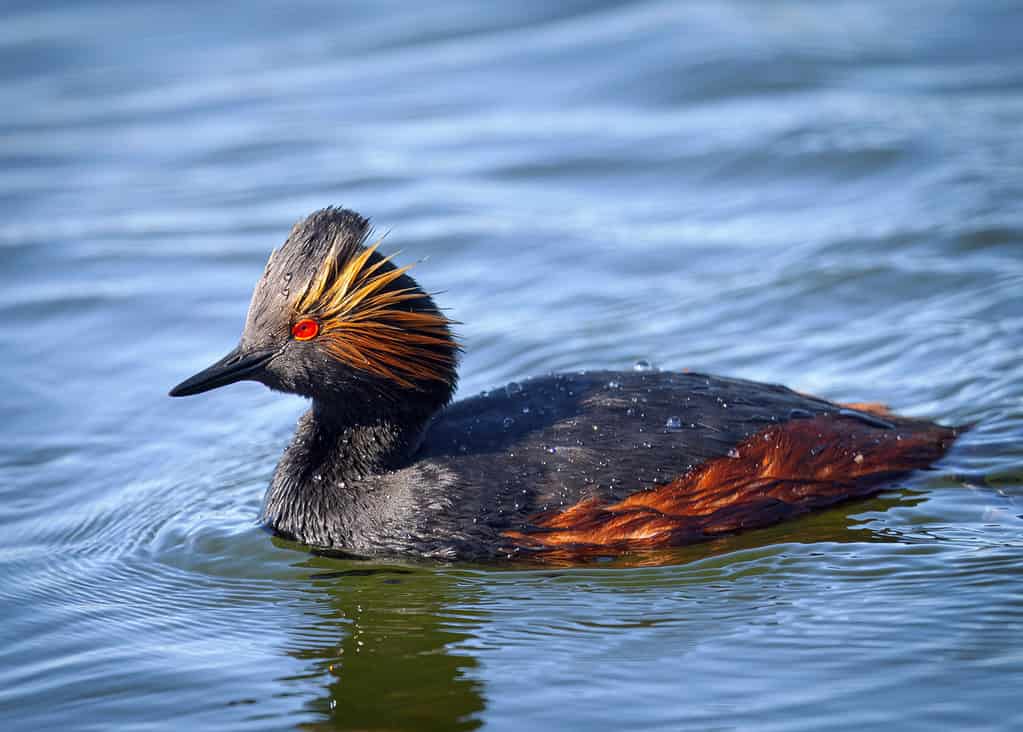
๐Ÿ‘ Eared Grebe

Eared grebes are the most abundant grebes in the world and often flock or nest in large numbers that can number in the thousands.

ยฉRanchorunner/Shutterstock.com

Predators, Threats, and Conservation Status

One-third of the grebe population is threatened or near-threatened. These water birds suffer from environmental and human-caused issues due to their habitat locations. Their threats include housing and urban development, agro-industry farming, fishing and harvesting, dam building, pollution, invasive species, climate change, and general human disturbance. At least three grebe species are already extinct.

What Eats Grebes?

While grebes donโ€™t have many natural predators, they are vulnerable when nesting. Their predators include raccoons, crows, coots, gulls, owls, eagles, falcons, and cottonmouths. Grebes typically dive underwater when threatened by predators, and their young can ride on their backs after theyโ€™ve hatched.

Reproduction, Young, and Molting

Mating occurs on their floating platform nests, and females lay three to seven eggs. Adults cover the eggs with soggy plant material and let them incubate for three to four weeks. After hatching, the young abandon their nest and spend their time on their parentsโ€™ backs. Most young are independent once they reach 10 to 16 weeks old.

Population

The grebe population is abundant, reaching six continents. The Western grebe alone has 90,000 mature individuals. However, most of their species are declining, and several species have threatened or endangered statuses.

View all 261 animals that start with G

Sources

  1. IUCN Red List / Accessed September 6, 2022
  2. Archive / Accessed September 6, 2022
  3. Senckenberg / Accessed September 6, 2022
  4. Britannica / Accessed September 6, 2022

About the Author

Niccoy Walker

Niccoy is a professional writer for A-Z Animals, and her primary focus is on birds, travel, and interesting facts of all kinds. Niccoy has been writing and researching about travel, nature, wildlife, and business for several years and holds a business degree from Metropolitan State University in Denver. A resident of Florida, Niccoy enjoys hiking, cooking, reading, and spending time at the beach.
Connect:

Thank you for reading! Have some feedback for us?

Contact the AZ Animals editorial team

Related Articles You May Find Interesting


Grebe FAQs (Frequently Asked Questions)

Some grebe species who nest in cold regions will migrate for the winter, while others stay in their environments year-round. Some species, like the short-winged grebe, are flightless.

Some grebes can fly around 30 Mph. Their flight is unstudied mainly due to their propensity for night flying.

They desert their nests shortly after the eggs hatch, and the young ride on their parentโ€™s backs, becoming independent within 25 to 62 days.

You can find them in freshwater habitats like lakes and marshes during the breeding season. In winter, they move to marine environments along coastlines.

Look for migrating birds in early spring and mid-fall around lakes, rivers, and coasts. You can find nesting grebes during spring and summer near freshwater sources and near the beach during winter.

The grebeโ€™s diet is primarily fish, invertebrates, and crustaceans. Some have more varied diets.

While some have stable populations, other grebe species are threatened or endangered. Their most common threats include climate warming, fishing nets, habitat loss, and fertilizers degrading their nesting sites.

A baby grebe is called a โ€œgrebette.โ€

Their lifespan varies significantly by species, ranging from a few years to 15.

A female shows she wants to mate by sitting in her nest, lifting her feathers, and clucking.