



K
Species Profile

Kakapo

Strigops habroptilus

Booming nights, ancient parrot life
Imogen Warren/Shutterstock.com

Kakapo Distribution

Click a location to explore more animals from that region

Endemic Species
Loading map...

Found in 1 country

At a Glance

Wild Species
Also Known As owl parrot, owl-parrot, flightless parrot
Diet Herbivore
Activity Nocturnal+
Lifespan 70 years
Weight 4 lbs
Did You Know?

It's the world's heaviest parrot: adults are ~58-64 cm long; males typically ~2-4 kg, females ~1.3-2.0 kg (species accounts incl. DOC/IUCN; see also Powlesland et al.).

Scientific Classification

The kākāpō is a large, moss-green, flightless, nocturnal parrot endemic to New Zealand. It is notable for lek breeding, a strong odor often described as musty/sweet, and extreme longevity. It is among the world’s rarest parrots and is the focus of intensive conservation management.

Kingdom
Animalia
Phylum
Chordata
Class
Aves
Order
Psittaciformes
Family
Strigopidae
Genus
Strigops
Species
Strigops habroptilus

Distinguishing Features

  • Flightless; reduced keel and strong legs for climbing and walking
  • Nocturnal behavior; roosts by day
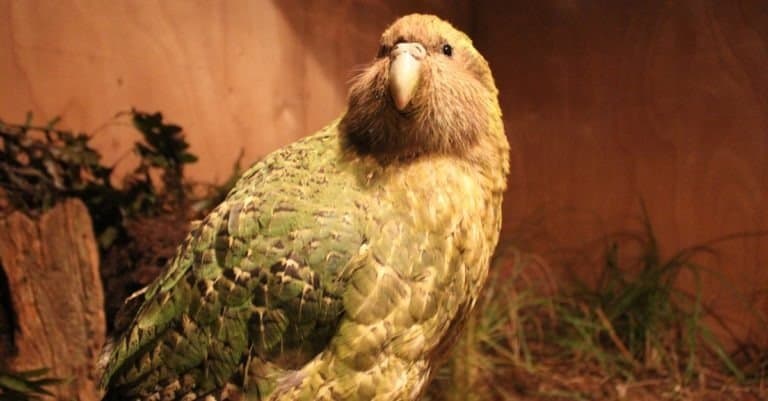
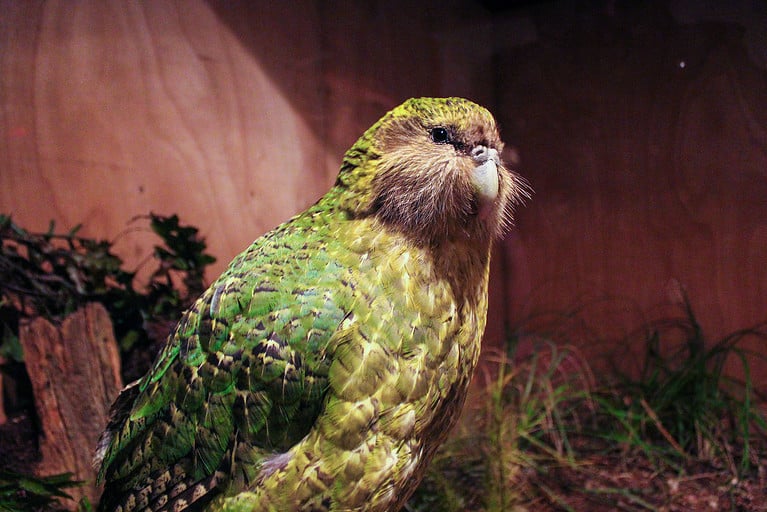
  • Green, mottled plumage with owl-like facial disc
  • Males form leks and produce deep low-frequency “booming” calls
  • Endemic to New Zealand; very limited managed populations

Physical Measurements

Males and females differ in size

Length
2 ft (1 ft 11 in – 2 ft 1 in)
1 ft 11 in (1 ft 10 in – 1 ft 12 in)
Weight
6 lbs (4 lbs – 9 lbs)
4 lbs (3 lbs – 4 lbs)
Tail Length
10 in (9 in – 11 in)

Appearance

Primary Colors
Secondary Colors
Skin Type Feathered bird integument; plumage notably soft and downy for a parrot (insulative for nocturnal, ground-dwelling life). Legs/feet covered in keratinized scales typical of birds; robust keratin beak.
Distinctive Features
  • Endemic to New Zealand; the only extant species in genus Strigops (family Strigopidae-distinct New Zealand parrot lineage).
  • Large, heavy-bodied, flightless parrot: adult total length typically ~58-64 cm. Wings are short/rounded; used for balance and controlled descents rather than powered flight.
  • Adult mass shows strong size range: males commonly ~2.2-4.0 kg; females commonly ~1.3-2.0 kg (males heavier on average).
  • Owl-like facial disk of specialized feathers (gives an 'owl-parrot' look) with forward-facing whisker-like feathers (rictal bristles) around the bill; adapted to nocturnal foraging and tactile sensing.
  • Large zygodactyl feet and strong legs for climbing and terrestrial locomotion; tail often used as a prop while climbing.
  • Distinctive musty/sweet odor (notable in adults), often mentioned as a characteristic scent of kākāpō.
  • Nocturnal: typically roosts by day and forages at night; plumage coloration functions primarily as camouflage in dim forest light.
  • Lek breeding system: males gather at traditional display sites and produce low-frequency 'booming' calls from bowl-shaped scrapes; booms can carry long distances (often cited as being audible over ~1 km under suitable conditions).
  • Breeding is strongly tied to periodic heavy fruiting ('mast') events of key food plants (notably rimu, Dacrydium cupressinum), so breeding is irregular and often occurs only in mast years.
  • Extreme longevity: individuals can live for many decades; maximum lifespan commonly cited as >60 years and potentially approaching ~90+ years under intensive management.
  • Conservation context (appearance-relevant handling/monitoring): Critically Endangered; managed in predator-free island sanctuaries and fenced sites with close monitoring, supplementary feeding, and health checks that document plumage condition and molt. Not a widespread 'wild' mainland species today.

Sexual Dimorphism

Sexual dimorphism is present but subtle in plumage; the most consistent differences are size and robustness. Both sexes share the same overall moss-green mottled camouflage pattern.

  • Larger and heavier on average (commonly ~2.2-4.0 kg) with a more robust overall build.
  • More associated with lek display behavior: males construct and repeatedly use bowl-shaped 'booming' sites; vocal display is the primary sexual signal rather than bright plumage.
  • Smaller and lighter on average (commonly ~1.3-2.0 kg) with a less bulky appearance.
  • Females do not boom; they visit male lek sites for mating and then nest/raise chicks, so breeding-associated wear may be seen as localized feather abrasion/soiling during nesting in some individuals.

Did You Know?

It's the world's heaviest parrot: adults are ~58-64 cm long; males typically ~2-4 kg, females ~1.3-2.0 kg (species accounts incl. DOC/IUCN; see also Powlesland et al.).

Males do not help raise chicks: kakapo are lek breeders-males boom from display bowls while females choose mates (Elliott et al.; Powlesland et al.).

The male's low-frequency "boom" can carry kilometers; acoustic studies report audibility up to ~5 km under good conditions (field reports in species monographs).

Breeding is strongly tied to "mast" fruiting of native trees (notably rimu, Dacrydium cupressinum), so big breeding years are irregular (Elliott et al. 2001).

Clutches are small-typically 1-4 eggs (often 2-3); incubation is about ~29-31 days (Powlesland et al.).

They're famously fragrant: individuals often have a musty/sweet odor used in social/sexual signaling (documented in behavioral ecology descriptions).

Exceptionally long-lived: individuals can live for many decades; longevity commonly reported at ≥60 years, with some estimates extending higher under protection (DOC species profiles).

Unique Adaptations

  • True flightlessness in a parrot: reduced keel and relatively short wings paired with robust legs and feet for climbing and walking.
  • Owl-like sensory toolkit: a facial "disc" of feathers and fine vibrissae-like feathers around the beak help with nocturnal navigation and food handling.
  • Low-frequency sound production suited to forests: booming calls are optimized for long-distance transmission from fixed display sites (a classic lek adaptation).
  • Moss-green, mottled plumage: highly effective camouflage on the New Zealand forest floor; males tend to be larger and more robust than females (sexual dimorphism).
  • Energy storage and slow pace: kākāpō can accumulate substantial fat reserves, supporting survival through variable food availability on islands.
  • Island-focused conservation fit: the species' ecology (ground-dwelling, predator-naïve) makes predator-free islands and intensive management especially effective (New Zealand Department of Conservation Kakapo Recovery Programme).

Interesting Behaviors

  • Nocturnal foraging: emerges at night to eat leaves, shoots, buds, flowers, fruit, and seeds; often follows regular paths on the forest floor.
  • Lek courtship: in breeding seasons, males clear "tracks" and maintain shallow display bowls; they alternate deep booming calls with higher "ching" calls to attract females.
  • Tree-climbing and controlled descents: although flightless, kakapo climb using powerful legs and beak; they can launch from height to glide or "parachute" down with spread wings.
  • Freeze-and-hide defense: when threatened, they commonly remain motionless and rely on moss-green camouflage-an effective strategy before mammalian predators arrived.
  • Long parental care by females: females alone incubate and rear chicks, making nesting success highly sensitive to predator presence and food supply.
  • Strong site fidelity: individuals use familiar home ranges, tracks, and roost sites, which managers leverage for monitoring and supplemental feeding when needed.

Cultural Significance

The name kākāpō means "night parrot." People once ate them, kept them as pets, and used their feathers for decoration. Today they are a New Zealand conservation symbol, showing harm from introduced predators and the hope of recovery work led by New Zealand's Department of Conservation Kakapo Recovery Programme.

Myths & Legends

Name and cultural memory: the bird's common name translates to "night parrot," reflecting its nocturnal habits and its place in traditional forest knowledge.

Cloak traditions: within Maori material culture, the bird's feathers became part of high-status garments; stories attached to such cloaks often emphasize prestige and careful custodianship of rare materials.

Pet-keeping anecdotes preserved in early histories: recorded accounts describe kakapo kept by Maori as companion birds (tethered or allowed to roam), reflecting a long-standing human-kakapo relationship rather than a single fixed mythic tale.

"String-and-track" hunting stories: historical narratives from the 19th century describe night hunting methods that exploited the kākāpō's ground tracks and stillness-stories now retold as cautionary history alongside the species' recovery.

Modern legend-in-the-making: 'Sirocco,' a hand-reared male kākāpō, became a widely told contemporary story in New Zealand (a living cultural anecdote) and helped galvanize public support for recovery efforts.

Conservation Status

CR Critically Endangered

Facing an extremely high risk of extinction in the wild.

Population Increasing

Protected Under

  • New Zealand Wildlife Act 1953 (fully protected species; prohibits killing, capture, or possession except by permit)
  • New Zealand Conservation Act 1987 (statutory basis for conservation management by the Department of Conservation)
  • CITES Appendix I (international trade prohibited except under exceptional permitted circumstances)

Life Cycle

Birth 2 chicks
Lifespan 70 years

Lifespan

In the Wild 50–95 years
In Captivity 55–100 years

Reproduction

Mating System Polygyny
Social Structure Lek Breeding
Breeding Pattern Transient
Fertilization Internal Fertilization
Birth Type Internal_fertilization

Behavior & Ecology

Social Lek (temporary male congregation); otherwise solitary Group: 1
Activity Nocturnal, Crepuscular
Diet Herbivore Dacrydium cupressinum fruit/arils (especially in mast years)

Temperament

Kākāpō (Strigops habroptilus) are usually not aggressive and let people and new things come close. They are curious and trusting, likely because they evolved without ground mammal predators.
Strong site fidelity to established home ranges and (for males) to traditional lek bowl sites; males can be territorial around bowls during the display season.
Sex/seasonal contrast: males become highly display-focused and competitive at leks during breeding, while females are secretive and risk-averse when nesting/with chicks.

Communication

Low-frequency 'booming' advertisement calls by males at night from lek bowls; carries over kilometers and functions in long-range attraction/assessment at leks Reported audible up to ~5 km in field accounts; Powlesland et al., 1992
Metallic 'ching' Bell-like) calls interspersed with booms at leks, used in close- to mid-range signalling during display (Powlesland et al., 1992
Harsh alarm/distress calls (variously described as squawks/screeches) when threatened or handled.
Contact calls and softer grunts/croaks used at close range Reported in behavioral ethograms from managed populations and earlier field work
Olfactory signalling: strong, persistent musty-sweet odor Species-typical) thought to function in individual/sex recognition and/or mate assessment; odor is conspicuous enough to aid human detection in the field (frequently noted in kakapo natural history and management literature
Visual/behavioral display at lek bowls: inflated body posture, rhythmic rocking, and orientation within the bowl during booming; use of traditional cleared 'bowls' and trackways as display infrastructure Powlesland et al., 1992
Tactile interactions are limited because adults are usually solitary, but include courtship mounting and brief physical contact during copulation at leks; females subsequently avoid contact while nesting.

Habitat

Forest Rainforest Coniferous Forest Woodland Shrubland Grassland Alpine Meadow Mountain Coastal +3
Biomes:
Temperate Forest Temperate Rainforest Alpine
Terrain:
Island Coastal Hilly Valley Mountainous
Elevation: Up to 4921 ft 3 in

Ecological Role

Large-bodied, flightless nocturnal herbivore and seed predator/short-distance disperser in New Zealand forest systems, with diet strongly tracking mast-fruiting podocarps (especially Dacrydium cupressinum).

Vegetation pruning/browsing that can influence plant community structure and regeneration patterns Seed predation and occasional endozoochorous dispersal of some fleshy-fruited species at local scales Nutrient cycling via concentrated droppings at roosting/foraging sites Trophic support for decomposers through discarded 'chews' and other plant remains

Diet Details

Other Foods:
Rimu Miro Podocarp fruits and seeds Shrub and tree browse Ferns Tussock grasses and sedges Herbaceous plants, roots and tubers Flowers and pollen/nectar Fungi +3

Human Interaction

Domestication Status

Wild

The kākāpō (Strigops habroptilus) is not domesticated. It is managed as a wild population in New Zealand on predator-free islands and fenced sanctuaries. Because it is large, flightless and nocturnal with a lek breeding system, humans give strict protection, hands-on care, research, and Māori cultural care after past hunting and predator loss.

Danger Level

Low
  • Physical injury risk is low: kakapo are non-venomous and generally non-aggressive; however, like other parrots they can deliver painful bites if stressed or handled.
  • Zoonotic disease risk is low but non-zero in any close bird-human contact setting (e.g., psittacosis/Chlamydia psittaci is a general parrot-associated concern), which is one reason handling is restricted to trained staff with biosecurity protocols.
  • Conservation-context risks: human-to-bird disease transmission and introduction of predators/pathogens are major concerns; strict quarantine/biosecurity measures are applied to protect the species.

As a Pet

Not Suitable as Pet

Legality: Not legal as a pet. The kākāpō (Strigops habroptilus) is a protected New Zealand endemic, listed as Critically Endangered (IUCN). Private ownership, sale, and export are banned; only permitted conservation staff may handle it.

Care Level: Expert Only

Purchase Cost:
Lifetime Cost:

Economic Value

Uses:
Conservation funding and employment (biosecurity, veterinary care, monitoring, translocations) Scientific research value (behavior, acoustics, reproductive biology, genetics/genomics, disease ecology) Education/media/public engagement (iconic flagship species) Cultural value (a treasured species for the Maori people; historical feather use)
Products:
  • No legal commercial products from the species (no lawful pet/feather trade).
  • Indirect economic value via conservation programs, grants, and controlled eco-education initiatives.

Relationships

Predators 9

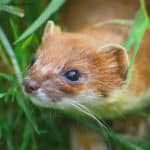
Stoat Mustela erminea
Domestic cat Felis catus
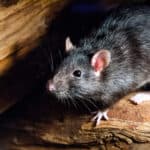
Ship rat Rattus rattus
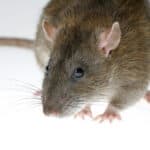
Norway rat Rattus norvegicus
Pacific rat Rattus exulans
Dog Canis lupus familiaris
Ferret Mustela putorius furo
Common brushtail possum Trichosurus vulpecula
Pig Sus scrofa

Related Species 3

Kea Nestor notabilis Shared Order
New Zealand kākā Nestor meridionalis Shared Order
Red-crowned parakeet Cyanoramphus novaezelandiae Shared Order

Ecological Equivalents 4

Animals that fill a similar ecological role in their ecosystem

Night parrot Pezoporus occidentalis Kākāpō (Strigops habroptilus) and similar parrots are nocturnal, ground-living, green, and hard to see. The kākāpō is unique: it is flightless and much heavier (body length 58–64 cm; males ~2.2–4.0 kg; females ~1.5–2.0 kg).
Southern brown kiwi Apteryx australis Nocturnal, flightless, ground-dwelling forest bird of New Zealand; shares predator susceptibility and conservation management needs (intensive predator control and translocations). Unlike the herbivorous kākāpō, kiwi are primarily invertebrate feeders, but both occupy low, terrestrial nighttime niches in New Zealand forests.
South Island takahē Porphyrio hochstetteri Large, flight-reduced (effectively flightless) New Zealand herbivore with strong site fidelity and high vulnerability to introduced mammalian predators; similarly requires managed sanctuaries for conservation. The kākāpō differs in being nocturnal and lek-breeding, whereas the takahē is diurnal and territorial.
Weka Gallirallus australis Terrestrial New Zealand rail that forages on the forest floor and can overlap in habitat use and impose similar ground-nesting pressures. Weka can also act as nest predators and scavengers in some contexts, highlighting similar ground-based ecological constraints for kākāpō.

Originating on the island of New Zealand, the kakapo is a large flightless bird that has evolved to fill a similar ecological niche as land mammals in the way that it roams the forest floor in search of food at night.

Though it was largely free of predators for millions of years, the introduction of actual mammals from outside the island had a devastating impact on kakapo bird numbers, since the birds were unprepared to deal with the threat of carnivores. Today, the kakapo bird has become something of a minor conservation celebrity around the world.

An Amazing Bird: 4 Kakapo Facts

  • Among the more unique facts, the kakapo bird walks around in a horizontal position with its bill nearly touching the ground. If it’s threatened, then the kakapo may stand upright to defend itself.
  • The kakapo bird is the only nocturnal and flightless parrot species in the world.
  • Polynesian settlers used kakapo feathers to make decorative cloaks and adornments. Their meat also provided a steady source of food.
  • In their native country, these parrots have won the New Zealand Bird of the Year competition twice in 2008 and 2020. This bird has also drawn some international curiosity. An infamous BBC video of the bird featuring British actor Stephen Fry has amassed almost 20 million views on YouTube.
  • Kakapos are the largest parrots in the world. They can weigh up to 8.8 pounds (4 kg), which makes them significantly larger than other parrot species, such as the hyacinth macaw, which can reach up to about 3.5 pounds (1.6 kg).

Where to Find the Kakapo

👁 Fiordland National Park

Kakapo can only be found in their native New Zealand.

©iStock.com/stockphoto52

These parrots are forest-dwelling birds that evolved entirely in their original native habitat of New Zealand.

Scientific Name

The scientific name of the kakapo is Strigops habroptilus. The genus Strigops (of which the kakapo appears to be the only living member) is derived from two separate Greek words: Strix, meaning owl, and ops, meaning appearance or face. The species name habroptilus is also the combination of two Greek words: habros, meaning soft, and ptilon, meaning feather. The closest living relatives of the kakapo are the fellow New Zealand birds, the kea and the kaka. Together, all three species belong to the wider order of parrots known as the Psittaciformes.
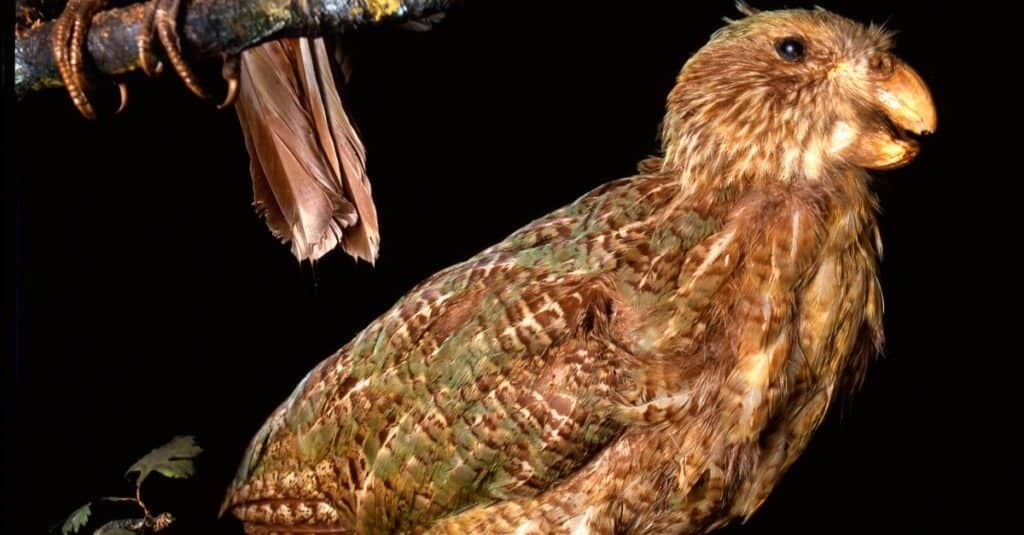
👁 Kakapo endemic to New Zealand

The kakapo shared a common ancestor with the kaka and the kea around 82 million years ago.

©COULANGES/Shutterstock.com

Evolution

The kakapo once shared a common ancestor with the kaka and the kea, both birds belonging to the New Zealand parrot genus, Nestor. The birds became isolated after New Zealand separated from Gondwana around 82 million years ago. Around 30 million years ago, the kakapo diverged from the genus Nestor. Kakapo was once thought to be related to the ground parrots and night parrots of Australia due to their similar coloration, but this has been disproven. The color seems to be an adaptation to terrestrial habits that evolved in the birds convergently.

Size, Appearance & Behavior
👁 Image

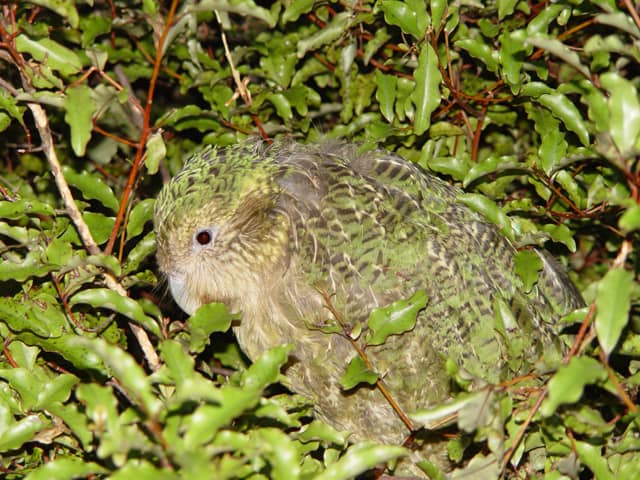
The kakapos’ plumage has evolved to blend in with its native habitat perfectly.

©Mnolf / CC BY-SA 3.0 – Original / License

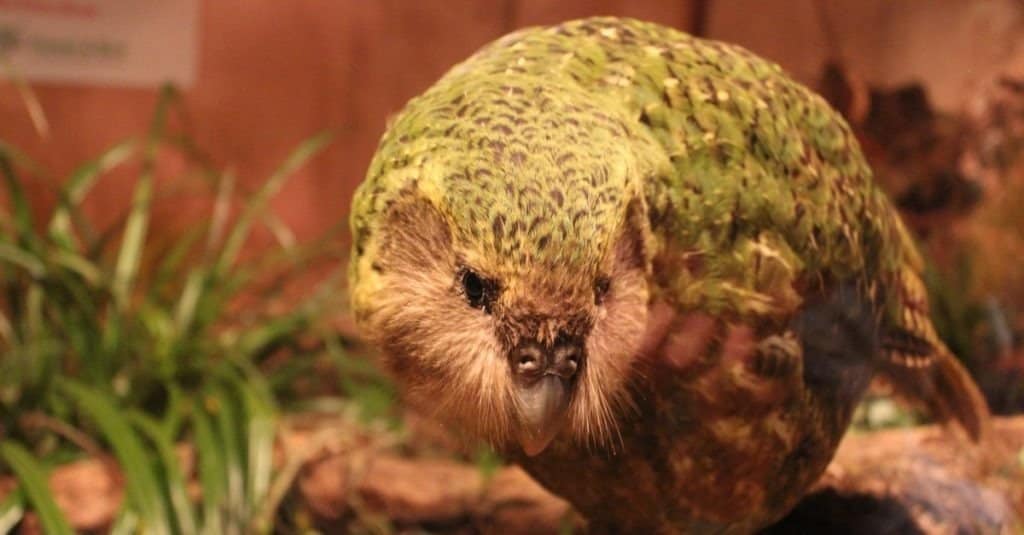
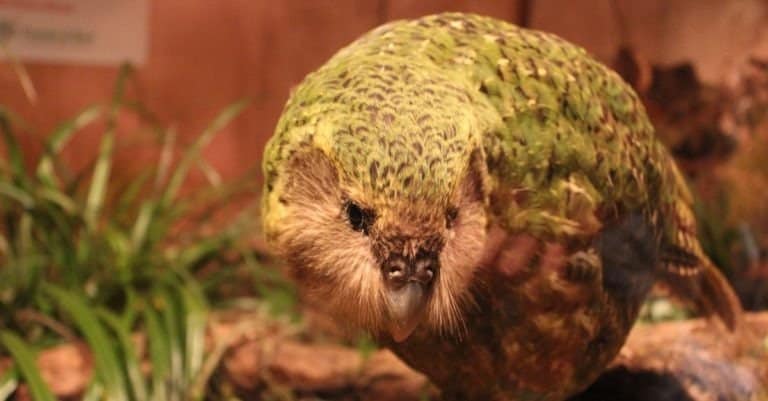
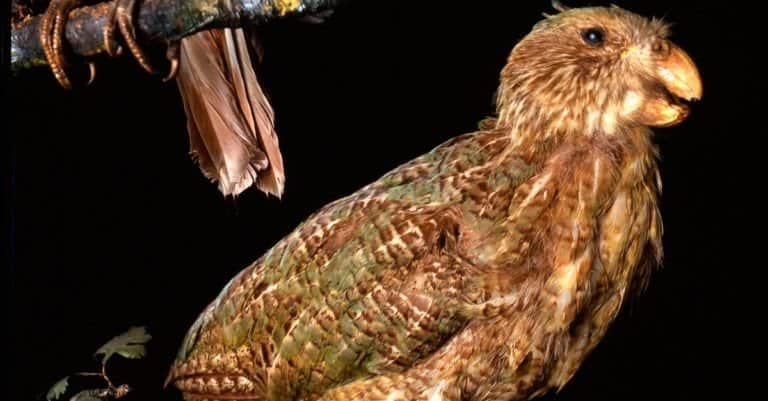
The kakapo has a long, round tail, a large, short beak (surrounded by delicate, whisker-like feathers), and a robust body with green and brown plumage. Resembling the owl from which its scientific name derives, the kakapo has forward-facing eyes and disc-like feathers on the face that redirect sound toward the ears. These adaptations allow the kakapo to perceive its surroundings very well in low-light conditions.

Like many other island-specific birds, the kakapo’s anatomy has evolved entirely in the absence of many serious predators. This means, most importantly, it can afford to be big. Measuring up to 25 inches in size and weighing up to 8.8 pounds (4 kg), the kakapo is one of the largest parrot species in the world. As a consequence of this ground-based lifestyle, the kakapo has evolved smaller wings that cannot possibly support its large weight.

Although it cannot fly, the kakapo does have the amazing ability to climb up trees with its strong feet. Among the more amazing facts, this bird will utilize its wings as a parachute to float safely to the ground. The wings also provide balance as it’s walking or running. The kakapo is not a social species, per se, except in the mating season. They are highly territorial birds that warn away trespassers with a loud “Kraak” sound. But each bird is intelligent and appears to exhibit a unique personality.
👁 Image

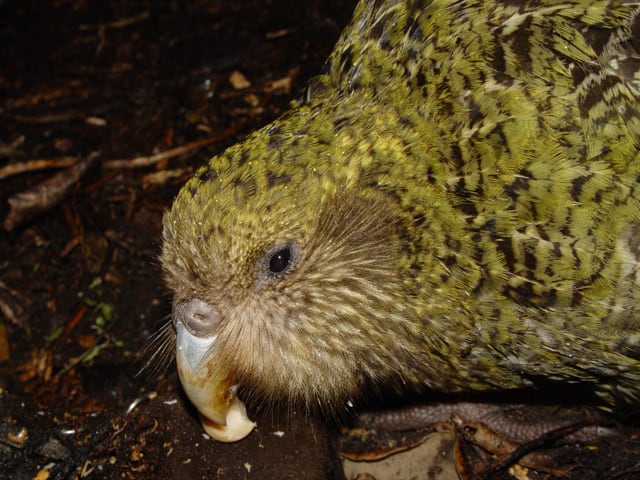
Kakapo eats fruits, seeds, leaf buds, shoots, tubers, rhizomes, pollens, mosses, and fungi.

©Mnolf / CC BY-SA 3.0 – Original / License

Diet

The kakapo is an herbivorous animal that grinds up food with its beak and mouth. Unlike many other bird species, it lacks the specialized organ known as the gizzard that normally grinds up food. It’s also one of the few land birds that can store large amounts of energy as body fat.

What does the kakapo bird eat?

The kakapo consumes fruit, seeds, leaf buds, shoots, tubers, rhizomes, pollen, moss, and fungi, all of which vary by season and location.

Predators, Threats, and Conservation Status

For millions of years, the kakapo encountered few natural predators in the wild. But the first wave of Polynesian settlers also brought rats and other mammals that fed on vulnerable chicks left alone in their nest for hours as the mother went in search of food. The arrival of European settlers completely transformed New Zealand’s ecosystem with the destruction of forests and the introduction of cats, ferrets, and stoats. By the 1950s, the kakapo was almost completely extinct. Only heroic conservation efforts succeeded in saving the kakapo, but the species is still considered to be critically endangered by the IUCN Red List.

What eats the kakapo bird?
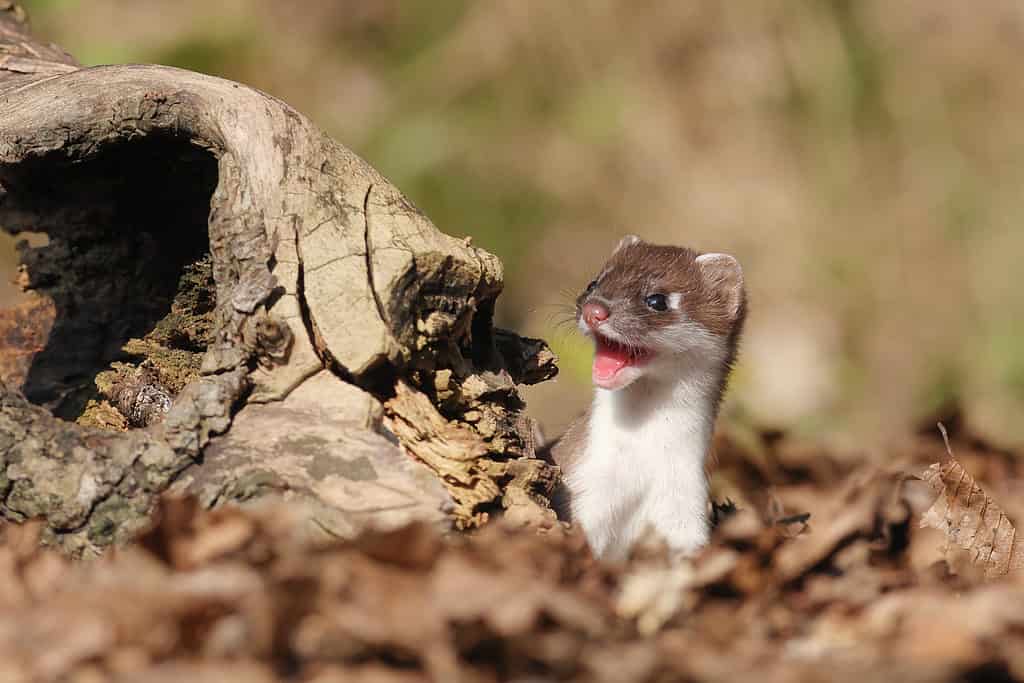
👁 Stoat by a log

Stoats are aggressive and ambitious hunters able to bring down animals that would seem too large, like the kakapo.

©Petr Muckstein/Shutterstock.com

Before large carnivorous mammals were introduced to New Zealand, the kakapo’s main predators were large birds of prey. It could usually fool other birds by freezing in place to blend in with the forest surroundings. But carnivorous mammals proved to be a more effective predator by hunting the kakapos with their scent. Because the kakapos did not have the time to evolve formidable defenses against land mammals, this had a devastating effect on population numbers.

Reproduction, Babies, and Lifespan
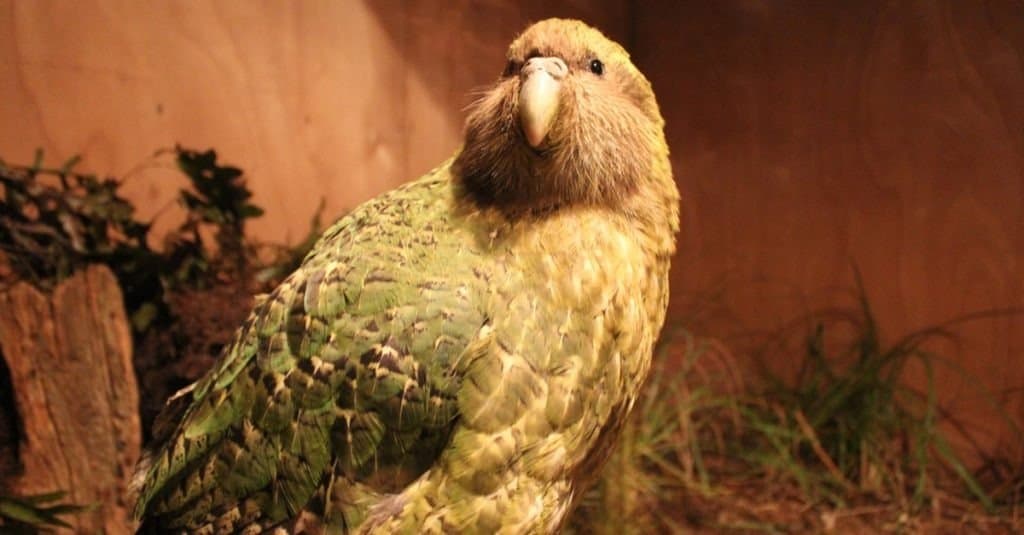
👁 Kakapo Parrot Endemic to New Zealand

Male kakapos have an elaborate and rather noisy courtship ritual.

©Imogen Warren/Shutterstock.com

It’s perhaps no exaggeration to say that the kakapo has one of the most elaborate and fascinating courtship rituals in the entire animal kingdom. As the reproduction period approaches (between December and February or March), male kakapo will leave their home territory and establish a mating area on the hilltops. These leks, as they’re called, consist of a hollow bowl carefully trimmed of all vegetation. An entire system of leks is linked together by long tracks running more than 100 feet in any direction.

These leks serve as a convenient place from which they can court females. This courtship involves an exuberant display in which the male will inflate his chest, bobbing his head, and broadcast a massive sound throughout the night that can carry for half a mile in all directions on the wind. Males produce these sounds from a unique air sac in their thorax.
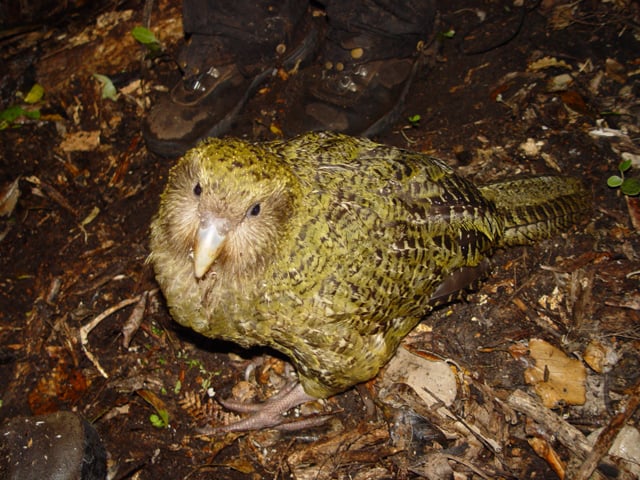
👁 Image

Female kakapo are responsible for building the nest, incubating eggs, and raising chicks on their own.

©Mnolf / CC BY-SA 3.0 – Original / License

Once he attracts interest from a potential mate, the male will seal the deal with a brief courtship dance. After fulfilling his reproductive duty, he will depart the scene, leaving the female with the full responsibility for building the nest, incubating the eggs, and raising the chicks. The female kakapo constructs its nest under the cover of plants, within rock crevices, or inside hollow tree trunks. The mother will produce only a few eggs, sometimes spaced months apart. After about 30 days of incubation, the chicks emerge from the eggs undeveloped and helpless (the technical term for this undeveloped state is altricial). As mentioned previously, the mother leaves the chicks unattended for long periods to search for food. The chicks are most vulnerable at this point in their lives.

If they survive this initial stage, the chicks will leave the nest after about 3.5 months, when they have fully developed their feathers. The typical kakapo has a long lifespan of 45 to 60 years in the wild. The female reaches sexual maturity at around nine years of age and reproduces on average only once every two to four years, which may contribute to their slow population growth.
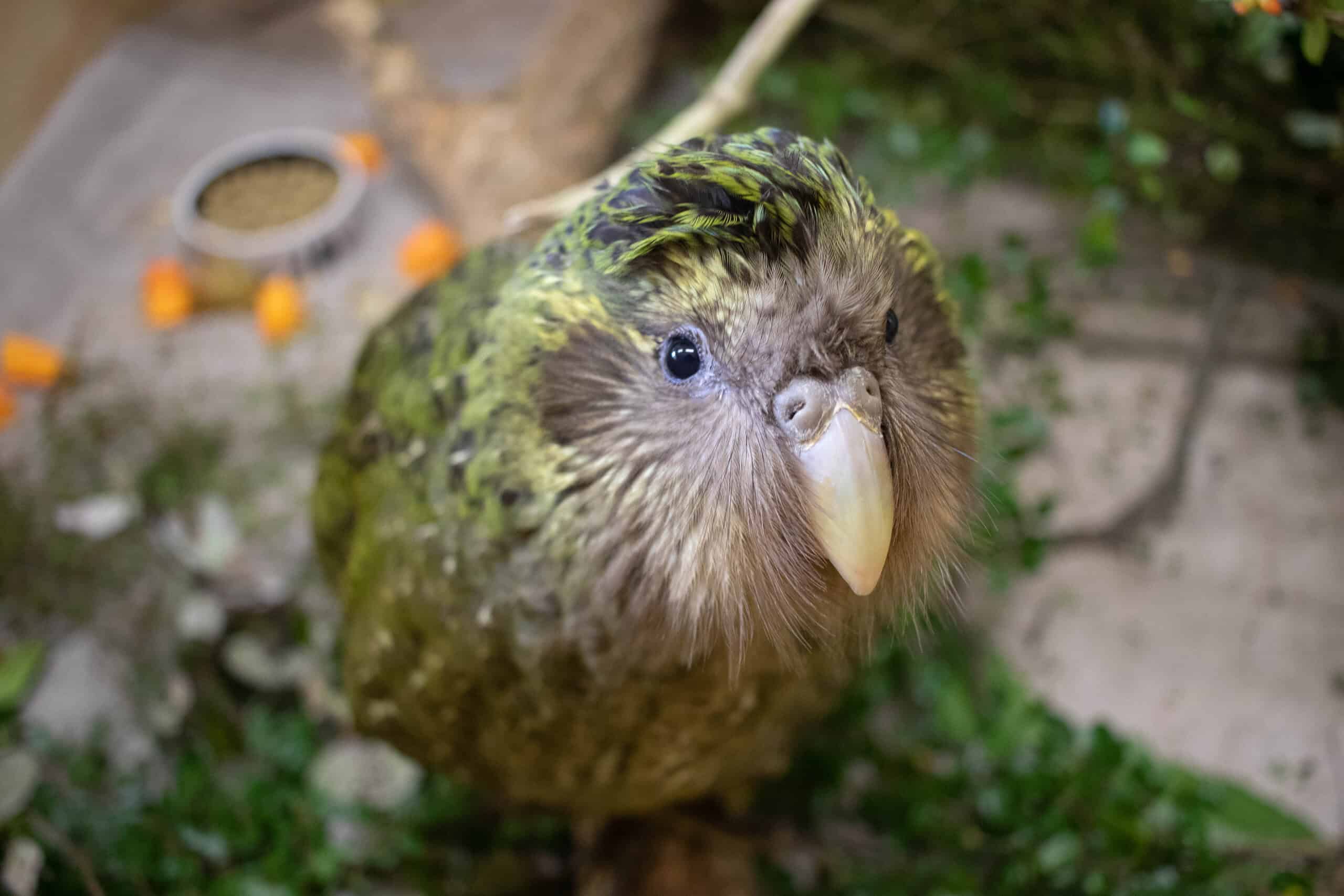
👁 kakapo flightless parrot

There are only around 200 kakapo left in the wild.

©Kimberley Collins / CC BY 2.0 – Original / License

Population

Once widespread across most of New Zealand, the bird began a rapid decline after the arrival of European settlers until it hit a low of around 50 or 60 individuals by the late 20th century. Only well-planned conservation efforts saved them from ultimate extinction. The remaining individuals were relocated to three offshore island sanctuaries, where they were free of predators. From this low population, conservationists have made some inroads toward reviving the species. Today, about 200 kakapos remain in the wild. But because of the low genetic diversity, modern kakapos have problems with disease resistance and infertility. DNA sequencing allows conservationists to construct a kakapo family tree to help minimize inbreeding.


View all 103 animals that start with K

Sources

  1. Britannica / Accessed January 16, 2021
  2. Animal Diversity Web / Accessed January 16, 2021

About the Author

Lisha Pace

After a career of working to provide opportunities for local communities to experience and create art, I am enjoying having time to write about two of my favorite things - nature and animals. Half of my life is spent outdoors, usually with my husband and sweet little fourteen year old dog. We love to take walks by the lake and take photos of the animals we meet including: otters, ospreys, Canadian geese, ducks and nesting bald eagles. I also enjoy reading, discovering books to add to my library, collecting and playing vinyl, and listening to my son's music.

Thank you for reading! Have some feedback for us?

Contact the AZ Animals editorial team

Related Articles You May Find Interesting


Kakapo FAQs (Frequently Asked Questions)

Kakapos live in areas of natural vegetation and dense jungles.

Predators of Kakapos include humans, cats, and stoats.

No, the kakapo maintains a home range the entire year and only travels a short distance for the breeding season.

No more than three per breeding season.

The kakapo cannot fly, but it can traverse the ground at slower speeds.

It has reduced wings that measure no more than a few feet.

At about 3.5 months of age.

Yes, kakapo does all of their foraging at night.

The kakapo eats fruits, seeds, leaf buds, shoots, tubers, rhizomes, pollens, mosses, and fungi.

A kakapo is a large flightless bird that belongs to the family of New Zealand parrots. It can be argued that the kakapo’s unique adaptations make it different from any other species on the planet.

The kakapo once called home the entire island habitat of New Zealand. Now it is confined to three small islands: Codfish, Maud, and Little Barrier. Deliberately kept free of predators, these habitats offer a refuge for the kakapo to live and thrive. Although closely monitored and cared for, these birds are still technically wild in nature.

Population numbers fluctuate from year to year, but in 2019, after a particularly successful year of breeding, the kakapo surpassed 200 for the first time in many decades.

Kakapos can live for 50 to 65 years.