K
Species Profile

Killifish

Cyprinodontiformes

Small fish, big survival strategies
Pavaphon Supanantananont/Shutterstock.com

Killifish Distribution

Click a location to explore more animals from that region

Invasive Species

This map shows coastal regions where Killifish are found.

Loading map...

Found in 53 countries

๐Ÿ‡ฆ๐Ÿ‡ด Angola ๐Ÿ‡ฆ๐Ÿ‡ท Argentina ๐Ÿ‡ง๐Ÿ‡ฉ Bangladesh ๐Ÿ‡ง๐Ÿ‡ท Brazil ๐Ÿ‡จ๐Ÿ‡ฉ Democratic Republic of Congo ๐Ÿ‡จ๐Ÿ‡ฌ Republic of Congo ๐Ÿ‡จ๐Ÿ‡ฒ Cameroon ๐Ÿ‡จ๐Ÿ‡ณ China ๐Ÿ‡จ๐Ÿ‡ด Colombia ๐Ÿ‡จ๐Ÿ‡บ Cuba ๐Ÿ‡ฉ๐Ÿ‡ด Dominican Republic ๐Ÿ‡ฉ๐Ÿ‡ฟ Algeria ๐Ÿ‡ช๐Ÿ‡จ Ecuador ๐Ÿ‡ช๐Ÿ‡ฌ Egypt ๐Ÿ‡ช๐Ÿ‡ธ Spain ๐Ÿ‡ช๐Ÿ‡น Ethiopia ๐Ÿ‡ซ๐Ÿ‡ท France ๐Ÿ‡ฌ๐Ÿ‡ฆ Gabon ๐Ÿ‡ฌ๐Ÿ‡ญ Ghana ๐Ÿ‡ฌ๐Ÿ‡ท Greece ๐Ÿ‡ญ๐Ÿ‡น Haiti ๐Ÿ‡ฎ๐Ÿ‡ฉ Indonesia ๐Ÿ‡ฎ๐Ÿ‡ฑ Israel ๐Ÿ‡ฎ๐Ÿ‡ณ India ๐Ÿ‡ฎ๐Ÿ‡ถ Iraq ๐Ÿ‡ฎ๐Ÿ‡ท Iran ๐Ÿ‡ฎ๐Ÿ‡น Italy ๐Ÿ‡ฏ๐Ÿ‡ต Japan ๐Ÿ‡ฐ๐Ÿ‡ช Kenya ๐Ÿ‡ฑ๐Ÿ‡ฐ Sri Lanka ๐Ÿ‡ฒ๐Ÿ‡ฆ Morocco ๐Ÿ‡ฒ๐Ÿ‡ฒ Myanmar ๐Ÿ‡ฒ๐Ÿ‡ฝ Mexico ๐Ÿ‡ฒ๐Ÿ‡พ Malaysia ๐Ÿ‡ฒ๐Ÿ‡ฟ Mozambique ๐Ÿ‡ณ๐Ÿ‡ฌ Nigeria ๐Ÿ‡ต๐Ÿ‡ช Peru ๐Ÿ‡ต๐Ÿ‡ญ Philippines ๐Ÿ‡ต๐Ÿ‡น Portugal ๐Ÿ‡ธ๐Ÿ‡ฆ Saudi Arabia ๐Ÿ‡ธ๐Ÿ‡ฉ Sudan ๐Ÿ‡ธ๐Ÿ‡ฌ Singapore ๐Ÿ‡ธ๐Ÿ‡ณ Senegal ๐Ÿ‡น๐Ÿ‡ญ Thailand ๐Ÿ‡น๐Ÿ‡ณ Tunisia ๐Ÿ‡น๐Ÿ‡ท Turkey ๐Ÿ‡น๐Ÿ‡ผ Taiwan ๐Ÿ‡น๐Ÿ‡ฟ Tanzania ๐Ÿ‡บ๐Ÿ‡ธ United States ๐Ÿ‡บ๐Ÿ‡พ Uruguay ๐Ÿ‡ป๐Ÿ‡ช Venezuela ๐Ÿ‡ป๐Ÿ‡ณ Vietnam ๐Ÿ‡ฟ๐Ÿ‡ฆ South Africa

At a Glance

Order Overview This page covers the Killifish order as a group. Stats below are general traits shared across the order.
Also Known As Pupfish, Topminnow, Panchax, Annual fish, Lampeye
Diet Omnivore
Activity Diurnal+
Lifespan 1.5 years
Weight 0.12 lbs
Status Not Evaluated
Did You Know?

Size spans ~2 cm (least killifish) to ~35 cm (four-eyed fish, Anableps) across the order.

Scientific Classification

Order Overview "Killifish" is not a single species but represents an entire order containing multiple species.

Killifishes are small ray-finned fishes best treated as a hub-level group within the order Cyprinodontiformes. Many are surface-oriented insectivores; numerous species are adapted to extreme environments (hypersaline pools, low oxygen waters), and some are "annual" fishes whose eggs survive seasonal drying.

Kingdom
Animalia
Phylum
Chordata
Class
Actinopterygii
Order
Cyprinodontiformes

Distinguishing Features

  • Generally small-bodied, surface-oriented fishes
  • Often upturned mouths suited to surface feeding
  • Many species show strong sexual dimorphism and bright male coloration
  • Includes annual life-history strategies in some African and South American groups (eggs diapause through dry season)
  • High tolerance in some species to salinity, temperature swings, and low oxygen

Physical Measurements

Males and females differ in size

Length
โ™‚ 2 in (1 in โ€“ 7 in)
โ™€ 3 in (1 in โ€“ 1 ft 1 in)
Weight
โ™‚ 0 lbs (0 lbs โ€“ 0 lbs)
โ™€ 0 lbs (0 lbs โ€“ 0 lbs)
Top Speed
6 mph
burst swimming

Appearance

Primary Colors
Secondary Colors
Skin Type Mostly smooth, mucus-coated skin with thin cycloid scales; scale size and coverage vary, with some small species appearing more 'sleek' and translucent, and many showing iridescent reflective cells.
Distinctive Features
  • Adult size range across the order is broad: ~1.5-20+ cm, with many species 3-8 cm.
  • Body form often streamlined with an upturned or terminal mouth; many are surface-oriented insectivores.
  • Fins often rounded to slightly pointed; males frequently develop elongated dorsal/anal/caudal fin extensions.
  • Eyes relatively large; some lineages show strong reflective 'lampeye' shine in low light.
  • Habitats span freshwater, brackish, and marine-influenced systems: streams, marshes, mangroves, springs, salt flats, and temporary pools.
  • Ecological extremes are common: tolerance of hypoxia, high temperatures, and hypersalinity occurs in multiple lineages (not universal).
  • Annual vs non-annual life histories: some 'annual' killifishes rely on diapause eggs surviving seasonal drying; many others are multi-year breeders.
  • Lifespan varies widely: annual species often ~3-12 months; non-annual species commonly ~2-5 years (sometimes longer in captivity).
  • Behavioral generalizations: many are opportunistic feeders (insects/crustaceans/algae), with variation from territorial to schooling tendencies depending on habitat and species.
  • Reproduction diversity: substrate spawning, plant spawning, and egg-burying occur; parental care is usually limited, but strategies vary.
  • Examples of well-known genera within the order often called killifishes include Fundulus, Nothobranchius, Aphyosemion, Kryptolebias, and Cyprinodon.

Sexual Dimorphism

Sexual dimorphism is common but variable across the order. Males are often more vividly colored with longer fins and stronger pattern contrast, while females tend to be drabber and rounder-bodied; some species show only subtle differences.

โ™‚
  • Brighter blues/reds/yellows with higher contrast spots/stripes, especially during breeding.
  • Elongated or more pointed dorsal/anal/caudal fins in many lineages.
  • More intense iridescence and darker fin margins used in courtship displays.
  • In some species, more territorial display behaviors accompany enhanced coloration.
โ™€
  • More subdued brown/olive/silver tones for camouflage; patterning often reduced.
  • Typically shorter, rounder fins with less extension.
  • Often deeper-bodied when gravid, with visibly fuller abdomen.
  • In some species, females are similar in size but markedly less colorful.

Did You Know?

Size spans ~2 cm (least killifish) to ~35 cm (four-eyed fish, Anableps) across the order.

Some are "annual" fishes: adults live only months, but embryos can pause development (diapause) until rains return.

The order includes both egg-layers (many killifishes/pupfishes) and livebearers (guppies, mollies, mosquitofish).

Several lineages tolerate extremes-hypersalinity, high temperatures, very low oxygen-and can gulp air at the surface.

Mangrove rivulus (Kryptolebias) can self-fertilize, a rare reproductive strategy among vertebrates.

Desert pupfishes (Cyprinodon) became conservation icons because many species are restricted to single springs or small basins.

Fundulus killifishes are widely used in pollution and adaptation research because some populations evolved tolerance to heavily contaminated estuaries.

Unique Adaptations

  • Embryonic diapause in many annual killifishes: eggs survive seasonal drought, heat, and low oxygen in drying substrates, then hatch when re-flooded.
  • Exceptional salinity tolerance in multiple lineages (euryhalinity): freshwater-brackish-marine transitions are common, especially in coastal killifishes and livebearers.
  • Low-oxygen survival strategies: surface respiration/air-gulping, high tolerance of hypoxia, and behaviors that track oxygen-rich boundary layers.
  • Extreme-environment specialization: desert spring pupfishes can withstand high temperatures and salinity swings that exclude most other fishes.
  • Reproductive innovations: livebearing (Poeciliidae), and in Kryptolebias, self-fertilizing hermaphroditism enabling colonization of isolated habitats.
  • Vision specialization in Anableps ("four-eyed fish"): each eye is optically divided to see above and below the waterline simultaneously.

Interesting Behaviors

  • Surface-oriented foraging is common: many patrol the meniscus for insects and larvae, though diets range from algae/grazing to predation depending on species and habitat.
  • Reproductive modes vary widely: many scatter or place eggs in plants/substrate; annual species often deposit eggs in bottom sediments; poeciliids give birth to live young after internal fertilization.
  • Courtship is often colorful and ritualized (fin displays, chasing, leading), but the intensity ranges from peaceful schooling species to highly territorial males.
  • Jumping/escape responses are frequent in shallow-water species; many are adept at moving between microhabitats during tides or drying events.
  • Some species make brief overland excursions in wet leaf litter or crab burrows (notably mangrove-associated forms), especially when water quality drops.
  • Flexible social structure: from loose aggregations in open water to strict dominance hierarchies in small pools where space is limited.

Cultural Significance

Cyprinodontiformes matter to people despite being small. Livebearers (guppies, mollies, platies) and killifishes (Aphyosemion, Nothobranchius, Fundulus) are popular in aquariums and captive breeding. Gambusia used for mosquito control can become invasive. Fundulus and Nothobranchius help pollution and aging studies. Cyprinodon are symbols of spring and desert wetland conservation.

Myths & Legends

Name origin rather than a single myth: "killifish" is commonly traced to Dutch-derived terms meaning creek or channel, reflecting early colonial naming for small fishes found in tidal creeks.

In parts of Africa and South America, seasonal 'fish that appear with the rains' are in stories about temporary pools. This fits annual killifish life cycles: eggs wait in dry mud until floods.

In Central American folklore, stories tell of killifish (Cyprinodontiformes) or other fish falling with stormsโ€”most famously the Honduran "Rain of Fish" in Yoro, a rainy-season wonder whose species varies by account.

In coastal communities where mangroves dominate, small mud-and-root-dwelling fishes (including rivulus/killifish) are sometimes treated as emblematic of mangrove "resilience," featuring in local nature narratives about life persisting in harsh, shifting waters.

Aquarists tell a famous story: dried killifish eggs were mailed across countries and "brought back to life" when wetted. This tale of hard work helped make killifish popular worldwide.

Conservation Status

NE Not Evaluated

Has not yet been evaluated against the criteria.

Population Unknown

Protected Under

  • U.S. Endangered Species Act (selected Cyprinodontiformes taxa, including several pupfishes and goodeids)
  • EU Habitats Directive / Natura 2000 (selected Mediterranean killifishes and habitats)
  • National threatened-species legislation and water-protection laws (varies by country and species)
  • Site-based protections for springs, wetlands, and coastal lagoons via protected areas and water-management regulations (local/regional)

Looking for a specific species?

Mummichog (often called a killifish in North America)

Fundulus heteroclitus

In many English-language contexts-especially in North America-the common name "killifish" most often points to Fundulus spp., and the mummichog is among the best-known, most-studied, and widely referenced species.

  • Habitat generalization: common in shallow coastal marshes, estuaries, ditches, and tide pools where salinity and temperature fluctuate strongly.
  • Feeding ecology: predominantly surface/edge insectivory and small-invertebrate predation; diet shifts with season and local prey availability.
  • Physiological tolerance: among the most euryhaline temperate fishes; often used in studies of environmental stress, pollution, and adaptation.

You might be looking for:

Mummichog / Atlantic killifish

22%

Fundulus heteroclitus

Common North American coastal killifish; euryhaline and tolerant of harsh conditions.

Turquoise killifish

20%

Nothobranchius furzeri

Short-lived African annual killifish widely used in aging research.

Lyretail killifish

16%

Aphyosemion australe

Popular aquarium killifish from West Africa; colorful, non-annual.

Mangrove rivulus

12%

Kryptolebias marmoratus

Notable for self-fertilizing hermaphroditism; brackish/mangrove habitats.

Desert pupfish

10%

Cyprinodon macularius

A cyprinodontiform often discussed alongside killifishes; desert spring specialist.

Life Cycle

Birth 20 frys
Lifespan 2 years

Lifespan

In the Wild 0.25โ€“5 years
In Captivity 0.5โ€“10 years

Reproduction

Mating System Polygynandry
Social Structure Transient
Breeding Pattern Transient
Fertilization Substrate Spawning
Birth Type Substrate_spawning

Behavior & Ecology

Social Shoal Group: 12
Activity Diurnal, Crepuscular, Cathemeral
Diet Omnivore aquatic insect larvae (especially mosquito larvae)

Temperament

Highly variable across the order: from peaceful shoalers to strongly territorial, combative males
Bold, surface-oriented foraging is common; risk-taking increases in food-rich, shallow habitats
Breeding season often increases aggression, chasing, and fin-nipping in some lineages
Stress tolerance varies widely; many tolerate low oxygen, salinity swings, and temperature extremes

Communication

Generally absent; sound production is not a major communication channel in most species
Visual signaling: male coloration changes, fin displays, lateral postures, and rapid darting courtship dances
Chemical cues: pheromones and odor cues used for mate readiness and species recognition in some taxa
Tactile contact: nudging and close-body positioning during courtship and spawning
Hydrodynamic cues: short bursts and body vibrations at close range during interactions

Habitat

Biomes:
Freshwater Wetland Marine Tropical Rainforest Tropical Dry Forest Savanna Temperate Forest Temperate Grassland Mediterranean Desert Hot Desert Cold +5
Terrain:
Coastal Riverine Plains Valley Island Sandy Muddy Rocky Karst +3
Elevation: -3937 in โ€“ 14819 ft 7 in

Ecological Role

Small, often abundant mesopredators/omnivores linking primary production and invertebrate communities to higher trophic levels across a wide range of freshwater, brackish, and hypersaline habitats; functional roles vary by habitat (surface insectivore vs benthic picker vs occasional small-fish predator).

suppression of nuisance aquatic insects (including mosquitoes) in many habitats transfer of energy from aquatic/terrestrial insect inputs to fish biomass that supports birds and larger fishes nutrient recycling via grazing on biofilms/periphyton and consumption of detritus-associated material stabilization of food webs in ephemeral/extreme systems through dietary flexibility during seasonal pulses

Diet Details

Main Prey:
aquatic insect larvae Terrestrial insects Small crustaceans Zooplankton and microinvertebrates Worms Mollusk and crustacean eggs Small fish +1
Other Foods:
Filamentous algae and periphyton Diatoms and other microalgae Detritus Plant fragments

Human Interaction

Domestication Status

Semi domesticated

Most toothcarps (killifish and relatives) stay wild, though some are gathered locally for aquariums, bait, and research. Some groups have long captive and selective breeding, making stable tank strains. Mosquitofish and some livebearers were moved or released for mosquito control and became invasive. Conservation colonies keep threatened pupfishes but are not domestication; they increase human care for survival.

Danger Level

Low
  • Minimal direct physical risk; some species may nip or bite if handled, usually causing only minor abrasions.
  • Standard aquarium-related infection risks are possible when handling tanks or water (for example, mycobacteria causing fish-tank granuloma via cuts), mitigated by gloves and good hygiene.
  • Allergic reactions to live foods, dried foods, or tank bioaerosols can occur in sensitive individuals.
  • Ecological/societal risk is higher than personal injury risk: illegal release or escape can contribute to invasions, predation on native fauna, and disease spread.

As a Pet

Suitable as Pet

Legality: Killifish (Cyprinodontiformes) bred for aquariums are often legal to keep and sell, but laws vary. Some species face limits, import or trade rules, and releasing them into the wild is usually banned.

Care Level: Moderate

Purchase Cost: $3 - $200
Lifetime Cost: $200 - $3,000

Economic Value

Uses:
Ornamental aquarium trade Biological control (mosquito suppression, historically and currently in some regions) Research and monitoring (ecotoxicology, environmental assessment, physiology of extreme tolerance) Bait and local subsistence/forage use (limited, region-specific) Conservation breeding and reintroduction programs (publicly funded/ecosystem services)
Products:
  • live aquarium fish (captive-bred strains and wild-collected species)
  • eggs (notably for hobby distribution in annual killifish groups)
  • aquarium supplies indirectly driven by keeping needs (tanks, filtration, live/frozen foods)
  • contracted mosquito-control stocking programs (where permitted)
  • research organisms and lab services tied to environmental testing

Relationships

Predators 6

Herons and egrets Ardeidae
Kingfisher Alcedinidae
Large predatory fish Centrarchidae, Cichlidae, Esocidae
Water snakes Nerodia
Aquatic turtles Emydidae
Dragonfly nymphs Odonata

Related Species 8

Mummichog Fundulus heteroclitus Shared Family
African turquoise killifish Nothobranchius furzeri Shared Family
Cape Lopez lyretail Aphyosemion australe Shared Family
Mangrove rivulus Kryptolebias marmoratus Shared Family
Desert pupfish Cyprinodon macularius Shared Family
Guppy Poecilia reticulata Shared Order
Mosquitofish Gambusia affinis Shared Order
Southern platyfish Xiphophorus maculatus Shared Order

Ecological Equivalents 4

Animals that fill a similar ecological role in their ecosystem

Mosquitofish Gambusia spp. Small, surface-oriented insectivores that often occupy warm, shallow, low-flow waters and feed heavily on mosquito larvae. Functionally similar to many killifish in ponds, marshes, and ditches.
Halfbeaks Hemiramphidae Surface-feeding fishes that take insects and other small prey at or near the water surface. They overlap strongly with the surface-foraging niche common across many Cyprinodontiformes.
Three-spined stickleback Gasterosteus aculeatus Small-bodied fish common in shallow fresh and brackish habitats. Overlaps in diet (aquatic invertebrates) and in tolerance of variable salinity and temperature seen in several killifish lineages.
Minnows Cyprinidae In many ponds and streams, small cyprinids fill comparable trophic roles as small omnivores/insectivores and serve as similar prey for birds and larger fish. Ecological overlap depends strongly on region and habitat.

Types of Killifish

13

Explore 13 recognized types of killifish

Mummichog Fundulus heteroclitus
Banded killifish Fundulus diaphanus
Longnose killifish Fundulus similis
African turquoise killifish Nothobranchius furzeri
Rachov's killifish Nothobranchius rachovii
Cape Lopez lyretail (killifish) Aphyosemion australe
Gardner's killifish Fundulopanchax gardneri
Mangrove rivulus Kryptolebias marmoratus
Desert pupfish Cyprinodon macularius
Devils Hole pupfish Cyprinodon diabolis
Guppy Poecilia reticulata
Mosquitofish Gambusia affinis
Green swordtail Xiphophorus hellerii

Killifish are vibrant freshwater fish widely distributed across the world. Antarctica and Australia are the only two places where they donโ€™t occur. Because of their strikingly beautiful colors, they are very popular among fish enthusiasts with home aquariums.

These fish are often sold under their scientific names, making it hard for novice fish enthusiasts to find or know what they are buying. So, a lot of research needs to go into purchasing and housing killifish.

Three Amazing Killifish Facts!

  • Killifish are primarily small fish, generally measuring between 2 to 3.5 inches long. However, larger species, like the Blue Gularis, can grow up to 6 inches.
  • Their diet mainly consists of insects floating on the surface, worms, insect larvae, algae, and plants, but some species are predatory and hunt smaller fish.
  • Distinguishing between killifish genders is easy, as males are much brighter than females and come in various, like blue, yellow, red, and green.

Five Different Types of Killifish

There are 1270 species of killifish, which all vary in color, size, and shape, but what they all have in common is their:

  • Striking patterns
  • Bright coloring
  • Flatheads
  • Mouths located at the point of their face or below it
  • Long, pointed, and curved teeth

Below are five of the most popular killifish to keep in an aquarium.

Red-Striped Killifish (Aphyosemion striatum)

The red-striped killifish is the perfect species for novice fish owners because they have peaceful temperaments and stunning neon colors. They have narrow blue and orange bodies covered with red dots and asymmetrical stripes.

Red-striped killifish are native to Equatorial Guinea and Gabon and inhabit freshwater swamps and shallow, slow-moving rivers in rainforests.

Chocolate Lyretail (Aphyosemion australe)

Aquarists are drawn to the chocolate lyretail because its bright orange coloring adds character to any aquarium. In addition, they are very adaptable and can acclimate to many ecosystems.

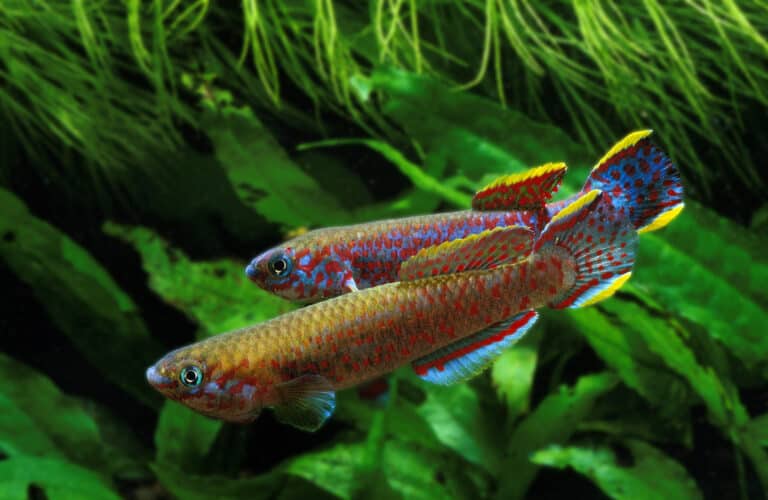
These fish have orange and light brown bodies littered with bright red spots. Male lyretails are brighter than females and are distinguished by their lyre-shaped tails and spiked fins. They are native to West Africa and occur in freshwater habitats like ponds or small rivers.

Two-Stripe Lyretail (Aphyosemion bivittatum)

The brightly colored two-stripe lyretail have elongated bodies with two luminescent red lines running down each side. Males have colorful and distinct dorsal and anal fins ranging from orange, blue, and green.

This tiny fish inhabits the rivers of Nigeria and Cameroon. However, it is easy to replicate their habitat in captivity by providing various floating plants and bogwood. The water in the aquarium must be warm, with slight acidity.

Two-stripe lyretails are predators and prey on shrimp and other small creatures in their habitat, but in captivity, their diet consists of the following:

  • Mosquito larvae
  • Bloodworms
  • Flakes

American Flagfish (Jordanella floridae)

The American flagfish is breathtakingly beautiful and admired by fish enthusiasts around the world for its vivid colors and adaptability.

They were actually named after the American flag because of their red and blue markings! In addition, both genders have a characteristic black dot on their side.

These stunning fish are native to the Central American states and Florida, where they occur in ponds, slow-running streams, and swamps. In captivity, they thrive in larger tanks with plenty of hardy plants and several hiding spots.

Blue Lyretail

The blue lyretail is a breathtaking fish, with its light blue body scattered with vivid red spots and patches of bright yellow on its fins.

They have a distinct lyre shape, and the maleโ€™s coloring is more prominent than the femaleโ€™s. In addition, these fish have large mouths and will eat anything that can fit into it.

Blue lyretails occur in lakes and swamps in African countries like Nigeria and Cameroon. They thrive in warm, soft waters but are highly adaptable and acclimate well into freshwater tanks. However, these males can show signs of aggression and will fight if there are too many blue lyretail males in the tank. The best ratio is 1 or 2 males to 4 or 5 females.

These tiny fish are omnivores, and their diet contains a lot of variety. In captivity, owners will feed them pellets, flakes, algae, and live foods.

Killifish Appearance
๐Ÿ‘ Killifish

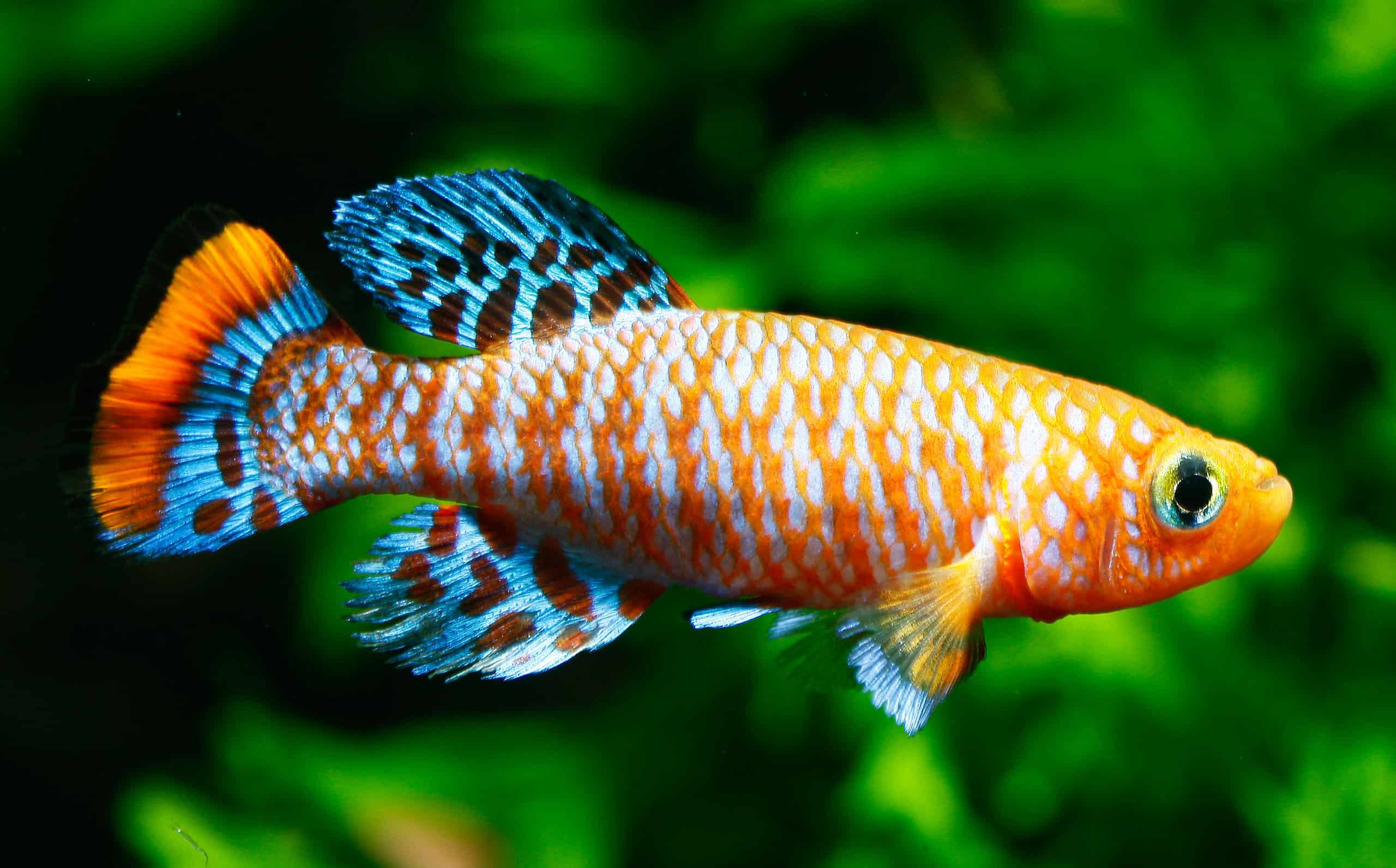
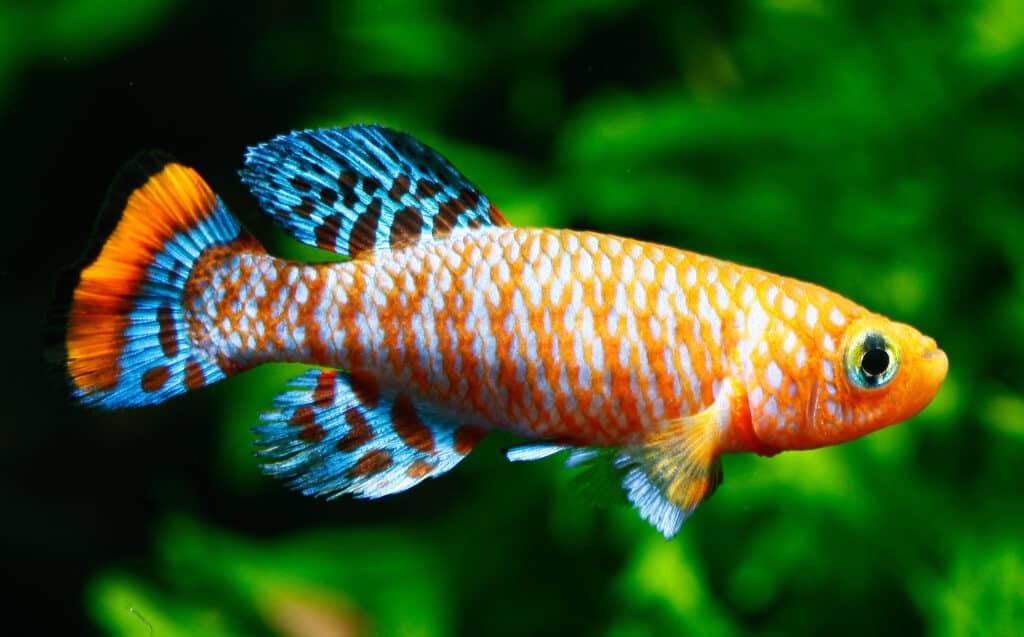
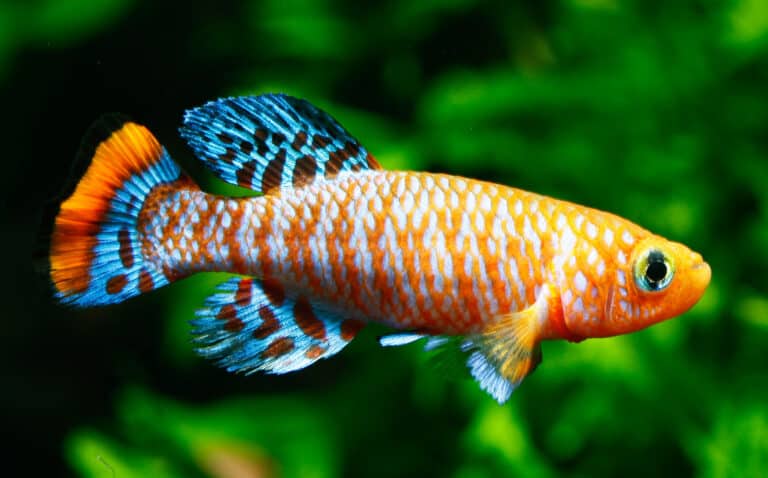
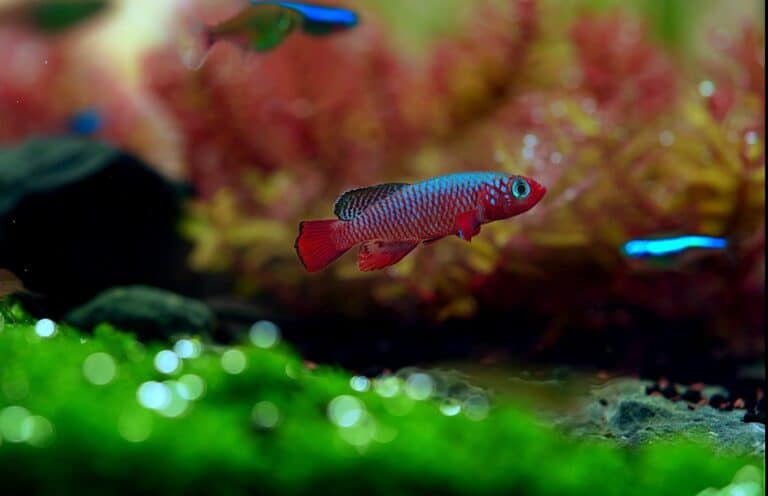
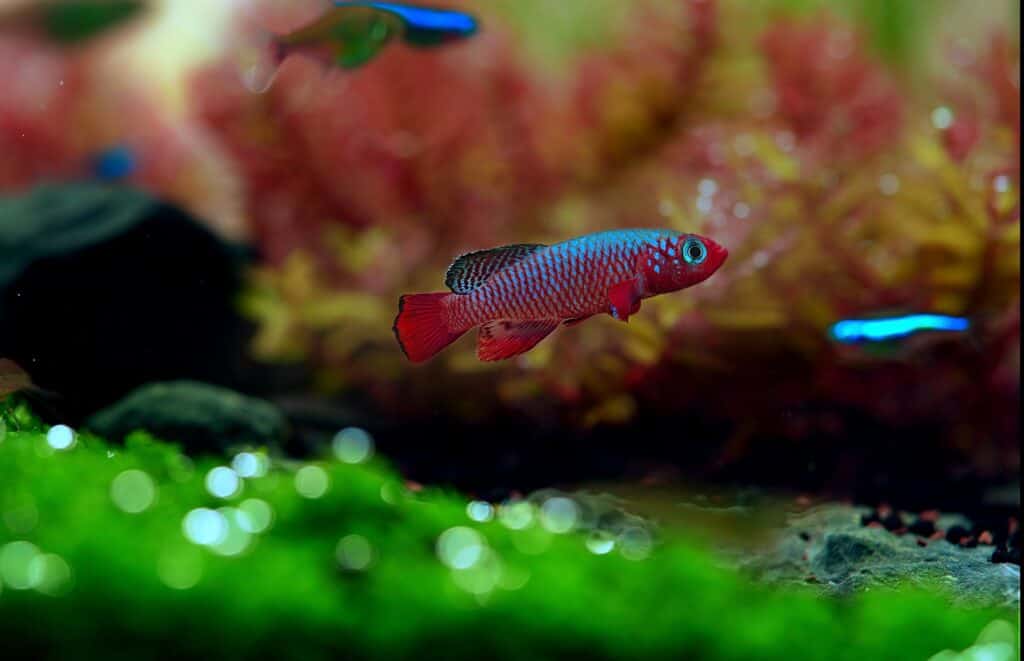
Because there are so many species of killifish, they vary significantly in appearance. However, all these species have one thing in common: their bright coloring and eye-catching patterns.

ยฉSelosh/Shutterstock.com

Because there are so many species of killifish, they vary significantly in appearance. However, all these species have one thing in common: their bright coloring and eye-catching patterns.

In addition, males are much more striking than females, who are usually brown and dull. Furthermore, the top of their heads are flat, and their mouths are filled with long, pointed, and curved teeth located at the tip of their faces or below.

Most of the killifish family members are slender and pike-shaped, making them great swimmers. Others have cylinder-shaped bodies with short, round fins. However, some species have long, wide fins.

While their body shape varies significantly, they all have a dorsal fin located towards the back of their bodies. In addition, it is common for the males of this family to have more prominent dorsal and anal fins.

Killifish are generally 2 to 3.5 inches long, but there are smaller species, like the Dwarf Madeka and the Hummingbird lampeye, who are less than an inch long. In addition, some species get pretty big, like the Orestias, which can reach lengths of 10.5 inches.

Killifish Behavior

Most killifish species are territorial, while some species will shoal. However, certain populations can be dense, and they can shift territories relatively quickly, especially when inhabiting shallow waters.

Furthermore, several species exist as passive tribes in quaint streams, dominated by alpha males fiercely defending their territory while still allowing females and juvenile males to pass through.

In Captivity

Killifish are highly sought after for their peaceful nature and ability to adapt to most aquarium communities. However, as mentioned above, male killifish can be pretty aggressive towards other males. So, itโ€™s best for novice owners to keep two killifish in a species-only tank until they become more knowledgeable.

However, more experienced owners can keep a group of killies in a bigger tank as long as there are enough places for them to hide. Alternatively, aquarists can keep one male with several females but should avoid getting any similar-looking male species. In addition, female killifish do well in a group without any males present.

These fish adjust well to communities of small, peaceful fish that require the same water conditions, like rummy nose tetras and neon tetras.

One thing all owners should know about this vivacious species is they are excellent jumpers, and their tanks should always have secure lids or hoods. But keep in mind that most killies are tiny and can jump through small openings.

Killifish Habitat

These luminous fish inhabit tropical and sub-tropical waters all over the world except for Australia and Antarctica. Killifish primarily live in swamps, creeks, pools, and shallow streams. However, some species occur in brackish estuaries.

Other species prefer colder temperatures and live in water bodies surrounded by overhanging trees and shrubs, which help cool the water and create subdued light. However, certain species flourish in desert pools with water exceeding temperatures of 90ยฐ F, like the pupfish that occur in the southwestern regions of the USA.

Aquarium Habitat

Smaller killifish are perfect for desktop or nano aquariums because of their tiny size. A 5 to 10-gallon tank is recommended for 3 killifish. However, if owners want a community-type setup, they need a 20-gallon tank at a minimum, especially if they want more than one male.

These fish need subdued lighting, and non-breeding aquariums should house peat moss or driftwood, which softens the water, and lowers the pH levels. In addition, the tank needs light-tolerant plants like Java fern, Java moss, and Cryptocoryne. Lastly, these sneaky fish are incredible jumpers, so a secure lid is essential.

Killifish Diet

These tiny fish are primarily carnivores, and their diets vary depending on their location and environment. However, they generally eat insect larvae, crustaceans, and worms. Other species of killifish are omnivores, and their diet consists of algae.

Diet in Captivity

When in captivity, killifish need live food to survive. They cannot live on flakes alone, so if owners cannot keep live prey in their homes, this is not the fish for them.

When aquarists obtain killifish for breeding purposes, they need to ensure these fish have a varied and well-balanced diet. Therefore, expert breeders will typically make their own food to guarantee they meet the exact nutritional requirements.

The best diet for killies includes:

  • Brine shrimp is always a winner with killifish and a good source of nutrition, and owners can purchase frozen brine shrimp
  • Daphnia is often used as live food, and owners can obtain it from ponds; however, too much can act as a laxative, so feed daphnia in moderation
  • Mosquito larvae can also be collected from ponds but are only available seasonally
  • Fruit flies
  • Paste foods
  • Dry foods
  • Beefheart

Killifish benefit from a variety of the foods listed above; feeding too much of the same food is never a good idea.

If you want to breed with these fish, itโ€™s also essential to know what the fry eat, as it differs from the adultsโ€™ diet. The best food to feed fry are:

  • Newly-hatched brine shrimp
  • Vinegar eels
  • Microworms
  • Infusoria
  • Grindal worms

Killifish Predators and Threats

The killifish falls prey to aerial birds like terns and gulls, wading birds like egrets and herons, and predatory fishes like bluefish and striped bass. In addition, fishermen use these distinctive fish as bait.

Unfortunately, wild killifish populations are declining due to human interaction, climate change, and habitat loss. For example, industrial developments like forestry activities and road building can negatively affect their numbers. Sadly, out of 1270 species of killifish, only 236 species arenโ€™t exploited for commercial purposes.

Killifish Reproduction, Babies, and Lifespan

Killifish fall into 3 classes, namely, annuals, semi-annuals, and non-annuals. Annuals lay their eggs in mud and live in swamps and ponds. In addition, they are fast growers and breed before the water dries. However, they donโ€™t have a very long lifespan and only live for 6 to 9 months.

Semi-annuals inhabit both wet and dry environments. Species in this classification leave their eggs to hatch on their own. They live longer than the annuals, usually around 2 to 3 years in cooler conditions. If they live in warmer climates, they only live for approximately 12 months.

Non-annuals live the longest, up to 5 years, depending on the specie, and inhabit permanent water bodies.

Killifish Population

As there are many species of killifish, itโ€™s impossible to know their exact population size. In addition, their conservation status varies depending on the species. Some types of killifish have abundant numbers, but others are endangered or even extinct.


View all 103 animals that start with K

Sources

  1. Aqueon / Accessed November 14, 2022
  2. Fish Keeping World / Accessed November 14, 2022
  3. Wikipedia / Accessed November 14, 2022

About the Author

Chanel Coetzee

Chanel Coetzee is a writer at A-Z Animals, primarily focusing on big cats, dogs, and travel. Chanel has been writing and researching about animals for over 10 years. She has also worked closely with big cats like lions, cheetahs, leopards, and tigers at a rescue and rehabilitation center in South Africa since 2009. As a resident of Cape Town, South Africa, Chanel enjoys beach walks with her Stafford bull terrier and traveling off the beaten path.
Connect:

Thank you for reading! Have some feedback for us?

Contact the AZ Animals editorial team

Related Articles You May Find Interesting

A Tiny โ€œWalkingโ€ Fish Is a Big Breakthrough for Aquarium Science


Killifish FAQs (Frequently Asked Questions)

The red-striped killifish is the perfect species for novice fish owners because they have peaceful temperaments and stunning neon colors.

They are fairly vicious predators of dwarf shrimp and even small fish such as micro rasboras and very small danios or tetras.

Killifish are highly sought after for their peaceful nature and ability to adapt to most aquarium communities. However, as mentioned above, male killifish can be pretty aggressive towards other males. So, itโ€™s best for novice owners to keep two killifish in a species-only tank until they become more knowledgeable.