
K
Species Profile

Koala

Phascolarctos cinereus

Eucalyptus expert, tree-top marsupial
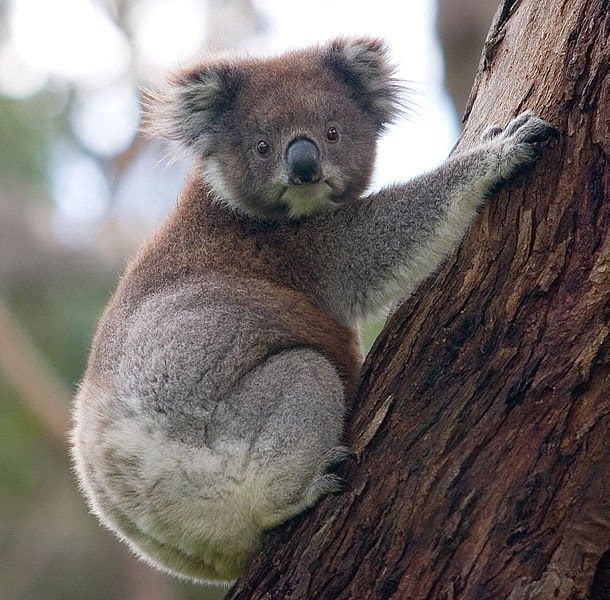
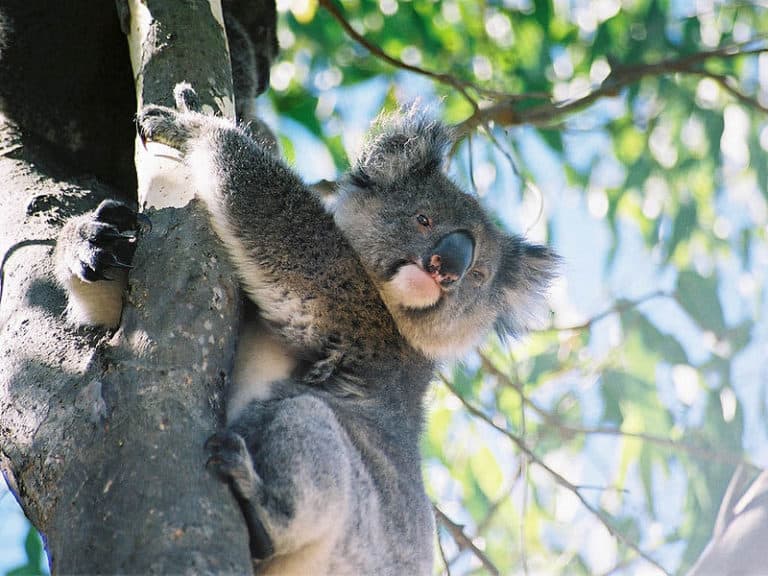
Diliff, CC BY-SA 3.0, via Wikimedia Commons

Koala Distribution

Click a location to explore more animals from that region

Endemic Species

This map shows coastal regions where Koala are found.

Loading map...

Found in 1 country

At a Glance

Wild Species
Diet Folivore
Activity Nocturnal+
Lifespan 12 years
Weight 15 lbs
Status Vulnerable
Did You Know?

Not a bear: the koala is a marsupial (Order Diprotodontia), carrying its young in a pouch.

Scientific Classification

The koala is an arboreal, leaf-eating Australian marsupial specialized for a eucalyptus-based diet, with a low metabolic rate, strong climbing adaptations, and a pouch for rearing young (joeys).

Kingdom
Animalia
Phylum
Chordata
Class
Mammalia
Order
Diprotodontia
Family
Phascolarctidae
Genus
Phascolarctos
Species
cinereus

Distinguishing Features

  • Arboreal marsupial with a pouch; mostly sedentary lifestyle
  • Specialized dentition and gut fermentation for eucalyptus leaves
  • Large, rounded ears; stout, tailless body; prominent leathery nose
  • Strong forelimbs with sharp claws; opposable digits for climbing

Physical Measurements

Males and females differ in size

Length
2 ft 6 in (1 ft 12 in – 2 ft 9 in)
Weight
22 lbs (13 lbs – 31 lbs)
14 lbs (9 lbs – 19 lbs)
Tail Length
Up to 0 in
Top Speed
9 mph
running

Appearance

Primary Colors
Secondary Colors
Skin Type Dense, woolly fur over tough skin; fur thickens in cooler southern habitats.
Distinctive Features
  • Australian arboreal marsupial (not a placental bear); robust body with no tail visible.
  • Adult head-body length typically 60-85 cm; shoulder height about 30 cm in sitting posture (field guides/ADW ranges).
  • Adult mass: males commonly ~6.5-14 kg; females ~5-11 kg, varying strongly by region and habitat productivity.
  • Broad, hairless, black nose with enlarged olfactory surface supporting eucalyptus leaf selection.
  • Large rounded ears with prominent pale fringes; excellent hearing for arboreal social calls.
  • Forelimbs longer than hindlimbs; strong shoulder/pectoral musculature for vertical climbing.
  • Hands with two opposable digits on forepaws; sharp, curved claws for gripping eucalyptus bark.
  • Hind feet with opposable hallux; fused second and third toes used for grooming (syndactyly).
  • Very low-energy physiology: commonly sleeps/rests ~18-20 hours per day, conserving energy on leaf diet.
  • Dietary ecology: specialist folivore feeding primarily on eucalyptus (Eucalyptus spp.) leaves; large hindgut for detoxification and fermentation.
  • Females have a rear-opening pouch for rearing a single joey; young later ride on the back.
  • Common visible health impacts in wild populations can include conjunctivitis from Chlamydia infections.
  • Key threats affecting body condition and survival: habitat loss/fragmentation, bushfire, heat stress, and disease.

Sexual Dimorphism

Males are larger on average and often show a bare, scent-gland patch mid-chest used in marking. Females are smaller and have the rear-opening pouch; overall coat color varies more by region than sex.

  • Larger body mass and broader head; more robust shoulders/neck.
  • Visible mid-chest scent gland area, often stained brown/yellowish from secretions.
  • More frequent facial scarring from male-male interactions can be evident in adults.
  • Smaller average mass and head width; more slender build.
  • Rear-opening pouch (marsupium) on abdomen for carrying and nursing the joey.
  • Teats inside pouch; pouch area may appear slightly hairless or worn in breeders.

Did You Know?

Not a bear: the koala is a marsupial (Order Diprotodontia), carrying its young in a pouch.

Adults are typically 60-85 cm long; weight varies by region-about 5-11 kg (females) and 6.5-14 kg (males).

Koalas can rest/sleep about 18-22 hours per day, conserving energy for a low-nutrient, toxin-rich leaf diet.

A joey is born after ~33-35 days' gestation and stays in the pouch for ~6-7 months; it's usually weaned around ~12 months.

Joeys start eating a special maternal fecal product ("pap") to seed gut microbes needed to digest eucalyptus.

Male koalas have a chest (sternal) scent gland and make deep bellows that can carry through forests, especially in breeding season.

Koala fingerprints are highly ridged and can closely resemble human fingerprints under magnification.

Unique Adaptations

  • Arboreal grip: powerful forelimbs; sharp curved claws; and a "two-thumb" hand (two opposable digits) for grasping branches.
  • Syndactylous hind foot: fused second and third toes form a grooming "comb," while the big toe is opposable for climbing.
  • Backward-opening pouch: helps keep debris out while climbing and supports the joey's secure attachment to teats.
  • Eucalyptus digestion system: hindgut fermentation with an enlarged cecum (about ~2 m long in adults reported in anatomical studies) to process fibrous leaves.
  • Detox capacity: liver enzyme systems (notably cytochrome P450 pathways) help handle eucalyptus oils and other plant secondary compounds.
  • Low-energy physiology: comparatively low metabolic rate for a mammal of its size, supporting an energy-limited leaf diet.
  • Dense, insulating fur and a compact body plan help with variable coastal-to-inland temperatures across the range.

Interesting Behaviors

  • Eucalyptus selectivity: individuals often feed from a limited set of preferred eucalypt species and even particular trees within a home area.
  • Nocturnal/crepuscular activity pattern: most feeding and movement occur at night; daytime is dominated by resting.
  • Vocal communication: males produce loud bellows during the breeding season; females and juveniles use softer vocalizations.
  • Scent-marking: males rub the sternal gland on trunks and branches; urine and fecal scent also contribute to chemical communication.
  • Thermoregulatory postures: during heat, koalas reposition to cooler parts of trees (e.g., thicker trunks) and adopt spreading postures to shed heat.
  • Mother-joey behavior: prolonged dependence (up to ~12 months), with back-carrying after pouch life ends.
  • Mostly solitary spacing: adults usually live alone, with overlapping home ranges and social contact concentrated around mating.

Cultural Significance

Koala (Phascolarctos cinereus) is a well-known symbol of Australia, shown in kids' books, stamps, and mascots. Many Aboriginal and Torres Strait Islander groups include koalas in totems and Country stories about eucalypt forests. Threats—land clearing, bushfire, heat, vehicle strikes, dogs, and disease—drive protection and rescue.

Myths & Legends

Aboriginal Dreaming stories in multiple regions tell how the koala came to have no tail-often as a moral lesson about selfishness or trickery, explaining the koala's short, barely visible tail today.

In some traditional stories, the koala (Phascolarctos cinereus) is a skilled tree-climber who gives bark or wood for tools or crossing water, linking it to forest knowledge and survival in eucalyptus country.

A recurring theme in regional Aboriginal storytelling contrasts the koala's calm, steady nature with more boastful animals, using koala characters to teach restraint, patience, or respect for shared resources.

Early colonial Australian folklore and later popular culture often showed the koala (Phascolarctos cinereus) as a gentle, sleepy bush companion; this image appeared in 20th-century children's stories and became a symbol of the Australian bush.

Conservation Status

VU Vulnerable (IUCN Red List)

Facing a high risk of extinction in the wild.

Population Decreasing

Protected Under

  • Australia: Environment Protection and Biodiversity Conservation Act 1999 (listed as Endangered for combined populations in Queensland, New South Wales and the Australian Capital Territory; listing made in 2022)
  • CITES: Appendix II (international trade regulated)
  • Australia: State/Territory wildlife protection laws (e.g., Queensland Nature Conservation Act 1992; New South Wales Biodiversity Conservation Act 2016; Victoria Wildlife Act 1975)

Life Cycle

Birth 1 joey
Lifespan 12 years

Lifespan

In the Wild 6–18 years
In Captivity 10–20 years

Reproduction

Mating System Polygyny
Social Structure Solitary
Breeding Pattern Transient
Fertilization Internal Fertilization
Birth Type Internal_fertilization

Koalas are largely solitary; in the Aug-Feb breeding season, males bellow, compete, and typically mate with multiple females whose home ranges overlap theirs. Mating is brief; gestation is ~33-35 days and usually one joey is reared solely by the mother.

Behavior & Ecology

Social No fixed group name Group: 1
Activity Nocturnal, Crepuscular, Cathemeral
Diet Folivore Eucalyptus leaves (preferred tree species vary by population and local availability; koalas typically focus on a small subset of eucalypt species within their home range).

Temperament

HUBS: Low-energy arboreal folivore; most time resting; activity peaks at night, varies with temperature and disturbance.
Generally sedentary and avoidant; adults maintain spacing via vocal/scent signals rather than group cohesion.
Adult males can be territorial/dominant and show aggression during breeding season encounters (biting/scratching).
Females are typically more tolerant of neighbors; strongest affiliative behavior is mother-joey contact.
Resting time commonly reported ~18-20 hours per day in field observations (Martin & Handasyde, 1999).
Longevity: commonly ~10-12 years in the wild; up to ~15-18 years in captivity (species husbandry summaries; varies by disease and habitat).

Communication

Male bellow Low-frequency, far-carrying); conveys body size information (Charlton et al., 2012, Biology Letters
Male and female grunts/growls during close encounters; escalates with agitation or mating interactions.
Harsh snarls, screams, and squawks during aggressive encounters or forced copulation attempts.
Mother-joey soft squeaks/whimpers; juvenile distress calls when separated.
Scent marking using sternal (chest) gland secretions-especially adult males-applied to tree trunks.
Urine and fecal scent cues at tree bases and along travel routes; supports spacing and recognition.
Tree scratching/claw marks on trunks may provide visual/olfactory cues when combined with scent.
Tactile communication between mother and joey Clinging, grooming, pouch/backs transport

Habitat

Biomes:
Temperate Forest Mediterranean Temperate Rainforest Wetland
Terrain:
Coastal Hilly Plains Valley Riverine
Elevation: Up to 5249 ft 4 in

Ecological Role

Specialized arboreal primary consumer (folivore) in Australian eucalypt woodlands and forests.

Influences eucalypt canopy dynamics through selective browsing (tree-level and species-level feeding pressure) Contributes to nutrient cycling via feces and urine inputs beneath roost/feeding trees Supports food webs as prey for large predators/scavengers (indirect role; not a dietary behavior) Acts as a habitat-quality indicator for eucalypt communities because feeding is tightly linked to leaf chemistry and tree condition

Diet Details

Other Foods:
Eucalyptus Corymbia foliage Angophora foliage Non-eucalypt browse

Human Interaction

Domestication Status

Wild

Koala (Phascolarctos cinereus) is not domesticated and is protected. It was hunted for fur in the late 1800s–early 1900s. Koalas eat mainly Eucalyptus, have low metabolism, and stress easily, so they are hard to keep. Human impacts: road and dog injuries, habitat loss, bushfires, disease (Chlamydia pecorum), rescue, zoos, and tourism.

Danger Level

Low
  • Bites and deep scratches from strong forelimb claws and jaws when handled or stressed (most common human injury pathway occurs during rescue/rehabilitation or unauthorized handling).
  • Secondary infection risk from bite/scratch wounds (general mammal-bite infection risk; requires standard wound hygiene and medical assessment).
  • Occupational hazard for carers: zoonotic risk is considered low overall; primary risks in practice are physical injury and stress-related handling incidents rather than well-documented zoonoses.

As a Pet

Not Suitable as Pet

Legality: Koala (Phascolarctos cinereus) are protected; private ownership is usually illegal. Only licensed zoos, sanctuaries, rehab centers, or research institutions may keep them under strict state, national, and quarantine rules.

Care Level: Expert Only

Purchase Cost:
Lifetime Cost: $300,000 - $1,500,000

Economic Value

Uses:
Ecotourism and wildlife tourism Zoo/sanctuary visitation and education programs Conservation fundraising and donations Research and veterinary service activity Cultural symbol/branding value
Products:
  • zoo/sanctuary admission and guided encounters (where permitted)
  • merchandise (plush toys, apparel, souvenirs)
  • conservation charity campaigns and sponsorship/adoption programs
  • media/licensing value tied to the koala as a national icon

Relationships

Predators 6

Dingo Canis lupus dingo
Red fox Vulpes vulpes
Dog Canis lupus familiaris
Powerful owl Ninox strenua
Wedge-tailed eagle Aquila audax
Carpet python Morelia spilota

Related Species 3

Little koala Litokoala konibbo Shared Family
Riversleigh koala Nimiokoala greystanesi Shared Family
Marilyn's koala Madakoala devisi Shared Family

Ecological Equivalents 6

Animals that fill a similar ecological role in their ecosystem

Common wombat Vombatus ursinus Fellow diprotodont marsupial and hindgut fermenter (with an enlarged caecum and colon) adapted to low-quality plant diets. Contrasts with the koala's arboreal eucalyptus specialization by filling a terrestrial grazing niche in overlapping Australian habitats.
Southern hairy-nosed wombat Lasiorhinus latifrons Shares diprotodont herbivore physiology (hindgut fermentation) and energy-conserving behavior; occupies arid to semi-arid shrubland and grassland systems where koalas may occur in adjacent woodland, making it a functional analogue for low-energy herbivory.
Common brushtail possum Trichosurus vulpecula Arboreal, mostly nocturnal marsupial of eucalypt forests and woodlands. Overlaps with koalas in tree use and folivory, although it is far more dietary-generalist than koalas. Both commonly use similar canopy strata and shelter sites, creating niche overlap in browsing pressure and habitat use.
Sugar glider Petaurus breviceps Nocturnal, arboreal marsupial that commonly shares eucalypt woodland and forest habitats and uses tree hollows; overlaps spatially in canopy and hollow resources, though diets differ — sugar gliders rely heavily on sap, nectar, and invertebrates, whereas koalas feed primarily on eucalyptus leaves.
Greater glider Petauroides volans Eucalypt-canopy specialist and strongly folivorous marsupial. Like koalas, it spends long periods inactive and depends on leaf chemistry and quality. One of the closest ecological analogues among living Australian arboreal mammals, sharing folivory and dependence on tree hollows.
Common ringtail possum Pseudocheirus peregrinus Arboreal, nocturnal folivore in eucalypt forests that can overlap with koalas. Both process fibrous leaves and are sensitive to leaf quality and habitat fragmentation, creating parallel ecological constraints.

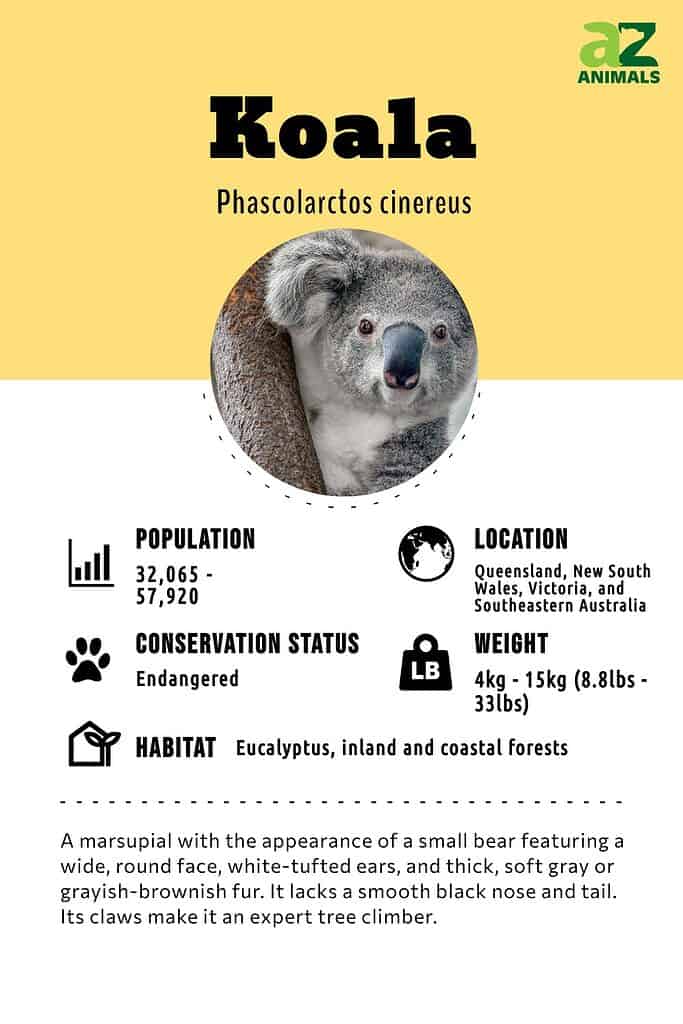
The koala is one of the most loved mammals in the world with its adorable round face, unique nose, and gentle demeanor. The name “koala” actually comes from the language of the Aborigines, and believed to mean “no drink.” Ironically, koalas don’t need to consume much water like most animals because the eucalyptus leaves they eat hydrate them naturally. These are just a few of multiple interesting characteristics of the koala.
Classification

The Koala is a small to medium-sized mammal that is found inhabiting a variety of different types of forest in south-eastern Australia. Despite its appearance and the fact that it is also known as the Koala Bear, Koalas are in fact marsupials but are so distinctive amongst this specially adapted family of mammals that they are classified in a scientific group of their own.

Although they are now considered to be one of Australia’s most iconic mammal species, when European settlers first arrived things were very different, with millions of Koalas known to have been killed every year for their pelts (fur). The Koala is a unique animal that famously feeds only on the leaves of the eucalyptus trees which they inhabit. However, this diet is very hard to digest and lacks many of the vital nutrients that are key to the survival of most animal species. Today, the Koala is affected by habitat loss as vast areas of land are cleared every year to support growing development.

Evolution

Scientists claim that koalas evolved over a span of 25 million years in forests on the Australian continent which was thicker and wetter than today’s. Their chewing apparatus evolved as the forests became drier and full of leaves and plants that were tougher to chew. It’s thought that the bite force of the Koala adapted to this challenge, allowing the koala to shred tough eucalyptus leaves.

Types of Koalas

There are three distinct types of koalas based on the region of Australia they inhabit and the color of their fur:

  • Brown Koalas – Native to the Victorian Region of Australia. Other names: Victorian koala and Southern koala.  Brown koalas have the thickest coats of the species to keep them warm in a cooler climate. They’re also the largest type of koala. There are up to 28,000 Brown koalas in Victoria and 19,000 in Southern Australia.
  • Gray Koalas – Native to Queensland, Australia, the Gray koalas have thin gray fur and are the smallest type. Other names: Northern koala and Queensland koala. This type is the most threatened.
  • Gray-Brown Koalas – Native to New South Wales, Australia. These koalas have gray-brown fur and face extinction with only 16,000 left in the wild. Other names: koalas of New South Wales, Grayish-Brown koalas.

Anatomy and Appearance

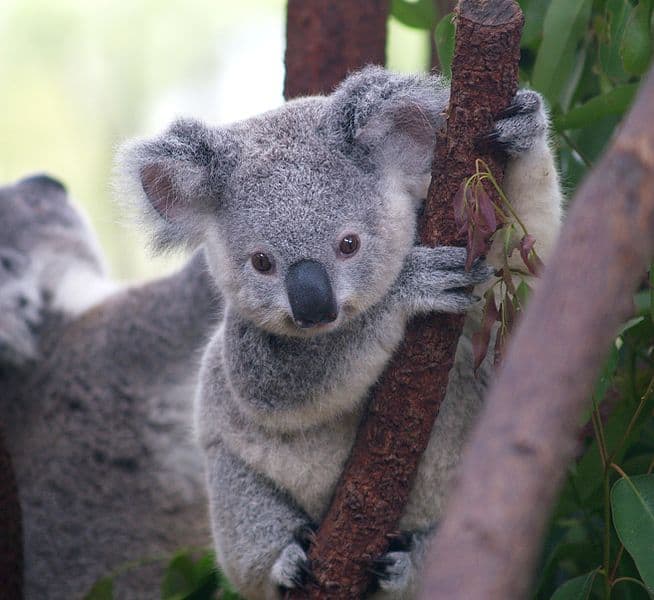
The Koala is one of the most charismatic of all marsupials with its large, wide face and round, white-tufted ears giving it the appearance of a small bear, along with its lack of a visible tail and smooth, black nose. The Koala has dense and soft grey or grey-brown fur which is lighter on its underside and mottled on the rear. Because Koalas spend almost all of their lives in the trees, they have evolved several adaptations to help them with their arboreal lifestyle including having short, powerful limbs tipped with sharp claws.

Having two opposable thumbs and three fingers on each hand means that Koalas can grip even the smoothest of bark when climbing and feeding in the trees. Koalas also have human-like fingerprints! Learn more amazing animal fun facts here.

Koalas move about in the trees by jumping, first gripping the trunk with their front paws (helped by their rough paw pads and claws) before then moving both their back legs up the tree together, allowing them to get higher up.

👁 Image

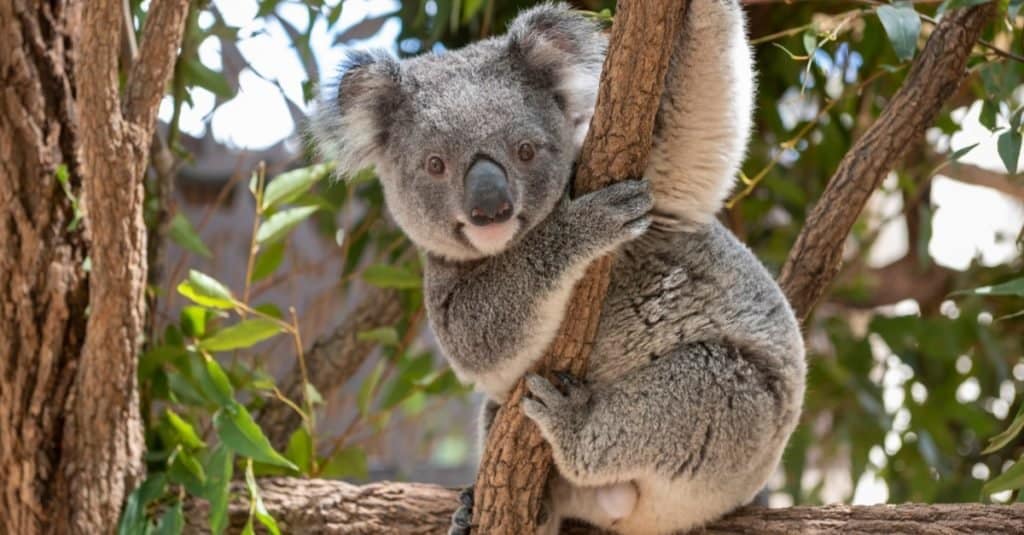
Koalas are able to grip onto smooth bark when climbing and feeding in the trees due to two opposable thumbs and three fingers on each hand.

©Diliff, CC BY-SA 3.0, via Wikimedia Commons – Original / License

Distribution and Habitat

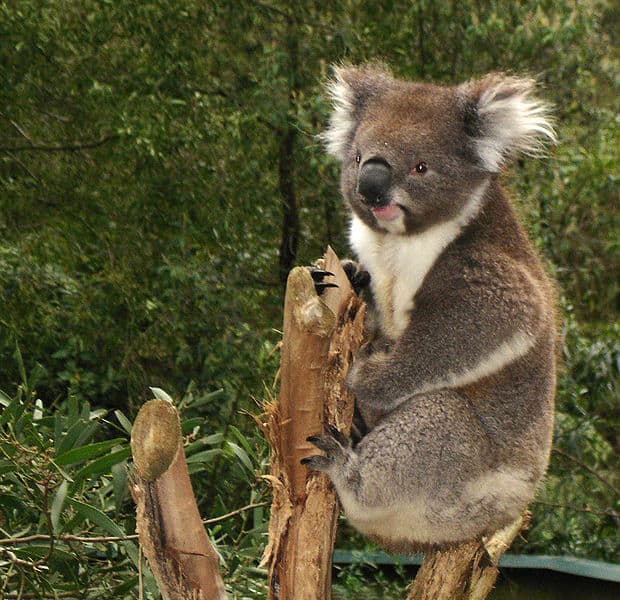
The Koala would have once been widespread throughout south-eastern Australia and on a number of its surrounding islands but populations (particularly in the south) were wiped out in some areas due to hunting. They are, however, surprisingly resilient and adaptable animals that are known to inhabit various types of forest from the tall eucalyptus forests to coastal regions and even low-lying woodlands further inland. Even though they are common in much of their natural range today, land clearance has not only meant a loss of their habitats but also separates populations from one another making them more and more isolated. It is not just the loss of habitat to Human activity though that has led to population declines in certain areas, as quick-spreading forest fires can devastate vast areas of land in minutes and severely affect the local Koala populations in the process.

👁 Image

Koalas inhabit various types of forests from coastal regions to low-lying woodlands further inland.

©Brian Dell Bdell555, Public domain, via Wikimedia Commons – Original / License

Behavior and Lifestyle

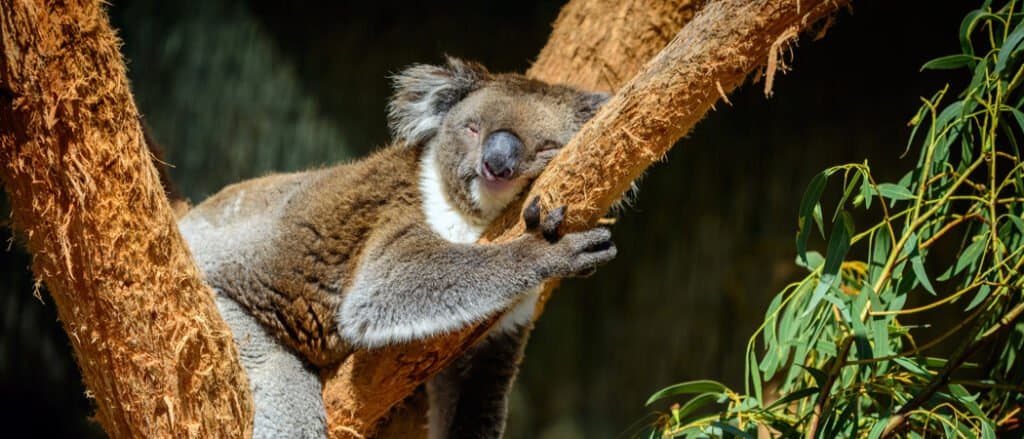
The Koala is a solitary and nocturnal animal that spends most of the daytime hours sleeping in the fork of a eucalyptus tree. Their low-energy diet (that is comprised only of the fibrous leaves of the eucalyptus) leads to Koalas leading a largely inactive lifestyle as they can happily spend up to 18 hours a day sleeping or simply just sit in the trees to conserve energy. Everything from sleeping to eating and even breeding is done in the trees as although Koalas are known to come down to the ground quite frequently, it is only so they can move to another tree. Koalas are also sedentary animals which means that they occupy a fixed home range that can vary in size depending on the abundance of food available (home ranges are smaller in areas with more food as there is no need to travel as far). Although the home ranges of males and females do overlap, males will not tolerate rival males intruding on their territory and fight viciously by scratching and biting.
👁 Sleeping Koala Bear

Koalas lead a largely inactive lifestyle, spending up to 18 hours a day sleeping or sitting in the trees to conserve energy.

©myphotobank.com.au/Shutterstock.com

Reproduction and Life Cycles

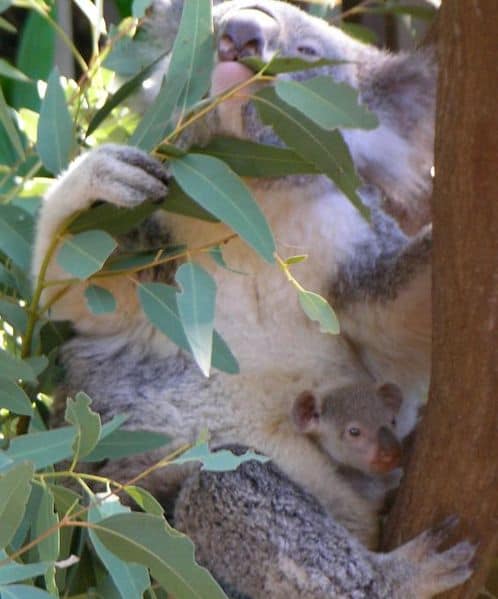
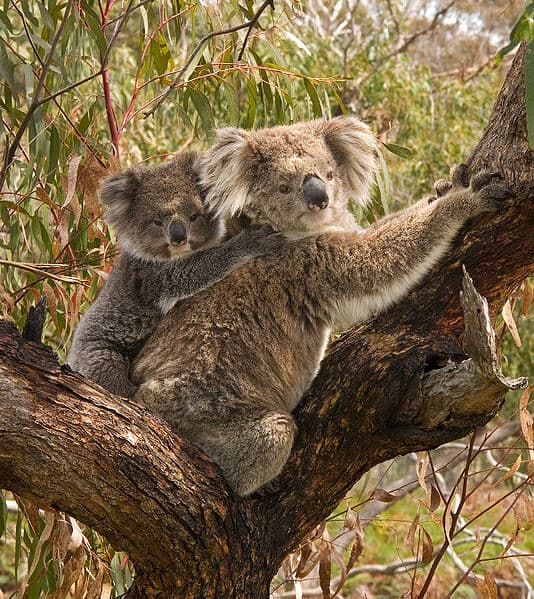
During the breeding season, males can be heard producing loud booming calls through the forest which are to both attract a female mate and also to deter any potential rivals. In Koala society it is the dominant male that gets to mate with the most females meaning that although males (like females) are able to reproduce from the age of two, breeding is not normally successful until the male Koala is between 4 and 5 years old and has established his dominance. After a gestation period that lasts for a mere 35 days, a single joey is born that is about the size of a bee and very underdeveloped, and immediately crawls unaided into the pouch on its mother’s belly. Here it attaches itself to one of the two teats and remains in the safety of the pouch until it is weaned at between 6 and 7 months old after having grown dramatically. The young Koala then clings onto its mother’s back where it tends to remain for another few months or until the next season’s young has developed and is ready to leave the pouch.
👁 Image

At 6-7 months old, the baby koala clings onto its mother’s back where it will remain for another few months

©Benjamint444, CC BY-SA 3.0, via Wikimedia Commons – Original / License

Diet and Prey

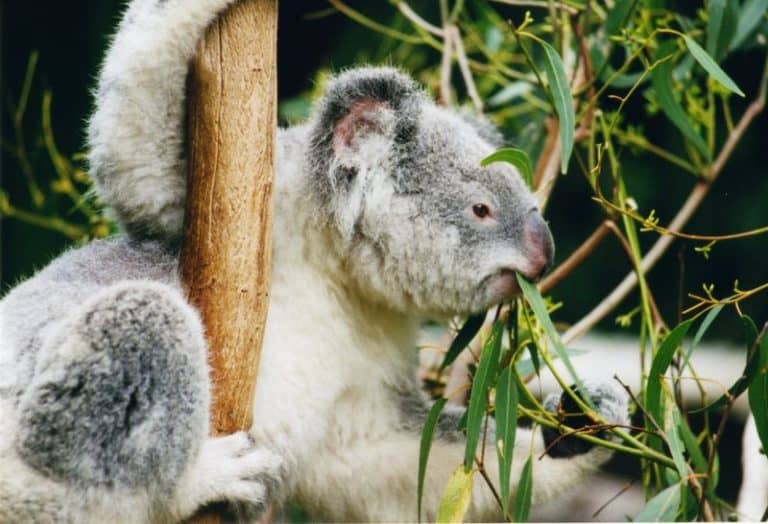
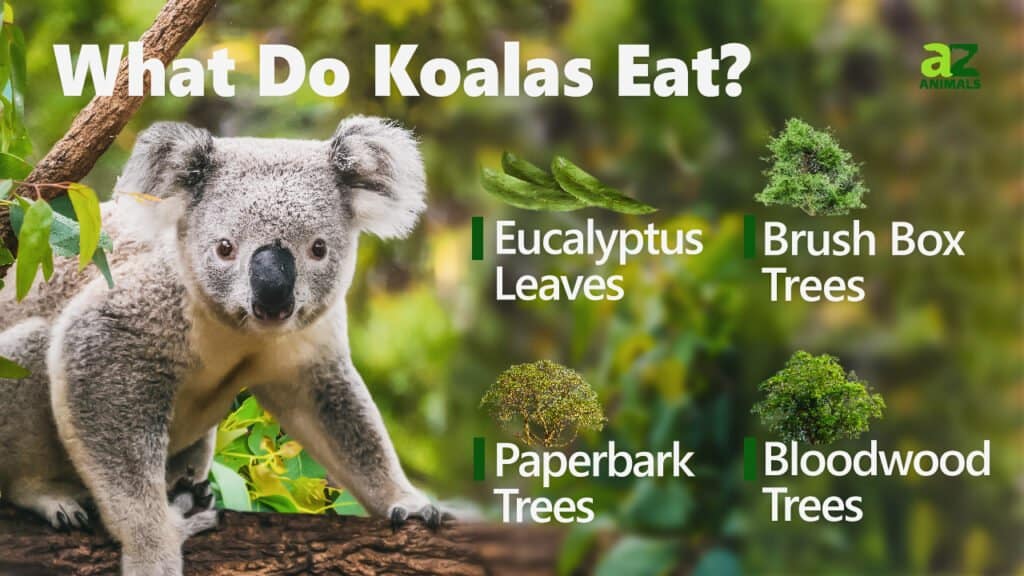
The Koala is a herbivorous animal that only feeds on the leaves of the eucalyptus (gum) tree in order to survive. Despite there being around 600 different species of eucalyptus, Koalas only seem to feed on 30 of them which depends on the surrounding habitat. Eucalyptus leaves are tough and fibrous and often toxic making them inedible to other herbivorous animals but the Koala has evolved to fill this gap in the ecosystem and has large cheek pouches where the leaves are stored. Once full, the Koala then begins to grind the leaves down into a pulp using their flat cheek teeth with some of the toxins then being detoxified by the liver. The Koala also has an incredibly long digestive tract to help it to break down the tough leaves which is more than three times its body length. To help the process Koalas are also known to occasionally eat soil, bark, and gravel to aid the digestion of such a fibrous plant.
👁 What Do Koalas Eat
Koalas live on a diet of eucalyptus leaves, paperbark trees, brush box trees, and bloodwood trees.

Predators and Threats

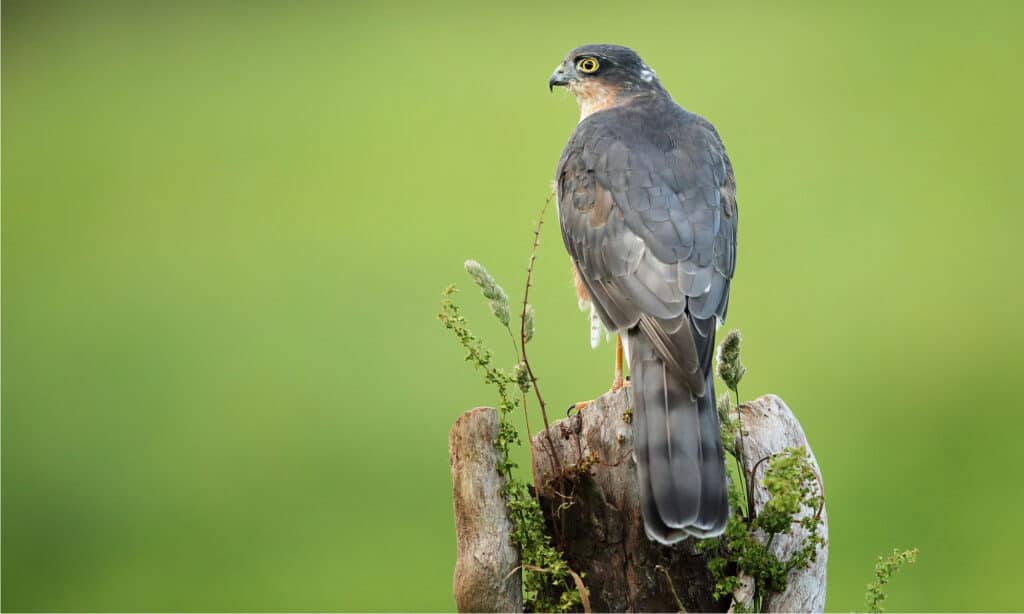
Despite being relatively small, the lack of native mammalian predators in Australia means that adult Koalas have very few natural predators except large birds of prey. Young Koalas are more vulnerable however and are preyed on by several different animals including snakes, but both are most threatened by domestic animals, particularly dogs, that not only attack Koalas but are also known to spread disease into local populations. This is one of the biggest threats to Koalas in certain areas as large numbers of individuals have been affected particularly by the Chlamydia bacterium, which can be treated with antibiotics. Other threats to the current Koala populations include habitat loss to growing Human settlements, tourist developments, and forest fires that can spread rapidly in semiarid regions. The Koala populations on several islands have also been affected by over-population as the increasing number of individuals means that there is less food to go around.
👁 sparrowhawk

Koalas are vulnerable to birds of prey such as hawks.

©Edwin Godinho/Shutterstock.com

Interesting Facts and Features

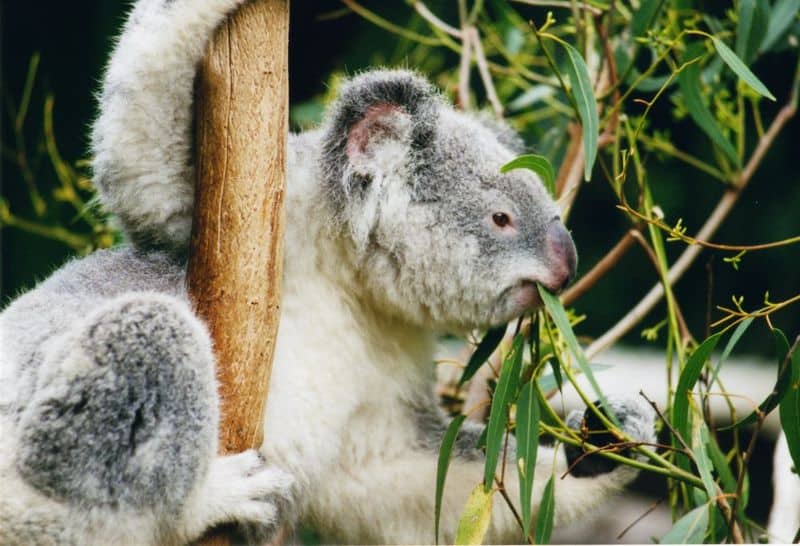
Due to the fact that Koalas sustain themselves on a diet that is only comprised of leaves they have little need to drink as they get almost all of the water that they need through their food. However, living on a diet that is so low in nutrients has led to the Koala evolving a very small brain for its body size as this organ can drain the body’s energy supplies. After having spent their first six months of life developing in their mother’s pouch suckling milk, baby Koalas must then attempt to eat solid foods with the first one being the soft droppings of their mother. Young Koalas are thought to do this as it contains a number of microbes that help the young to both fight off disease and to begin digesting the tough, fibrous leaves of the eucalyptus.
👁 Image

Koalas have little need to drink water because their diet of leaves hydrates them adequately.

©Arnaud Gaillard (arnaud () amarys.com), CC BY-SA 4.0, via Wikimedia Commons – Original / License

Koala Relationship with Humans

The Koala would have once been abundant throughout the forests of south-eastern Australia but intense hunting of them for their soft fur in the early 20th Century led to drastic population declines and even local extinction in some areas. When the industry peaked in 1924 two million pelts were traded and eventually led to public outcry over the situation. Since then, the hunting of Koalas has been banned and management of populations has seen them increase once again. Despite their rising population numbers though, Koalas are affected by Human activity throughout much of their natural range mainly in the form of habitat loss as vast areas of land are cleared annually for development and agriculture. However, the Koala today is one of Australia’s most famous and treasured species of mammal and is found on numerous emblems and in stories not just in Australia but worldwide.
👁 Animal Facts: Koalas

The status of koala bears has recently been changed from vulnerable to endangered.

©whitejellybeans/Shutterstock.com

Conservation Status and Life Today

Today, the Koala is listed by the IUCN as an animal that is Endangered in the wild. In the recent past, population numbers were stable and widespread, in fact too high in some areas with 10,000 individuals having been relocated back to mainland Australia over the past 75 years to prevent island populations from growing out of control. They are, however, becoming more and more remote and isolated from one another due to habitat loss, bushfires, road accidents, and domestic dog attacks. In fact, in December 2020, the bushfires killed an estimated 60,000 koalas. The Australian Koala Foundation now estimates there are less than 57,920 Koalas left in the wild, maybe as few as 32,065.

Some have also been introduced to diseases in certain areas. Where possible though, infected Koalas (and particularly those that have been attacked by domestic dogs) are given veterinary first aid to try and help them in the future and prevent a large outbreak spreading through entire populations.

View all 103 animals that start with K
How to say Koala in ...
Bulgarian
Коала
English
Koala
Catalan
Coala
Czech
Koala medvídkovitý
Danish
Koala
German
Koala
English
Koala
Esperanto
Koalo
Spanish
Phascolarctos cinereus
Finnish
Koala
French
Koala
Galician
Koala
Hebrew
קואלה
Croatian
Koala
Hungarian
Koala
Indonesian
Koala
Italian
Phascolarctos cinereus
Japanese
コアラ
Latin
Phascolarctos cinereus
Dutch
Koala
English
Koala
Polish
Koala
Portuguese
Coala
English
Koala
Slovenian
Koala
English
Koala
Swedish
Koala
Turkish
Koala
Vietnamese
Koala
Chinese
無尾熊

Sources

  1. David Burnie, Dorling Kindersley (2011) Animal, The Definitive Visual Guide To The World's Wildlife / Accessed November 7, 2008
  2. Tom Jackson, Lorenz Books (2007) The World Encyclopedia Of Animals / Accessed November 7, 2008
  3. David Burnie, Kingfisher (2011) The Kingfisher Animal Encyclopedia / Accessed November 7, 2008
  4. Richard Mackay, University of California Press (2009) The Atlas Of Endangered Species / Accessed November 7, 2008
  5. David Burnie, Dorling Kindersley (2008) Illustrated Encyclopedia Of Animals / Accessed November 7, 2008
  6. Dorling Kindersley (2006) Dorling Kindersley Encyclopedia Of Animals / Accessed November 7, 2008
  7. David W. Macdonald, Oxford University Press (2010) The Encyclopedia Of Mammals / Accessed November 7, 2008
  8. About Koalas / Accessed November 7, 2008
  9. Koala Information / Accessed November 7, 2008

About the Author

Abby Parks

Abby Parks has authored a fiction novel, theatrical plays, short stories, poems, and song lyrics. She's recorded two albums of her original songs, and is a multi-instrumentalist. She has managed a website for folk music and written articles on singer-songwriters, folk bands, and other things music-oriented. She's also a radio DJ for a folk music show. As well as having been a pet parent to rabbits, birds, dogs, and cats, Abby loves seeking sightings of animals in the wild and has witnessed some more exotic ones such as Puffins in the Farne Islands, Southern Pudu on the island of Chiloe (Chile), Penguins in the wild, and countless wild animals in the Rocky Mountains (Big Horn Sheep, Mountain Goats, Moose, Elk, Marmots, Beavers).
Connect:

Thank you for reading! Have some feedback for us?

Contact the AZ Animals editorial team

Related Articles You May Find Interesting

The Virginia Regions Where Bear Activity Is Hard to Ignore

👁 Image
Articles

Panamanian Golden Frogs Return To The Wild After Decades


Koala FAQs (Frequently Asked Questions)

Koalas are Herbivores, meaning they eat plants.

Koalas belong to the Kingdom Animalia.

Koalas belong to the phylum Chordata.

Koalas belong to the class Mammalia.

Koalas belong to the family Phascolarctidae.

Koalas belong to the order Diprotodontia.

Koalas belong to the genus Phascolarctos.

Koalas are covered in Fur.

Koalas live in southeastern Australia.

Koalas live in eucalyptus, inland, and coastal forests.

Predators of Koalas include birds of prey, dingos, and humans.

The average litter size for a Koala is 1.

Koalas spend up to 80% of their time sleeping or resting!

The Koala is also called the koala bear.

The biggest differences between a sloth and a koala are range, size, and speed. The koala lives exclusively in Australia, but the sloth lives in many countries in Central America and South America. Koalas are bigger than sloths, too. In fact, they can stand an entire head larger than the average sloth. Also, koalas are much faster than sloths, reaching speeds of 15-20mph over short distances when the need arises.

Koalas aren’t typically dangerous, but may become aggressive if threatened or cornered.