




L
Species Profile

Labradoodle

Canis lupus familiaris

Curly charm, clever heart.
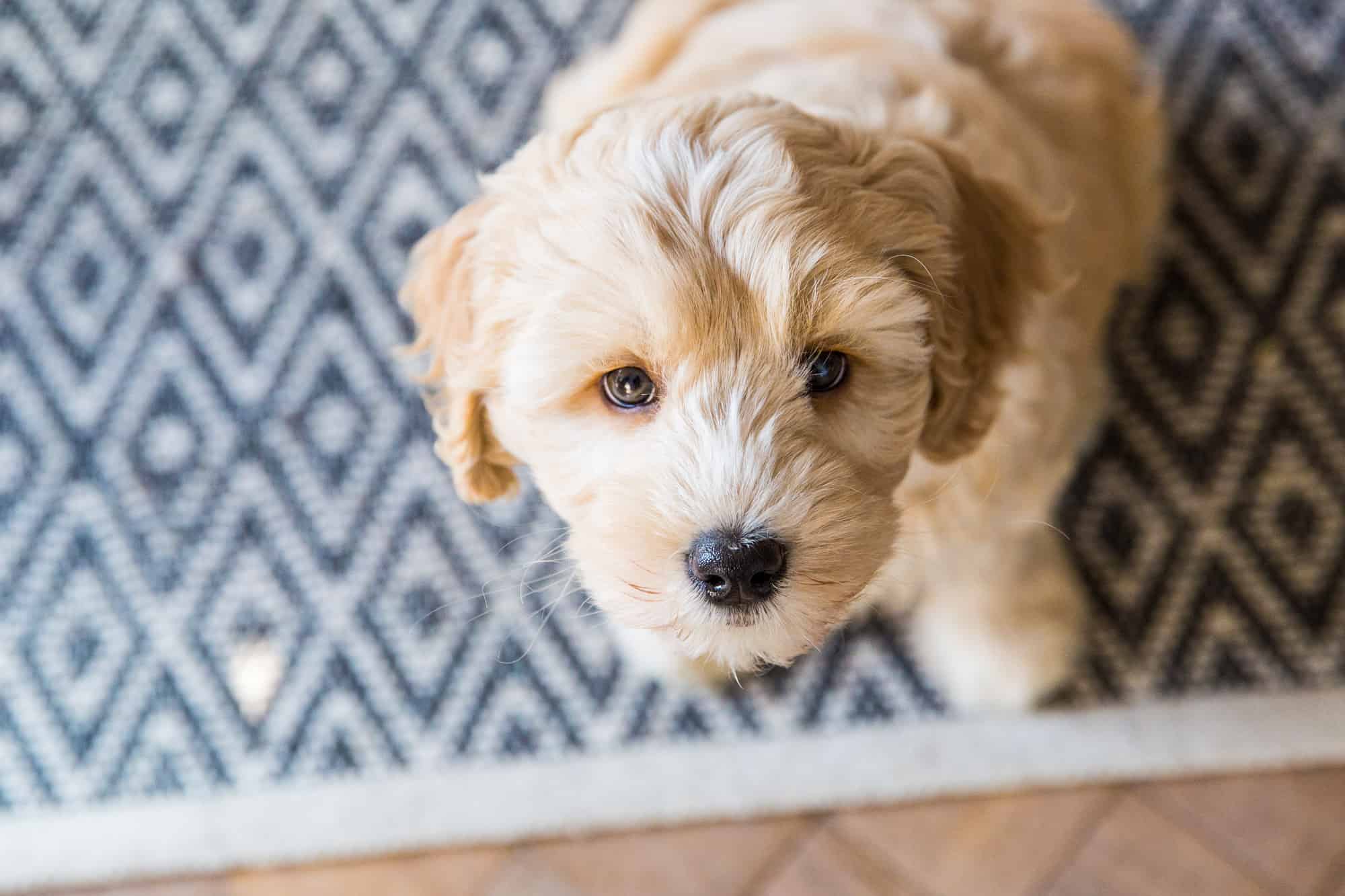
iStock.com/LSOphoto

Labradoodle Distribution

Click a location to explore more animals from that region

Origin Location

This map shows the native origin of the Labradoodle. As a domesticated species, they are now found worldwide.

Loading map...

Found in 1 country

Size Comparison

Human 5'8"
Labradoodle 1 ft 8 in

Labradoodle stands at 29% of average human height.

At a Glance

Domesticated
Also Known As Labrapoo, Lab-Poo, Labrapoodle, Labra-poodle, Laboroodle
Diet Omnivore
Activity Diurnal+
Lifespan 13 years
Weight 30 lbs
Status Not Evaluated
Did You Know?

The Labradoodle is a deliberately bred cross (not a naturally occurring wild "species") between a Labrador Retriever and a Poodle-often Standard, sometimes Miniature.

Scientific Classification

The Labradoodle is a deliberately bred cross between a Labrador Retriever and a Poodle (often Standard, sometimes Miniature). It is not a separate wild species; it is a domestic dog hybrid type with variable coat, size, and temperament depending on parentage and generation.

Kingdom
Animalia
Phylum
Chordata
Class
Mammalia
Order
Carnivora
Family
Canidae
Genus
Canis
Species
Canis lupus familiaris

Distinguishing Features

  • Hybrid domestic dog (Labrador Retriever × Poodle) rather than a standardized, universally recognized kennel-club breed
  • Highly variable coat types (curly/wavy/straight) and shedding levels depending on genetics
  • Often selected for trainability, sociability, and suitability as assistance/service dogs
  • Size varies with Poodle variety used (Standard vs Miniature), plus individual variation

Physical Measurements

Males and females differ in size

Height
1 ft 10 in (1 ft 2 in – 2 ft 1 in)
1 ft 7 in (1 ft 2 in – 1 ft 12 in)
Length
3 ft 1 in (2 ft 4 in – 3 ft 7 in)
Weight
53 lbs (15 lbs – 71 lbs)
40 lbs (15 lbs – 64 lbs)
Tail Length
1 ft 1 in (10 in – 1 ft 4 in)
1 ft 2 in (10 in – 1 ft 6 in)
Top Speed
28 mph
running

Appearance

Primary Colors
Secondary Colors
Skin Type Domestic dog skin with medium-to-high allergy sensitivity in some lines; coat density (double vs single) varies, affecting shedding and skin ventilation.
Distinctive Features
  • Deliberately bred domestic dog cross (Labrador Retriever and Poodle); not a separate wild species or distinct dog taxon.
  • Coat type is the key distinguisher from the base domestic dog population: can be straight (often more shedding), wavy "fleece," or tight-curly "wool" with variable shedding.
  • Size and build vary by parentage (Standard vs Miniature Poodle lines) and generation; ranges from athletic, Lab-like frame to more refined, Poodle-like proportions.
  • Head and muzzle vary; ears typically drop; tail may be Lab-thick ("otter") or finer and feathered.
  • Temperament often combines sociable, people-oriented Lab traits with Poodle alertness and trainability; energy level commonly moderate to high.
  • Hypoallergenic claims are not guaranteed; allergy suitability depends on individual coat, dander, and saliva sensitivity.
  • Common health concerns reflect both parent breeds: hip/elbow dysplasia, cranial cruciate ligament injury risk, progressive retinal atrophy, cataracts, and ear infections.
  • Skin/allergy issues can occur (atopy, food sensitivities), especially with dense coats and frequent moisture exposure.
  • Care needs: regular brushing to prevent matting (especially fleece/wool coats), professional grooming every ~6-10 weeks, routine ear cleaning/drying, and consistent exercise plus mental enrichment.
  • Weight management is important; Lab ancestry can predispose to overeating and obesity, increasing joint strain.

Sexual Dimorphism

Sexual dimorphism is mild: males are typically taller, heavier, and broader-chested, while females are often slightly smaller and more lightly built. Coat type and color do not reliably differ by sex.

  • Slightly larger average height and body mass
  • Broader skull and chest; thicker neck
  • May show more pronounced musculature in adult condition
  • Slightly smaller, lighter frame on average
  • Often narrower chest and finer head shape
  • May appear more compact even at similar height

Did You Know?

The Labradoodle is a deliberately bred cross (not a naturally occurring wild "species") between a Labrador Retriever and a Poodle-often Standard, sometimes Miniature.

The first widely documented purpose-bred Labradoodle was produced in Australia in the late 1980s for a guide-dog program seeking a low-allergen coat for a handler with allergies.

Coat types commonly fall into three categories-fleece (wavy), wool (curly), and hair (shedding)-and even littermates can differ.

"Hypoallergenic" isn't guaranteed: allergy triggers are proteins in dander/saliva, so individuals vary even with curlier coats.

Many Labradoodles inherit strong "retrieve" instincts from the Labrador and high trainability from the Poodle, making them frequent candidates for therapy/service work.

Because it's a cross, size can range widely (especially with Miniature Poodle ancestry), so adult weight is less predictable than in established pure breeds.

They are often strong swimmers, reflecting the Labrador's water-dog heritage and the Poodle's historical role as a water retriever.

Unique Adaptations

  • Domestic-dog tractability: like other Canis lupus familiaris, Labradoodles are highly tuned to human cues (voice, pointing, gaze), aiding training and partnership roles.
  • Coat variability as a functional trait: curlier, denser coats may trap loose hair and reduce visible shedding, but require more grooming to prevent matting.
  • Athletic versatility: many combine Labrador stamina with Poodle agility, supporting activities like obedience, scent work, dock diving, and hiking.
  • Strong olfactory ability typical of dogs, making them suitable for nose-work games and some detection-style training (though aptitude varies by individual).

Interesting Behaviors

  • "Velcro dog" tendencies: many seek close contact and follow their people room-to-room, reflecting social domestic-dog bonding.
  • Retrieving and carrying objects-shoes, toys, even mail-often shows up early and can be shaped into formal fetch or assistance tasks.
  • Play-bowing, zoomies, and bouncy gait are common in young dogs; mental enrichment helps prevent over-arousal.
  • Water enthusiasm: many will wade, paddle, or retrieve in water; introduce swimming safely and gradually.
  • High food motivation (often from Labrador lines) can boost training success but also increases risk of overeating if portions aren't managed.
  • Mouthing during play can persist if not redirected; consistent bite-inhibition games and chew options help.
  • Alert barking can occur, especially in under-exercised individuals; teaching a "quiet" cue and providing outlets reduces nuisance barking.

Cultural Significance

The Labradoodle (Canis lupus familiaris) became a symbol of late-20th/early-21st designer-dog trend, bred for family pets and service work. It sparked talks about what makes a breed, breeding ethics, clear health checks, and responsible rehoming.

Myths & Legends

Australian guide-dog origin story: In the late 1980s, breeders linked to Australian guide-dog programs mixed Labradors and Poodles to create the Labradoodle, hoping for Labrador steadiness and a Poodle-like coat for allergy-sensitive handlers.

Naming lore: "Labradoodle" entered popular telling as a playful portmanteau that spread globally; the name itself became part of the breed-type's legend, inspiring many later "-doodle" crosses.

Service-dog folklore in families: Owners and trainers frequently pass along anecdotal stories of Labradoodles intuitively alerting to distress or providing comfort-modern household legends that reinforce the cross's reputation as an empathic helper (individual ability varies).

Poodle-and-Lab heritage tales: The Labradoodle inherits narrative threads from its parent breeds-Poodles as historic European water retrievers and Labradors as Newfoundland-area retrievers-often woven into family stories explaining the cross's love of water and fetching.

The "teddy bear dog" story says the Labradoodle looks like a stuffed toy but acts like a working retriever. That image made it very popular in media and ads.

Conservation Status

NE Not Evaluated

Has not yet been evaluated against the criteria.

Population Stable

Life Cycle

Birth 7 pups
Lifespan 13 years

Lifespan

In the Wild 12–14 years
In Captivity 12–14 years

Reproduction

Mating System Polygynandry
Social Structure Managed Domestic
Breeding Pattern Transient
Fertilization Managed Selective
Birth Type Internal_fertilization

Behavior & Ecology

Social Pack Group: 3
Activity Diurnal, Crepuscular, Cathemeral
Diet Omnivore Cooked lean poultry (e.g., chicken or turkey)

Temperament

Breed distinction vs base species (domestic dog): intentionally selected cross with high sociability and trainability; coat/size/drive vary by generation and parent lines.
People-oriented, affiliative, and typically eager to engage; often bonds strongly to household members.
Generally playful and gentle; may be exuberant or mouthy as an adolescent without training.
Often highly trainable with reward-based methods; strong suitability for obedience, service, and therapy work in well-bred lines.
Social behavior HUBS (group-level): most individuals seek frequent human contact and enjoy group activities; variation driven by early socialization, poodle/lab balance, and energy level.
May show separation-related distress if under-stimulated or left alone abruptly; build independence gradually.
Can be distractible outdoors; consistent recall training and controlled greetings reduce overexcitement.
Health concerns (breed-relevant): hip/elbow dysplasia, progressive retinal atrophy, allergies/atopy, ear infections; some lines risk Addison's disease; large individuals may be bloat-prone.
Care requirements: daily exercise plus mental enrichment; structured training prevents nuisance barking/jumping.
Care requirements: coat maintenance varies (shedding to curly); routine brushing, professional grooming, and ear cleaning are common needs.

Communication

barking Alert, demand, play
whining Attention, anxiety, frustration
growling Boundary-setting, play growls
howling Occasional, context-dependent
tail carriage and wag patterns to signal arousal and friendliness
play bow and bouncy movement to initiate social play
facial expressions and soft eye contact for affiliative intent
ear position and body lean to show curiosity, uncertainty, or confidence
pawing, nudging, and bringing objects to solicit interaction
licking and muzzle nuzzles as appeasement/affiliation
scent investigation and marking behaviors, usually reduced by neutering and training

Habitat

Biomes:
Temperate Forest Temperate Grassland Mediterranean Boreal Forest (Taiga) Tundra Alpine Desert Hot Desert Cold Tropical Rainforest Tropical Dry Forest Savanna Freshwater Wetland Marine +8
Terrain:
Plains Hilly Mountainous Coastal Island Valley Riverine +1
Elevation: Up to 16404 ft 3 in

Ecological Role

Domestic companion omnivore; human-associated consumer that is primarily provisioned by people rather than functioning as a wild predator.

companionship and social support service/assistance and therapy work (common use in this cross) deterrence of some pests via presence (opportunistic rodent control) participation in human-managed nutrient cycling via pet-waste systems (anthropogenic context)

Diet Details

Main Prey:
Small mammals Birds and eggs Fish Insects and other invertebrates
Other Foods:
Fruits Vegetables Grains and starches Grasses and plant matter

Human Interaction

Domestication Status

Domesticated

Labradoodle (Canis lupus familiaris) is a planned cross of a Labrador Retriever and a Poodle (usually Standard). Bred in late 1980s Australia (popularized by Wally Conron) for guide and family work. Labradoodles vary by generation (F1, F1B, multigenerational) in size, coat, shedding, and how traits turn out. Often friendly and trainable; lower shedding is possible but not always hypoallergenic.

Danger Level

Low
  • Bite risk exists (as with any dog), typically related to fear, poor socialization, pain, or inadequate supervision-especially around children
  • Knock-down or collision risk from medium-to-large individuals during exuberant play
  • Allergy/asthma triggers: some people react to dander/saliva even if the dog sheds less; "hypoallergenic" is not assured
  • Zoonotic/parasitic risks are low with routine veterinary care but can include fleas/ticks, intestinal parasites, and skin infections

As a Pet

Suitable as Pet

Legality: Labradoodles are usually legal where pet dogs are allowed. Rules come from local dog laws, landlords or HOAs, or dangerous-dog rulings based on behavior. Some places limit breeding or need health papers.

Care Level: Moderate

Purchase Cost: $800 - $3,000
Lifetime Cost: $20,000 - $60,000

Economic Value

Uses:
Companion animal (family pet) market Service/assistance and therapy dog work Breeding (designer cross) and stud services Veterinary care and preventive health services Grooming industry (high coat-maintenance demand) Training/behavior services and daycare/boarding Pet products and insurance
Products:
  • Puppy sales/adoption fees
  • Training programs (basic manners to advanced assistance tasks)
  • Professional grooming (clipping, brushing, bathing) and grooming tools
  • Veterinary services (vaccines, parasite control, dental care, spay/neuter)
  • Pet insurance policies and wellness plans
  • Boarding/daycare and dog-walking services
  • Equipment (crates, leashes/harnesses, enrichment toys)

Relationships

Predators 4

Gray wolf Canis lupus
Coyote Canis latrans
Cougar Puma concolor
American alligator Alligator mississippiensis

Related Species 7

Gray wolf Canis lupus Shared Genus
Coyote Canis latrans Shared Genus
Golden jackal Canis aureus Shared Genus
African golden wolf Canis lupaster Shared Genus
Dhole Cuon alpinus Shared Family
African wild dog Lycaon pictus Shared Family
Red fox Vulpes vulpes Shared Family

Ecological Equivalents 4

Animals that fill a similar ecological role in their ecosystem

Golden Retriever Canis lupus familiaris Fills a similar niche as a family companion and service/therapy dog; has comparable sociability, trainability, and exercise needs, although coat type differs.
Portuguese Water Dog Canis lupus familiaris Often chosen for its lower-shedding coat and active, people-oriented temperament; shares similar grooming and training demands and is suitable for allergy-aware homes (no dog is truly hypoallergenic).
Standard Poodle Canis lupus familiaris One parent breed. Overlaps strongly in intelligence, athleticism, and coat-care requirements. Many Labradoodle traits track closely with poodle lineage and generation.
Labrador Retriever Canis lupus familiaris One parent breed. Overlaps in friendliness, biddability (trainability), and retrieving/play drive. Many Labradoodle temperaments and body types closely track Labrador lineage and generation.

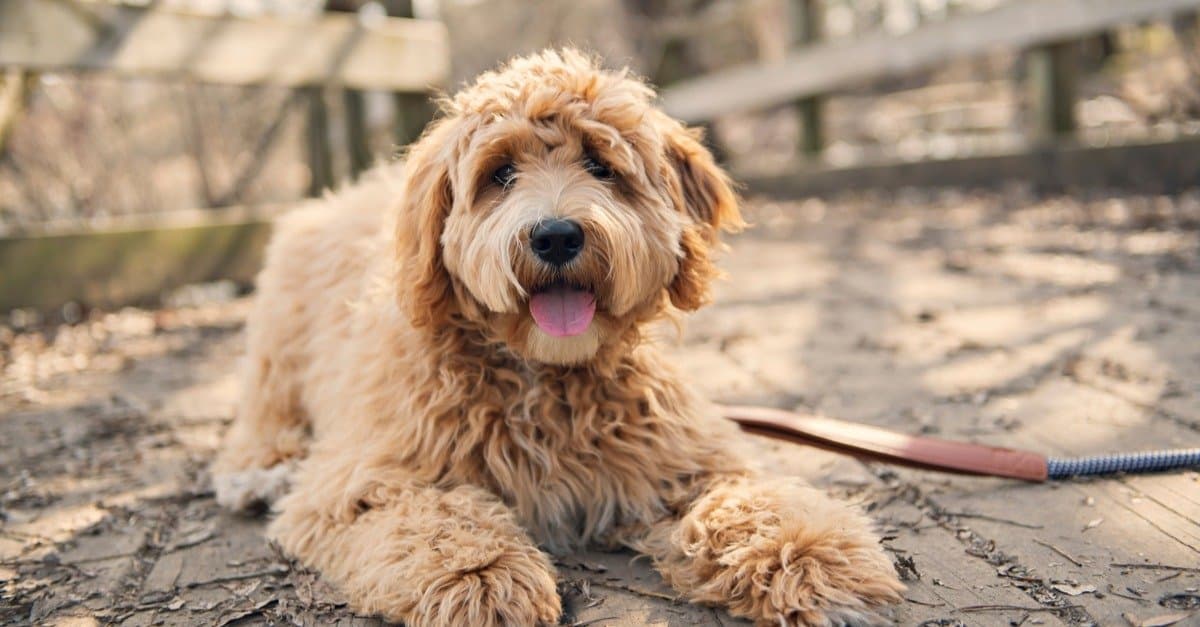
Labradoodles are a “designer breed” of dog that is a cross between a poodle and a Labrador retriever. They sometimes resemble stuffed animals with their sweet faces and curly coats, and their friendly temperaments make them popular pets.

The breed was created in Australia in 1989 by a man named Wally Conron. He originally crossbred the two dogs to create a service dog for a woman whose husband was allergic to the standard Labrador retrievers that are used as guide dogs. Today, they are highly sought after around the world as family pets.

Owning A Labradoodle: 3 Pros And Cons

ProsCons
Great family dogs
Labradoodles — while recently bred — have rapidly gained popularity. A big reason for their growing popularity is the breed’s incredible temperament. Labradoodles are affectionate with families and generally do very well with kids.
Exuberant
These dogs can be very excitable. This means they can jump around and generally roughhouse, which can make them a difficult breed to manage around children.
Less shedding
Labradoodles were first bred to be hypoallergenic guide dogs. This cross-breeding means that Labradoodles often have less shedding than their retriever lineage. However, this doesn’t mean that shedding isn’t a concern with Labradoodles.
Uneven shedding
While Labradoodles diminish their retriever lineage, they will still shed. If any house members have allergies to retrievers, you’ll want to ensure that a hypoallergenic dog like a Labradoodle doesn’t still have outsized impacts.
(Generally) easy to train
While all dogs are different, Labradoodles are generally easy-to-train dogs. However, they are an intelligent breed, so be prepared for independence and some stubbornness while training.
High-energy
Labradoodles require a good amount of exercise, with young Labradoodles requiring several walks per day. If you’re looking for a more sedentary breed, a Labradoodle may not be right for you.

Size

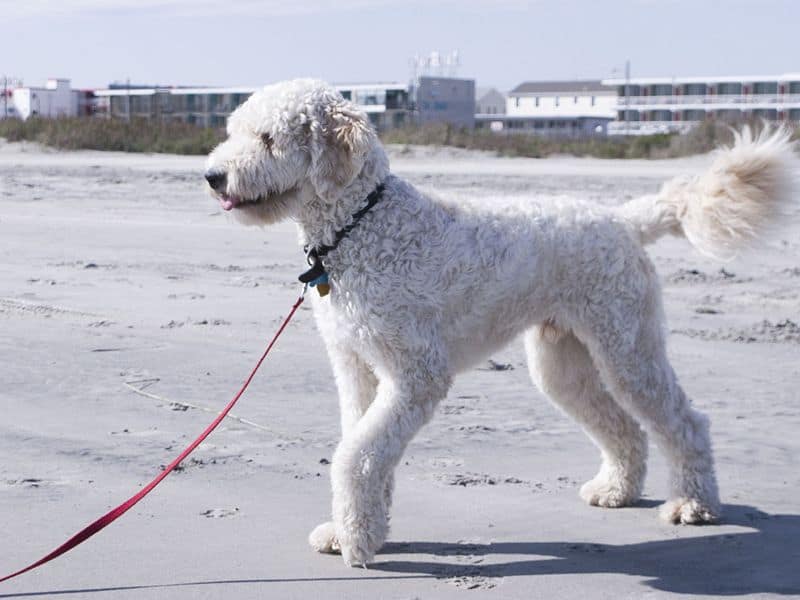
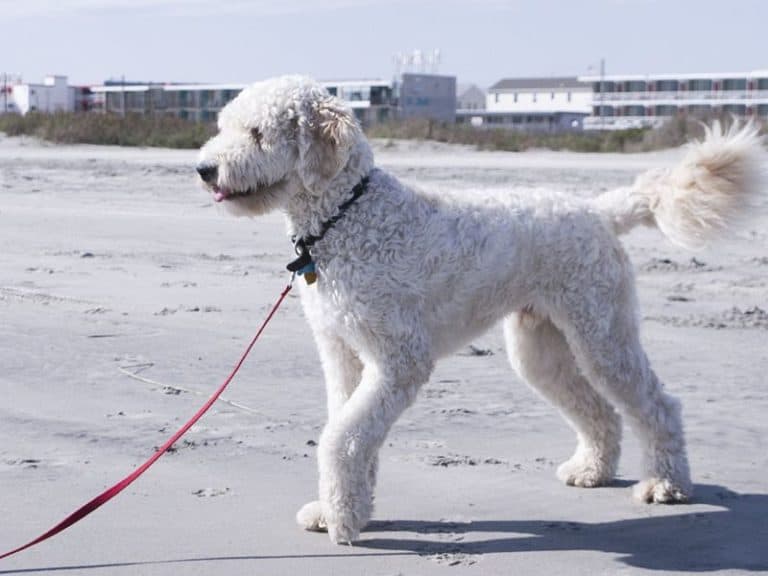
👁 Large adult labradoodle on leash, walking in the sand

Labradoodles can weigh anywhere from 50 to 65 pounds.

©lyrandian, CC BY 2.0, via Wikimedia Commons – Original / License

Standard labradoodles should stand about 24 inches tall for a male and 22 inches tall for a female. Both sexes can weigh anywhere from 50 to 65 pounds.

For medium labradoodles, both males and females should stand from 18 to 20 inches tall and weigh 30 to 45 pounds.

Mini labradoodles should be about 15 inches tall and weigh up to 25 pounds.

Common Health Issues

👁 Image

This breed may be prone to hip and elbow dysplasia.

©iStock.com/LSOphoto

Because they are a crossbreed, these dogs can be susceptible to the most common health issues for both Labrador retrievers and poodles. While buying from a reputable and well-established breeder lowers this risk, it’s still smart to be aware of the potential health problems your dog could have in the future.

In particular, they are prone to hip and elbow dysplasia. These are joint disorders that happen when the hip or elbow joint is not formed properly. The bones of the joint do not fit together smoothly, and the joint eventually deteriorates, which causes pain and loss of movement.

They may also be at risk for progressive retinal atrophy, which is a degenerative eye disease that ultimately leads to blindness in the dog.

Temperament And Behavior
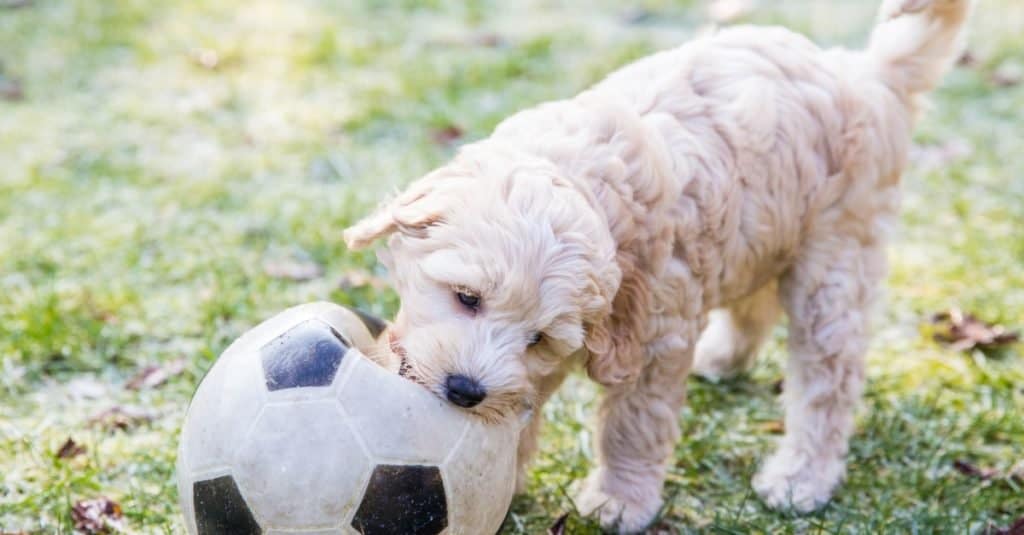
👁 Cream Australian Labradoodle puppy playing in the garden with a football in the mouth on the green grass

The Labradoodle does best with plenty of mental stimulation and engagement.

©Angeline Dobber/Shutterstock.com

These dogs are extremely intelligent, incredibly friendly, and full of personality. They are deeply intuitive and social dogs, and these traits mean that they typically do best in active environments with plenty of mental stimulation and engagement.

They have naturally curious and energetic personalities, so they often make great companions for children or adults with active lifestyles. They require a considerable amount of exercise, and they should be given plenty of toys and puzzles when at home so that they do not become bored or restless.

Labradoodles are easy to train and can learn behavior modifications and tricks very quickly. They are also able to adapt well to various types of environments, but it is important to socialize them well as puppies so that they begin using this adaptive trait at a young age.

How To Take Care Of Labradoodles

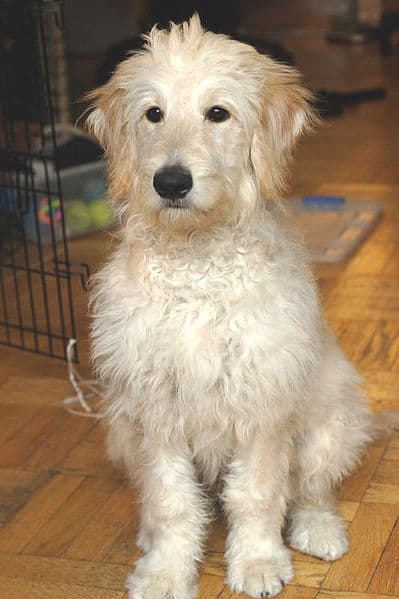
👁 Labradoodle sitting on wood floor

Labradoodles are said to thrive when fed an all-natural raw diet that contains a healthy mix of fats, proteins, and veggies.

©Raduw at the English Wikipedia, CC BY-SA, via Wikimedia Commons – Original / License

Food And Diet

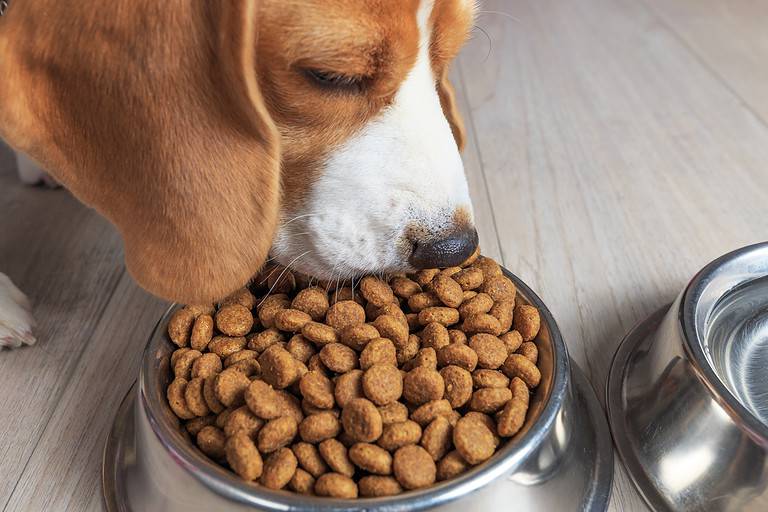
As with most dogs, many pet owners say that their labradoodles thrive when fed an all-natural raw diet that is a healthy mix of fats, proteins, and veggies.

If you don’t have the time or inclination to follow a raw diet, you can still find good kibble options that will keep your labradoodle healthy and happy. It’s important to buy food that has a healthy amount of carbohydrates for energy, protein for muscle support, veggies for fiber, and supplements like fish oil and calcium for bone health.

Puppies should be fed on a regular schedule to ensure that they get enough calories and nutrients for healthy growth. Foods that are rich in calcium are especially important for both puppies and mini breeds because they need plenty of bone health support.

To find the most appropriate food for your labradoodle, it’s recommended to work with your vet to formulate a feeding plan that keeps your dog healthy and happy.

Maintenance And Grooming
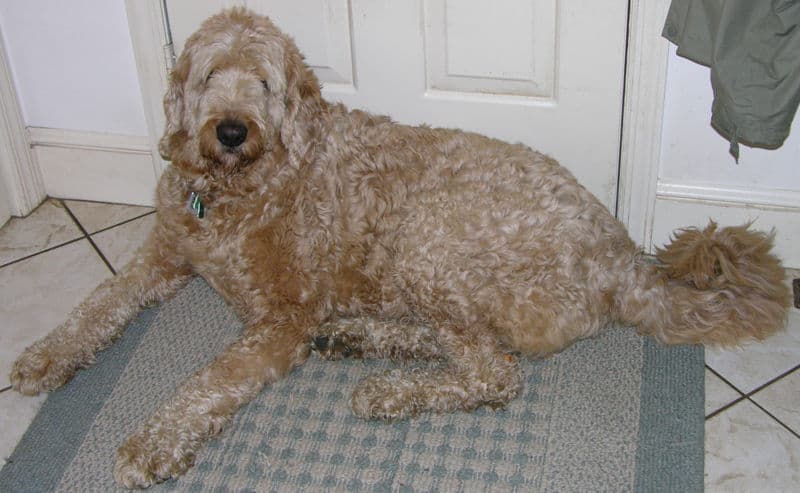
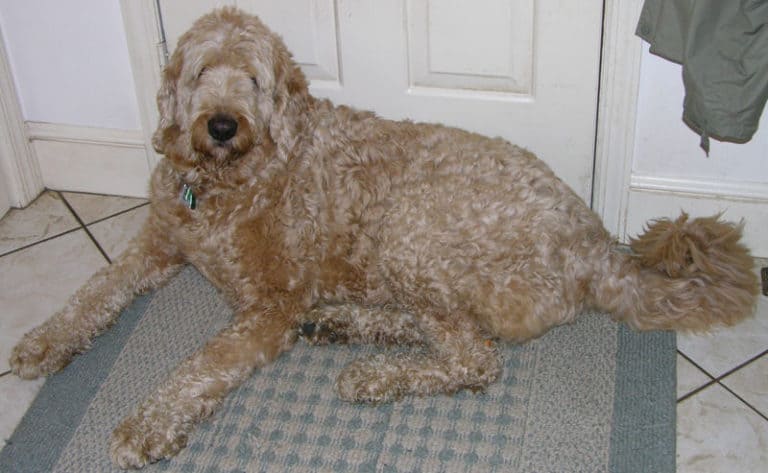
👁 Adult labradoodle dog sitting by the door

Labradoodles do not shed, but they still require maintenance and should be regularly groomed.

©Derek Ramsey (Ram-Man) / CC BY-SA 2.5, Wikimedia Commons – Original / License

These dogs are one of the few furry breeds that specifically do not shed, which means that people with allergies are often able to tolerate them much better than other dogs.

Despite the fact that they do not shed, they do require semi-regular maintenance. They should be groomed regularly so that they stay comfortable. This includes fur trimming, nail trimming, brushing, and an occasional bath.

Though for many owners, it is best to take them to an experienced professional groomer so that he or she can properly shape the fur and shave delicate areas.

Training

As mentioned before, this is a highly intelligent breed. They learn quickly, and they have the perfect personality for complex trick training if you desire.

The labradoodle’s inquisitive nature and energetic disposition make these dogs easy and fun to train.

Exercise
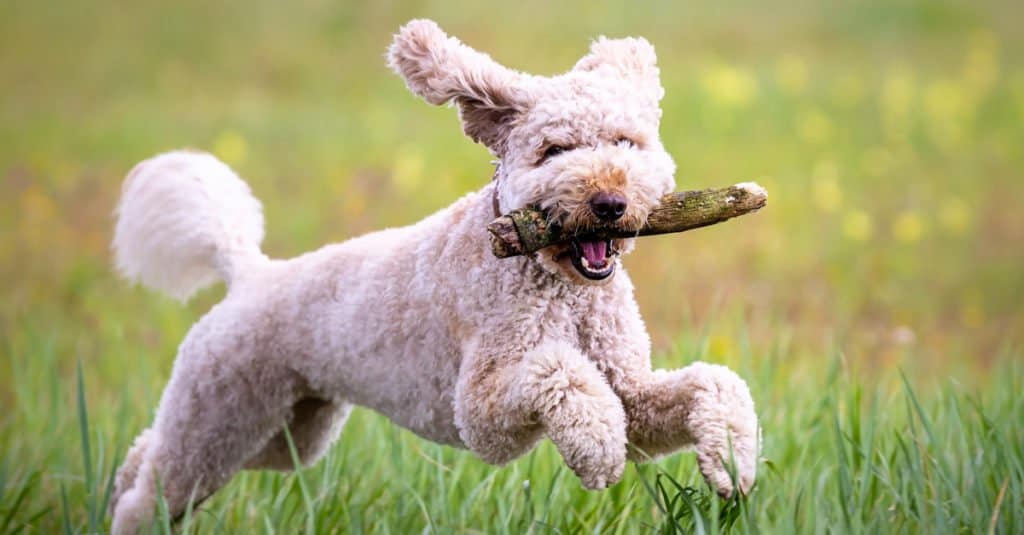
👁 white mini labradoodle

Labradoodles are a high-energy breed and should get a good amount of exercise, or else they can become bored or restless.

©Lynxs Photography/Shutterstock.com

These dogs are a fairly high-energy breed, so they must get an appropriate amount of exercise. They can become bored or restless somewhat easily, and this can lead to unwanted behaviors such as excessive barking, chewing, or digging.

On average, they do best when they get at least an hour of exercise every day. This includes walking, playing games, and learning tricks. They like active environments, and they do well in situations that have plenty of open space in which to run around and play.

Puppies
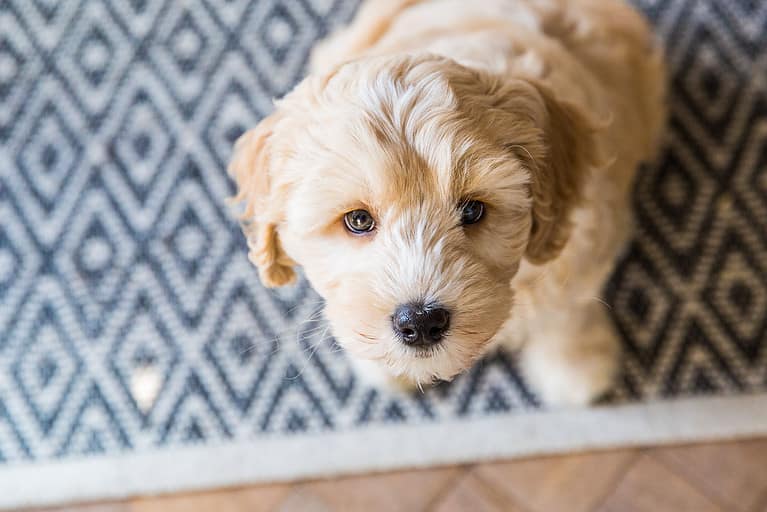
👁 White labradoodle puppy in the grass

Labradoodle puppies are eager to please, and a consistent training routine will be helpful.

©Angeline Dobber/Shutterstock.com

These puppies are often laid-back, playful, and eager to please. The best adult labradoodles are ones that were consistently well-trained from puppyhood, so potential owners need to understand that raising a labradoodle puppy will require a serious time commitment.

New owners should do plenty of research and consider enrolling their puppies in training classes early on so that they can get the most enjoyment out of their new furry companion.

Labradoodles And Children

Labradoodles are excellent with children. They are a very people-focused breed, and they are both playful and easygoing. Their high-energy nature often pairs well with younger children, and they are extremely sweet and loyal companions throughout their lives.

Dogs Similar To Labradoodles

  • Golden retrievers: They share a similar appearance and temperament. They’re sweet, intelligent, trainable, and well-suited to family life.
  • Labrador retrievers: These dogs also share a very similar temperament and energy level. They’re highly intelligent, trainable, and great with kids. They shed more than labradoodles.
  • Standard poodles: Like labradoodles, poodles are a low-shedding breed. They are extremely smart and obedient. They take time to warm up to new people, but they are friendly and loyal to their families.

Famous Labradoodles

Labradoodles are a relatively recent breed, but that hasn’t stopped celebrities from shopping up these incredible canines!

  • Jennifer Aniston has a Labradoodle.
  • Tiger Woods is the proud owner of not one… But two labradoodles named Riley and Yogi.
  • And finally, Christie Brinkley has discovered the joy of Labradoodles. Her dog, named Maple Sugar, has graced the cover of several magazines.
View all 130 animals that start with L

Sources

  1. David Burnie, Dorling Kindersley Animal, The Definitive Visual Guide To The World's Wildlife / Accessed December 16, 2008
  2. Tom Jackson, Lorenz Books The World Encyclopedia Of Animals / Accessed December 16, 2008
  3. David Burnie, Kingfisher The Kingfisher Animal Encyclopedia / Accessed December 16, 2008
  4. Richard Mackay, University of California Press The Atlas Of Endangered Species / Accessed December 16, 2008
  5. David Burnie, Dorling Kindersley Illustrated Encyclopedia Of Animals / Accessed December 16, 2008
  6. Dorling Kindersley Dorling Kindersley Encyclopedia Of Animals / Accessed December 16, 2008
  7. Today / Accessed October 13, 2020
  8. Embrace Pet Insurance / Accessed October 13, 2020
  9. Vcahospitals / Accessed October 13, 2020

About the Author

Melissa Bauernfeind

Melissa Bauernfeind was born in NYC and got her degree in Journalism from Boston University. She lived in San Diego for 10 years and is now back in NYC. She loves adventure and traveling the world with her husband but always misses her favorite little man, "P", half Chihuahua/half Jack Russell, all trouble. She got dive-certified so she could dive with the Great White Sharks someday and is hoping to swim with the Orcas as well.
Connect:

Thank you for reading! Have some feedback for us?

Contact the AZ Animals editorial team

Related Articles You May Find Interesting


Labradoodle FAQs (Frequently Asked Questions)

To purchase a labradoodle puppy from a reputable breeder, it’s common to pay anywhere from $1,200 to $3,000. If you find a labradoodle puppy at a price that is much lower than this, chances are good that it is coming from a puppy mill or an irresponsible breeder.

Most dog owners say that having a dog is more expensive than they initially expected, so it’s important to take ongoing costs of care into consideration. While the exact number may vary, it’s normal to expect to pay as much as $3,000 per year to own a labradoodle.

Labradoodles are great with kids. They have a playful, energetic and friendly disposition that makes them excellent family pets.

The average life expectancy of a labradoodle is about 12 years, but some may live up to 15 years.

The man who first created the breed in 1989 has expressed regret over his decision. He believes that he opened a “Pandora’s box” in creating designer breeds, and he says there are many “unscrupulous breeders” who intentionally breed these dogs to have undesirable traits or hereditary health issues.

In general, labradoodles are considered to be overall healthy dogs and excellent pets.

Labradoodles were originally bred to serve as guide dogs, which means that they have a sweet, gentle temperament. They are friendly, good with other animals, great with children and highly intelligent. All of these traits make them well-suited to be pets.

A labradoodle is a cross between a Labrador retriever and a poodle, and a goldendoodle is a cross between a golden retriever and a poodle.

These dogs share many similar traits, but one big difference is in their coats. Labradoodles tend to have thicker, glossier fur and come in a wide variety of coat colors. Goldendoodles tend to have fluffier, wavier curls and typically come in shades of cream, gold and caramel.

Otherwise, their temperaments, grooming needs, life expectancy and overall cost are very similar.

Australian Labradoodles differ from other labradoodles in that they are a cross between two of the following six approved breeds:

  • Poodle
  • Labrador retriever
  • Irish water spaniel
  • Curly coat retriever
  • American cocker spaniel
  • English cocker spaniel

Australian labradoodles also come in three sizes, including standard, medium, and mini. Their average size is similar to other variations of labradoodle.

The main difference between a Poodle and a Labradoodle is their parents.

Unlike Poodles, Labradoodles are mixed breeds. They are products of crossing between Labradors and Poodles. For this reason, Poodles are expensive and require a lot of time and attention.

Read about other differences here.

The notable differences are the parent breed, size, life span, and adaptability.

The Aussiedoodle comes from an Australian Shepherd breeding with a poodle, while the Labradoodle comes from a Labrador Retriever and poodle.

Labradoodles differ from Cockapoos in their breeding, as Labradoodles are a cross between Labrador retrievers and poodles, while Cockapoos are a cross between poodles and Cocker Spaniels.