
L
Species Profile

Limpet

Gastropoda

Cling hard, graze smart, ride the tide.
A. Mertens/Shutterstock.com

Limpet Distribution

Click a location to explore more animals from that region

Invasive Species

This map shows coastal regions where Limpet are found.

Loading map...

Found in 32 countries

๐Ÿ‡ฆ๐Ÿ‡ท Argentina ๐Ÿ‡ฆ๐Ÿ‡บ Australia ๐Ÿ‡ง๐Ÿ‡ท Brazil ๐Ÿ‡จ๐Ÿ‡ฆ Canada ๐Ÿ‡จ๐Ÿ‡ฑ Chile ๐Ÿ‡จ๐Ÿ‡ณ China ๐Ÿ‡ช๐Ÿ‡ฌ Egypt ๐Ÿ‡ช๐Ÿ‡ธ Spain ๐Ÿ‡ซ๐Ÿ‡ท France ๐Ÿ‡ฌ๐Ÿ‡ง United Kingdom ๐Ÿ‡ฌ๐Ÿ‡ท Greece ๐Ÿ‡ฎ๐Ÿ‡ฉ Indonesia ๐Ÿ‡ฎ๐Ÿ‡ช Ireland ๐Ÿ‡ฎ๐Ÿ‡ณ India ๐Ÿ‡ฎ๐Ÿ‡ธ Iceland ๐Ÿ‡ฎ๐Ÿ‡น Italy ๐Ÿ‡ฏ๐Ÿ‡ต Japan ๐Ÿ‡ฐ๐Ÿ‡ช Kenya ๐Ÿ‡ฐ๐Ÿ‡ท South Korea ๐Ÿ‡ฒ๐Ÿ‡ฆ Morocco ๐Ÿ‡ฒ๐Ÿ‡ฝ Mexico ๐Ÿ‡ฒ๐Ÿ‡พ Malaysia ๐Ÿ‡ณ๐Ÿ‡ด Norway ๐Ÿ‡ณ๐Ÿ‡ฟ New Zealand ๐Ÿ‡ต๐Ÿ‡ช Peru ๐Ÿ‡ต๐Ÿ‡ญ Philippines ๐Ÿ‡ต๐Ÿ‡น Portugal ๐Ÿ‡น๐Ÿ‡ญ Thailand ๐Ÿ‡น๐Ÿ‡ผ Taiwan ๐Ÿ‡บ๐Ÿ‡ธ United States ๐Ÿ‡ป๐Ÿ‡ณ Vietnam ๐Ÿ‡ฟ๐Ÿ‡ฆ South Africa

Size Comparison

Human 5'8"
Limpet 1 in

Limpet stands at 1% of average human height.

At a Glance

Class Overview This page covers the Limpet class as a group. Stats below are general traits shared across the class.
Diet Herbivore
Activity Nocturnal+
Lifespan 3 years
Weight 2 lbs
Status Not Evaluated
Did You Know?

"Limpet" is a body shape, not a single family-true limpets (Patellidae), keyhole limpets (Fissurellidae), and false/pulmonate limpets (Siphonariidae) aren't all close relatives.

Scientific Classification

Class Overview "Limpet" is not a single species but represents an entire class containing multiple species.

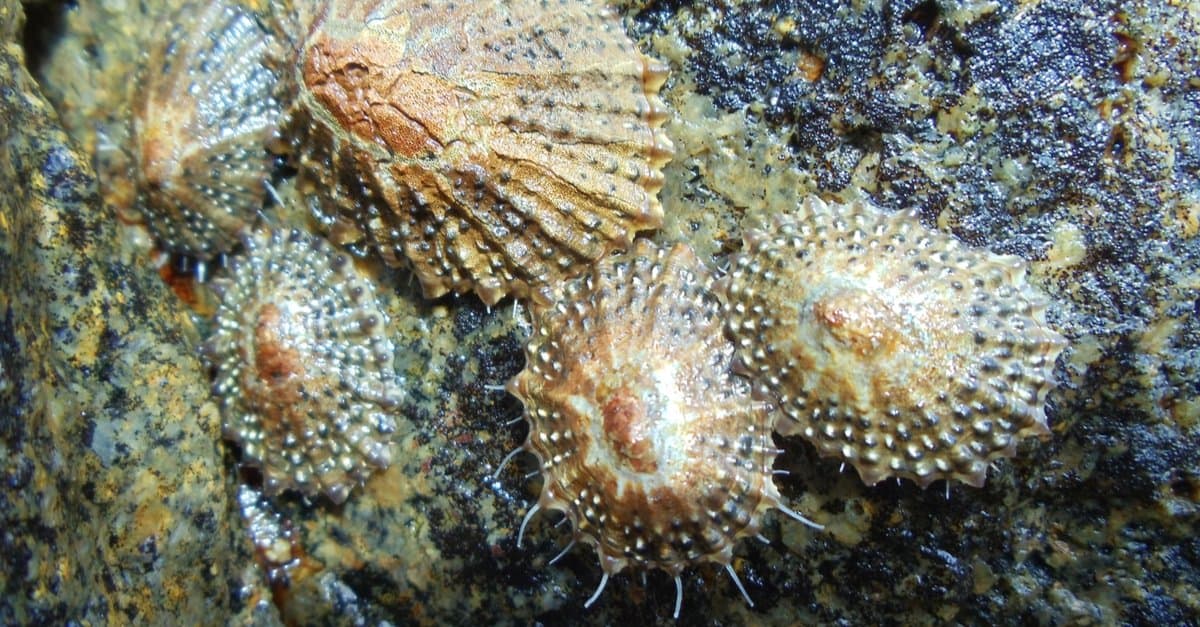
Limpets are gastropod mollusks characterized by a simple cap-shaped (conical) shell and a broad muscular foot that adheres strongly to rock and other hard substrates. The name describes body form more than close relatedness, so โ€œlimpetsโ€ include several distinct gastropod groups.

Kingdom
Animalia
Phylum
Mollusca
Class
Gastropoda

Distinguishing Features

  • Cap-shaped shell (often with radiating ribs; sometimes with an apical hole/slit in keyhole limpets)
  • Very strong adhesion via a large muscular foot (suction plus mucus)
  • Grazing lifestyleโ€”scrapes algae/biofilm using a radula
  • Intertidal adaptations such as homing behavior and tolerance of desiccation/temperature fluctuations (in many marine species)

Physical Measurements

Males and females differ in size

Height
โ™‚ 2 in (0 in โ€“ 8 in)
โ™€ 1 in (0 in โ€“ 8 in)
Length
โ™‚ 2 in (0 in โ€“ 8 in)
โ™€ 2 in (0 in โ€“ 8 in)
Weight
โ™‚ 0 lbs (0 lbs โ€“ 22 lbs)

Appearance

Primary Colors
Secondary Colors
Skin Type Hard calcareous shell over a soft body; broad muscular foot with thick mucus for adhesion; mantle edge may form sensory tentacles, and in keyhole/pulmonate limpets includes specialized openings/grooves for water/air flow.
Distinctive Features
  • Morphological group, not a single lineage: "limpet" form occurs across multiple gastropod clades within Gastropoda.
  • Shell shape range: low dome to steep cone; generally cap-shaped with off-center or central apex.
  • Size range across limpet-like gastropods: ~0.2-20 cm shell length/diameter (small rock limpets to very large forms).
  • Body plan: broad, powerful foot creates suction-like adhesion; mucus increases grip and reduces desiccation.
  • True limpets (Patellidae): solid cap shell, strong homing behavior common; intertidal grazers with robust radula.
  • Keyhole limpets (Fissurellidae): apical hole or slit ("keyhole") used to vent water and wastes from mantle cavity.
  • False/pulmonate limpets (Siphonariidae): air-breathing pulmonates with a mantle cavity functioning as a lung; often show a siphonal groove for ventilation.
  • Ecology generalization: most are intertidal to shallow subtidal, strongly associated with hard substrates; some occur deeper or in calmer habitats.
  • Behavioral range: many species graze microalgae/diatoms; some show strong site fidelity (homing scars), while others wander more widely.
  • Wave/desiccation adaptations vary: shell height, ribbing, and foot size often correlate with wave exposure and drying stress.
  • Lifespan range across limpet-like gastropods: typically ~1-20+ years, varying with size, habitat, and predation pressure.

Did You Know?

"Limpet" is a body shape, not a single family-true limpets (Patellidae), keyhole limpets (Fissurellidae), and false/pulmonate limpets (Siphonariidae) aren't all close relatives.

Across limpet-like gastropods, adult shell length ranges from ~1-2 mm in tiny species to ~120-150 mm in the largest keyhole/true limpets (varies by lineage).

Their grip can be extremely strong because the muscular foot forms a tight seal and uses mucus to resist wave lift and drying winds.

Many intertidal limpets "home," returning to the same resting spot; some even grind a shallow "home scar" into rock for a better seal.

Keyhole limpets have a hole or slit in the shell that vents water from the mantle cavity-helpful for respiration while clamped down.

Some "false limpets" (Siphonariidae) are air-breathing pulmonates, showing that limpet form evolved more than once for life on wave-battered shores.

Keyhole limpet hemocyanin (KLH), derived from a large keyhole limpet species, became an important tool in biomedical research as a strong immune stimulant.

Unique Adaptations

  • Cap-shaped shell: a low, conical profile reduces drag and lift from waves; similar shapes evolved independently in multiple gastropod lineages (convergent evolution).
  • Powerful adhesion system: a broad muscular foot plus mucus creates suction-like attachment and a watertight seal to limit desiccation during low tide.
  • Shell microstructure and toughness: many have strong, layered shells that resist cracking and abrasion from surf-driven sand and debris (details vary by family).
  • Homing scars: in some species, repeated resting in one spot matches the shell edge to the rock, improving the seal and reducing water loss.
  • Keyhole/slit ventilation (Fissurellidae): an apical opening channels exhalant water and wastes away from the head while the animal stays firmly attached.
  • Air-breathing limpets (Siphonariidae): pulmonate anatomy allows gas exchange with air when emersed, a useful twist on the limpet lifestyle.
  • High tolerance to stress: many intertidal limpets withstand big swings in temperature, salinity, and oxygen-though tolerance ranges widely among species and habitats.

Interesting Behaviors

  • Intertidal grazing: most scrape microalgae/diatoms with a radula, often feeding when wetted by tides; diet and timing vary by shore height and region.
  • Homing and site fidelity: many species repeatedly return to a specific spot after foraging; others roam more widely depending on food, crowding, and wave exposure.
  • Territoriality: in some true limpets, larger individuals can defend algal "gardens" or preferred patches, while other species are more tolerant and aggregate.
  • Tidal and daily rhythms: activity often tracks immersion/emersion cycles; some shift feeding to nighttime to reduce heat stress and predation.
  • Reproduction ranges widely: many are broadcast spawners with planktonic larvae, while some have more localized recruitment; sex change (sequential hermaphroditism) occurs in several limpet-like groups.
  • Predator responses: clamp-down behavior, shell edging against rock, and choosing crevices are common; predator communities differ (sea stars, crabs, fish, birds, snails).
  • Ecosystem engineering: by grazing, limpets can maintain "bare rock" zones and shape algal communities; effects vary strongly among shores and species densities.

Cultural Significance

Limpets (Gastropoda) appear in old shell heaps, showing people have long collected and eaten them; some still eat them today. 'Limpet' named a WWII cling-on mine and means someone who sticks. Keyhole limpet hemocyanin (KLH) is used in medical research.

Myths & Legends

Name-and-shape lore: the word "limpet" is tied to the idea of clinging-coastal English usage turned the animal into a symbol of tenacious attachment, giving rise to the enduring "stick like a limpet" saying.

Wartime naming story (20th-century historical anecdote): British developers popularized the term "limpet mine" for a naval explosive designed to cling to ships, explicitly borrowing the limpet's reputation for steadfast adhesion.

Shell-midden heritage: Many coastal traditions recall limpet gathering as part of old shore gathering ways; limpet shells in ancient middens are often used locally as proof of ancestors' ties to the sea.

Scientific naming origin: "Patella" (true limpets) comes from Latin for a small dish/pan-an old, widely repeated naming association based on the shell's shape rather than a single species story.

Conservation Status

NE Not Evaluated

Has not yet been evaluated against the criteria.

Population Unknown

Looking for a specific species?

Common limpet

Patella vulgata

  • Measurements across limpet-like gastropods: shells range from only a few millimeters in small species to ~15-20+ cm in the largest (e.g., giant limpets); many common intertidal species are a few centimeters.
  • Lifespan range: from short-lived species (often a few years) to longer-lived species that can reach a decade or more; growth and longevity vary strongly with temperature, food, and wave exposure.
  • Behavior/ecology generalizations: many are rock-attached grazers using a radula to scrape biofilm/diatoms/algae; many show 'homing' behavior to a scar on rock, but the tendency and precision vary by lineage and habitat.
  • Habitat breadth: most are marine intertidal/subtidal on hard substrates, but some are air-breathing shore limpets (Siphonaria) and others are freshwater limpets in streams/lakes-reflecting major ecological and physiological variation.

You might be looking for:

Common limpet

26%

Patella vulgata

A โ€œtrue limpetโ€ (family Patellidae) common on rocky shores of the NE Atlantic; strongly conical shell and powerful suction foot.

Keyhole limpets

18%

Fissurellidae (e.g., Diodora spp.)

Limpet-shaped marine gastropods with an apical hole or slit (โ€œkeyholeโ€) used for excurrent water flow.

False (pulmonate) limpets

16%

Siphonariidae (e.g., Siphonaria pectinata)

Air-breathing (pulmonate) marine limpets that resemble true limpets but are not closely related.

Freshwater limpets

12%

Ancylidae/Planorbidae lineages (e.g., Ancylus fluviatilis)

Small limpet-shaped freshwater snails found on stones and aquatic plants in streams and lakes.

Slipper limpet

10%

Crepidula fornicata

Often called a limpet but actually a slipper snail; has a cap-like shell with an internal โ€œdeck.โ€

Life Cycle

Birth 500 hatchlings
Lifespan 3 years

Lifespan

In the Wild 0.25โ€“50 years
In Captivity 0.25โ€“60 years

Reproduction

Mating System Promiscuity
Social Structure Aggregation Group
Breeding Pattern Transient
Fertilization Broadcast Spawning
Birth Type Broadcast_spawning

Most limpet-form gastropods are solitary or occur in loose aggregations; reproduction commonly involves synchronized broadcast spawning with no pair bonds, producing a largely promiscuous mating system. Some lineages show internal fertilization and/or sex change, so patterns vary.

Behavior & Ecology

Social Aggregation Group: 1
Activity Nocturnal, Crepuscular, Diurnal, Cathemeral
Diet Herbivore microalgal biofilm dominated by diatoms

Temperament

Generally non-aggressive; most conflicts are passive (displacement, pushing) rather than injurious
Often strongly site-attached in intertidal and limpet-like forms; some show homing and territoriality
Risk-averse and cryptic; many hide in crevices or burrow when disturbed
Opportunistic foragers; behavior shifts with tide, humidity, temperature, and predation pressure
Variable tolerance of conspecifics: from solitary spacing to high-density crowding on scarce substrate

Communication

Chemical cues and pheromones for mate finding, trail following, and species recognition
Mucus trails conveying information on recent presence, direction, and sometimes reproductive status
Tactile contact via tentacles/foot during courtship, spacing disputes, and substrate assessment
Environmental cue tracking (light, tide, moisture, temperature) coordinating activity timing more than social signaling
Occasional mechanical signals (shell/foot contact vibrations) during close interactions, not true vocalization

Habitat

Biomes:
Marine Freshwater Wetland Tropical Dry Forest Desert Hot Mediterranean Temperate Rainforest +1
Terrain:
Coastal Rocky Sandy Muddy Island Riverine Volcanic +1
Elevation: -433071 in โ€“ 16404 ft 3 in

Ecological Role

Primary consumers/mesograzers on hard substrates that regulate benthic algal films and influence intertidal/subtidal community structure

controls growth of microalgae and algal films on rocks (reduces algal overgrowth) promotes habitat heterogeneity by creating grazed patches that affect settlement and succession contributes to nutrient recycling via grazing, excretion, and biodeposition supports coastal food webs as prey for fishes, crabs, sea stars, and shorebirds can contribute to bioerosion and turnover of surface films on hard substrates

Diet Details

Other Foods:
Microalgal biofilm Diatoms Cyanobacteria Encrusting algae Filamentous algae Macroalgal spores and germlings Algal mat detritus +1

Human Interaction

Domestication Status

Wild

Limpets are not one domesticated line; โ€œlimpetโ€ is a body shape found in many, not closely related gastropod groups (polyphyletic) across Class Gastropoda. There is no history of intentional domestication. Humans mainly harvest limpets for food, bait, shells or aquaria and sometimes use simple local rules, but not selective breeding.

Danger Level

Low
  • Generally harmless; no venom typical of limpet-form gastropods.
  • Minor injuries possible from sharp shell edges or rocks while collecting, and slips/falls on wet intertidal surfaces.
  • Foodborne illness risk if eaten raw/undercooked or harvested from polluted waters (biotoxins/heavy metals/pathogens can bioaccumulate in some coastal settings).
  • Allergic reactions are possible but uncommon with handling/consumption, as with other mollusks.

As a Pet

Not Suitable as Pet

Legality: Limpets (Gastropoda) are usually legal to keep in home aquariums if you follow local collection and purchase rules. Many species or areas restrict taking or import. Always check local wildlife laws.

Care Level: Experienced

Purchase Cost: Up to $25
Lifetime Cost: $50 - $600

Economic Value

Uses:
Food (subsistence and local markets) Bait (recreational and artisanal fishing) Ornamental/shell trade (limited) Scientific/educational value (high, non-consumptive) Ecosystem services (non-market): grazing that influences algal cover and intertidal community structure
Products:
  • Fresh or cooked limpet meat (regional)
  • Dried/salted preparations in some locales
  • Fishing bait
  • Shell curios/souvenirs (small-scale)
  • Specimens for teaching and museum collections
  • Research organisms for adhesion/biomaterials studies and intertidal ecology

Relationships

Predators 6

Sea star Asterias rubens
Shore crab Carcinus maenas
Larger crabs Metacarcinus magister
Octopus Octopus vulgaris
Oystercatchers Haematopus ostralegus
Sea otter Enhydra lutris

Related Species 5

Common limpet Patella vulgata Shared Family
Giant owl limpet Lottia gigantea Shared Family
Rough keyhole limpet Diodora aspera Shared Family
Ribbed false limpet Siphonaria pectinata Shared Family
River limpet Ancylus fluviatilis Shared Family

Ecological Equivalents 4

Animals that fill a similar ecological role in their ecosystem

Chitons Polyplacophora Rock-clinging grazers that scrape microalgae and biofilm from hard substrates in intertidal and shallow subtidal zones; they have a low-profile, wave-resistant body plan.
Periwinkles Littorinidae Common intertidal algal grazers that compete for biofilm and algae on rocks; they overlap in habitat use, tolerance to tidal exposure, and predator pressures.
Sea urchins Echinoidea Herbivorous scrapers that strongly shape algal communities on rocky reefs; functionally similar as benthic grazers, though they have different feeding mechanics and mobility.
Barnacle Cirripedia They share the same hard-substrate intertidal habitat and are subject to similar wave and desiccation stresses; they are frequent spatial competitors for attachment sites. Barnacles filter-feed rather than graze.

Types of Limpet

8

Explore 8 recognized types of limpet

Common limpet Patella vulgata
Giant owl limpet Lottia gigantea
Rough keyhole limpet Diodora aspera
Ribbed false limpet Siphonaria pectinata
River limpet Ancylus fluviatilis
Blue-rayed limpet Patella pellucida
Tortoiseshell limpet Cellana testudinaria
Slipper limpet (cap-shaped limpet-like snail) Crepidula fornicata

Equipped with the strongest teeth on Earth, limpets are aquatic snails in the class Gastropoda. They get their name from their dish-shaped, conical shell, which protects them from predators and tides. They possess extremely strong teeth and powerful tongues coated in adhesive mucus that they use to attach themselves to rocks.  

5 Limpet Facts

  • While those that live near algae only live for a few years, a limpet that lives on bare rock can live up to 16 years.
  • Limpets will move around while feeding, but usually return to a favorite spot to rest.
  • A limpetโ€™s anus is located in the nuchal cavity near its head, so it must compact its feces before a bowel movement to avoid fouling the cavity.
  • Their teeth are the strongest known biological material with a tensile strength that exceeds spider silk and rivals the strongest commercial steels.
  • To reproduce, females and males release their eggs and sperm into the water through a process known as broadcast spawning.

Limpet Classification and Scientific Name

All are aquatic snails in the class Gastropoda. However, they are a polyphyletic group, which means that several unrelated species share the common name limpet. These groups all feature a conical shell shape but can otherwise belong to different orders and families. The scientific name for this shell shape, patelliform, means โ€œdish-shaped, โ€ and derives from the Latin words patella, meaning โ€œdish,โ€ and iformes, meaning โ€œthe form of.โ€ Although numerous species and groups go by this name, researchers recognize the clade Patellogastropoda as the โ€œtrue limpets.โ€ In particular, researchers distinguish species within the family Patellidae as a model group of true limpets. Moreover, the common limpet, Patella vulgata, is the type species of the type genus Patella in the family Patellidae. 

Gastropod clades and families with species that share this common name include:

  • Patellogastropoda โ€” โ€œtrue limpetsโ€
  • Vetigastropoda โ€” keyhole limpets, slit limpets, and deepwater limpets
  • Neritimorpha 
  • Heterobranchia โ€” limpet-shaped umbrella slugs, false limpets, air-breathing limpets
  • Neomphaloidea and Lepetodriloidea โ€” hydrothermal vent limpets
  • Hipponicidae โ€” hoof snails
  • Crepidula โ€” slipper limpets
  • Ancylidae โ€” lake limpets

Limpet Appearance 

๐Ÿ‘ Limpet

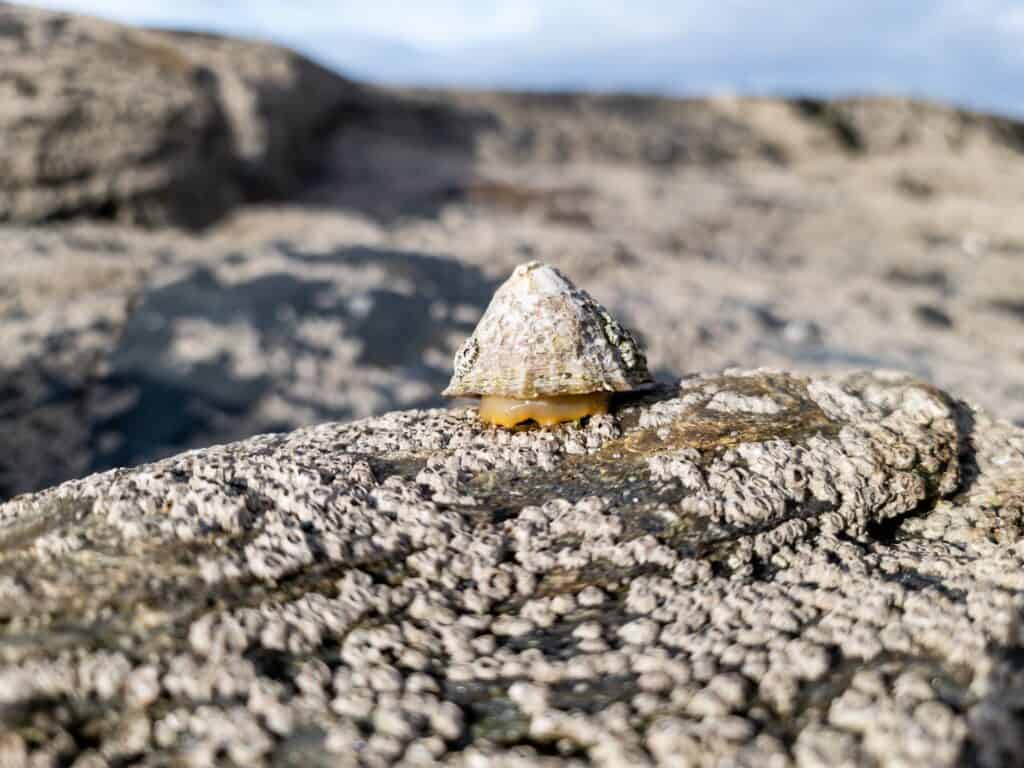
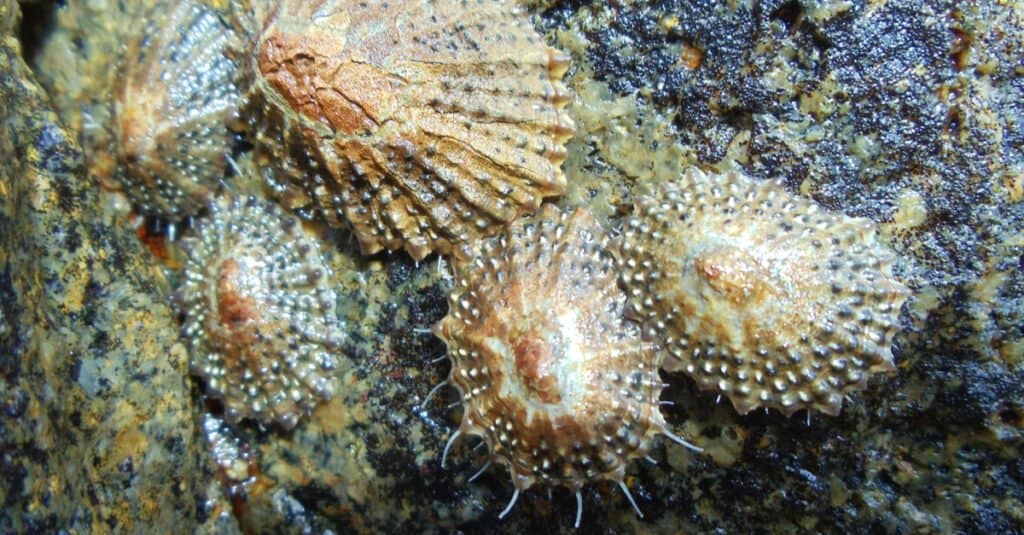
Limpets will move around while feeding, but usually return to a favorite spot to rest.

ยฉLukassek/Shutterstock.com

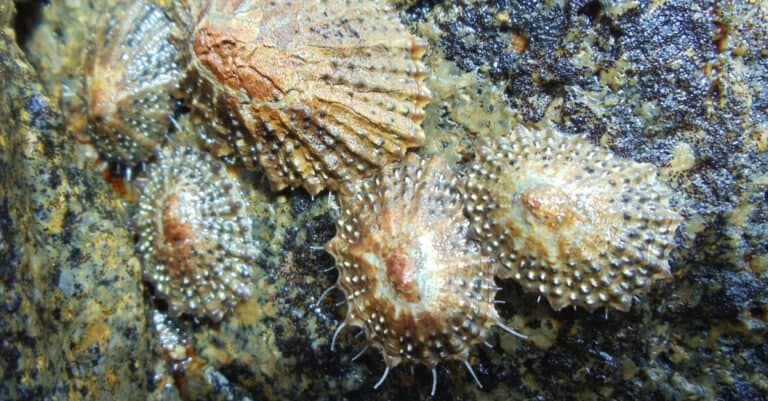
They can vary wildly in color, size, and shape. The one thing that all share in common is their conical shell. A common limpetโ€™s shell comes in green, brown, gray, or white hues. The shell typically features several rows of ridges and straight lines that run from the tip of the cone to the edge of the shell. On average, limpet shells measure between 1 and 4 inches long and weigh from 0.2 to 8.4 grams. Inside the shell rests the snailโ€™s body, which is also cone-like to fit the shape of the shell. The underside of its body consists of a muscular cushion known as the odontophore, which in turn supports the radula or tongue. They use their powerful tongues to scrape algae and seaweed off rocks and other surfaces. The tongue directs food into the downward-facing mouth and into the esophagus. 

Limpets possess hundreds of rows of sharp teeth, although only a few rows are dedicated to feeding. Their teeth are made from a mineral-protein composite, including iron, and are incredibly durable. With a tensile strength greater than spider silk and comparable to the strongest commercial steels, their teeth rank as the strongest known biological material in the world. Over time, they wear down their teeth but constantly replace them as they age. The teeth grow near the back of the radula and move forward over time, with each row getting replaced about once every 47 hours. 

Limpet Digestion

Their digestive tract is incredibly long and makes up a large part of their total mass. They require an extra-long digestive system and rectum to help them compact their fecal matter. Like other gastropods, limpets evolved to have a protective shell, but this added protection came at a price. As a result, their anus is located very close to their heads in a space known as the nuchal cavity. They must densely compact their feces to avoid soiling the cavity โ€” and their head โ€” with waste. A long digestive system aids in this process and allows them to maintain a healthy and clean living space. 

Limpet Distribution, Population, and Habitat

You can find them all over the world in intertidal zones and along rocky shores. Most tend to be confined to specific geographic zones, although their range can extend for hundreds or even thousands of miles. For example, common limpets range throughout Western Europe, shield limpets (Lottia pelta) live across the Pacific Northwest from Alaska to Baja California, and Australian freshwater limpets (Ancylastrum cumingianus) live in freshwater lakes in the Central Plateau of Tasmania. During high tide, limits move around to feed, but typically return to a favorite spot during low tide so they can secure and protect themselves from predators. Over time, the edges of the shell bore shallow grooves into the limpetโ€™s favored spot. These spots are known as homescars, and they help them stay attached to rocks during low tide. 

Limpets Predators and Prey

In the wild, several animals prey on this species. Their primary predators include crabs, lobsters, otters, seals, and starfish. During low tide, they must also contend with sea birds and lizards. Limpets have developed a number of adaptations to protect themselves from predators. Their shell serves as their first and most important form of defense. They attach themselves to rocks and other hard surfaces to protect their soft bodies using their powerful and adhesive tongues. The suction created by the tongue and mucus can make limpets extremely difficult to remove, thereby preventing predators from getting around their protective shells. Meanwhile, some other species developed other methods to protect themselves. For example, the rough keyhole limpet (Diodora aspera) hosts the scale worm (Anthessius nortoni). The limpet gives the scale word a home, while the scale worm protects it by biting and warding off predatory starfish.

Limpets are nocturnal herbivores that primarily eat algae, seaweed, and other marine vegetation. They use their powerful tongues or radula to scrape algae off rocks and other hard surfaces. During this process, they may sometimes also scrape young barnacles off rocks and consume them. They tend to move around while feeding, but will return to a preferred spot during the day to rest. Their feeding habits mean they serve an important role in maintaining the health of marine ecosystems as they control the rate of algae growth in the area. 

Limpet Reproduction and Lifespan 

Their sexual organs or gonads are located directly beneath the digestive system. When limpets are ready to reproduce, the gonads swell and burst, releasing either sperm or eggs into the surrounding water.  The gametes float around in the water until they come in contact with the gametes of other limpets, and fertilization takes place. This process, known as broadcast spawning, is most effective when multiple limpets in the same area release their gametes at the same time. Their larvae freely swim around for a while until they eventually settle down onto a rock or other hard surface and develop into adults. Unlike most animals, they possess the ability to change their sex depending on the reproductive needs of the environment. While most limpets are born male, they can change from male to female as they grow, and some will even switch back to male.

In addition to affecting its sex, a limpetโ€™s environment can significantly impact its life expectancy. Generally speaking, those that live in close proximity to large amounts of algae develop much more quickly. However, these limpets trade rapid development for a shortened lifespan. On average, those that live in close proximity to large amounts of algae only live for 2 or 3 years. Meanwhile, limpets that live on mostly bare rock can live up to 16 years, and some may live even longer.
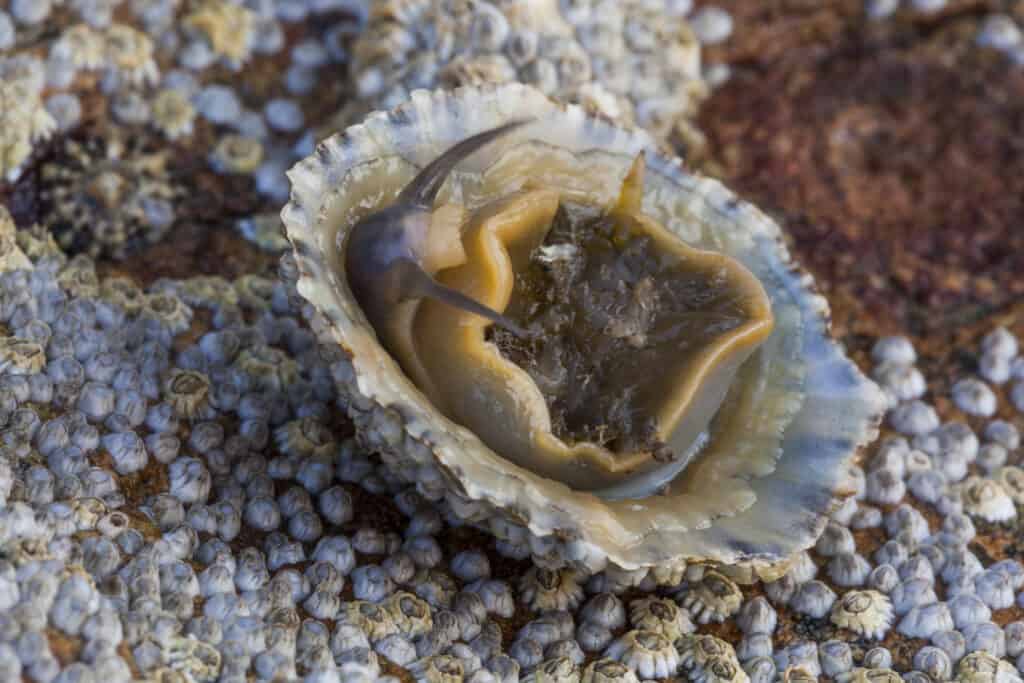
๐Ÿ‘ Limpet

You can find limpets all over the world in intertidal zones and along rocky shores.

ยฉCoxy58/Shutterstock.com

Limpet in Food and Cooking

Today, they are not commonly used in cooking, although they are edible. However, historically, limpets were eaten by many different people around the world.  Itโ€™s encouraged to remove any dark, inedible parts first and to rinse away any sand or debris before cooking. The best way to clean and cook a limpet is to boil it in water. They lose their shells quickly under high heat and take only a few minutes to cook. One popular way to prepare them is to boil them in water with pepper and anchovy sauce and then fry them in butter, vinegar, and pepper. 

Alternatively, you can bake them either in or out of their shells. Some people prefer to remove them from the shell and tenderize them with a hammer first before baking or frying. This is because limpets are notoriously chewy, so tenderizing can help make them more palatable. Lastly, some people choose to eat them raw. Be advised that eating them raw can pose considerable health risks, particularly if they live in an area with high pollution levels. 

Limpet Population

Overall, they are quite common and found nearly all over the world. They are extremely hardy and tend to adapt well to environmental changes and the effects of climate change. In fact, they may be particularly well situated to handle a warming climate. Warmer water can lead to increased algae growth. Increased algae provide more food for limpets to eat and can ensure more stable populations. While most limpet populations appear quite stable, a few are not faring as well. The ribbed Mediterranean limpet (Patella ferruginea) is native to the western Mediterranean Sea. Until the past few decades, it was quite common, but it has become rare and is now found only in a few locations. 

View all 130 animals that start with L

Sources

  1. Australian Museum / Accessed November 19, 2022
  2. American Oceans / Accessed November 19, 2022
  3. Scientific American / Accessed November 19, 2022

Thank you for reading! Have some feedback for us?

Contact the AZ Animals editorial team

Related Articles You May Find Interesting

A Little Known Mussel Is Disappearing and It Could Impact Entire Rivers

๐Ÿ‘ slug
Articles

Blue Blood and 27,000 Teeth: 10 Fascinating Facts About Slugs

Scientists Can Now Predict Where the Worldโ€™s Deadliest Scorpions Are Most Likely to Strike

This Iron-Toothed Sea Creature Found 18,000 Feet Down Has a Crowdsourced Name


Limpet FAQs (Frequently Asked Questions)

Limpets are nocturnal herbivores that primarily eat algae, seaweed, and other marine vegetation. That said, they may also consume young barnacles while scrounging for food.

You can find limpets in intertidal zones and rocky shores around the world.

While not widely eaten, limpets are edible when prepared properly and have historically been eaten by different cultures around the world.

Large crabs and starfish both prey on limpets as well as sea birds.