
L
Species Profile

Lungfish

Dipnoi

Breathe like a fish, live like a survivor
Galina Savina/Shutterstock.com

Lungfish Distribution

Click a location to explore more animals from that region

This map shows coastal regions where Lungfish are found.

Loading map...

At a Glance

Subclass Overview This page covers the Lungfish subclass as a group. Stats below are general traits shared across the subclass.
Also Known As Mudfish, Air-breathing fish, Living fossil
Diet Omnivore
Activity Nocturnal+
Lifespan 30 years
Weight 50 lbs
Status Not Evaluated
Did You Know?

Size range across living lungfishes: ~30 cm to ~1.5 m long (from small African species to Australia's large lungfish).

Scientific Classification

Subclass Overview "Lungfish" is not a single species but represents an entire subclass containing multiple species.

Lungfishes are air‑breathing lobe‑finned fishes characterized by functional lungs (in addition to gills) and a physiology adapted to low‑oxygen freshwater habitats. Extant lungfishes occur in Australia, South America, and Africa, and are notable for evolutionary relevance to early tetrapod relatives.

Kingdom
Animalia
Phylum
Chordata
Class
Sarcopterygii
Order
Dipnoi

Distinguishing Features

  • Presence of lungs enabling aerial respiration
  • Lobe‑finned (sarcopterygian) ancestry; fleshy paired fins (highly modified in African/South American forms)
  • Ability in many species to survive drought via aestivation (especially African and South American lungfishes)
  • Adaptations to low dissolved oxygen environments

Physical Measurements

Length
3 ft 3 in (12 in – 6 ft 7 in)
Weight
11 lbs (1 lbs – 110 lbs)
Top Speed
2 mph
swimming

Appearance

Primary Colors
Secondary Colors
Skin Type Thick, mucus-coated skin with small embedded scales (often reduced/obscured); tactile, slimy surface that resists desiccation and supports cutaneous respiration to varying degrees.
Distinctive Features
  • Measurements (range across extant Dipnoi): total length ~25-180 cm; mass from <1 kg to ~10-20+ kg in the largest individuals.
  • Lifespan (range across species): commonly ~15-50 years; some long-lived individuals can reach ~80-100+ years (notably in captivity).
  • Air-breathing physiology: functional lungs plus gills; frequent surfacing in hypoxic waters, with respiration strategy varying by lineage and season.
  • Body form varies: some robust with broad heads, others elongate/eel-like; all have lobe-finned heritage with paired fins often filamentous in African/South American forms.
  • Dentition: crushing tooth plates rather than typical marginal teeth; suited to hard-shelled prey and mixed diets.
  • Habitat/ecology (generalized): freshwater rivers, floodplains, swamps, and seasonal pools; strong tolerance of low oxygen and warm, stagnant conditions.
  • Drought survival varies: African and South American lungfishes commonly aestivate in burrows with mucus cocoons; Australian lungfish generally does not obligately aestivate and relies more on permanent waters.
  • Behavior varies but often includes nocturnal/crepuscular activity, sit-and-wait feeding, and opportunistic omnivory (invertebrates, mollusks, carrion, plant matter, small fish).

Sexual Dimorphism

Sexual dimorphism is often subtle, but in some African and South American lungfishes males develop temporary breeding-season pelvic fin filaments and associated swelling. Australian lungfish typically show minimal external dimorphism.

  • In some species, breeding males develop vascularized pelvic fin filaments ("external gills") to oxygenate nests.
  • May show seasonal enlargement around cloacal/urogenital region and increased nest-guarding behaviors (where present).
  • Often slightly fuller-bodied when gravid; otherwise external differences are minimal in many species.
  • Generally lack the male's temporary pelvic fin filament structures in lineages where they occur.

Did You Know?

Size range across living lungfishes: ~30 cm to ~1.5 m long (from small African species to Australia's large lungfish).

Lungfishes can be long-lived: roughly ~10 years in some species to 50-80+ years documented for the Australian lungfish in captivity.

All extant lungfishes breathe air with true lungs (in addition to gills), letting them survive in warm, stagnant, oxygen-poor waters.

African and South American lungfishes are typically obligate air-breathers as adults; Australia's lungfish relies more on gills and is not a classic long-term aestivator.

Some species endure drought by burrowing into mud and entering months-long aestivation, sealed in a mucus "cocoon."

During breeding, males of several African/South American species grow feathery, blood-rich pelvic fin filaments that help oxygenate the nest water for developing young.

Modern lungfishes are a small surviving branch of a once-diverse lineage; their anatomy helps scientists interpret early relatives on the tetrapod stem.

Unique Adaptations

  • Dual respiratory system: functional lungs plus gills, with physiology suited to hypoxic freshwater.
  • Aestivation toolkit (in several lineages): burrowing behavior, mucus cocoon formation, and metabolic depression to wait out drought.
  • Nitrogen-waste shift during air-breathing/aestivation: increased urea production/tolerance helps conserve water and manage waste when gill excretion is limited.
  • Lobe-finned body plan (Sarcopterygii): robust, limb-like paired fins and skeletal features that are informative for understanding early tetrapod relatives.
  • Sensory and feeding flexibility suited to murky wetlands: many can forage effectively in low visibility and tolerate wide swings in water quality.
  • Reproductive adaptation (in multiple African/South American species): vascular pelvic fin filaments in males that can raise oxygen availability around eggs/larvae in stagnant nests.

Interesting Behaviors

  • Air-gulping routines: many surface periodically to ventilate lungs; frequency varies with temperature and dissolved oxygen.
  • Drought survival strategies vary strongly: African and South American species often burrow and aestivate; the Australian lungfish generally persists in permanent waters and does not form the same prolonged dry-season cocoon.
  • Nest building and guarding occur in multiple species; adults may defend burrows/vegetation nests where eggs develop in low-oxygen conditions.
  • Seasonal movements within floodplains and backwaters are common where wet-dry cycles restructure habitat; patterns differ among riverine vs swamp-adapted species.
  • Feeding is flexible: diets span invertebrates, mollusks, crustaceans, and small fishes; proportions shift with local prey availability and life stage.
  • Low-oxygen tolerance behaviors: remaining relatively still, using aquatic vegetation cover, and timing activity to cooler periods can reduce oxygen demand.

Cultural Significance

Lungfish (Dipnoi), often called "living fossils", appear in museums and help explain how air-breathing and limb-like fins evolved. The Australian lungfish is an important river species; African and South American lungfish, called "mudfish", are eaten and burrow in droughts.

Myths & Legends

19th-century natural history lore: early European reports of the Queensland lungfish (then linked to the fossil name "Ceratodus") sparked popular "missing link" stories-presented in newspapers and lectures as a creature bridging fishes and land animals.

Naming traditions as cultural narrative: the term "lungfish" itself became a Victorian-era sensation because it foregrounded an animal that "breathes like a land creature," reinforcing public stories about evolution and deep time.

Colonial-era anecdote and reputation: Australian settlers' vernacular names such as "Burnett (or Queensland) salmon" entered local storytelling, reflecting how unfamiliar fauna were compared to known European fishes.

In markets and rainy season stories across parts of Africa and South America, people call lungfishes 'mudfish' and say they come back after the dry season when rains refill wetlands.

Conservation Status

NE Not Evaluated (group-level hub; IUCN assesses lungfishes at the species level, with statuses ranging from Least Concern to threatened categories)

Has not yet been evaluated against the criteria.

Population Unknown

Protected Under

  • Conservation landscape (hub-level): extant lungfish species show a status range from LC to threatened categories; common pressures are freshwater habitat modification, water extraction, and pollution. Notable at-risk species include the Australian lungfish (Vulnerable) and at least one West African species assessed as Endangered.
  • Geographic scope: lungfishes occur naturally in Australia, South America, and sub-Saharan Africa; protections therefore vary widely by basin and country, often tied to freshwater fishery rules, protected areas, and water-management policies.
  • Measurements (range across extant species): roughly ~30-200 cm total length (smallest African species to largest African/Australian individuals); mass ranges from a few hundred grams to roughly ~10-20+ kg depending on species and condition.
  • Lifespan (range across species): commonly ~10-30+ years in many African/South American lungfishes, with the Australian lungfish documented as exceptionally long-lived (often several decades; 50-80+ years reported).
  • Behavior/ecology (group generalizations with variation): all are air-breathing freshwater fishes of slow rivers, swamps, and floodplains; most are nocturnal/crepuscular benthic feeders. African and South American lungfishes commonly aestivate in dry seasons; the Australian lungfish typically does not. Reproduction often tracks floods; parental care occurs in some lineages.

Looking for a specific species?

Australian lungfish

Neoceratodus forsteri

Often highlighted in general references as "the lungfish" because it is the only living lungfish in Australia, is frequently cited in evolutionary discussions, and is one of the best-known extant dipnoans.

  • Subclass-wide size range is broad: roughly ~45 cm to ~2 m total length across living lungfish species (with substantial variation among the Australian, South American, and African lineages).
  • Lifespan varies widely among species and conditions: commonly reported from ~10-30+ years in several species, with exceptionally long-lived individuals in some taxa (often reported 60-80+ years in long-term captive/monitored cases).
  • Lungfish (Dipnoi) live in low-oxygen water and can breathe air. Australian lungfish rely more on gills and rarely go dormant; African and South American lungfishes must breathe air and can go dormant to survive drying.
  • Typical habitats across the group include slow rivers, billabongs/backwaters, swamps, and floodplains; ecology varies with local hydrology (permanent waters vs. seasonal wetlands).
  • Diet across Dipnoi is generally omnivorous/opportunistic (invertebrates, mollusks, small vertebrates, and plant material), with differences by species, size/age, and habitat.

You might be looking for:

Australian lungfish

30%

Neoceratodus forsteri

Only extant Australian lungfish; a large, slow-growing freshwater species in Queensland.

South American lungfish

25%

Lepidosiren paradoxa

Air-breathing lungfish from South America; capable of aestivation in mud during drought.

West African lungfish

15%

Protopterus annectens

One of several African Protopterus lungfishes; noted for strong aestivation ability.

Marbled lungfish

10%

Protopterus aethiopicus

Large African lungfish species complex from East/Central Africa.

Life Cycle

Birth 500 frys
Lifespan 30 years

Lifespan

In the Wild 10–100 years
In Captivity 15–110 years

Reproduction

Mating System Polygyny
Social Structure Transient
Breeding Pattern Seasonal
Fertilization Substrate Spawning
Birth Type Substrate_spawning

Behavior & Ecology

Social Aggregation Group: 2
Activity Nocturnal, Crepuscular, Cathemeral
Diet Omnivore Hard-shelled benthic invertebrates (especially snails/mollusks) and other slow-moving bottom fauna
Seasonal Hibernates

Temperament

Generally sedentary, secretive, and cover-oriented; emerges more in low light
Often tolerant at low densities, but can be territorial around burrows, shelters, or food
Aggression and activity typically increase during breeding (courtship, nest defense, rival exclusion)
Behavior varies with habitat oxygen, water level, and species (e.g., stronger nesting/guarding in some lineages)

Communication

Low-frequency grunts/clicks reported in some species, especially when disturbed or during interactions
Chemical cues in water for mate recognition and reproductive timing
Tactile contact and nudging during courtship; close-following near nests
Postural displays and fin/body movements for threat and spacing
Substrate or water-borne vibrations during movement in burrows or dense vegetation

Habitat

Biomes:
Freshwater Wetland Tropical Rainforest Tropical Dry Forest Savanna Temperate Forest
Terrain:
Riverine Plains Valley Muddy Sandy
Elevation: Up to 4921 ft 3 in

Ecological Role

Omnivorous benthic consumer and mesopredator in low-oxygen freshwater systems (wetlands, floodplains, slow rivers), linking invertebrate, plant/detrital, and small-vertebrate food webs.

regulation of aquatic invertebrate populations (including mollusks and insect larvae) energy transfer between detrital/plant pathways and higher trophic levels nutrient recycling via excretion, especially in seasonally pulsed floodplain systems bioturbation/substrate disturbance while foraging, influencing sediment mixing and microhabitats prey resource for larger predators (where present), supporting food-web stability

Diet Details

Main Prey:
Aquatic insect larvae Worms Snails and other mollusks Crustaceans Small fish and fish eggs Tadpoles
Other Foods:
Aquatic plants Algae and periphyton Detritus Seeds and soft fruits that fall into water

Human Interaction

Domestication Status

Wild

Lungfishes (Order Dipnoi) are not domesticated. People mainly catch them for food or small markets, fish them in local fisheries, collect them for research, and rarely keep them in aquariums. Interactions vary: African Protopterus are often harvested, South American Lepidosiren used locally as food, and Australian Neoceratodus is usually protected.

Danger Level

Low
  • Bites and lacerations when handling larger individuals (strong jaws/teeth; risk increases with size)
  • Minor injuries from thrashing/handling stress (slippery body, sudden lunges)
  • Potential zoonotic/skin infection risk common to handling freshwater fish (rare; mainly from poor wound care)
  • Ecological risk if released outside native range (invasive potential in suitable habitats), leading to indirect harm via ecosystem impacts rather than direct attacks

As a Pet

Not Suitable as Pet

Legality: Rules vary and often limit lungfish ownership. Many places require permits; some species—especially the Australian lungfish—are protected and not allowed in the pet trade. Transport, sale, and proof of legal source may be needed.

Care Level: Expert Only

Purchase Cost: $50 - $2,000
Lifetime Cost: $5,000 - $60,000

Economic Value

Uses:
Food fisheries (subsistence/local markets) Live animal trade (limited; aquarium/education) Scientific/biomedical and evolutionary research value Cultural/traditional use (localized) Conservation management/ecosystem value
Products:
  • meat (local consumption)
  • live specimens for public aquaria/educational display (where legal)
  • research specimens/data (non-commercial scientific value)

Relationships

Predators 8

Nile crocodile Crocodylus niloticus
African dwarf crocodile Osteolaemus tetraspis
Goliath heron Ardea goliath
Saddle-billed stork Ephippiorhynchus senegalensis
African sharptooth catfish Clarias gariepinus
Tigerfish Hydrocynus
Giant otter Pteronura brasiliensis
Human Homo sapiens

Related Species 6

Australian lungfish Neoceratodus forsteri Shared Order
South American lungfish Lepidosiren paradoxa Shared Order
West African lungfish Protopterus annectens Shared Family
Marbled lungfish Protopterus aethiopicus Shared Family
East African lungfish Protopterus amphibius Shared Genus
Spotted lungfish Protopterus dolloi Shared Genus

Ecological Equivalents 5

Animals that fill a similar ecological role in their ecosystem

Bichirs Polypterus spp. Freshwater fishes that frequently surface to gulp air using a lung-like organ. They overlap with lungfishes in low-oxygen swamps and floodplains and are often compared as "primitive" air-breathing fishes, though they are not close relatives.
Walking catfish Clarias batrachus Air-breathing freshwater fish tolerant of hypoxia; occupies stagnant or seasonally harsh waters similar to many lungfish habitats, representing convergent adaptation rather than shared ancestry.
Mudskippers Periophthalmus spp. Not freshwater lung-breathers, but strongly analogous ecologically and physiologically: fish capable of extended air exposure and of exploiting low-oxygen, marginal aquatic habitats.
Bowfin Amia calva A facultative air-breather using a modified gas bladder; it fills a similar niche as a hypoxia-tolerant predator in warm, weedy, low‑oxygen waters.
Swamp eels Synbranchus spp. Air-breathing fishes that persist in oxygen-poor wetlands and can endure seasonal drying; they often co-occur in comparable tropical/subtropical freshwater systems.

Types of Lungfish

6

Explore 6 recognized types of lungfish

Australian lungfish Neoceratodus forsteri
South American lungfish Lepidosiren paradoxa
West African lungfish Protopterus annectens
Marbled lungfish Protopterus aethiopicus
East African lungfish Protopterus amphibius
Spotted lungfish Protopterus dolloi

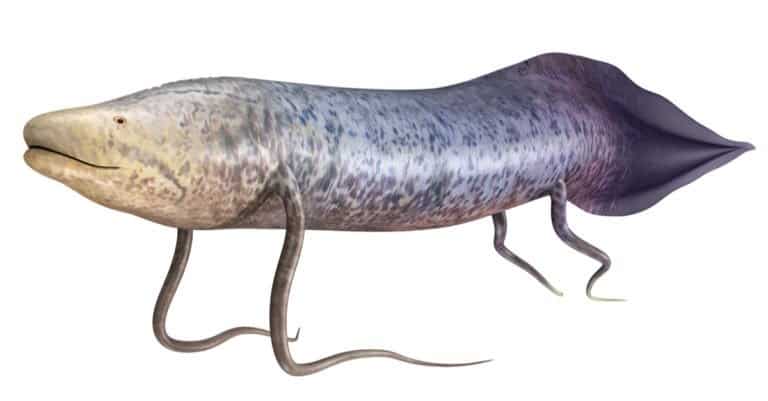
The modern lungfish is the product of an ancient lineage that dates back almost 400 million years. This “living fossil” is sometimes called primitive, but that does not mean its features are undeveloped, just that it has changed very little since first evolving. The most interesting characteristic of the lungfish is the presence of the internal lung, which serves multiple purposes. Like the swim bladder in other fish, the lung provides buoyancy while swimming, but it also absorbs oxygen and removes waste.

4 Lungfish Facts

  • Despite the presence of reduced or vestigial gills, most species must breathe exclusively through their pair of lungs. Only the Australian lungfish has fully operational gills, but one of its two lung sacs is also reduced or atrophied.
  • This creature may be the closest living relative of all tetrapods (mammals, amphibians, reptiles, etc). Some of the similarities between them include four limbs, a similar arrangement of skull bones, and the presence of tooth enamel and a pulmonary system. Some 400 million years ago, a fish-like ancestor began evolving into a tetrapod, and it probably looked something like the lungfish.
  • Some species survive the dry season by becoming dormant. This process involves burying their bodies in the bottom of the river or lake and then encasing themselves in mucous. Because the metabolic rate falls dramatically, the fish can remain in this state for more than a year. The South American lungfish burrows in the mud but doesn’t enter a dormant state. The Australian lungfish relies on neither strategy.
  • The Mortus lungfish is a fictional species in the online multiplayer video game Warframe. The mortus is highly fictionalized, however, with a big horn on its head and extravagant purple and red markings. The mortus is found in ponds all over the map.
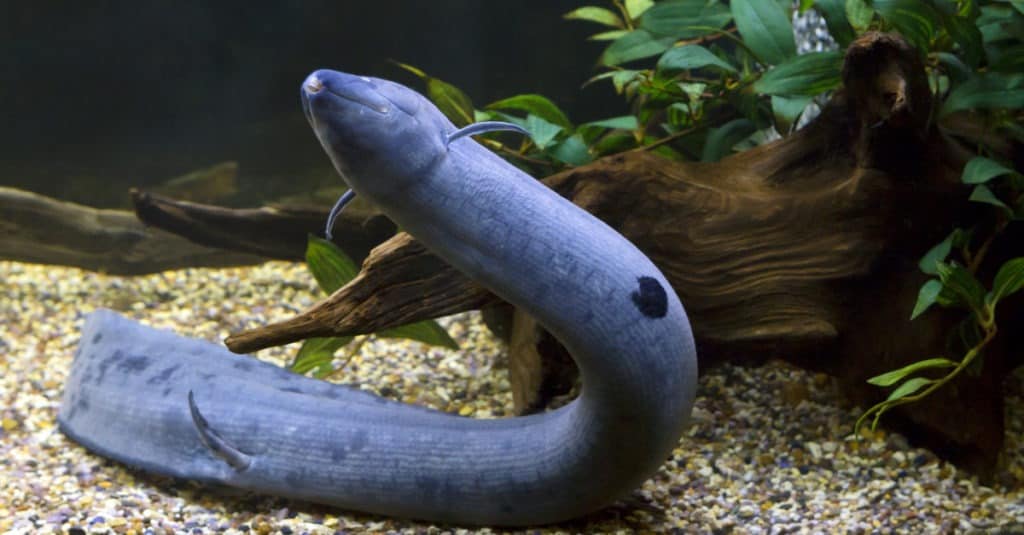
👁 South American lungfish

Not much is known about the South American lungfish.

©Galina Savina/Shutterstock.com

Lungfish Classification and Scientific Name

Lungfish belong to the order Dipnoi, a Latin term meaning roughly that it has two organs for breathing. The closest living relative of this creature is probably the ocean-based coelacanth, which was rediscovered in 1938. Both types of fish have changed little since evolving some 400 million years ago.

Lungfish Species

There are currently six species alive today. The four African lungfish all occupy a single genus, while the South American and Australian species both occupy their own genera.

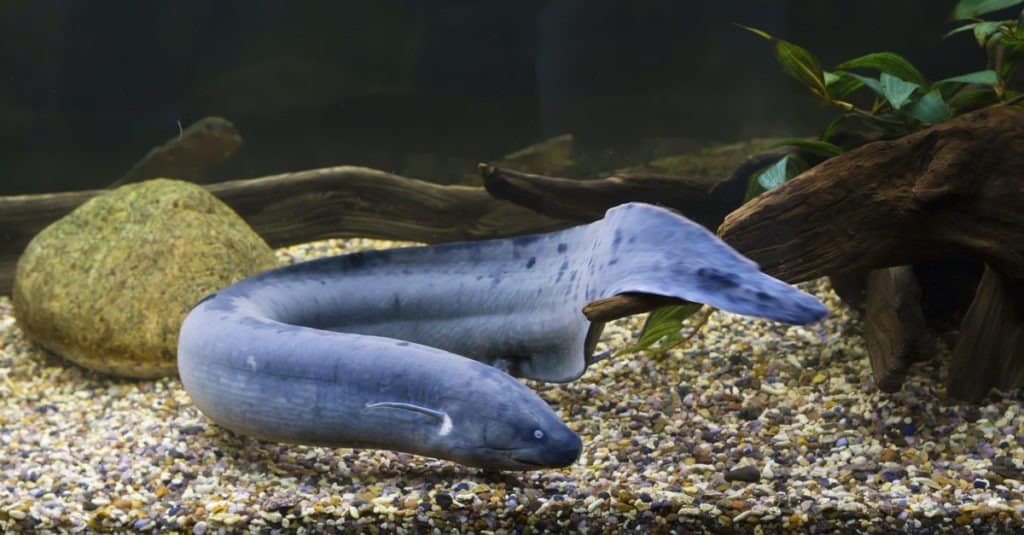
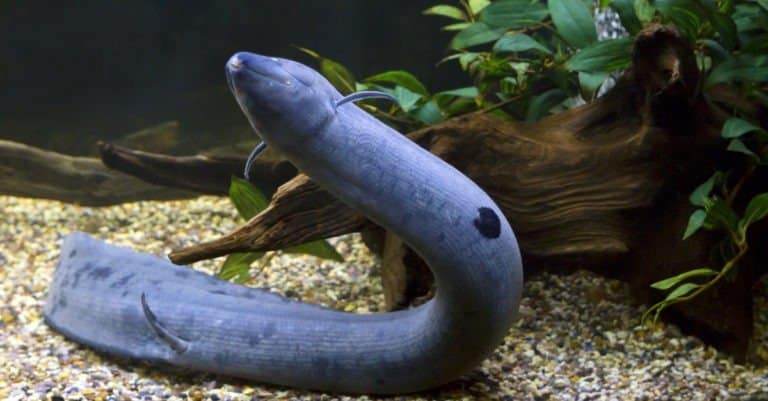
  • Gilled Lungfish (Protopterus amphibius): Sporting a blue or gray color, this species lives at the bottom of swamps and flood plains in East Africa. It is also known as the East African lungfish.
  • West African Lungfish (Protopterus annectens): As the name suggests, this species is endemic to West Africa. It has a long, eel-like body with an olive brown color and long, filament-like fins.
  • Spotted Lungfish (Protopterus dolloi): With a very long body covered in black spots (which diminish with age), this species is found in Gabon and the Republic of Congo.
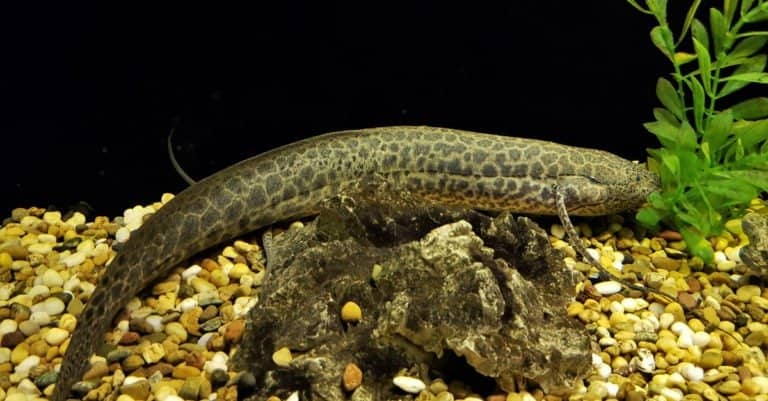
  • Marbled Lungfish (Protopterus aethiopicus): Found primarily in Eastern and Central Africa, the marbled lungfish has exceptionally long, sinewy fins and a leopard-like spot pattern.
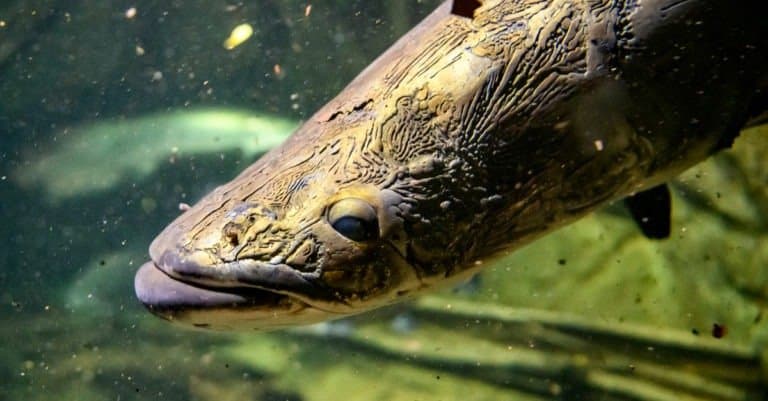
  • South American Lungfish (Lepidosiren paradoxa): Populating swamps and slow-moving waters, this species is something of a mystery. The juvenile has a unique pattern (gold spots on a black background) that fades to a brown or gray color as it ages.
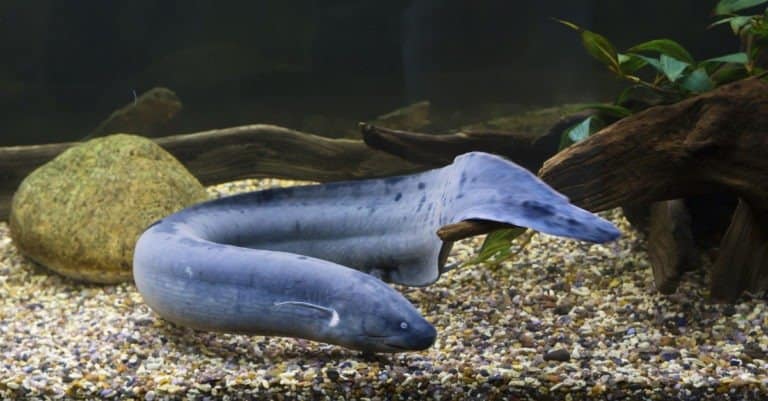
  • Queensland Lungfish (Neoceratodus forsteri): Sporting an olive brown back and yellowish-orange underside, this is the most “primitive” and distinct of all the lungfish. The body shape has remained almost unchanged for some 100 million years.

Lungfish Appearance

This is a type of lobe-finned fish whose dominant characteristic is the presence of a complex bone and muscular structure in the fins. It comes in a variety of different colors, body shapes, and sizes. The marbled lungfish is the largest currently living member of this order. It reaches up to a length of 7 feet and weighs almost 40 pounds, but even an average species grows to 4 feet and weighs up to 22 pounds. Most species have very poor vision (which can barely sense movement), but they compensate with their superior sense of touch, smell, and taste. Organs on the snout can also sense weak electrical fields. It has been suggested that the lungfish has changed very little over millions of years because of its stable environment and lack of real predators.

Lungfish Distribution, Population, and Habitat

This fish has a rather large and discontinuous range all over the tropical parts of the world. Four of the six species reside in Africa, while another species is endemic to Queensland, Australia. The only species in the Western Hemisphere resides in a small part of the Amazon basin near Paraguay. All of them are highly adapted for freshwater lakes, rivers, streams, and wetlands.

This fish was quite common all over the world until about 200 million years ago, when their numbers began to decrease. Most of the remaining species alive today are in no danger of extinction. According to the IUCN Red List, the four African species are currently classified as least concern, while only the Queensland lungfish is endangered. The South American lungfish is not categorized, since little is known about it.

Lungfish Predators and Prey

This fish is an apex predator in its native freshwater habitat. Almost nothing else grows large enough to eat it.

What Does the Lungfish Eat?

This creature’s diet consists of worms, crustaceans, insects, amphibians, plants, and even other lungfish. When opening its mouth, this animal sucks in prey and crushes them in its teeth. Although they will consume almost anything, some species can go years without eating.

What Eats the Lungfish?

An adult has no known natural predators, but the juveniles may fall prey to other fish and mammals.
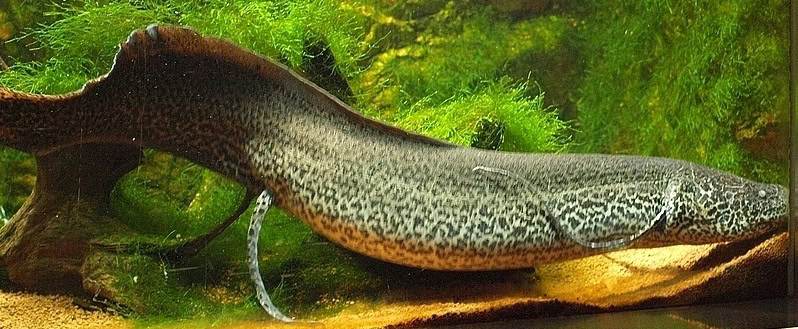
👁 marbled lungfish

Marbled lungfish have a leopard-like spotted pattern.

©OpenCage / CC BY 2.5 – Original / License

Lungfish Reproduction and Lifespan

This creature’s reproductive strategies vary by region and genus. Both the South American and Queensland lungfishes are different from the African lungfishes and from each other.

The African lungfish spawns at the beginning of the rainy season, at the end of winter. The larvae then emerge after about a week with bright red fan-like external gills to help them breathe until their lungs are fully developed. The male protects the young in his nest until they are ready to gain their independence.

The South American lungfish builds an even more elaborate nest consisting of a single vertical passage and a horizontal chamber at the bottom. The male, who guards the nest with his life, develops little tufts in the spawning season that release oxygen into the water to help the larvae breathe in their first few days of life before they can develop lungs.

The Australian lungfish doesn’t create a burrow at all. Instead, it lays the eggs among plants. The larvae, like the adults, have internal gills to breathe on their own.

Regardless of species, the lungfish is an especially long-lived fish. Recent research determined that some lungfish can live over 100 years. A Queensland lungfish named Granddad, which lived at the Shedd Aquarium in Chicago, was confirmed to be 109 years old when he was euthanized in 2017 due to declining health. He was seen by more than 100 million guests in his lifetime.

Lungfish in Fishing and Cooking

The lungfish is almost never used in human cuisine except as a local African delicacy where it’s particularly abundant.


View all 130 animals that start with L

Sources

  1. Britannica / Accessed December 1, 2020
  2. Oregon Zoo / Accessed December 1, 2020
  3. Shedd Aquarium / Accessed December 1, 2020

About the Author

Ashley Haugen

Ashley Haugen is the editor of A-Z Animals. She's a lifelong animal lover with an affinity for dogs, cows and chickens. When she's not immersed in A-Z-Animals.com (her favorite editorial job of her 25-year career), she can be found on the hiking trails of Middle Tennessee or hanging out with her family, both human and furry.
Connect:

Thank you for reading! Have some feedback for us?

Contact the AZ Animals editorial team

Related Articles You May Find Interesting

The Growing Black Bear Population Spreading Across New Hampshire Forests

👁 Image
Articles

A Mysterious Giant Phantom Jellyfish Appears in Rare Deep Sea Encounter


Lungfish FAQs (Frequently Asked Questions)

The lungfish diet consists of worms, crustaceans, insects, amphibians, plants, and other lungfish.

The lungfish breathes almost exclusively through its lungs. These organs are connected to a large tract that is covered in small blood vessels. Since the gills are poorly developed, most species of lungfish must return to the surface to breathe. The African lungfish needs to surface every 30 minutes on average. The Australian lungfish, which also relies on its gills to breathe, only needs to surface every 40 to 50 minutes.

By secreting a mucous, the lungfish can survive more than a year out of water. Otherwise, it would dry out.

Lungfish can be a little aggressive in their search for prey, but they aren’t aggressive toward humans.

Yes, but they are almost never caught for commercial purposes.