
M
Species Profile

Mandrill

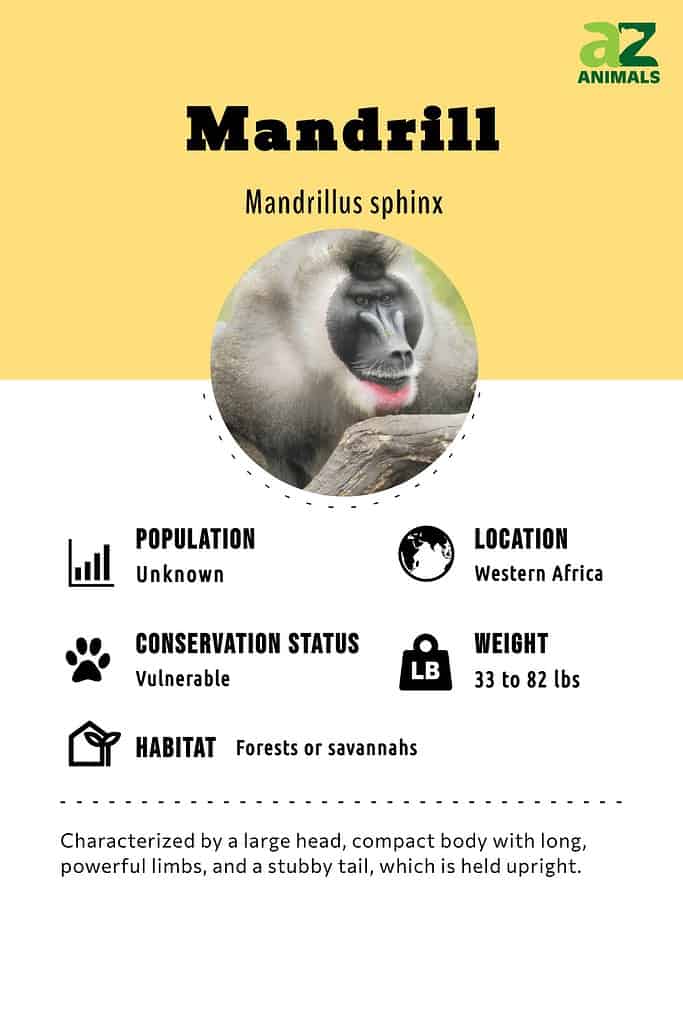
Mandrillus sphinx

Rainforest faces, forest foragers
Michael Pereckas / Creative Commons

Mandrill Distribution

Click a location to explore more animals from that region

Endemic Species
Loading map...

Size Comparison

Human 5'8"
Mandrill 1 ft 10 in

Mandrill stands at 32% of average human height.

At a Glance

Wild Species
Also Known As mandrill baboon, mandril
Diet Omnivore
Activity Diurnal
Lifespan 20 years
Weight 37 lbs
Status Vulnerable
Did You Know?

Mandrills are among the largest monkeys: adult males commonly weigh ~19-37 kg; adult females ~10-15 kg.

Scientific Classification

The mandrill is a large, primarily terrestrial Old World monkey noted for extreme sexual dimorphism and the maleโ€™s vivid red-and-blue facial ridges and brightly colored rump. It lives in Central African forests and is among the largest species of monkey.

Kingdom
Animalia
Phylum
Chordata
Class
Mammalia
Order
Primates
Family
Cercopithecidae
Genus
Mandrillus
Species
sphinx

Distinguishing Features

  • Adult males have striking red nasal ridge and blue lateral facial ridges; females are much less colorful
  • Robust build and large body size for a monkey; males often >20 kg
  • Short tail; mostly terrestrial but sleeps/forages in forest structure
  • Brightly colored rump and genital area (especially males)
  • Lives in large social groups; omnivorous diet (fruit, seeds, invertebrates, small vertebrates)

Physical Measurements

Males and females differ in size

Height
โ™‚ 1 ft 10 in (1 ft 6 in โ€“ 2 ft 2 in)
Length
โ™€ 2 ft 3 in (1 ft 12 in โ€“ 2 ft 6 in)
Weight
โ™‚ 66 lbs (44 lbs โ€“ 82 lbs)
โ™€ 26 lbs (22 lbs โ€“ 33 lbs)
Tail Length
โ™‚ 3 in (2 in โ€“ 4 in)
โ™€ 3 in (2 in โ€“ 4 in)
Top Speed
25 mph
running

Appearance

Primary Colors
Secondary Colors
Skin Type Dense coarse fur over most of body; bare, thickened, ridged facial skin and hairless ischial/perineal skin (sexual skin); prominent ischial callosities typical of Old World monkeys.
Distinctive Features
  • Old World monkey (Cercopithecidae) with short tail (typically ~5-10 cm).
  • Adult males have strongly ridged, laterally swollen muzzle with blue ridges and red midline stripe.
  • Brightly colored rump/perineal skin (pink-red with additional warm tones), most intense in dominant males.
  • Prominent pale beard/ruff; facial hair frames colored muzzle and enhances contrast.
  • Very robust build with long limbs adapted for mainly terrestrial forest travel and foraging.
  • Large canine teeth, especially in adult males (used in dominance displays and defense).
  • Strong sexual dimorphism in body size: adult males commonly ~19-37 kg vs females ~10-15 kg (reported ranges in field/captive sources).
  • Group-living forest primate; can form very large aggregations ("hordes"), with reports of several hundred individuals (documented in Gabon).
  • Omnivorous forager with frequent terrestrial feeding; diet includes fruit, seeds, invertebrates, and small vertebrates.
  • Conservation threats include hunting (bushmeat) and habitat loss/fragmentation in Central African forests (IUCN-assessed pressures).

Sexual Dimorphism

Extremely sexually dimorphic: adult males are much larger and show vivid red-and-blue facial ridges plus brighter perineal coloration, while females are smaller with muted facial coloration. Males also develop more robust heads and larger canines used in dominance displays.

โ™‚
  • Much larger body mass and more robust head/shoulders than females.
  • Vivid red nasal stripe and bright blue ridged facial swellings.
  • Brighter, more extensive pink-red perineal/ischial coloration.
  • Larger canine teeth and more pronounced cresting/facial musculature.
  • More conspicuous visual displays (yawning, facial/bodily postures) tied to coloration.
โ™€
  • Smaller overall size and more slender build.
  • Facial skin coloration present but markedly duller; reduced red/blue contrast.
  • Less extensive and less saturated perineal/ischial coloration.
  • Smaller canine teeth and less robust cranial features.
  • Color and ornamentation changes are subtler across social status.

Did You Know?

Mandrills are among the largest monkeys: adult males commonly weigh ~19-37 kg; adult females ~10-15 kg.

Head-body length is ~75-95 cm in males and ~55-66 cm in females; the tail is short (~5-10 cm).

Extreme sexual dimorphism: males can be more than twice the mass of females and develop the brightest red-and-blue facial ridges.

They can form exceptionally large "hordes"; aggregations up to about 1,300 individuals have been reported from Gabon's forests (field observations in Lopรฉ region).

Gestation is about 175 days (~5.8 months); births are often seasonal in equatorial forests, timed to peaks in food availability.

Mandrills are omnivores: fruit-heavy diets supplemented with seeds, fungi, insects, and small vertebrates; they are important seed dispersers.

Longevity: ~20+ years is possible in the wild; in captivity they can live 40+ years (records exceed four decades).

Unique Adaptations

  • Vivid structural and vascular skin coloration (red-and-blue facial ridges; bright rump) used in sexual and social signaling-especially in adult males.
  • Powerful jaws and large molars for processing hard items (seeds, nuts) alongside soft fruits; a flexible omnivorous toolkit.
  • Large cheek pouches (a cercopithecine trait) that increase feeding efficiency and reduce time exposed to predators/competitors.
  • Thick, tough ischial callosities ("sitting pads") typical of Old World monkeys, aiding long bouts of resting on branches and hard surfaces.
  • Short tail (unlike many monkeys) paired with strong terrestrial locomotion-well suited to moving through cluttered forest floor habitats.
  • Marked body-size dimorphism that supports a polygynous mating system: very large males can monopolize access during the breeding season.

Interesting Behaviors

  • Primarily terrestrial foraging: they travel and feed mostly on the forest floor but sleep and sometimes feed in trees.
  • Cheek-pouch "gather then process" feeding: they rapidly stuff foods into cheek pouches and later sort, chew, and swallow in safer spots.
  • Horde dynamics (fission-fusion): very large groups may split into smaller parties and later recombine, especially around patchy fruit resources.
  • Pronounced male competition: adult males fight with open-mouth threats and displays of large canines; top males gain disproportionate mating access.
  • Color as social signal: males' facial and rump coloration intensifies with dominance/testosterone and can change with social status.
  • Scent communication: they use sternal scent-glands and other scent-marking behaviors to leave chemical cues along travel routes and at key sites.
  • Mixed foraging tactics: they dig, rake leaf litter, and turn over debris to locate invertebrates and fallen fruits in dense rainforest understory.

Cultural Significance

Mandrill (Mandrillus sphinx) is a powerful, showy rainforest animal of Central Africa. People affect it through bushmeat hunting and new logging roads. Its bright colors make it an icon in zoos, art, and education about sexual selection and extreme dimorphism in Old World monkeys (Cercopithecidae), not apes.

Myths & Legends

Mandrill (Mandrillus sphinx) entered English from early West/Central African reports. The name probably means man + drill, linking it to the related drill (Mandrillus leucophaeus) and showing a humanlike, strong monkey.

Charles Darwin used brightly colored primates like the mandrill (Mandrillus sphinx) to show that flashy traits can evolve by mate choice and male competition, making the mandrill a classic example of sexual selection.

In modern culture, the wise primate Rafiki from Disney's The Lion King was visually based on a mandrill (Mandrillus sphinx) face. This connects mandrill colors to shaman or wise guide images in stories.

Conservation Status

VU Vulnerable

Facing a high risk of extinction in the wild.

Population Decreasing

Protected Under

  • CITES Appendix I
  • Protected under national wildlife legislation in range states (e.g., Gabon, Cameroon, Equatorial Guinea, Republic of the Congo) with varying enforcement
  • Occurs in multiple protected areas within its range (e.g., Lopรฉ National Park in Gabon; Campo Ma'an National Park in Cameroon; Monte Alรฉn National Park in Equatorial Guinea; Odzala-Kokoua National Park in the Republic of the Congo)

Life Cycle

Birth 1 infant
Lifespan 20 years

Lifespan

In the Wild 14โ€“24 years
In Captivity 18โ€“46 years

Reproduction

Mating System Polygyny
Social Structure Aggregation Group
Breeding Pattern Transient
Fertilization Internal Fertilization
Birth Type Internal_fertilization

In large multi-male/multi-female troops, reproduction is highly skewed: dominant adult males monopolize most peri-ovulatory matings and paternities (e.g., Setchell et al., 2005). Copulation is brief, internal fertilization; no pair-bonding-mating is opportunistic during seasonal estrus.

Behavior & Ecology

Social Horde Group: 615
Activity Diurnal
Diet Omnivore Ripe forest fruits (often including figs; oil palm fruits are also frequently taken where available).

Temperament

Female-centered sociality: females are philopatric and form matrilines; males disperse (Setchell et al.).
Strong dominance gradients: adult males show pronounced rank-related access to estrous females.
Fission-fusion dynamics: subgroup composition changes with foraging, travel, and resting demands.
Male sociality is seasonal: adult males commonly solitary, joining hordes around mating opportunities.
Generally wary and cryptic in dense forest; can be bold at mineral licks and rich feeding sites.
High tolerance within female kin networks; aggression more frequent around mates, rank disputes, and provisioning.

Communication

Grunts used as close-range contact calls during foraging and travel.
Alarm barks/screams given to predators and sudden disturbances; recruit group attention.
Low-frequency "roars"/threat vocalizations by adult males during dominance and mating competition.
Teeth-grinding and other noisy threat-associated sounds during tense interactions.
Facial and rump color signals: male redness/brightness tracks status and testosterone Setchell & Dixson
Facial expressions (stares, open-mouth threats), head-bobbing, and body postures to signal intent.
Olfactory communication via scent-marking and sniffing Including sternal/anogenital cues
Tactile social bonding: grooming, infant handling, and contact sitting within matrilines.

Habitat

Biomes:
Tropical Rainforest Wetland Savanna
Terrain:
Hilly Plateau Plains Valley Riverine
Elevation: Up to 5905 ft 6 in

Ecological Role

Omnivorous forest-floor forager functioning as both seed disperser and seed predator, and as a predator of invertebrates and small vertebrates.

Seed dispersal via endozoochory for many fleshy-fruited plants (movement of seeds away from parent trees) Seed predation/processing that can influence plant recruitment and community composition Bioturbation/soil disturbance from digging and litter-raking, affecting nutrient cycling and seed/seedling microhabitats Regulation of some invertebrate populations through predation

Diet Details

Main Prey:
Other Foods:
Ripe fruits Oil palm fruit Drupes and berries Seeds Nuts Young leaves Pith and shoots Roots and tubers Bark Fungi +4

Human Interaction

Domestication Status

Wild

Mandrill (Mandrillus sphinx) is wild and not domesticated. Humans affect them mainly by hunting for bushmeat, habitat loss from logging and farming, capture for zoos and past research, and rare illegal pet trade. Mandrills are ground-dwelling forest monkeys that form huge hordes (hundreds), making them vulnerable. Males are much larger (~20โ€“33 kg; females ~10โ€“13 kg). Wild lifespan ~20+ years, ~40+ in captivity.

Danger Level

High
  • Severe bite trauma: mandrills are large, powerful primates with long canine teeth; defensive/aggressive bites can cause deep lacerations, tendon damage, and infection.
  • Zoonotic disease risk from bites/scratches/body fluids (e.g., exposure to simian retroviruses documented in African primates such as simian foamy virus and related agents; risk depends on local pathogen prevalence and handling practices).
  • Handling/capture risk: chemical restraint and transport are hazardous for both humans and animals; improper restraint can trigger attacks.
  • Unpredictable aggression, especially in sexually mature males (linked to strong sexual dimorphism and dominance competition).

As a Pet

Not Suitable as Pet

Legality: Mandrill (Mandrillus sphinx) pet ownership is mostly illegal or tightly limited. CITES usually blocks trade. In the US rules vary by state; buying/selling, shows, and breeding need USDA-APHIS permits. EU bans or needs special permits.

Care Level: Expert Only

Purchase Cost: $5,000 - $20,000
Lifetime Cost: $100,000 - $500,000

Economic Value

Uses:
Ecotourism and wildlife-viewing value (national parks/reserves in Central Africa) Zoo exhibit and conservation-education value Biomedical and behavioral research value (historical and current noninvasive research contexts) Subsistence and commercial bushmeat value (illegal/unsustainable in many areas) Ecosystem services (seed dispersal in tropical forests)
Products:
  • bushmeat (meat; illegal or regulated in many range contexts)
  • non-material services: tourism/recreation, education, scientific knowledge

Relationships

Predators 5

Leopard Panthera pardus
African crowned eagle Stephanoaetus coronatus
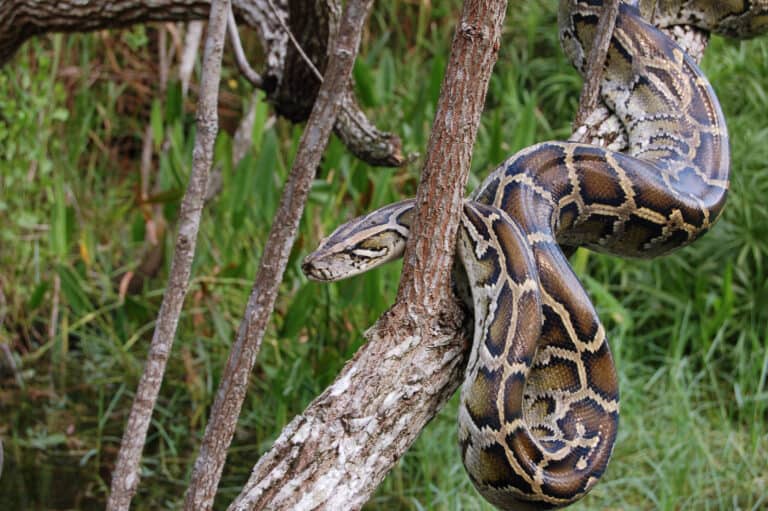
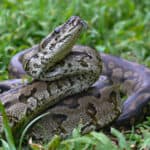
African rock python Python sebae
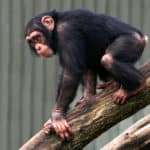
Chimpanzee Pan troglodytes
Human Homo sapiens

Related Species 8

Drill Mandrillus leucophaeus Shared Genus
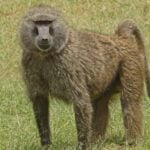
Olive baboon Papio anubis Shared Family
Chacma baboon Papio ursinus Shared Family
Guinea baboon Papio papio Shared Family
Gelada Theropithecus gelada Shared Family
Sooty mangabey Cercocebus atys Shared Family
Red-capped mangabey Cercocebus torquatus Shared Family
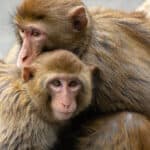
Rhesus macaque Macaca mulatta Shared Family

Ecological Equivalents 5

Animals that fill a similar ecological role in their ecosystem

Drill Mandrillus leucophaeus Large, mostly ground-living Central African forest papionin monkey that forages on the forest floor for fruits, seeds, and insects. Both Mandrillus species exhibit pronounced maleโ€“female size differences and bright male coloration.
Olive baboon Papio anubis Mandrills are large, ground-dwelling monkeys that eat plants, insects, and small animals and live in large social groups. Olive baboons overlap with mandrills at forest-savanna edges and compete for fruit and ground foods; baboons use more open areas than mandrills.
Sooty mangabey Cercocebus atys Both species live partly on the ground in West and Central African forests, eat seeds, nuts, fruits, insects, and small animals, may compete for seasonal fruit and other forest-floor foods, and can consume or sometimes disperse seeds.
Chimpanzee Pan troglodytes Co-occurs with mandrills in Central African forests; both eat mainly ripe fruit with some animal prey, use the same foraging patches, and compete at fruit trees. Chimpanzees sometimes prey on young, which can affect seed fate.
Red river hog Potamochoerus porcus Non-primate niche analogue: a forest-floor omnivore in Central African rainforests that feeds on fallen fruit, roots, invertebrates, and small vertebrates. Like mandrills, it can concentrate at mast/fruiting events and may indirectly compete for ground-level fruit abundance in dense forest settings.

โ€œThe mandrill has a truly unique appearance that sets it apart from other primates.โ€œ

Although nearly weighing as much as an ape, the mandrill is actually a type of monkey, splitting its time between the ground and trees. Its bright facial colors and oddly shimmering fur are instant head turners for gawking tourists and zoo-goers alike. However, the spread of human civilization has threatened the survival of the species throughout its native habitat in Africa.

3 Incredible Mandrill Facts

  • The mandrill is an animal that displays a vivid and striking coloration around the body that defies easy description. This feature once led Charles Darwin to write, โ€œNo other member in the whole class of mammals is colored in so extraordinary a manner as the adult male mandrills.โ€
  • Mandrills store food in their extra-large cheek pouches.
  • The character of Rafiki from The Lion King, though described as a baboon, appears to have the colorful face of the mandrill.
๐Ÿ‘ Image

Scientific Name

The scientific name for the mandrill is Mandrillus sphinx. It is named after the ancient Greek mythological figure that had the head of a human and the body of an animal, perhaps reflecting its strange appearance.

The mandrill is part of the family Cercopithecidae, which includes all Old World monkeys. As the name implies, the Old World monkeys live exclusively in Africa and Asia. This distinguishes them from the New World monkeys, which live in the Americas. The physical differences between them are subtle, but Old World monkeys lack a prehensile tail and have a more prominent nose.

Evolution And Origin

As a result of convergent evolution, which is when a species inhabits similar ecological areas and adapts similarly to the same selective pressures, the mandrill, as well as the drill, was originally classified as a forest baboon as they had many baboon-like traits. While the exact history of the mandrill is not well known due to a lack of fossil findings, the first monkey appears around 34 million years ago, during the Eocene era, which then led to the evolution of the Old World Monkey, in the Miocene era, 24 million years ago.

Types Of

The mandrill is only one of two living species in the genus Mandrillus sphinx. The other living species is the Mandrillus leucophaeus, commonly known as just the drill. Both of these species have similar social structures, habitats, and appearances, but the drill is also far less colorful than its vivacious sibling.

Appearance
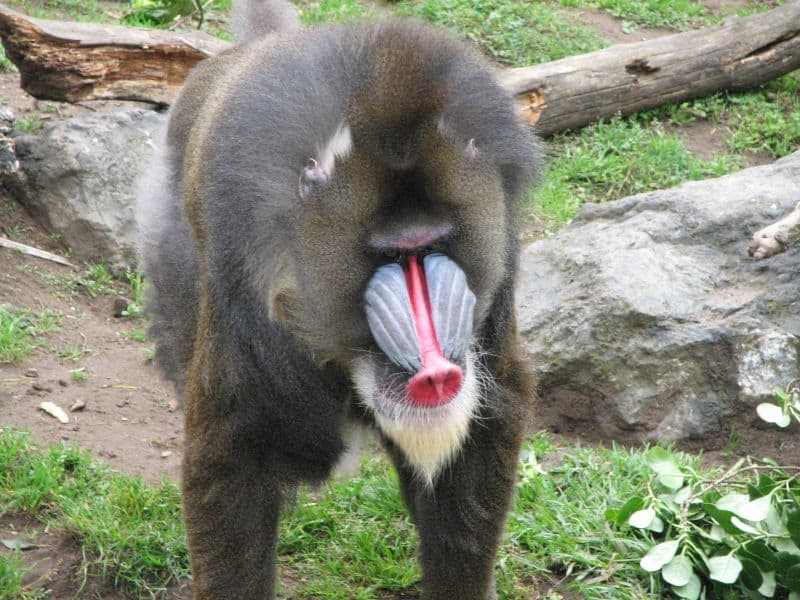
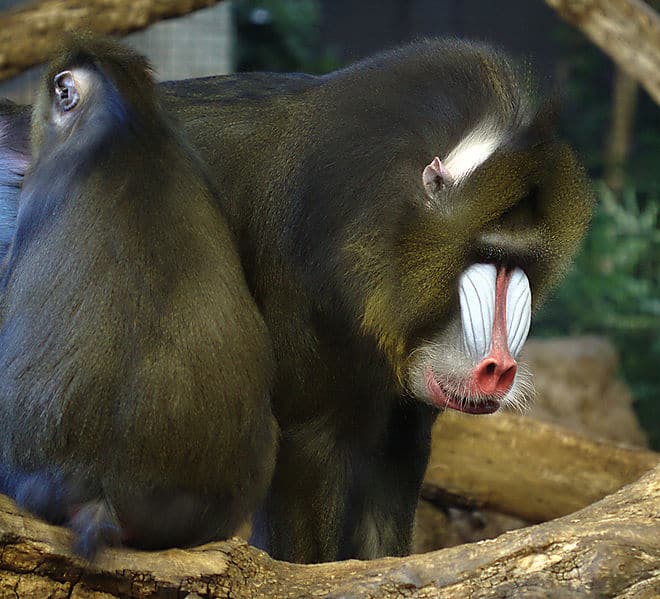
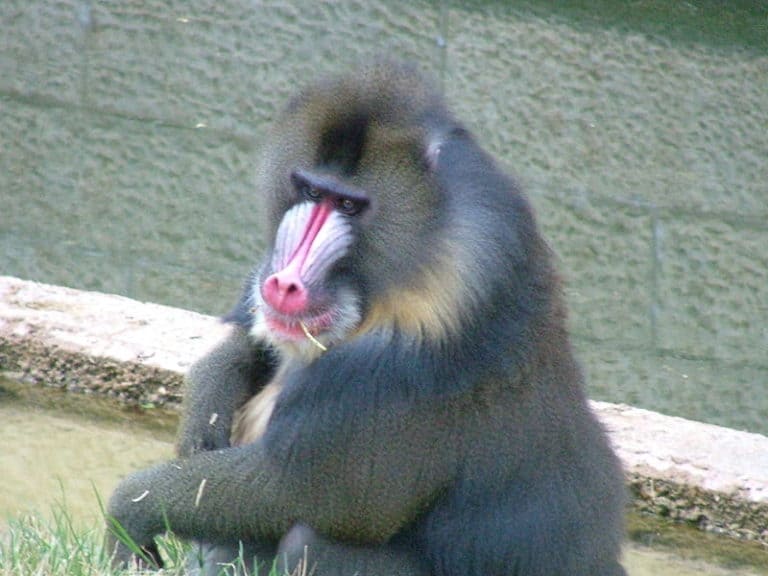
๐Ÿ‘ Facial view of the mandrill

Mandrills are most recognized by the bright red markings on certain parts of their bodies.

ยฉJust chaos / Creative Commons โ€“ Original

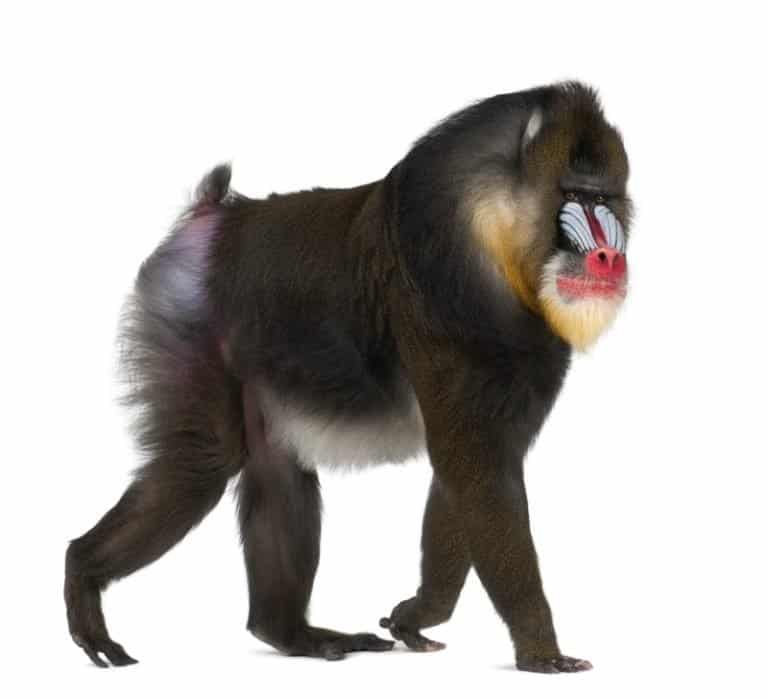
Unique in appearance, the mandrill is an animal that features a very long muzzle, a prominent brow, and a short, almost nonexistent tail. This is complemented by an elegant coat of dark green and gray fur with tufts of white hair on its stomach and a long, yellow beard. Combined with its long, muscular limbs, compact body, and enlarged head, the mandrill looks a bit unusual to the human eye, as if it was put together from various parts. But the species is actually quite adept and agile with a large range of movements and postures. Though normally walking on all four limbs, the mandrill can also sit or lay down on its rather thick rear end. It also has opposable thumbs and big toes for grasping objects and climbing trees. The animal spends part of its life above ground, jumping from branch to branch.

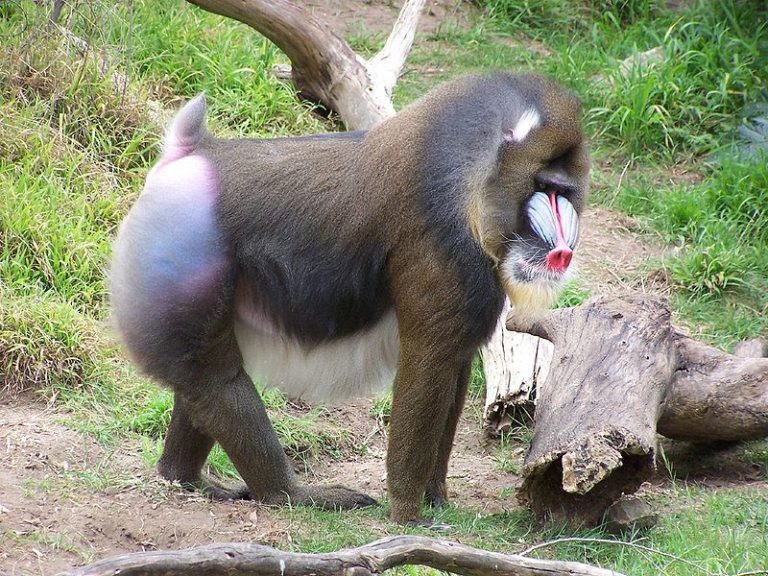
The most recognizable aspect of the mandrillโ€™s appearance is the exotic markings on certain parts of the body, including the bright red ridges of the nose and mouth, light blue cheeks, and colorful rear end. These markings actually serve an important social function. When incensed or worked up, some of the colors on the body will become more intense. A display of the rump may also demonstrate submissiveness or female mating availability.

In sheer size, the mandrill is perhaps the largest of the Old World monkeys. The male of the species can weigh around 70 pounds and possibly more than 100 pounds while reaching a height of more than 30 inches. The mandrill size is about the same as a large dog. However, the female is significantly smaller than the male; it weighs only around 30 pounds. This extreme difference between the mandrill size in sexes is one of the largest among primates. Another important sexual distinction is that males tend to sport brighter colors. This has important implications for the mating behavior of the species, since brighter colors may signify dominance.

Teeth
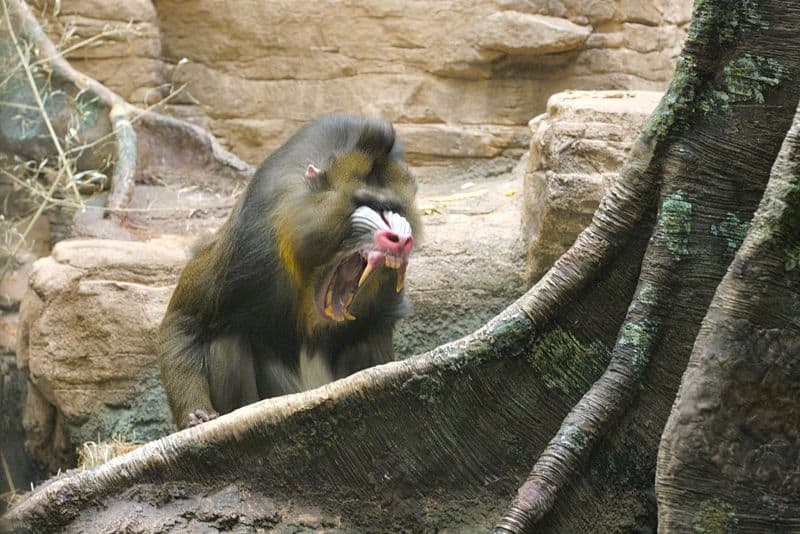
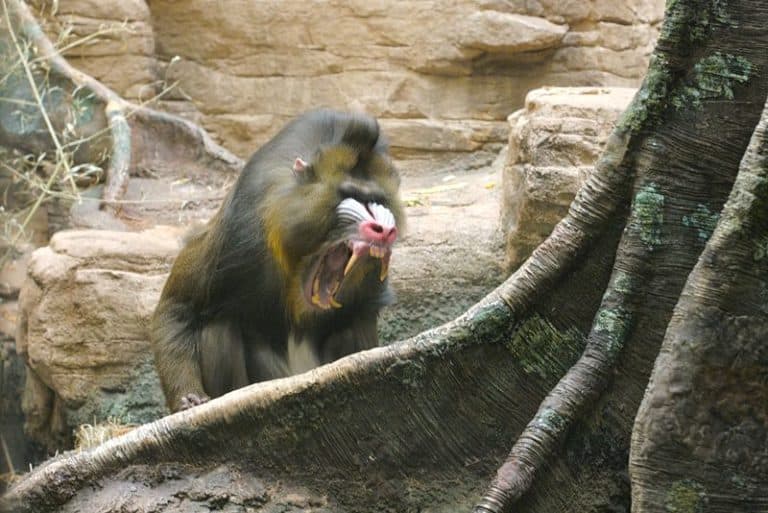
๐Ÿ‘ Mandrill showing large canine teeth

Mandrill

ยฉRyan E. Poplin / Creative Commons

The massive canine teeth are normally hidden from view, but when the mandrill opens its mouth, they become very apparent.

Behavior
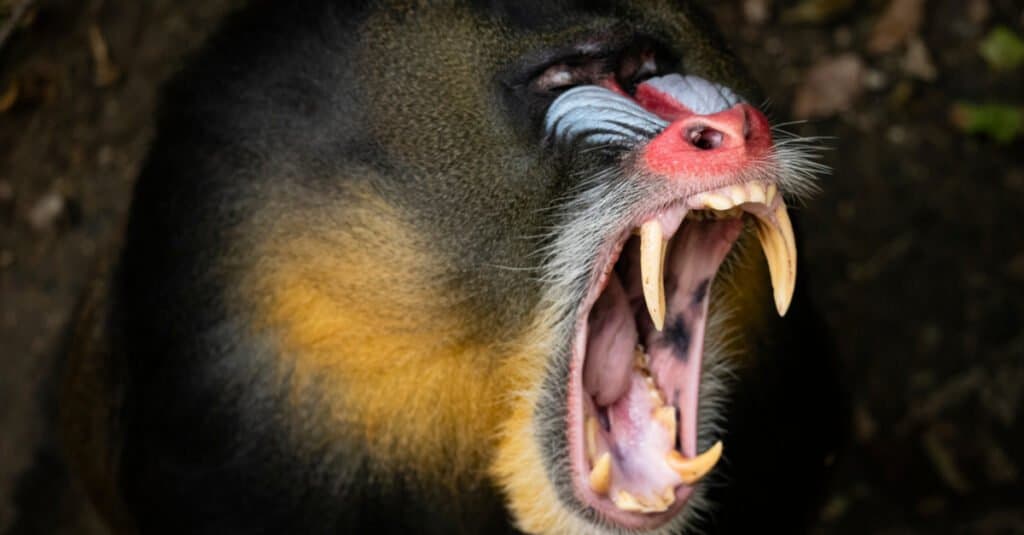
๐Ÿ‘ Monkey Teeth - Mandrill Teeth

Mandrills expose their teeth as one of their communication strategies.

ยฉMaciej Kopaniecki/Shutterstock.com

Coloration is only one aspect of the mandrillโ€™s vast array of communication strategies. Visual signals, body posture, scent markers, and vocalizations are used to convey all sorts of information for mating, playfulness, warnings, and other behavior. For example, the exposure of teeth is one of the most common signals. It is actually a sign of friendliness and joviality rather than an aggressive action. If the mandrill does become angered, then it will visibly slap the ground with its hands and stare with intensity at its target. Grooming is another common behavior that helps to reinforce bonds between members of the group. They will also use various vocal sounds such as grunts and howls to communicate mood, especially if they lose visual contact with each other. And the presence of a scent gland on the chest enables them to signal their presence by rubbing various chemicals on objects.

Because social relations are such an important aspect of their behavior, mandrills seek safety in large numbers. A single group, known as a troop or horde, can consist of around 50 members, though some groups may join together for short periods of time. The largest group ever recorded was around 1,200. The horde has a distinct social hierarchy in which every member has a place. At the top of the hierarchy is a single dominant male who has exclusive breeding rights and the responsibility to defend the group from outside threats. The health and stability of the entire horde can often depend on the actions of the leader.

Male and female mandrills exhibit very different relationships within and to the group. Males tend to wander away from the group after reaching full maturity and will sometimes form all-male bachelor groups. The females stay within the same group of their birth, which often allows them to form strong lifelong bonds with each other.

Mandrill intelligence isnโ€™t quite as well-explored by scientists as gorillas and chimpanzees, but observations in captivity and the wild have documented a variety of different tool uses, both to hunt for food and for grooming. Studies also suggest that they are capable of displaying decent long-term memory, facial recognition, and problem-solving.

Habitat
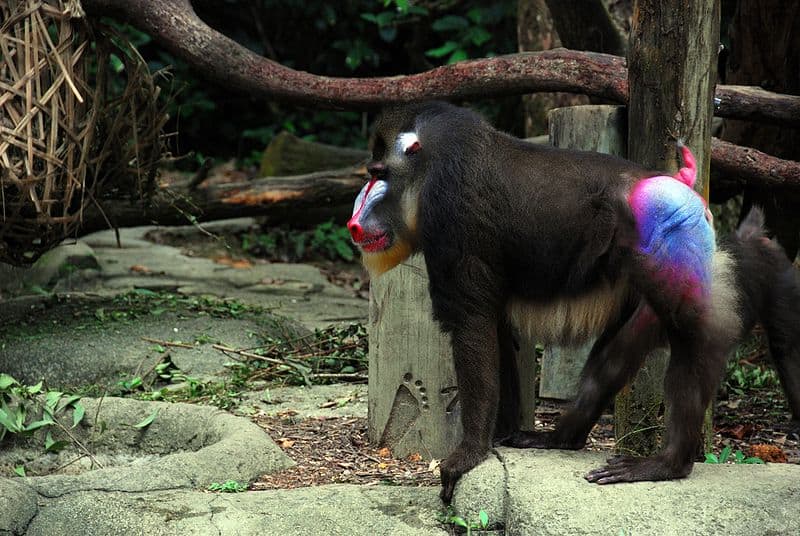
๐Ÿ‘ Mandrill

Mandrills live mostly in forests in Western Africa.

ยฉRobert Young / Creative Commons โ€“ Original

Mandrills primarily live in the forests of Western Africa, often adjacent to rivers, wetlands, or savannahs. The animalโ€™s main range straddles the countries of Congo, Gabon, Cameroon, and Equatorial Guinea. Although primarily adapted for a terrestrial lifestyle, this species actually gathers together at night in the trees for safety and comfort. They have a tendency to switch between different trees every night within their range.

Population
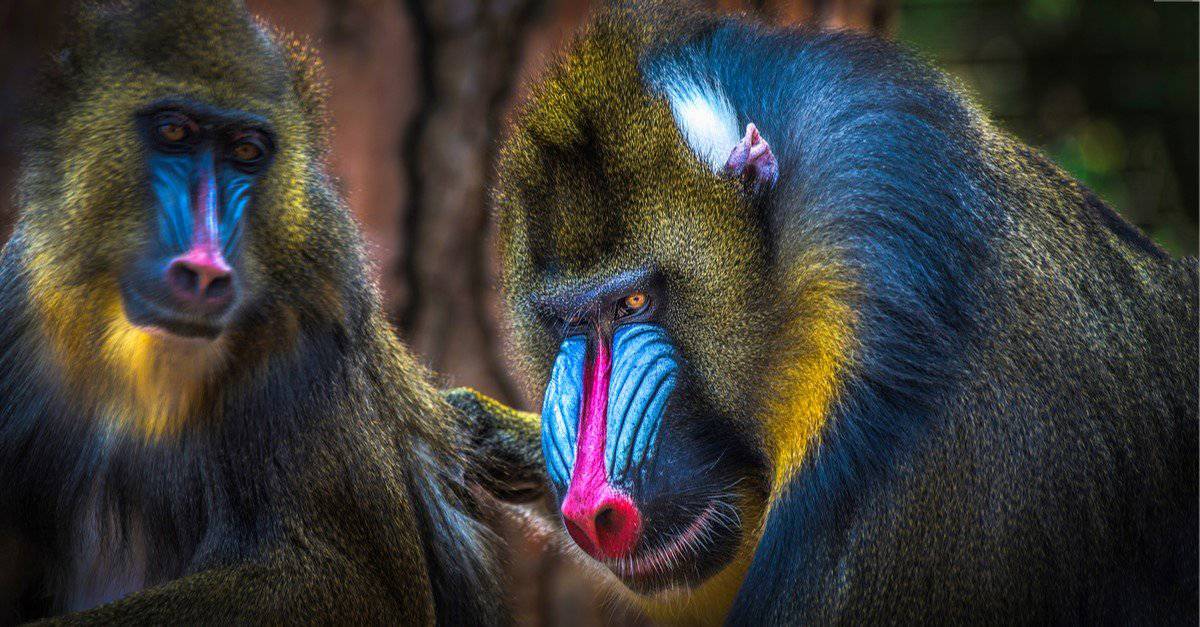
๐Ÿ‘ Most Colorful Animals: Mandrill

Mandrills are threatened by destruction in their habitat and hunting for their meat.

ยฉNikolay 007/Shutterstock.com

According to the IUCN Red List, which classifies the conservation status of many species, mandrills are currently vulnerable to extinction. Exact population numbers are unknown, but habitat destruction from agriculture, industry, and human settlements appears to be the leading cause of their slow decline. Mandrill bushmeat, or the hunting of wildlife for food, is still an ongoing practice in 21st-century Africa as well. In order to prevent their extinction, conservation efforts are focused on the institution of anti-poaching and surveillance measures to prevent excessive hunting. Conservationists also need to work with local governments to halt the decline of natural habitats. Mandrills donโ€™t yet need emergency measures to survive, but the downward trend in numbers is worrying.

Diet

Mandrills are expert foragers that hunt both plants and small animals such as fungi, roots, seeds, fruit, insects, worms, amphibians, lizards, snakes, snails, eggs, and small mammals. Their diet is truly prolific and may include as many as a hundred different species. The mandrill sexes pursue different hunting strategies. Adult males tend to forage on the ground, whereas females and children tend to forage in the trees. The mandrills play an important ecological role by helping to disperse seeds around the local forest environment.

Predators And Threats

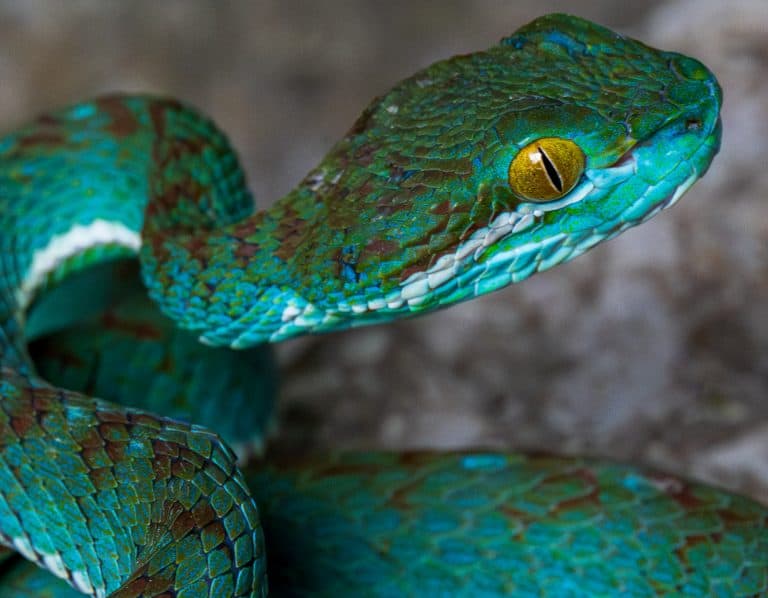
Because of their large size, mandrills have few natural predators in the wild, except for leopards and, of course, humans, who have traditionally hunted them for food. Mandrills may be killed by accidental contact with venomous snakes too. The size of the group alone provides plenty of protection against danger, but if an individual is cornered, then the large canine teeth also provide a suitable defense. More recently, habitat loss has been another significant danger to their continued existence.

Reproduction, Babies, And Lifespan
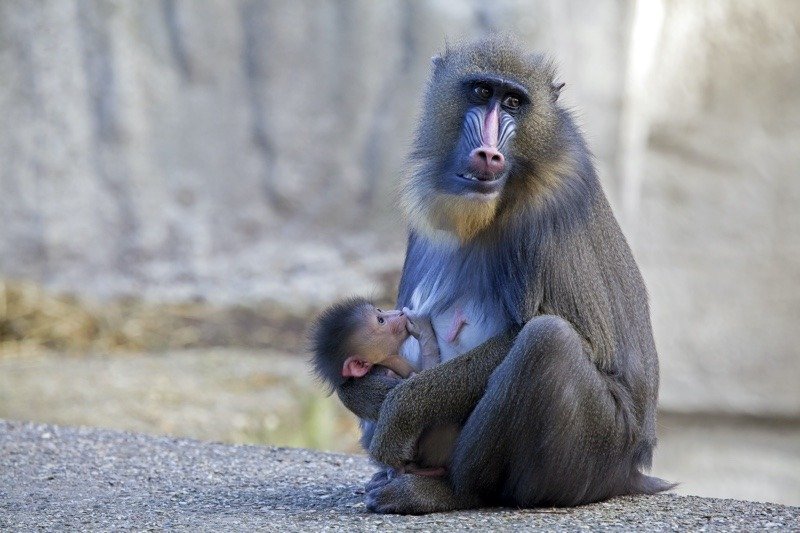
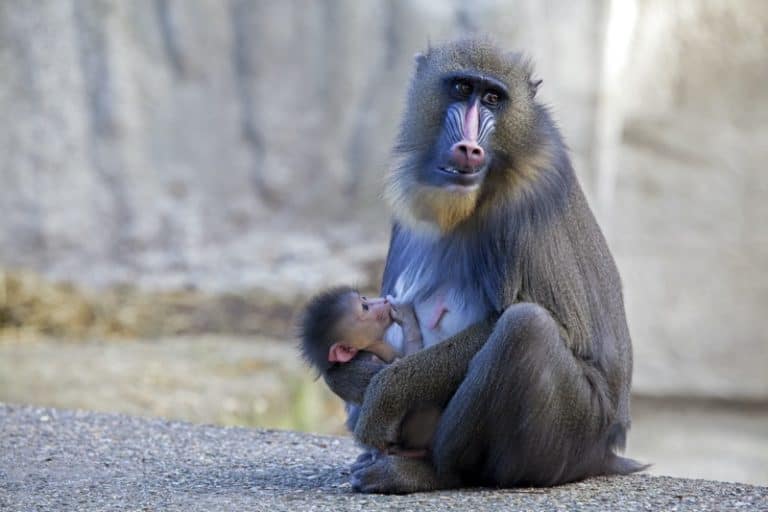
๐Ÿ‘ Mother and baby mandrill

Females only birth one baby at a time, although twins have been observed in captivity.

ยฉEdwin Butter/Shutterstock.com

Mandrills form a harem-type society in which a single male has exclusive mating rights with a group of females. In an interesting twist, the females actually choose which males they will breed with. One theory is that the females select the male with the brightest colors because the intensity of the colors is a direct reflection of the maleโ€™s testosterone level, which denotes its health and physical viability. This is an example of sexual selection in which one sex develops exaggerated features to convey information and help the opposite sex choose an appropriate mate. Another possibility is that male coloration becomes brighter only after being selected by females. Either way, male aggression does occur and sometimes turns deadly, but itโ€™s not as pronounced as you might expect.

The timing of the breeding season varies based on food supply, but it tends to occur every two years between the months of July and October. The female will carry the young for about six months from around January to March before finally giving birth. Only one mandrill is produced at a time, while twins have only been observed in captivity. For the first two months of its life, the young mandrill sports a black coat and pink skin, which will develop into its regular coat over the ensuing months and years. The mother provides the vast majority of the protection, feeding, and grooming, while the father contributes very little directly but may help indirectly by protecting the group.

After achieving independence, the young mandrill must find food on its own and work its way through the ranks of the group hierarchy. A female mandrill will reach sexual maturity after a minimum of four years. Males, on the other hand, take a full nine years to reach sexual maturity. Mandrills typically live more than 20 years in the wild. The highest lifespan ever recorded was 46 years in captivity.

In The Zoo

Mandrills are a regular fixture at the San Diego Zoo. The first pair of mandrills, Peter and Suzy, arrived in 1923 but never reproduced with each other. The zoo later established a breeding program in 1938 and maintained a consistence presence of mandrills ever since, even welcoming a new child in 2016. Mandrills are also a regular sight at the Denver Zoo, the San Francisco Zoo, and the Columbus Zoo and Aquarium.

View all 330 animals that start with M

Sources

  1. Animal Diversity
  2. San Diego Zoo
  3. Scientific American
  4. IUCN Red List

About the Author

Melissa Bauernfeind

Melissa Bauernfeind was born in NYC and got her degree in Journalism from Boston University. She lived in San Diego for 10 years and is now back in NYC. She loves adventure and traveling the world with her husband but always misses her favorite little man, "P", half Chihuahua/half Jack Russell, all trouble. She got dive-certified so she could dive with the Great White Sharks someday and is hoping to swim with the Orcas as well.
Connect:

Thank you for reading! Have some feedback for us?

Contact the AZ Animals editorial team

Related Articles You May Find Interesting


Mandrill FAQs (Frequently Asked Questions)

The mandrill is actually a type of monkey, not an ape. There is some confusion on these terms. Both monkeys and apes are primates, but they have distinct evolutionary lineages and some differences in their physiology and appearance. More confusingly, the Old World monkeys are actually more closely related to apes such as chimpanzees and gorillas than the New World monkeys. The important thing to remember is that all three groups are very distinct from each other.

The mandrill is an omnivorous species that feeds exclusively on plant matter and small animals.

Mandrills occupy rainforests, forested stream beds, and similar types of forests. These areas provide an abundant source of food and water.

The mandrills and baboons were once classified in the same genus. However, the mandrill was eventually moved to the genus Mandrillus, while the baboon was kept in Papio. Like the mandrill, the baboon is one of the largest primates in the world. It has a similar diet and social arrangement. However, there are several important differences, including the absence of colorful facial features in the baboon.

The mandrill can be quite aggressive about defending its territory. However, this species has no desire to attack humans if left alone in peace.

Mandrills belong to the Kingdom Animalia.

Mandrills belong to the class Mammalia.

Mandrills belong to the phylum Chordata.

Mandrills belong to the family Cercopithecidae.

Mandrills belong to the order Primates.

Mandrills are covered in Fur.

Mandrills belong to the genus Mandrillus.

Predators of Mandrills include leopards, eagles, and snakes.

The average number of babies a Mandrill has is 1.

Mandrills have distinctively colored noses and rumps!

The scientific name for the Mandrill is Mandrillus Sphinx.

Mandrills can live for 20 to 28 years.

A Mandrill can travel at speeds of up to 25 miles per hour.

A gorilla would win a fight against a mandrill without much effort. When provoked to anger, gorillas become fierce creatures that show off their strength, speed, agility, and intelligence by systematically maiming their foes. They are much stronger than mandrills, and they have a massive size advantage where they can be over five times their size.