

Quick Take
- Margays require 180-degree foot rotation to achieve head-first descent from the forest canopy.
- The IUCN reduced the count from 11 subspecies to 3, complicating current conservation monitoring efforts.
- It is unorthodox that Margays utilize vocal mimicry of prey to facilitate a successful ambush.
- The scat analysis process was necessary to confirm that Jaguars and Pumas act as primary predators.
The margay is a small, spotted cat native to South America, Central America, and Mexico. It is roughly the size of a domestic cat, and about a third of the size of its close relative, the ocelot. Margays are excellent climbers, and they spend much of their time sleeping or resting in the branches of trees. They even mate in trees and often hunt there, too.
Margays have adaptations to help them climb, including back feet that can rotate up to 180 degrees and long, thick tails that they use for balance. They also have large feet that they can use to easily walk on high limbs or to walk almost silently on the forest floor. These skilled hunters have been observed mimicking the calls of juvenile monkeys to ambush their parents. Today, their numbers are in decline due to illegal hunting, habitat fragmentation, and pressures from ocelots throughout their range.
Incredible Margay Facts
- Margays can be distinguished from ocelots by their enormous eyes and huge feet.
- These cats can jump 12 feet horizontally in the trees, with their legs outstretched like a squirrel.
- Although highly adapted for climbing, margays do not spend all their time in trees.
- Margays are roughly the size of domestic cats; a little bit longer and a little bit lighter.
- The taxonomy of the margay is currently under review. While 11 subspecies were recognized before, currently the IUCN recognizes only three.
- Melanistic margays were discovered in 2013 and have been spotted in Colombia and Costa Rica.
Where to Find Margays
Margays are found in Mexico, Central America, and much of South America, from Colombia and Venezuela, east of the Andes, all the way to northern Argentina and Uruguay. They live mostly in forests, whether thick and continuous forests or in smaller forested areas of the savanna. They inhabit both deciduous and evergreen forests.
Sometimes called the “tree ocelot” or the “monkey cat,” the margay is extremely well adapted to living in trees and spends much of its time aloft in the branches. Individuals range over large territories, covering up to 6 square miles or more, and hunt both on the ground and in the trees. Although margays usually avoid human settlements, they will use areas such as abandoned plantations and forests that have been previously disturbed by human activity.
Classification and Scientific Name
The scientific name of the margay is Leopardus wiedii. The Leopardus genus also includes other small, wild cats native to southern North America, Central America, and South America. These include ocelots, pampas cats, tiger cats, the Andean cat, Geoffroy’s cat, and the tiny guiña, also known as the kodkod, which is the smallest cat species native to the Americas.
The margay was originally described in 1821 by Heinrich Rudolf Schinz. Named Felis wiedii, the genus was eventually revised to Leopardus. The specific epithet, wiedii, was given in honor of Prince Maximilian of Wied-Neuwied, a German explorer, ethnologist, and naturalist who studied the plants, animals, and people of Brazil and parts of North America extensively.
The Integrated Taxonomic Information System lists eleven subspecies of Leopardus wiedii. However, according to the IUCN Red List, the taxonomy of this species is “currently under review by the IUCN SSC Cat Specialist Group.” They recognize only three distinct and separate subspecies: Leopardus wiedii wiedii in South America south of the Amazon, Leopardus wiedii vigens in South America north of the Amazon, and Leopardus wiedii glauculus in Central America. They note that there is much genetic diversity across the vast range, and more data needs to be analyzed. It is possible that the taxonomy of the species may be revised in the future based on a more in-depth study.
Appearance
Margays, like most other members of the Leopardus genus, are small cats. Their bodies are about 19 to 31 inches long, with tails extending 13 to 20 inches. They weigh between about 5.7 and 8.8 pounds. This makes them longer than the average domesticated cat, but lighter.
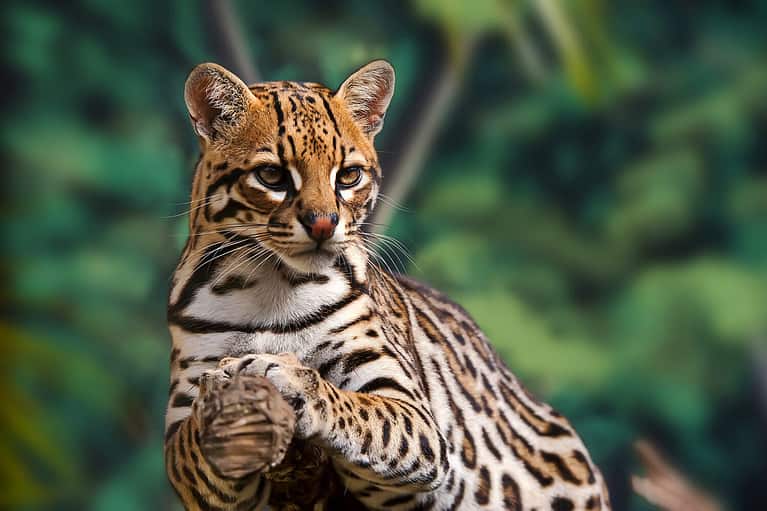
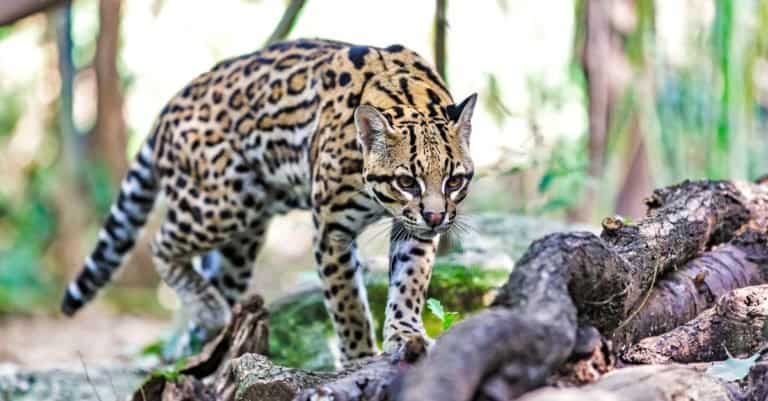
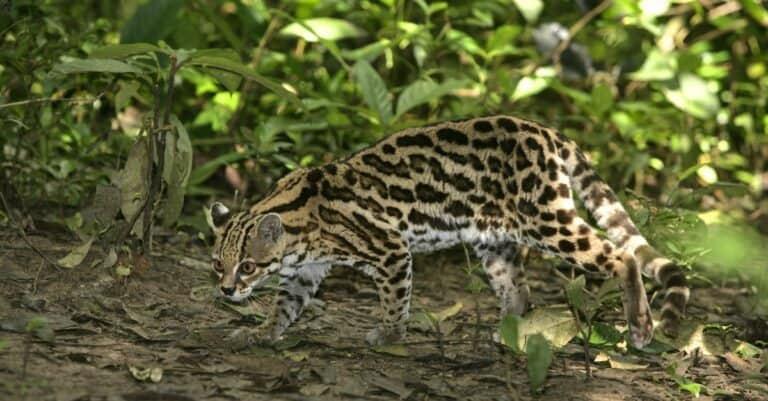
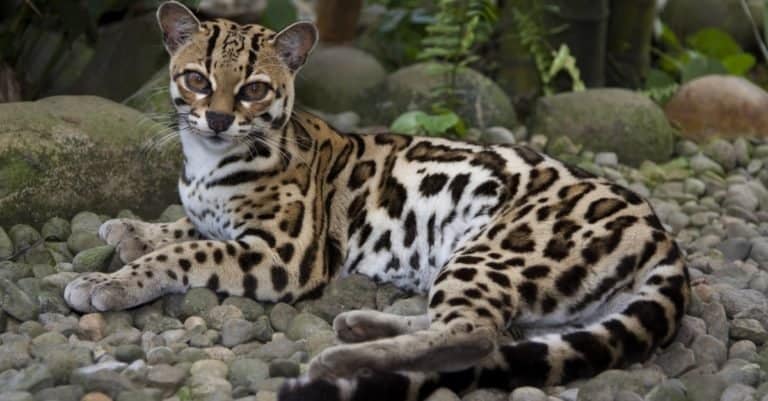
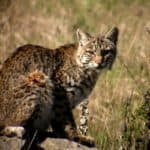
The margay has soft and thick tan or yellowish-brown fur with rows of dark brown or black markings, including open rosettes and streaks. The fur at the nape of its neck runs backward toward the crown of its head. Its underside is pale, with buff or white fur. It has broad, dark, and irregular bands and a black tip on its long tail. The backs of its ears are also black, with white circular spots.
In 2013, researchers recorded the first evidence of melanistic margays. Since that time, melanism has been recorded in individual margays in populations in Colombia and Costa Rica. Melanistic cats are black, or nearly black in color, due to a recessive gene. Melanistic varieties of some cats, such as the jaguar, are fairly common, but melanistic margays are rare and seem to be confined to a small part of their overall range.
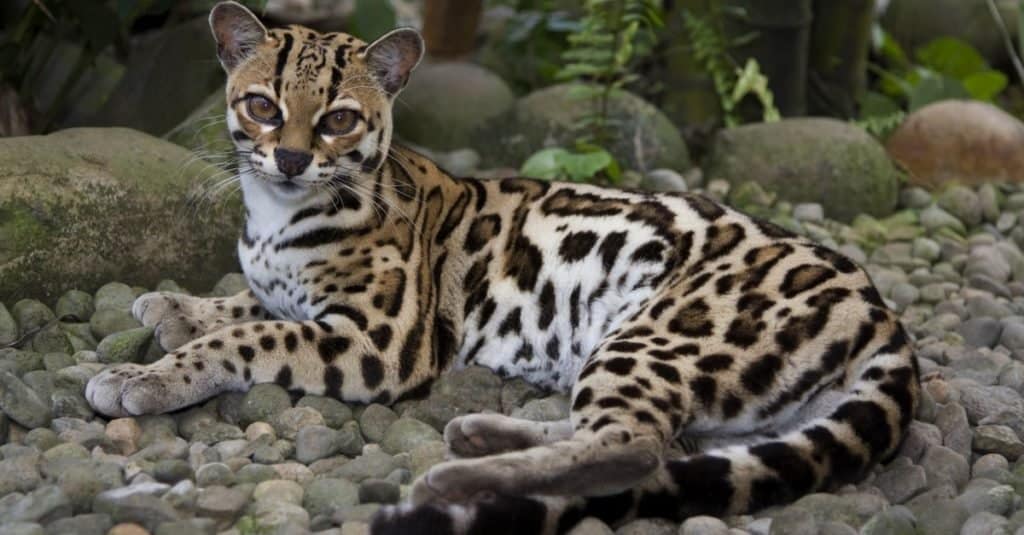
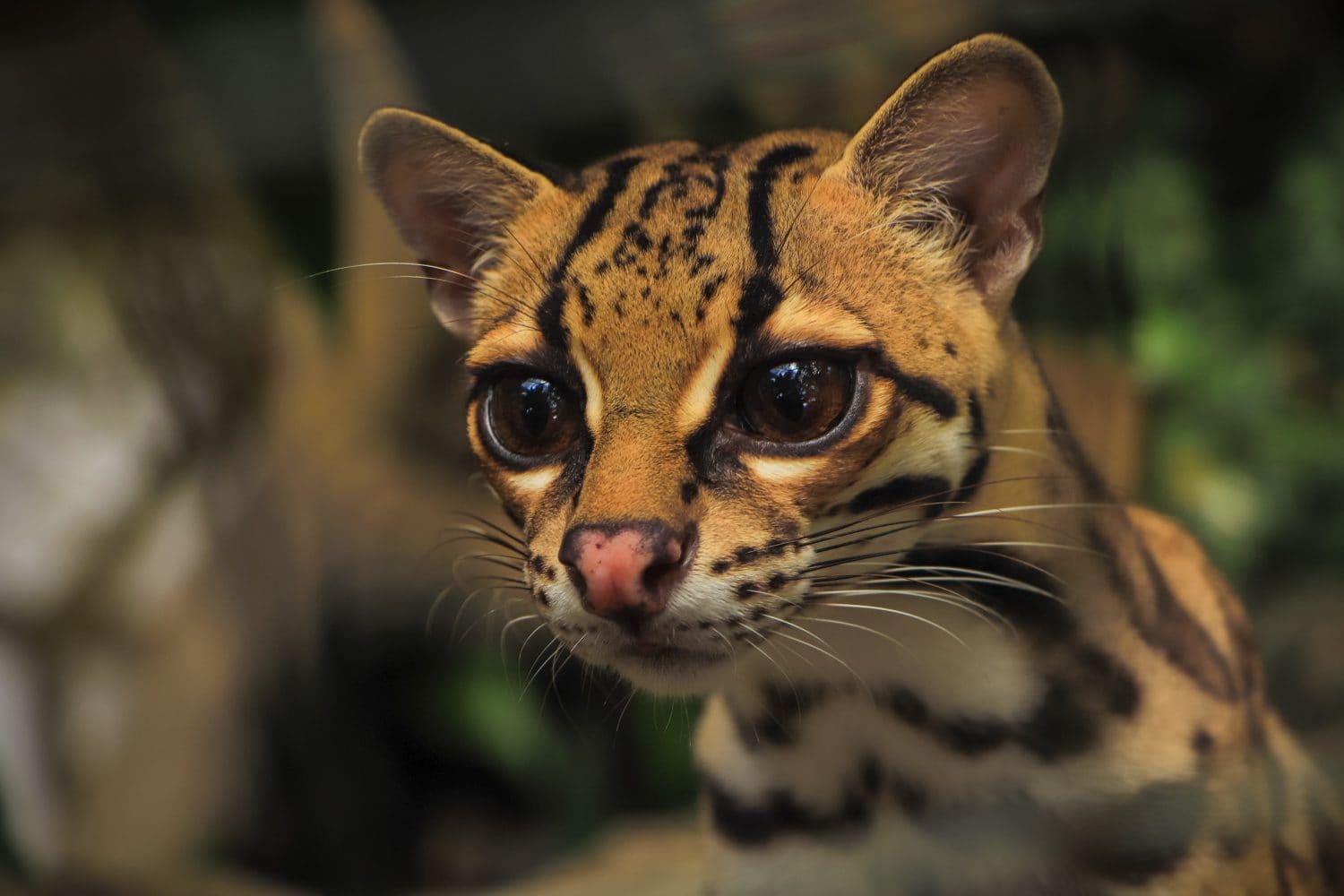
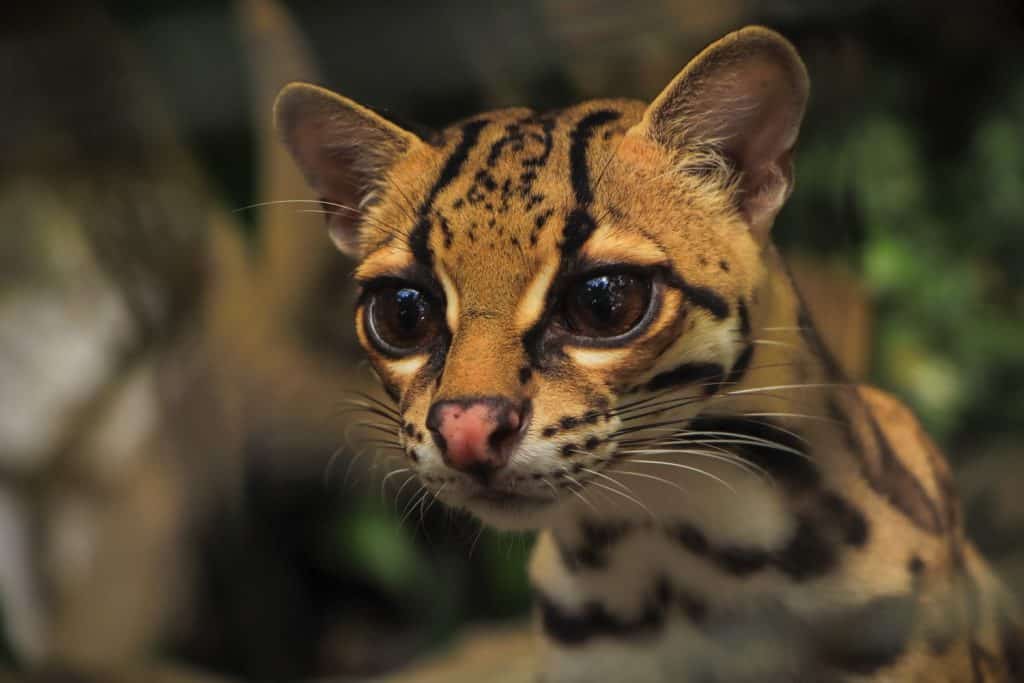
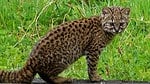
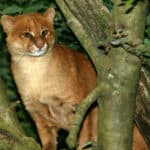
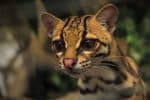
The margay has huge eyes, large feet, and a long, thick tail perfect for its mostly nocturnal life spent largely in the trees.
©Jeff Grabert/Shutterstock.com
Distinctive features
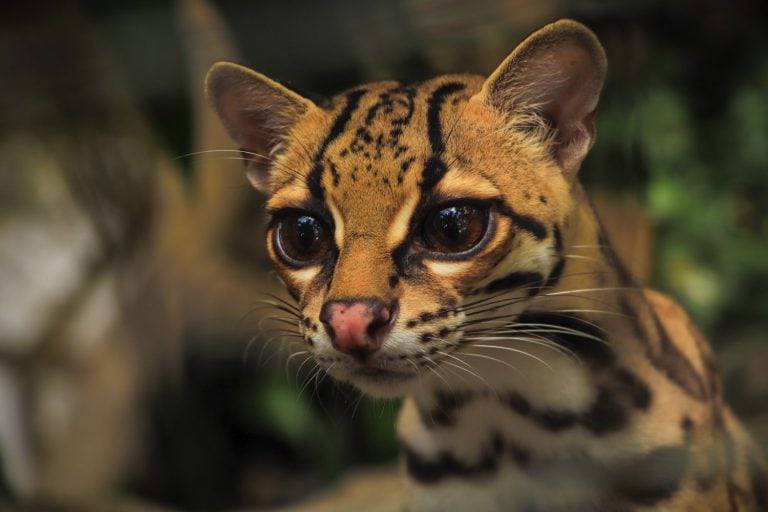
Margays are often mistaken for ocelots, which are larger and share much of the same range. Both species have dark markings on their face, running up from their pink nose and over their forehead. They also have two dark stripes on each cheek. Margays, however, have huge, dark brown eyes which appear to bulge as compared with ocelots, giving their muzzle a more narrow and delicate appearance. They also have distinctively large feet, specially adapted for climbing and jumping from limb to limb in the trees.
Behavior
Margays are solitary cats that are well adapted for spending time high in trees. They have no problems climbing trees and can even descend headfirst. They can jump up to 12 feet horizontally. When they jump, they spread out all four legs like a squirrel and use their long tails to help balance. They can hang from branches by a single back leg because their back feet can rotate 180 degrees.
Margays are known to sleep, rest, and even hunt among the branches of the forest where they live. The margay does not spend all of its time in the tree canopy, however. It spends a lot of its time on the ground, traveling and hunting, especially at night. Margays are mostly nocturnal, although they are sometimes active during the day. They cover large areas, from 4 to 6 miles or more, using scent glands between their toes and on their faces to mark their territories. In some areas, the wide ranges of males do tend to overlap.
Diet
Margays are omnivores, but meat makes up most of their diet. They eat a variety of prey, including birds, reptiles, and both terrestrial and scansorial, or climbing, mammals, especially small rodents. They also eat bird eggs and a variety of fruits, and even grasses and other vegetation.
Most of the margay’s prey are nocturnal. They eat all sorts of small to medium mammals, from rabbits, squirrels, rats, and agoutis to small primates. Margays are known as intelligent and tricky hunters. They have even been observed mimicking the calls of young pied tamarins to lure adults.
Reproduction
Margays are serially monogamous. Pairs mate for a season. They stay close and hunt together through the breeding season, but males leave before the offspring are born.
These cats reach sexual maturity at around 2 years of age, and females tend to give birth only once every two years. The female margay’s estrus cycle lasts from 32 to 36 days, with estrus itself lasting 4 to 10 days. Females attract males with a mating call. Males answer with their own vocalizations and by shaking their heads from side to side.
Margay copulation is similar to that of domestic cats. It lasts approximately 60 seconds and usually takes place in a tree. Once impregnated, the female’s gestation period lasts approximately 80 days.
Margays usually give birth to just one kitten, but sometimes two. Females have only two teats, and they care for their offspring alone. The young are usually born between March and June, and the kittens weigh just 3 to 6 ounces. It takes two weeks for their eyes to open, and they don’t eat solid food until they are 7 to 8 weeks old.
Young margays reach maturity and independence at around 9 to 12 months. However, it will take them another year or possibly two to begin to reproduce.
Predators & Threats
Margays have few natural predators. They are sometimes killed by ocelots due to competition for resources and territory. The remains of margays have also been found in the scat of larger cats, such as jaguars and pumas.
Humans are by far the greatest threat to margays. Because of their thick, soft fur, they have long been exploited for their skins. In a single decade, from the 1970s to the mid 1980s, more than 125,000 margay skins were traded. Although they are legally protected today, margays are still illegally killed and traded.
Human activity has harmed the margay in other ways, too. Habitat degradation and fragmentation are serious problems for existing margay populations. The species is listed as Near Threatened on the IUCN Red List, with populations decreasing mainly due to the destruction and fragmentation of forest habitat. Populations outside the Amazon basin are at the highest risk.
Lifespan of the Margay
Margays can live up to approximately 20 years. They do not reproduce well in captivity, and most of the margays in captivity originated in the wild.