



M
Species Profile

Mauzer

Canis lupus familiaris

Bearded buddy, big heart.
David Clarine/Shutterstock.com

Mauzer Distribution

Domesticated Species

Found Worldwide

Size Comparison

Human 5'8"
Mauzer 12 in

Mauzer stands at 17% of average human height.

At a Glance

Domesticated
Diet Omnivore
Activity Cathemeral+
Lifespan 13 years
Weight 9 lbs
Status Not Evaluated
Did You Know?

"Mauzer" is a designer cross, not a standardized kennel-club breed-appearance and temperament can vary widely by litter.

Scientific Classification

A β€œMauzer” typically refers to a small companion dog produced by crossing a Maltese with a Miniature Schnauzer. As a mixed/designer cross, traits vary by individual (coat type, shedding, temperament, adult size).

Kingdom
Animalia
Phylum
Chordata
Class
Mammalia
Order
Carnivora
Family
Canidae
Genus
Canis
Species
lupus

Distinguishing Features

  • Small companion-dog size typical of Maltese/Schnauzer mixes
  • Coat often wavy to wiry; may show Schnauzer-like facial furnishings (beard/eyebrows)
  • Color variable (white/cream/gray/black mixes depending on parents)
  • Temperament often alert and people-oriented; can be more vocal/watchful from Schnauzer lineage

Physical Measurements

Males and females differ in size

Height
β™‚ 1 ft 1 in (11 in – 1 ft 2 in)
♀ 11 in (9 in – 1 ft 1 in)
Length
β™‚ 1 ft 6 in (1 ft 3 in – 1 ft 8 in)
Weight
β™‚ 17 lbs (11 lbs – 22 lbs)
♀ 11 lbs (8 lbs – 15 lbs)
Tail Length
β™‚ 6 in (5 in – 8 in)
♀ 6 in (4 in – 7 in)
Top Speed
17 mph
running

Appearance

Primary Colors
Secondary Colors
Skin Type Domestic dog skin with moderate pigment; may be allergy-prone with potential dryness/itching in sensitive individuals.
Distinctive Features
  • Designer cross (Maltese Γ— Miniature Schnauzer), not a standardized/consistent formal breed; individuals vary widely.
  • Small companion build relative to the base species (Canis lupus); compact frame with short-to-moderate muzzle.
  • Coat can be silky (Maltese-like), wiry (Schnauzer-like), or mixed; typically low-shedding but not guaranteed.
  • Characteristic Schnauzer-style beard/mustache and pronounced eyebrows may develop, especially with wiry coats.
  • Ears often V-shaped and drop/semidrop; eyes usually dark and round-to-oval.
  • Grooming needs are higher than many dogs: regular brushing, professional clipping/hand-stripping, and tear/face cleaning.
  • Dental care is critical (small-dog tendency): frequent tooth brushing and routine cleanings.
  • Common health concerns to monitor: dental disease, patellar luxation, tracheal collapse, allergies/atopy, and eye issues (e.g., cataracts).
  • Schnauzer-line risks may appear in some individuals: hyperlipidemia/pancreatitis tendency and urinary stones; vet screening advised.
  • Exercise needs are moderate: daily walks plus play; benefits from early training and socialization to reduce barking/guarding tendencies.

Sexual Dimorphism

Dimorphism is mild, typical of small domestic dogs. Males are often slightly taller/heavier with a broader head and chest, while females may appear finer-boned and lighter overall; coat and color differences are not sex-linked.

β™‚
  • Slightly greater average height and weight.
  • Broader head and chest; heavier bone in some individuals.
  • May show more pronounced facial furnishings in some lines.
♀
  • Slightly smaller, finer-boned frame.
  • Often a narrower chest and lighter head profile.
  • May appear more delicate in overall silhouette.

Did You Know?

"Mauzer" is a designer cross, not a standardized kennel-club breed-appearance and temperament can vary widely by litter.

Many inherit the Schnauzer's signature facial furnishings (beard/eyebrows) paired with the Maltese's softer, lighter coat texture.

Color can range from white/cream to salt-and-pepper, black, or mixed-often reflecting Schnauzer genetics.

Some Mauzers are "low-shedding," but none are truly hypoallergenic; dander and saliva proteins still trigger allergies.

They often show classic terrier-style alertness from the Schnauzer side but with Maltese-style lap-dog affection.

Because both parent breeds are small, Mauzers commonly fit well in apartments-if they get daily exercise and mental enrichment.

Their "designer dog" popularity grew with late-20th/early-21st century demand for small companion crosses.

Unique Adaptations

  • Companion-breed sociability: selective breeding in domestic dogs favors reading human cues; many Mauzers are especially responsive to voice and routine.
  • Small-body efficiency: compared with the base species (wolf), reduced size lowers space and caloric needs-well-suited to indoor living.
  • Coat versatility: can inherit a Schnauzer-like wiry double coat or a softer Maltese-like coat; both can offer some weather buffering but require grooming.
  • High trainability potential: Schnauzer biddability + Maltese eagerness can make a strong learner when trained with short, positive sessions.
  • Urban adaptability: tolerance for household noises and frequent handling is often higher than in wild canids, reflecting domestication and companion selection.

Interesting Behaviors

  • Shadowing/"velcro dog" tendencies: following family members room-to-room, especially if they lean Maltese in attachment.
  • Alert barking at doorbells or novel sounds, a watchdog trait common in Miniature Schnauzers; benefits from early noise desensitization.
  • Digging or "busy nose" sniffing in yards/on walks-terrier ancestry can show up as investigative persistence.
  • Play-bowing, quick sprints ("zoomies"), then settling into lap time-an on/off companion energy pattern.
  • Face-focused social behavior: seeking eye contact, pawing for attention, and "talking" with soft whines or grumbles when excited.
  • Possible resource guarding of laps/toys if under-socialized; responds well to reward-based trading games and calm boundaries.

Cultural Significance

The Mauzer (Maltese Γ— Miniature Schnauzer, Canis lupus familiaris) is a designer dog mix made to be a companion. Not a formal breed, it shows a trend for small, friendly urban family dogs offering companionship and emotional support.

Myths & Legends

In European folklore, the schnauzer-type "bearded ratter" dog was prized in stables and inns; stories often credit these wiry, whiskered dogs with keeping granaries safe from rats and safeguarding horses at night.

Maltese dogs are frequently linked to classical Mediterranean lore and elite companionship-small white lapdogs appear in historical accounts and art as cherished household favorites in port cities and noble homes.

In English-speaking tradition, the belief that a small dog's presence brings comfort and "keeps the house calm" shows up in domestic sayings and sentimental Victorian-era anecdotes about lapdogs as guardians of the hearth.

Sailors' and merchants' tales around Mediterranean toy dogs sometimes describe them as lucky travel companions-kept close to ward off misfortune on voyages and long road journeys.

Naming lore in modern pet culture treats portmanteau names (like "Mauzer") as identity tales-owners often share origin stories about combining the Maltese's sweetness with the schnauzer's spirited beard-and-brains personality.

Conservation Status

NE Not Evaluated

Has not yet been evaluated against the criteria.

Population Stable

Life Cycle

Birth 4 pups
Lifespan 13 years

Lifespan

In the Wild 12–15 years
In Captivity 10–18 years

Reproduction

Mating System Polygynandry
Social Structure Managed Domestic
Breeding Pattern Transient
Fertilization Managed Selective
Birth Type Internal_fertilization

Mauzers follow domestic-dog reproduction: mating is typically arranged by humans during the female's estrus, with either sex potentially breeding with multiple partners across cycles. Pair bonds are not maintained beyond mating; parental care is primarily maternal.

Behavior & Ecology

Social Pack Group: 3
Activity Cathemeral, Diurnal, Crepuscular
Diet Omnivore Lean, highly palatable animal proteins (commonly chicken or turkey) in a complete small-breed formulated diet.

Temperament

Species context (domestic dog): highly social generalist; behavior is shaped by human schedules and training.
Distinguishing from base species (gray wolf): reduced territorial roaming, stronger neotenous bonding, more frequent barking, lower coordinated group hunting.
Mauzer hallmark: companion-oriented, people-focused, often "velcro" with moderate watchdog/alert tendencies.
Variation (designer cross): temperament ranges from Maltese-affectionate to Schnauzer-independent; early socialization strongly influences stranger tolerance.
HUBS (households) common patterns: follows owners room-to-room, prefers proximity resting, seeks lap/physical contact; individuals vary in clinginess.
HUBS variation: some are bold and outgoing with guests; others are reserved and bark-first, warm-up-later.
Training style: responsive to positive reinforcement; can be stubborn if Schnauzer-leaning; benefits from short, frequent sessions.
Barking tendency: can be vocal/alert; consistent "quiet" cue training and enrichment reduce nuisance barking.
Dog-dog sociability: typically playful with familiar dogs; may show small-dog overconfidence or reactivity without structured exposure.
Child compatibility: usually good with gentle handling; may be sensitive to rough play due to small size.
Health concerns (breed-typical risks): dental disease/retained teeth, patellar luxation, tracheal collapse, allergic/atopic skin disease, ear infections, eye issues (tear staining/irritation).
Metabolic/weight concerns: small dogs gain weight easily; Schnauzer lineage may predispose to lipid issues-monitor diet and treats.
Care requirements: regular grooming (coat can be wiry or soft), routine brushing, professional trims/hand-stripping depending on coat type.
Care requirements: daily dental care, nail/ear maintenance, and moderate daily exercise plus puzzle toys to prevent boredom behaviors.
Separation risk: may develop separation distress; gradual alone-time training and predictable routines help.

Communication

sharp alert bark
repetitive barking when excited or unsure
whine/whimper for attention or separation distress
growl/snarl as a boundary signal
yip during play
rare low howl in response to sirens/other dogs
tail carriage and wag speed to signal arousal and friendliness
ear and facial expression changes (brows/whiskers) for uncertainty or curiosity
play-bow invitations and bouncy approach patterns
pawing/nudging to solicit contact or play
freezing/averted gaze/lip-licking as calming or stress signals
scent marking and sniffing routines to assess people/dogs and new spaces
body blocking or leaning to seek security near trusted people

Habitat

Biomes:
Temperate Forest Boreal Forest (Taiga) Tundra Temperate Grassland Mediterranean Desert Hot Desert Cold Savanna Tropical Dry Forest Tropical Rainforest Alpine Wetland Freshwater Marine +8
Terrain:
Plains Hilly Valley Coastal Mountainous Island
Elevation: Up to 16404 ft 3 in

Ecological Role

Domesticated companion omnivore; primarily a commensal of humans with minor opportunistic predation on small pests.

Human companionship and social support Potential small-scale pest deterrence (alerting/barking; occasional capture of insects/rodents) Acts as a host for pet-associated microbial transfer and, if unmanaged, can contribute to local wildlife disturbance (mitigated by leashing/supervision)

Diet Details

Main Prey:
Small rodents Small birds Lizards Insects Small invertebrates
Other Foods:
Grasses Berries and other fruits Vegetables Starches and grains Plant and fungal matter

Human Interaction

Domestication Status

Domesticated

Mauzer (Maltese Γ— Miniature Schnauzer; Canis lupus familiaris) is a designer cross for companionship, not a kennel-club breed. Humans favor small size, being good with families, and lower shedding. Mauzers rely on people for grooming, vet care, and training. They live indoors, may be therapy pets, and can bark or have separation distress.

Danger Level

Low
  • nips/bites if fearful, under-socialized, or handled roughly (higher risk around small children without supervision)
  • resource guarding or reactivity in some individuals (trainable/managed)
  • allergens (dander/saliva) despite often being marketed as "hypoallergenic"
  • zoonotic risks typical of pet dogs if poorly maintained (intestinal parasites, ringworm), minimized with routine care

As a Pet

Suitable as Pet

Legality: Mauzer (Maltese Γ— Miniature Schnauzer) is usually legal to own but must follow local rules (licenses, rabies shots, leash laws), housing or HOA limits, and general pet limits; breed bans are rare.

Care Level: Moderate

Purchase Cost: $300 - $2,500
Lifetime Cost: $18,000 - $45,000

Economic Value

Uses:
Companion animal market (designer mixes) Veterinary services and preventive care Professional grooming Training/behavior services Pet retail (food, crates, toys, dental products) Pet insurance and boarding/daycare
Products:
  • puppy sales/adoption fees
  • spay/neuter, vaccinations, parasite prevention
  • regular grooming (clip/hand-scissor, bathing, ear care)
  • training classes (puppy socialization, basic obedience)
  • specialty diets (weight management, sensitive skin/GI if needed)
  • dental cleanings and dental-homecare products

Relationships

Predators 5

Coyote Canis latrans
Bobcat Lynx rufus
Cougar Puma concolor
Great horned owl Bubo virginianus
Golden eagle Aquila chrysaetos

Related Species 6

Gray wolf Canis lupus Shared Species
Coyote Canis latrans Shared Genus
Golden jackal Canis aureus Shared Genus
African golden wolf Canis lupaster Shared Genus
Ethiopian wolf Canis simensis Shared Genus
Red fox Vulpes vulpes Shared Family

Ecological Equivalents 5

Animals that fill a similar ecological role in their ecosystem

Maltese Canis lupus familiaris Direct contributor to the Mauzer. Overlaps strongly in the companion niche, small size, and grooming needs.
Miniature Schnauzer Canis lupus familiaris Direct contributor to the Mauzer. Overlaps in alert watchdog behavior, intelligence, and often low-shedding coat tendencies.
Yorkshire Terrier Canis lupus familiaris Small companion dog commonly kept in apartments. Exhibits "big-dog" confidence in a small body and often provides vocal alerting.
Shih Tzu Canis lupus familiaris Comparable role as an affectionate, small household companion that requires frequent grooming.
Miniature Poodle Canis lupus familiaris Occupies a similar niche as a highly trainable small companion. Often compared because of low-shedding coats and similar grooming and maintenance needs.

The Mauzer is a mix between a  Maltese and a Schnauzer, making the cutest, energetic, and happy dog. This breed is low-maintenance and loyal; they make fantastic companions for seniors, couples, families with older kids, or singles.

However, they can be stubborn and might nip if provoked, which is why training them from a young age is really beneficial.

Training requires a lot of patience, and they are not suitable dogs for families with young children. Mauzers tend to bond with a specific person in the home and will follow them like a shadow. So, being left alone causes them stress and anxiety, and they can become destructive when acting out.

Four Different Types of Maltese and Schnauzer Mixes

Because this breed is a hybrid, there is only one type. However, its parents, the Maltese and Schnauzer, have several designer mixes, including:

Papitese (Maltese Papillon Mix)

The Papitese is a mix between a Papillion and a Maltese. This breed is calm, curious, feisty, and adventurous. Papitese might be small, but they have big personalities. These pups will act as your shadow and never leave your side, which causes separation anxiety if left alone for long periods.

Malteagle (Beagle x Maltese Mix)

Malteagles are a cross between a Beagle and Maltese. They are a great breed to have around children because of their gentle and affectionate nature. However, they are challenging t train because of their classic Beagle stubbornness.

Schnauzer Lab (Labrador Retriever x Schnauzer Mix)

The Schnauzer Lab is a combination of a Labrador Retriever and a Schnauzer. This is a very social breed; they are fantastic with children and other pets.

These dogs are an excellent choice for active families that like being outdoors on hikes, swimming, and jogging. Unfortunately, if Schnauzer Labs are denied exercise, they can act out in mischievous ways.

Schpit (Pit Bull x Schnauzer Mix)

Schpits are a result of crossbreeding Pitbulls with Schnauzers. They are stocky dogs but inherit the wiry hair from the Schnauzer. Schpits are active and love attention from their human family. In fact, they don’t like being left alone and will need lots of exercise and toys to keep them distracted.

Three Pros and Cons of Owning a Mauzer

Knowing what you are getting into before buying or adopting a puppy is always good. So, here are Mauzer’s pros and cons.

Pros

  • Requires minimal grooming
  • Hardly sheds
  • Mauzers are very obedient

Cons

  • Can bark a lot
  • Not suited for families with young children
  • They can nip if provoked or over excited

The Best Dog Food for a Mauzer

Making sure the Mauzer sticks to a healthy and balanced diet is essential for their health as they are prone to obesity. That’s why free-feeding is not an option with this breed. Instead, they need to be fed 2 to 3 small meals throughout the day.

In addition, you need to make sure your pup is getting the correct food for its various life stages. For example, while feeding them high-quality kibble formulated for small breeds is good, you need to be sure that they are eating the right food for their puppy, adult, and senior stages as well.

Mauzer Size and Weight

Mauzers are a small breed of dog, and males are typically bigger than females, weighing 18 to 20 pounds and measuring 13 to 14 inches tall. The females weigh 17 to 20 pounds and measure 10 to 12 inches tall.

Mauzer Common Health Issues

Unfortunately, Mauzeres are prone to the same health issues as their parents. However, hybrids are usually healthier than their parent breeds and can live longer, and there is no guarantee they will inherit any health issues from the Maltese or Schnauzer.

But, it is possible, and they are susceptible to:

But despite all these potential health issues, Mauzers have a long lifespan of 12 to 15 years.

Mauzer Temperament

Mauzers might take a while to adapt to a new home as they tend to bond with one person, but once they are comfortable, they are affectionate and need plenty of attention. This breed is fun-loving and will keep you company all the time.

However, they tend to bark a lot, like when they hear or see anything strange, and also like to yap when they hear other dogs barking.

Mauzers are protective and alert; however, they like to be dominant, may exhibit bold behavior, and are known to nip when provoked.

This behavior can be curbed by socializing and training them from puppies, but Mauzers are not the ideal dog for families with young kids as they may become jealous of the attention that the children receive.

However, overall, this breed is friendly, feisty, playful, and happy, and when they are not protecting you from the dangers of the world, they are delighted to spend time on your lap cuddling with you.

How to Take Care of a Mauzer
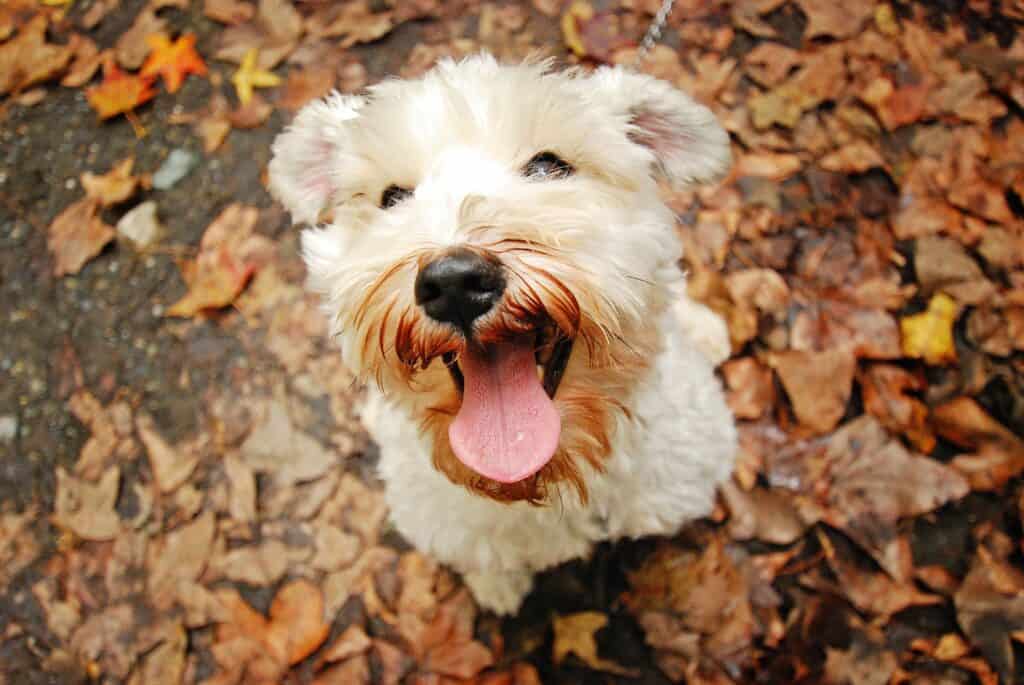
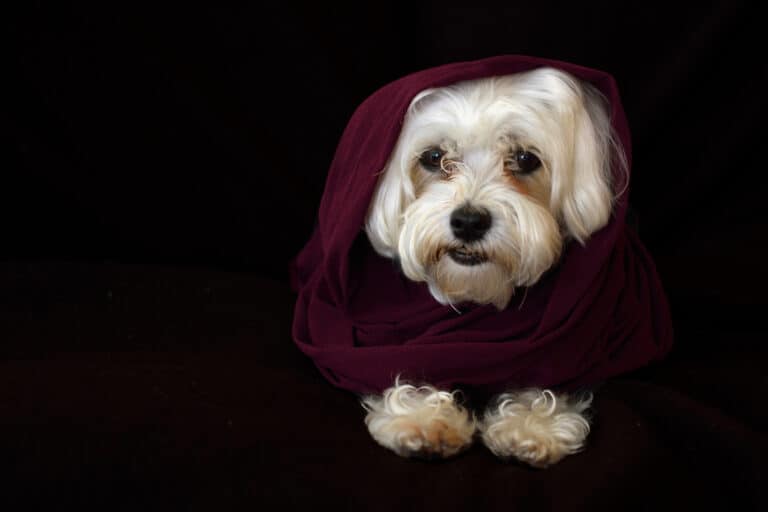
πŸ‘ Mauzer

Their grooming will depend on the type of coat they inherit, but it is typically medium-length, soft, fluffy fur that requires a good brush twice a week.

Β©NiaB/Shutterstock.com

Caring for a Mauzer can differ depending on which parent it takes after, but they are usually low maintenance compared to other small breeds.

Grooming

Their grooming will depend on the type of coat they inherit, but it is typically medium-length, soft, fluffy fur that requires a good brush twice a week. However, if they take after the Schnauzer, they will have thick and wiry coats and will need vigorous brushing at least 3 times a week.

Mauzers don’t need to bathe often. They have natural oils that keep their skin hydrated and healthy, so only wash them when necessary. However, when they bathe, they will require shampoo formulated for sensitive skin because they are prone to dry skin.

Keep the hair around their face trimmed at all times, and their ears need cleaning once a month because they are short and floppy and can accumulate a lot of gunk.

Their nails should be trimmed every 3 months or when their claws start to touch the floor. In addition, Mauzers need their teeth brushed 3 times a week minimum, but every day is ideal.

Training

Mauzers are tough to train. While intelligent, they are stubborn and tend to nip when challenged. But, if trained from a young age, you can curb this behavior; the same applies to socialization.  

This breed needs a firm and consistent hand when training and they respond best to praise and treats or rewards.

Exercise

Exercise is vital for the Mauzers’ mental and physical health. They are very energetic dogs and need several short walks or one long walk per day. In addition, these dogs will really benefit from socializing in dog parks or interactive play to keep their minds and body happy.

But, if they don’t receive enough stimulation, this breed can display negative behaviors. They also suffer from separation anxiety and shouldn’t be left alone for long periods.

Puppies

Female Mauzers give birth to litters of 8 to 10 puppies. Because this breed is so small, their pups are tiny and fragile, so they must always be handled with extreme caution to prevent injury.

Mauzers are one of the rarer designer crossbreeds, so potential buyers can expect to pay anywhere from $250 to $750 per puppy.

Mauzers and Children

Mauzers are fantastic pets for families with older children because they are prone to nipping. But this does not mean they can’t be around younger kids. With the proper training and socialization skills, they get along well with small children who have been taught how to interact correctly. In addition, they thrive in single-parent homes and do well with seniors as well.

If socialized from an early age, the Mauzer gets along great with other pets, but because they like to be the boss and have a tendency to nip, they need to be introduced as puppies.

Naming your pup is special, so why not pick from these meaningful and popular names for Mauzers:

  • Molly
  • Sophie
  • Daisy
  • Lola
  • Maggie
  • Zoey
  • Eddie
  • Ludwig
  • Otto
  • Pippo
  • Pongo

Up Next

View all 330 animals that start with M

Sources

  1. Pet Keen / Accessed October 10, 2022
  2. Wag Walking / Accessed October 10, 2022
  3. Pet Guide / Accessed October 10, 2022
  4. Hepper / Accessed October 10, 2022

About the Author

Chanel Coetzee

Chanel Coetzee is a writer at A-Z Animals, primarily focusing on big cats, dogs, and travel. Chanel has been writing and researching about animals for over 10 years. She has also worked closely with big cats like lions, cheetahs, leopards, and tigers at a rescue and rehabilitation center in South Africa since 2009. As a resident of Cape Town, South Africa, Chanel enjoys beach walks with her Stafford bull terrier and traveling off the beaten path.
Connect:

Thank you for reading! Have some feedback for us?

Contact the AZ Animals editorial team

Related Articles You May Find Interesting


Mauzer FAQs (Frequently Asked Questions)

Yes, Mauzers are hypoallergenic.

Mauzers have a long lifespan of 12 to 15 years.

A Snorkie is a Schnauzer crossbred with a Yorkshire terrier.