M
Species Profile

Muntjac

Muntiacus

Small deer, big bark.
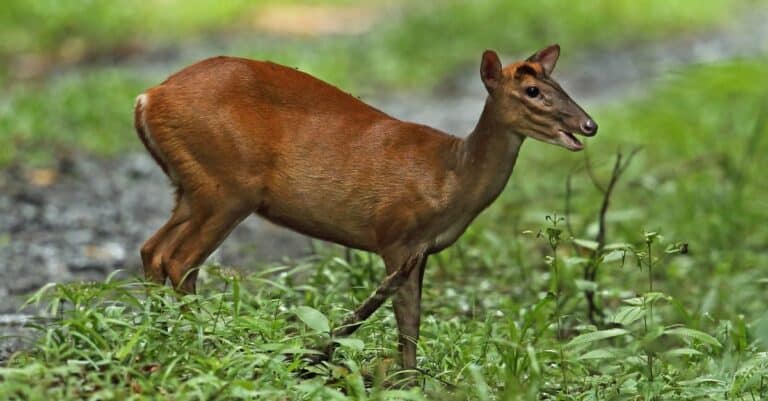
iStock.com/MikeLane45

At a Glance

Genus Overview This page covers the Muntjac genus as a group. Stats below are general traits shared across the genus.
Also Known As Muntjac, Muntjak, Kijang
Diet Herbivore
Activity Crepuscular+
Lifespan 11 years
Weight 50 lbs
Status Not Evaluated
Did You Know?

The genus spans some of the smallest to medium-small deer-roughly ~45-70 cm at the shoulder and ~70-135 cm in head-body length across species.

Scientific Classification

Genus Overview "Muntjac" is not a single species but represents an entire genus containing multiple species.

Muntjacs are small-bodied deer (genus Muntiacus) known for their loud alarm calls (โ€œbarkingโ€), short antlers (in males), and prominent pedicles and facial scent glands used in marking. They are primarily forest and woodland deer of South and Southeast Asia, with some species introduced outside their native range.

Kingdom
Animalia
Phylum
Chordata
Class
Mammalia
Order
Artiodactyla
Family
Cervidae
Genus
Muntiacus

Distinguishing Features

  • Small deer with relatively short legs and compact body
  • Males often have small antlers on elongated bony pedicles; some species have more substantial antlers
  • Enlarged upper canines (โ€œtusksโ€) in males used in combat
  • Large preorbital glands and frequent scent-marking behavior
  • Characteristic loud alarm call (the โ€œbarkโ€)

Physical Measurements

Males and females differ in size

Height
โ™‚ 1 ft 12 in (1 ft 4 in โ€“ 2 ft 7 in)
โ™€ 1 ft 10 in (1 ft 6 in โ€“ 2 ft 4 in)
Length
โ™‚ 3 ft 11 in (2 ft 7 in โ€“ 5 ft 3 in)
โ™€ 3 ft 10 in (2 ft 7 in โ€“ 5 ft 3 in)
Weight
โ™‚ 49 lbs (18 lbs โ€“ 110 lbs)
โ™€ 49 lbs (18 lbs โ€“ 99 lbs)
Tail Length
โ™‚ 7 in (4 in โ€“ 10 in)
โ™€ 7 in (4 in โ€“ 10 in)
Top Speed
31 mph
running

Appearance

Primary Colors
Secondary Colors
Skin Type Dense short-to-medium fur over typical cervid skin; seasonal thickening and color shifts vary by species and elevation.
Distinctive Features
  • Measurements (genus-wide range): head-body ~70-135 cm; shoulder height ~40-65 cm; tail ~10-25 cm; mass ~8-35+ kg (smallest to largest species).
  • Lifespan range: typically ~8-12 years in the wild; up to ~15-20 years in captivity (varies by species and husbandry).
  • Very loud alarm "barking" call used in vigilance and disturbance contexts; frequency and calling context vary among species/populations.
  • Strong scent-marking ecology: enlarged facial (preorbital) glands, forehead rubbing, and gland secretions used on vegetation and trails.
  • Prominent bony pedicles on the skull; males carry short, simple antlers emerging from pedicles (antler size varies strongly by species).
  • Males typically have elongated, tusk-like upper canines used in displays and fighting; degree of canine enlargement varies.
  • Generally small-bodied, forest/woodland-adapted deer with rounded rump, relatively large ears, and low-slung posture.
  • Ecology generalized: mostly solitary and territorial; activity often crepuscular/nocturnal, but diurnality increases in low-disturbance habitats (varies by species).
  • Diet generalized: browsers and mixed feeders on leaves, shoots, fruits, and herbs; local diets shift with season and habitat type.
  • Distribution generalized: South and Southeast Asian forests/woodlands; some species extend into montane habitats; Reeves's muntjac has introduced populations outside native range (notably parts of Europe).

Sexual Dimorphism

Sexual dimorphism is common but variable across species. Males usually have prominent pedicles with short antlers and enlarged upper canines, plus stronger head/neck musculature; females typically lack antlers and have smaller canines, with subtler facial gland expression.

โ™‚
  • Short antlers on prominent pedicles (size/shape vary by species and age).
  • Elongated upper canines ("tusks") used in combat and displays.
  • Often thicker neck and more robust head profile.
  • More conspicuous forehead/face rubbing and scent-marking behaviors in many populations.
โ™€
  • No antlers; pedicles absent or greatly reduced.
  • Upper canines present but much smaller and less protrusive.
  • Typically slightly smaller, with slimmer head/neck profile.
  • Marking behavior present but often less showy; varies by species and local ecology.

Did You Know?

The genus spans some of the smallest to medium-small deer-roughly ~45-70 cm at the shoulder and ~70-135 cm in head-body length across species.

Males grow short antlers on unusually long bony pedicles; the pedicles stay prominent even when antlers are shed.

Many muntjacs give a loud, repeated "bark" when alarmed-often for minutes-alerting other animals as well as rival muntjacs.

Both sexes have well-developed facial scent glands (notably preorbital glands) used to mark trails, territories, and favored feeding spots.

Several species were only recognized by science in recent decades; the "giant muntjac" became widely known after being described in the 1990s.

Reeves's muntjac, native to East Asia, has established introduced wild populations in Great Britain and parts of Europe, where it's now a familiar woodland deer.

Unlike many larger, herd-forming deer, muntjacs are typically solitary and intensely territorial-small bodies, big attitude.

Unique Adaptations

  • Long antler pedicles: males carry antlers atop elongated pedicles-an unusual cervid trait that supports short, frequently replaced antlers suited to dense vegetation.
  • Tusk-like upper canines (especially in males): used as slashing weapons in close combat, complementing the short antlers in forested habitats.
  • Highly developed facial scent glands: large preorbital glands allow precise chemical signaling in thick understory where visibility is limited.
  • Compact "forest deer" build: relatively small body and low profile aid maneuverability through bamboo, shrubs, and tangled understory across many species.
  • Vocal anti-predator signaling: the bark functions as both a warning to nearby animals and a possible signal to predators that they've been detected.

Interesting Behaviors

  • Alarm "barking": a sharp, repeated call used when detecting predators or disturbances; call rate and persistence vary by species and context.
  • Scent-marking networks: frequent rubbing and gland-marking (especially with facial/preorbital glands), plus latrine use in some populations; intensity varies with season and local density.
  • Territorial spacing: many species maintain small, well-defended home ranges; boundary disputes may involve posturing, chasing, and in males, canine-and-antler fights.
  • Solitary, cryptic movement: typically alone or in mother-young pairs; more nocturnal or crepuscular where human activity is high, but can be daytime-active in quiet forests.
  • Flexible foraging: primarily browsers (leaves, shoots, herbs) with heavy use of fallen fruit when available; some species/populations shift diet seasonally with monsoon/fruiting cycles.
  • Cover-first behavior: when threatened, they often freeze, slip into dense understory, then bark from concealment-rather than fleeing long distances like open-country deer.

Cultural Significance

Muntjacs (barking deer) (Muntiacus) are called "barking deer" in South and Southeast Asia and used as a forest alarm. Hunted for meat and hides, they signal healthy undergrowth and fruiting. Reeves's muntjac in Britain barks at night and sparks woodland management debates.

Myths & Legends

In parts of South Asia and the Himalayan foothills, hunters and herders believe Muntjacs (barking deer) give a sharp call that warns a tiger or leopard is nearby. They may stop or bring livestock in.

In Southeast Asian forest stories, repeated barking by muntjacs (Muntiacus) in thick cover is often seen as the deer warning of a stranger, making them part of forest guardian tales.

The name muntjac (barking deer) (Muntiacus) came into European languages through Dutch from Southeast Asian local names for these small deer, showing early encounters and trade era natural history, not one origin myth.

In modern British rural folklore, the introduced Reeves's muntjac is often blamed for unexplained night 'barking' in woods, giving the muntjac a small place in local stories about strange countryside sounds.

Conservation Status

NE Not Evaluated (genus-level taxa are not assessed by IUCN); across Muntiacus, species statuses span from Least Concern to Endangered, with several poorly known taxa listed as Data Deficient and a few narrow-range Indochinese/Chinese endemics among the most at risk (e.g., giant muntjac assessed as Endangered).

Has not yet been evaluated against the criteria.

Population Unknown

Protected Under

  • Protected-area networks across South and Southeast Asia (effectiveness varies; many populations occur inside reserves but still face snaring).
  • National hunting regulations and species-protection schedules in multiple range states (species-specific legal status varies by country).
  • CITES listings apply to selected Muntiacus species in international trade controls (not uniform across the genus).

Looking for a specific species?

Red muntjac (Indian muntjac / barking deer)

Muntiacus muntjak

This is the species most widely and historically referred to as "barking deer" across South and Southeast Asia, and the common name is most strongly associated with it in general usage.

  • Genus-wide size range (smallest to largest muntjacs): ~8-40 kg; ~80-135 cm head-body length; ~45-70 cm shoulder height (species vary substantially, and some lineages are still being revised).
  • Genus-wide lifespan range: typically ~10-15 years in the wild; up to ~16-20 years reported in captivity (varies by species, conditions, and predation pressure).
  • Genus-wide shared traits: loud alarm 'barks', strong use of facial/preorbital scent glands and forehead glands for marking, and (in males) short antlers on long pedicles with prominent upper canines used in fights.
  • Common ecology across the genus: primarily solitary to pair-living, strongly cover-associated forest/woodland deer; activity often crepuscular/nocturnal, but timing varies with disturbance, hunting pressure, and local predator risk.
  • Diet generalization across the genus: mainly browsers (leaves, shoots, shrubs) with frequent fruit use; grazing on grasses is usually secondary and more variable by habitat and season.

You might be looking for:

Indian muntjac

30%

Muntiacus muntjak

Widespread South and Southeast Asian muntjac; one of the most commonly referenced species.

Reeves's muntjac (Chinese muntjac)

28%

Muntiacus reevesi

Native to China/Taiwan; introduced and established in parts of Europe (notably the UK).

Giant muntjac

14%

Muntiacus vuquangensis

Rare, larger-bodied muntjac from the Annamite Range (Vietnam/Laos).

Black muntjac

10%

Muntiacus crinifrons

Vulnerable species from eastern China; darker coat and restricted range.

Fea's muntjac

7%

Muntiacus feae

Southeast Asian species (Myanmar/Thailand region); comparatively less commonly encountered in general references.

Life Cycle

Birth 1 fawn
Lifespan 11 years

Lifespan

In the Wild 6โ€“17 years
In Captivity 10โ€“23 years

Reproduction

Mating System Polygyny
Social Structure Solitary
Breeding Pattern Transient
Fertilization Internal Fertilization
Birth Type Internal_fertilization

Across Muntiacus, adults are mostly solitary and territorial; males use scent marking and fights to access overlapping female ranges. Mating is typically polygynous with brief associations (often year-round in tropics), though local pair-bonding/serial monogamy may occur in some populations.

Behavior & Ecology

Social Family group Group: 1
Activity Crepuscular, Nocturnal, Cathemeral, Diurnal
Diet Herbivore Fallen fruits (notably soft fruits such as figs where available) and tender new browse

Temperament

Generally shy, secretive, and cover-dependent; strong flight response when disturbed
Highly vigilant; frequently pauses to scan and may freeze before fleeing
Territorial tendencies are common, especially in males; intensity varies by species and density
Males can be aggressive in close encounters (rut or territorial disputes), otherwise avoidant
Often tolerant of brief proximity at concentrated resources, but groups remain loosely organized
Habituation to humans varies widely, especially in introduced or urban-edge populations

Communication

Loud alarm 'bark' given repeatedly when detecting predators or unusual disturbance
Short grunts/snorts in close-range interactions
Bleats or soft calls between doe and fawn
High-pitched squeals during intense conflict or capture
Scent marking with preorbital (facial) glands on twigs, stems, and low branches
Forehead/pedicle rubbing and scraping to deposit scent and signal territorial occupancy
Urine and fecal marking at latrines or along paths; used for individual recognition
Visual postures (head-up alert, stamping) and rapid flight through cover as threat response

Habitat

Biomes:
Tropical Rainforest Tropical Dry Forest Temperate Forest Alpine Wetland
Terrain:
Mountainous Hilly Plateau Plains Valley Coastal Island Riverine Karst Rocky +4
Elevation: Up to 11482 ft 11 in

Ecological Role

Understory browser/frugivorous herbivore in forest and woodland systems; contributes to plant community dynamics and, where fruit intake is substantial, functions as a seed disperser (with degree of frugivory varying among species and habitats).

Seed dispersal for a range of fleshy-fruited plants (importance varies by locality and season) Shaping understory structure through selective browsing and pruning of saplings/shrubs Nutrient cycling via dung deposition and localized soil enrichment Linking forest-edge and interior food webs by moving plant biomass into higher trophic levels as prey for large carnivores

Diet Details

Other Foods:
Tender leaves and browse Young shoots, buds and tips Herbs and forbs Grasses and sedges Fallen fruits and berries Flowers and soft plant parts Seeds and nuts Bark and twigs Fungi Cultivated plants and crops +4

Human Interaction

Domestication Status

Wild

Muntjacs (barking deer, Muntiacus) are wild, not domesticated. People hunt them for meat and hides, manage their numbers, and sometimes keep or breed them in zoos, parks, private collections, or deer farms. Introduced Reeves's muntjac became wild in parts of Europe and the UK, leading to killing, road collisions, and pest control.

Danger Level

Moderate
  • Physical injury from kicks, bites, or slashing with elongated upper canines (tusks), especially during handling, restraint, or breeding season; severity varies by species and individual temperament
  • Injury from antler/pedicle strikes in males (antlers are short but can still cause puncture/laceration)
  • Zoonotic/parasite risks typical of wild cervids (e.g., ticks and tick-borne diseases; regional bacterial/parasitic infections)
  • Vehicle collisions where populations occur near roads (often a major human safety risk in introduced ranges)
  • Property/land-use conflicts (garden/forestry damage) that can escalate risky close encounters during attempted capture or deterrence

As a Pet

Not Suitable as Pet

Legality: Rules for Muntjacs (barking deer) (Muntiacus) vary by place. Many areas treat them as exotic wildlife/cervids: ownership may be banned, limited to licensed exhibitors/rehabbers, or need permits, fencing, and vet checks. Check local wildlife, agriculture, and invasive-species laws.

Care Level: Expert Only

Purchase Cost: $500 - $3,000
Lifetime Cost: $15,000 - $80,000

Economic Value

Uses:
Wild meat (subsistence and commercial venison) Hunting/harvest value (local sport hunting, pest-control culls in introduced ranges) Hides/skins and minor by-products Traditional/local medicinal uses in some regions (varies by culture and species) Captive display (zoos/wildlife parks) and limited private exotic trade Forestry/agricultural impact in some introduced or high-density populations (economic cost) Research/education (behavior, ecology, invasion biology)
Products:
  • Venison/bushmeat
  • Hides/leather
  • Skulls/trophies (limited compared with larger deer)
  • Live animals for licensed collections (where legal)

Relationships

Predators 7

Tiger Panthera tigris
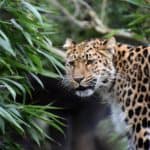
Leopard Panthera pardus
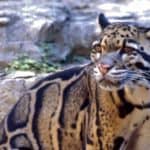
Clouded leopard Neofelis nebulosa
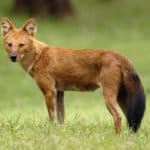
Dhole Cuon alpinus
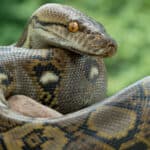
Python Python spp.
Saltwater crocodile Crocodylus porosus
Human Homo sapiens

Related Species 6

Tufted deer Elaphodus cephalophus Shared Family
Water deer Hydropotes inermis Shared Family
Roe deer Capreolus Shared Family
Sika deer Cervus nippon Shared Family
Sambar Rusa unicolor Shared Family
Chital Axis axis Shared Family

Ecological Equivalents 4

Animals that fill a similar ecological role in their ecosystem

Chevrotains Tragulus spp. They overlap in many Asian forest and woodland habitats and are similarly small-bodied and shy, with browse-heavy diets and a reliance on dense cover (though chevrotains are not true deer).
Duikers Cephalophus spp. Ecological analogs: small forest browsers that use dense understory and cryptic behavior, with similar predator-avoidance strategies despite occurring on a different continent.
Hog deer Axis porcinus Small-to-medium deer of South and Southeast Asian mosaic habitats that use cover and browse or graze opportunistically; they can share forestโ€“grassland edges and experience similar predator suites.
Bushbuck Tragelaphus scriptus Comparable "small forest antelope" role: a solitary, secretive browser in dense vegetation, exhibiting strong site fidelity and reliance on cover โ€” an analogous role to similar species in other regions/taxa.

Types of Muntjac

12

Explore 12 recognized types of muntjac

Red muntjac (Indian muntjac) Muntiacus muntjak
Reeves's muntjac Muntiacus reevesi
Giant muntjac Muntiacus vuquangensis
Hairy-fronted muntjac Muntiacus crinifrons
Fea's muntjac Muntiacus feae
Leaf muntjac (Putao muntjac) Muntiacus putaoensis
Roosevelt's muntjac Muntiacus rooseveltorum
Gongshan muntjac Muntiacus gongshanensis
Annamite (Truong Son) muntjac Muntiacus truongsonensis
Bornean yellow muntjac Muntiacus atherodes
Malabar muntjac Muntiacus malabaricus
Northern red muntjac Muntiacus vaginalis

The muntjac is characterized by short antlers and long canine teeth, both features of early โ€œprimitiveโ€ deer.

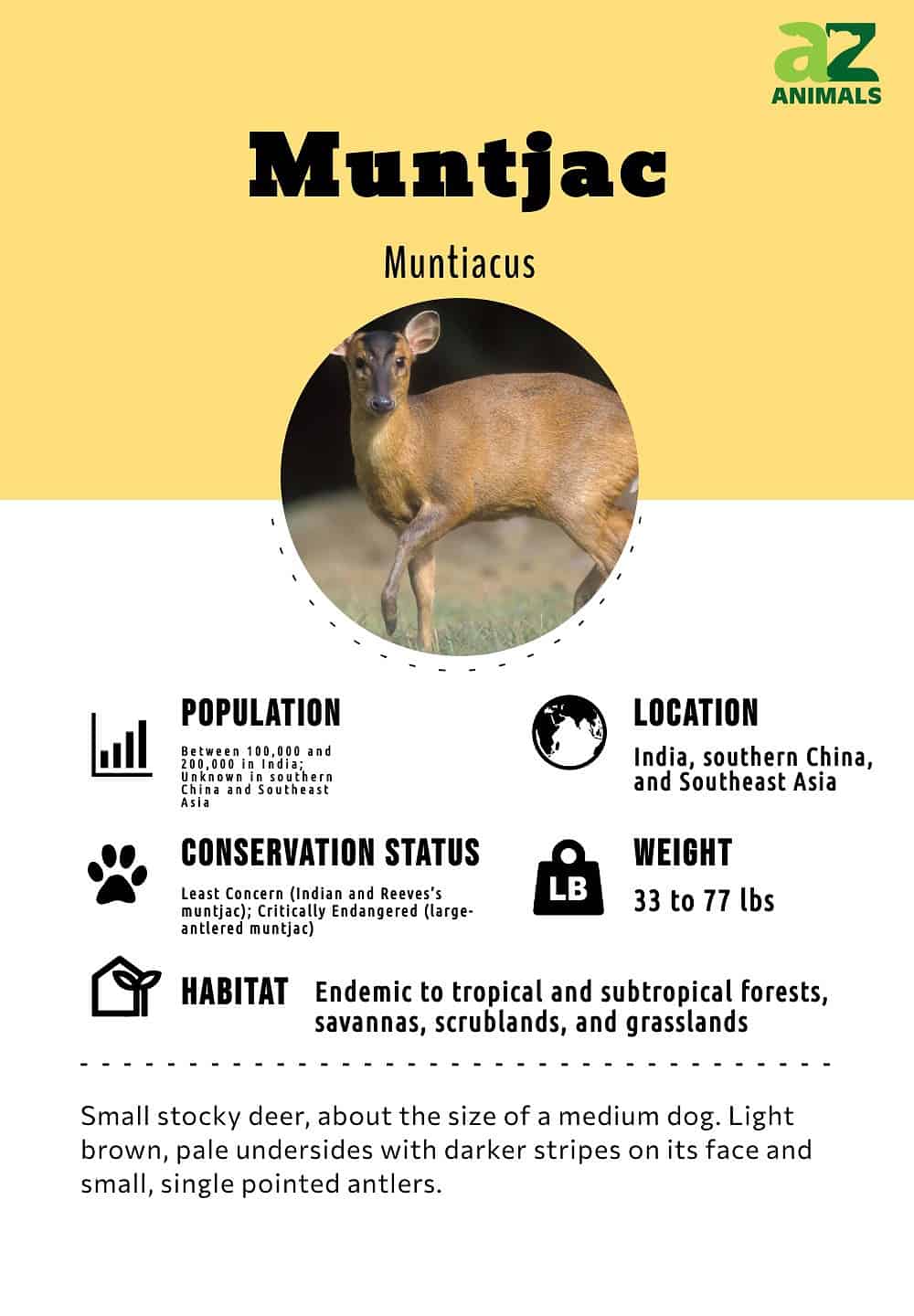
The muntjac (pronounced munt-jack with an โ€œuhโ€ sound) is a genus of small deer native to Asia. Itโ€™s also known as the barking deer (because of the sound it makes) and the rib-faced deer (because of the bony ridges along the face). There are currently 12 recognized species in this group. The best-known and most widespread species is the Indian muntjac, which itself has given rise to around 15 distinctive subspecies. This animal bears strong similarities to the Chinese water deer and the tufted deer.

5 Incredible Muntjac Facts!

  • Based on DNA analysis and fossil evidence, itโ€™s estimated that the first true deer, which probably resembled the muntjac, arose some 15 to 30 million years ago from tusked ancestors. The tusks gradually disappeared at the exact same time as the antlers evolved, but the muntjac retains both of these features into the modern day. They probably split off from other types of deer around seven million years ago. The muntjac has remained mostly unchanged since then, while the other deer diversified greatly.
  • This animal may have once roamed across Europe as well as Asia. Fossil remains have been found in France, Germany, and Poland.
  • The muntjac has perhaps one of the strangest cases of chromosome counts in the entire animal kingdom (chromosomes are essentially large bundles of DNA in the cells). According to one scientific study, the male Indian muntjac has only seven pairs of chromosomes (the female has only six), which is the lowest number of any known mammal. Reeveโ€™s muntjac, on the other hand, has 46 pairs of chromosomes, the same number as humans. Itโ€™s not entirely clear why the chromosome count varies so much, but it may have interesting implications for mammalian evolution.
  • The antlers are composed of hard bones which can grow again every year once theyโ€™re lost.
  • The male is called a buck, whereas the female is called a doe. The young baby is called a fawn.

To read more interesting facts, check out 10 incredible muntjac facts.
๐Ÿ‘ Image

Scientific Name

The scientific name of this genus is Muntiacus. The name comes from the Dutch word muntjak, which itself is derived from an indigenous word originating from the island of Java. It entered English vocabulary after the Netherlands colonized the Indonesian region. This genus is a member of the deer family and a type of even-toed ungulate (like cows and pigs).

Types Of

The muntjac, also known as the rib-faced deer or the barking deer, has 12 known species. The most common species is the Indian Muntjac, found throughout Southeast Asia, although it isnโ€™t very well known. Here are the 12 different species of muntjac:

  • Indian muntjac
  • Reeveโ€™s muntjac
  • Pu Hoat muntjac
  • Giant muntjac
  • Feaโ€™s muntjac
  • Truong Son muntjac
  • Hairy Fronted muntjac
  • Bornean Yellow muntjac
  • Gongshan muntjac
  • Rooseveltโ€™s muntjac
  • Leaf muntjac
  • Northern red muntjac

Appearance

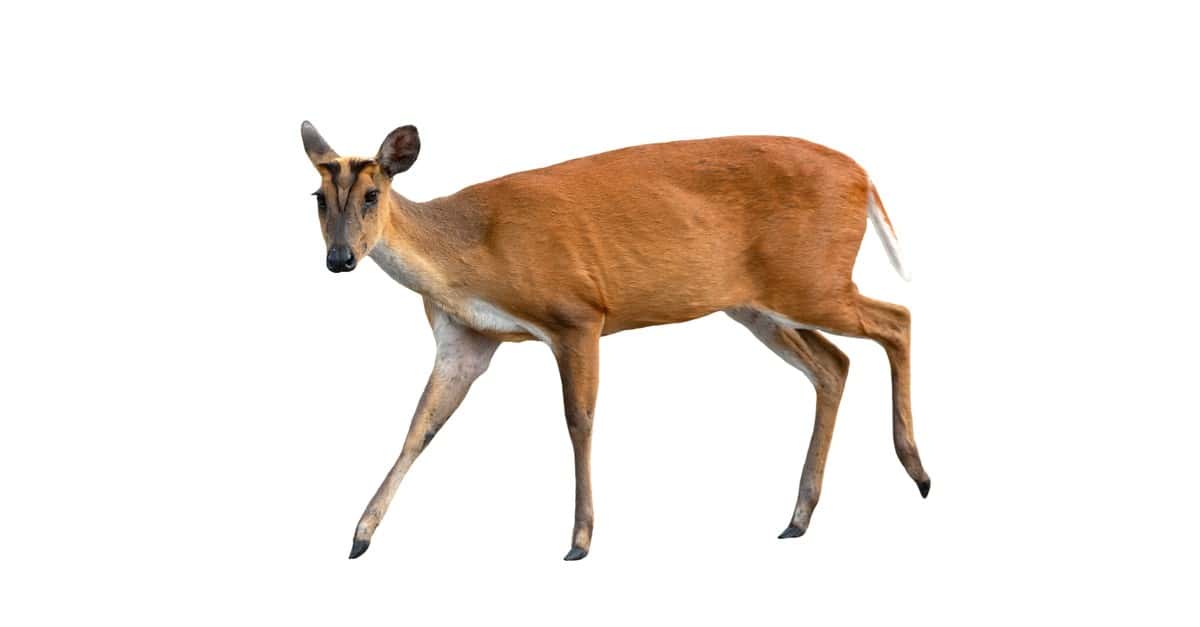
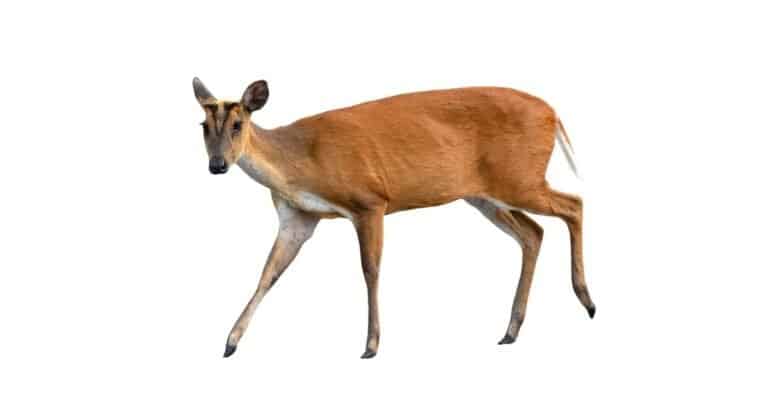
๐Ÿ‘ Muntjac isolated on white background.

Muntjac has short, dense fur and a triangular head with oval-shaped ears.

ยฉIndependent birds/Shutterstock.com

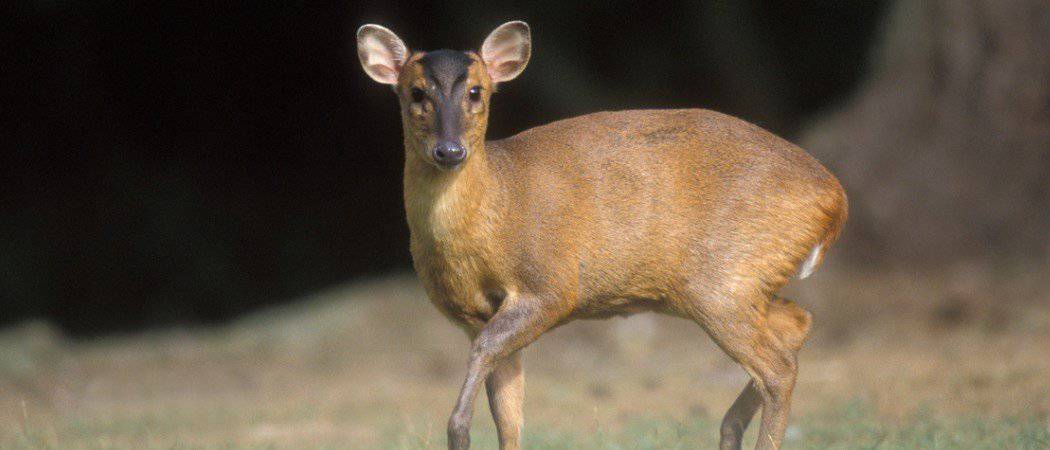
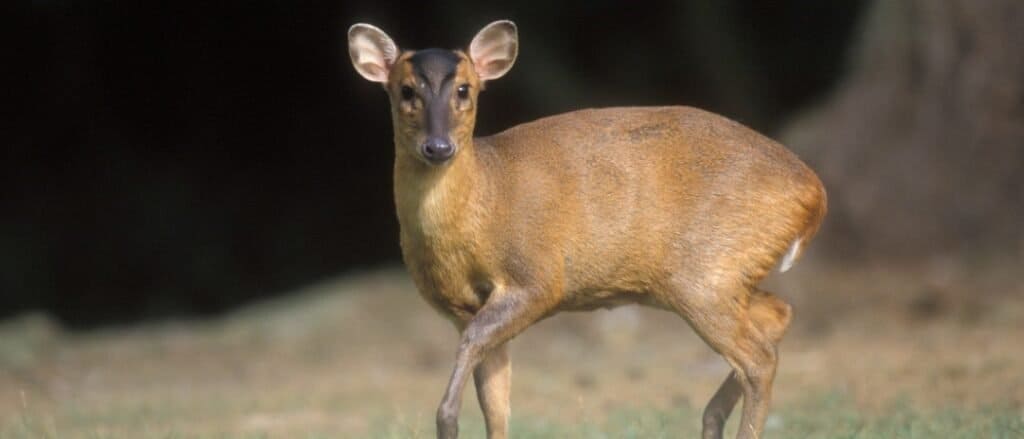
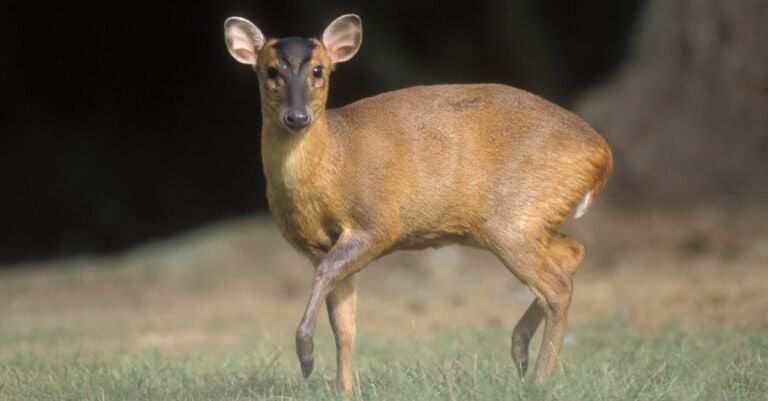
The muntjac looks very much like a miniature deer. They are characterized by short but dense fur, a triangular head, oval-shaped ears, and slender legs. Coloration varies between dark brown and yellow, depending on the season, with white markings on the abdomen and black marks possible on the face.

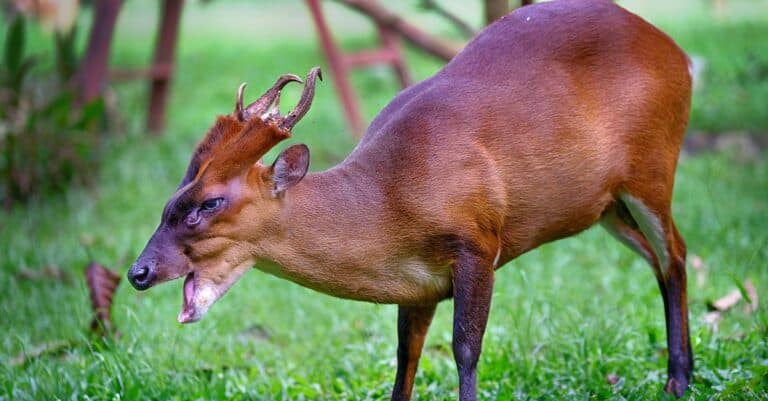
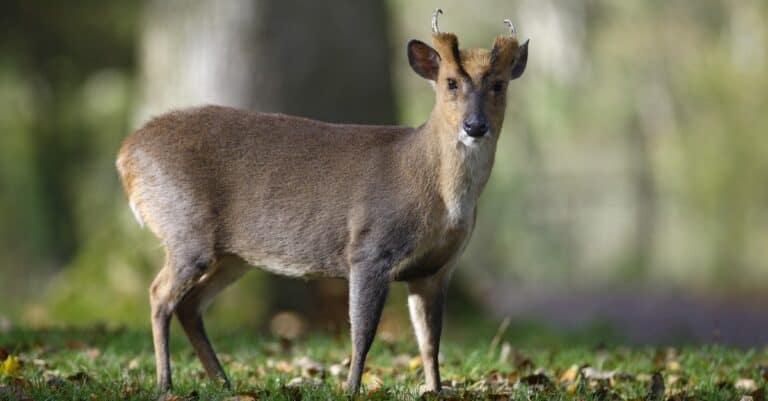
The most prominent characteristics, at least on the male, are the short antlers that grow from the head and the tusk-like upper canine teeth that project from the mouth. These antlers tend to have a simpler structure than the antlers grown by other types of deer. The females have small knobs instead of antlers, and their bodies are generally smaller in size than males.

Depending on the sex and the species, this animal normally stands somewhere between 15 and 25 inches tall at the shoulders, or about the same as a medium-sized dog breed. It also has a body weight of up to 77 pounds.

Behavior
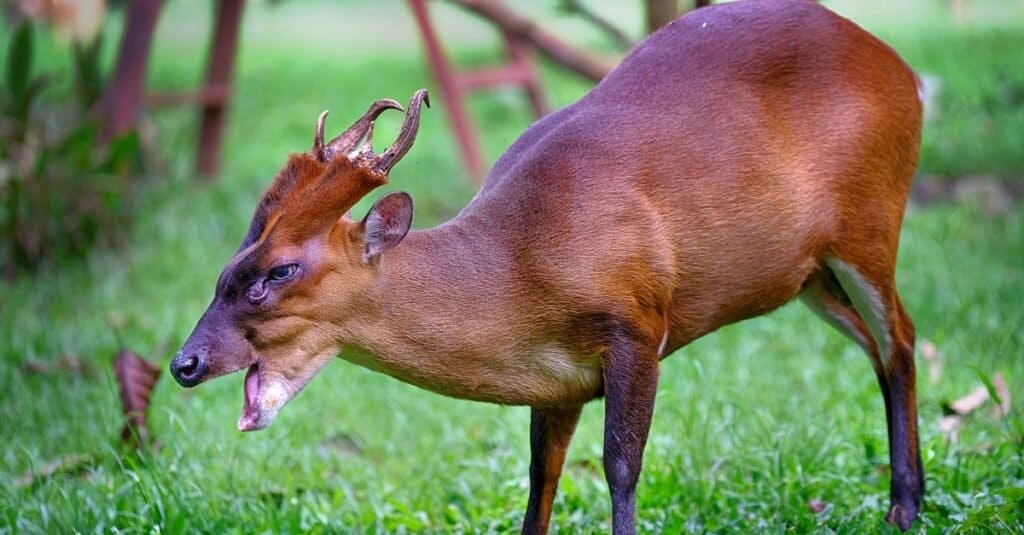
๐Ÿ‘ The Indian muntjac (Muntiacus muntjak), also called Southern red muntjac and barking deer, is a deer species native to South and Southeast Asia.

The Indian muntjac (Muntiacus muntjak), also called Southern red muntjac and barking deer spends much of its life alone.

ยฉPLOO Galary/Shutterstock.com

This animal spends much of its life in a state of solitary seclusion, feeding and sleeping alone. Most personal interactions seem to only occur when this animal mates. Each male will maintain and defend his own separate territory that overlaps with the territory of the females. The males will fight each other for access to mates and territory. Some species will lock antlers with each other to determine male dominance. The upper canines also serve as a very important offensive weapon. The weaker male will usually yield before he suffers a serious injury, but the canines are sharp enough to inflict wounds against more serious predators and threats. When they need to get away, the muntjac is also incredibly fast and agile, evading the grip of most predators.

Despite its solitary social behavior, the muntjac is capable of emitting several vocalizations. In mating situations, the male will make a harsh buzzing sound, and the female will reciprocate with a cat-like whine to show she is receptive and willing.

The most well-known of these calls, though, is the loud barking sound for which itโ€™s named. The muntjac only appears to make this vocalization when it is facing down a predator or a rival. Scientists still debate the significance of this call. Itโ€™s been suggested that this is actually just a cry of internal distress and doesnโ€™t serve as a general warning call to others. This is based on the fact that the sound doesnโ€™t appear to carry through thick vegetation very well. Another possible explanation is that the cry serves to let the predator know the muntjac is aware of its presence. A muntjac must always look out for the signs of an ambush and never let its guard down.

Regardless of its reasons, most intra-species communication is done through scent rather than vocalizations. The muntjac will mark its territory and identity using a scent gland located near the eye. Studies have shown that the scent conveys important information about the individual, including its age, sex, and even place of origin (though this does not necessarily mean the animal is able to process or understand this level of information).

Habitat
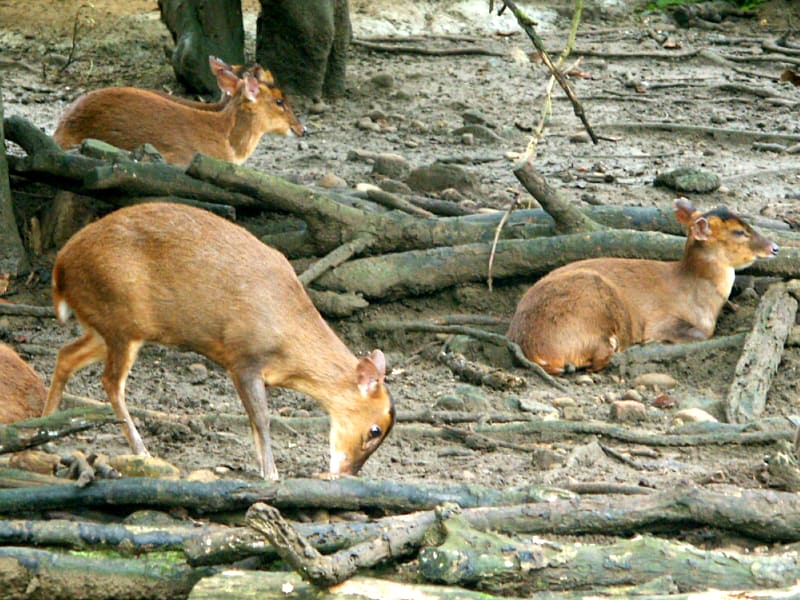
๐Ÿ‘ Formosan Reeves muntjac (endemic animals of Taiwan)

Formosan Reeves muntjac are endemic to tropical and subtropical forests, savannahs, scrublands and grasslands.

ยฉKaurJmeb / Creative Commons โ€“ Original

The muntjac is endemic to the tropical and subtropical forests, savannahs, scrublands, and grasslands of India, southern China, and Southeast Asia. This includes the large islands of Sri Lanka, Java, Sumatra, and Borneo. Small populations have also been established in the United Kingdom, France, and Japan from escaped deer farms. They are found at elevations up to 10,000 feet and never wander very far from a source of water.

Predators And Threats

Despite how common and widespread they are, the muntjac faces several threats in their native habitat. The greatest current threat appears to be habitat destruction. Southeast Asia has one of the highest rates of deforestation in the world due to poor forest management and non-stop development. This limits their population numbers and exposes them to predators. The muntjac has been traditionally hunted for thousands of years for their meat and skin. They may serve a similar ecological role as the white-tailed deer in North America and the red deer in Europe.

What Eats The Muntjac?

In its native habitat, the muntjac has to contend with a number of fearsome predators, including tigers, leopards, jackals, dholes, crocodiles, foxes, and even pythons. Humans are also a significant source of predation. In England, where there are fewer sources of predators, the number of these animals has increased rapidly.

What Does The Muntjac Eat?

The muntjac spends much of the day browsing among plants and trees. It has a specialized digestive system to process the vegetation. But there are many different components of its diet, including fruits, foliage, seeds, bark, mushrooms, bird eggs, and even dead carrion. There are also some reports that it obtains nutrients by eating small birds and mammals live. The scientific term for this type of feeding behavior is a generalist. It doesnโ€™t seem to have a preference for any single type of food.

Reproduction And Life Cycle
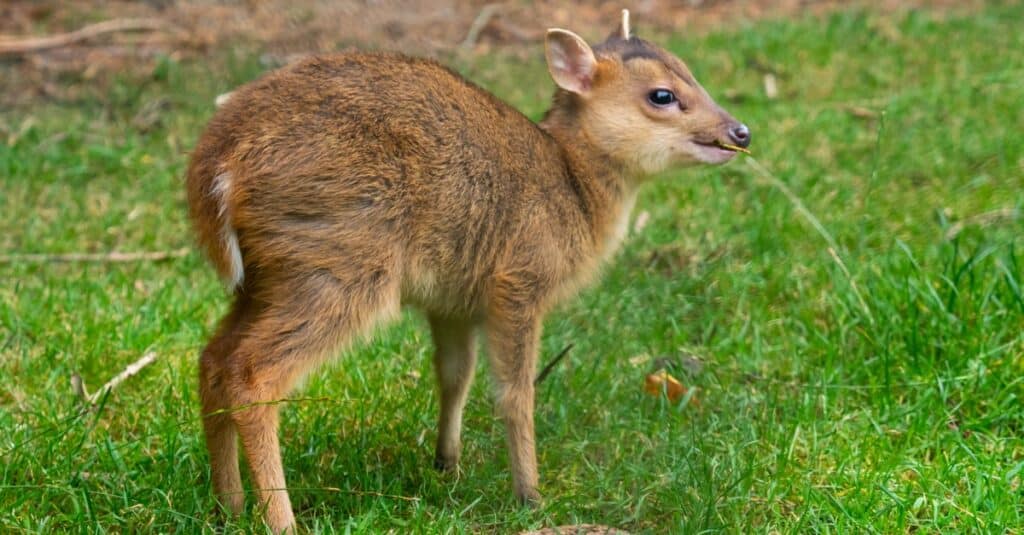
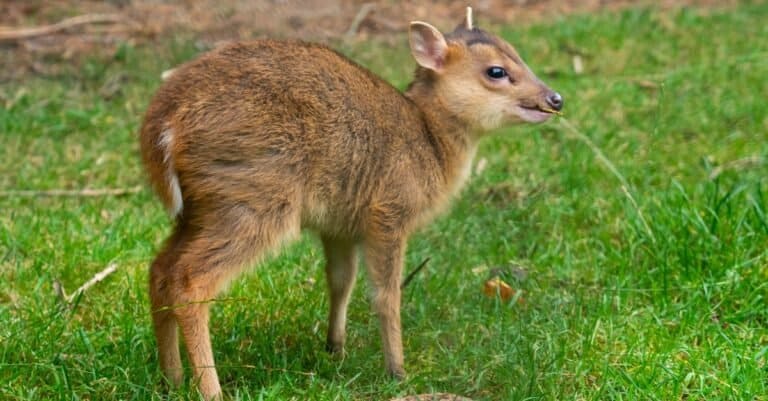
๐Ÿ‘ Young Muntjac Deer, Muntiacus reevesi, standing on the grass.

Young Muntjac Deer develop rapidly.

ยฉStephan Morris/Shutterstock.com

Whereas most other deer have a seasonal โ€œrutโ€ in which the male becomes sexually aroused for a limited time, the muntjac largely appears to reproduce all year round in its native habitat (with only a few exceptions). As mentioned previously, the male will attempt to monopolize reproductive access to several females at a time by fighting anyone who challenges his supremacy. His home range often overlaps with the range of the females he mates with. The weakest males (which are usually the youngest) may have few if any mates at all. The canines appear to play a significant role in combat. The antlers are used as well, but theyโ€™re hardly as large or elaborate as other types of deer.

After a gestation period of around six to eight months, the mother gives birth to one, rarely two, offspring at a time. The baby is weaned quickly off milk and develops rapidly so it is ready to breed as soon as possible. Individuals tend to reach sexual maturity after about a year. The mother devotes a lot of time early on to feeding, protecting, and teaching her baby fawn how to survive, but once theyโ€™re independent, all parental investment will promptly end. The normal lifespan of this animal is somewhere between 10 and 15 years in the wild. Many of them will die from predation and disease before they reach the natural end of their lives. But some individuals have been known to live more than 20 years in captivity.

Population

Population numbers across the entire genus are difficult to estimate, but there might be somewhere between 100,000 and 200,000 muntjacs in India alone. According to the IUCN Red List, the conservation status ranges anywhere between least concern (Indian and Reevesโ€™s muntjac) and critically endangered (the large-antlered muntjac). Most species havenโ€™t yet been classified because the IUCN lacks critical population data, but numbers appear to be declining for most species.


View all 330 animals that start with M

Sources

  1. Britannica / Accessed September 8, 2021
  2. Thai National Parks / Accessed September 8, 2021
  3. Sea World Parks & Entertainment / Accessed September 8, 2021

About the Author

Melissa Bauernfeind

Melissa Bauernfeind was born in NYC and got her degree in Journalism from Boston University. She lived in San Diego for 10 years and is now back in NYC. She loves adventure and traveling the world with her husband but always misses her favorite little man, "P", half Chihuahua/half Jack Russell, all trouble. She got dive-certified so she could dive with the Great White Sharks someday and is hoping to swim with the Orcas as well.
Connect:

Thank you for reading! Have some feedback for us?

Contact the AZ Animals editorial team

Related Articles You May Find Interesting


Muntjac FAQs (Frequently Asked Questions)

The muntjac is the smallest member of the deer family, with the weight and height of a medium-sized dog. Native to the dense tropical forests, scrublands, and savannas of southern Asia, it can be identified by the presence of tusk-like canines projecting outward from the mouth, as well as relatively simple antlers. It normally has a lifespan of 10 to 15 years in the wild.

The muntjac is an omnivore. They eat a combination of both plant matter and meat. Plant matter seems to be their most common food source, but they will feed on meat if the opportunity arises.

The muntjac lives in the tropical forests of South and Southeast Asia. The successful introduction into the temperate climates of Europe proves that they can live in other habitats as well.

Because of their wild nature and need for lots of space, the muntjac would not make a good pet. People have successfully managed to keep them on deer farms, especially if they are raised from an early age, but they should be treated as wild animals and not domesticated pets except under extraordinary circumstances. Many countries have bans against importing or keeping exotic pets without a license.

The muntjac is considered to be an invasive species in some parts of Europe because they can cause some damage to crops and theyโ€™re not as restrained by predators as in their native habitat.