
Quick Take
- Surviving extreme cold requires packing 167 Pygmy nuthatches into a single tree cavity.
- A short tail prevents these birds from utilizing standard stabilization techniques required for vertical foraging.
- The nest opening must be constricted to ensure the safety of the developing brood.
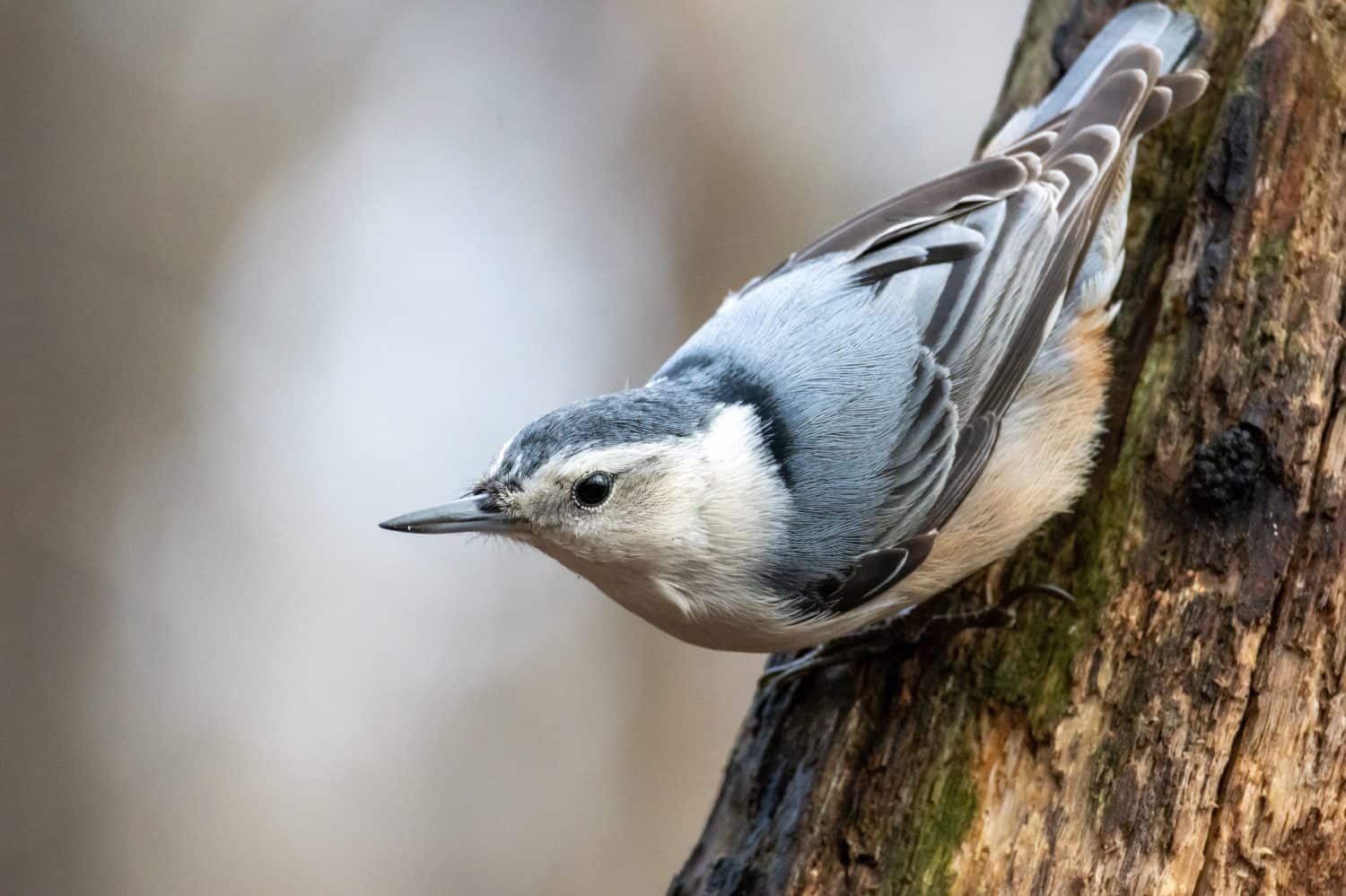
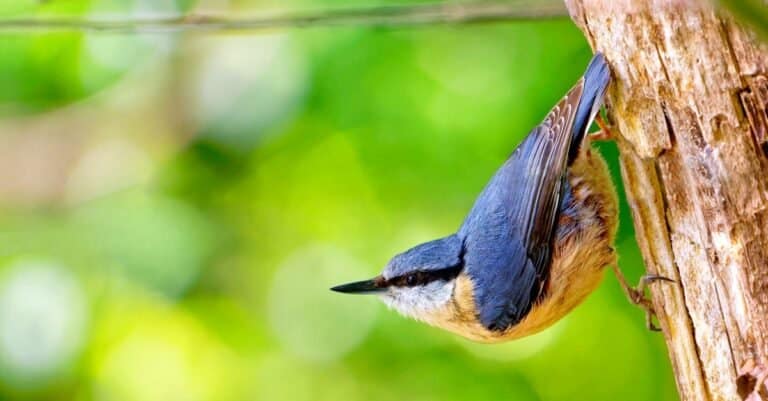
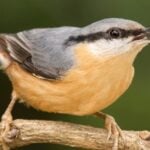
You may have seen a nuthatch foraging for food along the trunk of a tree. They look like some tiny woodpecker, with their long, sharply pointed beaks and the way they peck against the bark of trees. It’s usually easy to tell the difference, though. These little birds are just as comfortable foraging upside down as they are right side up.
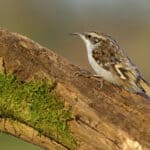
Whereas woodpeckers and treecreepers use their long tails for balance, nuthatches have short tails. They use their incredibly strong feet and claws to hold onto tree bark, rocks, or artificial surfaces, and use quick little hops to move up, down, or in any direction as they search for insects and other invertebrates or stuff tasty seeds, nuts, and berries in crevices for later consumption.
Incredible Nuthatch Facts
- Twenty-nine species of nuthatches have been identified around the world.
- Nuthatches spend a considerable amount of time upside down, foraging for insects as they hop up and down trees.
- People often mistake nuthatches for woodpeckers because of their long, pointed beaks and their foraging behavior.
- Some species of nuthatches are endangered.
- Some of these birds range over most of a continent, while others have very small habitats.
- Nuthatches come in a variety of colors, including gray, black, white, brown, red, and even blue.
Where to Find Nuthatches
Nuthatches can be found throughout most of the Northern Hemisphere. They are commonly found in wooded areas in North America, Europe, Asia, and even into northern Africa. They are often seen around human populations, frequenting bird feeders and foraging on the trunks of trees.
Most nuthatches do not migrate, and individuals tend to stay in the same small area all year. Backyard birders, however, may insist that they are more numerous in the winter. This could be because many other songbirds do migrate, leaving birds like nuthatches, chickadees, cardinals, and certain sparrows a free run at feeders. And of course, in colder months when seeds and berries are less available, those feeders become a more important source of food for birds.
Classification and Scientific Name
All nuthatches belong to the same genus, Sitta, which was described by Linnaeus in 1758. A total of 29 species have been described, with dozens of subspecies. Sitta canadensis, or the red-breasted nuthatch, was the first to be added to the taxonomic record by Linnaeus in 1766. Sitta ledanti, the Algerian nuthatch, was added most recently in 1976.
Appearance
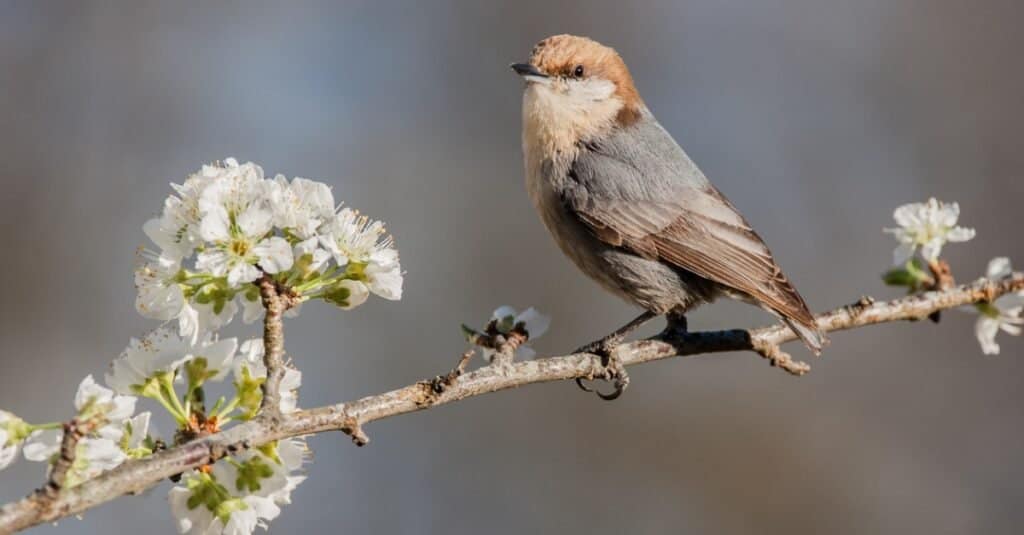
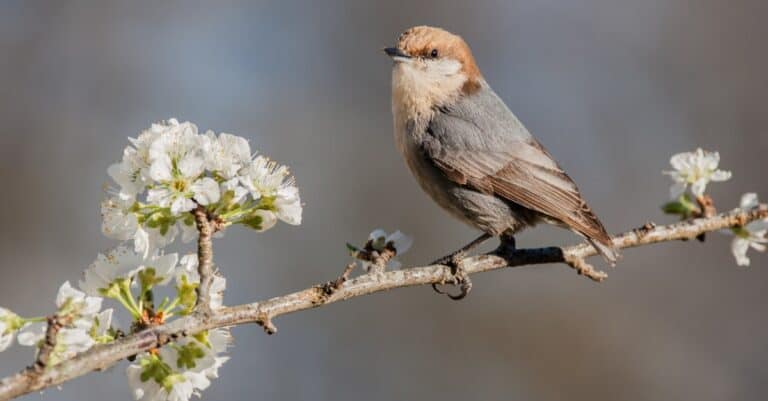
The brown-headed nuthatch averages around four inches in length.
©iStock.com/MattCuda
Caps, masks, stripes, and a variety of colors. That’s one way to describe the appearance of nuthatches. There is remarkable variation from species to species. Some of these birds have dark or even shiny black caps on the tops of their heads. Some have dark masks or eyelines, with or without a striking white eyebrow-like supercilium.
North American Nuthatches
The two most common nuthatches in North America have similar body shapes and sizes. They both have black beaks that are long and pointed. They both have short legs, short tails, and are primarily gray in color. But they are easy to differentiate if you know what to look for.
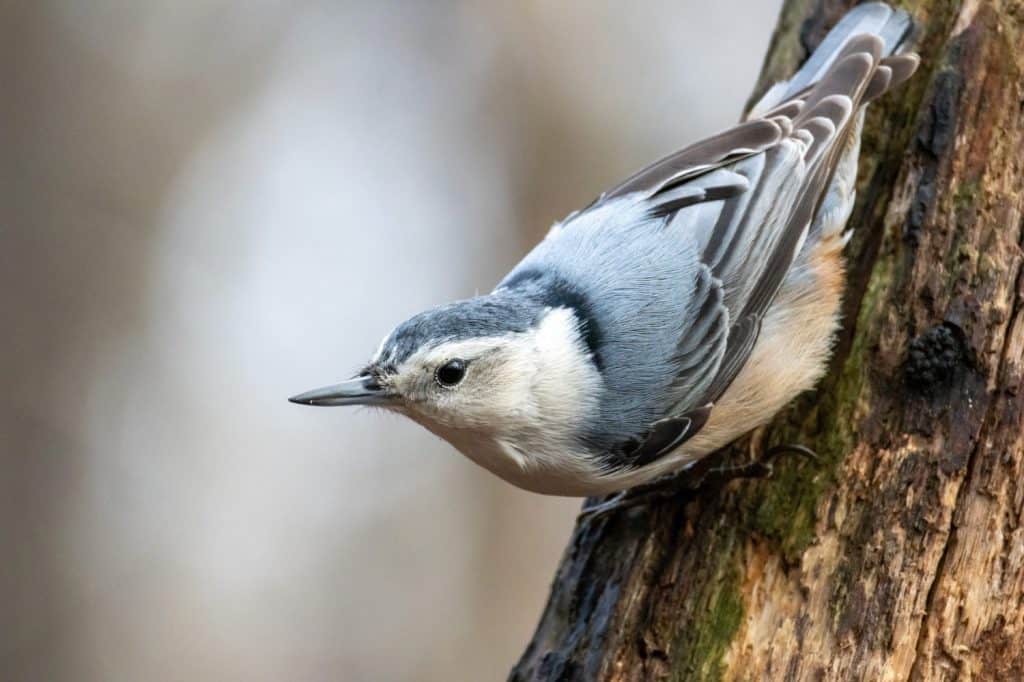
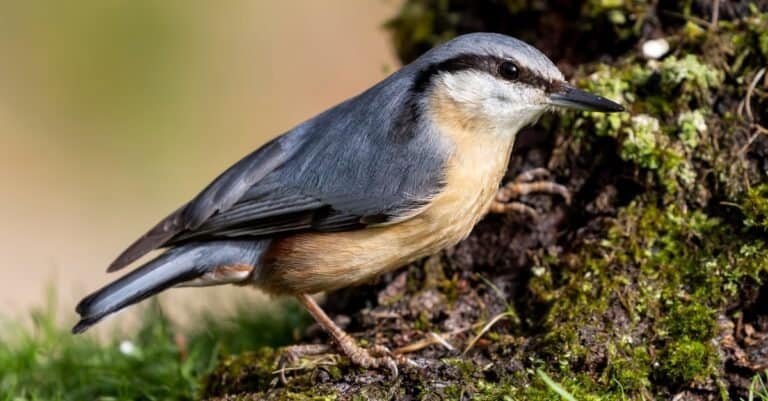
The white-breasted nuthatch, Sitta carolinensis, has a gray back with black markings and a white breast and face. It has a black hood-like cap that extends from the forehead to the back of the neck.
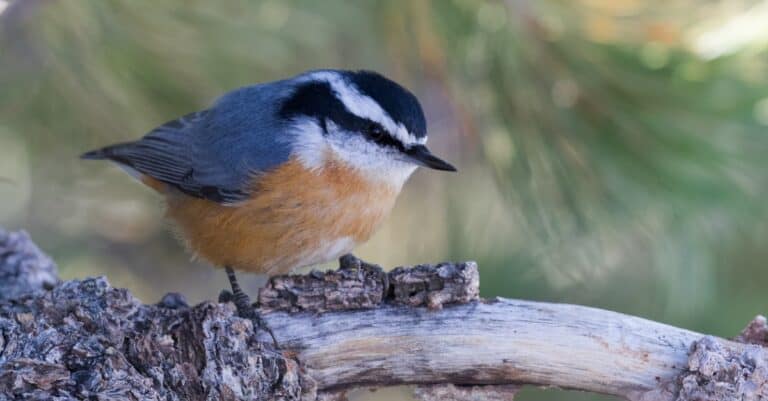
The red-breasted nuthatch, Sitta canadensis, has a red breast a bit less vibrant than that of the American robin, a white throat, black eyeline, a wide white supercilium, and a black cap. It looks similar to the Eurasian nuthatch, Sitta europaea, found across Europe, except that the Eurasian nuthatch has black markings on the wings and lacks the white supercilium and black cap.
Variations Around the World
Nuthatches around the world vary widely in colors and patterns, although they share the following characteristics: long and pointed beaks, short legs with strong feet and claws, short tails, and compact bodies. Some species stand out, with colorations that really set them apart. For instance, the white-tailed nuthatch, Sitta himalayensis, native to the Himalayas, is gray and red with a prominent black eyeline that extends to its neck and a small white spot on its tail.
The velvet-fronted nuthatch, Sitta frontalis, found in Southeast Asia from Nepal and India to Indonesia, is perhaps the biggest outlier among the various species. It has vibrant blue feathers on its back with black markings on the wings and a small black cap just above its beak. Its underside is pure white. It has bright yellow eyes, and its beak is red instead of the usual black. It is shaped like other nuthatches, but otherwise shares little in appearance with most of the genus.
Behavior
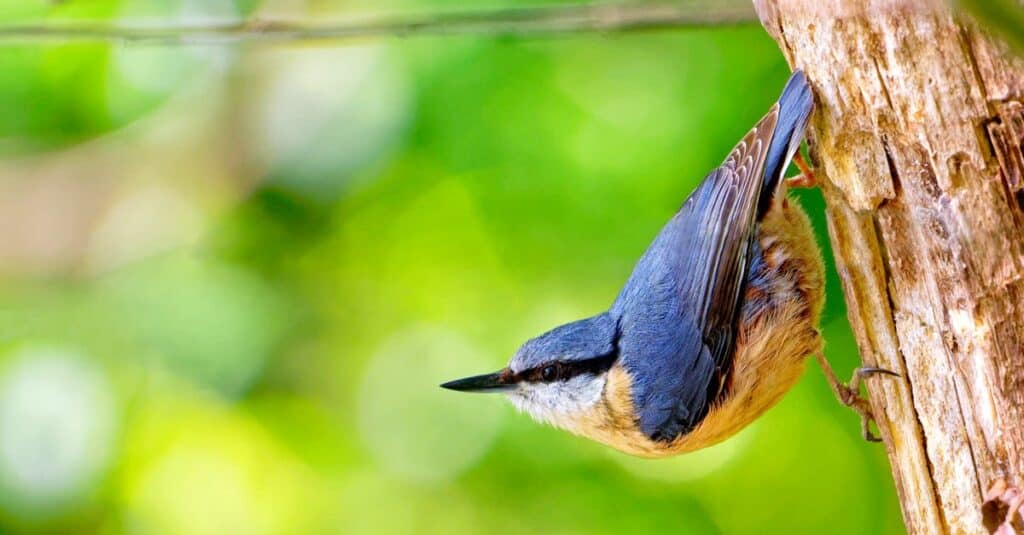
The Eurasian nuthatch, also called the wood nuthatch, hangs on a tree trunk in the forest.
©Hajakely/Shutterstock.com
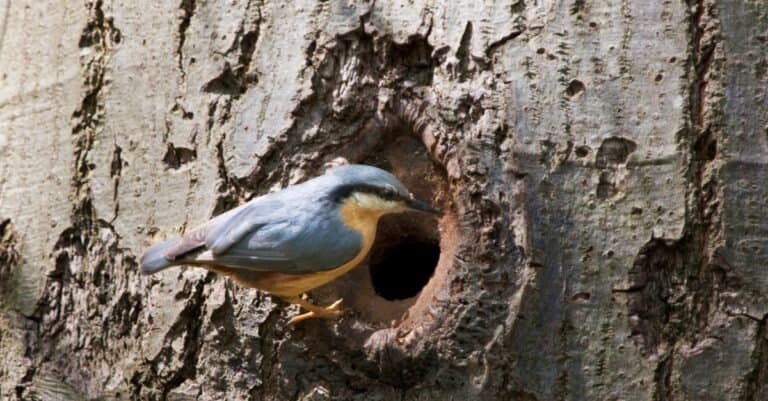
Most nuthatch species make their homes in wooded areas. They make their nests in cavities in trees, often using holes that either formed naturally or were made by woodpeckers. To help protect the nest, the industrious birds will decrease the size of the opening to the cavity, packing it with mud, sap, and even insect parts.
In cold weather, large groups of these small birds are known to roost together inside a single tree cavity. Up to 167 Pygmy nuthatches have been observed in a colonial roost. Although the birds use this strategy quite effectively to conserve energy and stay warm, it can be deadly. Researchers have found several dead birds in these communal roosts, possibly crushed or suffocated.
The Western rock nuthatch, found from Croatia to Iran, and the Eastern rock nuthatch, found from Turkey to Kazakhstan south of the Caspian Sea, differ from other species. They make their homes in crevices, holes, or overhangs in rocks. They also tend to close in the opening of their nesting sites with mud, feathers, feces, or other material, leaving a hole just large enough to go in and out.
One of the most interesting behaviors of the nuthatch is the way it moves up and down a tree, rock, or other surface. They are often mistaken for cute, tiny woodpeckers, thanks to their long, sharp beaks and the way they peck at trees. But woodpeckers tend to stay upright, using their tails to help stabilize their bodies as they forage. Nuthatches seem comfortable foraging in any orientation and spend a considerable amount of their time upside down. They use their strong feet to hop around, up and down a tree trunk or other surface in any direction they choose.
Diet
Nuthatches do all that hopping and pecking up and down trees because that’s where they find one of their favorite foods. Insects or other invertebrates living in and under the bark of a tree are a staple of their diet. Their long, sharp beaks are perfect for pecking through or lifting bark to get at a hearty meal.
These birds also eat grains, berries, and, of course, nuts. In fact, that is how they got their name. They cram nuts into tight crevices in a tree’s bark, then use their sharp beaks to break open the hard shells and hatch the edible portion from inside. They also use crevices in the bark of trees to store extra seeds, berries, and other food for later consumption.
Many nuthatches live closely with humans, and they may be found at feeders, especially in the winter. Because most Sitta species do not migrate, they can be spotted year-round. In North America, it is common to see white-breasted nuthatches and similarly colored chickadees together at feeders throughout the winter.
Reproduction
Nuthatches are monogamous birds that usually breed in the spring. They typically have one or two broods per year, depending on the species. The brood size can vary widely. Some species can lay up to 13 eggs, although 5 to 9 is more common. The incubation time varies, taking an average of 12 to 18 days, and fledglings leave the nest around 21 to 27 days after hatching.
Male and female nuthatches look similar to one another. In most species, there are small differences that can be spotted by experienced birders, but usually not the striking differences seen in songbirds that are sexually dimorphic. Juveniles usually look similar to their parents.
The age of molting can vary, not only between species but also among individuals of the same species. Most of these birds are not migratory, and the juveniles are not driven to disperse far from home. They reach sexual maturity around their first spring, when they mate and have broods of their own.
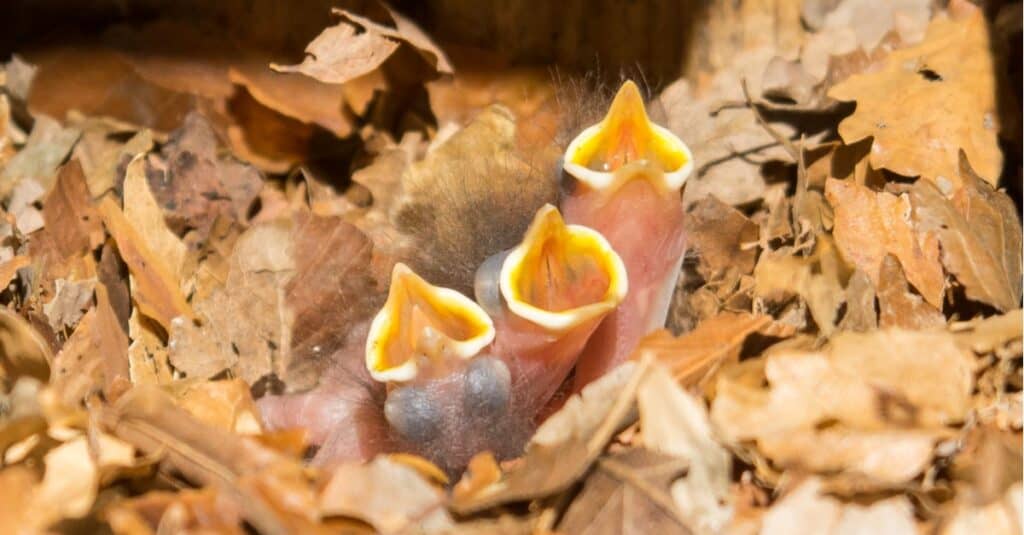
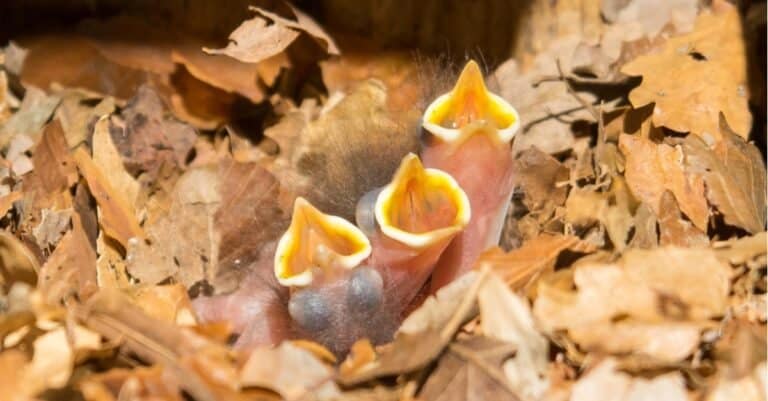
Eurasian nuthatch (Sitta europaea) babies waiting to be fed.
©Arnau Soler/Shutterstock.com
Predators
Nuthatches are at risk of predation from owls, hawks, and, perhaps surprisingly, squirrels. The same tree cavities these birds use for nesting are prime real estate for squirrels, and they can be fierce competitors. They are equally aggressive, though, in defending their nests.
An example of the defensive behavior of white-breasted nuthatches was recorded in 1942 by an observer in Albany, New York. A pair of these birds, male and female, were confronted at their nest by a squirrel. Although they were considerably smaller than their foe, they raised their feathers to appear larger and vibrated their wings, perhaps to stun or confuse their adversary. A single peck from one of the birds was then enough to convince the squirrel to look elsewhere for shelter.
Lifespan of the Nuthatch
The average lifespan of a nuthatch is somewhere between 2 and 3.5 years, but some species have had individuals recorded over 10 years of age. Predators are a common threat to nuthatches, but so are things like deforestation, severe weather, and wildfires. Some of these threats can be mitigated by changes in human behavior.
Nuthatch Species at Risk
Although many nuthatch species have stable populations or are increasing in numbers, there are a few that are at particular risk. Most have a limited range and have suffered substantial habitat loss due to deforestation. Some are now endangered.
The Algerian nuthatch, Sitta ledanti, is endangered, with an estimated population of 1,000 to 2,500 birds. It exists in only a small region of Algeria.
The endangered giant nuthatch, Sitta magna, is the largest of all the species in the Sitta genus and lives only in a small region of Myanmar. Deforestation is an issue affecting multiple species in this country.
The white-browed nuthatch, Sitta victoriae, also of Myanmar, was recently listed as endangered with a declining population estimated at between 1,000 and 2,500 mature individuals.
The Bahama nuthatch, Sitta insularis, found only on Grand Bahama Island, is critically endangered with an estimated population of fewer than 50 birds. As recently as 2004, the population was estimated at 1800, but recent hurricanes have all but wiped out the species.