O
Species Profile

Ostrich

Struthio camelus

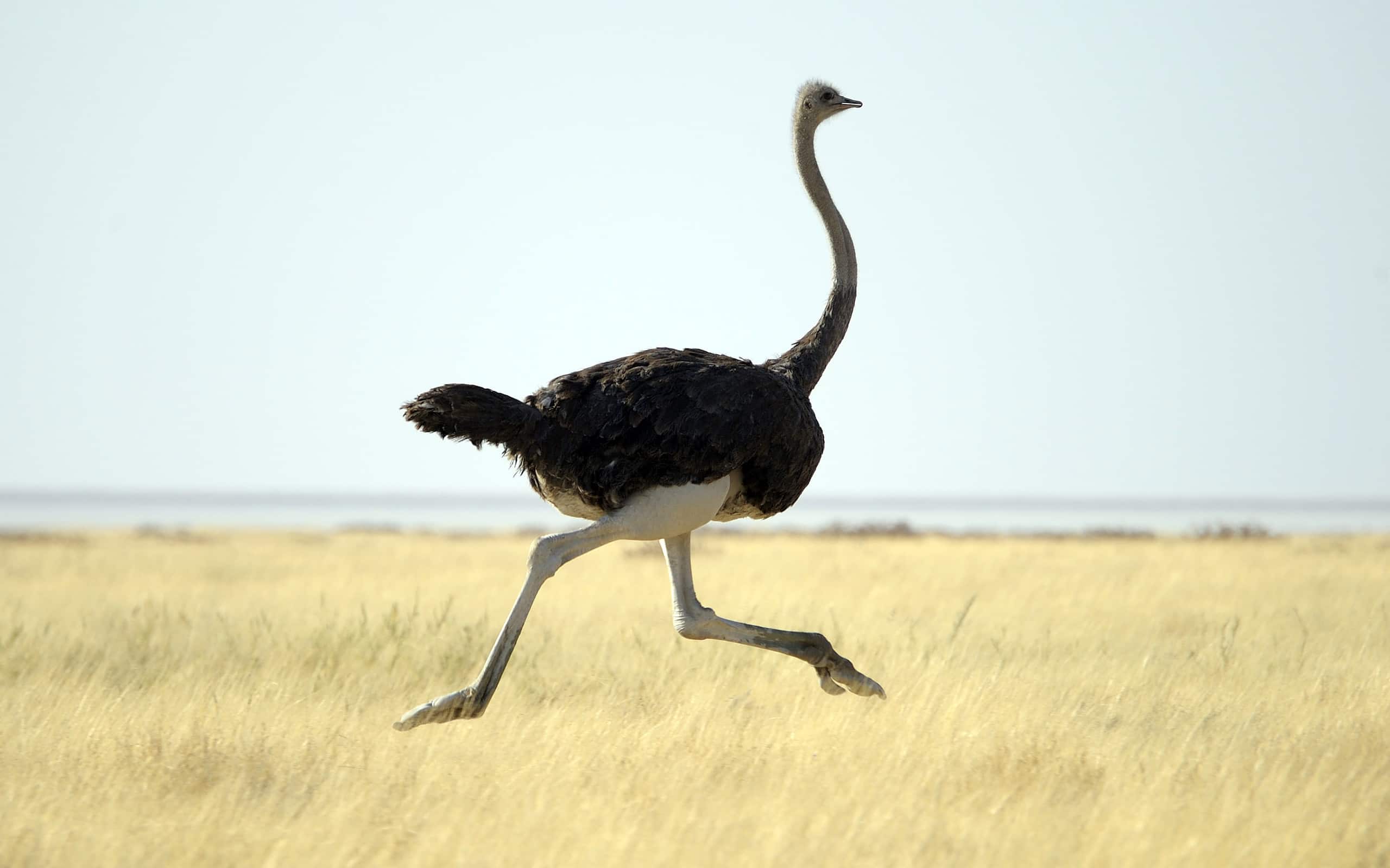
Two toes. One mission: outrun.
JohnCarnemolla/iStock via Getty Images

At a Glance

Wild Species
Also Known As Ostrich, Greater ostrich, African ostrich
Diet Omnivore
Activity Diurnal+
Lifespan 35 years
Weight 145 lbs
Status Least Concern
Did You Know?

Adult height: males ~2.1-2.75 m; females ~1.75-2.0 m (HBW/Davies).

Scientific Classification

The common ostrich is the worldโ€™s largest living bird and a flightless ratite adapted for fast running in open habitats.

Kingdom
Animalia
Phylum
Chordata
Class
Aves
Order
Struthioniformes
Family
Struthionidae
Genus
Struthio
Species
Struthio camelus

Distinguishing Features

  • Very large, flightless bird with long neck and legs
  • Two-toed feet adapted for running
  • Sexual dimorphism: males typically black-and-white plumage; females more brown/gray
  • High running speed and powerful kicks for defense

Physical Measurements

Males and females differ in size

Height
โ™‚ 8 ft 2 in (6 ft 11 in โ€“ 9 ft 2 in)
โ™€ 6 ft 1 in (5 ft 7 in โ€“ 6 ft 7 in)
Length
โ™‚ 8 ft 2 in (6 ft 11 in โ€“ 9 ft)
โ™€ 5 ft 11 in (5 ft 3 in โ€“ 6 ft 7 in)
Weight
โ™‚ 287 lbs (229 lbs โ€“ 344 lbs)
โ™€ 220 lbs (198 lbs โ€“ 243 lbs)
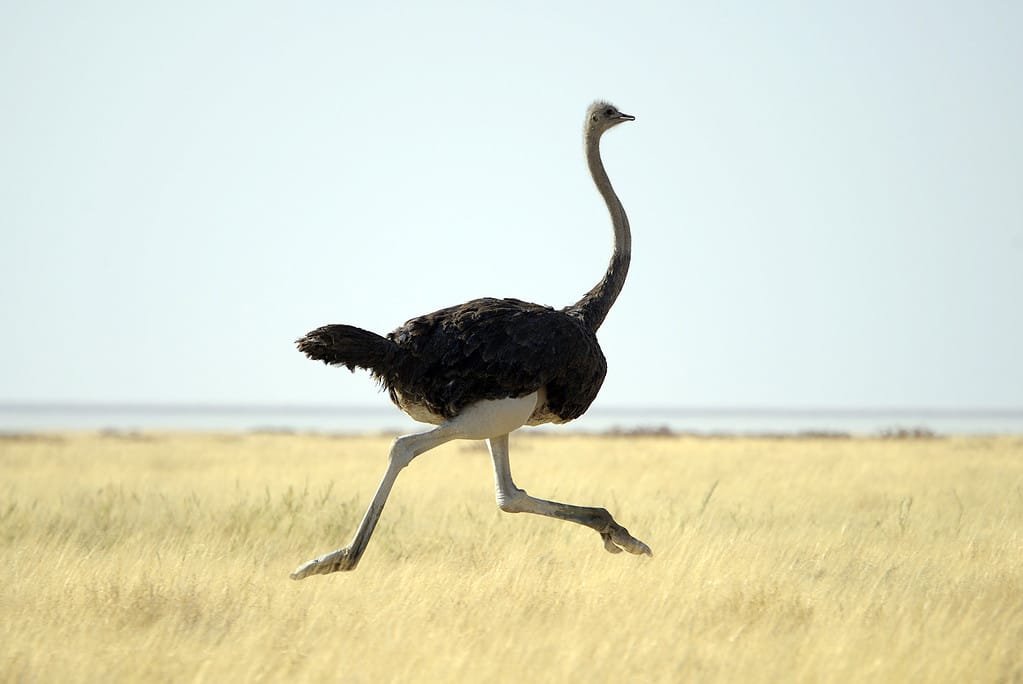
Top Speed
43 mph
running

Appearance

Primary Colors
Secondary Colors
Skin Type Feathered body with loose, hairlike plumes; bare, thick, scaly skin on legs and much of neck.
Distinctive Features
  • World's largest living bird; adult height typically: males 2.1-2.8 m, females 1.7-2.0 m (Davies, 2002).
  • Body mass commonly: males ~104-156 kg, females ~90-110 kg (Davies, 2002; HBW).
  • Flightless ratite: flat sternum lacking keel; reduced wings used for balance, braking, and display rather than flight.
  • Two-toed foot (digits III and IV only); enlarged inner toe with hoof-like nail optimizes cursorial traction and powerful kicking.
  • Cursorial locomotion: running bursts reported up to ~70 km/h; long elastic stride aids efficient travel in open habitats (Alexander, 2003; Hutchinson et al., 2015).
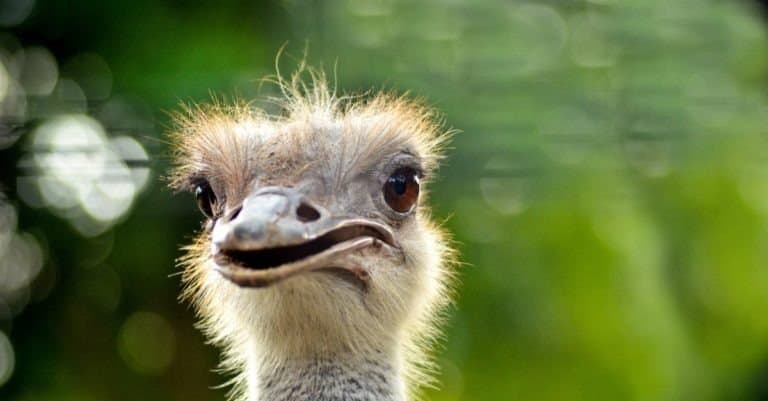
  • Large eyes (~5 cm diameter) with long eyelashes reduce glare and protect from sand/dust; keen long-distance vision in savannas.
  • Feathers lack interlocking barbules, forming soft plumes that aid insulation and thermoregulation despite heat exposure (ratite trait).
  • Largest eggs among living birds: ~15-16 cm long and ~1.4-1.6 kg; thick shell supports communal nesting (Deeming, 1999).
  • Omnivorous diet in open African habitats: grasses, seeds, leaves, and flowers; also insects and small vertebrates when available.
  • Typical lifespan ~30-40 years in the wild; up to ~50 years reported in captivity (Davies, 2002; zoo records).
  • Behavioral ecology: dust-bathing and wing-spreading for thermoregulation; communal breeding with shared incubation/guarding by adults.

Sexual Dimorphism

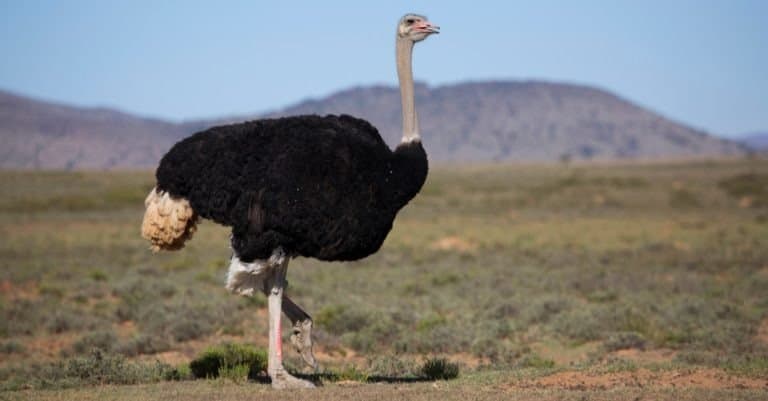
Strong plumage and size dimorphism: adult males are larger with black body feathers and white wings/tail, while females and juveniles are gray-brown. Breeding males often show brighter pinkish neck and leg skin during display.

โ™‚
  • Larger average body size and taller stature than females (Davies, 2002).
  • Black body plumage with contrasting white wing and tail plumes.
  • Breeding season skin on neck/legs often becomes more vividly pinkish; used in displays and territorial signaling.
  • More prominent courtship displays (wing-fanning, bowing) centered on high-contrast plumage.
โ™€
  • Gray-brown to brown plumage overall, providing camouflage at nest and while foraging.
  • Generally smaller and lighter-bodied than males (Davies, 2002).
  • Less conspicuous wing/tail contrast; plumage tone more uniform for concealment.
  • Typically responsible for much of daytime incubation in communal nests, relying on cryptic coloration.

Did You Know?

Adult height: males ~2.1-2.75 m; females ~1.75-2.0 m (HBW/Davies).

Body mass commonly ~90-130 kg; large males can reach ~150+ kg (HBW/Davies).

Top running speed is widely reported up to ~70 km/h, with long, efficient strides for open-country sprinting.

Eggs are the largest of any living bird: typically ~1.2-1.8 kg each; incubation about ~42 days is common (species accounts).

Two toes per foot (unique among living birds): a large, hoof-like 3rd toe bears most of the weight; the smaller 4th toe aids balance.

Longevity: often ~30-40 years; can exceed ~40 and reach ~50+ years in captivity (zoo/species records).

Unique Adaptations

  • Cursorial (running) body plan: long distal leg segments and elastic tendons store and return energy, improving running efficiency over open ground.
  • Two-toed foot specialization: reduced digits lower distal limb mass and increase stride efficiency; the enlarged main toe functions like a springy, hoofed platform for speed.
  • Paleognath (ratite) anatomy: a flat breastbone lacking a keel reflects loss of flight muscles, while leg musculature is highly developed for locomotion.
  • Exceptional vision: very large eyes (about ~5 cm across in many reports) and an elevated head/neck provide long-distance predator detection on open plains.
  • Hindgut fermentation: an enlarged hindgut (including sizeable ceca) helps extract nutrients and water from fibrous vegetation-useful in semi-arid habitats.
  • Eggshell engineering: very thick, strong shells reduce breakage and water loss in exposed nests; the large egg is a major energy investment suited to open-country breeding.

Interesting Behaviors

  • Communal nesting: multiple females may lay in one nest scrape, but a dominant hen's eggs tend to occupy the safest central positions; subdominant eggs are often pushed to the margins.
  • Incubation shifts: females typically sit by day (camouflage in brown plumage), while the black-plumaged male often incubates at night-matching day/night visibility in open habitats.
  • Threat display and defense: adults can hiss, spread wings, and deliver powerful forward kicks; the large toenail can act like a dagger against predators.
  • Courtship displays ("dancing"): males perform wing-fanning, swaying, and booming vocalizations to advertise fitness and territory.
  • Heat management behavior: in extreme sun they may hold wings out as shade and use open-mouth panting to shed heat; they also rest during the hottest periods.
  • Foraging strategy: mostly plant-eating but opportunistically omnivorous-pecking seeds, grasses, leaves, flowers, insects, and small vertebrates; frequently swallow pebbles (gastroliths) to grind tough food in the gizzard.

Cultural Significance

Common ostrich (Struthio camelus) is both useful and a symbol: eggshells used for beads and containers in Africa; feathers prized in Ancient Egypt, Rome, and 19thโ€“early 20th century fashion. Modern farming in southern Africa produces meat, leather, and feathers. Ostriches appear in sayings and cartoons as a symbol of avoidance.

Myths & Legends

Ancient Egypt: the goddess Ma'at-embodiment of truth and cosmic order-is closely associated with an ostrich feather, used symbolically in the weighing of the heart in the afterlife.

Medieval European bestiaries repeated marvels about ostriches: that they could digest iron and that they incubated eggs by staring at them-stories meant to teach moral lessons about endurance and vigilance.

North and East African folktales tell 'why' stories that explain the ostrich's strong legs, not being able to fly, and huge eggs as the result of pride, trickery, or a bad bargain with other animals.

Arabic naming lore: the scientific epithet camelus echoes an old perception of the ostrich as "camel-like" (long neck, desert life), a comparison found in historical travel writing and natural histories.

A widespread modern tale claims ostriches "bury their heads in the sand" to hide; this image became a durable cultural motif in literature and cartoons, shaping the ostrich as a symbol of denial.

Conservation Status

LC Least Concern

Widespread and abundant in the wild.

Population Decreasing

Protected Under

  • Occurs in numerous protected areas across its range (national parks, game reserves, and conservancies).
  • Subject to national wildlife protection/harvest regulations in many range states; legal status and permitted offtake vary by country and province/state.

Life Cycle

Birth 8 chicks
Lifespan 35 years

Lifespan

In the Wild 30โ€“40 years
In Captivity 40โ€“50 years

Reproduction

Mating System Polygyny
Social Structure Harem Based
Breeding Pattern Seasonal
Fertilization Internal Fertilization
Birth Type Internal_fertilization

Breeding is typically harem polygyny: a dominant territorial male mates with a "major" female and several minor females that lay in a communal nest (often ~15-60 eggs total). The male and major female perform most incubation (~42 days) and chick defense.

Behavior & Ecology

Social Flock Group: 10
Activity Diurnal, Crepuscular
Diet Omnivore Seeds and green plant matter (especially grasses/forbs)

Temperament

Generally wary and highly vigilant; group living increases detection and dilution against predators (Davies 2002).
Breeding males become strongly territorial and can be aggressive toward intruders (Davies 2002).
Outside breeding season, typically gregarious and tolerant, often mixing with other ungulate herds (Bertram 1992).
Adults show strong antipredator defense of chicks (kicking, distraction displays) when threatened (Bertram 1992).

Communication

Low-frequency booming by breeding males Inflated throat/neck) used in courtship and advertising (Davies 2002
Hisses/snorts given in alarm or agitation at close range Davies 2002
Grunts and clucks used in short-range social interactions, including at nests Davies 2002
Chicks produce contact peeps/whistles to maintain cohesion with guarding adults Bertram 1992
Visual courtship displays: wing spreading, kneeling, rhythmic 'dancing' and feather erection Davies 2002
Threat/appeasement postures: neck height changes, head orientation, and lateral body presentation Davies 2002
Territory and dominance signaling via approach/retreat, chasing, and ritualized display runs Bertram 1992
Group coordination through movement cues-individuals follow initiators during departures and flight responses Davies 2002

Habitat

Biomes:
Savanna Desert Hot Temperate Grassland
Terrain:
Plains Plateau Rocky Sandy
Elevation: Up to 9842 ft 6 in

Ecological Role

Large-bodied omnivorous grazer/browser and opportunistic invertebrate predator in open savanna/steppe systems; also functions as a mobile seed consumer and disperser.

Seed dispersal via ingestion and defecation of viable seeds (where fruits/seeds are eaten) Regulation of insect populations (notably outbreaks of orthopterans) Links plant productivity to higher trophic levels (eggs/chicks and occasionally adults support predators/scavengers) Nutrient cycling through movement and deposition of dung across open habitats

Diet Details

Main Prey:
Grasshoppers and locusts Beetle Termite Locust Small invertebrates Small vertebrates Bird eggs and nestlings Carrion +2
Other Foods:
Grasses Forbs and herbaceous plants Leaves and shoots of shrubs Seeds and grains Pods Flowers Fruits and berries +1

Human Interaction

Domestication Status

Semi domesticated

The common ostrich (Struthio camelus) is not fully domesticated but is semi-domesticated: kept and bred on farms while keeping wild ways. People used ostriches for feathers and display since ancient North Africa and the Mediterranean. Large-scale farming grew in South Africa in the mid-to-late 1800s for feathers, later leather and meat.

Danger Level

High
  • Powerful forward kicks (often with the inner toe claw) can cause severe trauma and have been implicated in rare human fatalities
  • Aggression and charging behavior, especially territorial adult males during breeding season and when defending nests/chicks
  • Handling injuries on farms (knock-down, trampling, lacerations) during restraint, transport, or enclosure entry
  • Vehicle collisions in open habitats where ostriches cross roads (risk to occupants due to large body mass and height)

As a Pet

Not Suitable as Pet

Legality: Varies by jurisdiction. Commonly regulated as livestock/exotic wildlife rather than a companion animal; many areas require permits, specific enclosure standards, transport documentation, and/or zoning approval. Some places prohibit private possession outside licensed farms, exhibitors, or educational facilities.

Care Level: Expert Only

Purchase Cost: $500 - $3,000
Lifetime Cost: $20,000 - $80,000

Economic Value

Uses:
Commercial farming (livestock/agriculture) Wildlife tourism and display Leather and textile markets Meat production Egg and byproduct crafts
Products:
  • Meat (red meat; commonly marketed as low-fat relative to many red meats)
  • Leather (high-value hide used for luxury goods)
  • Feathers (decorative, fashion/industrial dusting uses historically important)
  • Eggs (food use; also carved/decorated craft items)
  • Chicks/breeding stock sales
  • Tourism experiences (farm visits, exhibits)

Relationships

Predators 9

Lion Panthera leo
Leopard Panthera pardus
Cheetah Acinonyx jubatus
African Wild Dog Lycaon pictus
Spotted Hyena Crocuta crocuta
Black-backed Jackal Lupulella mesomelas
Side-striped Jackal Lupulella adusta
Olive Baboon Papio anubis
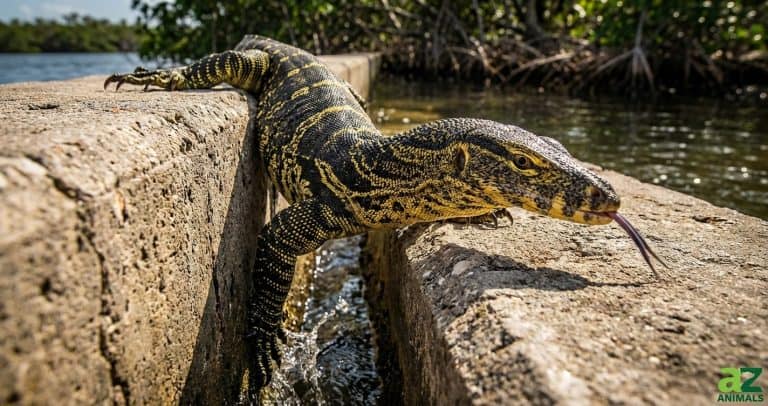
Nile Monitor Varanus niloticus

Related Species 1

Somali Ostrich Struthio molybdophanes Shared Genus

Ecological Equivalents 3

Animals that fill a similar ecological role in their ecosystem

Emu Dromaius novaehollandiae Large, cursorial, flightless ratite that occupies open habitats. Fills an analogous niche as a primarily herbivorous/omnivorous ground forager that relies on long-distance walking and running and on predator avoidance via speed; both rely on powerful legs rather than flight.
Greater Rhea Rhea americana Ecological analogue in South American grasslands and savannas: a large, flightless, open-country omnivore/herbivore with comparable sociality and breeding-system elements (male incubation and guarding occur in rheas; ostriches show communal nesting with a dominant pair and shared incubation).
Southern Cassowary Casuarius casuarius Similar ratite: a large, flightless, strong-legged ground bird that inhabits dense rainforest rather than open savanna; primarily eats fruit and plants with some animal prey and uses running and powerful kicks to escape predators.

The ostrich looks like an unusual chimera cooked up in a lab. When writing about it, the Greek philosopher Aristotle did not know whether to classify it as a bird or a mammal. But the ostrich belongs to an unusual group of flightless birds well-adapted for life on the ground. Years of hunting almost drove them to extinction, but numbers have recovered sufficiently so that the ostrich now roams the plains of Africa once again.

Incredible Ostrich Facts

  • The ostrich eye, at around 2 inches across, is the largest of any known land animal worldwide.
  • The ostrich is the only bird with two toes. Every other type of bird has three or four.
  • The ostrich was once hunted or farmed in large numbers for its feathers, dating back to ancient Egypt, Babylon, and Assyria. These feathers were used by royalty, upper-class women, and even medieval knights. By 1913, as hunting subsided, more than a million ostriches were raised on farms. However, a fall in the popularity of ostrich feathers caused the farms to decline as well.
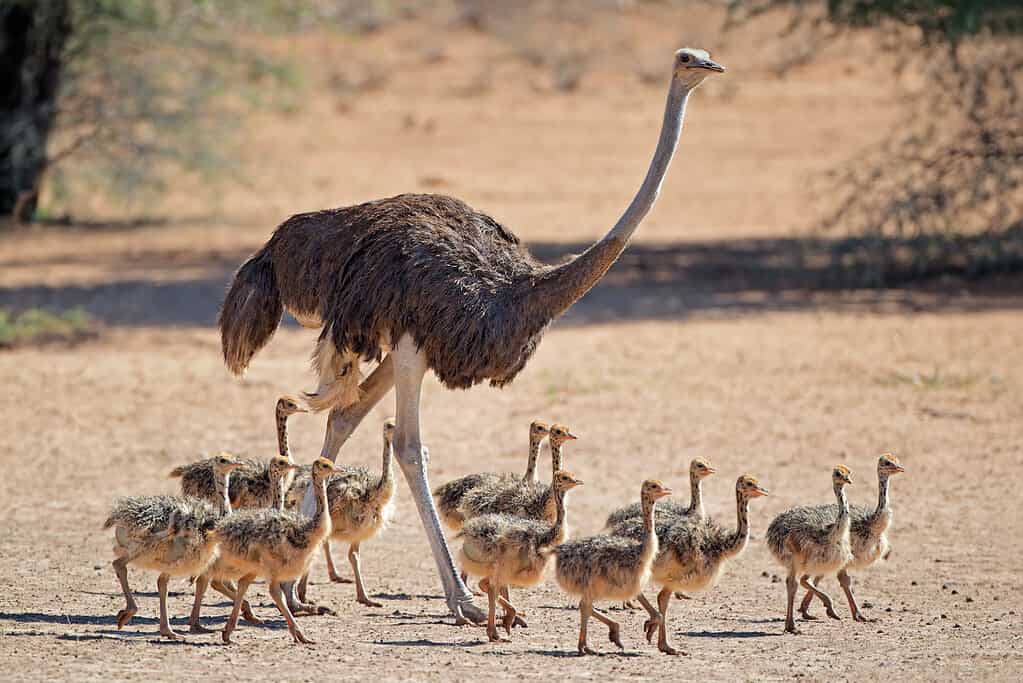
๐Ÿ‘ Female ostrich with chicks

The ostrich is a large, flightless bird with long legs and two toes.

ยฉEcoPic/iStock via Getty Images

Scientific Name and Species

The scientific name of the ostrich genus is Struthio, derived from the Ancient Greek term for the ostrich and the sparrow. Struthio camelus is also known simply as the common ostrich. (Camelus, as you might expect, is Greek for camel, perhaps named for its ability to go long periods without water.) 

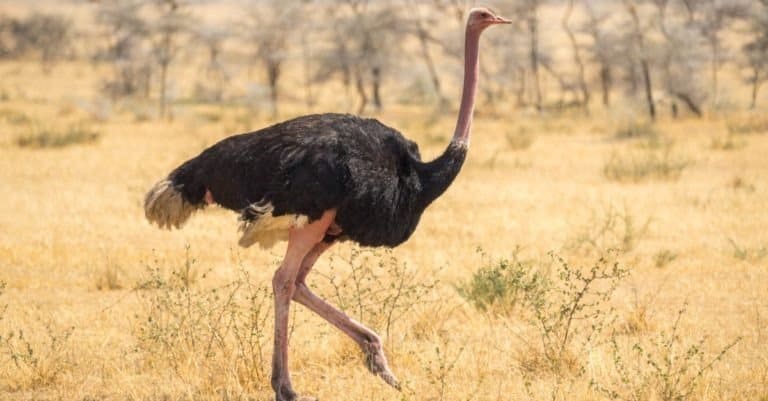
There are two species of ostrich: the Somali ostrich (Struthio molybdophanes) and the common ostrich (Struthio camelus). Sub-species of the common ostrich include the Masai ostrich (a pink-skinned variety also called East African ostrich), the nominative ostrich (red-necked ostrich or Barbary ostrich), the South African ostrich (Black-necked ostrich or Cape ostrich), and the Arabian ostrich (a Syrian or Middle Eastern ostrich, now extinct). 

The ostrich is an example of a ratite: a distantly related group of large flightless birds, including the kiwi, the emu, and the rhea. It was once assumed that the ratites belonged to a single order. However, genetic analysis suggests that these birds had separate evolutionary lineages, so they were placed in different orders entirely. The ostrich is now the only living member of its family and order.
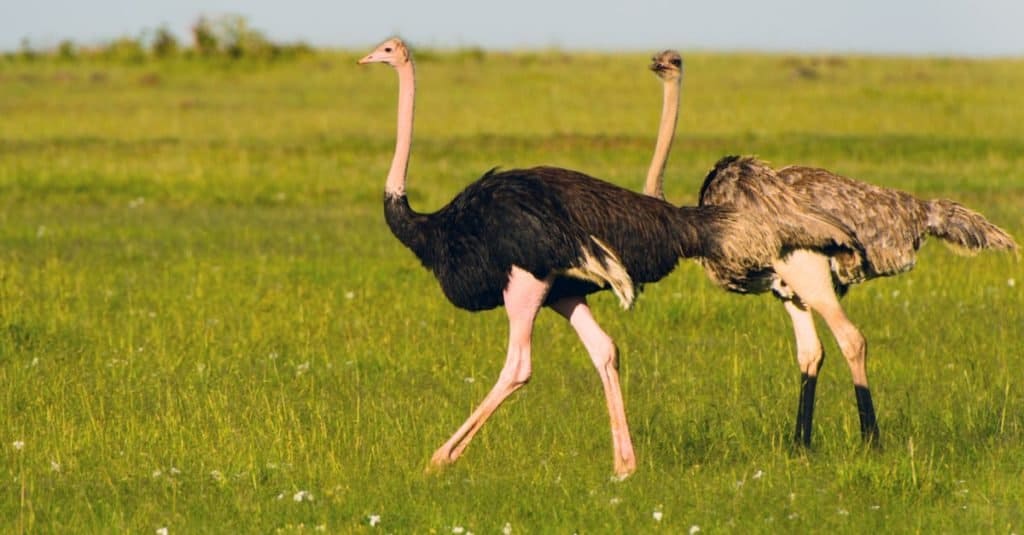
๐Ÿ‘ Safari Animals You MUST See: Masai Ostrich

The ostrich is a ratite: a distantly related group of large flightless birds that includes the kiwi, emu, and rhea.

ยฉCristian Zamfir/Shutterstock.com

Evolution

The earliest ostrich fossils date back around 20 to 25 million years. Around 12 million years ago, ostriches evolved to the larger size they are known for. This was also when they began to leave Africa for the rest of Eurasia. All of these non-African species are now extinct.

One interesting trait that the ostrich developed in its evolution is its two toes, whereas most birds have four. The two-toed structure of this ratite helps the ostrich run at high speeds. Itโ€™s believed that ostriches evolved in the steppes of Central Asia and then spread to Africa 20 million years ago. In the early Cenozoic, their ancestors inhabited much of the Northern Hemisphere 40 million years ago.

Little is known about their early ancestors or why these birds developed their large size. Their closest relative is the kiwi bird, native to New Zealand. Itโ€™s speculated that early kiwis could fly, explaining why they became so distant in location from their much larger relatives.
๐Ÿ‘ ostrich flock

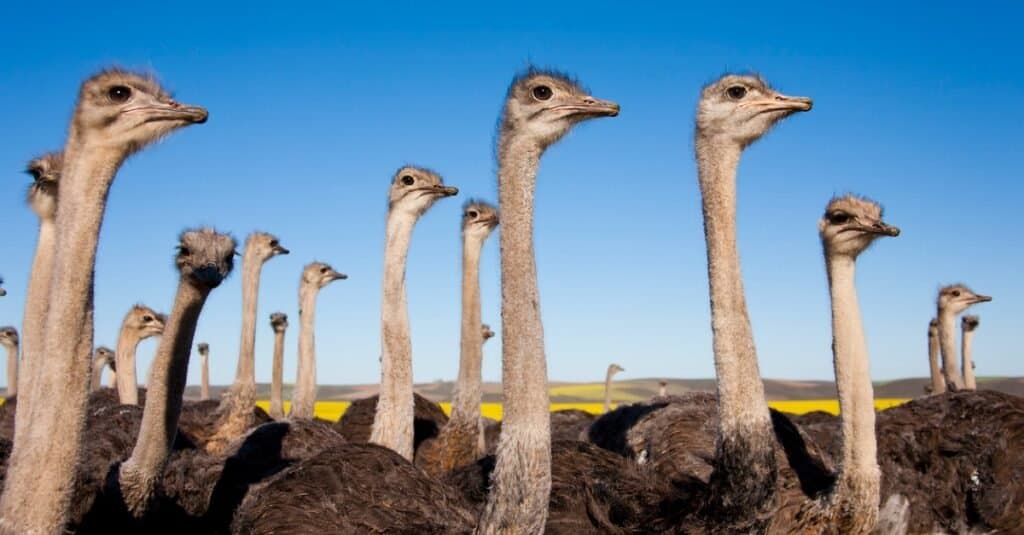
The common ostrich mainly grazes in savanna habitats.

ยฉiStock.com/AndreaWillmore

Appearance

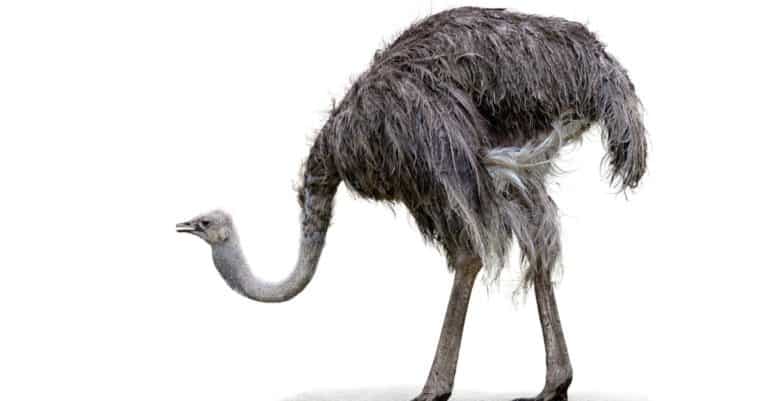
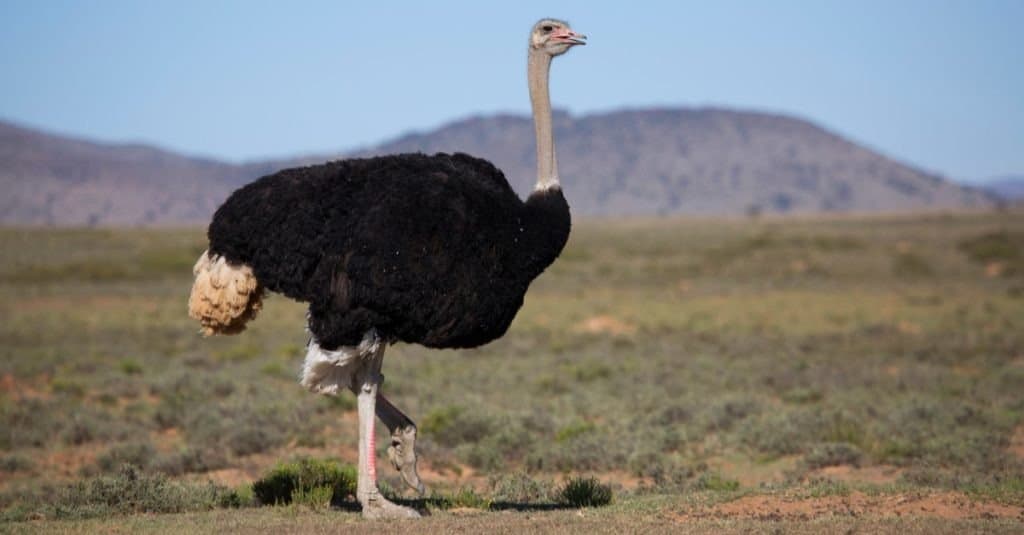
The ostrich is easily distinguishable from all other birds by its sheer size. Luxuriating in its soft black and white plumage, the male ostrich stands up to 9 feet high and weighs up to 320 pounds. The female, which measures up to 6 feet and 242 pounds, respectively, is much smaller. She and her younger chicks exhibit more gray-brown feathers around the main body. Regardless of sex, the ostrichโ€™s long and sinewy neck, head, and legs are almost completely bald except for a small down layer. The skin is either pink or gray, but the exact colors and patterns may vary by the subspecies.

Given the ostrichโ€™s large size, itโ€™s no surprise that the wings are completely incapable of flight. The evidence suggests that the wings (along with the tail) help the bird maintain balance and court females. The incredibly soft feathers, which lack the waterproof quality of many other birds, hang rather loose off the body.
๐Ÿ‘ male common ostrich, Struthio camelus, searching for food and patrolling the area

The male ostrich stands up to 9 feet high and weighs up to 320 pounds.

ยฉDirk M. de Boer/Shutterstock.com

Behavior

The ostrich is a social species that congregates in flocks of five to 50 birds in the breeding season and smaller groups of two to five members throughout the rest of the year. These flocks are often seen in the company of other grazing animals like antelopes and zebras. However, this tolerance for other species doesnโ€™t necessarily extend to different flocks since these birds will guard their territory fiercely from outside intruders. Unlike the rich sounds of many other birds, the ostrich can make a roar and a sharp hiss, often used by males to intimidate each other. Ostriches also make booming sounds or low drumming calls when agitated.

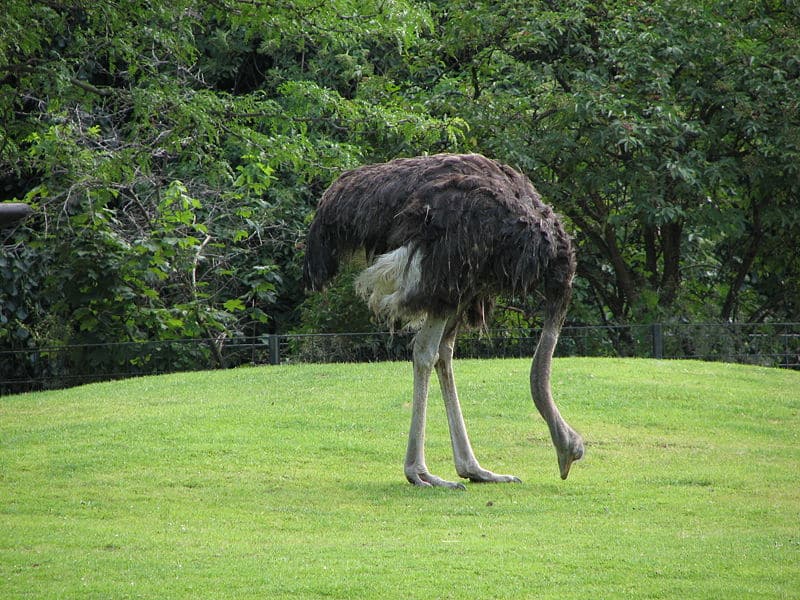
These birds spend almost all day grazing and foraging for food, which is abundant in the African savannas. Although they can go for long periods without liquids, ostriches appear to have a strong affinity for large bodies of water, where they often take baths to clean themselves off.

Contrary to popular myth, ostriches do not bury their heads in the sand when threatened; rather, they press their head and neck flat against the ground, perhaps to avoid detection. Their first instinct is to run away or hide from danger, but that does not mean the bird lacks defenses. The ostrich has a rather vicious clawed foot that can kill a predator as large as a lion.
๐Ÿ‘ Image

Ostriches spend almost the entire day grazing and foraging for food.

ยฉAdamantios / Creative Commons โ€“ Original

Habitat

These birds inhabit the savannas, woodlands, and deserts of Africa. They are endemic to a large strip of land between Western Africa, the Horn of Africa, and Southern Africa. The savanna sometimes provides a brush for the ostrich to hide in, but the bird relies on its speed and cleverness whenever the brush is sparse to evade predators.
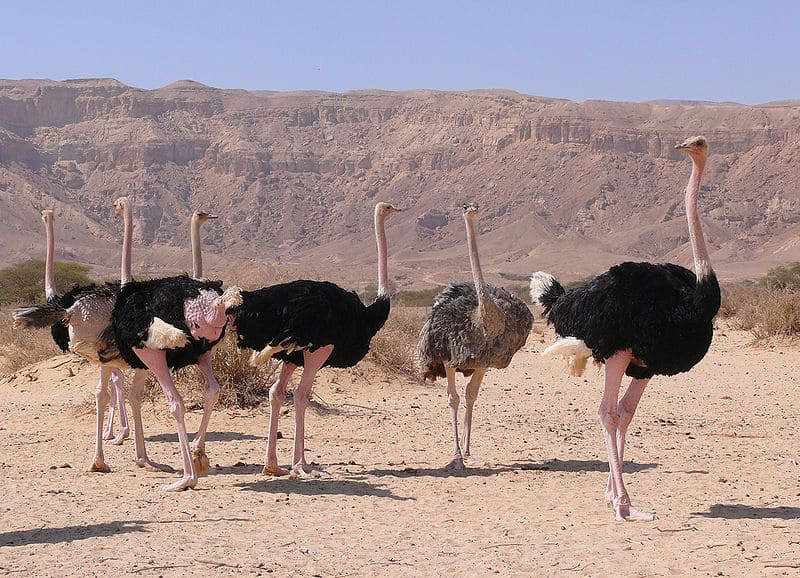
๐Ÿ‘ Image

Ostriches inhabit savannas, woodlands, and desert habitats in Africa.

ยฉMathKnight / Creative Commons โ€“ Original

Diet and Digestion

These birds enjoy an omnivorous diet heavy in plant material. The birdโ€™s diet comprises seeds, grass, fruits, and flowers. It sometimes supplements this with insects, reptiles, or other meat left over by carnivores. 

This bird has an intestinal tract some 46 feet long to squeeze out as many nutrients as possible. It consumes stones, sand, and food and then grinds it in the specialized gizzard organ. These birds can also survive without a single drop of water for several days. They can lose up to a quarter of their body weight in water before they need to drink again.

Predators and Threats

The biggest threat to these birds has been human hunting. The drive to harvest its feathers almost led to the ostrichโ€™s extinction in the 18th century. As ostrich farming became more common, this practice lost some appeal. However, hunting, habitat loss, and even predation still pose some risks to the ostrich.

Despite its formidable size, the bird is threatened by all kinds of carnivores, including lions, cheetahs, leopards, hyenas, and African hunting dogs. vultures, warthogs, and mongooses also raid nests for their eggs. Except for the cheetah, most predators cannot keep up with the ostrichโ€™s impressive speed, so they wait to ambush the unsuspecting bird.
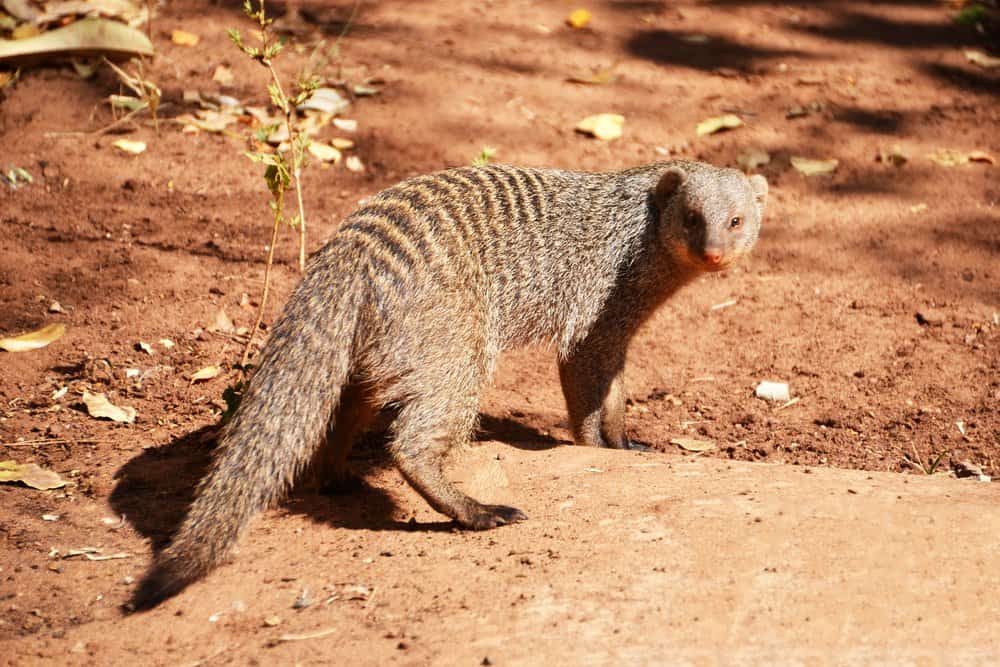
๐Ÿ‘ Mongoose (Helogale Parvula) - standing on sandy rock

The mongoose is known to raid ostrich nests, preying on the eggs.

ยฉOscar David Toledo Marin/Shutterstock.com

Reproduction, Babies, and Lifespan

The breeding season lasts between March and September of each year. The male performs an elaborate dance in which he appears to bow down to the ground and shake his feathers, first one wing and then the other, while his tail bobs up and down. The dance is intended to exhibit the maleโ€™s strength and health so that the female can judge. The most territorial male will mate with flocks of three to five hens at a time, but it only forms a pair bond with the most dominant hen. Other males will also have the opportunity to mate with the remaining females.

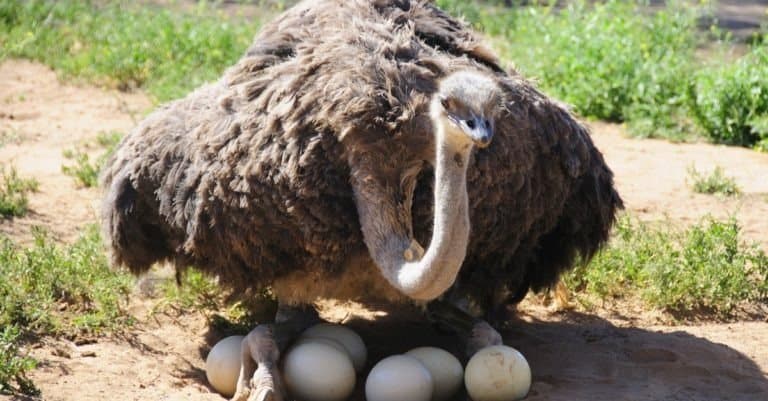
Together, the fertilized females will dump their eggs into a communal nest (consisting of just a simple hole dug in the ground). The dominant hen places her eggs at the center, giving them the best chance at survival, but all of the eggs have a better chance to survive than if they were incubated in a separate nest. Each female bird can produce seven to 10 eggs simultaneously, but the communal nest can hold up to 60. Weighing more than 3 pounds, these eggs are the largest of any species on the planet. They are nearly as large as dinosaur eggs. Males and females take turns guarding the nest. The groupโ€™s females watch over it during the day, while the males take over at night.
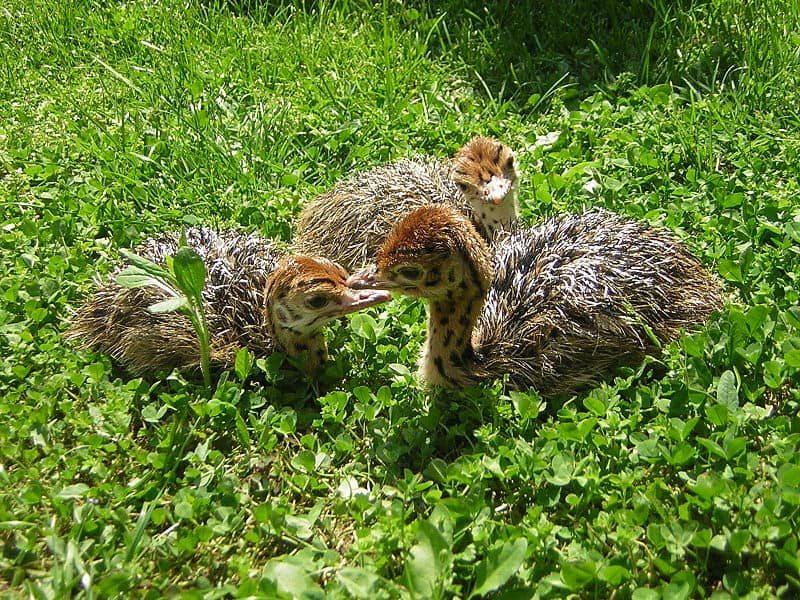
๐Ÿ‘ Image

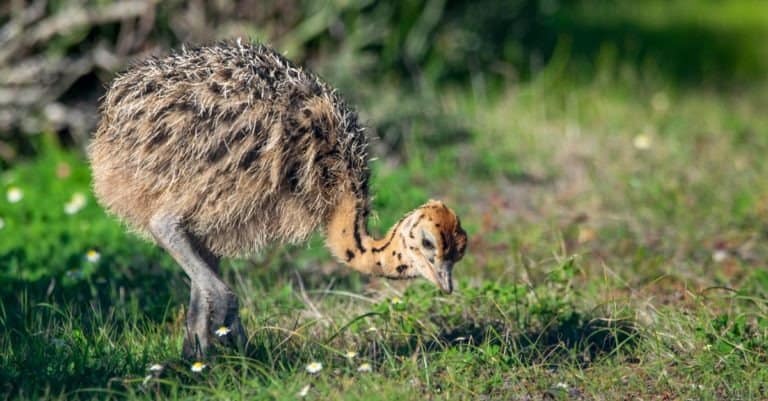
Ostrich chicks emerge from their eggs already the size of a chicken and sport a stiff down coat.

ยฉAnicap / Creative Commons โ€“ Original

After an incubation period of 42 to 46 days, the chicks will emerge from the eggs with a stiff down, measuring about the same size as a chicken. After they leave the nest, the parents will take the chicks under the wing to protect them from the harsh sunlight or rain. When threatened, the male will attempt to distract the predator with a display of loud noises and an outstretched neck while the females and chicks attempt to find cover.

The baby bird grows quickly; at about six months, it is almost the same size as the adult bird. It will reach sexual maturity after three to four years, which is relatively long compared to most birds. The regular lifespan of these birds is about 30 to 40 years in the wild and about 50 years in captivity.
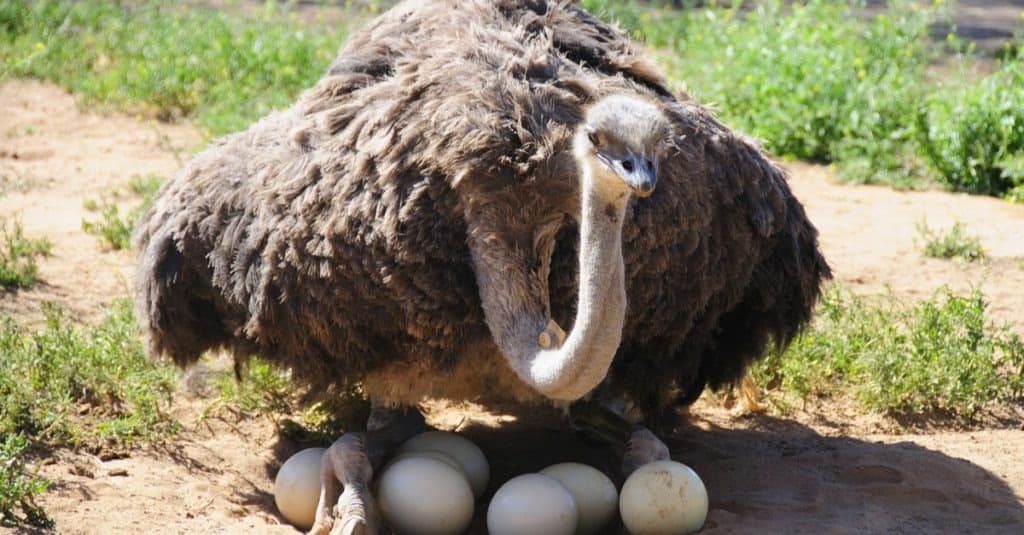
๐Ÿ‘ Female Ostrich sitting on the eggs

Female ostriches lay their eggs in a communal nest.

ยฉDominique de La Croix/Shutterstock.com

Population

The IUCN Red List considers the common ostrich a species of least concern, while the Somali ostrich is potentially vulnerable to extinction. Both species appear to be decreasing slightly in number, and it is estimated that no more than 150,000 ostriches remain in the wild. 

View all 87 animals that start with O

Sources

  1. San Diego Zoo / Accessed January 22, 2021
  2. Animal Diversity Web / Accessed January 22, 2021
  3. African Wildlife Foundation / Accessed January 22, 2021
  4. Mental Floss / Accessed January 22, 2021

About the Author

Abby Parks

Abby Parks has authored a fiction novel, theatrical plays, short stories, poems, and song lyrics. She's recorded two albums of her original songs, and is a multi-instrumentalist. She has managed a website for folk music and written articles on singer-songwriters, folk bands, and other things music-oriented. She's also a radio DJ for a folk music show. As well as having been a pet parent to rabbits, birds, dogs, and cats, Abby loves seeking sightings of animals in the wild and has witnessed some more exotic ones such as Puffins in the Farne Islands, Southern Pudu on the island of Chiloe (Chile), Penguins in the wild, and countless wild animals in the Rocky Mountains (Big Horn Sheep, Mountain Goats, Moose, Elk, Marmots, Beavers).
Connect:

Thank you for reading! Have some feedback for us?

Contact the AZ Animals editorial team

Related Articles You May Find Interesting


Ostrich FAQs (Frequently Asked Questions)

No, the ostrich stays largely within the same area all year around.

Ostriches have a wingspan of around 6.6 feet. Given its overall size, the wingspan to body length is not particularly exceptional for a bird.

The baby ostrich leaves the nest only a few days after hatching. They are completely ready to follow their parents around and begin foraging.

An ostrich can travel at speeds of 30-37 miles per hour on average and up to 43 mph maximum speed.

When separating ostriches vs rheas, you need to consider a few key differences. First, ostriches live in Africa while rheas are found in South America. Second, ostriches are significantly larger than rheas, with a height that can reach twice as tall. Third, rheas have three toes while ostriches have two.

The key differences between a cassowary and an ostrich are the size, appearance, range, and social structure.

Ostriches have more hollow bones compared to the T-Rex, though the T-Rex has some hollow bones. In addition, the T-Rex has strikingly similar legs and walking strides compared to the ostrich.