

P
Species Profile

Pheasant

Phasianidae

From forest jewels to gamefield sprinters
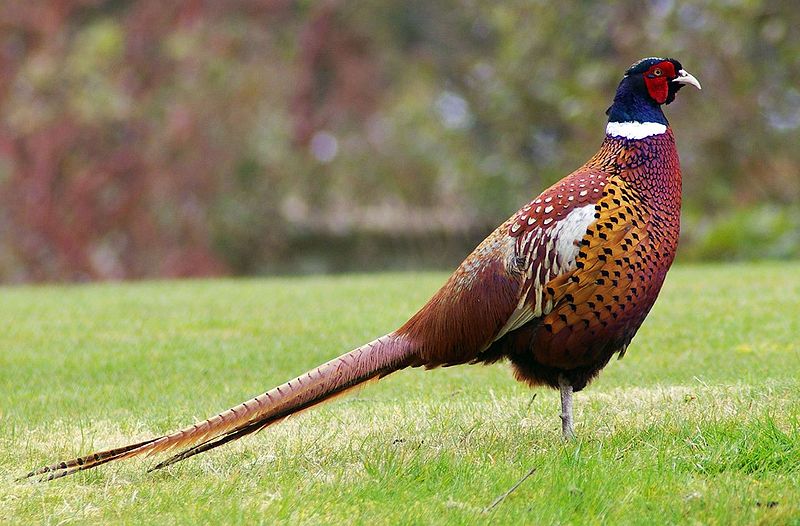
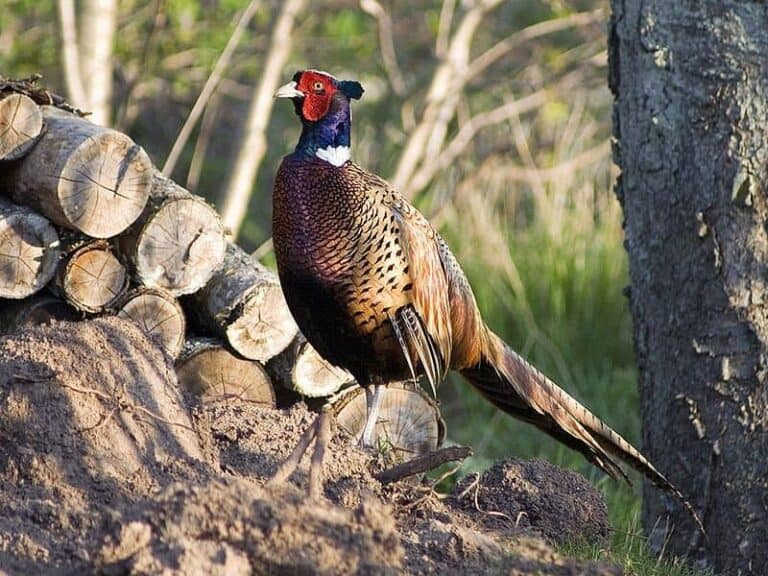
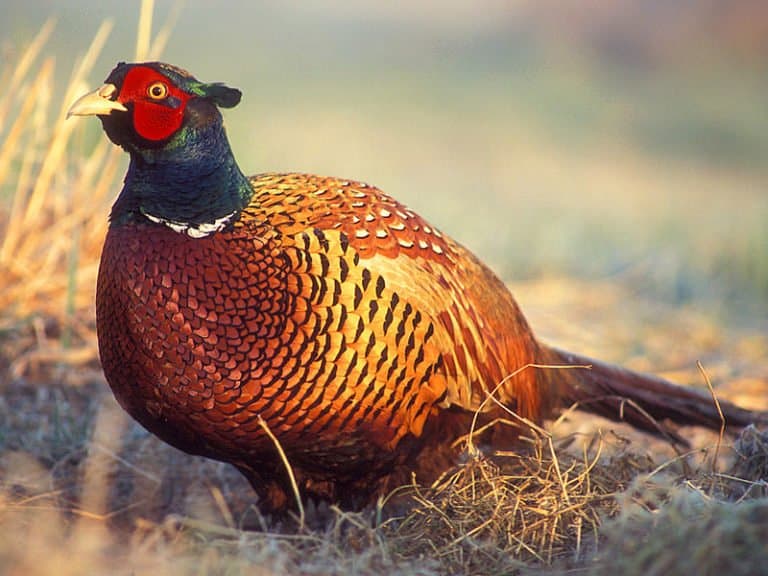
gary noon, CC BY-SA 2.0, via Wikimedia Commons

Pheasant Distribution

Click a location to explore more animals from that region

Invasive Species
Loading map...

Size Comparison

Human 5'8"
Pheasant 1 ft 6 in

Pheasant stands at 26% of average human height.

At a Glance

Family Overview This page covers the Pheasant family as a group. Stats below are general traits shared across the family.
Also Known As Gamebird, Faisan (French), Faisรกn (Spanish), Fazant (Dutch), Fasan (German), Faisรฃo (Portuguese)
Diet Omnivore
Activity Diurnal+
Lifespan 3 years
Weight 6 lbs
Status Not Evaluated
Did You Know?

Size spans extremes: ~12-250 cm long (tail/train included), from ~30-70 g to ~4-6+ kg across the family.

Scientific Classification

Family Overview "Pheasant" is not a single species but represents an entire family containing multiple species.

Pheasants are medium-to-large galliform birds in the family Phasianidae. Many species show strong sexual dimorphism, with males bearing bright plumage, ornamental crests, wattles, and long tails; females are typically mottled and cryptic. They are primarily ground-dwelling, feeding on seeds, shoots, berries, and invertebrates, and they rely on burst flight for escape.

Kingdom
Animalia
Phylum
Chordata
Class
Aves
Order
Galliformes
Family
Phasianidae

Distinguishing Features

  • Galliform body plan: robust body, short rounded wings, strong legs adapted for walking and scratching
  • Frequent sexual dimorphism (males often brightly colored with elongated tail feathers)
  • Ground nesting and ground foraging; rapid explosive takeoff flight
  • Often associated with edge habitats and mixed farmland/woodland landscapes (varies by species)

Physical Measurements

Males and females differ in size

Height
โ™‚ 1 ft 6 in (5 in โ€“ 3 ft 7 in)
Length
โ™‚ 2 ft 6 in (1 ft 9 in โ€“ 2 ft 11 in)
โ™€ 1 ft 11 in (1 ft 9 in โ€“ 2 ft)
Weight
โ™‚ 2 lbs (2 lbs โ€“ 3 lbs)
โ™€ 2 lbs (2 lbs โ€“ 3 lbs)
Tail Length
โ™‚ 1 ft 8 in (1 ft 4 in โ€“ 1 ft 12 in)
โ™€ 9 in (8 in โ€“ 10 in)
Top Speed
50 mph
burst flight

Appearance

Primary Colors
Secondary Colors
Skin Type Dense feathered plumage; keratin beak and scaly legs; some species with bare facial skin/wattles and males often with spurs.
Distinctive Features
  • Family-level diversity includes pheasants, partridges, quails, junglefowl, peafowl, and allies; not all are 'pheasant-like.'
  • Size range across Phasianidae: ~12-90 cm body length; total length (with tail/train) up to ~230 cm in largest males.
  • Mass range across family: ~0.03-0.05 kg (small quail-like forms) up to ~4-6 kg (large peafowl/junglefowl relatives).
  • Typical lifespan ranges: ~1-8+ years in wild (often limited by predation); up to ~10-25 years in captivity for larger, well-kept species.
  • Common ecology: predominantly ground-dwelling; strong legs for walking/scratching; explosive burst flight for escape, with many roosting in trees or dense cover.
  • Diet generally omnivorous: seeds, shoots, buds, berries, and substantial invertebrates; proportions vary by season, habitat, and species.
  • Habitats span forests, woodland edges, scrub, grasslands, montane thickets, and agricultural mosaics; many tolerate human-modified landscapes.
  • Distribution: greatest diversity in Eurasia; also Africa and parts of Australasia; widespread human introductions for hunting/ornamentals (notably ring-necked pheasant).
  • Social and breeding systems vary: solitary/pairs to coveys; monogamy to strong polygyny; elaborate courtship displays and lekking occur in some lineages.
  • Nesting typically on ground with well-camouflaged eggs; clutch sizes and parental care vary widely (female-only care common, but not universal).

Sexual Dimorphism

Sexual dimorphism is common but variable: many pheasant- and peafowl-like taxa have brightly colored, ornamented males and cryptic females, while several partridge/quail groups are more similar between sexes with subtler differences.

โ™‚
  • Brighter, often iridescent plumage with bold contrasts (collars, bars, ocelli) in many species
  • Elongated tail or train in several lineages; tail length can dominate total length
  • Crests, ear tufts, or ornamental feathering in some genera
  • Bare facial skin, wattles, or comb-like ornaments (often red) in some groups
  • Leg spurs commonly present or larger in males, used in competition
โ™€
  • More mottled brown/tan cryptic plumage for ground nesting concealment
  • Shorter tail and reduced or absent ornamental trains/crests in many taxa
  • Less extensive bare facial skin/wattles where present
  • Generally smaller body size in strongly dimorphic species, but varies by lineage

Did You Know?

Size spans extremes: ~12-250 cm long (tail/train included), from ~30-70 g to ~4-6+ kg across the family.

Many species show striking sexual dimorphism: males often have long tails, crests, wattles, or iridescent plumage; females are typically cryptic.

Most are ground-foragers that "scratch" like chickens, eating a flexible mix of seeds, shoots, berries, and invertebrates.

Escape strategy is often to freeze and rely on camouflage-then explode into loud, rapid flight at the last moment.

Breeding systems vary widely: many are polygynous; some form pair bonds; several use display grounds (leks) or elaborate courtship arenas.

Native diversity is greatest in Eurasia (especially South & East Asia), but some members occur in Africa; humans have also moved certain species widely (notably the common/ring-necked pheasant).

Phasianidae includes major cultural birds: peafowl revered in South Asia, and the domesticated chicken descends from red junglefowl within this family.

Unique Adaptations

  • Cryptic female plumage and patterned feathers that break up body outline-an adaptation strongly linked to ground nesting in many species.
  • Powerful legs and feet for scratching, running, and steep-slope climbing; many can sprint rapidly through cover.
  • Short, rounded wings and strong flight muscles tuned for sudden, noisy "flush" flights rather than long-distance soaring.
  • Ornamental structures (elongated tails, trains, crests, facial wattles, spurs) used in sexual selection; degree and form vary dramatically across the family.
  • Gizzard and digestive flexibility suited to mixed diets, allowing seasonal switching between hard seeds, greens, fruits, and animal prey.
  • Chicks are typically precocial (mobile soon after hatching), an adaptation to ground life-though timing and family-group behavior differ among species.

Interesting Behaviors

  • Dawn-and-dusk activity peaks are common; many feed in openings but retreat to cover quickly-yet patterns vary by habitat and predation pressure.
  • Courtship can be highly theatrical: strutting, wing-dragging, fanning tails/trains (in peafowl), calling, and showing eye-spots or iridescence; some species gather at communal display sites while others display alone.
  • Dust-bathing is widespread for feather maintenance and parasite control; some species also sunbathe with wings spread.
  • Vigilant group living occurs in several lineages (especially smaller, quail/partridge-like members), while many larger "pheasant-like" birds are more solitary outside breeding.
  • Roosting strategies vary: some roost in trees (including many pheasant-like forest birds), others on the ground in dense cover-often switching with season and disturbance.
  • Nest defense is usually indirect (distraction displays, stealthy departures), reflecting ground nests and reliance on camouflage; clutch size and parental care range from modest to large depending on species and environment.

Cultural Significance

Phasianidae are linked to humans: gamebirds used in hunting and conservation, ornamental birds like peafowl and pheasants, and the domesticated chicken (from red junglefowl) used for food, ritual, and symbolism. Feathers feature in dress and art; peafowl mean beauty. People spread the common (ringโ€‘necked) pheasant for sport and display.

Myths & Legends

Greek tradition ties the peacock to Hera: after the giant Argus Panoptes was slain, Hera set his many eyes into the peacock's tail as a lasting emblem of watchfulness.

In Hindu tradition, the war god Kartikeya is often depicted riding a peacock, making the bird a divine mount and symbol of victory and protection.

Stories of Krishna frequently include the peacock feather as a sign of divine beauty and playful love, and peacock imagery appears widely in devotional art and song.

In Chinese tradition, the Chinese phoenix is commonly depicted as a pheasant-like sovereign bird; its appearance symbolizes harmony and auspicious rule in classical lore and iconography.

The Japanese folktale of "Peach Boy" features a pheasant as one of the hero's animal companions, aiding his quest alongside a dog and a monkey.

European theater lore long treated peacock feathers as unlucky to keep on stage, a superstition sometimes linked to the 'eyes' on the feathers and their association with watchfulness or ill fate.

Looking for a specific species?

Common pheasant (Ring-necked pheasant)

Phasianus colchicus

In everyday English, "pheasant" most often refers to the widely introduced, game-managed Common Pheasant.

  • Family-wide size range spans very small Old World quail to very large pheasants/peafowl: roughly ~12 cm to >200 cm total length (including tail/elongated upper tail coverts), with strong variation among lineages.
  • Across Phasianidae, many species show marked sexual dimorphism (brightly ornamented males; cryptic females), but the degree varies widely and is reduced in some taxa.
  • Diet across the family is broadly omnivorous: seeds/green plant material dominate much of the year, with invertebrates especially important for chicks; proportions shift by habitat and season.
  • Typical anti-predator strategy is terrestrial concealment and rapid, explosive flush flight to cover; some species are more arboreal/roosting, while others are more open-country and flocking.
  • Lifespan varies greatly by species and context: commonly a few years in the wild (high juvenile mortality), with potential to reach into the low-to-mid teens in captivity for some larger taxa.

You might be looking for:

Common (Ring-necked) Pheasant

55%

Phasianus colchicus

The best-known and most widely introduced pheasant; often what people mean by โ€œpheasantโ€ in everyday contexts.

Golden Pheasant

12%

Chrysolophus pictus

Highly ornamented Asian pheasant commonly kept in aviaries; striking golden crest and red body.

Lady Amherst's Pheasant

8%

Chrysolophus amherstiae

Ornamental pheasant noted for its patterned mantle and long tail; native to SW China/Myanmar region.

Reeves's Pheasant

7%

Syrmaticus reevesii

Large pheasant with extremely long tail; native to China and sometimes feral elsewhere.

Koklass Pheasant

5%

Pucrasia macrolopha

Montane pheasant of the Himalayas and adjacent regions; relatively cryptic compared with ornamental species.

Life Cycle

Birth 10 chicks
Lifespan 3 years

Lifespan

In the Wild 1โ€“15 years
In Captivity 5โ€“18 years

Reproduction

Mating System Polygyny
Social Structure Harem Based
Breeding Pattern Seasonal
Fertilization Internal Fertilization
Birth Type Internal_fertilization

Across Phasianidae, males commonly display and compete for access to multiple females, often via harem-like associations or lek-like display sites; however, some species are seasonally monogamous. Females typically build nests, incubate, and rear chicks with little or no male care.

Behavior & Ecology

Social Flock Group: 12
Activity Diurnal, Crepuscular, Matutinal, Vespertine
Diet Omnivore Seeds/grains plus seasonally abundant insects (especially for chicks); exact preferences vary widely by genus, habitat, and season across Phasianidae.

Temperament

Wary and cover-oriented
Males often territorial in breeding season
Aggressive during male-male competition
Females typically secretive while nesting
Seasonally gregarious outside breeding
Startle-prone with explosive escape flights

Communication

loud male crowing/calls to advertise territory and status
contact calls between flock members and between hen and chicks
alarm calls (often sharp clucks/squawks) to signal threats
distress calls during capture or predator attacks
visual courtship displays Tail fanning, wing-drooping, strutting, crest raising
lek-like gathering and display in some species; others display from territories
postural threats and chasing to maintain dominance and spacing
wing-whirring/drumming and rapid burst flight as conspicuous signals
scent/chemical cues are minor compared with visual and acoustic signaling

Habitat

Biomes:
Tropical Rainforest Tropical Dry Forest Savanna Desert Hot Desert Cold Mediterranean Temperate Grassland Temperate Forest Temperate Rainforest Boreal Forest (Taiga) Tundra Alpine Freshwater Wetland +8
Terrain:
Mountainous Hilly Plateau Plains Valley Coastal Island Riverine Karst Rocky Sandy Muddy +6
Elevation: Up to 17060 ft 5 in

Ecological Role

Omnivorous ground-foraging birds that function as both seed consumers (and occasional dispersers) and important invertebrate predators; also key prey for a wide range of carnivores across their native and introduced ranges.

regulation of insect populations (including some agricultural pests) seed predation that can influence plant community composition and weed dynamics limited seed dispersal via fruit consumption in some species soil and leaf-litter disturbance through scratching, aiding decomposition and nutrient cycling supporting food webs as abundant prey for raptors and mammalian predators

Diet Details

Main Prey:
Beetles and other insects Caterpillars and other insect larvae Ants and termites Grasshoppers and crickets Flies and other soft-bodied insects Earthworm Snails and slugs Other small invertebrates +2
Other Foods:
Seeds grains and spilled crops Grass Shoots and young leaves Buds and catkins Roots, tubers, and bulbs Berries and other fleshy fruits Nuts and acorns Forbs and broadleaf herbaceous plants +3

Human Interaction

Domestication Status

Semi domesticated

Phasianidae include fully domesticated chickens (Gallus) and farmed quail, many captive-bred pheasants and partridges, and wild, often protected species. Humans raise them for eggs, meat, hunting releases, and decoration, use their feathers, and keep them for research. Problems include crop damage, escaped nonnative birds, collisions, and disease risks.

Danger Level

Low
  • Defensive aggression (especially territorial males in breeding season); peafowl and large pheasants can scratch/peck and some males have spurs capable of minor-to-moderate lacerations
  • Zoonotic and foodborne pathogens associated with poultry handling (e.g., Salmonella; avian influenza risk in outbreaks; ectoparasites in poorly managed housing)
  • Allergies/respiratory irritation from feather dander and coop dust
  • Injuries related to handling, escapes, or collisions (birds flushing suddenly; road hazards in rural areas)

As a Pet

Suitable as Pet

Legality: Laws vary by species and place. Domestic chickens and common quail are usually allowed with local rules. Many wild pheasants, partridges, peafowl need permits or are protected (national laws, CITES). Check local wildlife and conservation lists.

Care Level: Moderate

Purchase Cost: $10 - $5,000
Lifetime Cost: $300 - $20,000

Economic Value

Uses:
Food production Hunting/game management Ornamental/aviculture trade Feather/fiber crafts Scientific research and education Cultural and religious significance Ecosystem services (insect consumption/seed dispersal; variable)
Products:
  • meat (poultry and gamebird markets)
  • eggs (commercial and smallholder)
  • live birds (backyard poultry, aviary and ornamental birds)
  • feathers/plumes (decor, regalia, fly-tying and crafts)
  • hunting preserves and guided shoots (released gamebirds in some regions)
  • biomedical and agricultural research models (notably chickens)

Relationships

Predators 10

Red fox Vulpes vulpes
Coyote Canis latrans
Raccoon Procyon lotor
Martens Martes spp.
Wildcats Felis spp.
Eagle Aquila spp.
Hawks Accipiter spp.; Buteo spp.
Falcons Falco spp.
Owls Strigidae
Large snakes Serpentes

Related Species 4

Guineafowl Numididae Shared Order
New World quail Odontophoridae Shared Order
Chachalacas, guans, and curassows Cracidae Shared Order
Megapodes Megapodiidae Shared Order

Ecological Equivalents 4

Animals that fill a similar ecological role in their ecosystem

Grouse Tetraoninae Cold- and temperate-adapted, ground-focused galliforms; many share largely herbivorous diets, cryptic females, and reliance on short burst flight โ€” though grouse are typically more specialized for harsh climates and may lek more consistently.
Partridges and Old World quail Phasianidae They overlap strongly in habitat use โ€” fields, scrub, and woodland edges โ€” in foraging style, consuming seeds, green plant matter, and invertebrates, and in predator-avoidance behavior, using freeze or flush responses.
Guineafowl Numididae Ecological look-alikes in many savanna/woodland mosaics: terrestrial flocking, omnivorous foraging, and exposure to similar predator suites. Guineafowl tend to be more strongly social and more open-country oriented.
Rails and crakes Rallidae Not closely related but convergent as secretive, ground-walking birds that use dense cover; both often eat seeds and invertebrates and rely on rapid escape rather than sustained flight. Rails are more wetland-associated.

Types of Pheasant

32

Explore 32 recognized types of pheasant

Common pheasant Phasianus colchicus
Green pheasant Phasianus versicolor
Golden pheasant Chrysolophus pictus
Lady Amherst's pheasant Chrysolophus amherstiae
Reeves's pheasant Syrmaticus reevesii
Copper pheasant Syrmaticus soemmerringii
Mikado pheasant Syrmaticus mikado
Elliot's pheasant Syrmaticus ellioti
Mrs. Hume's pheasant Syrmaticus humiae
Koklass pheasant Pucrasia macrolopha
Cheer pheasant Catreus wallichii
Kalij pheasant Lophura leucomelanos
Silver pheasant Lophura nycthemera
Swinhoe's pheasant Lophura swinhoii
Crested fireback Lophura ignita
Bulwer's pheasant Lophura bulweri
Malayan peacock-pheasant Polyplectron malacense
Grey peacock-pheasant Polyplectron bicalcaratum
Great argus Argusianus argus
Crestless fireback Lophura erythrophthalma
Himalayan monal Lophophorus impejanus
Sclater's monal Lophophorus sclateri
Chinese monal Lophophorus lhuysii
Western tragopan Tragopan melanocephalus
Satyr tragopan Tragopan satyra
Temminck's tragopan Tragopan temminckii
Cabot's tragopan Tragopan caboti
Blood pheasant Ithaginis cruentus
Tibetan snowcock Tetraogallus tibetanus
Indian peafowl Pavo cristatus
Green peafowl Pavo muticus
Red junglefowl Gallus gallus

A beautiful and popular game bird, the pheasant is a relative of the partridge.
๐Ÿ‘ Image
Portrait of a Pheasant

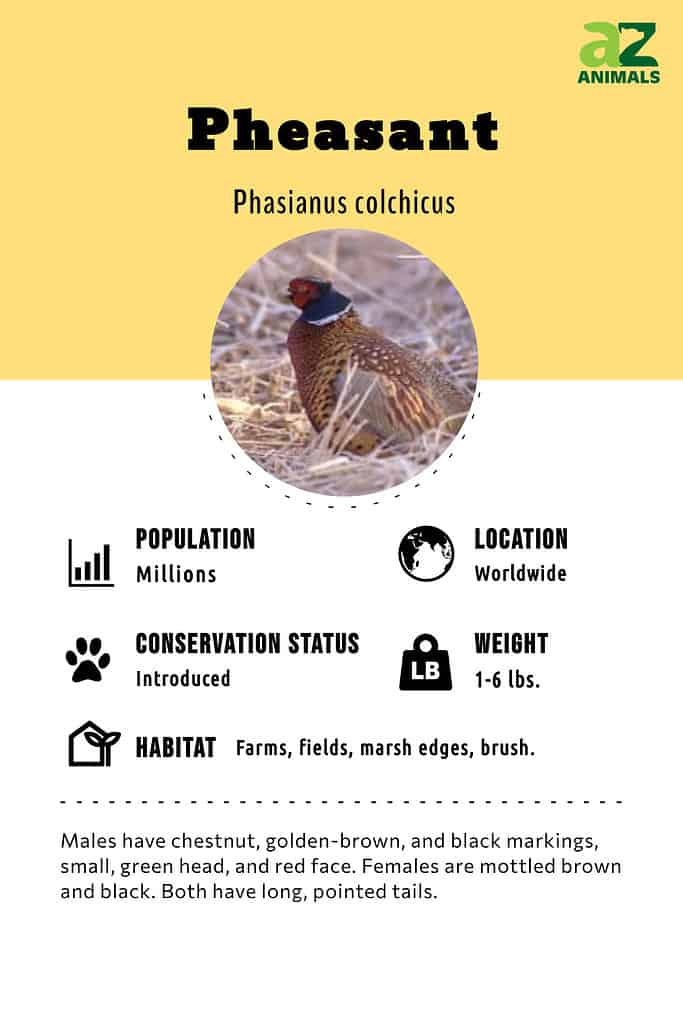
Pheasants are gorgeous game birds that feature beautiful plumage and long, powerful legs. There are an estimated 49 pheasant species, but the Common Pheasant, the Golden Pheasant, the Reevesโ€™s Pheasant, and the Silver Pheasant are some of the most well-known types. Pheasants are able to fly, but theyโ€™re clumsy at it and prefer to be on the ground. It is the state bird of South Dakota.
 

4 Amazing Facts

โ€ข Pheasants have powerful breast muscles that give them the ability to rise almost vertically into the air and reach speeds of up to 50 miles per hour, if needed, to escape danger. Hunters take advantage of this characteristic by โ€œflushingโ€ them out of cover and into the air where they can be seen and targeted.
โ€ข Pheasants donโ€™t like to fly and normally cover only 600 feet in a flight.
โ€ข Pheasants are able to enter a dormant state in extremely cold temperatures.
โ€ข Pheasants taste like chicken but have a slightly sweeter flavor
 

Scientific Name
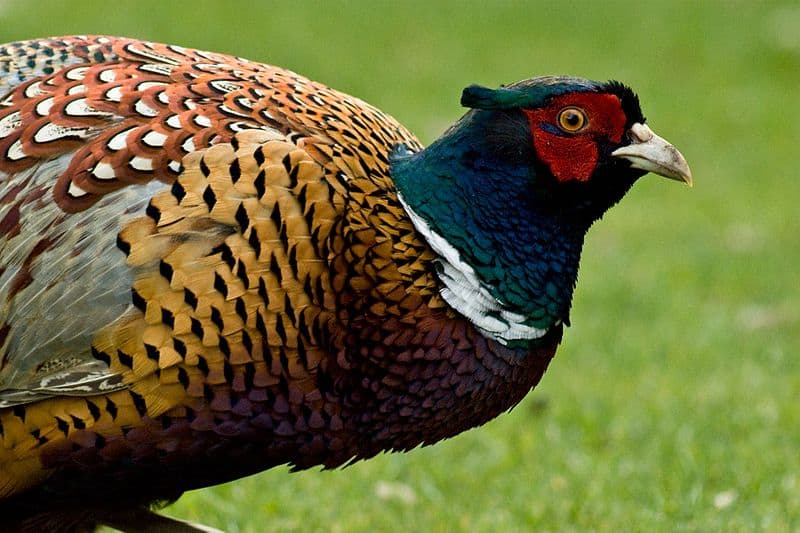
๐Ÿ‘ Portrait of a Pheasant

The Pheasant,

Phasianus colchicus

, has about 30 subspecies.

ยฉCommon_Pheasant_Phasianus_Colchicus.jpg: David Croad derivative work: Donkey shot, CC BY 3.0, via Wikimedia Commons โ€“ Original / License

The scientific name for the common pheasant is Phasianus colchicus, and the bird is in the Phasianidae family, Galliformes order, Aves class. The species name, colchicus, is a Latin word that means โ€œof Colchis.โ€ In the past, Colchis was a country located on the Black Sea. Today, it is the country of Georgia. The birdโ€™s genus name is from the Latin word โ€œphasianus,โ€ which means, luckily enough, pheasant.

An alternate name for the common pheasant is ring-necked pheasant. There are approximately 30 subspecies of these birds. You can identify a subspecies bird by its male plumage. In particular, youโ€™ll be looking for a white ring around the birdโ€™s neck or a lack of one.

Pheasants were once thought to be closely related to chickens, but recent studies have shown that they diverged into separate subfamilies about 20 million years ago. They are, however, in the same bird family as the partridge.

Like chickens, pheasants are native to Asia, but they were introduced into Europe during the time of the Roman Empire. They were then brought to Great Britain by the Normans in the 11th century and to the United States during the 1880s.

Appearance and Behavior
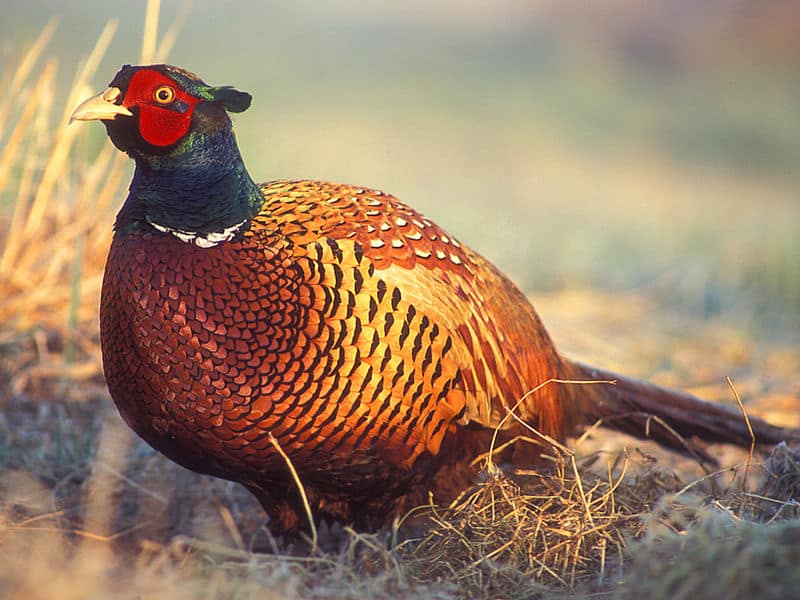
๐Ÿ‘ Pheasant sitting on grass

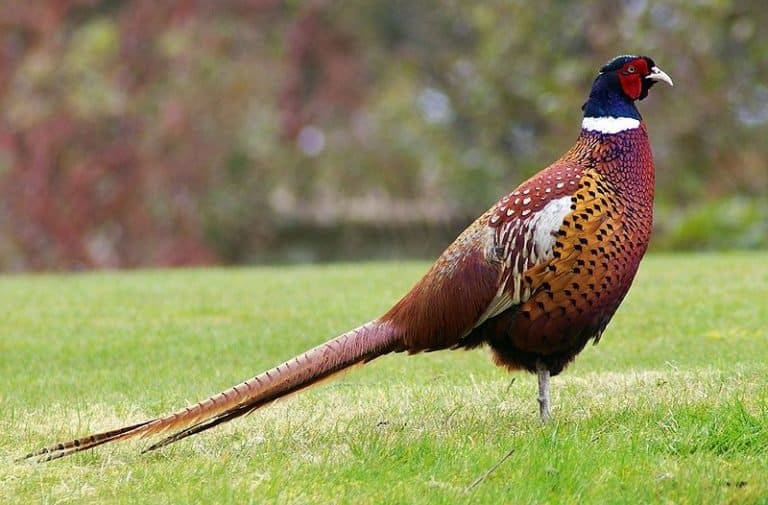
The male pheasant is much more colorful with its gold, green, red, and brown hues than the plain brown female.

ยฉLukasz Lukasik / CC BY-SA 3.0, from Wikimedia Commons, the free media repository โ€“ Original / License

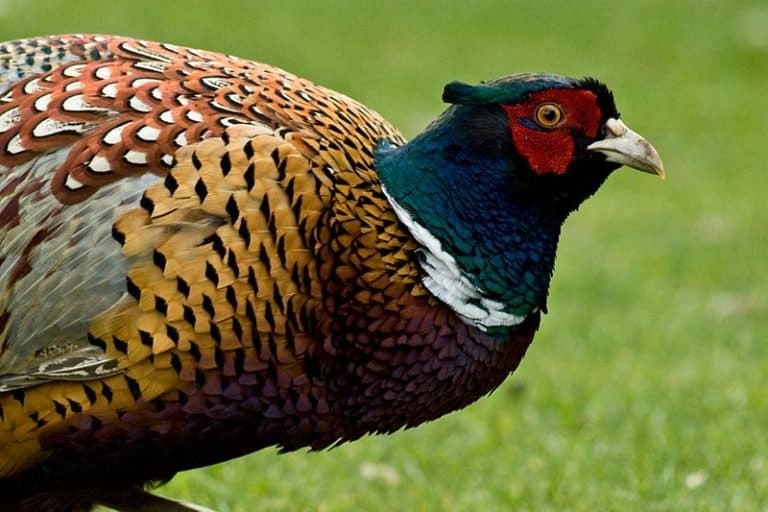
Male and female pheasants look very different. Male birds, which are also called cocks and roosters, feature vibrant red masks across their faces. Their faces are surrounded by shimmery green feathers located on the sides of their heads. Females are generally unadorned and are typically a plain buff shade of brown. The basic coloring of females keeps them more camouflaged from predators. Both males and females have long, pointed tails. The tail of the bird is often half of the birdโ€™s total length. When a pheasant believes itself to be in danger, it will emit a coarse croaking noise. The birds also have strong leg muscles that help them run away from predators.

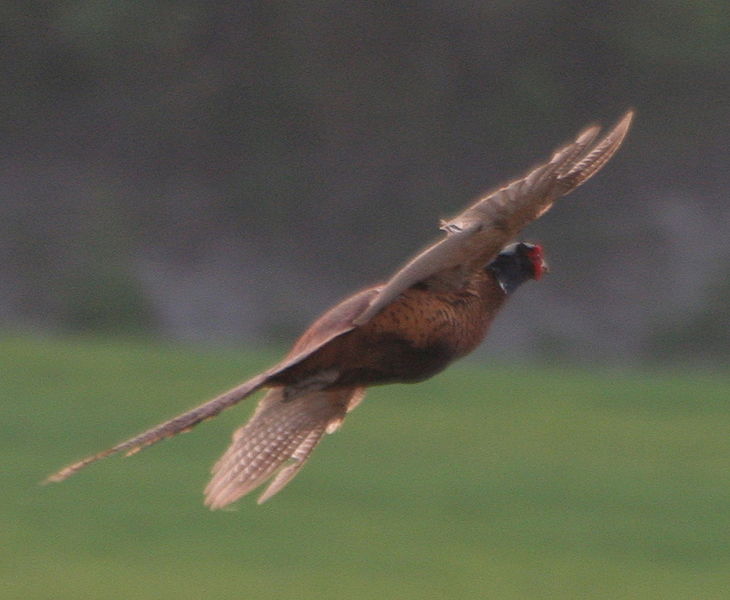
An adult pheasant bird measures around 21 inches to 34 inches in length. The birds have a wingspan that ranges from 28 inches to 34 inches, and they weigh from 2 pounds to 3 pounds. When it comes to traveling from place to place, these birds prefer to walk or run. Theyโ€™re not slow. In fact, the birds can run up to 10 miles an hour. If you should startle one, it may erupt from its hiding place and fly into the air at a speed of up to 50 miles an hour.

Roosters feature bright coloring that includes a golden comb tinged with red. This coloring starts at the tip of their heads and along their necks. The bird has a bright red undercoating, a light brown, long banded tail, and dark wings. Their lower back is golden, and their upper back is green. Males have bright yellow eyes. Their throat, face, and chin are rust-colored while their wattles, skin, beak, legs, and feet are yellow.

Females are not as brightly colored. The females have speckled brown feathers as well as light brown faces, breasts, throats, and wings. Their feet are a light yellow. Also, female Golden Pheasants are less fluffy than the males are.

This bird species does not have sweat glands. If they become too hot, then they will pant in the same way that dogs do to expel any extra body heat. As with other creatures, including people, these birds donโ€™t like being out in the bad weather. Instead of going out, the birds will remain in their roosts for days at a time without eating.

These birds donโ€™t migrate. You might find the birds hanging out alone or in small groups. To eliminate dirt, oil, dead skin cells, and old feathers, they will give themselves dust baths.

Habitat
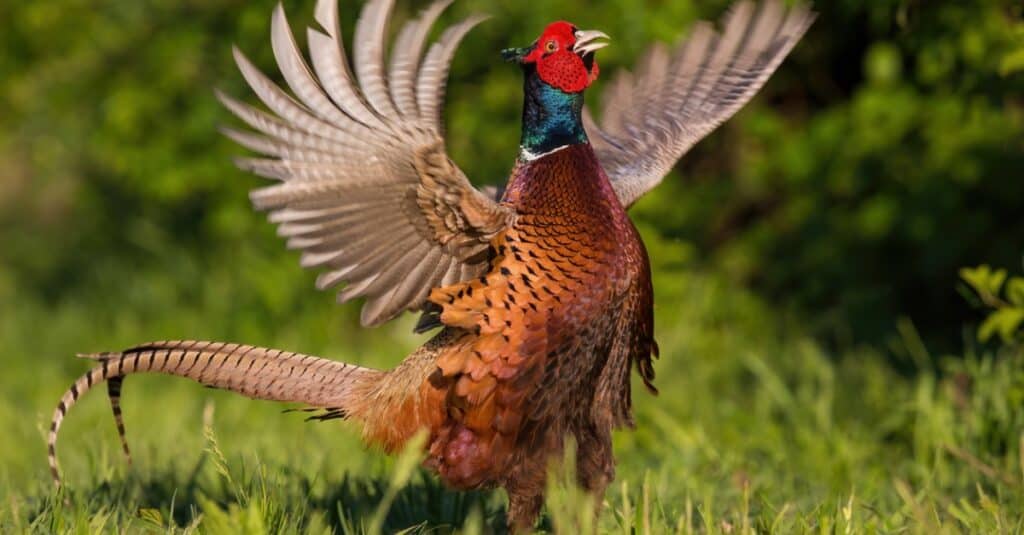
๐Ÿ‘ Common Pheasant

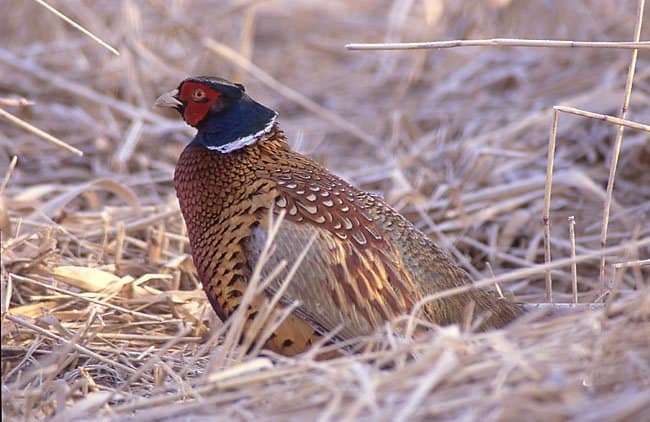
This Common Pheasant changes habitats according to its seasonal needs.

ยฉiStock.com/JMrocek

These birds live in varied habitats ranging from sea level to mountain areas that are 11,000 feet high. They reside in grasslands, deserts, and forests. Despite being adaptable to diverse habitats, the birds prefer certain kinds of environments for particular activities. For instance, in the spring and summer, they roost in dense shrubs and trees. When fall arrives, the birds move to farm fields, forested wetlands, and weedy places. Early season nesting causes the birds to look for shelter along fence lines, ditches, and grassy roadsides. As vegetation starts to grow denser and taller in the spring, pheasants move their nesting activities to alfalfa fields and hayfields. These birds nest on the ground, but at night, the birds roost in tree branches.

Diet

The diet of the ring-necked pheasant varies with the seasons. During the winter, the birds eat roots, berries, grains, and seeds. When summer arrives, they chow down on insects, spiders, and fresh green shoots. If theyโ€™re being raised for food or sport, then it takes about 100 pounds of feed to sustain 50 chicks for 6 weeks. This amount is an estimated 2 pounds of feed for each bird during the first six weeks. As the birds reach 6 weeks to 20 weeks of age, each bird will need to eat about 1 pound of feed every week.

While pheasants may eat earthworms in the wild, donโ€™t give your birds worms, if youโ€™re raising pheasants. Worms can be a health risk because they may transmit the eggs of a number of harmful parasites.

Predators and Threats
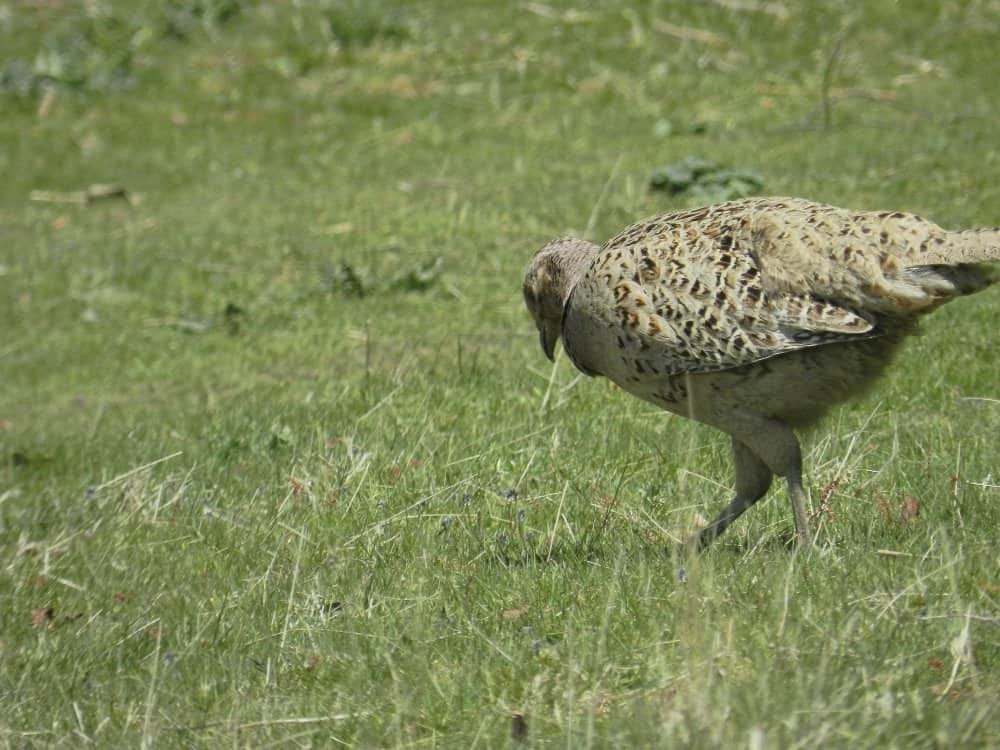
๐Ÿ‘ A female Pheasant at RSPB Minsmere Reserve

A female pheasant does not have the bright colors of the male and is thus better able to hide and be protected.

ยฉMillie Bond โ€“ Copyright A-Z Animals

Animals that prey on young pheasants include owls, foxes and hawks, while skunks and raccoons like to feed on pheasant eggs. Owls and hawks are able to target the birds easily during the winter because the snow decreases a pheasantโ€™s ability to hide. While pheasants are not currently at risk of becoming extinct, the bird populations are decreasing from habitat losses and excess human hunting. In fact, in their natural habitats, hunters have caused the birds to come close to extinction. People are responsible for habitat destruction and egg collecting.

Pheasants are also at risk from avian influenza, which is a disease that affects domestic birds and those in the wild. When a bird becomes infected with the disease, they can spread it to others from their saliva, feces and nasal secretions.
 

Reproduction, Babies and Lifespan

Pheasants typically start their mating ritual late in March, and it peaks in May. During this time, male pheasants claim their territories. These vary in size from several acres to areas that measure a half section or more. To attract a female, the rooster will crow and strut. If another male should enter his territory, then he will attack. A male bird will also beat his wings rapidly, showing a hen that he is strong and powerful; therefore, his offspring will be strong and powerful too.

Ring-necked pheasants make their nests under a hedge or within dense cover. They line their nests with leaves and grass. Sometimes, the female birds will nest inside a nest that another bird has abandoned. Male pheasants are polygynous and frequently have a harem that includes several female birds.

Pheasants produce from eight to 15 eggs. They are able to have as many as 18 eggs, but in most cases, they have from 10 to 12. Pheasant eggs are olive colored, and the female birds lay them throughout a two to three-week period from April to June. For pheasants, the incubation time is around 22 to 27 days. Once baby pheasants have hatched, they will stay by their mother for a few weeks. However, they will leave the nest at just a few hours old. Chicks are born with their eyes open. They are also covered in down.
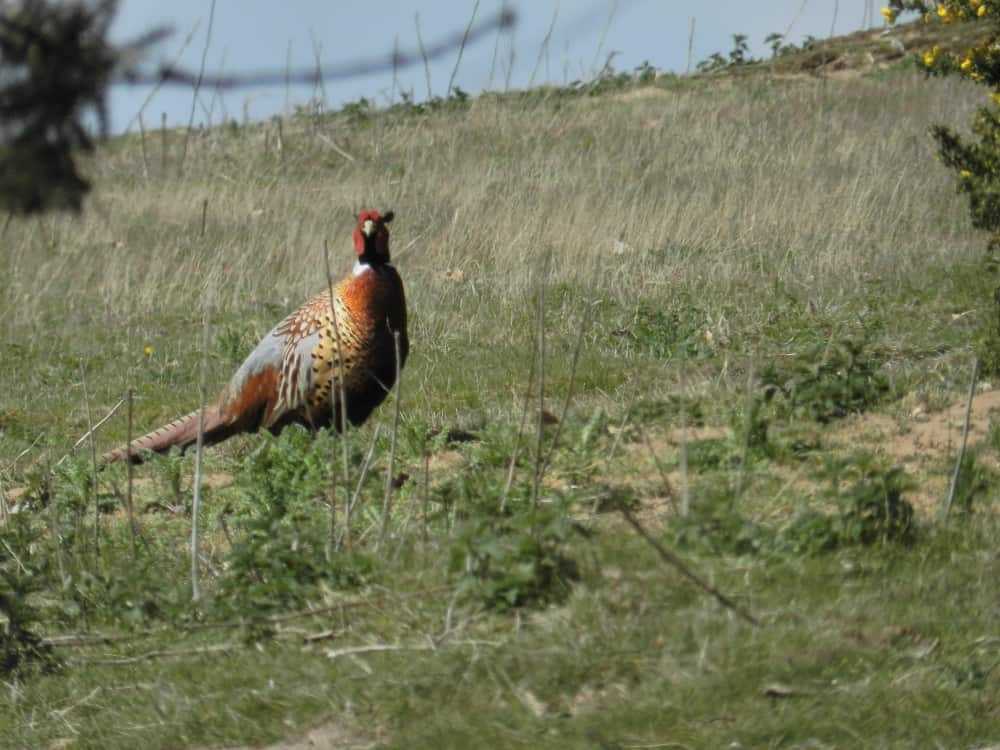
๐Ÿ‘ A male Pheasant at RSPB Minsmere Reserve

The Pheasant chick will look like an adult at 15 weeks old and can expect to survive only one or two years.

ยฉMillie Bond โ€“ Copyright A-Z Animals


Like other birds, baby pheasants are called chicks. After they hatch, chicks grow fast. Theyโ€™re able to fly when theyโ€™re just 12 to 14 days old. Chicks look like adult pheasants once they reach 15 weeks old. Chicks will eat the same things as adults. They dine on fruit, grain, and leaves along with caterpillars, grasshoppers, and other insects.

Pheasants are a prey bird, and as such, they must confront major mortality sources that start from the time that they are inside an egg within a nest. During a mild winter in a protective habitat, pheasants have a 95% survival rate, but during a severe winter, the birds have a 50% survival rate. If a winter is mild and the birds are in a poor habitat, they have an 80% survival rate. If they are dealing with a harsh winter in a poor habitat, then their survival rate is just 20%. In the wild, pheasants live for 1 to 2 years. When theyโ€™re kept in captivity, they live for as long as 18 years.
 

Pheasant Population

The pheasant population is decreasing in many places. During the โ€˜60s and โ€˜70s, more than 250,000 hunters killed over a million of them a few times each year just in the state of Illinois. Changes in farming and how people use land has caused a big decline in the pheasant population. In the year 2000, an estimated 59,000 hunters killed around 157,000 birds. For the 2017 to 2018 hunting season, approximately 12,500 hunters harvested almost 34,000 wild birds. The pheasant population is different state by state, of course, and hunting seasons, enforced by the state, make sure that no more pheasants are shot than can be replaced.

In Great Britain, where pheasants are raised on farms, 50 million can be released for the summer hunting season. So many are killed, though, that only 5 million are left afterwards. However, the numbers will increase again after the next yearโ€™s production.
 

View all 247 animals that start with P

Sources

  1. David Burnie, Dorling Kindersley (2011) Animal, The Definitive Visual Guide To The World's Wildlife / Accessed October 7, 2009
  2. Tom Jackson, Lorenz Books (2007) The World Encyclopedia Of Animals / Accessed October 7, 2009
  3. David Burnie, Kingfisher (2011) The Kingfisher Animal Encyclopedia / Accessed October 7, 2009
  4. Richard Mackay, University of California Press (2009) The Atlas Of Endangered Species / Accessed October 7, 2009
  5. David Burnie, Dorling Kindersley (2008) Illustrated Encyclopedia Of Animals / Accessed October 7, 2009
  6. Dorling Kindersley (2006) Dorling Kindersley Encyclopedia Of Animals / Accessed October 7, 2009
  7. Christopher Perrins, Oxford University Press (2009) The Encyclopedia Of Birds / Accessed October 7, 2009

Thank you for reading! Have some feedback for us?

Contact the AZ Animals editorial team

Related Articles You May Find Interesting


Pheasant FAQs (Frequently Asked Questions)

Pheasants are omnivorous ground eaters. The birds dine on leaves, insects, wild fruit, nuts and grains.

Since pheasants are birds, the taste of them is generally compared to chicken. However, the birds usually live in the wild, and because they are omnivores, they will eat almost anything edible, and what they eat influences how they taste to you. If you eat one, it will likely remind you of chicken, but pheasant meat is usually gamier and sweeter in flavor.

Pheasants live throughout the world because of human intervention.

Pheasants belong to the Kingdom Animalia.

Pheasants belong to the phylum Chordata.

Pheasants belong to the class Aves.

Pheasants belong to the family Phasianidae.

Pheasants belong to the order Galliformes.

Pheasants belong to the genus Phasianus.

Pheasants are covered in Feathers.

Pheasants have brightly colored feathers and long tails.

Pheasants eat insects, berries, and seeds.

Predators of Pheasants include foxes, dogs, and humans.

Pheasants typically lay 10 eggs.

Female Pheasants lay between 8 and 12 eggs per clutch!

The scientific name for the Pheasant is Phasianus Colchicus.

Pheasants can live for 7 to 10 years.

The Pheasant has a wingspan of 71cm to 86cm (28in to 34in).

The key differences between a grouse and a pheasant are taxonomy, appearance, distribution, and diet.

The key differences between a pheasant and a chicken are appearance, diet, domestication, and population.

The key differences between a partridge and a pheasant are size, color, and tail length.

The key differences between pheasant and quail are size, color, lifespan, diet, habitat, species, and temperament.