

P
Species Profile

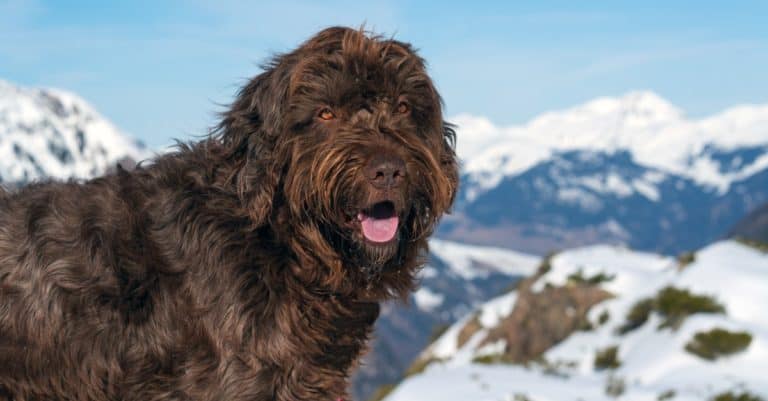
Pudelpointer

Canis lupus familiaris

Point. Retrieve. Repeat.
Chamois huntress/Shutterstock.com

Pudelpointer Distribution

Click a location to explore more animals from that region

Origin Location

This map shows the native origin of the Pudelpointer. As a domesticated species, they are now found worldwide.

Loading map...

Found in 1 country

Size Comparison

Human 5'8"
Pudelpointer 1 ft 12 in

Pudelpointer stands at 35% of average human height.

At a Glance

Domesticated
Also Known As Pudel-Pointer, Pudel Pointer, German Pudelpointer, Deutsch Pudelpointer
Diet Omnivore
Activity Diurnal+
Lifespan 4 years
Weight 32 lbs
Status Not Evaluated
Did You Know?

The Pudelpointer was developed in Germany specifically to combine a Pointer's pointing style with a Poodle's water work and trainability.

Scientific Classification

The Pudelpointer is a modern German versatile hunting dog (gundog) developed for both pointing and retrieving; it is a domestic dog breed.

Kingdom
Animalia
Phylum
Chordata
Class
Mammalia
Order
Carnivora
Family
Canidae
Genus
Canis
Species
Canis lupus

Distinguishing Features

  • Versatile gundog: points game and retrieves on land and water
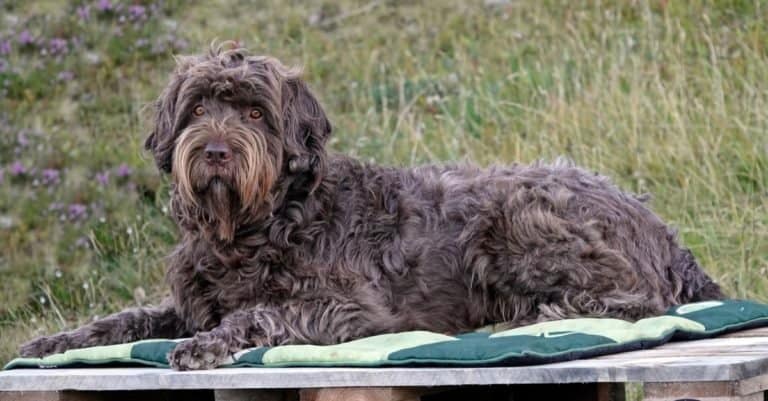
  • Often has a wiry/harsh coat with facial furnishings (beard/eyebrows) in many lines
  • Athletic, medium-to-large build suited for endurance work
  • Bred for strong scenting ability, trainability, and cooperation with handlers

Physical Measurements

Males and females differ in size

Height
2 ft 1 in (1 ft 12 in – 2 ft 3 in)
1 ft 10 in (1 ft 9 in – 2 ft)
Length
3 ft 7 in (3 ft 1 in – 4 ft 1 in)
Weight
64 lbs (55 lbs – 75 lbs)
53 lbs (44 lbs – 60 lbs)
Tail Length
12 in (10 in – 1 ft 2 in)
10 in (9 in – 12 in)
Top Speed
30 mph
running

Appearance

Primary Colors
Secondary Colors
Skin Type Mammalian skin with moderate thickness and good pigmentation; protected by a weather-resistant double coat (variable by line). Ears are pendulous and require routine inspection/cleaning to prevent moisture-related irritation.
Distinctive Features
  • Domestic dog breed (Canis lupus familiaris), not a wild canid; selectively bred for human-guided hunting work.
  • Modern German versatile hunting gundog developed for pointing and retrieving; strong nose, high trainability, and water/field versatility distinguish it from generalized village-dog or wolf phenotype.
  • Not a Poodle or Pointer: typically has harsher, more functional coat than a Poodle (less tightly curled), and a sturdier, more all-purpose build than many specialist pointers.
  • Athletic, medium-to-large, balanced frame; deep chest, strong loin, and efficient ground-covering gait for long days afield.
  • Head is moderately broad with pronounced eyebrows and beard/mustache ("furnishings") common in many individuals; eyes often amber to brown with alert expression.
  • Tail often carried level with back when working; overall look emphasizes durability over showy ornamentation.
  • Care: high exercise needs (daily vigorous activity + scent/field work); thrives with structured training and mental enrichment to prevent restlessness.
  • Coat care: weekly brushing/stripping as needed; remove burrs after hunts; bathing only as necessary to preserve coat oils.
  • Common gundog health issues: risk of hip dysplasia, ear infections from pendulous ears and water work, eye problems like entropion/ectropion in some lines, and bloat in deep‑chested dogs; keep them lean and screened.

Sexual Dimorphism

Males are typically larger and heavier-boned with broader heads and thicker necks. Females are usually slightly smaller, finer through the chest and muzzle, while maintaining the same athletic, work-ready proportions.

  • More robust musculature and heavier bone
  • Broader skull with stronger muzzle
  • Thicker neck and forequarters
  • Slightly lighter frame and narrower head
  • Often more refined chest and neck
  • Same coat types and working structure, scaled smaller

Did You Know?

The Pudelpointer was developed in Germany specifically to combine a Pointer's pointing style with a Poodle's water work and trainability.

Despite the name, it's its own breed-distinct from modern Poodles and from English Pointers.

Many Pudelpointers have a harsh, weather-resistant coat and facial "furnishings" (beard/eyebrows) suited to briars and cold marshes.

They're considered a "versatile" hunting dog: expected to track, point, retrieve, and work on land and in water.

Breed development is strongly tied to performance testing traditions in German hunting culture rather than show-ring fashion.

Their coat can be low-shedding compared with many gundogs, but it's not guaranteed hypoallergenic.

A well-bred Pudelpointer typically has strong natural retrieving instincts and a notable desire to work closely with its handler.

Unique Adaptations

  • Harsh, dense outer coat with protective undercoat (varies by line) helps shed water, insulate, and reduce snagging in brush-useful for marsh and upland cover.
  • Athletic, medium-to-large build optimized for endurance rather than sprint-only speed, supporting all-day field work.
  • Strong olfactory performance typical of domestic dogs, selectively reinforced in gundogs for efficient locating of dispersed scent plumes.
  • Biddability and handler-focus: selection for cooperative hunting, recall, and steadiness around gunfire and birds.
  • Retrieving specialization: selection for grip control and persistence, supporting repeated land/water retrieves under distraction.

Interesting Behaviors

  • Intense "freeze" on point when scenting game, often with a high, focused head carriage and still body.
  • Purposeful quartering (searching in a zig-zag pattern) to efficiently cover ground while checking back with the handler.
  • Water confidence: eager, direct entries into water and persistent swimming to complete a retrieve.
  • "Soft mouth" carrying: many naturally hold game or training dummies gently without crushing.
  • Problem-solving in scent work: will cast into the wind, circle, and re-acquire scent rather than giving up.
  • High work drive with an "off switch" at home when adequately exercised-often calm indoors after training.
  • Use of the tail as a steering rudder in swimming and as a communication tool during field search.

Cultural Significance

Pudelpointer (Canis lupus familiaris) comes from a German working-dog tradition. Bred for tracking, pointing, retrieving and water work, it is an all-around gundog for forests, fields and wetlands, with breeding based on hunting tests.

Myths & Legends

German hunters tell a story that the Pudelpointer was made as a one dog solution, combining the Pointer's steady point and the Poodle's water skill, and so got its name.

Early breed history is told as stories of strict selection: only dogs that proved themselves in real hunting and field tests were bred, a near craft tradition passed down among hunters.

Among sporting dog groups, a long-held belief says a good Pudelpointer should be ready to crash through thorny brush for upland birds and dive into icy water to retrieve, called a proverb among handlers.

Conservation Status

NE Not Evaluated

Has not yet been evaluated against the criteria.

Population Stable

Life Cycle

Birth 7 pups
Lifespan 4 years

Lifespan

In the Wild 2–8 years
In Captivity 12–14 years

Reproduction

Mating System Polygynandry
Social Structure Managed Domestic
Breeding Pattern Serial
Fertilization Managed Selective
Birth Type Managed_selective

As a selectively bred Pudelpointer (domestic dog), mating is typically human-managed with planned pairings; individuals form temporary breeding pairs per heat cycle. Stud males may sire multiple litters across females, and parents do not receive helper care.

Behavior & Ecology

Social Pack Group: 4
Activity Diurnal, Crepuscular
Diet Omnivore High-protein meat-based meals (e.g., poultry or fish) with training rewards from lean meat or freeze-dried organ treats

Temperament

Breed distinction vs base domestic dog: intentionally selected for cooperative pointing/retrieving and water work.
High drive and endurance; needs daily vigorous exercise plus scent/field problem-solving.
Handler-focused and biddable; responds best to structured, reward-based training.
Social with familiar people; can be reserved with strangers without early exposure.
Generally dog-social, especially when raised in groups; may show same-sex tension if unmanaged.
Strong prey drive and tracking focus; recall and impulse control require consistent proofing.
HUBS (breed group patterns): versatile gundogs are cooperative, energetic, trainable; variation by lines and socialization.
Care: regular off-leash/working outlets, swimming/retrieving, and nosework prevent frustration behaviors.
Care: coat is low-shedding but needs brushing/stripping; ears need routine checks after water/field work.
Health concerns: hip/elbow dysplasia risk; screen breeding stock and manage body condition.
Health concerns: ear infections, allergies/skin issues, and bloat risk-use feeding/management precautions.

Communication

Alert bark when novel stimuli appear
Excited yips/whines during anticipation Leash, hunt, retrieve
Low growl as distance-increasing warning in conflict
Contented grumbles/sighs during rest and bonding
Scent marking and investigative sniffing to map territory and track game
Highly readable body language: tail carriage, ear set, weight shift, freezing/pointing posture
Retrieving presentation behaviors: carrying, delivery to hand, and re-engagement cues
Eye contact and checking-in loops with handler during field search patterns

Habitat

Biomes:
Temperate Forest Temperate Grassland Wetland Boreal Forest (Taiga) Tundra Alpine Mediterranean Desert Hot Desert Cold Freshwater Marine +5
Terrain:
Plains Hilly Riverine Valley Coastal
Elevation: Up to 16404 ft 3 in

Ecological Role

Human-associated omnivorous mesopredator (domestic working dog) used to locate, flush, retrieve, and dispatch game under handler control; ecologically, impacts wildlife primarily through managed hunting activities and, if free-roaming, opportunistic predation/scavenging.

Assists regulated harvest of game (supports wildlife management objectives) Retrieval reduces lost/wounded game and improves harvest efficiency Carries out scent-based location of downed animals, aiding ethical recovery In human settings, provides companionship and working utility rather than a natural trophic role

Diet Details

Other Foods:
Cooked grains and starches Vegetables Fruits Dietary fiber sources

Human Interaction

Domestication Status

Domesticated

Canis lupus familiaris (domestic dog) comes from gray wolves and was shaped by long human selection for work and company. The Pudelpointer, from Germany in the late 1800s–early 1900s, was bred by crossing Poodle and English Pointer for steady pointing and reliable retrieving, strong nose, handler focus, endurance, and a low-shedding wiry coat for brush and cold water.

Danger Level

Low
  • Typical domestic-dog bite risk if poorly socialized, fearful, in pain, or mishandled
  • High prey drive may lead to chasing-risk of knocking over small children during high-arousal play
  • Mouthy retrieving behavior in young dogs without training; can cause nips
  • Guarding behavior is not a primary breed trait, but resource guarding can occur in individuals
  • Field environments add risks (firearms, rough terrain, water hazards); requires responsible supervision

As a Pet

Suitable as Pet

Legality: Pudelpointer (Canis lupus familiaris) are generally legal as pets in the U.S. and most places that allow dogs. Local rules (licenses, leashes, shots, breeding, housing/HOA) apply, and any dog can be limited by local law.

Care Level: Experienced

Purchase Cost: $1,500 - $3,500
Lifetime Cost: $20,000 - $45,000

Economic Value

Uses:
Companion animal (active households) Sporting/hunting dog industry (versatile gundog) Working services (detection/SAR potential, field trialing) Breeding and training services Pet products and veterinary services
Products:
  • Hunting companionship and field performance (pointing/retrieving, tracking wounded game)
  • Professional training/handling services (gun-dog training, obedience, recall/e-collar conditioning where used)
  • Breeding/puppy sales and stud services (with health testing)
  • Equipment and supplies (crates, GPS collars, long lines, retrieve dummies, vests)
  • Veterinary care demand (preventive care, orthopedic screening, emergency care for bloat risk)

Relationships

Predators 5

Gray wolf Canis lupus
Coyote Canis latrans
Cougar Puma concolor
Brown bear Ursus arctos
Golden eagle Aquila chrysaetos

Related Species 7

Domestic dog Canis lupus familiaris Shared Species
Gray wolf Canis lupus Shared Species
Coyote Canis latrans Shared Genus
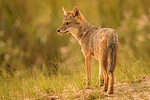
Golden jackal Canis aureus Shared Genus
Ethiopian wolf Canis simensis Shared Genus
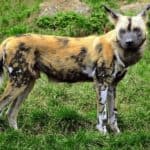
African wild dog Lycaon pictus Shared Family
Red fox Vulpes vulpes Shared Family

Ecological Equivalents 5

Animals that fill a similar ecological role in their ecosystem

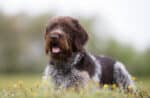
German Wirehaired Pointer Canis lupus familiaris Closest match is the German Wirehaired Pointer, a wire-coated pointing and retrieving gundog for upland birds and water work. Shares care needs: a rough, weather-resistant coat (requires brushing and occasional hand-stripping), plus high daily exercise and training.
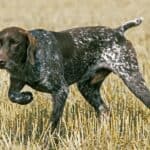
German Shorthaired Pointer Canis lupus familiaris Fulfills a similar role as a pointing dog for upland game and tracking, but typically has a shorter coat and overheats more easily than the Pudelpointer. Pudelpointers have rough, weather‑proof coats and a strong water‑retrieving drive.
Labrador Retriever Canis lupus familiaris Overlap in the retrieving/waterfowl hunting niche. Pudelpointers add a reliable pointing component and a wiry coat that sheds debris and offers protection in cover. Both breeds require intensive physical and mental work. They share common health watch-outs, notably hip dysplasia risk, so screening is important.
Chesapeake Bay Retriever Canis lupus familiaris Both have a comparable work ethic for waterfowl hunting and harsh-weather conditions. The Chesapeake Bay Retriever is more specialized for retrieving, while the Pudelpointer is typically more versatile across pointing and retrieving. Both breeds benefit from strong conditioning, ear care after water exposure, and structured training to prevent behavior issues from under-stimulation.
English Pointer Canis lupus familiaris Shares the upland pointing role. The English Pointer is more focused and covers wider ground, while the Pudelpointer is bred as an all-around hunter (pointing, tracking, retrieving) and has a wire coat that resists thorns and cold water.

Breed a poodle with an English Pointer and you get a Pudelpointer. These dogs originated in Germany back in the early 1880s. The word poodle is written as pudel in German. Breeders wanted an intelligent dog that could swim like a poodle and hunt like an English Pointer. This crossbreed is friendly, energetic, and eager to please its owner.

These smart, gentle dogs are great for families with children. Keep in mind, they need a lot of exercise each day, so a home with a large backyard is an ideal setup for this canine.

3 Pros and Cons of Owning a Pudelpointer

Pros!Cons!
An easy grooming routine
This dog needs to be brushed just once per week. However, if a dog goes for a walk in the woods, it may need to be brushed afterward to remove twigs, dirt, burs, etc. from its coat.
A prey-driven dog
Because this dog was bred for hunting game, it must be monitored around the small pets (gerbils, hamsters, rabbits, birds) in a household. They don’t know the animal is a pet. When they see a small animal, their instincts tell them to chase it!
Low shedding
Though they are not strictly hypoallergenic, Pudelpointers shed a low amount of hair throughout the year. They are known as seasonal shedders, meaning they shed a little more hair at the beginning of the spring and fall seasons.
Needs lots of exercise
Pudelpointers are used to running, jumping, trotting, and exploring. They need at least 60 minutes of exercise per day to stay healthy.
Child-friendly
Though these dogs were bred to accompany their owner on hunting trips, they do well with families with young children.
Not apartment-friendly
These dogs are not suitable for apartment dwellers. They require a lot of space to move around.
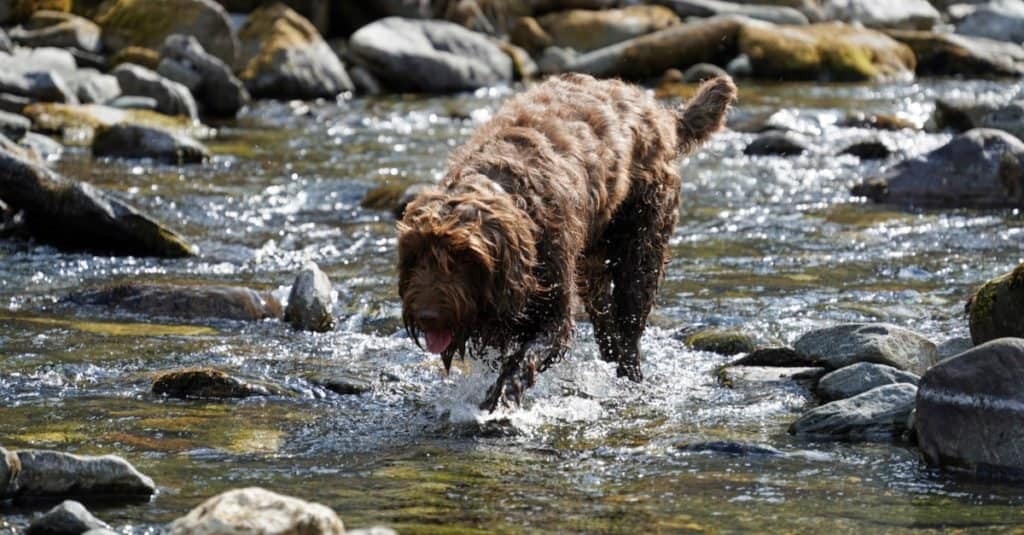
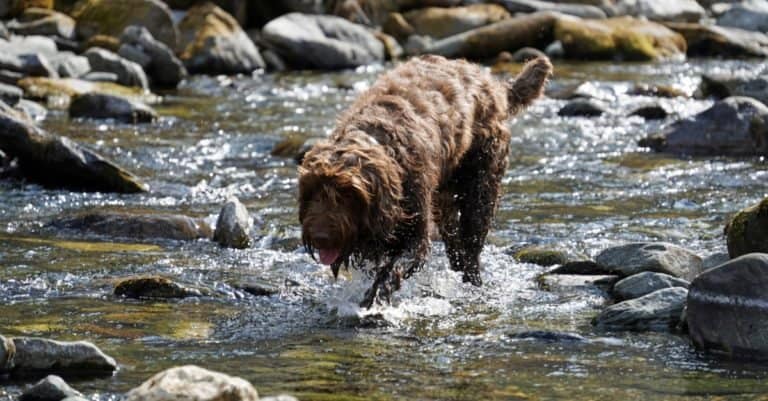
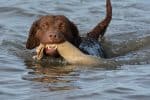
👁 A Pudelpointer, in a mountain creek on a warm and sunny day.

A Pudelpointer in a mountain creek on a warm and sunny day.

©Chamois huntress/Shutterstock.com

Pudelpointer Size and Weight

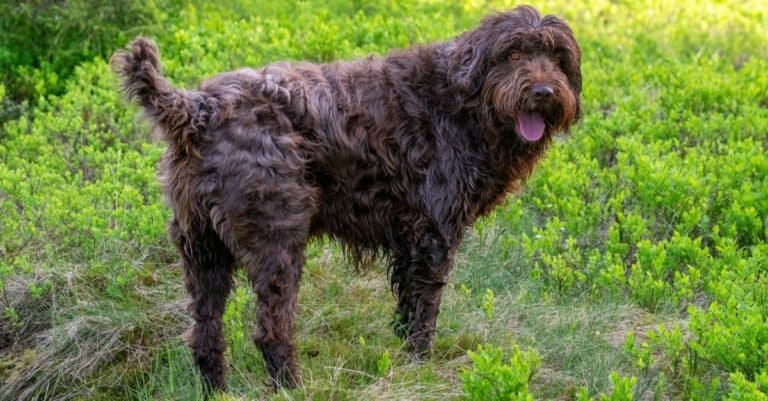
Pudelpointers are medium to large dogs with a coat of medium-length hair. Both males and females can grow to a height of 26 inches. In addition, both males and females can weigh as much as 70 pounds, full-grown. A 7-week-old Pudelpointer weighs around 8 pounds. These dogs are considered fully grown at 18 months to 2 years old.

Pudelpointer Common Health Issues

Pudelpointers have some common health issues owners should bear in mind. One of those is hip dysplasia. Hip dysplasia occurs when the ball and socket of the hip joint don’t fit together properly. A dog with this condition may hop, limp, or run awkwardly. There are a few treatments for this condition, including physical therapy, surgery, weight loss, and supplements.

Another common health issue is bloat. Bloat occurs when a dog’s stomach fills with air, food, or water, causing this organ to twist. This is a serious condition and can only be relieved by a veterinarian. Some symptoms of bloat include a swollen abdomen, a lot of drooling, retching, and restlessness.

A third common health issue of this dog is an ear infection. This dog’s cute, floppy ears hang down. So, they can easily get wet, take on dirt, twigs, burs, and other debris, leading to an infection. Redness, excessive wax, and drainage can be signs of an ear infection. Of course, these are painful for a dog. A veterinarian can prescribe medicine to cure an ear infection. Plus, an owner can take steps to make sure their dog’s ears stay clean to prevent infection.

Pudelpointer Temperament and Behavior

The personality of a Pudelpointer is best described as friendly. These dogs enjoy spending time with their family, no matter the activity. Pudelpointers are ideal for families with kids who love to hike, visit the park, camp, and otherwise spend countless hours outdoors!

One of the most notable traits of this crossbreed is intelligence. Though they can sometimes have an independent streak, they are quick to learn their obedience training lessons. When it’s out hunting for a game with its owner, this dog is focused on its task. Alternatively, when at home on the sofa with family members, this dog’s behavior is gentle and sweet.

How to Take Care of a Pudelpointer

Taking the best possible care of this pet starts with learning as much about its health issues, diet, exercise needs, and more. Whether a family gets a puppy from a breeder or an adult Pudelpointer from a rescue organization, knowing all about this dog benefits everyone!

The Best Dog Food for Pudelpointers

Pudelpointer puppies and adult dogs need different types of nutrients to maintain good health. Check out some dietary considerations for both puppies and adults. Also, remember that dogs who bloat need their owners to closely monitor portion sizes and avoid timing meals too close to exercise.

Pudelpointer puppy food: Lean protein in this puppy’s diet supplies it with amino acids that support the healthy growth of bones, muscles, skin, and nails. Protein can help a puppy to start out with strong bones and possibly defend against the development of hip dysplasia. Fat gives it the energy to run and play. Vitamin A supports healthy eyes and a strong immune system. Vitamin C and E are antioxidants. Calcium contributes to a puppy’s strong teeth and bones.

Pudelpointer adult dog food: A limited amount of fat in an adult dog’s diet helps it to have an adequate amount of energy while not adding excess weight. Protein is necessary for healthy muscles, cartilage, and joints. Vitamin B12 supports a dog’s nervous system. Vitamin C and selenium are important antioxidants. Fiber helps an adult dog maintain proper digestion.

Pudelpointer Maintenance and Grooming

How much does a Pudelpointer shed? Though Pudelpointers aren’t hypoallergenic, they shed a very low amount of hair. However, the shedding increases temporarily at the change of season in the fall and spring.

A slicker brush is a valuable tool for grooming the medium-length hair of this crossbreed dog. It removes loose hair and tangles while smoothing out the rest of its coat. These dogs should be brushed once a week. A grooming glove is great to use on this pet’s face, legs, and tail.

Cleaning a Pudelpointer’s ears is another part of its grooming routine. Their ears hang down, so they pick up moisture, dirt, and dust. When this debris builds up, it can cause an ear infection. So, it’s a good idea to clean the underside of their ears with a soft cloth and a mild cleaning solution designed for this purpose.

Sometimes these dogs suffer from environmental allergies. They may be allergic to pollen, dust, or mold. Red patches of skin, dryness, and excessive scratching or biting of its skin are all signs of an environmental allergy. A vet can help a Pudelpointer owner determine the cause of the allergy and the appropriate treatment.

Pudelpointer Training

Though these dogs are intelligent, they can sometimes have an independent streak. This can make obedience training a little difficult for an owner. Training this crossbreed pup indoors can minimize distractions. Also, using preferred treats and plenty of verbal praise can help this canine to quickly take in each lesson.

Pudelpointer Exercise

A Pudelpointer needs around 60 minutes of exercise each day to stay both emotionally and physically healthy. Allowing this canine to run in the woods, a local park, or in a field, are great ways to give it vigorous exercise. Before playing or even walking off-leash, the dog should be trained to come back to you when called in case a safety risk arises. Taking this pet to the dog park or playing fetch in the backyard are other ideas for exercise.

This crossbreed canine is not a good choice for apartment living because it needs a lot of space to move around.

Pudelpointer Puppies

One thing to remember with Pudelpointer puppies is that they are born with the desire to chase down prey. So, even a small puppy may try to go after the family’s rabbit, bird, etc. It’s important to monitor their activity even as puppies.

Pudelpointers and Children

Though they were bred for hunting, these dogs are gentle and patient with children. This dog is a great choice for families with or without kids.

Dogs Similar to Pudelpointers

Other dogs similar to Pudelpointers are Labrador retrievers, bloodhounds, and Irish setters.

  • Labrador Retriever: These dogs and Pudelpointers are about the same weight and are known for their friendly temperament. One difference is that Pudelpointers point when they see prey, and Labrador retrievers move to drive prey out of its hiding place.
  • Bloodhound: Both of these dogs have a gentle temperament and love to be around their families. But bloodhounds weigh much more than Pudelpointers.
  • Irish Setter: These dogs are around the same height and weight. They are both very energetic as well. However, an Irish setter’s coat requires much more grooming attention than a Pudelpointer’s.
View all 247 animals that start with P

Sources

  1. Wikipedia / Accessed June 26, 2021
  2. American Kennel Club / Accessed June 26, 2021

About the Author

A-Z Animals Staff

AZ Animals is a growing team of animals experts, researchers, farmers, conservationists, writers, editors, and -- of course -- pet owners who have come together to help you better understand the animal kingdom and how we interact.
Connect:

Thank you for reading! Have some feedback for us?

Contact the AZ Animals editorial team

Related Articles You May Find Interesting


Pudelpointer FAQs (Frequently Asked Questions)

A Pudelpointer is a crossbreed canine. Its parents are the poodle and the English Pointer. This dog was bred for hunting but makes a great pet for families as well.

Breeders charge around $1000 for Pudelpointer puppies. People who don’t want to visit breeders in search of a Pudelpointer puppy have an alternative. They can visit a Pudelpointer rescue organization. These organizations adopt out puppies and adult dogs for a small fee. This fee helps to support and maintain the rescue organization.

The yearly veterinary costs for a Pudelpointer range from $500 to $700.

The monthly food cost for this crossbreed dog ranges from $50 to $100.

Yes, these dogs are good with kids.

Pudelpointers can live to be 14 years old, or older in some cases!

Yes. As long as a Pudelpointer receives around 60 minutes of vigorous exercise each day, they are a good choice for families. Families who love to spend time outdoors camping, walking, and exploring would be an especially good match for this pet.

No, they are not strictly hypoallergenic. But they shed a very low amount of hair for most of the year.

No. These dogs are very focused on the task when they are hunting, but they’re not aggressive.