


P
Species Profile

Python

Pythonidae

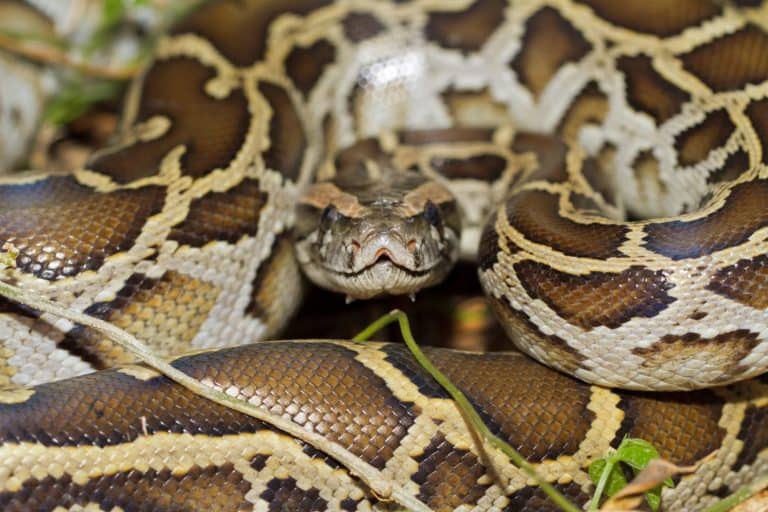
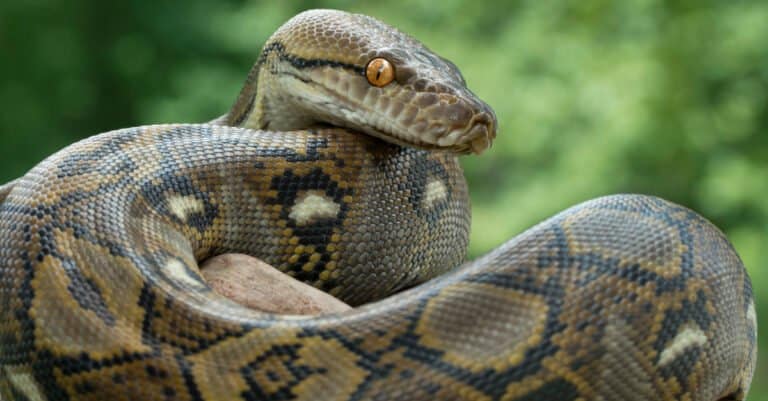
Big squeeze, bigger diversity.
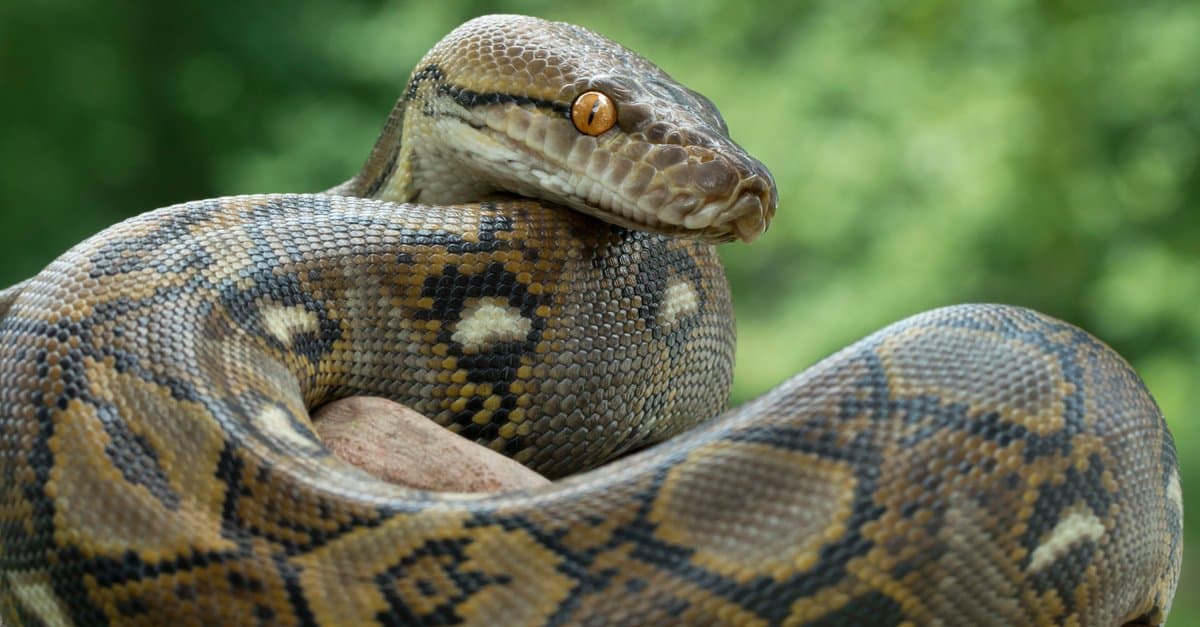
Mark_Kostich/Shutterstock.com

Python Distribution

Click a location to explore more animals from that region

Invasive Species
Loading map...

Found in 55 countries

๐Ÿ‡ฆ๐Ÿ‡ด Angola ๐Ÿ‡ฆ๐Ÿ‡บ Australia ๐Ÿ‡ง๐Ÿ‡ฉ Bangladesh ๐Ÿ‡ง๐Ÿ‡ฎ Burundi ๐Ÿ‡ง๐Ÿ‡ฏ Benin ๐Ÿ‡ง๐Ÿ‡ณ Brunei Darussalam ๐Ÿ‡ง๐Ÿ‡ผ Botswana ๐Ÿ‡จ๐Ÿ‡ฉ Democratic Republic of Congo ๐Ÿ‡จ๐Ÿ‡ซ Central African Republic ๐Ÿ‡จ๐Ÿ‡ฌ Republic of Congo ๐Ÿ‡จ๐Ÿ‡ฎ Cรดte d'Ivoire ๐Ÿ‡จ๐Ÿ‡ฒ Cameroon ๐Ÿ‡จ๐Ÿ‡ณ China ๐Ÿ‡ฉ๐Ÿ‡ฏ Djibouti ๐Ÿ‡ช๐Ÿ‡ท Eritrea ๐Ÿ‡ช๐Ÿ‡น Ethiopia ๐Ÿ‡ฌ๐Ÿ‡ฆ Gabon ๐Ÿ‡ฌ๐Ÿ‡ญ Ghana ๐Ÿ‡ฌ๐Ÿ‡ฒ Gambia ๐Ÿ‡ฌ๐Ÿ‡ณ Guinea ๐Ÿ‡ฌ๐Ÿ‡ถ Equatorial Guinea ๐Ÿ‡ฎ๐Ÿ‡ฉ Indonesia ๐Ÿ‡ฎ๐Ÿ‡ณ India ๐Ÿ‡ฐ๐Ÿ‡ช Kenya ๐Ÿ‡ฐ๐Ÿ‡ญ Cambodia ๐Ÿ‡ฑ๐Ÿ‡ฆ Lao People's Democratic Republic ๐Ÿ‡ฑ๐Ÿ‡ฐ Sri Lanka ๐Ÿ‡ฑ๐Ÿ‡ท Liberia ๐Ÿ‡ฒ๐Ÿ‡ฒ Myanmar ๐Ÿ‡ฒ๐Ÿ‡ผ Malawi ๐Ÿ‡ฒ๐Ÿ‡พ Malaysia ๐Ÿ‡ฒ๐Ÿ‡ฟ Mozambique ๐Ÿ‡ณ๐Ÿ‡ฆ Namibia ๐Ÿ‡ณ๐Ÿ‡ฌ Nigeria ๐Ÿ‡ณ๐Ÿ‡ต Nepal ๐Ÿ‡ต๐Ÿ‡ฌ Papua New Guinea ๐Ÿ‡ต๐Ÿ‡ญ Philippines ๐Ÿ‡ต๐Ÿ‡ฐ Pakistan ๐Ÿ‡ท๐Ÿ‡ผ Rwanda ๐Ÿ‡ธ๐Ÿ‡ง Solomon Islands ๐Ÿ‡ธ๐Ÿ‡ฉ Sudan ๐Ÿ‡ธ๐Ÿ‡ฌ Singapore ๐Ÿ‡ธ๐Ÿ‡ฑ Sierra Leone ๐Ÿ‡ธ๐Ÿ‡ณ Senegal ๐Ÿ‡ธ๐Ÿ‡ด Somalia ๐Ÿ‡ธ๐Ÿ‡ธ South Sudan ๐Ÿ‡น๐Ÿ‡ฌ Togo ๐Ÿ‡น๐Ÿ‡ญ Thailand ๐Ÿ‡น๐Ÿ‡ฑ Timor-Leste ๐Ÿ‡น๐Ÿ‡ฟ Tanzania ๐Ÿ‡บ๐Ÿ‡ฌ Uganda ๐Ÿ‡ป๐Ÿ‡ณ Vietnam ๐Ÿ‡ฟ๐Ÿ‡ฆ South Africa ๐Ÿ‡ฟ๐Ÿ‡ฒ Zambia ๐Ÿ‡ฟ๐Ÿ‡ผ Zimbabwe

At a Glance

Family Overview This page covers the Python family as a group. Stats below are general traits shared across the family.
Also Known As Constrictor, Pythonid, True python, Old World python
Diet Carnivore
Activity Nocturnal+
Lifespan 18 years
Weight 100 lbs
Status Not Evaluated
Did You Know?

Pythonidae includes both tiny, arboreal species and some of the world's longest snakes (reticulated python can exceed 6 m).

Scientific Classification

Family Overview "Python" is not a single species but represents an entire family containing multiple species.

Pythons (family Pythonidae) are nonvenomous constricting snakes found mainly in Africa, Asia, and Australia/New Guinea. They subdue prey via constriction and typically swallow prey whole. Many species are robust-bodied, with heat-sensing labial pits in several lineages and strong associations with forest, savanna, and wetland habitats depending on species.

Kingdom
Animalia
Phylum
Chordata
Class
Reptilia
Order
Squamata
Family
Pythonidae

Distinguishing Features

  • Nonvenomous constrictors (kill prey by constriction)
  • Elongate, muscular bodies with recurved teeth adapted for gripping prey
  • Scales often patterned for camouflage; many species can be very large
  • Reptiles: ectothermic, lung-breathing, and lay eggs in many species (some brood/coil around eggs)

Physical Measurements

Males and females differ in size

Length
โ™‚ 9 ft 10 in (1 ft 12 in โ€“ 26 ft 3 in)
โ™€ 8 ft 2 in (1 ft 6 in โ€“ 24 ft 7 in)
Weight
โ™‚ 18 lbs (0 lbs โ€“ 165 lbs)
โ™€ 22 lbs (0 lbs โ€“ 353 lbs)
Tail Length
โ™‚ 1 ft 6 in (3 in โ€“ 4 ft 11 in)
โ™€ 1 ft 6 in (2 in โ€“ 4 ft 3 in)
Top Speed
5 mph
slithering

Appearance

Primary Colors
Secondary Colors
Skin Type Overlapping keratin scales with a glossy to matte finish; typically smooth (facilitating locomotion), with mild keeling in some taxa; enlarged ventral scutes for traction and occasional iridescence depending on species and lighting.
Distinctive Features
  • Size range across family: roughly ~0.6 m to 7+ m total length; mass from a few hundred grams to 70+ kg in the largest species.
  • Lifespan varies widely: commonly ~10-30+ years, with some individuals exceeding 30 years in captivity.
  • Nonvenomous constrictors: subdue prey by constriction, then swallow prey whole; skull and jaw joints allow extreme gape.
  • Prey breadth is large and size-dependent: insects and small lizards in small species; rodents, birds, bats, and other reptiles commonly; large mammals taken only by the biggest pythons.
  • Habitat use is diverse: terrestrial and ambush-oriented forms, strongly arboreal species, and semi-aquatic/wetland-associated species all occur within the family.
  • Activity patterns often nocturnal or crepuscular, but vary with climate, prey availability, and human disturbance.
  • Geographic distribution spans Africa, South and Southeast Asia, and Australia/New Guinea (family-level range; absent from the Americas).
  • Many (not all) pythons have heat-sensing labial pits that aid hunting warm-blooded prey; pit development and prominence vary among lineages.
  • Reproduction is typically oviparous; females of several species brood eggs and may raise body temperature via muscular shivering.
  • Robust body with a relatively short to moderate tail in many terrestrial species; arboreal forms often have more prehensile tails and slender profiles.
  • Pelvic spurs are present (vestigial hindlimbs), often more noticeable in males; used in courtship.
  • Often avoid humans and rely on cryptic coloration; defensive behaviors include hissing, coiling, striking, and musk release.
  • Distinct from boas (Boidae): similar constrictor lifestyle, but Pythonidae is a separate family with its own anatomical traits and distribution.

Sexual Dimorphism

Sexual dimorphism is usually subtle: females commonly attain greater body mass and length, while males often have proportionally longer tails and larger pelvic spurs. Degree varies by species and population.

โ™‚
  • Proportionally longer tail beyond the cloaca in many species
  • Pelvic spurs typically larger and used during courtship
  • Often smaller-bodied than females in the same population
  • May travel more during breeding season while searching for mates
โ™€
  • Typically larger overall length and especially greater girth/mass
  • Body shape often more robust when reproductively active
  • Greater abdominal capacity related to egg production
  • In several species, females brood and guard eggs after laying

Did You Know?

Pythonidae includes both tiny, arboreal species and some of the world's longest snakes (reticulated python can exceed 6 m).

They kill prey by constriction-cutting off blood flow-then swallow it whole (often head-first).

Several python lineages have heat-sensing labial pits that help detect warm-blooded prey in low light.

Many pythons can go weeks to months between meals after a large prey item.

Some species are excellent climbers, others are ground-hunters, and some are strongly tied to wetlands and rivers.

Most pythons are oviparous (egg-laying), and maternal egg-brooding occurs in multiple species, with shivering thermogenesis reported in some.

Python jaws and stretchy ligaments let them consume prey far wider than their head.

Unique Adaptations

  • Highly kinetic skull: movable jaw bones and stretchy ligaments enable swallowing large prey whole; teeth are backward-curved for grip.
  • Constrictor physiology: specialized muscle use and circulatory effects make constriction an efficient subduing strategy; grip scales aid traction during coiling.
  • Heat-sensing labial pits (in several python lineages): infrared detection helps locate endothermic prey and choose strike points; presence and development vary across species.
  • Cryptic coloration and patterning: blotches, bands, or reticulation break up outline in forests, savannas, leaf litter, or riparian habitats; some species show strong local pattern variation.
  • Robust body plan with strong axial muscles: supports both heavy-bodied ground hunting and climbing in many species; tail prehensility is more developed in arboreal forms.
  • Low metabolic demand: many pythons can fast for long periods, then dramatically upregulate digestion after feeding.
  • Egg-related traits: leathery-shelled eggs, nest-site selection in sheltered microhabitats, and in some species maternal thermoregulation behaviors while brooding.

Interesting Behaviors

  • Constrict-and-hold feeding: typically striking, coiling rapidly, then maintaining pressure until prey is incapacitated; prey choice varies from small mammals and birds to reptiles (and in larger species, medium-to-large mammals).
  • Ambush vs active foraging: many species rely on sit-and-wait tactics along game trails, burrow edges, or waterlines; others patrol or climb to hunt nests.
  • Habitat partitioning: across the family you find arboreal specialists (often slender, prehensile-tailed), terrestrial generalists (robust-bodied), and semi-aquatic hunters that take prey at water margins.
  • Seasonal activity shifts: in cooler or drier seasons some species reduce activity, sheltering in hollows, rock crevices, burrows, or dense vegetation.
  • Brooding and nest attendance: females of several species coil around eggs, guarding them and helping regulate temperature and humidity; level of maternal care varies widely among species.
  • Human-modified landscapes: some pythons persist near farms or villages where rodents are abundant; others are forest-dependent and sensitive to habitat loss.
  • Size-structured ecology: smaller pythons focus on small vertebrates (lizards, frogs, small birds/mammals), while the largest species can take much larger mammals-creating wide dietary range across the family.

Cultural Significance

Pythons (Pythonidae) across Africa, Asia and Australia and New Guinea are important symbols of water, fertility, protection and kingship. They are sacred in some cultures, used in medicine and skins, and linked to conservation, shrines and guardian or royal roles.

Myths & Legends

In Dahomey (Fon, Benin), the rainbow serpent Dan (also called Da or Ayida-Weddo) stands for cosmic support and order. Serpent images in Vodun link these ideas to powerful local snakes like pythons.

Ouidah/Whydah python veneration (Benin): local traditions include reverence for pythons, with temples and protective taboos around harming them; pythons are treated as sacred beings and sometimes associated with good fortune and community well-being.

Yoruba traditions (Nigeria/Benin): Oshun is linked to rivers and prosperity; serpent/river symbolism appears in stories and ritual art, and large snakes such as pythons are sometimes treated as potent water-associated beings in regional folklore.

Across Southeast Asia and Indonesia, many folk tales tell of giant snakesโ€”often like pythonsโ€”that guard forests, rivers, or treasure, can change shape, and sometimes marry or live with humans.

Australian Aboriginal stories of the Rainbow Serpent link this creator being to waterholes, rivers, and life; large snakes in these tales often match important local snakes, including pythons.

In Papua New Guinea and the New Guinea Highlands, large snakes like pythons appear in clan stories and origin tales as powerful bush beings linked to rivers and landforms, sometimes seen as ancestors or spirits.

The name "python" comes from an old Greek myth about a giant snake, Python, linked to Delphi and Apollo. Europeans later used it for large constrictor snakes, shaping cultural links.

Conservation Status

NE Not Evaluated (family-level taxa like Pythonidae are not assessed as a single unit; conservation status is assessed per species). Across the family, species statuses span from Least Concern (LC) to Critically Endangered (CR), with some island-restricted and heavily traded taxa among the most at risk.

Has not yet been evaluated against the criteria.

Population Unknown

Protected Under

  • CITES Appendix I (some Pythonidae species/populations)
  • CITES Appendix II (many Pythonidae species; international trade regulated)
  • National and state/provincial wildlife protection laws across many range countries (vary by species and jurisdiction)

Looking for a specific species?

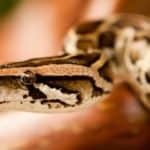
Burmese python

Python bivittatus

"Python" is the common name for large, nonvenomous constrictor snakes in the family Pythonidae (and sometimes closely related lineages); the Burmese python (Python bivittatus) is one well-known species, including as an invasive population in Florida.

  • Pythons vary a lot in size: small species like Antaresia spp. are about 0.6โ€“1.0 m long, while the reticulated python is usually 3โ€“6 m and can reach about 7 m.
  • Across Pythonidae, adult mass spans from well under 1 kg in the smallest species to many tens of kilograms in the largest; body form ranges from slender arboreal species to extremely robust terrestrial/semi-aquatic species.
  • Lifespan across the family commonly ranges ~10-30+ years, with many medium/large species frequently exceeding 20 years in captivity; longevity varies substantially by species and conditions.
  • Shared ecology/behavior: nonvenomous constrictors that typically ambush and swallow prey whole; many are nocturnal/crepuscular, with habitat use ranging from arid scrub to rainforest canopies to wetlands (strong variation among genera/species).
  • Reproduction is generally oviparous (egg-laying); several species show notable maternal egg-brooding (coiling and thermoregulating), but clutch size, seasonality, and parental investment vary widely across the family.
View Burmese python Profile

You might be looking for:

Reticulated Python

22%

Malayopython reticulatus

Worldโ€™s longest snake by total length; Southeast Asia; powerful constrictor often associated with wetlands and forest edges.

View Profile

Burmese Python

20%

Python bivittatus

Large Asian python; notable for invasive populations in Florida; semi-aquatic tendencies.

View Profile

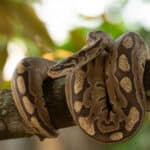
Ball Python

18%

Python regius

Smaller West/Central African python; famous in the pet trade; defensive โ€˜ballingโ€™ behavior.

View Profile

Green Tree Python

14%

Morelia viridis

Arboreal rainforest python from New Guinea/Australia region; bright green adult coloration; often coiled on branches.

View Profile

African Rock Python

12%

Python sebae

Large African python; strong constrictor across sub-Saharan habitats near water.

View Profile

Life Cycle

Birth 25 hatchlings
Lifespan 18 years

Lifespan

In the Wild 8โ€“30 years
In Captivity 12โ€“50 years

Reproduction

Mating System Polygynandry
Social Structure Solitary
Breeding Pattern Seasonal
Fertilization Internal Fertilization
Birth Type Internal_fertilization

Across Pythonidae, adults are mostly solitary and come together briefly to breed. Males widely search for receptive females and may compete (including male-male combat); females may mate with multiple males. Pair bonds are absent; maternal-only egg brooding is common but variable.

Behavior & Ecology

Social No fixed group name Group: 1
Activity Nocturnal, Crepuscular, Cathemeral, Diurnal
Diet Carnivore Small to medium mammals (particularly rodents)
Seasonal Hibernates

Temperament

Generally cryptic and avoidance-oriented; relies on camouflage and immobility
Defensive when threatened: hissing, striking, biting, and tight coiling
Ambush-predator persistence; long stationary periods followed by sudden bursts
Temperature-dependent boldness and activity; cooler conditions often increase basking and diurnality
Species and individual variation: some remain calm with disturbance, others are highly defensive
Juveniles often more defensive and more frequently active than large adults

Communication

hissing Primary defensive sound
forceful exhalation/puffing during threat displays
chemical signaling via pheromone trails for mate finding and reproductive status
tactile cues during courtship: chin rubbing, body alignment, and tail searching
postural displays: coiling, head elevation, and gaping to deter predators
substrate vibration and rapid movement as disturbance signals
scent marking from cloacal glands and skin lipids used in individual and mate recognition

Habitat

Biomes:
Tropical Rainforest Tropical Dry Forest Savanna Desert Hot Mediterranean Temperate Forest Freshwater Wetland +2
Terrain:
Mountainous Hilly Plateau Plains Valley Coastal Island Riverine Volcanic Karst Rocky Sandy Muddy +7
Elevation: Up to 7545 ft 11 in

Ecological Role

Predatory regulators across a wide range of habitats; pythons function as mesopredators in many systems and can be apex predators locally where very large-bodied species occur. Their ecological impact varies with body size and habitat use, from controlling small vertebrates (especially rodents) to influencing bird and mammal community structure in places where large pythons are common.

Population control of rodents and other small mammals (potentially reducing crop damage and disease-vector hosts) Trophic regulation that can stabilize prey communities and reduce overabundance of certain vertebrates Nutrient transfer within ecosystems via predation and subsequent waste/carcass decomposition (indirectly supporting scavengers and decomposers) Serving as prey for larger predators (e.g., large birds of prey, crocodilians, big mammals) especially when young, contributing to food-web connectivity

Diet Details

Main Prey:
Small mammals Medium mammals Birds Reptiles Amphibians Fish Eggs and nestlings +1

Human Interaction

Domestication Status

Wild

Pythonidae (pythons) are wild reptiles with a long history of human useโ€”hunting, trade, and keeping in captivityโ€”but they are not truly domesticated. Many species are bred in captivity and may accept handling, yet remain wild in behavior and body. They vary greatly in size, lifespan, habitat (arboreal, terrestrial, semi-aquatic) and hunting style.

Danger Level

Moderate
  • Bites: typically defensive; can cause puncture wounds and infection risk (especially with large individuals).
  • Constricting injury: most species pose low risk to healthy adults, but large-bodied pythons can cause severe injury or (rarely) fatalities, particularly involving children or small adults and/or unsafe handling practices.
  • Feeding accidents: mistaken-identity strikes during feeding; risk increases with size and poor protocols.
  • Zoonoses: Salmonella and other enteric bacteria; risk mitigated by hygiene.
  • Allergic reactions/asthma triggers from bedding/animal dander (keeper-dependent).
  • Escapes and invasive impacts: released/escaped animals can threaten local wildlife and create public-safety concerns, leading to regulatory restrictions.

As a Pet

Suitable as Pet

Legality: Laws vary by country, state, and by species or size. Many places allow small to medium pythons with care rules; large species often need permits, special cages, insurance, or are banned. International trade may follow CITES and need captive-bred papers.

Care Level: Moderate

Purchase Cost: $50 - $5,000
Lifetime Cost: $3,000 - $60,000

Economic Value

Uses:
Pet and captive-breeding trade Leather/skins industry Meat/subsistence use Traditional medicine and cultural use (region-dependent) Pest control/ecosystem services Ecotourism and wildlife education Scientific research (physiology, biomechanics, ecology)
Products:
  • live animals (captive-bred and, in some regions, wild-caught)
  • tanned skins/leather goods
  • meat and byproducts (region-dependent)
  • exhibit animals for education/zoos
  • research specimens/data

Relationships

Predators 5

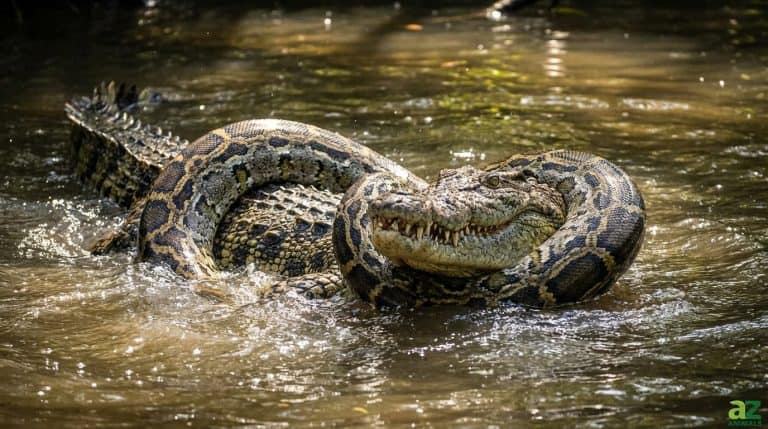
Crocodiles and alligators Crocodylidae and Alligatoridae
Large raptors Accipitridae
Large cats Panthera spp.
Monitor lizard Varanus
Human Homo sapiens

Related Species 4

Boas Boidae Shared Order
Anacondas Eunectes Shared Order
Calabar burrowing python Calabaria reinhardtii Shared Order
Sunbeam snakes Xenopeltis Shared Order

Ecological Equivalents 5

Animals that fill a similar ecological role in their ecosystem

Boa constrictor Boa constrictor A large, nonvenomous constrictor that subdues prey by constriction and occupies similar predator niches in forest edges, savannas, and riparian habitats, though it is a boa rather than a python.
Green anaconda Eunectes murinus An extremely large, semi-aquatic constrictor that overlaps with some python ecological roles, particularly ambush predation in wetlands, illustrating convergent ecology in a different family.
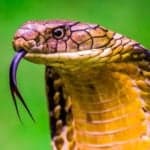
King cobra Ophiophagus hannah Shares habitat regions in parts of Asia and can occupy high trophic levels, but differs markedly by using venom and specializing on snakes; included as a functional/ecological contrast to constricting pythons.
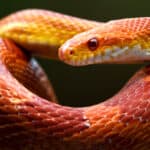
Corn snake Pantherophis guttatus A nonvenomous, rodent-eating snake that overlaps with the prey niches of small pythons, especially in human-modified habitats. It is a colubrid that is generally much smaller and has different reproductive and hunting ecology.
Monitor lizard Varanus spp. In Africa, Asia, and Australia, large monitor lizards can be competing predators (taking similar prey) and are also major predators of python nests and juveniles, creating both competition and predatorโ€“prey interactions.

Types of Python

31

Explore 31 recognized types of python

Ball python Python regius
Burmese python Python bivittatus
Indian python Python molurus
African rock python Python sebae
Southern African rock python Python natalensis
Angolan python Python anchietae
Reticulated python Malayopython reticulatus
Timor python Malayopython timoriensis
Amethystine (scrub) python Simalia amethistina
Boelen's python Simalia boeleni
Moluccan python Simalia clastolepis
Macklot's python Simalia mackloti
Tanimbar python Simalia nauta
Oenpelli python Simalia oenpelliensis
Papuan python Apodora papuana
Olive python Liasis olivaceus
Water python Liasis fuscus
Green tree python Morelia viridis
Carpet python (species complex) Morelia spilota
Centralian python Morelia bredli
Rough-scaled python Morelia carinata
Pygmy python Antaresia perthensis
Children's python Antaresia childreni
Spotted python Antaresia maculosa
Stimson's python Antaresia stimsoni
Black-headed python Aspidites melanocephalus
Woma python Aspidites ramsayi
White-lipped python Leiopython albertisii
Biak white-lipped python Leiopython biakensis
D'Albert's python Bothrochilus albertisii
Bismarck ringed python Bothrochilus boa

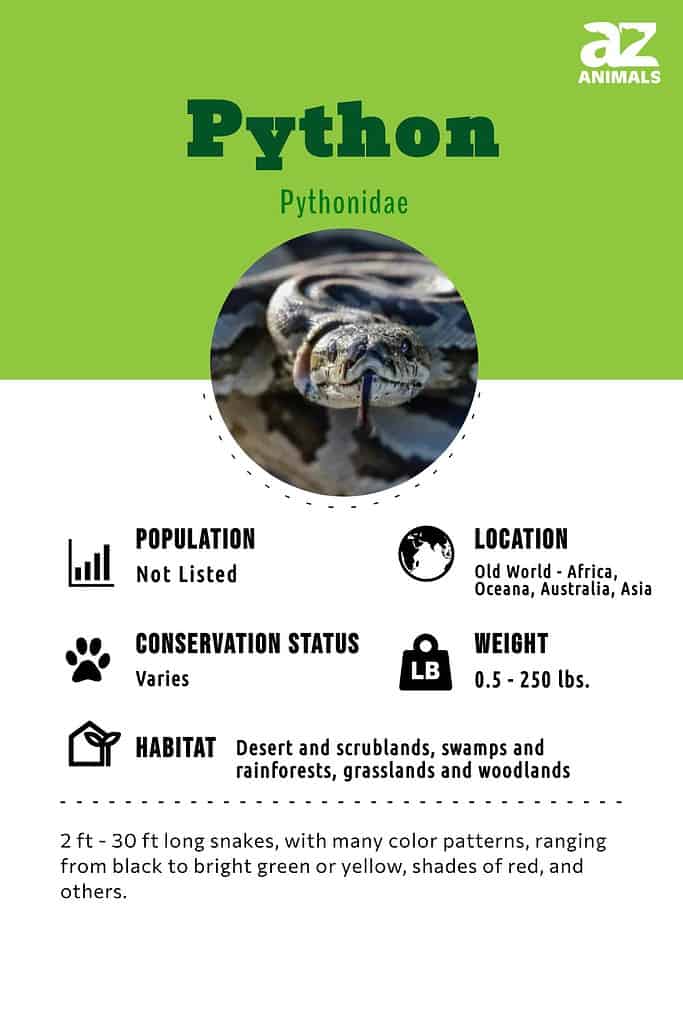
Pythons are Old World snakes that inhabit a wide variety of habitats in Australia, Africa, Oceana, and Asia.

Theyโ€™re nonvenomous and members of the Pythonidae family of snakes that constrict their prey with strong, muscular bodies. Theyโ€™re popular as pets, and many species of these beautiful snakes are available from breeders, including ball pythons, reticulated pythons, and carpet pythons.

Amazing Facts About Pythons

  • The longest python captured was a reticulated python that measured 26.25 feet long.
  • They donโ€™t crush their prey to death; instead, the pressure pythons exert when constricting their prey causes heart failure.
  • Most arboreal pythons have longer teeth than terrestrial species. Scientists believe that this is so they can get through the feathers of the birds they often eat.
๐Ÿ‘ Image

Where to Find Pythons

These are Old World snakes, meaning that they are not native to areas in the Americas, which are part of the New World. Instead, they make their homes in Africa, Australia, Oceana, and Asia. Habitats like rainforests, grasslands, woodlands, swamps, deserts, scrublands, and rocky terrain are home to over 40 species of python.

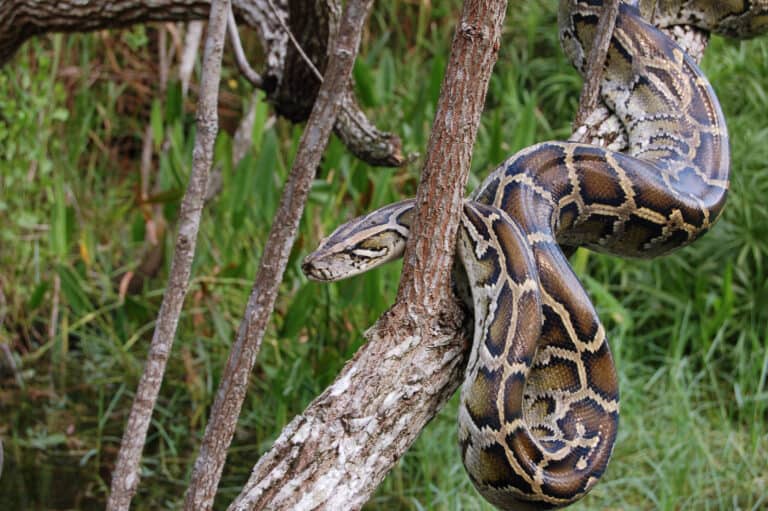
Some, like the Burmese python, have established breeding populations in countries outside their home range. These sometimes become invasive, crowding out native animals when they compete for the same prey items. This is true in Florida, where there theyโ€™ve had a breeding population since the 1990s.

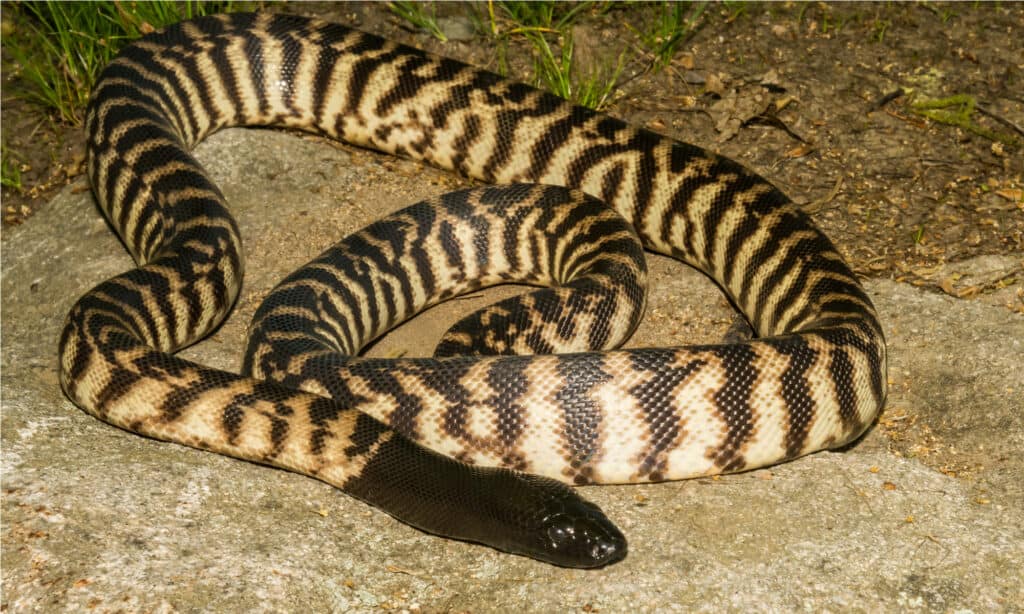
These snakes can be active during the night or day; when they need to rest or digest they seek shelter in rocky outcrops, abandoned animal burrows, and in the branches or hollows of trees. However, there are a couple of exceptions to this. The woma and black-headed python dig their own burrows by scooping the dirt with their heads and curving their necks to drag it out of the hole. To keep dirt out of their mouths, the snakesโ€™ lower jaws fit inside the upper jaws.

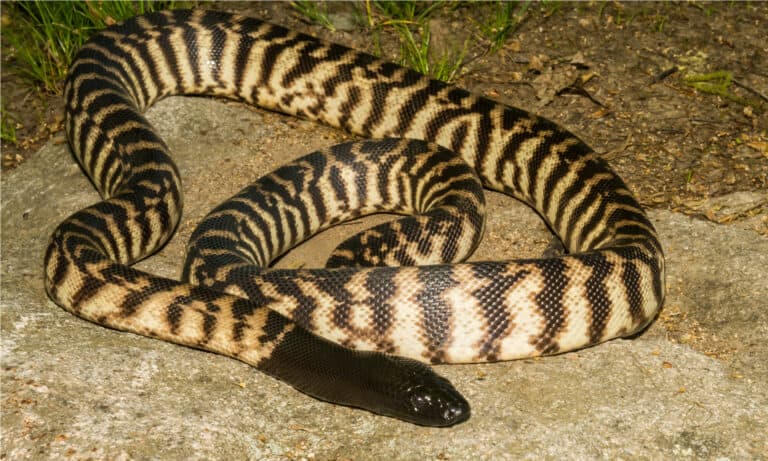
๐Ÿ‘ Black-Headed Python

This speciesโ€™ black head color sets it apart from others.

ยฉJay Ondreicka/Shutterstock.com

Diet and Feeding Habits

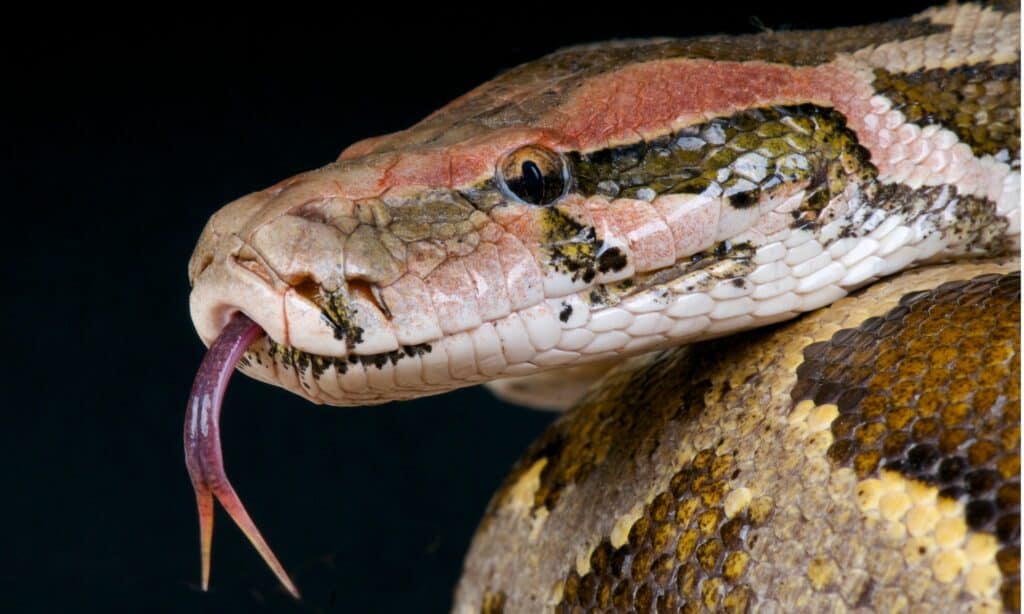
Most of these snakes are ambush predators, although some actively forage. Using their sight, smell, and heat-sensing pits along their lips, the snakes can even find their prey amid dense foliage in the dark. They have sharp teeth that they use to grab their prey, then quickly wrap their coils around it. Then, they squeeze until the animalโ€™s heart stops.

They swallow their food whole, usually beginning at the head. Pythons have very flexible skulls, thanks to having extra joints; and skin that stretches to astounding lengths. Depending upon their size, these snakes eat a wide variety of animals. Anything from rodents and birds to lizards, monkeys, pigs, wallabies, or antelope may be included in their diet.
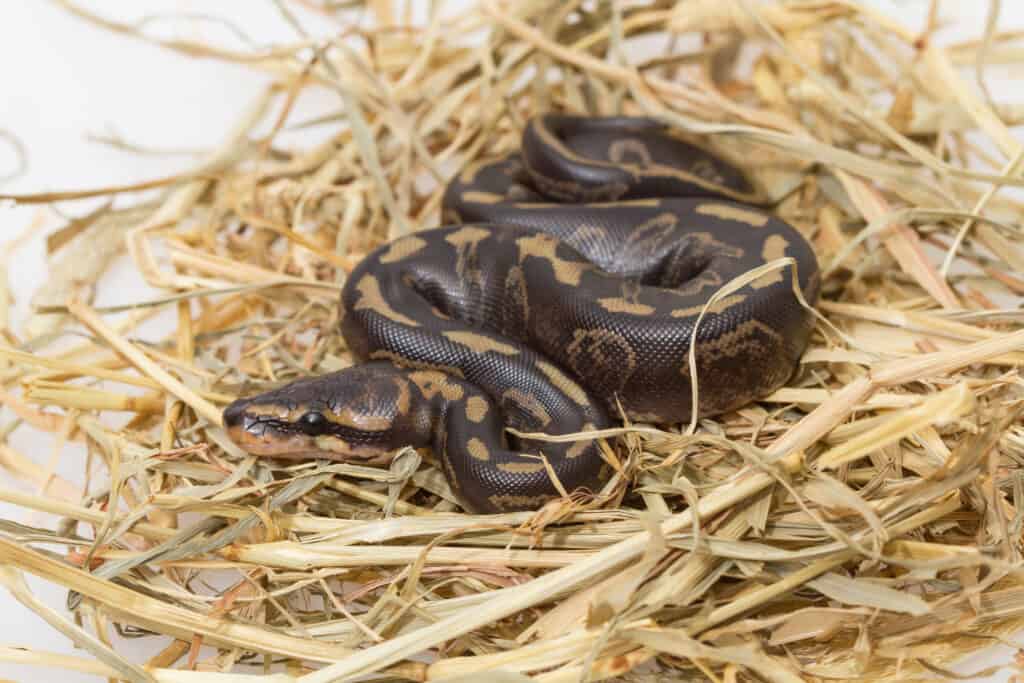
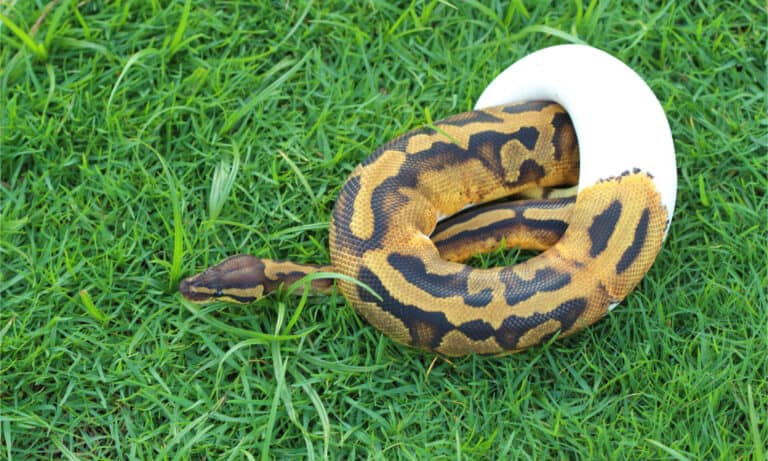
๐Ÿ‘ black pastel ball python

A black pastel ball python is black with cream or yellow spots.

ยฉBluedog Studio/Shutterstock.com

Scientific Name

Pythons were once classified in the same family as boas; and, while there are many similarities, there are also differences. In the early 2000s, genetic testing revealed that these Old World snake species were different from the boas โ€“ vastly.

In these prime examples of convergent evolution, where similar species evolve in very different parts of the world, two families of nonvenomous snakes evolved. One very big difference is that pythons are egg-layers, while boas give birth to live young. A second, but more subtle difference, is that a pythonโ€™s heat-sensing pits are on its lip or labial scales, whereas a boaโ€™s heat-sensing pits are between its labial scales.

The Pythonidae family name is a reference to the fabled serpent that the god Apollo killed in the founding of the Delphi temple of ancient Greek mythology. It has been used when referring to the monsters that inhabit the depths of dark, dank places. Python is sometimes loosely used to describe any very large snake.
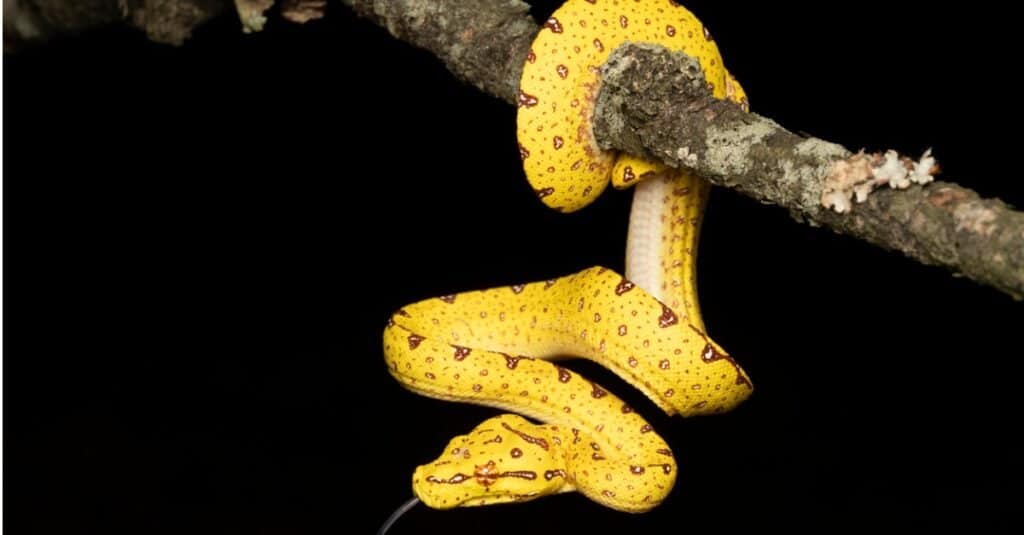
๐Ÿ‘ boa vs python

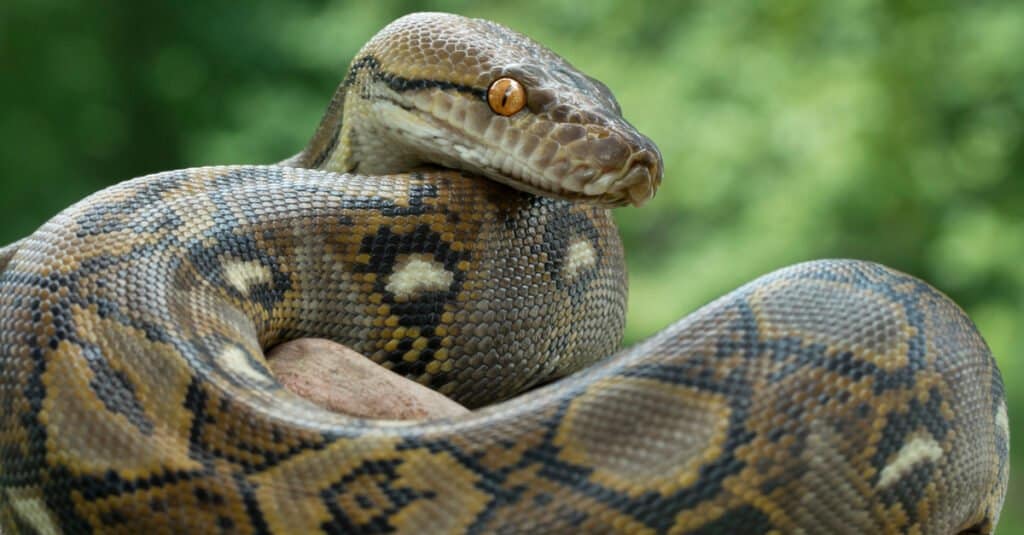
The

Pythonidae

family name is a reference to the fabled serpent that the god Apollo killed.

ยฉiStock.com/Mark Kostich

History and Evolution

Similar to other species of snake, pythonsโ€™ ancestors were actually legged reptiles, similar to lizards and reptiles that spent more time in and near water. As you might have guessed, they either lost their legs or they became vestigial, as they became more and more unused. It is interesting to imagine animals evolving to have legs and then evolving to lose them! There are benefits of being extremely low to the ground when your prey is on that level!

Pythons were previously classified with boas, but modern research has shown that the pythons and boas are separate species due to convergent evolution in different parts of the world, much like monkeys evolved differently in Africa and South America while having shared ancestors. Some of the major differences are that boas give birth to live young, and pythons lay eggs. Pythons also have their heat-sensing pits on their labial scales, and boas have them in between their labial scales.

Population and Conservation Status

Most python species are widely traded and bred as pets, so they arenโ€™t in danger of going extinct. However, wild populations of some species (including ball pythons, and popular pets) are vulnerable to habitat loss and destruction, invasive species competing for resources, and hunting for skin and food.

According to the IUCN, most species are classified as least concern, but they rank a few species as near threatened, endangered, vulnerable, or data deficient. For example, the Oenpelli rock python, which lives in northern Australia, has fewer than 10,000 mature individuals in the wild.

๐Ÿ‘ ball python with mouth open
Pythons are classified as least concern.

Appearance and Description

Pythons can be nocturnal, diurnal, or crepuscular, depending on the species. They generally have triangular-shaped heads and many have heat-sensing pits along their lip. These snakes are considered primitive and still have vestigial hind limbs and pelvises. The vestigial limbs, called spurs are larger in the males and used during mating.

The snakes can be as small as 24 inches at maturity, as is the childrenโ€™s python; and they can be as long as several yards, such as the reticulated python or the Oenpelli python. Ground-dwelling species are usually more muscular than their arboreal counterparts, but not always. Their size and bulk are dependent upon their environment and lifestyle.

Contrary to the myths you may have heard, these snakes do not launch themselves from trees to land on prey below them. Snakes, in general, are too delicate to handle that sort of behavior. Many arboreal pythons have prehensile tails, which they use to hang from branches or cave ceilings and snatch birds and bats as they fly by. Some species use their tail as a lure to attract prey to them. Many of these snakes live high up in the canopy of the forest, only occasionally coming down to the ground.

While two species of terrestrial (ground-dwelling) pythons dig their own burrows, most of these often use tree hollows and the abandoned burrows of other animals for shelter when they need to rest.

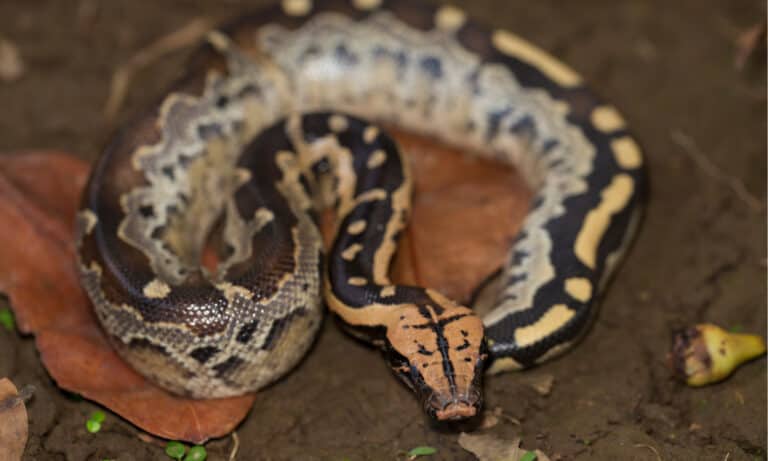
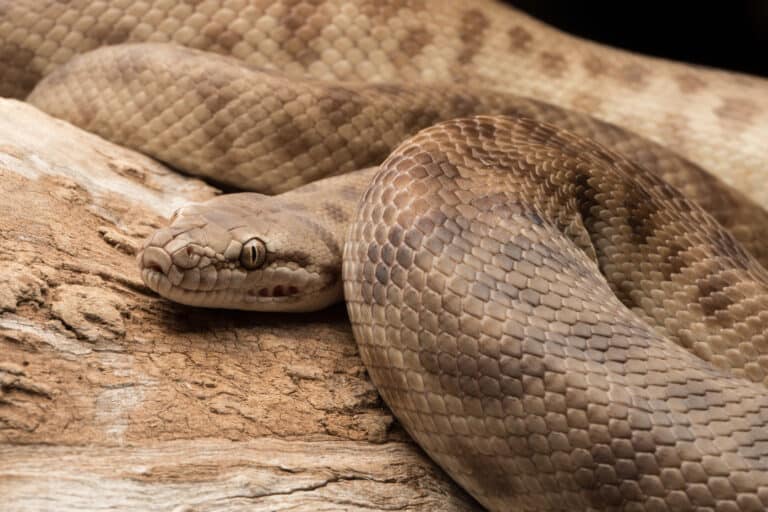
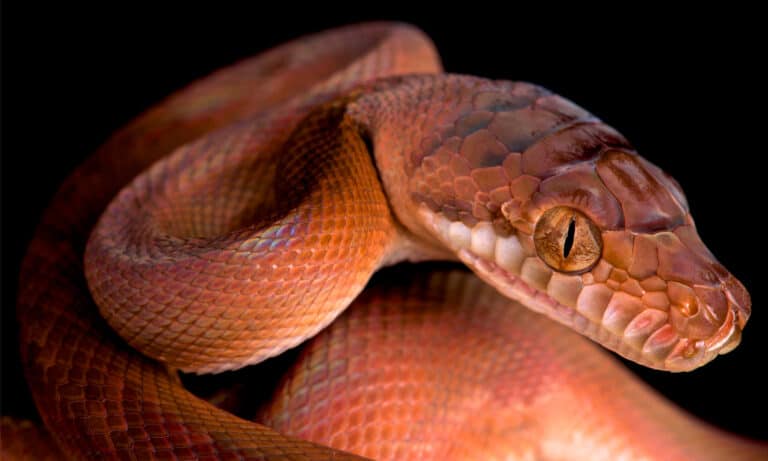
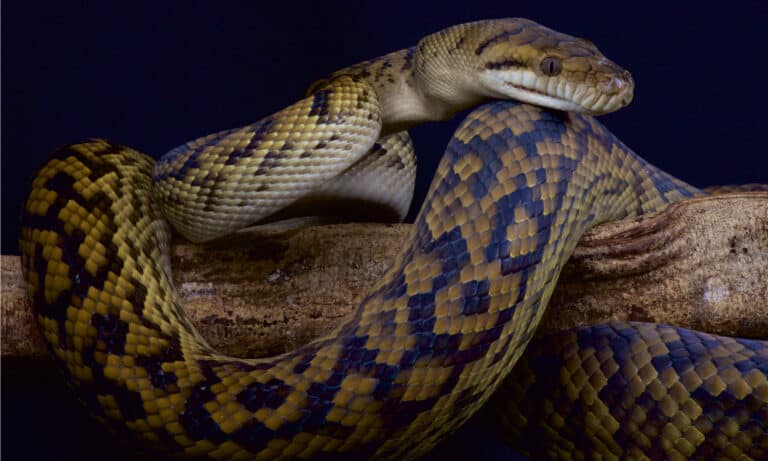
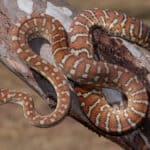
There are approximately 42 different species, all with different color patterns and size ranges. They range from black to bright green or yellow, shades of red, and a host of other colors.
๐Ÿ‘ Rock Python vs. Burmese Python How Are They Different Cover image

Types

With over 40 species, Pythonidae is a diverse family. Weโ€™ve listed some of the most interesting or popular species here:

Antaresia

These snakes are all native to Australia and only reach about six feet long, at their longest.

Apodora

This monotypic genus (a genus only containing one species) is native to Papua New Guinea.

  • Papuan olive python (A. papuana)

Aspidites

Another genus endemic to Australia, these are sometimes kept as pets.

Bothrochilus

This species is endemic to the Bismarck Archipelago and grows to a length of six feet.

  • Bismarck ringed python (B. boa)

Leiopython

These species are native to New Guinea; they have also been observed regurgitating fur from their meals.

  • Dโ€™Albertโ€™s python (L. albertisii)
  • Southern white-lipped python (L. fredparkeri)

Liasis

Snakes from the Liasis genus are native to Indonesia, New Guinea, and Australia.

Malayopython

Native to India and Southeast Asia, there are two recognized species in the genus.

Morelia

Generally speaking, these snakes are arboreal or semi-arboreal and often more slender than other species.

Nyctophilopython

Native to a tiny region in northern Australia, theyโ€™re slender and inhabit areas with rock outcrops for hiding.

Python

The โ€œtrue pythons,โ€ theyโ€™re native to areas in the tropics and subtropics in the Eastern Hemisphere.

Simalia

Native to Indonesia, Australia, and Papua New Guinea.

๐Ÿ‘ The Indian python is a large non venomous snake species found India,Nepal,Pakistan,Sri Lanka,Bhutan and Bangladesh.

The Indian python is a large nonvenomous snake species found in India, Nepal, Pakistan, Sri Lanka, Bhutan, and Bangladesh.

ยฉiStock.com/reptiles4all

How Dangerous are They?

Pythons arenโ€™t venomous, so the only danger most people would encounter with one is an infected bite or a very cranky snake constricting them.

Larger species like reticulated and Burmese pythons can injure or kill people when theyโ€™re threatened. There are a few reports of reticulated pythons attacking people, according to an article in Proceedings of the National Academy of Sciences of the United States of America, but those are rare occurrences and usually the result of a snake being threatened by the individual who was attacked.

Behavior and Humans

In the wild, pythons generally avoid people. Those kept as pets become accustomed to interacting with people, and often become quite docile. Some even seem to enjoy the interaction. Many of these species make great pet snakes โ€“ theyโ€™re beautiful and typically easy to handle with a little practice. Larger species, like Burmese and reticulated pythons, should only be kept by people who have experience with big snakes, and most require an additional person to help handle the really big ones.
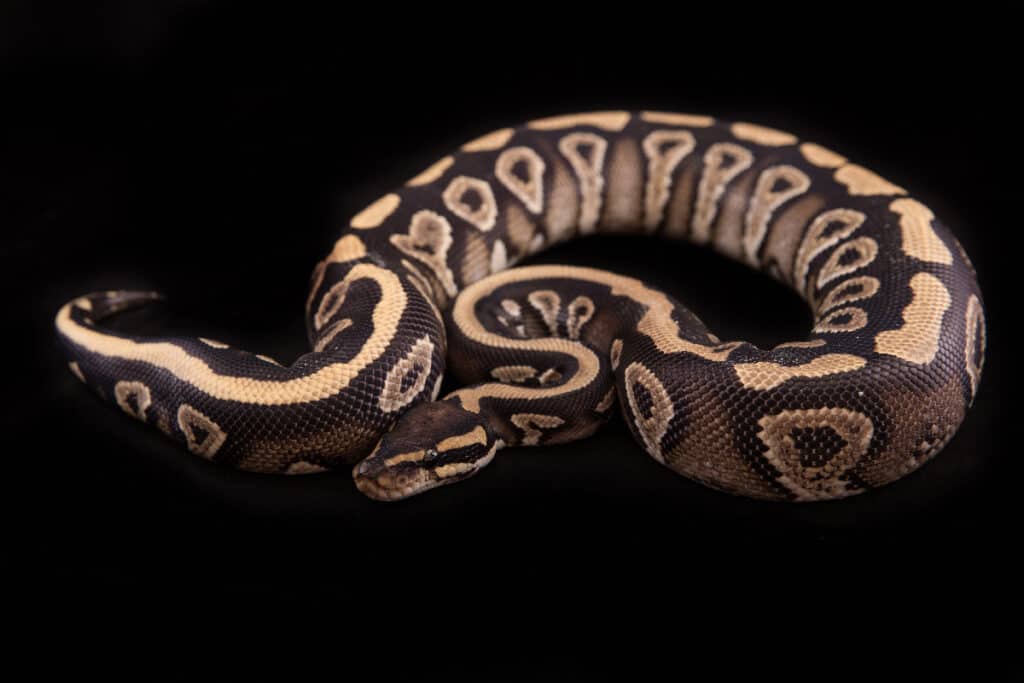
๐Ÿ‘ Image

Ball pythons are popular pets.

ยฉSanne Romijn Fotografie/Shutterstock.com

These snakes help keep ecosystems in balance, and although people often keep them as pets, ideally we should only bring home captive-bred individuals; it would allow some of the wild populations to recover from over-harvesting for the pet trade.

View all 247 animals that start with P

Sources

  1. Pythons | San Diego Zoo / Accessed May 28, 2022
  2. Ball Python | Reptile Database / Accessed May 28, 2022
  3. Headland, Thomas N. and Harry W. Greene; Hunterโ€“gatherers and other primates as prey, predators, and competitors of snakes | PNAS / Published December 12, 2011 / Accessed May 28, 2022

About the Author

Gail Baker Nelson

Gail Baker Nelson is a writer at A-Z Animals where she focuses on reptiles and dogs. Gail has been writing for over a decade and uses her experience training her dogs and keeping toads, lizards, and snakes in her work. A resident of Texas, Gail loves working with her three dogs and caring for her cat, and pet ball python.
Connect:

Thank you for reading! Have some feedback for us?

Contact the AZ Animals editorial team

Related Articles You May Find Interesting


Python FAQs (Frequently Asked Questions)

These are Old World snakes, meaning they are native to Africa, Asia, Oceana, and Australia. Even though you can find Burmese Pythons in Florida, they didnโ€™t evolve there.

These snakes have a pretty wide variety in their diet, even though itโ€™s all meat. Theyโ€™re obligate carnivores, which means they only eat meat. Almost all of them eat rodents and lizards when theyโ€™re small; while some graduate to larger prey as they grow, such as rabbits, pigs, monkeys, and more.

These are ambush predators. Some will actively forage for prey, but most hang out, camouflaged, while they wait for their food to show up.

Bigger specimens can be dangerous; a reticulated python can get really big โ€“ 20+ feet sometimes. Otherwise, theyโ€™re not all that dangerous because they arenโ€™t venomous.