
R
Species Profile

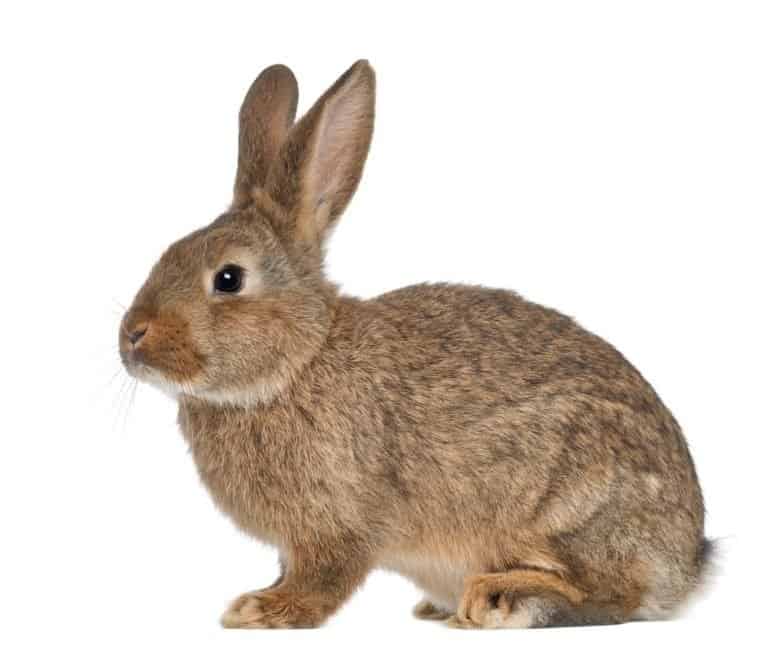
Rabbit

Leporidae

Fast feet, big ears, clever guts.
Masteruk / Creative Commons

Rabbit Distribution

Click a location to explore more animals from that region

Invasive Species
Loading map...

Found in 38 countries

๐Ÿ‡ฆ๐Ÿ‡ท Argentina ๐Ÿ‡ง๐Ÿ‡ท Brazil ๐Ÿ‡จ๐Ÿ‡ฆ Canada ๐Ÿ‡จ๐Ÿ‡ณ China ๐Ÿ‡จ๐Ÿ‡ด Colombia ๐Ÿ‡จ๐Ÿ‡ท Costa Rica ๐Ÿ‡ฉ๐Ÿ‡ช Germany ๐Ÿ‡ฉ๐Ÿ‡ฟ Algeria ๐Ÿ‡ช๐Ÿ‡ฌ Egypt ๐Ÿ‡ช๐Ÿ‡ธ Spain ๐Ÿ‡ซ๐Ÿ‡ฎ Finland ๐Ÿ‡ซ๐Ÿ‡ท France ๐Ÿ‡ฌ๐Ÿ‡ง United Kingdom ๐Ÿ‡ฌ๐Ÿ‡ท Greece ๐Ÿ‡ฌ๐Ÿ‡น Guatemala ๐Ÿ‡ฎ๐Ÿ‡ช Ireland ๐Ÿ‡ฎ๐Ÿ‡ณ India ๐Ÿ‡ฎ๐Ÿ‡ท Iran ๐Ÿ‡ฎ๐Ÿ‡น Italy ๐Ÿ‡ฏ๐Ÿ‡ต Japan ๐Ÿ‡ฐ๐Ÿ‡ช Kenya ๐Ÿ‡ฐ๐Ÿ‡ท South Korea ๐Ÿ‡ฐ๐Ÿ‡ฟ Kazakhstan ๐Ÿ‡ฒ๐Ÿ‡ฆ Morocco ๐Ÿ‡ฒ๐Ÿ‡ณ Mongolia ๐Ÿ‡ฒ๐Ÿ‡ฝ Mexico ๐Ÿ‡ณ๐Ÿ‡ด Norway ๐Ÿ‡ต๐Ÿ‡ฐ Pakistan ๐Ÿ‡ต๐Ÿ‡ฑ Poland ๐Ÿ‡ต๐Ÿ‡น Portugal ๐Ÿ‡ท๐Ÿ‡บ Russia ๐Ÿ‡ธ๐Ÿ‡ช Sweden ๐Ÿ‡น๐Ÿ‡ญ Thailand ๐Ÿ‡น๐Ÿ‡ณ Tunisia ๐Ÿ‡น๐Ÿ‡ท Turkey ๐Ÿ‡บ๐Ÿ‡ธ United States ๐Ÿ‡ป๐Ÿ‡ณ Vietnam ๐Ÿ‡ฟ๐Ÿ‡ฆ South Africa

Size Comparison

Human 5'8"
Rabbit 8 in

Rabbit stands at 12% of average human height.

At a Glance

Family Overview This page covers the Rabbit family as a group. Stats below are general traits shared across the family.
Also Known As bunny, bunny rabbit, coney, cony
Diet Herbivore
Activity Crepuscular+
Lifespan 3 years
Weight 10 lbs
Status Not Evaluated
Did You Know?

Size across Leporidae spans roughly ~24-75 cm head-body length and ~0.35-7 kg, from tiny pygmy rabbits to the largest hares.

Scientific Classification

Family Overview "Rabbit" is not a single species but represents an entire family containing multiple species.

Rabbits are small to medium-sized lagomorph mammals in the family Leporidae (order Lagomorpha). They are characterized by powerful hind legs, long ears, continuously growing incisors, and herbivorous diets with hindgut fermentation and coprophagy. The term โ€œrabbitโ€ commonly covers several genera (e.g., Oryctolagus, Sylvilagus) and typically excludes the true hares (genus Lepus), though both are leporids.

Kingdom
Animalia
Phylum
Chordata
Class
Mammalia
Order
Lagomorpha
Family
Leporidae

Distinguishing Features

  • Lagomorph dentition: two pairs of upper incisors (a small second pair behind the main incisors)
  • Long ears (variable by species), strong hind limbs adapted for rapid hopping
  • Herbivory with hindgut fermentation; frequent production of soft cecotropes consumed directly (coprophagy)
  • Many species are crepuscular and rely on camouflage, speed, and cover

Physical Measurements

Height
12 in (6 in โ€“ 1 ft 10 in)
Length
1 ft 6 in (9 in โ€“ 2 ft 10 in)
Weight
5 lbs (1 lbs โ€“ 15 lbs)
Tail Length
2 in (1 in โ€“ 6 in)
Top Speed
35 mph
running

Appearance

Primary Colors
Secondary Colors
Skin Type Thick, dense fur with soft underfur and longer guard hairs; skin is flexible and adapted for rapid movement. Feet are furred (including soles) for traction and insulation; whiskers are well developed.
Distinctive Features
  • Family-wide size range: ~20-75 cm head-body length; ~0.3-7+ kg body mass; ears ~4-15+ cm, generally longer in hares (Lepus).
  • Powerful elongated hind legs and lightweight build for rapid sprinting, bounding, and sharp turns (zig-zag escape).
  • Long external ears with rich blood supply for hearing and thermoregulation; ear length and pigmentation vary by habitat.
  • Lagomorph dentition: continuously growing incisors (two upper pairs) and diastema; adapted for clipping vegetation.
  • Herbivorous diet with hindgut fermentation; routine coprophagy (soft feces) to recover nutrients and microbes.
  • Young vary by lineage: many 'rabbits' (several genera) have altricial kits in nests/burrows; hares (genus Lepus) have precocial leverets and are less burrow-dependent.
  • Burrowing and sociality vary widely: some form extensive warrens and colonies (e.g., European rabbit), while many species are solitary and use forms, dense cover, or simple scrapes.
  • Ecology: important grazers/browsers shaping plant communities; key prey for raptors, carnivores, and snakes; high reproductive potential is common but not universal.
  • Activity often crepuscular/nocturnal, but flexible; many show strong habitat-linked coat thickness, molt timing, and (in some) seasonal whitening.

Sexual Dimorphism

Sexual dimorphism is usually subtle across Leporidae. Females are often slightly larger/heavier and may show more pronounced mammary development during breeding; males may have relatively larger heads or scent-marking glands, but differences vary by species.

โ™‚
  • Often slightly smaller-bodied overall; differences may be minimal in many species.
  • May show relatively broader head/neck in some taxa.
  • More frequent visible scent-marking behavior; chin/inguinal glands prominent in some species.
โ™€
  • Often slightly larger/heavier, especially during breeding seasons.
  • Mammary glands and nipples more apparent when lactating.
  • May show increased abdominal girth in late gestation; external differences otherwise limited.

Did You Know?

Size across Leporidae spans roughly ~24-75 cm head-body length and ~0.35-7 kg, from tiny pygmy rabbits to the largest hares.

Ears aren't just for hearing: in many species they also shed heat-one reason desert-dwelling leporids often have especially long ears.

All leporids have continuously growing incisors plus small second upper incisors ("peg teeth") tucked behind the main pair-one hallmark of lagomorphs.

Many rabbits rely on burrows (warrens), but many hares don't dig extensive burrows and instead use shallow "forms" above ground.

Young differ across the family: many rabbits have altricial kits (born blind and relatively undeveloped), while hares (genus Lepus) have precocial leverets (furred, eyes open).

Leporids practice coprophagy (specifically caecotrophy): they re-ingest soft cecal pellets to capture vitamins and nutrients from tough plants.

Lifespan varies widely by species and setting: many wild individuals live only a few years, while some-especially in captivity/domestic settings-may reach ~10-12+ years.

Unique Adaptations

  • Hindgut fermentation with an enlarged cecum allows extraction of energy from fibrous plants; caecotrophy "recycles" nutrients (notably B vitamins and microbial protein).
  • Lagomorph dentition: ever-growing incisors and cheek teeth, plus the distinctive second upper incisors ("peg teeth") behind the first pair.
  • Powerful hind limbs and a flexible spine enable long bounds and rapid evasive maneuvers-key in a predator-rich lifestyle.
  • Large, laterally placed eyes provide a wide field of view for early predator detection.
  • Long ears enhance hearing; dense ear blood vessels in many species help with thermoregulation in hot environments.
  • Camouflage and molt cycles: many leporids match local soils/vegetation, and some northern species grow pale winter coats for snow cover.
  • Highly efficient reproduction and rapid maturation (variable by species) help many populations rebound after losses-though this can also drive boom-bust cycles.

Interesting Behaviors

  • Crepuscular activity is common (dawn/dusk foraging), but timing shifts with climate, predators, and human disturbance.
  • High-speed escape tactics: explosive acceleration, zig-zag running, and sudden direction changes; many also freeze to avoid detection.
  • Hind-foot thumping as an alarm signal is common in many rabbits and some hares, but frequency and context vary by species and population.
  • Social systems range from highly social (e.g., European rabbit warrens with complex burrow networks) to largely solitary or loosely social species.
  • Reproductive output is generally high across the family, with multiple litters in favorable seasons; timing and litter sizes vary greatly by latitude and food supply.
  • Scent marking (chin glands, urine, feces) helps define territories, advertise breeding condition, and organize social space.
  • Diet is mostly grasses and other herbaceous plants; many species shift seasonally to browse, bark, or crops when available.

Cultural Significance

Across cultures, Leporidae (rabbits and hares) stand for fertility, spring, speed, and cleverness. They appear in art and stories, have been hunted, domesticated (Oryctolagus cuniculus), become invasive, help shape food webs as grazers and prey, and some face habitat loss.

Myths & Legends

The Moon Rabbit/Jade Rabbit (East Asia): in Chinese tradition the Jade Rabbit lives on the Moon pounding an elixir; related "rabbit-in-the-moon" imagery appears across East and Southeast Asia.

A Buddhist moral tale often called 'The Hare in the Moon': a self-sacrificing hare offers itself as food; a god (often identified with Indra) places the hare's image on the Moon.

The White Hare of Inaba (Japan): a hare tricks crocodile-like creatures to cross the sea, is punished, then healed; the tale connects the hare to deities and marriage fortune in the Izumo tradition.

Br'er Rabbit (African American folklore): a clever trickster rabbit who outwits stronger foes; these stories draw heavily from West and Central African trickster traditions carried into the Americas.

Nanabozho and the Great Hare (Anishinaabe/Algonquian traditions): in some stories Nanabozho-often associated with a great hare-shapes the world, teaches people, and brings cultural knowledge.

The 'Four Hundred Rabbits' (Aztec tradition): a group of rabbit deities linked to a fermented agave drink, abundance, and intoxication.

Rabbit's foot luck (European & African American folk belief): carried as a charm for good fortune; it persists as a widespread cultural superstition in many regions.

Conservation Status

NE Not Evaluated

Has not yet been evaluated against the criteria.

Population Unknown

Protected Under

  • Varies widely by country and species; many leporids are covered under national/provincial wildlife and hunting regulations (seasons, bag limits, protected areas).
  • CITES protections apply to some threatened members (e.g., Appendix I listing for the volcano rabbit, Romerolagus diazi).
  • Regional conservation instruments may apply to particular threatened species and habitats (e.g., protected-area networks and habitat directives where applicable).

Looking for a specific species?

European rabbit

Oryctolagus cuniculus

  • Family-wide size range (smallest to largest leporids): roughly ~24-75+ cm head-body length and ~0.4-7 kg, spanning very small rabbits (e.g., pygmy rabbit) to large hares.
  • Family-wide lifespan range: commonly ~1-7 years in the wild (high juvenile mortality), with maxima around ~9-12+ years in favorable captive/low-predation conditions (varies strongly by species and environment).
  • Shared ecology/physiology across Leporidae: herbivory with hindgut fermentation, continuously growing incisors, and routine cecotrophy (coprophagy) to recover nutrients from plant material.
  • Behavior varies widely within the family: many rabbits are crepuscular and may burrow/socialize (notably Oryctolagus), while many hares (Lepus) are more solitary, rely on above-ground forms/scrapes, and use speed/camouflage rather than burrow refuge.
  • Broad habitat diversity across the family: grasslands, shrublands, deserts, forests/edges, wetlands, and tundra/alpine zones-often key mid-trophic prey shaping predator communities and vegetation dynamics.
View European rabbit Profile

You might be looking for:

European Rabbit

55%

Oryctolagus cuniculus

The best-known โ€œrabbitโ€ worldwide; source species for most domestic rabbits and widely introduced/invasive.

View Profile

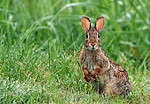
Eastern Cottontail

20%

Sylvilagus floridanus

Common North American rabbit, often meant colloquially in the U.S. when someone says โ€œrabbit.โ€

View Profile

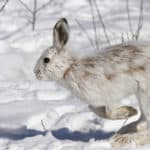
Snowshoe Hare (often confused with โ€œrabbitโ€)

10%

Lepus americanus

A true hare (genus Lepus), frequently called a rabbit in casual speech; larger feet and seasonal coat change.

View Profile

Swamp Rabbit

7%

Sylvilagus aquaticus

North American rabbit associated with wetlands and dense cover.

Pygmy Rabbit

5%

Brachylagus idahoensis

Smallest North American leporid; sagebrush specialist.

Life Cycle

Birth 4 kits
Lifespan 3 years

Lifespan

In the Wild 1โ€“12 years
In Captivity 3โ€“16 years

Reproduction

Mating System Polygynandry
Social Structure Aggregation Group
Breeding Pattern Transient
Fertilization Internal Fertilization
Birth Type Internal_fertilization

Across Leporidae, mating is typically polygynandrous: both sexes may mate with multiple partners, often amid male competition and brief consortships. Social context ranges from warren-based aggregations to largely solitary species; parental care is mostly maternal-only.

Behavior & Ecology

Social Colony Group: 12
Activity Crepuscular, Nocturnal, Cathemeral, Diurnal
Diet Herbivore Tender grasses and leafy forbs (varies by species, habitat, and season)

Temperament

Vigilant and risk-averse, with rapid flight responses
Generally shy toward novel stimuli; habituation varies by population and hunting pressure
Socially tolerant in colonial rabbits, but dominance and aggression can occur
Territoriality ranges from strong scent-based spacing to broad overlap among neighbors
Increased aggression and chasing during breeding seasons, especially among males

Communication

grunts and low growls during close interactions or mild aggression
squeals and screams when distressed, captured, or seriously threatened
soft clucks/whimpers (reported in some species) during contact or courtship
tooth-clicking or tooth-grinding associated with arousal; context varies
hind-foot thumping as an alarm signal and deterrent
scent marking with chin, urine, and fecal pellets to advertise presence and status
body postures (crouching, stretching, boxing) and ear positioning to signal intent
visual chasing displays and leaps during courtship or territorial disputes
allogrooming and nose-touching in tolerant groups, reinforcing social bonds

Habitat

Biomes:
Tropical Rainforest Tropical Dry Forest Savanna Desert Hot Desert Cold Mediterranean Temperate Grassland Temperate Forest Temperate Rainforest Boreal Forest (Taiga) Tundra Alpine Wetland +7
Terrain:
Mountainous Hilly Plateau Plains Valley Coastal Island Riverine Volcanic Karst Rocky Sandy Muddy +7
Elevation: Up to 17060 ft 5 in

Ecological Role

Widespread primary consumers and key prey-base mammals across many terrestrial ecosystems (grasslands, shrublands, forests, deserts, and agricultural landscapes), with diet breadth varying among genera and environments.

Trophic support: major prey for a wide range of predators (raptors, foxes, coyotes, felids, mustelids, snakes) Vegetation shaping: grazing/browsing influences plant community composition, regeneration, and edge dynamics Nutrient cycling: pellet deposition and coprophagy-linked digestion contribute to nutrient redistribution and soil fertility Soil disturbance: scraping/digging for food and maintenance of forms/burrows in some leporids can aerate soils and affect microhabitats Plant dispersal (limited/variable): incidental movement of some seeds/spores via fur or feces, generally secondary to their grazing impact

Diet Details

Other Foods:
Grasses Herbaceous forbs and weeds Browse Bark and twigs Sedges and rushes Agricultural crops and garden plants Fruits, berries and fallen fruit Seeds Fungi +3

Human Interaction

Domestication Status

Semi domesticated

Leporidae are mostly wild. Only the European rabbit (Oryctolagus cuniculus) was domesticated in the Mediterranean and western Europe and bred into many domestic rabbits, which also formed feral populations worldwide. Other leporids (cottontails, pygmy rabbits, hares/jackrabbits) have been kept sometimes but are not truly domesticated and often do poorly as pets.

Danger Level

Low
  • Bites and scratches (usually minor; higher risk when frightened/handled improperly)
  • Zoonotic disease exposure from wild individuals/carcasses (e.g., tularemia; also ectoparasites like ticks/fleas that can carry pathogens)
  • Allergies/asthma triggers from dander, hay, bedding dust, and urine ammonia in indoor settings
  • Vehicle collisions in rural/suburban areas (hares/jackrabbits can be large enough to cause accidents)
  • Agricultural/property conflicts leading to human injury indirectly during hunting/trapping or use of pest-control methods

As a Pet

Suitable as Pet

Legality: Laws vary. Domestic rabbits (from Oryctolagus cuniculus) are legal pets in most places, though cities may limit outdoor keeping, breeding, or numbers. Keeping wild rabbits/hares usually needs permits. Check local wildlife and invasive species rules.

Care Level: Moderate

Purchase Cost: Up to $500
Lifetime Cost: $3,000 - $15,000

Economic Value

Uses:
Companion animals (domestic rabbit pet trade) Meat production (rabbitry; local to industrial scales depending on region) Fiber/fur (e.g., Angora wool from domestic rabbits; pelts) Laboratory and biomedical research models Hunting/harvest (wild rabbits and hares for meat, sport, and population control) Agriculture and landscaping impacts (crop/garden damage; fencing/management industries) Conservation/ecosystem roles (prey base for predators; habitat management and restoration programs)
Products:
  • live animals (pets, breeding stock)
  • rabbit meat
  • pelts/fur
  • Angora wool and textile blends
  • manure/compost inputs
  • research animals and derived data (toxicology, immunology, development, etc.)
  • hunting-related goods and services (licenses, equipment, processing)
  • pest-control and exclusion materials (fencing, tree guards)

Relationships

Predators 16

Red fox Vulpes vulpes
Coyote Canis latrans
Gray wolf Canis lupus
Bobcat Lynx rufus
Canada lynx Lynx canadensis
Eurasian lynx Lynx lynx
Golden eagle Aquila chrysaetos
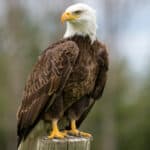
Bald eagle Haliaeetus leucocephalus
Great horned owl Bubo virginianus
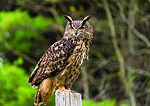
Eurasian eagle-owl Bubo bubo
Goshawk Accipiter gentilis
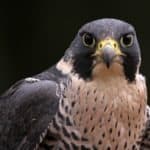
Peregrine falcon Falco peregrinus
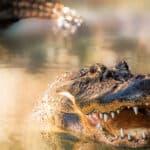
American alligator Alligator mississippiensis
Pythons Python spp.
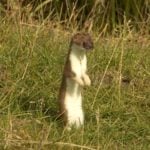
Weasels Mustela spp.
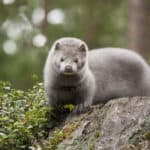
American mink Neogale vison

Related Species 8

European rabbit Oryctolagus cuniculus Shared Family
Eastern cottontail Sylvilagus floridanus Shared Family
European hare Lepus europaeus Shared Family
Pygmy rabbit Brachylagus idahoensis Shared Family
Snowshoe hare Lepus americanus Shared Family
Jackrabbits Lepus Shared Family
Cottontail rabbits Sylvilagus Shared Family
Pikas Ochotona Shared Order

Ecological Equivalents 5

Animals that fill a similar ecological role in their ecosystem

American pika Ochotona princeps A close lagomorph relative that occupies a similar small-herbivore niche. Differs by being non-burrowing, adapted to alpine talus habitats, and lacking the long ears and hindlimb specialization seen in many leporids.
Guinea pig Cavia porcellus Small-bodied, herbivorous hindgut fermenters that graze on grasses and forbs and serve as prey for similar predators; convergence in dentition (ever-growing incisors) and grazing ecology despite being rodents.
Ground squirrel Burrowing, grassland herbivores/omnivores that overlap in habitat and predator communities; they play a similar role as mid-sized prey and as consumers of vegetation.
Marmot Marmota spp. Medium-sized terrestrial herbivores in open habitats, often montane, that face heavy predation pressure. They overlap in grazing impacts and in the use of burrows, although marmots are larger and hibernate more consistently.
Small ungulates In some arid systems, small browsing and grazing mammals share vegetation use and predator exposure patterns, although ungulates differ markedly in physiology and locomotion.

Types of Rabbit

28

Explore 28 recognized types of rabbit

European rabbit Oryctolagus cuniculus
Eastern cottontail Sylvilagus floridanus
Desert cottontail Sylvilagus audubonii
Mountain cottontail Sylvilagus nuttallii
New England cottontail Sylvilagus transitionalis
Brush rabbit Sylvilagus bachmani
Marsh rabbit Sylvilagus palustris
Swamp rabbit Sylvilagus aquaticus
Pygmy rabbit Brachylagus idahoensis
Volcano rabbit Romerolagus diazi
Hispid hare (hispid rabbit) Caprolagus hispidus
Amami rabbit Pentalagus furnessi
Sumatran striped rabbit Nesolagus netscheri
Annamite striped rabbit Nesolagus timminsi
Bunyoro rabbit Poelagus marjorita
Hare-like rabbit Pronolagus rupestris
Natal red rock rabbit Pronolagus crassicaudatus
Bushman rabbit Bunolagus monticularis
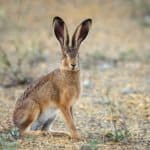
European hare (brown hare) Lepus europaeus
Snowshoe hare Lepus americanus
White-tailed jackrabbit Lepus townsendii
Black-tailed jackrabbit Lepus californicus
Arctic hare Lepus arcticus
Mountain hare Lepus timidus
Cape hare Lepus capensis
Alaskan hare Lepus othus
Japanese hare Lepus brachyurus
Broom hare Lepus castroviejoi

Rabbits have been domesticated since Roman times, and possibly even from before that.

Rabbits really do breed like rabbits. The female is ready to breed almost any time, and sheโ€™ll have a litter of babies about 30 days after breeding. These bipedal herbivores eat a diet of mostly green foods, but they are also opportunistic feeders that will eat seeds, fruit, and bark. They live in large groups in underground tunnels called warrens with anything from a few to dozens of roommates.
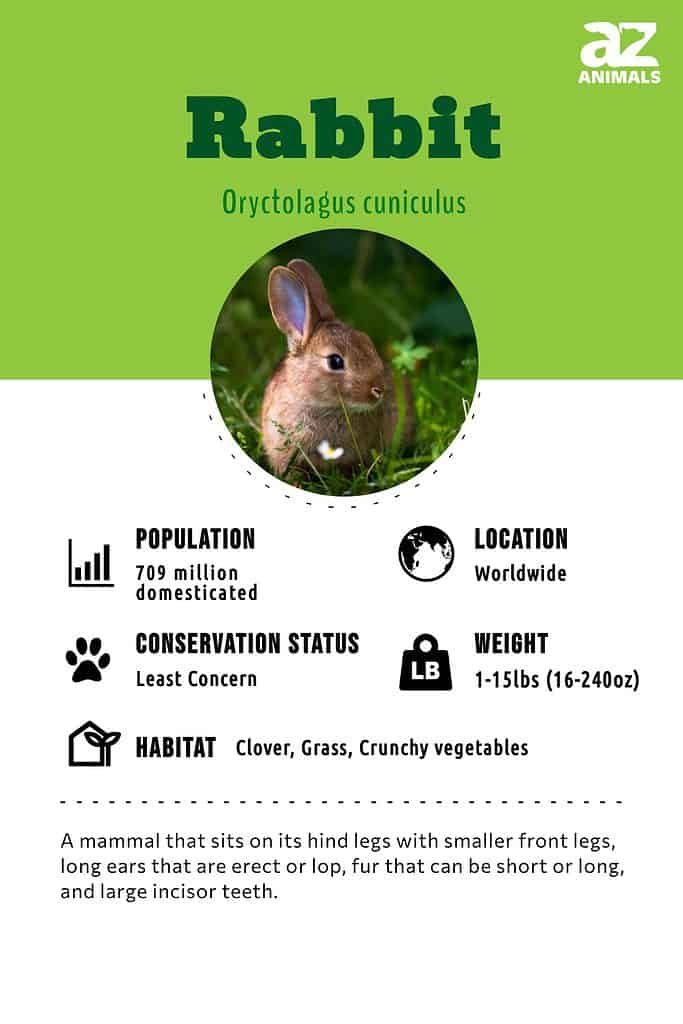
Incredible Rabbit Facts!

1. A rabbit canโ€™t vomit.
2. A rabbit can see nearly 360 degrees around him.
3. Rabbits live in underground tunnels called warrens.
4. Rabbits can jump nearly 10 feet in a long jump.
5. A rabbitโ€™s teeth grow throughout its lifetime.

Scientific Name

The scientific name for these animals depends on what kind of rabbit is being discussed. In general, they belong to the order Lagomorpha and the family Leporidae, while the hare does not. Within that genus are dozens of rabbit names that include the scientific name for the rabbit as a part of the classification.

The taxonomy list includes rabbits such as Oryctolagus cuniculus, the scientific name covering all pet rabbits. In this name, the word Oryctolagus represents the genus name and cuniculus is the species. Some of the other rabbits covered in the taxonomy here include the genus Nesolagus, which covers the Sumatran striped rabbit, Nesolagus netscheri, and the Annamite striped rabbit, Nesolagus timminsi.

It also covers the genus Pentalagus, which includes the Amami rabbit, and Pentalagus furnessi, plus the genus Poelagus, which includes the Central African Rabbit, the Poelagus marjorita. There are many others since weโ€™re talking about more than 300 breeds, but these are a few of the major ones covered by the various classification listings.
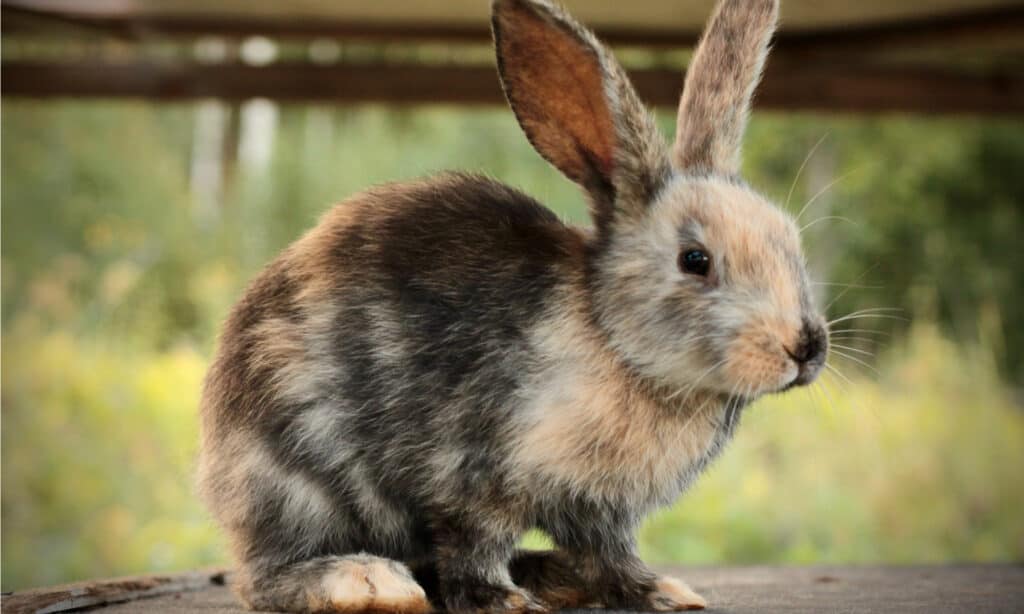
๐Ÿ‘ male rabbit

Rabbits belong to the order Lagomorpha and the family Leporidae.

ยฉLNbjors/Shutterstock.com

Evolution

The oldest known fossil of a primitive rabbit was dated as 55 million years old. The ancestor is named Gomphos elkema. Based on a study of it, scientists believe some early lagomorphs (the group that includes hares and rabbits) moved like rabbits, having hind legs that were longer than their front legs. These hind legs could be used to hop.

These early rodents had longer tails, molar teeth, and primitive jaws. In general, rabbits are distinguished from other modern rodents because they have two sets of incisor teeth, one set behind the other. Rabbits were originally grouped with rodents under the class Glires, but have since been separated because many of their similarities are believed to be the result of convergent evolution. Recent DNA analysis and the discovery of a common ancestor have supported the view that they share.

Appearance

The rabbitโ€™s appearance is an animal that sits on its large hind legs and has shorter front legs. The animal also has large ears that vary in size based on the type. The hare looks similar to the rabbit but is not the same. These ears are used to radiate heat into the air when the animal has been running or is otherwise excited or when it lives in the wilderness and needs to use its ears to maintain its comfort. They can also be turned to listen to sounds to determine where a predator might be coming from or to make sure that an area is safe.

These animals come in a variety of sizes. Pygmy rabbits grow to only eight inches long and weigh in at less than a pound, even when fully grown. Chinchillas are at the other end of the scale, weighing in at about 16 pounds. Most Flemish giants stop at about 22 pounds, but one rabbit, also a Flemish giant, beat all the rest by weighing in at 49 pounds and stretching 4 feet, 3 inches long.
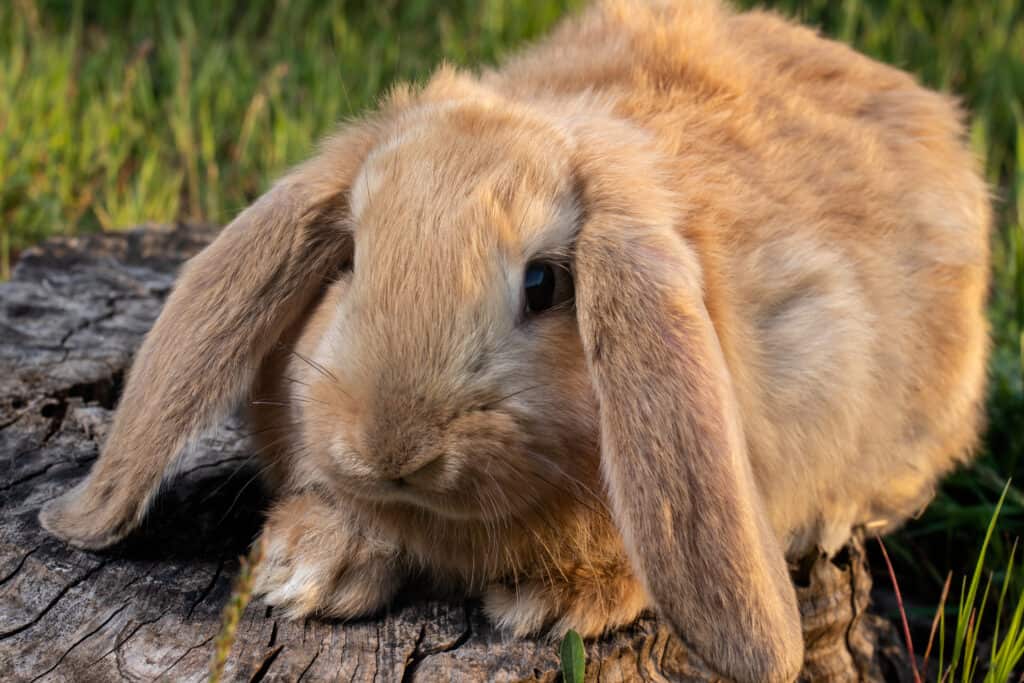
๐Ÿ‘ Brown French Lop

Some rabbit breeds are characterized by lop ears, like the French lop.

ยฉGarna Zarina/Shutterstock.com

Behavior

Rabbit behavior includes using its shape to escape from danger when it needs to. This sometimes means that the animal needs to sit still and sometimes it needs to run. Whatever they choose is also likely to change as the rabbit is hunted, though this depends on what the animal needs at the time.

Rabbits hop by bounds, moving quickly over terrain when they need to escape from predators. They can also freeze in place when they need to. This sometimes results in a failure of the chase, letting the animal go free for another day. It all depends on the situation at the time.

When rabbits eat, they will often graze heavily for the first half an hour or so, then switch to eating their own poop pellets as they are excreted. They need to do this to get the benefit of their food as they eat. Eating partially-digested poop is an important way they accomplish this. They will often take the food from their anuses and chew it again to get the benefit of it. These animals cannot vomit, so if they eat too much of the wrong thing they can end up dying from it.

To know if rabbits are rodents, read here.
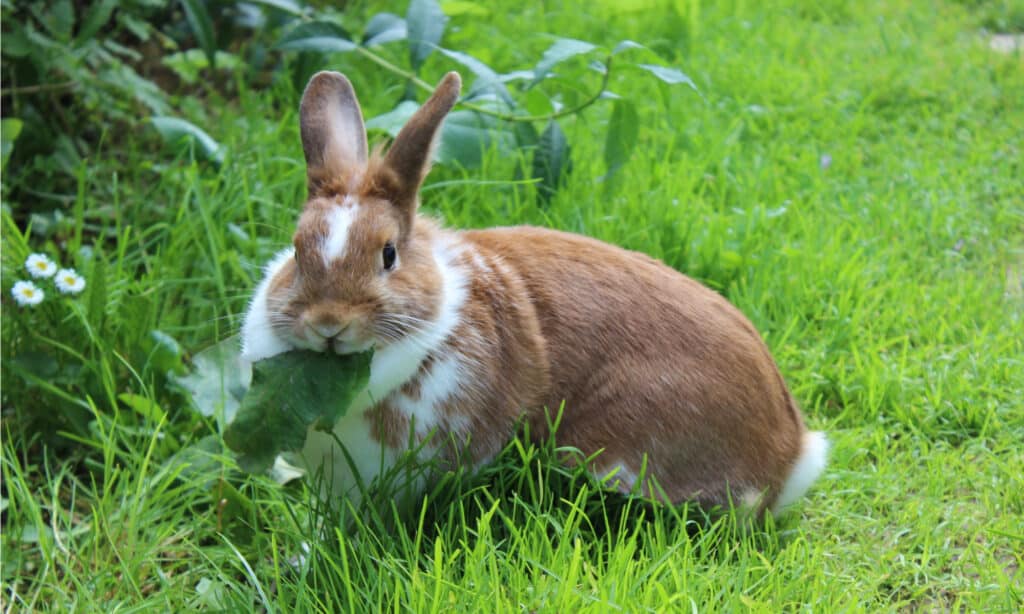
๐Ÿ‘ Giant rabbit eating

Rabbits usually graze heavily for the first half an hour or so, then switch to eating their own poop pellets as they are excreted.

ยฉReal Moment/Shutterstock.com

Habitat

These animals live in large groups known as warrens, living under the ground in spaces carved out by them as they move in. They typically live in these warrens with a group of other rabbits in meadows, deserts, woods, grasslands, wetlands, or forests. Not all rabbits live in a warren. Some species live out in the open instead.

More than half of the worldโ€™s rabbits live in North America, but bunnies are also native to southwest Europe, Sumatra, Southeast Asia, some parts of Japan, and in parts of Africa and South America. They are not normally found in Eurasia or most of South America, though in some cases they may be taken to these places and released.
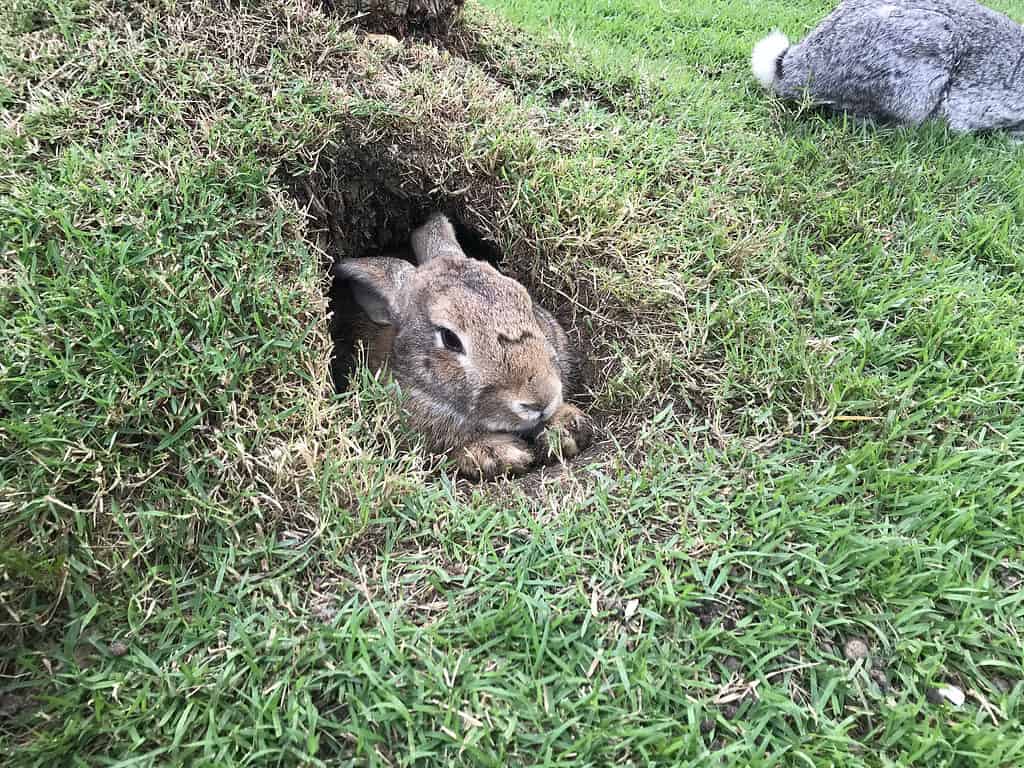
๐Ÿ‘ Wild rabbit in a burrow

Rabbits typically live in warrens with other rabbits in meadows, deserts, woods, grasslands, wetlands, or forests.

ยฉChaturong Krirkkriangkrai/Shutterstock.com

Diet

A rabbit will eat all kinds of soft, grassy foods, including grass, leafy weeds, and forbs. They will also eat fruit, bark, and many other kinds of food that grow in the woods and meadows where they live. They will digest what they can of the food and will then poop out the hard bits in poop that are not eaten. The soft bits are typically pooped out and then eaten again before being done with.

The rabbit digests a lot of its food in the cecum, which takes joins the large intestine to take up about 40% of its digestive tract. The cecum is even bigger than the stomach. The cecum helps to separate the โ€œgoodโ€ poop from the โ€œbad.โ€ The bad poop is pooped out of the rabbit and the good poop โ€“ called cecotropes โ€” is eaten by the bunny and goes back through the rabbit again before being pooped out. While this may seem kind of gross, it is important to the rabbitโ€™s digestive system and is necessary for the animal to survive.

To get the complete details on what rabbits eat, make sure to read our complete guide: โ€˜What Do Rabbits Eat.โ€™

๐Ÿ‘ Image
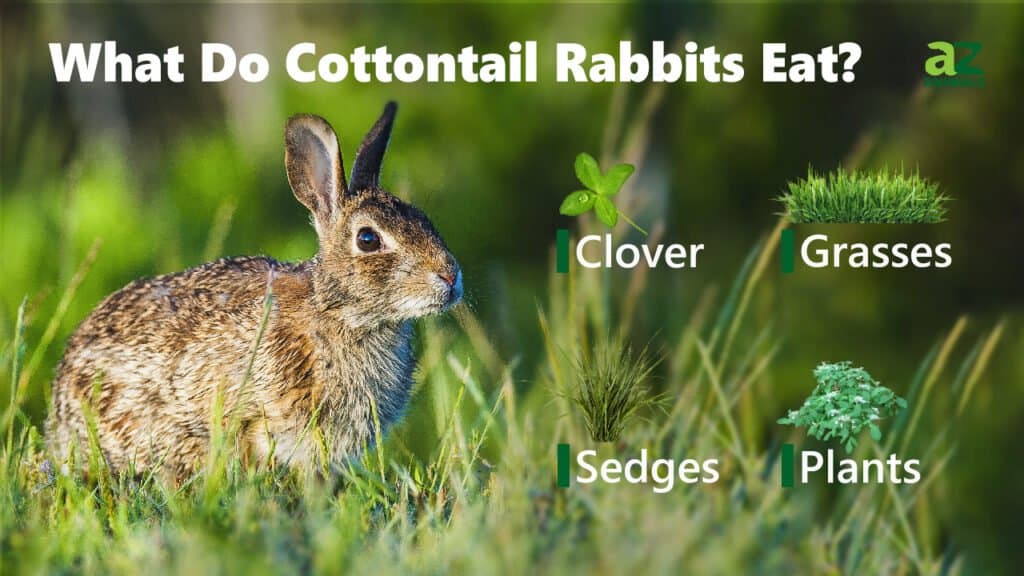
Wild rabbits eat clover, grasses, sedges, and plants.

Predators and Threats

Almost everything that eats meat will eat a rabbit if itโ€™s big enough. This includes animals such as foxes, wolves, bobcats, eagles, owls, and coyotes. Any of these animals, and more, are sure to grab a rabbit snack if given a chance to do so.

Bunnies will do what they need to do to survive, including thumping on the ground if they feel threatened. Their eyesight also has a good deal of vision devoted to overhead scanning, helping them to avoid birds. If confronted on the ground they will jump into a burrow if necessary or hop away using a zig-zag pattern. Their big teeth will also help them to bite if they can. If they can escape, they will live to hunt another day.
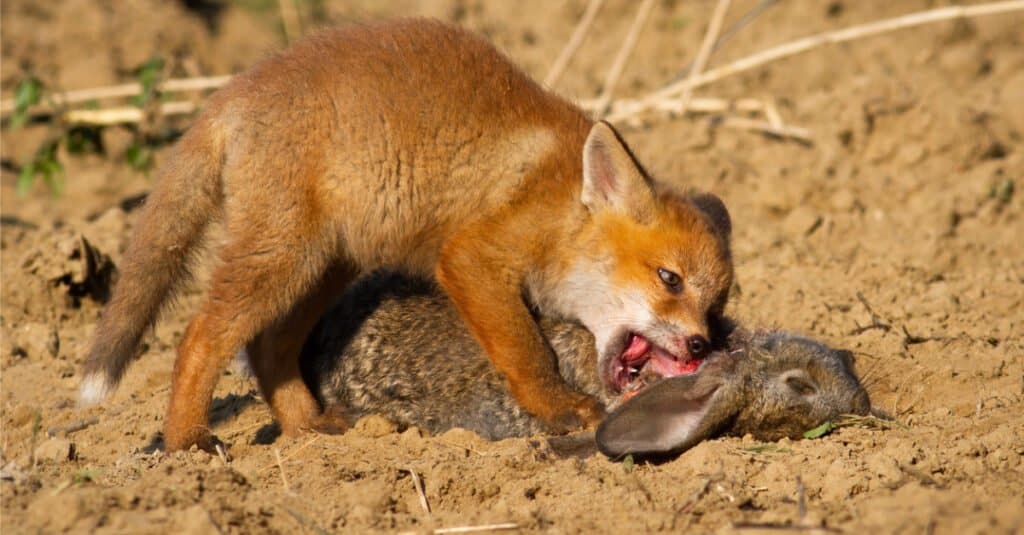
๐Ÿ‘ Fox Teeth-Red Fox Eating

Foxes are predators of rabbits.

ยฉiStock.com/JMrocek

Reproduction, Babies, and Lifespan

Reproduction occurs almost anytime two adults get together since females can get pregnant almost anytime they breed. The male simply climbs on top of the female and breeds her, with no introduction needed. He will breed as many females as he can, but itโ€™s best to give him a break in between breedings so he doesnโ€™t wear himself out.

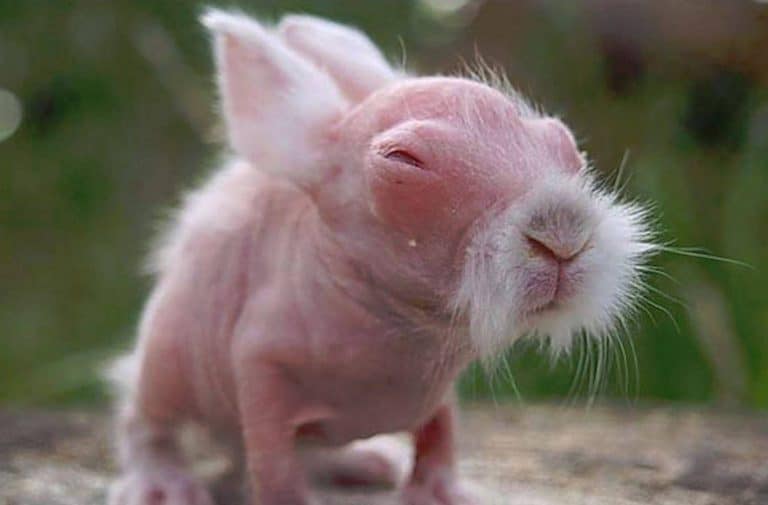
Once the male, known as the buck, inseminates the female, known as the doe, she will get pregnant and will produce a litter of babies, called kittens or kits, for about 30 days. The mother typically gives birth to six youngsters. The babies are born naked and blind, completely dependent on their mother at first, though within a couple of weeks, they are strong and ready to run around on their own. They live with their mother for about a month before they are ready to move on. By then she is often pregnant again. They are ready to have babies of their own by the time they are about three months old.

The lifespan of a pet bunny can be very long, with the longest-living rabbit known to have died in Tasmania at 18 years old. By contrast, wild animals such as an eastern cottontail live less than a year. Most rabbits that live in captivity can live anywhere from 10 to 12 years, on average.

Rabbits may develop problems along the way, with diseases such as the pathogens Bordetella bronchiseptica and Escherichia coli being common. They can also contract rabbit hemorrhagic disease (RHD), also known as myxomatosis. They are also vulnerable to things such as tapeworms and external parasites including fleas and ticks.
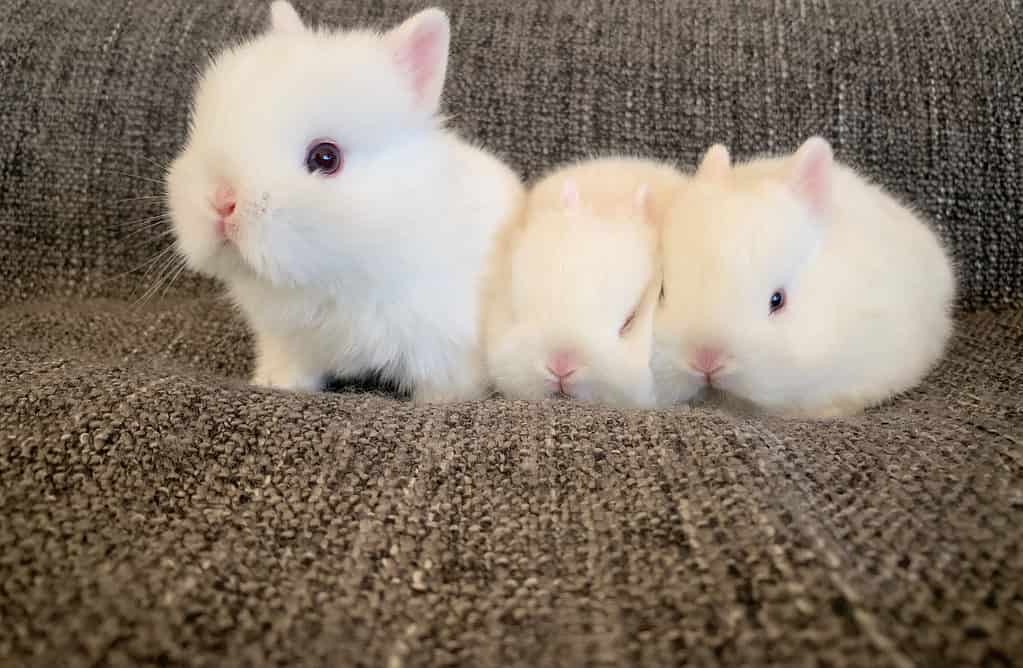
๐Ÿ‘ Netherland dwarf white baby rabbits

A litter of baby bunnies are called kittens or kits.

ยฉJayOg/Shutterstock.com

Population

It isnโ€™t clear how many of these animals exist in the world today, but they are not threatened. They are listed as being of Least Concern on the A to Z animal website, since in most places where they live their population is stable, and in many places, it is even on the rise. They are capable of living anywhere that humans can live.

Rabbits in places such as Eastern Australia continue to grow despite human efforts to stop them, and the more baby bunnies that get released the faster the population will grow. Once they have gotten started there isnโ€™t much of a way to stop them, so itโ€™s important to think before you release a bunny into the wild.
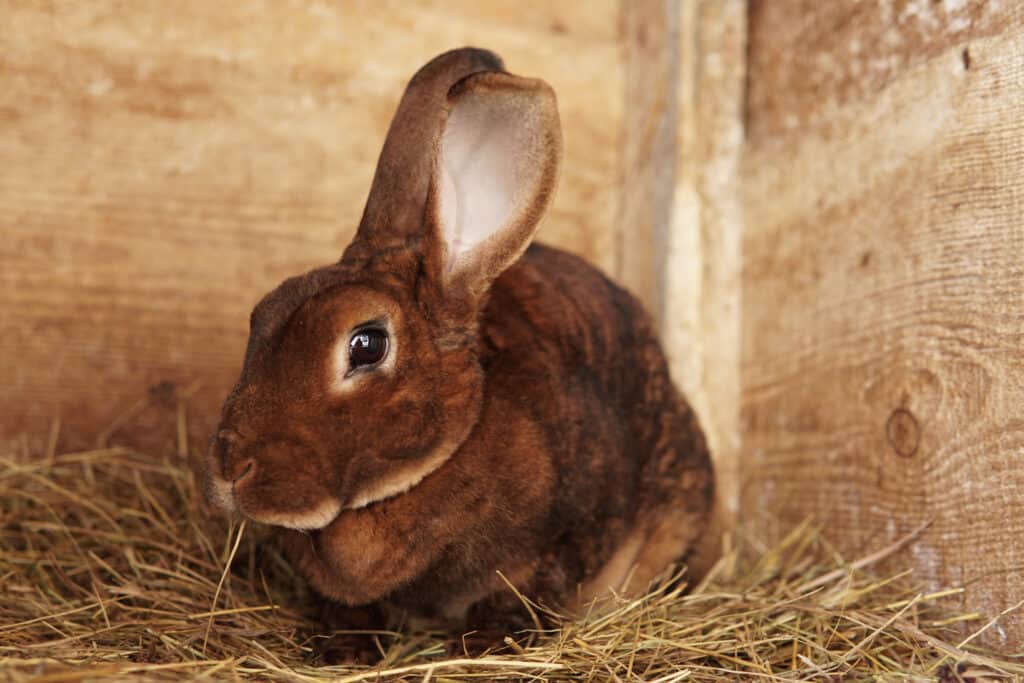
๐Ÿ‘ Rex rabbit appearance

The Rex rabbit, known for its silky fur, is a popular house pet.

ยฉDiana Sklarova/Shutterstock.com

Types of Rabbits

There are at least 305 breeds of domestic rabbits around the world. Below is a list of almost 200 breeds:

  • Alaska
  • Altex
  • American โ€“ Native to the U.S. Short blue and white hair, 9-12lbs.
  • American Chincilla
  • American Fuzzy Lop โ€“ Ntive to U.S. Short haired, solid, lop-eared, 3.5-4lbs.
  • American Sable
  • Angora โ€“ Native to Turkey. Has long white angora hair, 4.4-12lbs. One of oldest domestic breeds.
  • Argente Bleu โ€“ One of the oldest breeds of French show rabbits. Silver top hair with Argente Bleu markings on lower hair shaft.
  • Argente Brun [UK] โ€“ One of the oldest breeds of French show rabbits. Silver top hair with Argente Brun markings on lower hair shaft.
  • Argente Brun [US] โ€“ One of the oldest breeds of French show rabbits. Silver top hair with Argente Brun markings on lower hair shaft.
  • Argente Clair โ€“ One of the oldest breeds of French show rabbits. Silver top hair with Argente Clair markings on lower hair shaft.
  • Argente Crรจme [UK] โ€“ One of the oldest breeds of French show rabbits. Silver top hair with Argente Crรจme markings on lower hair shaft.
  • Argente De Champagne [UK] โ€“ One of the oldest breeds of French show rabbits. Silver top hair with Argente de Champagne markings on lower hair shaft.
  • Argente Noir โ€“ One of the oldest breeds of French show rabbits. Silver top hair with Argente Noir markings on lower hair shaft.
  • Argente St Hubert โ€“ One of the oldest breeds of French show rabbits. Silver top hair with Argente St Hubert markings on lower hair shaft.
  • Armenian Marder
  • Astrex
  • Aurora Negro
  • Baladi Black
  • Baladi Red
  • Baladi White
  • Bauscat
  • Beige [UK]
  • Belgian Hare [UK]
  • Beveren [UK]
  • Beveren [US]
  • Big Silver Marten
  • Blanc de Bouscat
  • Blanc de Hotot
  • Blanc de Popielno
  • Blanc de Termonde
  • Blue of Ham
  • Blue of Sint-Niklaas
  • Bourbonnais Grey
  • Brazillian
  • Brittania Petit [US]
  • British Giant
  • Brown Chestnut of Lorraine
  • Caldes
  • Californian [UK] โ€“ Native to California. White, short hair with dark points, erect ears.
  • Californian [US] โ€“ Native to California. White, short hair with dark points, erect ears.
  • Canadian Plush Lop
  • Carmagnola Grey
  • Cashmere Lop โ€“ Native to the U.K. Long-haired, lop-eared rabbit between 4.5-5.5 lbs.
  • Champagne dโ€™Argent
  • Chaudry
  • Checkered Giant
  • Chinchilla [UK]
  • Chinchilla Giganta [UK]
  • Cinamon
  • Continental Giant Coloured
  • Continental Giant White
  • Creme dโ€™Argent
  • Crillo
  • Cuban Brown
  • Czech Red
  • Czech Solver
  • Czech Spot
  • Czech White
  • Dalmation
  • Deilenaar
  • Dutch [UK] โ€“ Native to U.K. Short-haired rabbit with erect ears and โ€œDutchโ€ markings, 3.5-5.5 lbs.
  • Dutch [US] โ€“ Native to U.K. Short-haired rabbit with erect ears and โ€œDutchโ€ markings, 3.5-5.5 lbs.
  • Dwarf Hotot
  • Dwarf Lop [UK] โ€“ Native to Europe/Germany. Short-haired, lop-eared breed with many colors, 4.25-5.25lbs.
  • Enderby Island
  • English Angora
  • English Lop โ€“ Native to U.K. Short-haired, lop-eared breed with many colors, 10-11lbs.
  • English Spot
  • Fauve de Bourgogne
  • Flemish Gian [UK]
  • Flemish Giant [US]
  • Florida White
  • Fox
  • Fox-Silver [UK]
  • French Angora โ€“ Native to France. Long angora hair, erect ears, 7.5-10.5lbs.
  • French Lop โ€“ Native to France. Short-haired, lop-eared breed with many colors, 10lbs.
  • Gabali
  • German Angora โ€“ Native to Germany. Long angora hair, erect ears, 5.5-12lbs.
  • Giant Chinchilla [US]
  • Giant Havana
  • Giant Marburger
  • Giant Papillon [UK]
  • Giant Silver
  • Giant Smoke Pearl
  • Giza White
  • Golden Glavcot
  • Gotland
  • Gouwenaar
  • Grey Pearl of Halle
  • Gรผzelรงamlฤฑ
  • Harlequin [UK] โ€“ Native to France. Harlequin coloring, short-haired, erect ears.
  • Harlequin [US] โ€“ Native to France. Japanese coloring, short-haired, erect ears.
  • Harlequin Rex โ€“ Native to France. Harlequin coloring, short-haired, erect ears.
  • Havana [UK]
  • Havana [US]
  • Himalayan
  • Holland Lop [US] โ€“ Native to Netherlands. Short-haired, lop-eared rabbit in varied colors, 4-6.5lbs.
  • Hulstlander
  • Hungarian Giant
  • Isabella
  • Jamora
  • Japanese White
  • Jersey Wooly
  • Kabyle
  • Lilac [UK]
  • Lilac [US]
  • Lionhead [UK] โ€“ Native to Europe. Long mane around face, erect ears, varied colors.
  • Lionhead [US] โ€“ Native to Europe. Long mane around face, erect ears, varied colors.
  • Liptov Baldspotted Rabbit
  • Lynx
  • Marburger Feh [UK]
  • Mecklenburger Piebald
  • Meissner Lop
  • Mellerud Rabbit
  • Mini Lop [US] โ€“ Native to Netherlands. Lop-eared, short-haired, 5-6lbs.
  • Mini Rex [US]
  • Mini Satin [US]
  • Miniature Cashmere Lop
  • Miniature Lion Lop
  • Miniature Lop [UK/NL]
  • Miniature Papillon
  • Miniature Rex [UK]
  • Miniature Satin [UK]
  • Moshtohor
  • Netherland Dwarf โ€“ Native to Netherlands. Short erect ears, short hair, 1-2.5 lbs.
  • New Zealand [US]
  • New Zealand [UK]
  • New Zealand White [UK]
  • Nitransky
  • Opossom
  • Orange
  • Orylag
  • ร˜restad
  • Palomino
  • Pannon White
  • Perlfee
  • Plush Lop (Miniature)
  • Plush Lop (Standard)
  • Pointed Beveren
  • Polish [UK]
  • Polish [US]
  • Rex [US] โ€“ Native to France. Short rex hair, varied colors, erect ears, 6-10.5lbs.
  • Rhinelander
  • Rhone
  • SA Phendula
  • Sachsengold
  • Sallander
  • San Juan
  • Satin [UK]
  • Satin [US]
  • Satin Angora
  • Schwarzgrannen [UK]
  • Separator [DE]
  • Siamese Sable
  • Siberian
  • Silver [UK]
  • Silver [US]
  • Silver Fox [UK]
  • Silver Fox [US]
  • Silver Marten
  • Simenwar
  • Slovenian Rabbit
  • Smoke Pearl
  • Spanish Giant
  • Squirrel
  • Standard Chinchilla
  • Stone Rabbit
  • Sussex
  • Swedish Fur
  • Swedish Hare
  • Swiss Fox
  • Tadla
  • Tan
  • Teddy Dwarf
  • Teddy Lop
  • Thrianta
  • Thuringer
  • Tri-Color Dutch
  • Tri-Color English
  • Trรธnder
  • V-line
  • Velveteen Lop
  • Vienna Colored
  • Vienna White
  • Wheaten
  • Wheaten Lynx
  • White Country
  • Zemmouri
  • Zika

Below are some species of wild rabbits:

  • Swamp rabbit Sylvilagus aquaticus
  • Desert cottontail Sylvilagus audubonii
  • Brush rabbit Sylvilagus bachmani
  • Forest rabbit Sylvilagus brasiliensis
  • Mexican cottontail Sylvilagus cunicularis
  • Diceโ€™s cottontail Sylvilagus dicei
  • Eastern cottontail Sylvilagus floridanus
  • Tres Marias rabbit Sylvilagus graysoni
  • Omilteme cottontail Sylvilagus insonus
  • San Jose brush rabbit Sylvilagus mansuetus
  • Mountain cottontail Sylvilagus nuttallii
  • Marsh rabbit Sylvilagus palustris
  • New England cottontail Sylvilagus transitionalis
  • Volcano rabbit Romerolagus diazi
  • Sumatran striped rabbit Nesolagus netscheri
  • Annamite striped rabbit Nesolagus timminsi
  • Bushman rabbit Bunolagus monticularis
  • European rabbit Oryctolagus cuniculus
  • European rabbit Oryctolagus cuniculus
  • Central African Rabbit Poelagus marjorita
View all 180 animals that start with R

Sources

  1. David Burnie, Dorling Kindersley (2011) Animal, The Definitive Visual Guide To The World's Wildlife / Accessed December 5, 2008
  2. Tom Jackson, Lorenz Books (2007) The World Encyclopedia Of Animals / Accessed December 5, 2008
  3. David Burnie, Kingfisher (2011) The Kingfisher Animal Encyclopedia / Accessed December 5, 2008
  4. Richard Mackay, University of California Press (2009) The Atlas Of Endangered Species / Accessed December 5, 2008
  5. David Burnie, Dorling Kindersley (2008) Illustrated Encyclopedia Of Animals / Accessed December 5, 2008
  6. Dorling Kindersley (2006) Dorling Kindersley Encyclopedia Of Animals / Accessed December 5, 2008
  7. David W. Macdonald, Oxford University Press (2010) The Encyclopedia Of Mammals / Accessed December 5, 2008
  8. Britannica / Accessed November 1, 2020
  9. Wikipedia / Accessed November 1, 2020

About the Author

Abby Parks

Abby Parks has authored a fiction novel, theatrical plays, short stories, poems, and song lyrics. She's recorded two albums of her original songs, and is a multi-instrumentalist. She has managed a website for folk music and written articles on singer-songwriters, folk bands, and other things music-oriented. She's also a radio DJ for a folk music show. As well as having been a pet parent to rabbits, birds, dogs, and cats, Abby loves seeking sightings of animals in the wild and has witnessed some more exotic ones such as Puffins in the Farne Islands, Southern Pudu on the island of Chiloe (Chile), Penguins in the wild, and countless wild animals in the Rocky Mountains (Big Horn Sheep, Mountain Goats, Moose, Elk, Marmots, Beavers).
Connect:

Thank you for reading! Have some feedback for us?

Contact the AZ Animals editorial team

Related Articles You May Find Interesting


Rabbit FAQs (Frequently Asked Questions)

The idea of a โ€œluckyโ€ rabbitโ€™s foot has a long history. For long periods rabbit feet were associated with witchcraft. In the 1800s there were often sold as charms for cleverness. In the 1930s they became a popular good luck charm in Britain.

They eat nothing that doesnโ€™t grow from the ground, except when each baby drinks its motherโ€™s milk for the first month or so of its life. A rabbit is an herbivore.

Yes, a rabbit is an animal.

A group of rabbits is called a colony or a den. A group of rabbits is also sometimes referred to as a warren, but that name actually belongs to where they live and not to the rabbits who live there.

What you really need to know here is what species of rabbit you are referring to. A rabbit can belong to many different species, depending on the particular rabbit you are talking about. Most rabbits belong to the group Oryctolagus cuniculus, a group that contains most pet species as well as the European wild rabbit.

In general, a rabbit tends to be a bit smaller than a hare. The rabbit also has smaller ears.

When kept as a pet a rabbit can live about 8 to 10 years though some may live much longer.

Most people get their baby bunnies at a pet shop or directly from a breeder. The place you get yours from will depend on the kind of rabbit you are looking for as well as the time of year. Most baby bunnies are much more likely to be available in the spring and summer, with some but not as many being available in the fall and winter.

Rabbits belong to the Kingdom Animalia.

Rabbits belong to the phylum Chordata.

Rabbits belong to the class Mammalia.

Rabbits belong to the family Leporidae.

Rabbits belong to the order Lagomorpha.

Rabbits belong to the genus Oryctolagus.

Rabbits are covered in Fur.

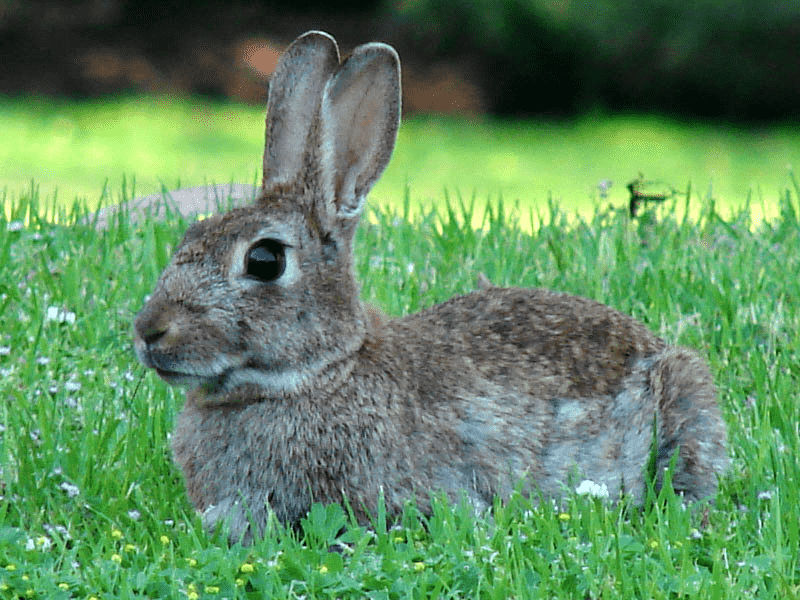
Rabbits live in forest thickets, meadows, and woodlands.

Rabbits eat clover, grass, and crunchy vegetables.

Predators of Rabbits include foxes, wolves, bobcats, eagles, owls, and coyotes.

The average litter size for a Rabbit is 6.

There are more than 50 different species of Rabbit!

The scientific name for the Rabbit is Oryctolagus cuniculus.

The main differences between rabbit poop and deer poop are size, shape, and appearance. Rabbit poop is smaller than deer poop, with each pellet measuring less than a centimeter in diameter. Deer poop can measure between 2cm and 3cm for each pellet, and they excrete larger piles that contain more pellets per bowel movement.

The key differences between male rabbits and female rabbits are physical appearance, temperament, and behavior.

Rabbits do not hibernate, theyโ€™re adapted to the cold weather and like to forage year-round!