
R
Species Profile

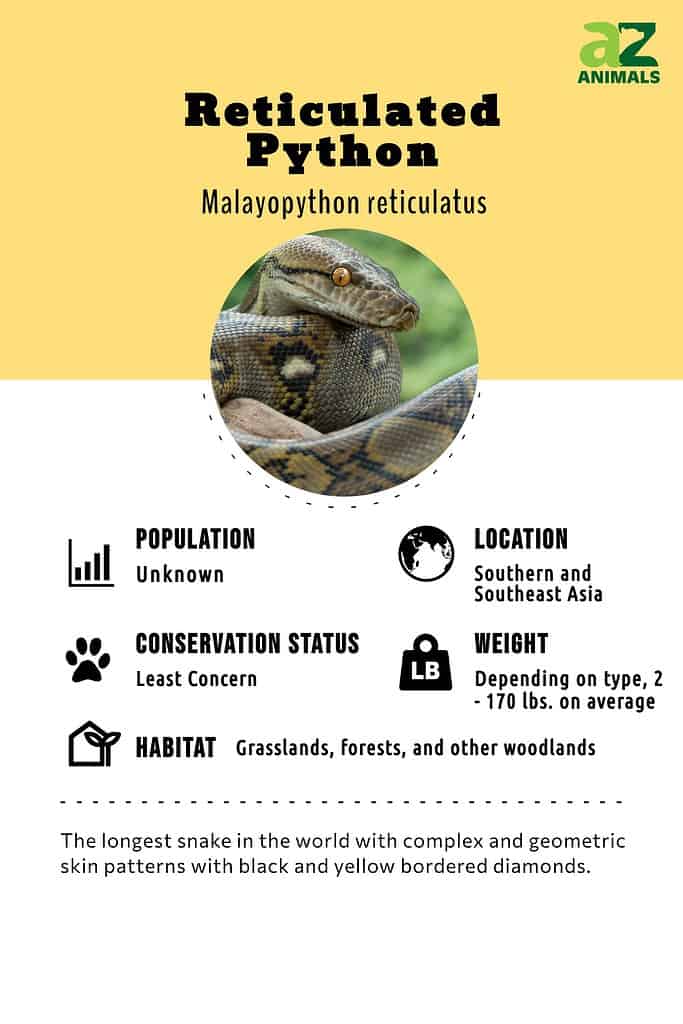
Reticulated python

Malayopython reticulatus

The net-patterned giant constrictor
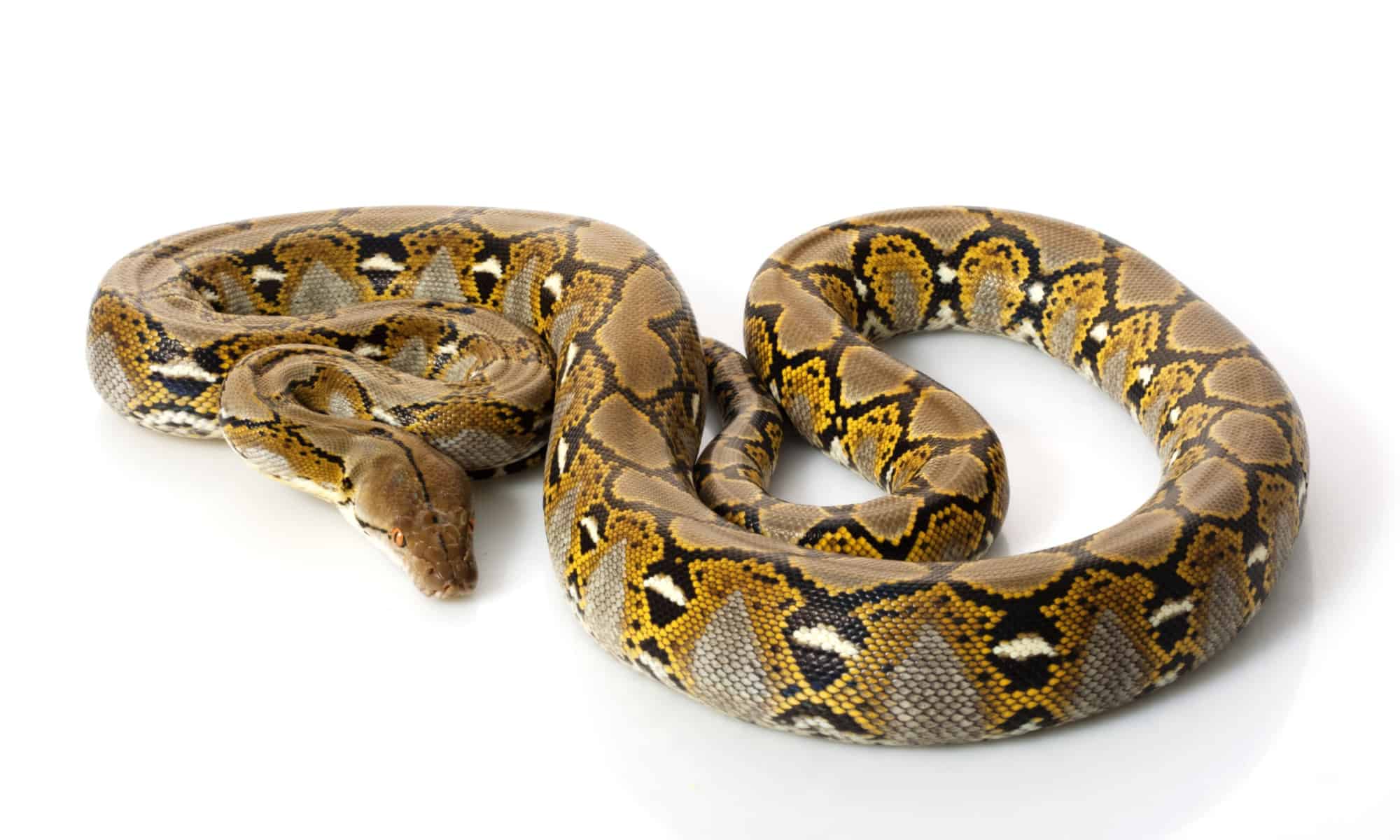
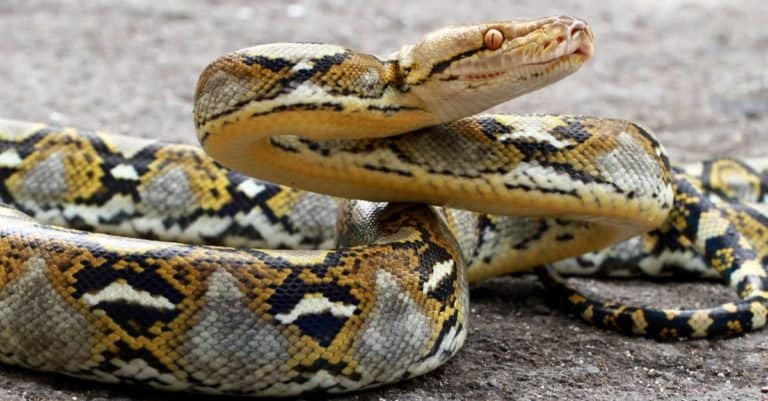
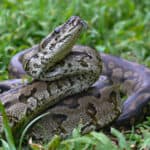
fivespots/Shutterstock.com

At a Glance

Wild Species
Also Known As retic
Diet Carnivore
Activity Nocturnal+
Lifespan 15 years
Weight 100 lbs
Status Least Concern
Did You Know?

It's among the longest snakes on Earth; a frequently cited, well-documented maximum is ~6.95 m total length (reported in major python references such as Barker & Barker, 2010).

Scientific Classification

A very large, nonvenomous constrictor snake native to South and Southeast Asia, known for its distinctive net-like (reticulated) pattern and for being among the longest snake species.

Kingdom
Animalia
Phylum
Chordata
Class
Reptilia
Order
Squamata
Family
Pythonidae
Genus
Malayopython
Species
reticulatus

Distinguishing Features

  • Complex net-like dark pattern outlined with lighter edges along the body
  • Large, muscular constrictor with heat-sensing pits on the lips (typical of pythons)
  • Strongly arboreal/semiaquatic tendencies in some habitats; adept swimmer
  • Noted for exceptional length among snakes (individual maximum sizes are variable and often overstated)

Physical Measurements

Males and females differ in size

Length
13 ft 1 in (8 ft 2 in – 21 ft 4 in)
14 ft 9 in (9 ft 10 in – 21 ft 4 in)
Weight
55 lbs (11 lbs – 198 lbs)
110 lbs (44 lbs – 198 lbs)
Tail Length
1 ft 10 in (11 in – 2 ft 12 in)
1 ft 10 in (1 ft 2 in – 2 ft 6 in)
Top Speed
1 mph
slithering

Appearance

Primary Colors
Secondary Colors
Skin Type Dry, keratinized reptile skin covered in smooth, glossy overlapping scales; ventral scutes are enlarged for traction; labial scales bear heat-sensing pits typical of Pythonidae.
Distinctive Features
  • One of the world's longest snakes; typical adult total length ~3.0-6.0 m, with exceptionally large individuals >6 m (reports of greater lengths exist but are often disputed without standardized measurement).
  • Largest widely reported standardized measurement in captivity is 7.67 m for an individual named "Medusa"; extreme claims beyond this require caution and independent verification.
  • Robust but relatively laterally compressed body; head elongated with a distinct neck and large eyes.
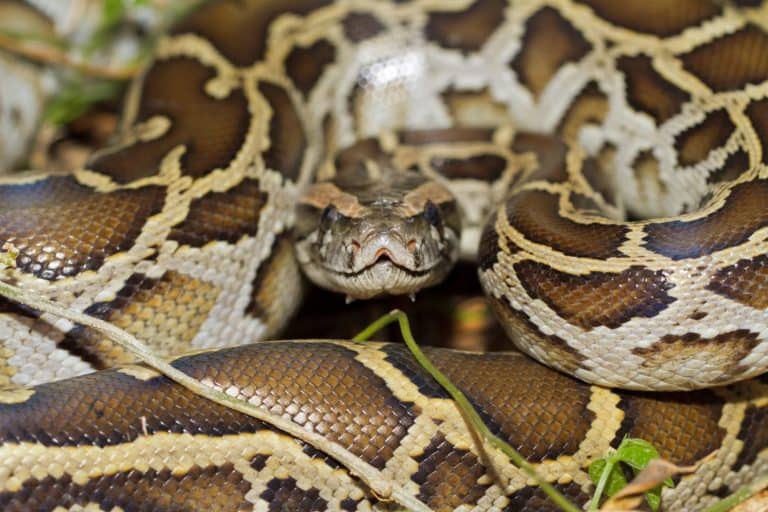
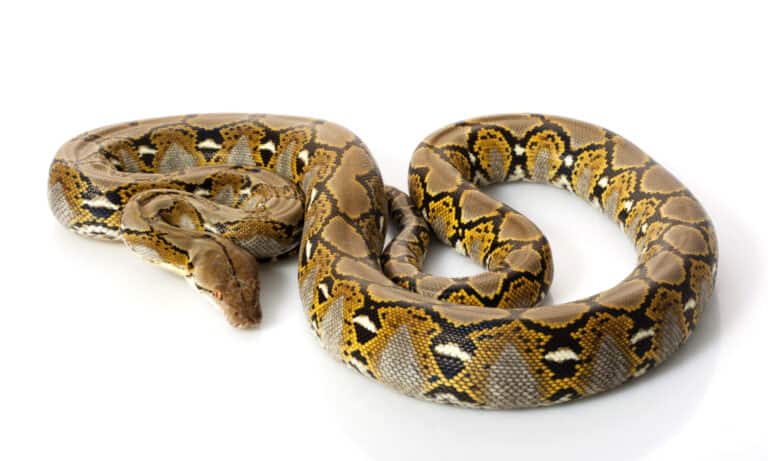
  • Signature 'reticulated' dorsal network: black outlines forming a chain of geometric diamonds/polygons-key field ID trait versus Burmese python patterns.
  • Strong iridescent sheen on many individuals, especially noticeable on darker scales under angled light.
  • Large heat-sensing labial pits along upper/lower lips used for detecting endothermic prey at night.
  • Behavior notes (species-typical): primarily crepuscular/nocturnal ambush constrictor; excellent swimmer and commonly uses riparian/coastal habitats; juveniles are more arboreal than large adults.
  • Longevity: commonly ~20-30 years in captivity; wild lifespan is less certain and varies with hunting and habitat pressures.

Sexual Dimorphism

Females are generally longer and heavier than males at maturity, while males typically have proportionally longer tails and more prominent pelvic spurs. Dimorphism is most evident in adult body size and tail-base proportions rather than coloration.

  • Typically smaller overall body length and mass than adult females from the same population.
  • Proportionally longer tail and more pronounced tail-base thickening for hemipenes.
  • Pelvic spurs often appear more prominent and are used during courtship.
  • Typically larger-bodied and heavier than males; large adults dominate extreme size records.
  • Shorter proportionate tail length with a broader mid-body girth when mature.
  • Greater abdominal capacity associated with egg production (gravid females visibly distend).

Did You Know?

It's among the longest snakes on Earth; a frequently cited, well-documented maximum is ~6.95 m total length (reported in major python references such as Barker & Barker, 2010).

Adults commonly measure ~3-6 m, with juveniles more arboreal and adults more ground-oriented as their mass increases (summarized in Auliya, 2006; Barker & Barker, 2010).

Despite its size, it is nonvenomous-prey is killed by constriction, not venom.

Clutches are large: commonly ~15-80 eggs, and females coil around eggs to guard them (Barker & Barker, 2010).

Hatchlings are typically ~60-70 cm long and already show the species' characteristic "net" patterning (Barker & Barker, 2010).

It's an excellent swimmer and can move along waterways and between islands-one reason it occupies many parts of the Sunda region and nearby archipelagos (Auliya, 2006).

Unique Adaptations

  • Reticulated camouflage: the high-contrast "net" pattern breaks up the body outline in dappled forest light and along riparian vegetation-key for ambush concealment.
  • Heat-sensing labial pits: infrared-sensitive pits along the lips help detect warm-blooded prey in darkness or dense cover (a python family trait).
  • Highly kinetic skull and recurved teeth: a flexible jaw apparatus allows swallowing prey far wider than the head.
  • Expandable body and slow metabolism: can withstand long fasting periods between large meals-an advantage for a sit-and-wait predator.
  • Strong axial musculature and ventral scales: enables both powerful constriction and efficient locomotion across mud, leaf litter, and into water.
  • Salt-tolerant island dispersal (inferred from distribution): presence across many islands suggests the ability to traverse brackish/coastal waterways and persist in coastal habitats (Auliya, 2006).

Interesting Behaviors

  • Ambush hunting: lies motionless along game trails, riverbanks, and forest edges, striking rapidly when prey enters range (Auliya, 2006).
  • Powerful constriction: coils tighten with each exhale of the prey; modern physiological studies on constrictors show rapid circulatory collapse is a primary lethal mechanism (general constrictor findings: Boback et al., 2015; applicable to large pythons' method).
  • Seasonal reproduction: in many areas, breeding aligns with local wet/dry seasonality; males may actively search for receptive females.
  • Maternal egg attendance: females typically remain coiled around the clutch through incubation, defending it and regulating exposure (Barker & Barker, 2010).
  • Ontogenetic habitat shift: juveniles climb readily (reducing predation risk), while very large adults are mostly terrestrial but still enter water frequently (Auliya, 2006).
  • Opportunistic diet: takes a wide range of mammals and birds; large individuals can take sizeable prey, which contributes to both fear and folklore in its range.
  • Human-edge behavior: commonly uses canals, plantations, and peri-urban wetlands where rodents and domestic animals are abundant, which increases conflict and rescue calls in places like peninsular Malaysia and Indonesia.

Cultural Significance

Across South and Southeast Asia, the reticulated python (Malayopython reticulatus) is a famous giant snake in rural life, in warning stories and village removals. It drives a large wildlife trade for leather and pets, shaping laws, monitoring, and community attitudes in Indonesia, Malaysia, and nearby regions.

Myths & Legends

Serpent-deity traditions (South and Southeast Asia): In Hindu and Buddhist traditions and related local cosmologies, serpent deities are associated with water, fertility, protection, and royal power, and are commonly represented as large serpents.

Moon-swallowing sea serpent legend (Philippines): A traditional story describes a colossal sea serpent said to swallow the moon, causing eclipses; rituals were performed to drive it away.

Cosmic serpent tradition (India): Some Hindu narratives describe a world-supporting cosmic serpent associated with endurance and vastness; such ideas can shape how giant snakes are discussed.

In river and forest communities of Indonesia and the Malay Peninsula, stories call huge snakes guardians of springs, caves, and forest spots. People approach these places with ritual respect, alongside real reticulated python sightings.

Conservation Status

LC Least Concern

Widespread and abundant in the wild.

Population Unknown

Protected Under

  • CITES Appendix II (regulated international trade)

Life Cycle

Birth 35 hatchlings
Lifespan 15 years

Lifespan

In the Wild 10–20 years
In Captivity 15–32 years

Reproduction

Mating System Polygynandry
Social Structure Solitary
Breeding Pattern Transient
Fertilization Internal Fertilization
Birth Type Internal_fertilization

Reticulated pythons are largely solitary; males actively search for receptive females and may compete with other males. Pairing is brief, with no lasting bond; females lay and brood eggs alone, without helper care.

Behavior & Ecology

Social None (typically solitary) Group: 1
Activity Nocturnal, Crepuscular, Cathemeral
Diet Carnivore Medium-sized mammals (especially rodents) where abundant; larger individuals frequently take pigs and other medium-to-large mammals when available.

Temperament

Predominantly solitary ambush predator; interactions peak during breeding; behavior varies with prey and disturbance.
Secretive and avoidant; remains motionless when approached, relying on camouflage (Auliya 2006).
Defensive when cornered: body inflation, loud hiss, striking; bites more likely in juveniles (Barker & Barker 2019).
Breeding season includes male mate-searching and male-male combat bouts; otherwise minimal sociality (Barker & Barker 2019).

Communication

Loud defensive hissing/expelled-air 'huff' during threat display Barker & Barker 2019
Chemical communication via pheromones; males follow female scent trails using tongue-flicking and vomeronasal organ Auliya 2006
Tactile cues during courtship/mating: body alignment, cloacal contact, and prolonged coiling Barker & Barker 2019
Vibration/substrate-borne cues: body movements and strikes can transmit vibrations at close range General Squamata behavior; Auliya 2006

Habitat

Biomes:
Tropical Rainforest Tropical Dry Forest Freshwater Wetland Marine
Terrain:
Plains Valley Hilly Coastal Island Riverine Muddy +1
Elevation: Up to 4265 ft 1 in

Ecological Role

Large mesopredator/apex predator (context-dependent) in South and Southeast Asian forests, plantations, and peri-urban mosaics; important predator of small-medium mammals and birds.

Top-down regulation of rodent and other small-medium vertebrate populations (potentially affecting crop/pest dynamics) Energy transfer across trophic levels by converting abundant small mammals/birds into biomass available to higher predators/scavengers when pythons are preyed upon or die Influences prey behavior and habitat use via predation risk (landscape-of-fear effects), especially in edge habitats

Diet Details

Main Prey:
Rats and other rodents Shrews and treeshrews Bat Ground and roosting birds Civets and other small carnivores Primates Pangolin Pig Small deer Domestic mammals +4

Human Interaction

Domestication Status

Wild

Reticulated python (Malayopython reticulatus) has no domestication history. People hunt or kill it, harvest it for leather and meat (notably Indonesia and Malaysia), and keep or breed it in captivity for the pet trade and color morphs (selection, not domestication). It is on CITES Appendix II (since 1975). Also tied to cultural stories, farm nuisance, rare attacks, and invasive escapes.

Danger Level

High
  • Severe bite trauma (large recurved teeth; high risk of laceration and secondary infection).
  • Constriction injury or fatal asphyxia in rare cases-risk increases sharply with larger individuals; safe handling typically requires multiple experienced adults for big animals.
  • Zoonotic disease risk typical of reptiles (e.g., Salmonella) via handling/cleaning.
  • Public-safety risk from escapes (unsecured large constrictors can injure people and kill pets/livestock).

As a Pet

Not Suitable as Pet

Legality: Reticulated python (Malayopython reticulatus): Laws vary by country and state. International trade is controlled (CITES Appendix II). Many places allow keeping with permits, secure cages, and registration; some ban or call it a dangerous animal.

Care Level: Expert Only

Purchase Cost: $150 - $3,000
Lifetime Cost: $15,000 - $60,000

Economic Value

Uses:
Leather/skins Food Pet trade Traditional/folk uses Wildlife management (conflict mitigation costs)
Products:
  • python leather (skins) for fashion goods (belts, bags, shoes)
  • meat for local consumption and sale in parts of Southeast Asia
  • live animals for the global reptile pet trade (including captive-bred color/pattern morphs)
  • by-products in some local markets (e.g., fat/oil in folk medicine-highly variable and not standardized)

Relationships

Predators 6

Saltwater crocodile Crocodylus porosus
Siamese crocodile Crocodylus siamensis
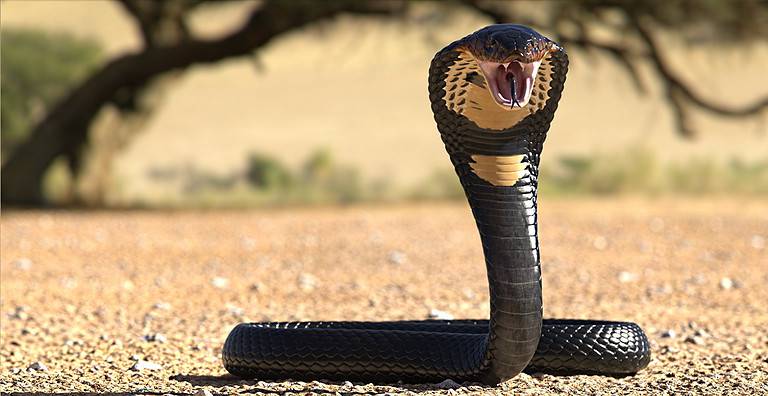
King cobra Ophiophagus hannah
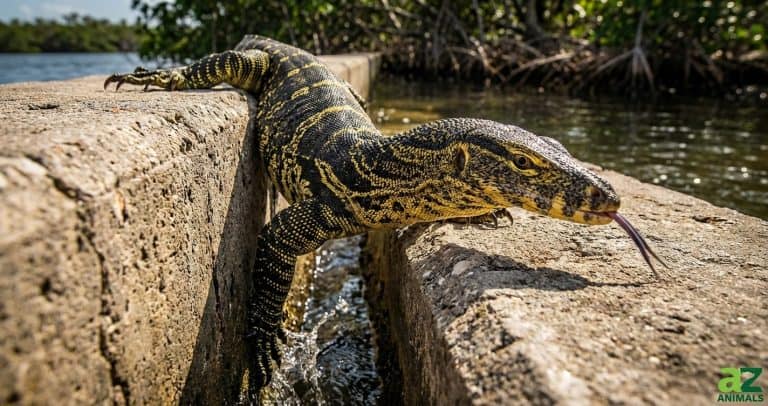
Water monitor Varanus salvator
Crested serpent eagle Spilornis cheela
Human Homo sapiens

Related Species 6

Timor python Malayopython timoriensis Shared Genus
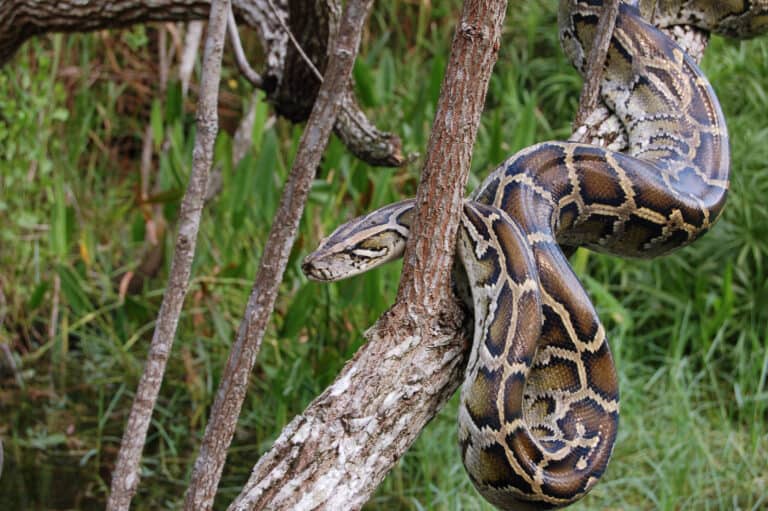
Burmese python Python bivittatus Shared Family
Indian python Python molurus Shared Family
African rock python Python sebae Shared Family
Ball python Python regius Shared Family
Carpet python Morelia spilota Shared Family

Ecological Equivalents 4

Animals that fill a similar ecological role in their ecosystem

Green anaconda Eunectes murinus Very large, nonvenomous constrictor occupying a similar trophic role as a mammal- and bird-eating ambush predator. Both often hunt along waterways in swamp and riverine habitats and take prey up to medium-sized ungulates and pigs when available.
Reticulated python Malayopython reticulatus Large Asian python that ambushes prey, primarily active at night and at dawn/dusk. Oviparous — females coil around clutches and shiver to generate heat; adults typically ~3–6 m, with clutches ranging from tens to over 100 eggs.
King cobra Ophiophagus hannah Shares many of the same forest-edge and riverine landscapes in South and Southeast Asia, and overlaps in dietary niche at the community level through a strong reliance on reptiles. King cobras specialize on snakes; reticulated pythons take reptiles as part of a broader prey base.
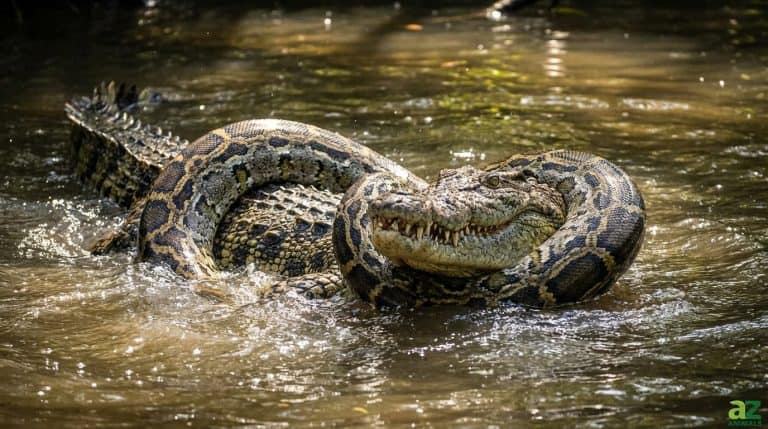
Saltwater crocodile Crocodylus porosus Occupies overlapping riparian and estuarine habitats and fills a similar apex-predator role in some local food webs. Interactions can include competition for prey (mammals and birds near water) and direct predation on pythons.

The reticulated python is the world’s longest snake and is a nonvenomous constrictor native to Southeast and South Asia.

These are big, beautiful snakes, and just because they’re nonvenomous doesn’t make them not dangerous in the wrong hands. These snakes are one of the few with actual accounts of them having eaten humans.

Incredible Reticulated Python Facts

  • The longest reticulated python living is said to be over 25 feet long.
  • It’s an excellent swimmer, and many people have reported seeing one far out into the ocean.
  • In at least two reported cases, an adult human was eaten by a reticulated python.
  • They were among the first species to colonize Krakatau when it emerged.
👁 Image

Scientific Name and Classification

Reticulated pythons are members of the family Pythonidae, cousins to snakes like the Burmese python, ball python, and green tree python. Their scientific name is Malayopython reticulatus. The genus, Malayopython, refers to its morphological and genetic status as a sister species to those of the Python genus. Reticulatus is its specific name and describes its markings and color pattern, which are “net-like.”

The genus name is the subject of some controversy.

In 1801, Johann Gottlob Theaenus Schneider, a German naturalist, described two specimens that were located in the Göttingen Museum. He believed they were different species because their patterns were a little different from one another. Schneider called them Boa rhombeata and Boa reticulata.

In later years reticulated python was variously reclassified as Python reticulatus, Constrictor schneideri, and Python schneiderii. The early 2000s saw more classification changes for this species as genetic research was completed. Scientists proposed several other genus names, including Broghammerus and Python.

However, the International Code of Zoological Nomenclature accepted Malayopython reticulatus as its scientific name and left Python reticulatus and Boa reticulata as synonyms. So, until something else comes to light, that’s likely where it will stay.
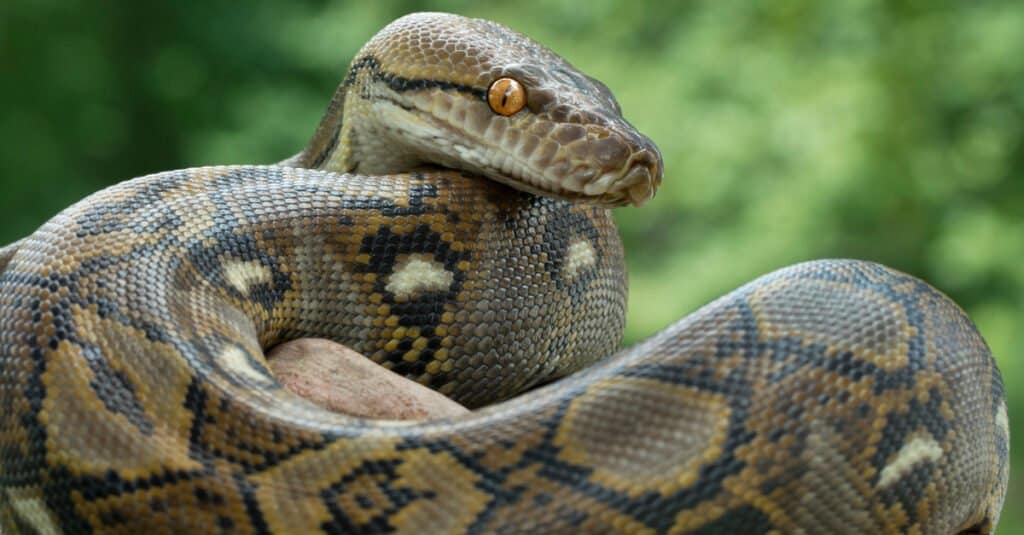
👁 reticulated python
Reticulatus

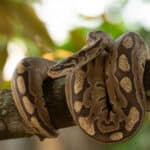
is its specific name and describes its markings and color pattern, which are “net-like.”

©Mark_Kostich/Shutterstock.com

Types

These snakes come in a wide variety of color patterns, and many of the variations can be based on their location. However, there are three subspecies, and two of them are dwarf species that occur on islands.

  • Asiatic Reticulated Python (M. r. reticulatus) – This is the nominate subspecies and the one holding the longest snakes.
  • Kayaudi or Tanahjampean Reticulated Python (M. r. jampeanus) – You’ll find this subspecies south of Sulawesi, on Tanahjampea in the Selayar Archipelago. It’s a dwarf subspecies and only reaches half the length of the Asiatic reticulated python.
  • Selayar Reticulated Python (M. r. saputai) – Inhabits Selayar Island and nearby Sulawesi. It’s also a dwarf subspecies.
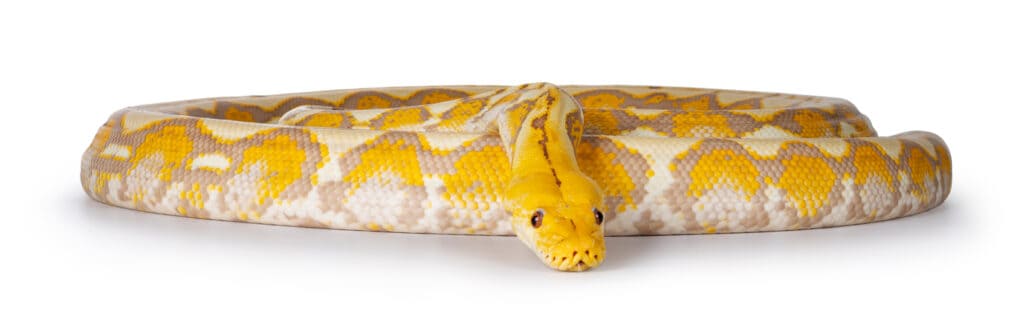
👁 Full body shot of Lavender Albino Reticulated python snake. Isolated on white background.

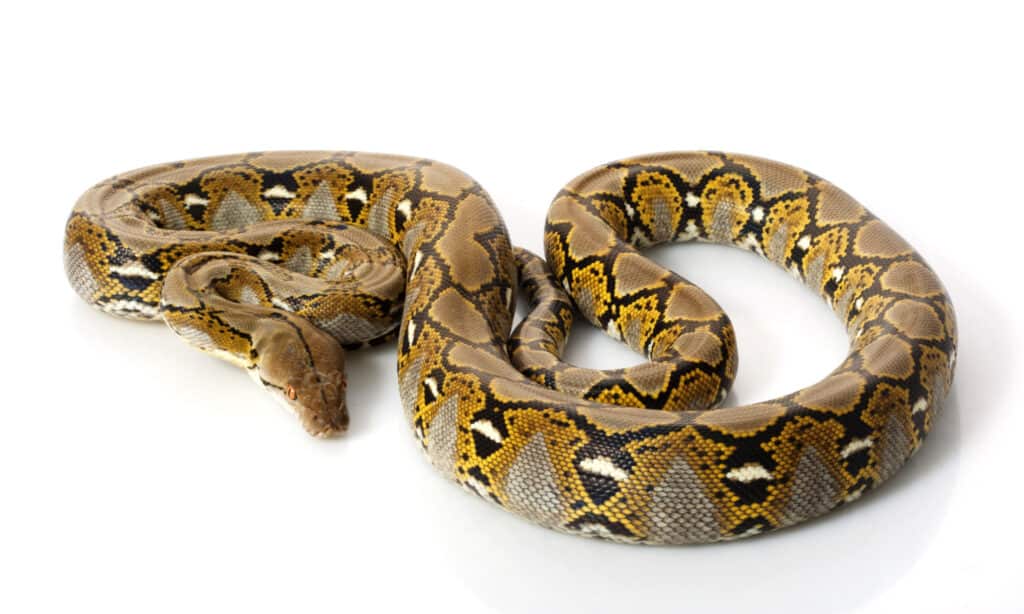
Reticulated pythons are named for their pattern of interlocking diamonds.

©Nynke van Holten/Shutterstock.com

Appearance

Individuals of this species hold records for the longest snake in the world and one of the top three heaviest snakes. Snakes are notoriously difficult to measure, so even though there have been reports of individuals exceeding 30 feet, those have never been verified. However, the longest scientifically measured reticulated python was 22 ft, 10 in, and weighed 130 pounds after not eating for almost three months. According to the Guinness Book of World Records, the longest-living snake is a reticulated python named Medusa, kept by its owner in Kansas City, Missouri. In 2011, Medusa reportedly measured 25 ft 2 in and weighed over 350 pounds.

However big they can get, the truly large are very rare; most reticulated pythons don’t exceed 20 feet long.

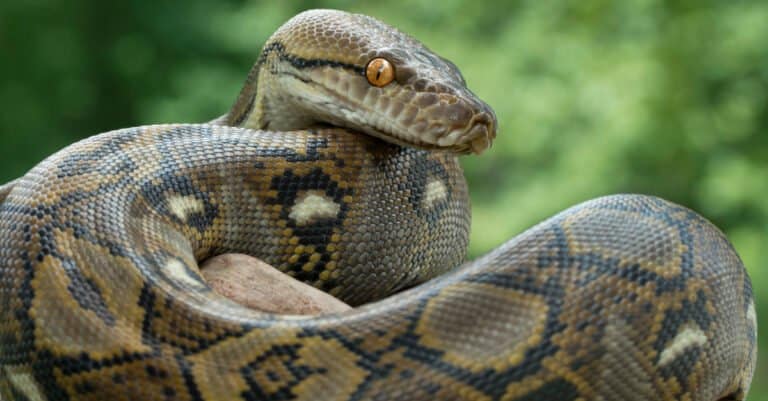
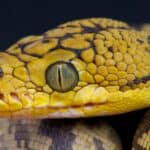
The reticulated python is a heavy-bodied, very long snake with a proportionately large head. Like most other python species, it has heat-sensing pits. The pits are deep and well-developed, located on the front upper and lower labials and the lower rear labials. Its eyes are usually orange or orange-red, and it has vertical pupils.

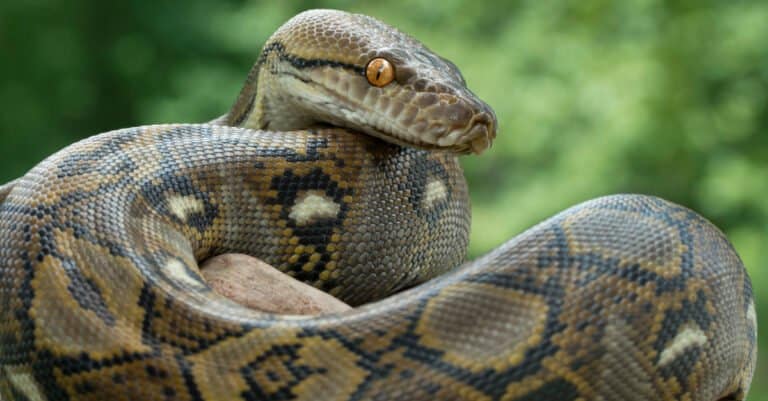
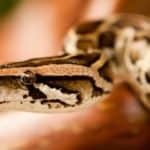
Their color pattern is geometric and quite complex. Along the center of its back, there are black and yellow bordered diamonds, and on its sides are smaller shapes that can vary from oval to triangular with lighter colored centers. The head of most reticulated pythons has a stripe that starts just behind its nose and continues to the neck. There are also dark stripes that start behind the eyes and extend downward toward the back of the jaw. The belly is usually lighter colored and varies from cream to yellow-orange. Across the reticulated python’s wide geographic distribution, the color pattern varies considerably.

👁 Reticulated python on white background

This reticulated python shows the dorsal line beginning right behind its nose and the net-like appearance of its markings.

©fivespots/Shutterstock.com

History and Evolution

Snakes’ and pythons’ ancestors were actually reptiles with legs that looked similar to lizards. They were also other aquatic reptiles. Over time, these animals found less and less use for their legs, and over millions of years, they evolved without their legs, or they became vestigial. This is probably due to the advantages of being very close to the ground and, therefore, close to their prey.

Pythons were previously classified with boas, but modern research has shown that the pythons and boas are separate species due to convergent evolution in different parts of the world, much like monkeys evolved differently in Africa and South America while having shared ancestors. Some of the major differences are that boas give birth to live young, and pythons lay eggs. Pythons also have their heat-sensing pits on their labial scales, and boas have them in between their labial scales.

Reticulated Pythons also being very good swimmers very well could have allowed them to relocate to other lands and islands early on in their history. Then, they evolved into different subspecies depending on their new environments.
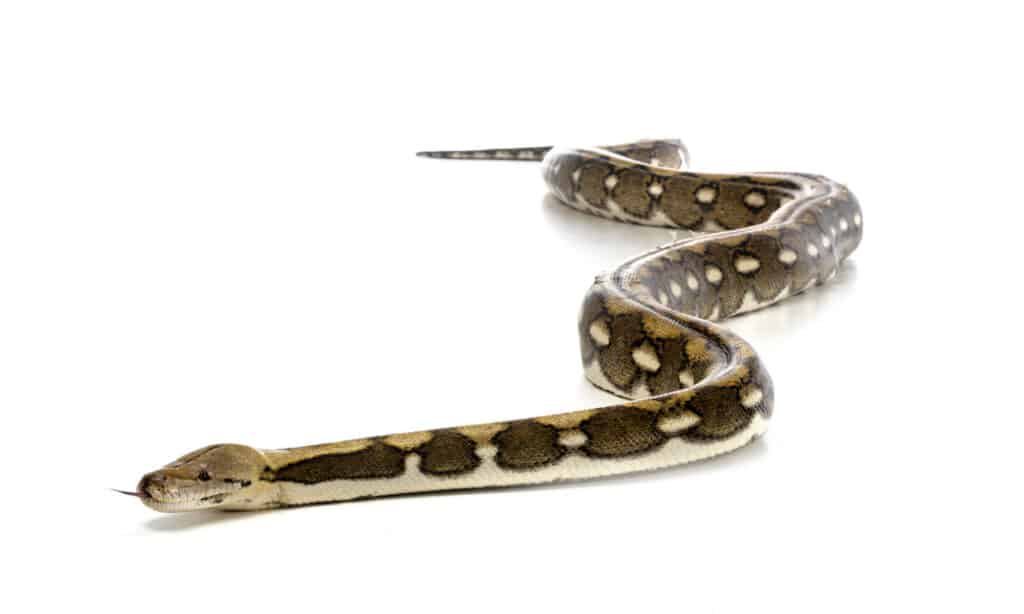
👁 Reticulated python in front of white background

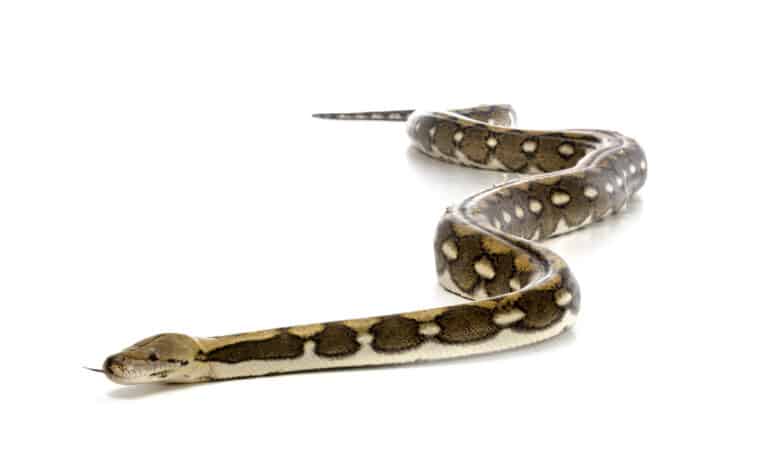
Reticulated pythons are excellent swimmers.

©cynoclub/Shutterstock.com

Behavior

This species, despite its striking color patterns, camouflage well within its environment. It’s an example of disruptive coloration, a type of camouflage where the animal’s pattern helps break up the outlines of its body. This pattern helps this giant snake disappear into the brush and allows it to ambush its prey.

Reticulated pythons live most of their lives alone. Being solitary creatures makes ambushing their prey much easier. Like all pythons, this snake prefers to lie in wait until something tasty crosses its path. It has large teeth that can measure up to an inch long. These teeth, combined with strong jaws and a muscular body, make this snake a deadly predator. It kills by constriction and then swallows its prey whole. This is a fairly aggressive snake in the wild and hisses loudly when someone disturbs it.

The reticulated python is one of the few snakes that is confirmed to prey on humans. This fact is part of what prompted the U.S. Government to add it to the list of banned imports in the Lacey Act.

Those who keep reticulated pythons as pets don’t always handle larger snakes often because they can be difficult to work with because of their size. It’s illegal to own one of these in some states without a permit.

Habitat

These snakes are common throughout much of Southeast Asia, including Bangladesh, Cambodia, Myanmar, Laos, Thailand, Vietnam, Malaysia, and Singapore. They also occur in Indonesia and the Philippines. There’s one recorded individual found on mainland India, but it doesn’t appear to have been part of a breeding population there.

Reticulated pythons inhabit woodlands and adjacent grasslands and rainforests; it often stays near rivers and lakes. Some people have reported finding them in the sewers in Singapore, Indonesia, and Borneo. The species’ swimming capabilities are excellent, and it has been able to colonize many small islands within its range. When Krakatau emerged, it was one of the first species to colonize the new island.
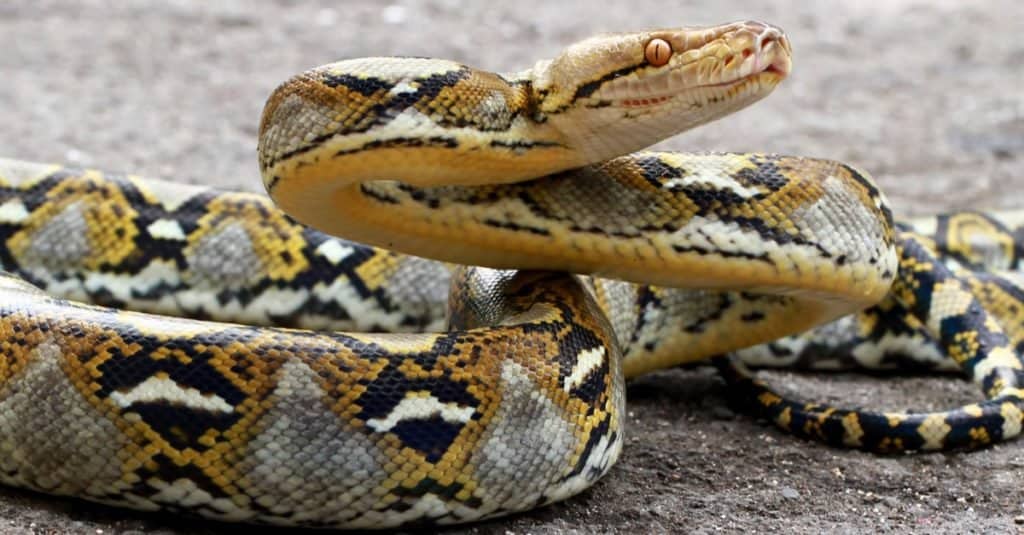
👁 Biggest Snakes: The Reticulated Python

Reticulated pythons inhabit woodlands and adjacent grasslands and rainforests; it often stays near rivers and lakes.

©Opayaza12/Shutterstock.com

Diet

This snake’s diet normally includes a variety of mammals and birds. Smaller individuals, up to about 9-13 feet long, mostly eat rats, other rodents, bats, and treeshrews. As they grow, reticulated pythons switch to bigger prey such as the Indian civet, binturong, various primates, slow lorises, deer, and pigs. Pythons that live near villages and cities also take stray cats, dogs, and chickens.

Even though this snake can get large enough to swallow an adult human, the shoulder width of some people can pose a problem for the snake. Even with the problem of shoulder width, these snakes have gone into forest huts and taken small children.

Verified Attacks on Humans

Although attacks are rare, there are some well-documented instances. Here are a few:

Predators, Threats, and Conservation

Throughout most of their natural range, they’re common. The IUCN Redlist of Threatened Species lists them as “Least Concern.” However, there are some pockets where habitat destruction and over-harvesting for food, skin, and the pet trade may have reduced their numbers. These snakes have few natural predators as adults. However, the juveniles are eaten by various birds of prey and carnivorous mammals; in addition, local tribes often eat them as part of their diet.

Even in those areas where people have actively hunted reticulated pythons for food or in the pet trade, the numbers don’t seem to be decreasing. The snake reproduces easily and matures at a young age. Of course, due to the difficulty in counting snake populations, it’s possible that their population is more fragmented than we realize as yet.

Reproduction, Babies, and Lifespan

The only time they’re likely to be around another of their own species is during mating season, which is during February and March. Reticulated pythons live most of their 25+ year lifespan alone. During mating season, the females release pheromones that attract males to them. Often, the female mates with multiple males during a single mating season.

After breeding, the female finds a snug place on the ground to lay 15-80 eggs. She will stay coiled around them until they hatch. Assuming an ideal temperature of 88-90 degrees, the eggs hatch approximately 88 days later. Neonates generally measure at least two feet long when they hatch; they are independent when they leave the egg and mature in 2-5 years.

Similar Animals

  • The Burmese Python is also really big. And it’s got a breeding population in southern Florida that’s wiping out native wildlife.
  • Rock Pythons are native to Africa and can weigh over 200 pounds.
  • Blood Pythons have beautiful reds in the color pattern, which is where they get the name blood python.
View all 180 animals that start with R

Sources

  1. Integrated Taxonomic Information System / Accessed July 16, 2022
  2. Reticulated Python | IUCN Redlist of Threatened Species / Published September 2, 2011 / Accessed July 16, 2022
  3. Reticulated Python | Reptile Database / Accessed July 16, 2022
  4. Predators and Competitors | Cornell Chronicle / Published December 11, 2011 / Accessed July 16, 2022

About the Author

Gail Baker Nelson

Gail Baker Nelson is a writer at A-Z Animals where she focuses on reptiles and dogs. Gail has been writing for over a decade and uses her experience training her dogs and keeping toads, lizards, and snakes in her work. A resident of Texas, Gail loves working with her three dogs and caring for her cat, and pet ball python.
Connect:

Thank you for reading! Have some feedback for us?

Contact the AZ Animals editorial team

Related Articles You May Find Interesting

King Cobra vs. Mongoose: Why This Snake Fight Isn’t as One-Sided as It Looks

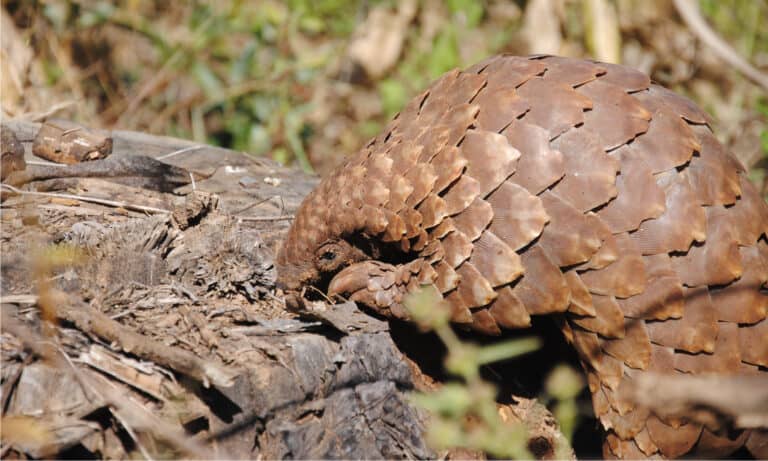
This Pangolin’s Lunch Routine Shows Why the World’s Most Trafficked Mammal Is So Unique


Reticulated python FAQs (Frequently Asked Questions)

Yes, these are among the more aggressive of the pythons.

Yes, and it’s one of the few examples of a snake being large enough to do so – combined with documented accounts of it happening.

It’s their pattern! Reticulated is from a Latin word that means “net-like.” The complicated geometric pattern this species exhibits often resembles a network of interlocking shapes.

In the wild, they eat whatever they can overpower and swallow. In captivity, most people feed them rats, mice, chickens, and rabbits.

That depends. Do you have the space and money to set up a proper enclosure? Do you have the experience and friends to help you handle what will become a 15-foot-long tube of muscle? If you’re unsure about any of those things, a ball python is probably a better choice.