R
Species Profile

Root Aphids

Small sap-feeders, big ecosystem impact
Floki/Shutterstock.com

Root Aphids Distribution

Click a location to explore more animals from that region

Origin Location

This map shows the native origin of the Root Aphids. As a cosmopolitan species, they are now found worldwide.

Loading map...

At a Glance

Family Overview This page covers the Root Aphids family as a group. Stats below are general traits shared across the family.
Also Known As aphid, aphids, plant louse, plant lice, greenfly, sap-sucker
Diet Herbivore
Activity Cathemeral+
Lifespan 30 years
Weight 1.0E-5 lbs
Status Not Evaluated
Did You Know?

Across Aphididae, body length ranges roughly from ~0.5 mm in the smallest species to ~8 mm in the largest (notably some conifer aphids like Cinara).

Scientific Classification

Family Overview "Root Aphids" is not a single species but represents an entire family containing multiple species.

Root aphids are sap-feeding hemipterans that live on or near plant roots, extracting phloem sap and often forming dense colonies in soil or at the root crown. Many have complex life cycles with winged and wingless forms, and some alternate between woody and herbaceous hosts.

Kingdom
Animalia
Phylum
Arthropoda
Class
Insecta
Order
Hemiptera
Family
Aphididae

Distinguishing Features

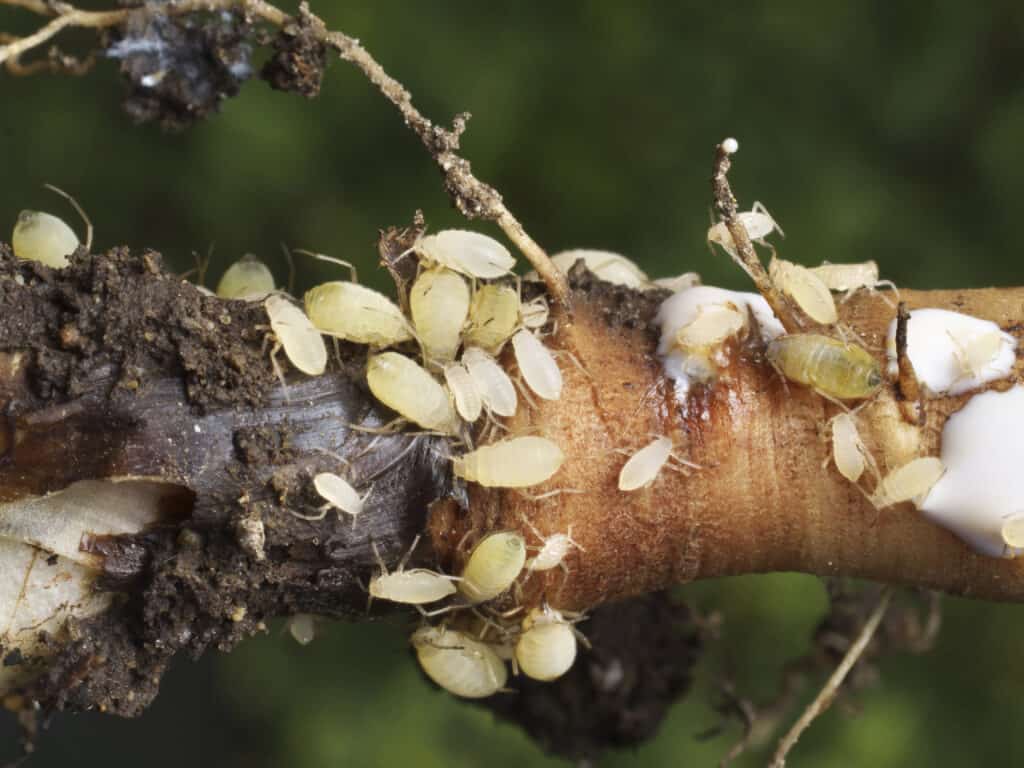
  • Small soft-bodied sap-feeders (aphid-like), often pale/whitish when root-dwelling
  • Colonies on roots; may be tended by ants for honeydew
  • Some taxa produce waxy filaments or appear ‘woolly’
  • Winged dispersal forms may appear seasonally

Physical Measurements

Males and females differ in size

Length
0 in (0 in – 0 in)
Weight
0 lbs (0 lbs – 0 lbs)
Tail Length
0 in (0 in – 0 in)
Top Speed
1 mph
flying

Appearance

Primary Colors
Secondary Colors
Skin Type Soft-bodied, thin cuticle with flexible abdomen; many produce honeydew and have wax secretions (powder, bloom, or filaments), especially in subterranean/root or gall-associated taxa.
Distinctive Features
  • Adult body length across family roughly ~0.5-10 mm (smallest to largest aphids).
  • Wing polymorphism common: wingless (apterous) and winged (alate) morphs within one species.
  • Paired siphunculi (cornicles) typically present; shape varies from pores to long tubes.
  • Cauda (tail-like process) often visible; variable in length and shape across taxa.
  • Piercing-sucking rostrum for phloem feeding; forms dense colonies on hosts.
  • Waxy coverings/filaments common in several groups; can make colonies look cottony.
  • Root-feeding forms often occur at root crowns or on fine roots; some live in soil crevices.
  • Ant attendance is widespread: ants harvest honeydew and may transport/protect colonies.
  • Life cycles are diverse: many have multiple generations per year, cyclic parthenogenesis, and host alternation in some lineages; overwintering frequently as eggs.
  • Individual longevity typically spans days to several weeks; annual persistence often via many overlapping generations or overwintering stages, varying widely by climate and host.

Sexual Dimorphism

Sexual forms occur in many species but are seasonal and variable. Males are often smaller and more frequently winged, while sexual females are specialized for egg-laying; much of the year may be dominated by parthenogenetic females with little obvious dimorphism.

  • Often smaller-bodied and more slender than females.
  • Frequently winged (alate) in species with seasonal sexual generation.
  • Reduced or non-feeding tendency in some taxa; shorter adult lifespan common.
  • Parthenogenetic females commonly wingless and colony-forming for much of the season.
  • Oviparous (sexual) females often more robust, adapted to producing overwintering eggs.
  • Body size and coloration can vary strongly with morph (apterous vs alate) and host.

Did You Know?

Across Aphididae, body length ranges roughly from ~0.5 mm in the smallest species to ~8 mm in the largest (notably some conifer aphids like Cinara).

Many aphids can reproduce without mating (parthenogenesis) for multiple generations, allowing populations to surge rapidly when conditions are good.

"Root aphids" are a common-name/ecological grouping (not one species): many are Aphididae that feed on or near roots, especially in groups such as Eriosomatinae, but root-feeding occurs in more than one lineage.

Aphids excrete sugary honeydew; ants often "milk" aphids for it and, in return, protect colonies from predators-this is especially common in soil/root settings.

Some aphids induce plants to build galls-highly specialized growths that house and feed the colony (gall-making is common in several Aphididae lineages).

Aphid life cycles vary widely: some alternate between woody and herbaceous hosts, while others stay on one host all year; some have winged dispersers, others stay wingless.

Several aphids transmit plant viruses; this role (beneficial to the aphid, harmful to plants) makes them major players in agriculture and ecosystems.

Unique Adaptations

  • Piercing-sucking mouthparts (Hemiptera trait): a needle-like stylet bundle taps plant phloem; aphids manage high-sugar, low-amino-acid sap using specialized physiology and symbionts.
  • Symbiotic bacteria (notably Buchnera aphidicola in most true aphids): provide essential amino acids missing from phloem sap-key to aphid success on nutrient-poor diets.
  • Cornicles (siphunculi): paired tubes on the abdomen in many Aphididae that secrete defensive droplets/waxes; their shape and presence vary among lineages and help identify groups.
  • Rapid generation turnover: across species, development from birth to reproducing adult can be about ~5-30 days depending on temperature and host quality, enabling boom-and-bust dynamics.
  • Overwinter strategies: many species survive cold seasons as eggs on host plants (often lasting months), while others persist as live females where winters are mild or in protected habitats.
  • Wax and woolly coatings: some groups (including many "woolly aphids," often within Eriosomatinae) produce dense wax filaments that reduce desiccation and hinder predators/parasitoids-useful for exposed shoots or soil-adjacent habitats.

Interesting Behaviors

  • Colony living with polymorphism: many species produce both wingless forms (for rapid local growth) and winged forms (for dispersal), often triggered by crowding, host decline, or season.
  • Host alternation (in many, not all, species): a sexual generation and overwintering eggs may occur on a woody "primary host," with parthenogenetic generations moving to herbaceous "secondary hosts."
  • Root-feeding ecology (root aphids): colonies may cluster on fine roots or at the root crown, feeding on phloem sap in soil; these colonies can be dense and hard to detect aboveground.
  • Ant mutualism: ants may carry aphids to better feeding sites, shelter them in soil galleries, and defend them from predators/parasitoids in exchange for honeydew.
  • Alarm signaling and defense: many aphids release an alarm pheromone (often (E)-beta-farnesene in numerous species) that prompts nearby aphids to disperse or drop from the plant; defensive waxes and sticky secretions vary among groups.
  • Seasonal life-history diversity: across the family, some species are obligatorily sexual with an egg stage (holocyclic), others remain parthenogenetic year-round in mild climates or greenhouses (anholocyclic).

Cultural Significance

Aphididae, or aphids, are major crop pests and virus carriers, leading farmers to use ladybirds, parasitoid wasps, and greenhouse monitoring. They drove early study of parthenogenesis and complex life cycles. Gall-forming aphids make Chinese gallnuts on sumac for tannin, inks, dyes, remedies.

Myths & Legends

Chinese tradition around "fivefold galls": tannin-rich galls produced on sumac leaves by an aphid, long used for dyes, ink, and traditional remedies.

In the 17th–18th centuries, European observers wrote widely read accounts of aphids that seemed to give birth without mating, which became a famous wonder in natural philosophy and early entomology.

Garden and farming lore (Europe, later widely): "ants mean aphids" became a practical saying-because ant attendance often signals hidden aphid colonies (including root colonies), guiding growers to look for the insects where damage begins.

The common names "greenfly" and "plant lice" entered everyday speech (especially in Britain and Europe) as symbolic shorthand for sudden garden infestations-tiny, multiplying adversaries that appear almost overnight.

Looking for a specific species?

Green peach aphid

Myzus persicae

Aphididae is a highly diverse aphid family (over 5,000 described species) that includes many widespread, polyphagous agricultural and garden pests; numerous members are economically important because aphids are major vectors of plant viruses.

  • Family-wide body length is typically about 0.1 to 1.0 cm (most species about 0.1 to 0.4 cm), with substantial variation by subfamily and host niche (for example, root-feeders, gall-formers, conifer feeders).
  • Lifespan varies: parthenogenetic generations live about 1-8 weeks (often shorter in hot, dry weather). Overwintering eggs can last months in diapause; some species overwinter as nymphs or adults.
  • Core ecology across Aphididae: phloem-feeding with piercing-sucking stylets; honeydew production is common and frequently leads to ant attendance, mold growth, and altered plant-microbe communities.
  • Life cycles are often complex: many species show cyclic parthenogenesis (multiple asexual generations) with a sexual generation seasonally; winged/wingless morphs are common, but the degree of host alternation and seasonality varies greatly among taxa.
  • Major impacts and interactions are diverse: many species transmit plant viruses; some induce galls; many root-associated species form dense soil/root-crown colonies; defenses include wax/wool, alarm pheromones, dropping behavior, and (in some lineages) soldier morphs.

You might be looking for:

True aphids (root-feeding forms)

70%

Aphididae (notably Eriosomatinae: e.g., Pemphigus, Forda)

Most insects called “root aphids” in gardens/greenhouses are Aphididae that live on roots, often tended by ants; many are in Eriosomatinae (woolly/root aphids).

Phylloxerans (sometimes called root aphids in viticulture)

20%

Phylloxeridae (e.g., Daktulosphaira vitifoliae)

Grape phylloxera and relatives are close relatives of aphids and may be loosely referred to as root aphids because they attack roots.

Root mealybugs (common misidentification)

10%

Pseudococcidae (e.g., Rhizoecus spp.)

Frequently confused with “root aphids” in houseplants; they are scale insects, not aphids.

Life Cycle

Birth 40 nymphs
Lifespan 30 years

Lifespan

In the Wild 7–90 years
In Captivity 10–120 years

Reproduction

Mating System Asexual Reproduction
Social Structure Aggregation Group
Breeding Pattern Not Applicable
Fertilization Parthenogenesis
Birth Type Parthenogenesis

Across Aphididae, reproduction is typically cyclical: many generations of clonal, viviparous parthenogenesis form dense colonies, with an intermittent sexual phase in some lineages where males mate with multiple females; no pair bonds or parental care occur.

Behavior & Ecology

Social Colony Group: 200
Activity Cathemeral, Diurnal
Diet Herbivore Nutrient-rich phloem sap from actively growing host tissues (new shoots/leaf veins) or root-crown phloem in root-feeding lineages
Seasonal Migratory, Hibernates 62 mi

Temperament

Generally non-aggressive and sedentary while feeding; rely on concealment and rapid reproduction
Highly gregarious in many species; crowding tolerance varies widely across taxa and hosts
Defensive when disturbed: alarm signaling, dropping from host, kicking, wax secretion in some groups
Risk-averse behaviors increase with predation/parasitoid pressure; some exhibit ant-dependent boldness

Communication

alarm pheromone release (e.g., E-β-farnesene) triggering dispersal, dropping, and defensive movements
substrate-borne vibrations (tremulation/drumming) used in disturbance contexts and some social coordination
chemical cues in honeydew and cuticular residues that influence aggregation, spacing, and ant attendance
tactile antennation and short-range contact signaling among crowded individuals
ant-mediated signaling via honeydew exchange and ant attendance altering aphid movement and defense

Habitat

Biomes:
Tropical Rainforest Tropical Dry Forest Savanna Desert Hot Desert Cold Mediterranean Temperate Grassland Temperate Forest Temperate Rainforest Boreal Forest (Taiga) Tundra Alpine Freshwater Wetland +8
Terrain:
Plains Valley Hilly Plateau Mountainous Coastal Island Riverine Volcanic Karst Rocky Sandy Muddy +7
Elevation: Up to 16404 ft 3 in

Ecological Role

Primary consumers (phloem-feeding herbivores) in terrestrial ecosystems, often functioning as significant plant pests; they are also key prey for many predators/parasitoids and frequent mutualists of ants via honeydew.

Energy transfer from plants to higher trophic levels (supporting predators/parasitoids such as lady beetles, lacewings, hoverflies, parasitoid wasps) Honeydew production that fuels food webs (ants, microbes) and can promote sooty mold growth on plant surfaces Plant community impacts via sap removal, growth distortion, and stress (including root-feeding damage in subterranean species) Major vectors of plant pathogens, especially plant viruses, influencing crop and wild-plant disease dynamics Mutualisms with ants that can alter arthropod community structure and plant-herbivore interactions Localized nutrient redistribution via honeydew deposition (carbon-rich inputs to leaf/soil surfaces)

Diet Details

Other Foods:
Phloem sap Sap from herbaceous plants Sap from woody plants Root and root-crown phloem sap Phloem sap

Human Interaction

Domestication Status

Wild

Aphididae (aphids) are wild insects and have not been domesticated. But people keep aphids in controlled cultures, often as clonal, asexual laboratory colonies on host plants, for basic and applied research, such as plant–insect interactions, symbiosis, genetics, pesticide tests, and to raise or test biological control agents.

Danger Level

Low
  • Do not typically bite or sting; direct injury is rare
  • Allergic reactions/irritation can occur in sensitive individuals (handling plants with heavy infestations, honeydew/sooty mold exposure)
  • Indirect harm via food-security and economic impacts (crop loss; virus transmission)
  • Potential for nuisance issues in homes/greenhouses via mass occurrences on houseplants or introduced infested soil/root balls

As a Pet

Not Suitable as Pet

Legality: Aphids are usually legal to keep in small numbers, but many are plant pests. Moving or importing live aphids or infested plants may be blocked by quarantine rules, and release or risky indoor keeping can be illegal.

Care Level: Moderate

Purchase Cost: Up to $25
Lifetime Cost: $10 - $250

Economic Value

Uses:
Agriculture & horticulture (major pests; crop losses) Plant biosecurity (quarantine, inspections, certification) Forestry & ornamentals (damage, aesthetic loss, decline) Plant pathology (virus vectors; disease management costs) Biological control industry (prey/hosts for beneficial insects; banker-plant systems) Research & education (model organisms; symbiosis with endosymbionts; evolutionary ecology) Apiculture/food products (honeydew honey in some systems where aphid honeydew is abundant)
Products:
  • Economic losses from reduced yield/quality and contamination (honeydew/sooty mold)
  • Costs of management: scouting, insecticides, resistant cultivars, biological control releases
  • Quarantine services and compliance costs for nurseries/greenhouses
  • Research outputs: lab colonies, experimental systems, published data
  • Biocontrol supply chains: aphid cultures used to maintain predators/parasitoids (e.g., lady beetles, lacewings, parasitoid wasps)
  • Honeydew inputs that can contribute to honeydew honey production in some regions/hosts

Relationships

Predators 8

Lady beetles Coccinellidae
Green lacewing Chrysopidae
Hoverfly larvae Syrphidae
Aphid parasitoid wasps Aphidiinae
Aphelinid parasitoid wasps Aphelinidae
Aphid predatory midge Aphidoletes aphidimyza
Ground beetle Carabidae
Spider Araneae

Related Species 5

Pine aphids Lachninae Shared Family
True aphids Aphididae Shared Family
Woolly aphids Eriosomatinae Shared Family
Adelgids Adelgidae Shared Order
Phylloxerans Phylloxeridae Shared Family

Ecological Equivalents 5

Animals that fill a similar ecological role in their ecosystem

Mealybugs Pseudococcidae Like many aphids, mealybugs are sap-feeding Sternorrhyncha; several lineages specialize on roots and form dense, waxy colonies in soil and at the root crown.
Soft scale insects Coccidae Sedentary phloem feeders that excrete honeydew and are commonly tended by ants. They overlap strongly with aphids in plant-host use and in predator and parasitoid guilds.
Whiteflies Aleyrodidae Sap-feeding hemipterans that produce honeydew and can vector plant viruses. They occupy a similar plant-sap niche, mostly aboveground, and have functionally similar feeding ecology.
Leafhoppers and planthoppers Auchenorrhyncha Sap-feeders that insert stylets into vascular tissues and can transmit plant pathogens; undergo host-plant–driven population booms, though they are not as commonly ant-tended as aphids.
Grape phylloxera Daktulosphaira vitifoliae An aphid-like, root-feeding insect that forms root galls (nodosities) and causes major root damage; occupies a similar niche to root-feeding aphids but belongs to Phylloxeridae rather than Aphididae.

Types of Root Aphids

12

Explore 12 recognized types of root aphids

Green peach aphid Myzus persicae
Cotton/melon aphid Aphis gossypii
Black bean aphid Aphis fabae
Pea aphid Acyrthosiphon pisum
English grain aphid Sitobion avenae
Bird cherry-oat aphid Rhopalosiphum padi
Rice root aphid Rhopalosiphum rufiabdominale
Woolly apple aphid Eriosoma lanigerum
Giant willow aphid Tuberolachnus salignus
Lettuce root aphid (poplar gall aphid) Pemphigus bursarius
Ant root aphid Forda formicaria
Dogwood-grass aphid Anoecia corni

Root aphids that live above or at the soil line are members of the Phylloxera family and are near-cousins of aphids. Unfortunately, they are an escalating problem, particularly among indoor growers. In addition, they are spreading fast to regions where they previously did not occur.

Unlike green aphids, they are hard to spot on stems and leaves, so there is a bigger chance they can get out of control. In addition, they multiply rapidly and suck up copious amounts of sap, depleting the plant’s vigor and eventually killing them.

Root Aphid Scientific Name

Root aphids belong to the order Hemiptera, a diverse group of insects that vary in shape, color, and size. This order consists of 6000 species and ranges in size from 0,04 to 4.3 inches. Hemiptera means “half wing,” and their common features include 2 sets of wings. However, some species are wingless, and others only have forewings.

Some species have hardened wings at the base, but most have membranous wings. In addition, they have sharpened mouthparts that pierce plants and suck out the sap; these piercing appendages are often referred to as proboscis or rostrums and extend from underneath the head.

Hemipteran’s offspring resemble adults but are smaller. They are often mistaken for beetles; however, root aphids are distinguished by their mouthparts, which are sharp and pointed, while beetles have mandibulate.

They are members of the Aphididae family, which consists of small, soft-bodied insects. Similar characteristics include two little tubes protruding from the end of the abdomen called cornicles. In addition, they have small eyes and piercing mouthparts.

They come in various colors, from green to black, to brown, to red, and have long antennae. Aphididae move incredibly slowly. In fact, they barely move at all.

Because there are so many species of root aphids, there are many different scientific names; some species include:

Rice Root Aphid (Rhopalosiphum ruiabdominalis)

Rice root aphids are native to North America and can survive outdoors all year long. They are considered major pests because they negatively affect plants that grow in soil and hydroponic systems. In addition, they differ from other aphid species due to their life cycle that entirely takes place underground, which makes it harder to recognize an infestation.

While they can reproduce throughout the year, they can only stay alive for a few days without feeding on a host. In addition, they don’t lay eggs but give birth to live offspring.

Corn Root Aphid (Anuraphis maidi radicis)

The corn root aphid is very similar to woolly aphids because they suck sap from plants and leave behind a waxy substance called honeydew.

This substance can become moldy, causing the tops of plants to turn black and giving off a sooty appearance. While they mainly infest cultivated grasses like corn, they also attack grassy-type weeds.

These aphids are blueish-green or gray, have soft bodies, and have a spherical shape. They are tiny, only measuring 1/16 inches in length. They reproduce, on average, 9 generations a year, and unlike most insects, they give live birth.

Hawthrone-Carrot Aphids (Dysaphis crataegi)

Hawthrone-carrot aphids are small insects, only measuring 0.08 inches long on their primary hosts. They have short antennae, and their coloring varies from green to gray, dusted with wax particles.

The wingless females have a yellow-gray or green-gray coloring on their secondary host and are dusted with fine wax particles. However, winged viviparous females are reddish-gray color with black markings, while egg-laying females are red with black markings.

Tulip Bulbs Aphids (Dysaphis tulipae)

Tulip aphids are tiny pale to dark green insects with medium to long darkened cornicles. Because they prefer to feed on tulip bulbs, they are often referred to as tulip bulb aphids.

They also infest shoots, leaves, buds, and flowers after they have started to grow. Unfortunately, they are detrimental to these plants because they can transmit the tulip-breaking virus and yellow streak virus in the landscape. In addition, these aphids give birth to live nymphs that slowly mature into winged or wingless adults.

Root Aphid Appearance
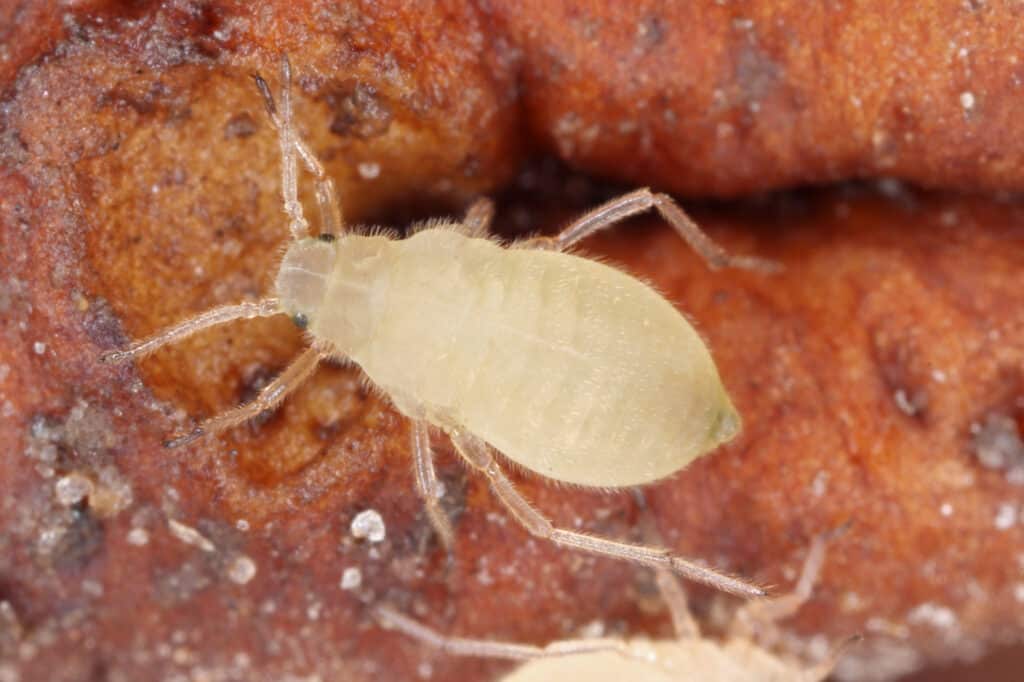
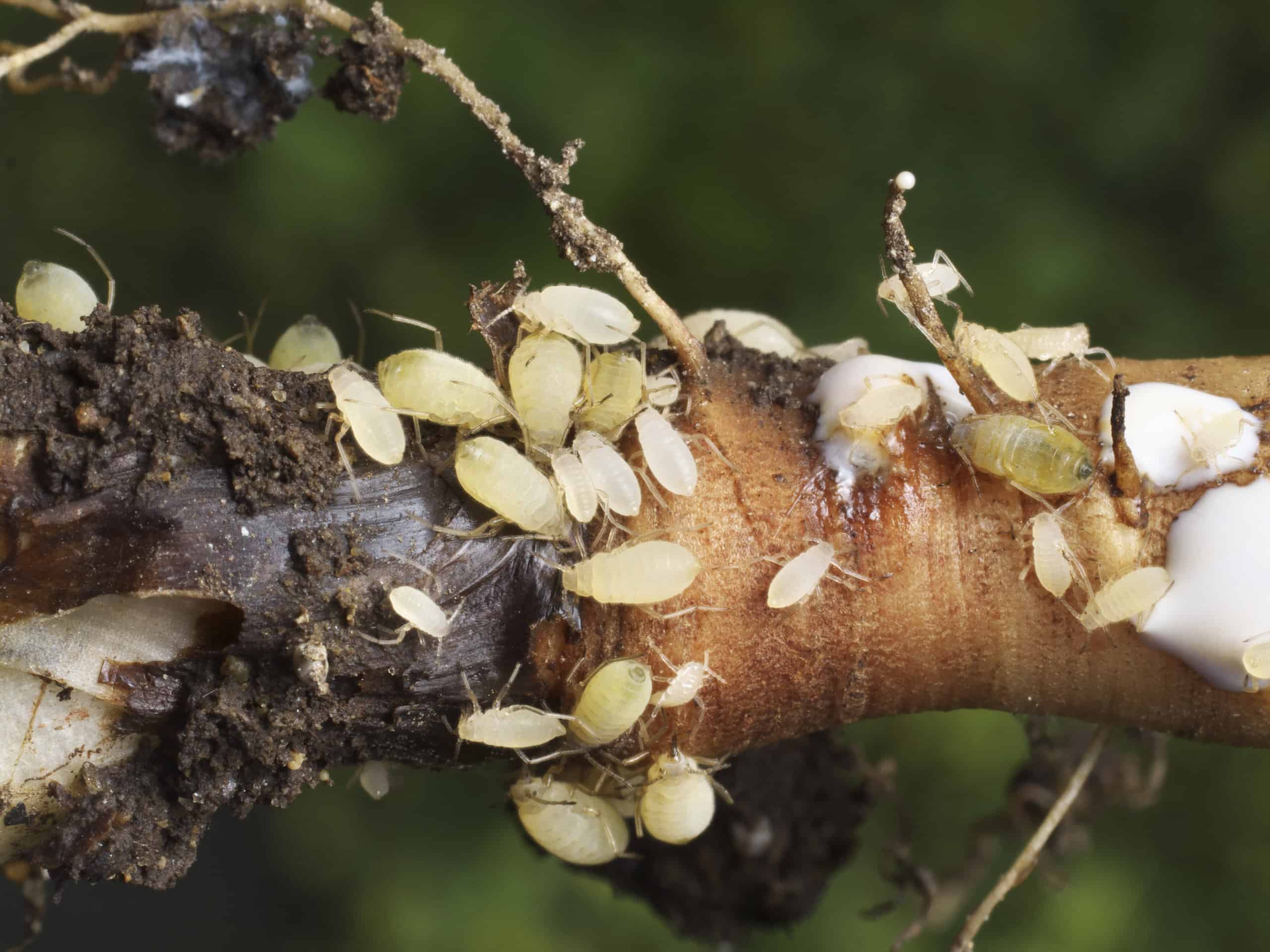
👁 Close up of a colony of root aphids (Trama troglodytes) sucking on dandelion roots.

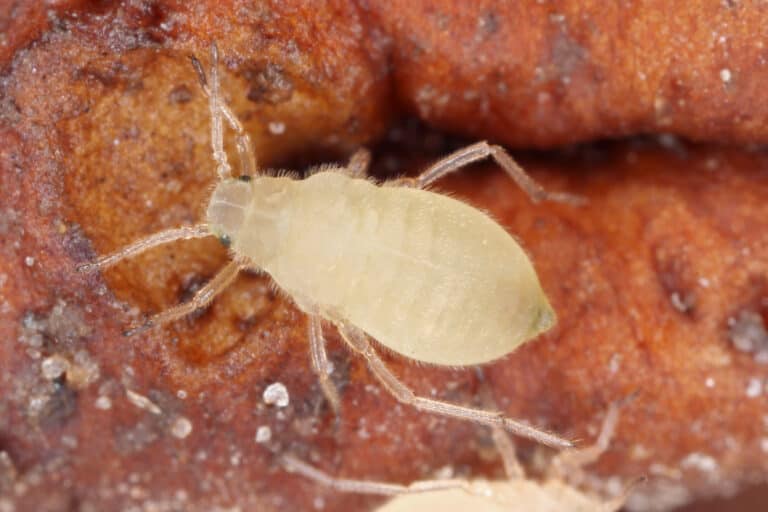
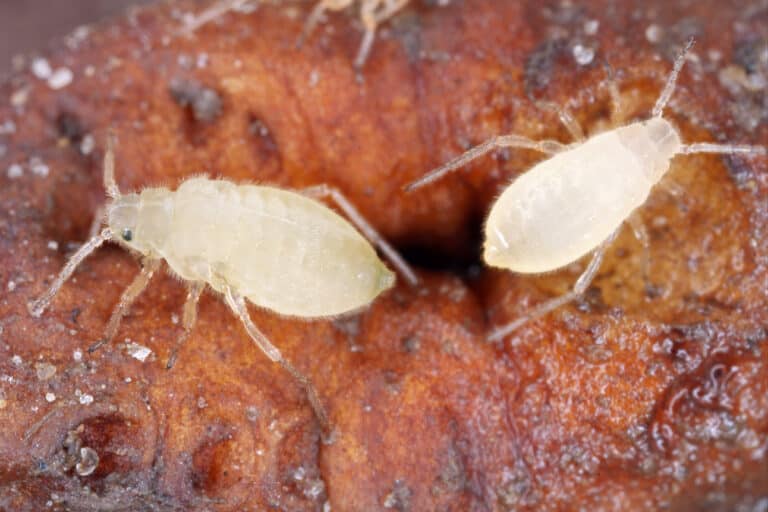
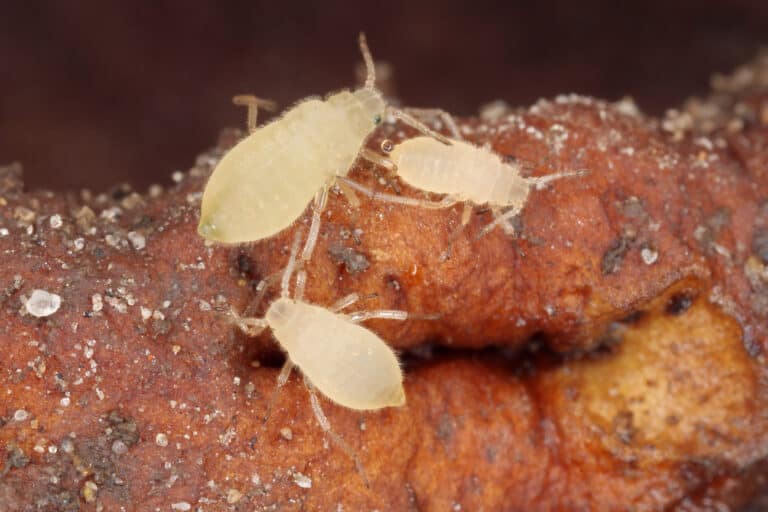
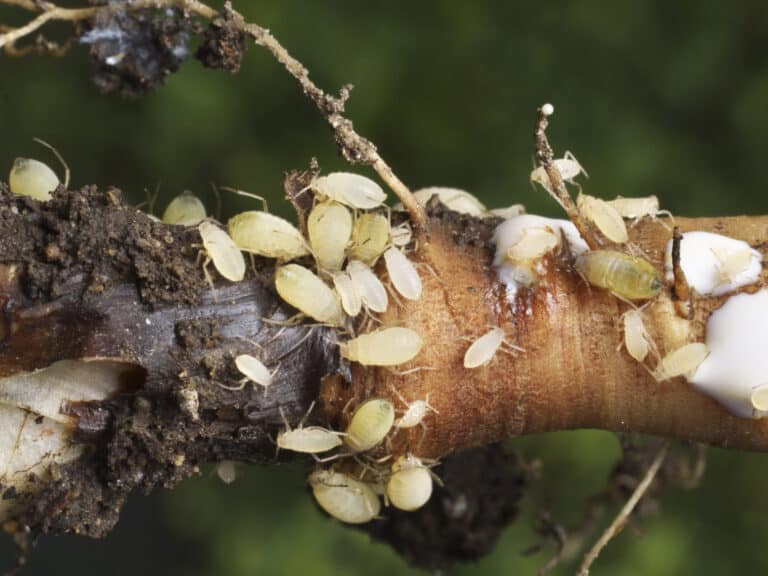
Root aphids look very similar to aphid species found on new stems and leaves, but they’re pear-shaped with shorter legs and antennae.

©Tomasz Klejdysz/Shutterstock.com

Root aphids range in color from white to whitish-yellow or brown. They look very similar to aphid species found on new stems and leaves. However, they are pear-shaped and have shorter legs and antennae.

Most root aphid species have pipes penetrating from underneath the abdomen and pointed sharpened mouthparts, which they use for extracting sap from underground bulbs, roots, and rhizomes.

In addition, later in their life cycle, they secrete a white, waxy substance that covers their bodies and also leaves a trail as they move across the host.

People often confuse them for mealybugs, who also cover their bodies in a white, threadlike substance. However, root aphids are tiny insects that only measure around 0.09 inches long.

Root Aphid Behavior

These aphids burrow into the root of plants, often creating scars on the leaves, which makes them susceptible to mildew and various diseases. As the infestation grows, root aphids will crawl up to the stem to feed.

Once they have sucked the plant dry, they will sprout wings which help them to fly to new plants ready for the plucking.

Root Aphid Habitat

As their name suggests, these aphids primarily feed on the roots of plants, particularly rice plants. However, their hosts have significantly changed as their populations have moved to various geographic regions. They now feed on crops like:

  • Tomatoes
  • Cereal
  • Potatoes
  • Peppers
  • Cannabis

Root Aphid Diet

Root aphids feed on plants like coreopsis, veronica, aster, and sedum. In addition, they like herbs like basil and oregano. But their diets do depend on their geographical range.

Root Aphid Predators and Threats

Root aphids have many predators, and they will vary depending on the habitat; however, some predators include:

The only threat to root aphids are humans trying to eliminate infestations. However, because of their high reproduction rate, their population numbers are not under any threat.

Root Aphid Life Cycle

Root aphids’ life cycle consists of three stages, which include:

The Nymph Stage

Nymphs take 9 to 10 days on average to mature, with a complete lifespan of an estimated 30 days. Depending on the species, they have 6 to 8 legs that measure between 0.04 to 0.08 inches.

During the nymph phase, there are 4 stages of development. They tend to gravitate to the plant’s root system. The nymphs are relatively slow crawlers but can quickly move from plant to plant through growing medium debris, water passing through drainage holes in potted plants, and dirty grow equipment.

The Wingless Adult Stage

Wingless adults spend their developmental stage on the roots of plants and can measure up to 0.12 inches long. They reproduce asexually in enclosed cultivation areas and can produce multiple new offspring daily.

While males are produced, female root aphids give live birth to genetically similar female aphids. They reproduce so fast that their population numbers can double every 1.5 days!

The Winged Adult Stage

During their life cycle, root aphids can develop wings, which is why some people mistake them for fungus gnats. However, there are slight differences, like winged root aphids are slimmer than fungus gnats, who are weaker fliers.

Their ability to infest indoor growing facilities is relatively unknown. But there are theories that include females entering through vents or open doors. Infestations by winged adults can cause wilting, stunted growth, and sometimes death.

Root Aphid Prevention

Insecticides don’t really work on root aphids because they usually occur on the outside or bottom of the root ball, where it is hard to penetrate, so if using insecticide, make sure the plant is completely drenched. In addition, their waxy substance provides protection against insecticides.

The best prevention method is to pull plants from their pots and examine the roots for any waxy secretions. If any are found, the best thing to do is to discard the plant entirely.

While they might not be common in greenhouse crops, if any of these plants start to exhibit nutrient deficiencies, it’s best to check them for root aphids.

View all 180 animals that start with R

Sources

  1. Planet Natural / Accessed September 26, 2022
  2. Michigan State University / Accessed September 26, 2022
  3. Gardening / Accessed September 26, 2022
  4. ProMix / Accessed September 26, 2022

About the Author

Chanel Coetzee

Chanel Coetzee is a writer at A-Z Animals, primarily focusing on big cats, dogs, and travel. Chanel has been writing and researching about animals for over 10 years. She has also worked closely with big cats like lions, cheetahs, leopards, and tigers at a rescue and rehabilitation center in South Africa since 2009. As a resident of Cape Town, South Africa, Chanel enjoys beach walks with her Stafford bull terrier and traveling off the beaten path.
Connect:

Thank you for reading! Have some feedback for us?

Contact the AZ Animals editorial team

Related Articles You May Find Interesting

👁 Image
Articles

How Snow Flies Survive Subzero Cold with Special Antifreeze Proteins

The Beetle with an Invisibility Cloak: How a Chemical “Catch-22” Traps Parasites Inside Ant Fortresses

👁 Image
Articles

The Reproductive Secrets of Hissing Cockroaches


Root Aphids FAQs (Frequently Asked Questions)

The best prevention method is to pull plants from their pots and examine the roots for any waxy secretions. If any are found, the best thing to do is to discard the plant entirely.

During their life cycle, root aphids can develop wings, which is why some people mistake them for fungus gnats. However, there are slight differences, like winged root aphids are slimmer than fungus gnats, who are weaker fliers.

Root aphids range in color from white to whitish-yellow or brown. They look very similar to aphid species found on new stems and leaves. However, they are pear-shaped and have shorter legs and antennae.