
S
Species Profile

Saiga

Saiga tatarica

Built for dust: the steppe's proboscis
Yakov Oskanov/Shutterstock.com

Saiga Distribution

Click a location to explore more animals from that region

Loading map...

Size Comparison

Human 5'8"
Saiga 2 ft 4 in

Saiga stands at 41% of average human height.

At a Glance

Wild Species
Also Known As Saiga, Saigak, Tatar gazelle, Tartar gazelle
Diet Herbivore
Activity Crepuscular+
Lifespan 8 years
Weight 69 lbs
Did You Know?

That "trunk" is an enlarged, flexible nasal proboscis that helps filter steppe dust and warm/cool inhaled air (classic syntheses: Nowak, 1999; Bannikov et al., 1961).

Scientific Classification

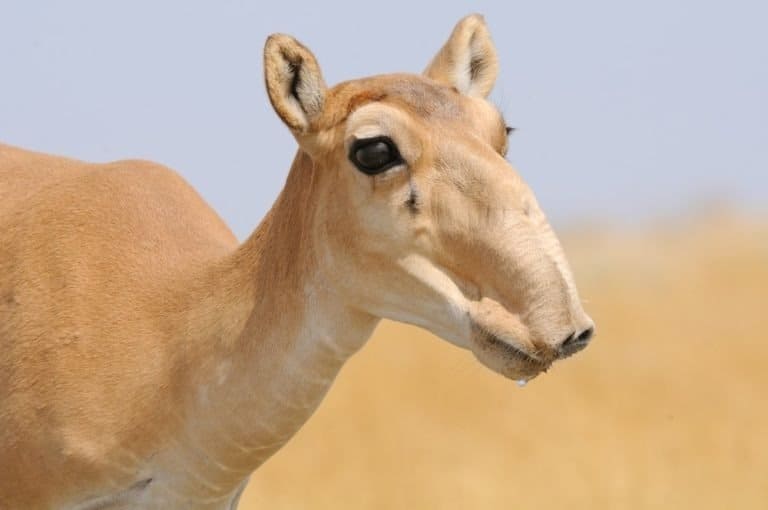
The saiga is a migratory Eurasian steppe antelope famous for its enlarged, flexible nose (proboscis), which helps filter dust and condition inhaled air in extreme steppe climates. It forms large herds and is strongly associated with open grassland and semi-desert steppe ecosystems.

Kingdom
Animalia
Phylum
Chordata
Class
Mammalia
Order
Artiodactyla
Family
Bovidae
Genus
Saiga
Species
tatarica

Distinguishing Features

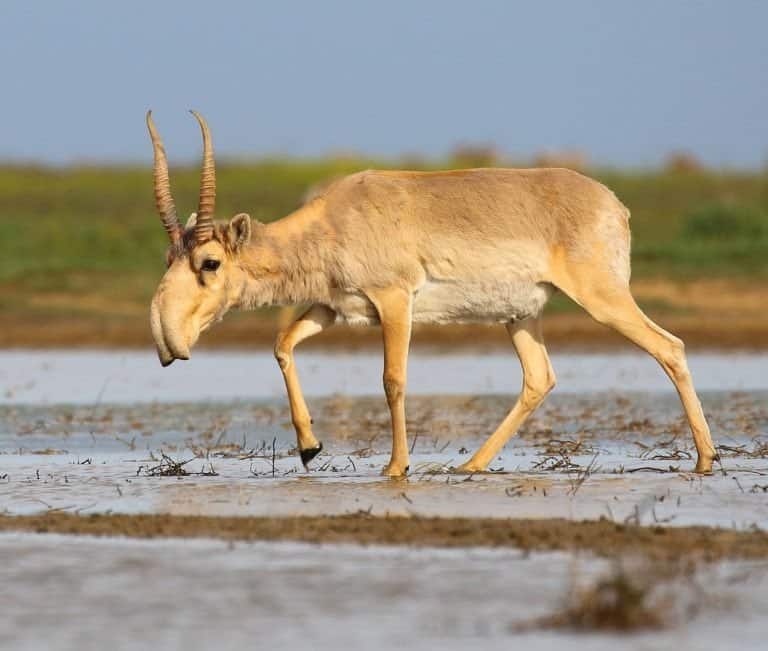
  • Distinctive enlarged, downward-pointing, flexible nose (proboscis)
  • Pale sandy coat that thickens in winter
  • Both sexes are similar in size; males bear amber-colored, ringed horns
  • Highly migratory with large seasonal aggregations in open steppe

Physical Measurements

Males and females differ in size

Height
โ™‚ 2 ft 5 in (2 ft 3 in โ€“ 2 ft 7 in)
โ™€ 2 ft 4 in (1 ft 12 in โ€“ 2 ft 7 in)
Length
โ™€ 4 ft 5 in (3 ft 9 in โ€“ 5 ft 2 in)
Weight
โ™‚ 116 lbs (79 lbs โ€“ 152 lbs)
โ™€ 66 lbs (46 lbs โ€“ 88 lbs)
Tail Length
โ™‚ 4 in (2 in โ€“ 5 in)
โ™€ 4 in (2 in โ€“ 5 in)
Top Speed
50 mph
running

Appearance

Primary Colors
Secondary Colors
Skin Type Hair/fur over tough hide; short summer coat, thick insulating winter coat (seasonal molt).
Distinctive Features
  • Pronounced inflatable nasal proboscis with enlarged nostrils; filters dust and conditions inhaled air in cold, dry steppe winds (HMW/Wilson & Mittermeier).
  • Adult head-body length typically 100-140 cm; shoulder height about 60-80 cm (commonly reported ranges in standard mammalogy references).
  • Adult mass commonly ~21-51 kg (females) and ~36-63 kg (males), varying seasonally and among populations (reported in mammal compendia).
  • Males bear paired, pale 'amber' translucent horns with strong annulations; horn length commonly ~20-25 cm (adult males; standard species accounts).
  • Short tail (often ~6-12 cm) and relatively long, slender legs adapted for long-distance steppe travel.
  • Migratory steppe ungulate forming large, seasonally moving herds that can reach thousands; movements track forage and snow conditions across Kazakhstan/Lower Volga-Ural and adjacent regions (IUCN species accounts).
  • Longevity often ~6-10 years in the wild; up to ~12 years recorded under human care in some references (species accounts).

Sexual Dimorphism

Sexes differ strongly: males are larger and horned, females usually hornless. Horn-targeted poaching selectively removes males, skewing sex ratios and disrupting breeding in migratory steppe herds.

โ™‚
  • Paired, annulated, translucent horns (~20-25 cm) used in rut competition.
  • Heavier, more robust neck and shoulders; overall larger average body mass.
  • More conspicuous rut-related behaviors (neck swelling/odor glands reported in breeding season).
โ™€
  • Typically hornless (or only tiny rudiments exceptionally).
  • Slightly smaller, more gracile build on average.
  • Often form maternal groups; twins are common in this species (species biology accounts).

Did You Know?

That "trunk" is an enlarged, flexible nasal proboscis that helps filter steppe dust and warm/cool inhaled air (classic syntheses: Nowak, 1999; Bannikov et al., 1961).

Size: head-body length 108-146 cm; shoulder height ~60-80 cm; tail 6-12 cm; mass commonly ~26-69 kg with males heavier on average (ADW/Nowak, compiled ranges).

Only males have horns (strong sexual dimorphism). Typical horn length is ~20-28 cm; horns are pale/amber and distinctly ringed (Nowak, 1999; FAO/field guides).

Gestation is about 150 days, and twins are common-an adaptation to highly variable steppe conditions (Nowak, 1999; species accounts).

Saiga can form enormous migratory herds; historically they numbered in the millions across the Eurasian steppe (IUCN Red List historical context).

In May 2015, >200,000 saiga died in Kazakhstan in a rapid mass-mortality event linked to Pasteurella multocida type B under unusual weather conditions (Kock et al., 2018, Science Advances).

Unique Adaptations

  • Enlarged nasal proboscis: complex turbinates and an expanded nasal chamber help trap dust and condition air (warming cold winter air; cooling and humidifying hot, dry summer air) in extreme continental climates (summarized in mammalogy references such as Nowak, 1999).
  • Lightweight, cursorial build for speed and endurance on flat terrain; elongated limbs and efficient gait support rapid long-range movement across open steppe.
  • Seasonal coat change: dense, pale winter coat for insulation and camouflage in snowy/bleached landscapes; shorter summer coat for heat dissipation (species accounts).
  • High reproductive output (frequent twinning) helps populations rebound after harsh winters-but also makes them sensitive to adult survival losses (e.g., horn-targeted male removal).
  • Horn dimorphism (males only) reduces female energetic costs and may improve female survival/fecundity-yet makes males disproportionately vulnerable when horns are targeted by poachers for trade.

Interesting Behaviors

  • Seasonal long-distance migration across open steppe and semi-desert, tracking fresh forage and snow conditions; movements concentrate animals into huge, fast-moving herds that can change direction abruptly in response to disturbance.
  • Rut (late autumn/early winter): adult males defend harems and compete intensely; post-rut male condition often crashes due to reduced feeding and high energy expenditure, increasing winter mortality risk (reported in classic field studies/species accounts).
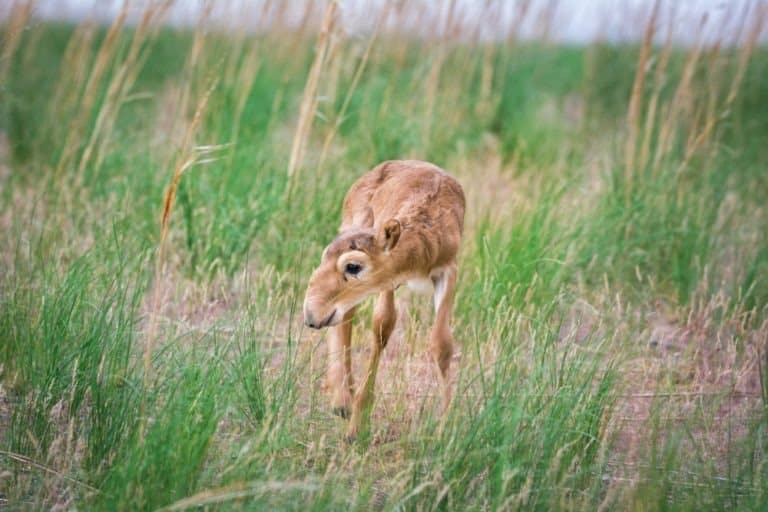
  • Calving is highly synchronized in spring (often May), with females gathering in calving areas; newborns hide (lying-out strategy) for camouflage while mothers forage nearby.
  • Predator-avoidance relies on open-habitat vigilance and group flight rather than cover; herds "wave" and surge, with individuals keying off neighbors' movement cues.
  • Strong fidelity to traditional migratory corridors and seasonal ranges-disruption by fences/roads can cause crowding at barriers and reduced access to critical pastures/water.
  • Sex/age structuring in herds varies seasonally: bachelor groups outside the rut, mixed herds during migration, and female-dominated groups around calving.

Cultural Significance

Saiga Antelope (Saiga tatarica) is a key species of the Eurasian steppe, tied to Kazakhstan and Central Asian grasslands. Its horns are used in traditional medicine, causing poaching of males and population collapse. It is a symbol for steppe conservation and threats.

Myths & Legends

Across the steppe, the Saiga Antelope (Saiga tatarica) long drew travelers' stories for its odd, big nose; explorers and early naturalists treated the unusual muzzle as a strange, almost mythical trait.

In Chinese medicine tradition, antelope hornโ€”often from the Saiga antelopeโ€”was used to cool fevers and 'clear heat,' giving the animal a strong symbolic link to healing and protection.

People on the Eurasian steppe tell stories of the Saiga Antelope (Saiga tatarica). As a migrating game and symbol of abundance, its disappearances teach about overhunting, harsh winters, and respect for land.

Conservation Status

NT Near Threatened

Likely to qualify for a threatened category in the near future.

Population Increasing

Protected Under

  • CITES Appendix II (international trade strictly regulated; saiga horn trade controls widely applied by range and consumer states)
  • Convention on Migratory Species (CMS) Appendix II; Saiga Antelope Memorandum of Understanding (CMS Saiga MOU) coordinating range-state conservation actions
  • National legal protection in key range states (e.g., Kazakhstan and the Russian Federation prohibit hunting/possession; enforcement and anti-poaching operations are central to recovery)

Life Cycle

Birth 2 calfs
Lifespan 8 years

Lifespan

In the Wild 6โ€“10 years
In Captivity 8โ€“12 years

Reproduction

Mating System Polygyny
Social Structure Harem Based
Breeding Pattern Seasonal
Fertilization Internal Fertilization
Birth Type Internal_fertilization

During the November-December rut, dominant males defend harems typically ~5-30 females (occasionally >40), engaging in intense fights and scent marking. After mating, associations dissolve; females gestate ~150 days and usually rear twins without male help.

Behavior & Ecology

Social Herd Group: 50
Activity Crepuscular, Diurnal, Cathemeral
Diet Herbivore Wormwood/sagebrush (Artemisia spp.)-frequently reported as a key winter browse and a characteristic component of saiga diets in Eurasian semi-desert/steppe (e.g., Bekenov, Grachev & Milner-Gulland 1998, Mammal Review).
Seasonal Migratory 621 mi

Temperament

HUBS: strongly gregarious, migratory steppe antelope; herd size peaks during migration/winter (Bannikov et al., 1961; Milner-Gulland et al., 2001).
Highly wary and flight-prone; disturbance increases vigilance and shifts activity toward night (Singh et al., 2010; IUCN Saiga tatarica assessment).
Seasonal sociality: rut (late autumn) dominated by male territoriality and harem defense; post-rut male condition often poor (Bannikov et al., 1961; Milner-Gulland et al., 2001).
Calving is strongly synchronized; females form nursery groups soon after parturition, reducing individual predation risk (Bannikov et al., 1961; Milner-Gulland et al., 2001).
Life history (reported maxima): females up to ~10-12 years; males typically shorter-lived (~6 years), with elevated rut mortality (Bannikov et al., 1961; Nowak, 1999).
Adult size (typical ranges reported): shoulder height ~60-80 cm; mass female ~26-40 kg, male ~36-63 kg (Nowak, 1999; IUCN).

Communication

Low bleats/contact calls between mothers and calves Bannikov et al., 1961
Snorts/grunts during alarm and close-range interactions Bannikov et al., 1961
Rutting males emit loud nasal calls/roars associated with harem defense Bannikov et al., 1961; Milner-Gulland et al., 2001
Olfactory communication: males scent-mark via urine, dung, and glandular secretions during rut Bannikov et al., 1961
Visual threat displays: horn presentation, head-high posture, and chasing during male-male contests Bannikov et al., 1961
Group coordination via movement cues: rapid alignment and collective flight responses in open terrain Milner-Gulland et al., 2001
Close-contact tactile signals: nose-to-nose and body contact within dense herds, especially in nursery groups Bannikov et al., 1961

Habitat

Biomes:
Temperate Grassland Desert Cold
Terrain:
Plains Plateau Sandy
Elevation: -1102 in โ€“ 5249 ft 4 in

Ecological Role

Large migratory primary consumer of Eurasian steppe/semi-desert ecosystems; functions as a landscape-scale grazer/browser that couples distant patches via seasonal movement and provides a major prey base for large carnivores (e.g., wolves) and scavengers.

Regulates steppe vegetation structure via large-scale grazing/browsing, helping limit dominance/encroachment of some shrubs and influencing plant community composition Nutrient redistribution and soil fertilization through dung/urine deposition along migratory routes and calving/stopover areas Supports food webs as high-biomass prey for predators (notably wolves) and as carcass resources for scavengers Potential seed dispersal/transport (epizoochory and endozoochory) and creation of microsites for plant establishment via trampling and grazing disturbance

Diet Details

Other Foods:
Wormwoods/sagebrushes Salt-tolerant shrubs and forbs Feather grasses and other steppe grasses Steppe forbs Ephedra

Human Interaction

Domestication Status

Wild

Saiga antelope (Saiga tatarica) is wild and not domesticated. People have hunted it for meat, hide and especially male horns, and kept small numbers in zoos for conservation. Threats include hunting/poaching, fences and roads, grazing and development, and disease die-offs (e.g., 2015 Kazakhstan). Saigas are highly migratory, herd-forming steppe animals; males have 20โ€“40 cm ridged horns.

Danger Level

Low
  • Physical injury risk is generally low because saigas are shy and avoid humans, but they can kick, charge, or injure handlers when stressed (notably during capture, transport, or veterinary procedures).
  • Zoonotic/occupational risks exist for people handling carcasses or live animals (e.g., exposure to blood/tissues, ticks, enteric pathogens), especially in hunting/poaching or field veterinary contexts.
  • Traffic and infrastructure interactions: sudden herd movements and migration crossings can create collision hazards where roads/railways intersect migration routes.

As a Pet

Not Suitable as Pet

Legality: Saiga antelope (Saiga tatarica) are generally illegal or not possible as private pets. Trade is controlled by CITES Appendix II and keeping needs permits, usually limited to zoos or licensed centers.

Care Level: Expert Only

Purchase Cost: $5,000 - $15,000
Lifetime Cost: $40,000 - $120,000

Economic Value

Uses:
Wildlife trade (regulated/illegal depending on context) Subsistence and commercial hunting (historical/illegal in many areas today) Conservation funding and eco-tourism (limited, site-specific) Ecosystem services (steppe herbivory dynamics; cultural/natural heritage value)
Products:
  • Meat (historically important; now widely restricted)
  • Hides/leather (historical)
  • Male horns (high-value commodity used in traditional medicine markets; key driver of poaching)
  • Non-consumptive value via wildlife viewing and conservation programs (localized)

Relationships

Predators 5

Gray wolf Canis lupus
Red fox Vulpes vulpes
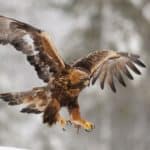
Golden eagle Aquila chrysaetos
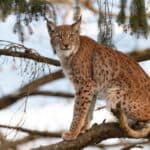
Eurasian lynx Lynx lynx
Human Homo sapiens

Related Species 7

Mongolian saiga Saiga tatarica mongolica Shared Species
Domestic cattle Bos taurus Shared Family
Argali Ovis ammon Shared Family
Goitered gazelle Gazella subgutturosa Shared Family
Mongolian gazelle Procapra gutturosa Shared Family
Blackbuck Antilope cervicapra Shared Family
Tibetan antelope Pantholops hodgsonii Shared Family

Ecological Equivalents 5

Animals that fill a similar ecological role in their ecosystem

Mongolian gazelle Procapra gutturosa Like saigas, it forms very large, highly mobile herds in open steppe and semi-desert. Both are long-distance movers that track patchy, rainfall-driven forage and use open terrain to reduce ambush risk.
Goitered gazelle Gazella subgutturosa Shares an arid steppe to semi-desert niche and seasonal movements. Both rely heavily on drought-tolerant forbs and shrubs (e.g., Artemisia and chenopods) when grasses are scarce.
Asiatic wild ass Equus hemionus kulan Occupies Eurasian steppeโ€“semi-desert landscapes and exhibits wide-ranging movements between seasonal grazing areas and water. Uses a similar predator-avoidance strategy based on open-country speed and vigilance.
Argali Ovis ammon Overlaps with the saiga in parts of Central Asia and occupies open, strongly seasonal country; both are prey for wolves and are shaped by winter severity and forage availability, although argali use more rugged terrain.
Przewalski's horse Equus ferus przewalskii Steppe grazer adapted to extreme continental climates. Ecological similarity is primarily due to a shared forage base (grasses and forbs) and exposure to harsh winters and openโ€‘land predators, despite differences in social structure.

โ€œThe Saiga is called the large-nosed antelope.โ€

Thriving in the harsh dry grasslands of Central Asia, this unique-looking antelope is instantly recognizable by its sizable nose with wide-set nostrils. The saigaโ€™s snout is used for dust filtration, a necessary tool in its dry habitat. These antelope have been listed as Critically Endangered by the IUCNโ€™s Red List since 2001. They are a yellowish-red color in the summer and gray color in the winter. Males have horns that are slightly curved in a lyre-like shape.

Incredible Saiga Facts!

  • The saigaโ€™s nose serves many purposes. It heats the air in the winter, filters out dust in the summer, and also amplifies mating calls.
  • Saiga has suffered one of the fastest declines of any animal, due to both poaching and annual disease.
  • The saiga is an animal that can congregate in herds of around 1000 individuals.
  • Males focuses all of their energy on their harem during the breeding season, which increases their mortality rate.

Saiga Scientific Name

The name Saiga is derived from the Russian word sajgรกk, which is a kind of chamois fabric. There are two subspecies of saiga: Saiga tatarica and Saiga tartarica mongolica. The dominant subspecies, S. tartarica, is found over a wider range in Russia and Kazakhstan. The smaller subspecies, S. t. mongolica is only found in western Mongolia.

Saiga Appearance

These antelope are a light reddish-yellow color with paler fur underneath in the summer. Their winter coats are longer and are a duller grey color. They look similar to goats save for their large snout, which both males and females possess. Their nostrils face downward. They have long, thin legs and a boxy body. Males have amber-colored horns that are slightly curved. They stand at about 0.6-0.8 meters tall, and the biggest saiga antelopes are up to 1.5 meters long. Females are about three-quarters the size of males.
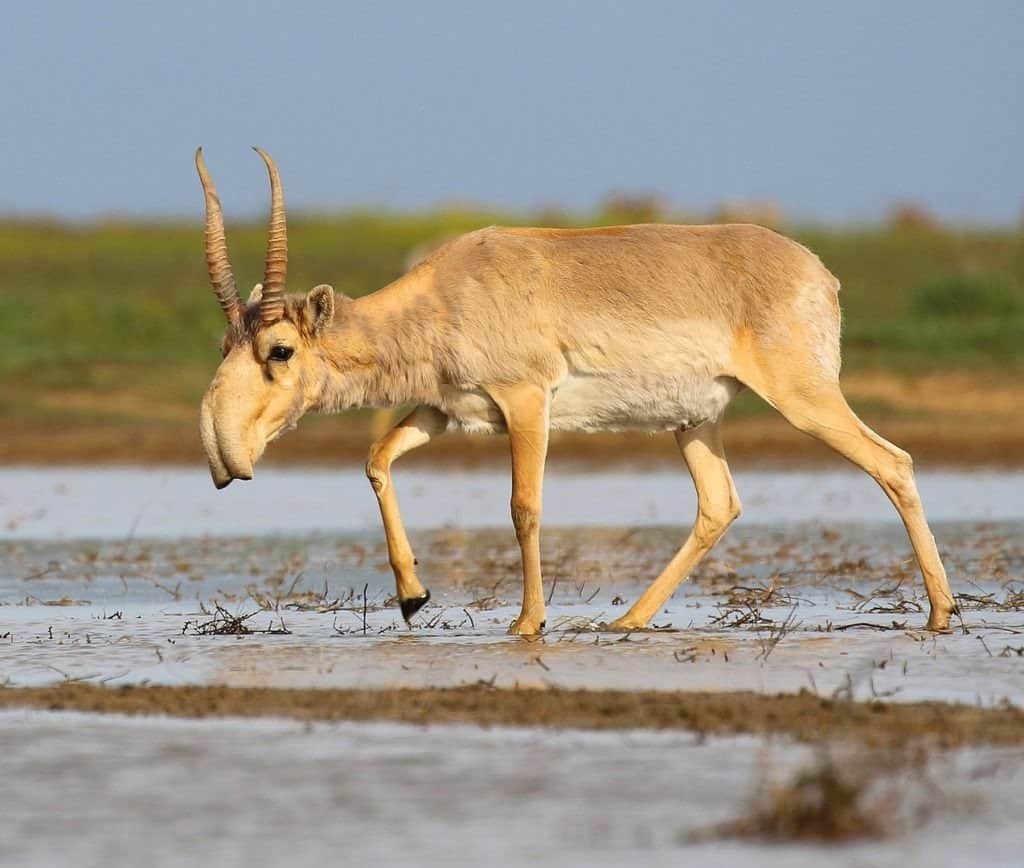
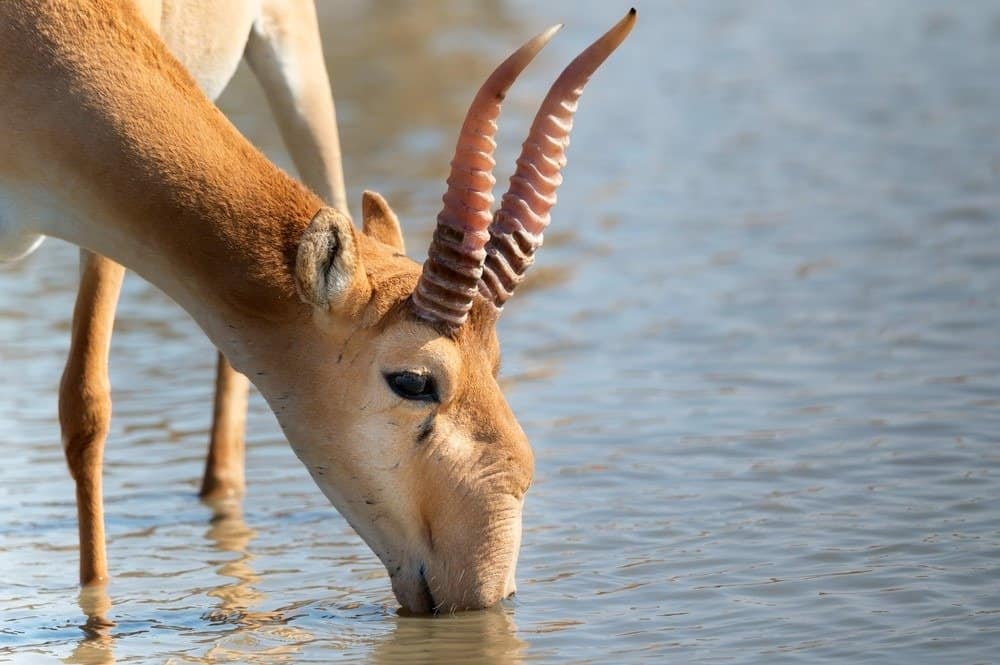
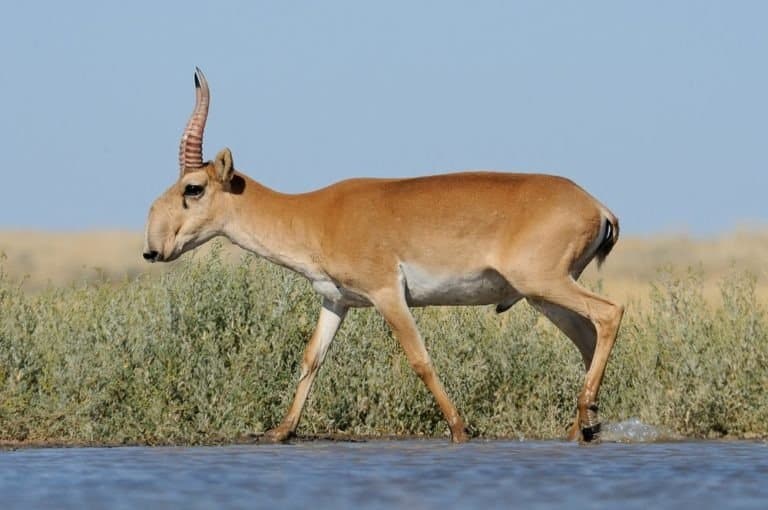
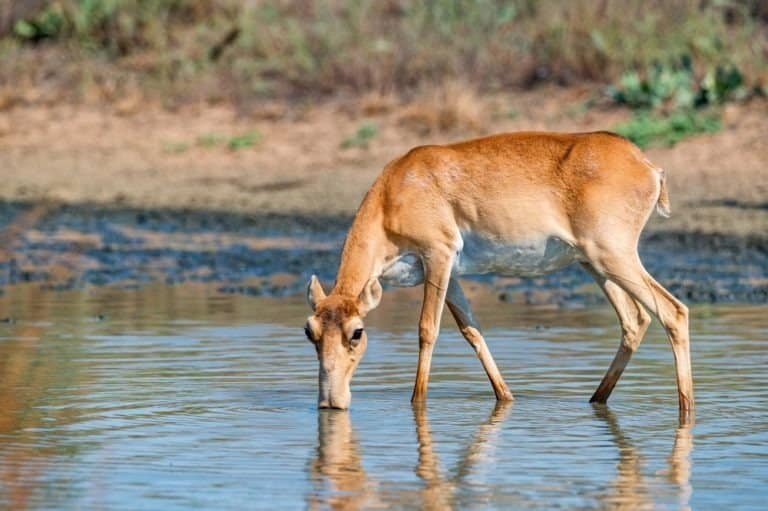
๐Ÿ‘ Wild saiga antelope, Saiga tatarica tatarica visiting a waterhole at the Stepnoi Sanctuary, Astrakhan Oblast, Russia

Wild saiga antelope, visiting a waterhole at the Stepnoi Sanctuary, Astrakhan Oblast, Russia.

ยฉAndrey Giljov / CC BY-SA 4.0 โ€“ Original / License

Saiga Behavior

The saiga is an animal that can live in groups of around 1000 individuals, but groups of 30-40 are more common outside of the breeding season. Large herds of females migrate together before the breeding season and then split up into smaller groups. Large groups of only males have been reported as well. They travel up to 72 miles a day in a nomadic lifestyle, and large mass migrations happen so the saiga can avoid a harsh winter.

During the day, these antelopes graze on the prairie grasses and find watering holes. At night, they dig circular impressions in the earth before falling asleep. Saiga is a nomadic species, but they do follow some general migration paths from north to south. Fences and borders between countries often interfere with these migration patterns.

The saigaโ€™s nose is its most unique feature and serves multiple purposes. In the summer, the nostrils help filter out dust from the surrounding environment. In the winter, the noseโ€™s large surface area helps warm the air as the saiga breathes it in. It is also thought that the nose helps amplify mating calls during the breeding season.

Saiga Habitat

There are a few distinct populations of saiga, mostly of the dominant subspecies S. tartarica. These populations roam the semi-arid grasslands of Central Asia, including Mongolia, Kazakhstan, Russia, and Kalmykia. They prefer dry conditions. Larger herds of these antelope congregate in mostly flat areas, devoid of hills and lacking in rough and rugged terrain.

Saiga Diet

These antelope are herbivores. They graze daily on hundreds of different ground-dwelling plants in the Central Asian steppes. They prefer grasses, lichens, sagebrush, and summer cypress. Many of the plants in the saigaโ€™s diet are poisonous to other animals.

Saiga Predators and Threats

Adult saiga fall prey to wolves, their natural predators on the Asian plains. Young antelope are preyed upon by feral dogs and foxes. These antelopes can run at a high speed, and use this speed to escape predators on the steppes.

Humans are by far the biggest threat to the remaining saiga antelope populations. These antelopes have been through many instances of population decline and were protected by the Soviet Union beginning in 1921. After the fall of the Soviet Union, protections on these animals ceased to exist for quite some time. This is in part what contributed to their steep population decline.

Rural communities in China and Central Asia fell into poverty after the Soviet Unionโ€™s fall. Saiga meat and horn are highly sought after โ€“ their horns are particularly valuable in Chinese medicine. Large amounts of poaching and hunting drove the species into decline. Poachers often speed into the herds with motorcycles in order to target large amounts of the antelopes. Because male saiga is targeted for their horns, this often means that there are not enough males to mate with females during the mating season.

These animals are also prone to a slew of annual illnesses and viruses that further threaten an already Critically Endangered species. A bacterial infection called pasteurellosis was the downfall of thousands of saiga antelope in 2010 and 2015. This infection killed off thousands of individuals and affected many subsets of the saiga population.

Saiga Reproduction and Life Cycle

Females are sexually mature within the first year of their life, whereas males do not reach sexual maturity until they are 2 years old.

During the breeding season, saiga antelopes split into smaller factions with one male and about 5-10 females. The males will fight with their curved horns for control of the harem, defending it from encroaching males who want to steal them away. The fights that break out between saiga antelopes are violent and can often be fatal. The males do not graze at all during the breeding season, as they spend every moment defending their harem of females. This means that 80-90% of male antelopes die during the mating season, either while defending their harem or succumbing to malnutrition.

Female antelopes have a gestation period of around 5 months. They give birth to one or two young, which stay hidden in the grass. These young are called calves. They spend about 8 days in the grass until they are able to walk around. After 4 months, the young are weaned from their mothers.

These antelopes live between 10-12 years in the wild.

Saiga Population

There are currently 5 major populations of these antelope throughout their Central Asian range. The total number of saiga in existence is unknown, but estimates place them between 50,000 to 150,000 individuals. Their populations used to number in the millions.

Conservation efforts have noted an increase in their offspring in 2019. The previous year, only 58 saiga calves were born and counted by researchers. In 2019, that number was over 500. This is not enough on its own to save the declining populations of endangered saiga antelopes, but it is a sign that conservation efforts may be working.

View all 385 animals that start with S

Sources

  1. Wikipedia / Accessed December 2, 2020
  2. Wiktionary / Accessed December 2, 2020
  3. Saiga Antelope / Accessed December 2, 2020
  4. Fauna & Flora International / Accessed December 2, 2020
  5. WCS Mongolia / Accessed December 2, 2020
  6. U.S. Fish & Wildlife Service / Accessed December 2, 2020
  7. Animal Diversity Web / Accessed December 2, 2020
  8. Britannica / Accessed December 2, 2020
  9. Animals Network / Accessed December 2, 2020

About the Author

A-Z Animals Staff

AZ Animals is a growing team of animals experts, researchers, farmers, conservationists, writers, editors, and -- of course -- pet owners who have come together to help you better understand the animal kingdom and how we interact.
Connect:

Thank you for reading! Have some feedback for us?

Contact the AZ Animals editorial team

Related Articles You May Find Interesting


Saiga FAQs (Frequently Asked Questions)

Saiga is herbivores. Their diet consists of hundreds of ground-dwelling plants in the Central Asian steppes. Primarily, they eat grasses, lichens, sagebrush, and summer cypress.

Saiga is pronounced Sigh-guh.

A Saiga is a type of antelope found in Central Asia. The saiga is noteworthy because of its large, flexible nose, which acts as a filter. The nose keeps out dust in the summer months and warms up freezing air in the winter.

The name saiga comes from the Russian word sajgรกk. Sajรกk refers to a type of chamois fabric.

Saiga is listed as a Critically Endangered species according to the IUCNโ€™s Red List. There is an estimated 123,450-124,000 saiga remaining in the wild.

Like many antelopes, saiga has twins as an evolutionary response to being a prey animal. Having twins boosts the likelihood that more babies will survive both childhood and future encounters with prey animals.

Saigas belong to the Kingdom Animalia.

A Saiga can travel at speeds of up to 50 miles per hour.