

S
Species Profile

Sand Cat

Felis margarita

Small cat. Big desert survival.
slowmotiongli/Shutterstock.com

Size Comparison

Human 5'8"
Sand Cat 11 in

Sand Cat stands at 16% of average human height.

At a Glance

Wild Species
Also Known As Desert cat, Dune cat, Sand dune cat
Diet Carnivore
Activity Nocturnal+
Lifespan 8 years
Weight 3.4 lbs
Status Least Concern
Did You Know?

Size: head-body length 39-52 cm; tail 23-31 cm; weight ~1.35-3.4 kg (males typically heavier).

Scientific Classification

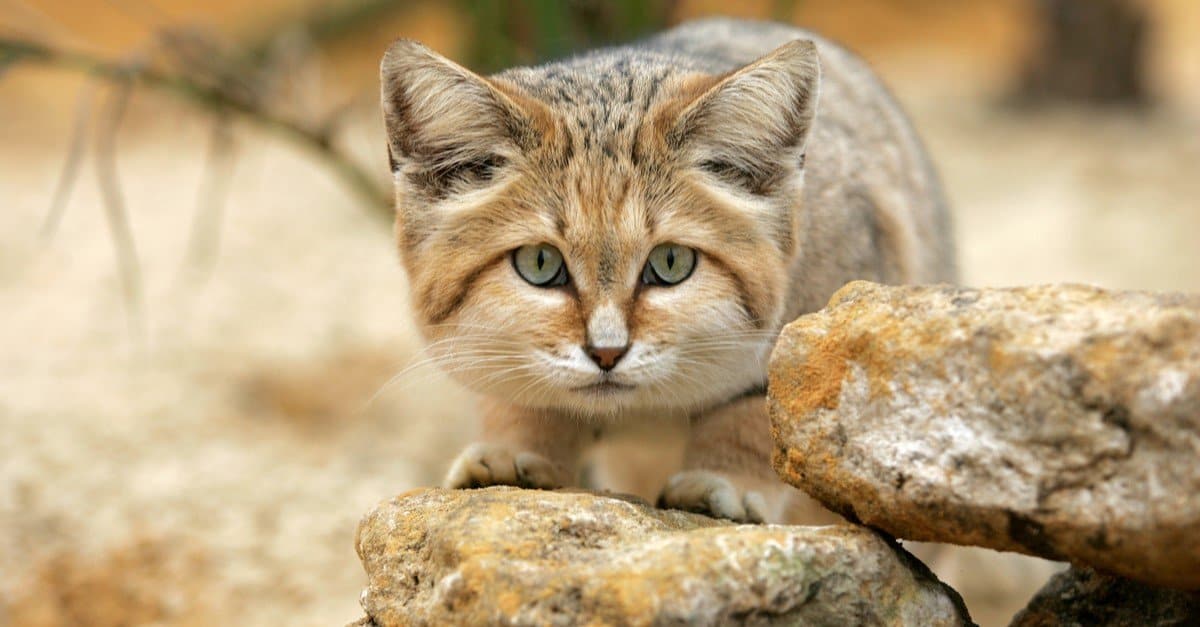
The sand cat is a small felid specialized for life in deserts of North Africa, the Middle East, and parts of Central Asia. It is noted for its broad, low-profile head, very large ears, and furred footpads that help it move over hot or loose sand.

Kingdom
Animalia
Phylum
Chordata
Class
Mammalia
Order
Carnivora
Family
Felidae
Genus
Felis
Species
margarita

Distinguishing Features

  • Very large triangular ears set low on the head (enhances hearing and heat dissipation)
  • Thick fur and fully furred footpads for insulation from hot/cold sand
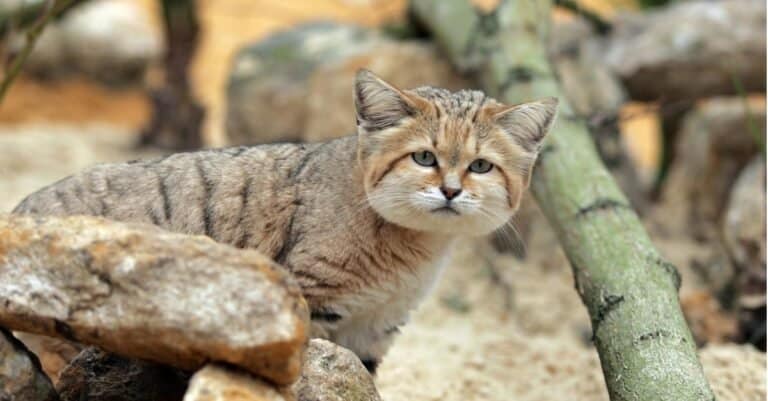
  • Pale sandy coat with subtle striping/spots; ringed tail with darker tip
  • Compact body and low stance adapted to open desert terrain
  • Nocturnal/crepuscular behavior; relies heavily on small rodents, reptiles, and insects

Physical Measurements

Height
11 in (9 in โ€“ 12 in)
Length
2 ft 5 in (2 ft โ€“ 2 ft 9 in)
Weight
6 lbs (4 lbs โ€“ 7 lbs)
Tail Length
11 in (9 in โ€“ 1 ft)
Top Speed
25 mph
running

Appearance

Primary Colors
Secondary Colors
Skin Type Dense desert-adapted fur: soft woolly underfur with longer guard hairs; heavily furred footpads that cover the skin and reduce heat/sand contact.
Distinctive Features
  • Small felid: head-body length 39-52 cm; tail length 23-31 cm (Sunquist & Sunquist, 2002).
  • Lightweight build: typical mass about 1.5-3.4 kg, males averaging larger than females (IUCN Red List species account: Felis margarita).
  • Broad, low-profile head with very large ears set wide apart, enhancing directional hearing in open desert (IUCN Red List: Felis margarita).
  • Ear backs show darker patches; facial markings include faint cheek lines and pale eye surrounds.
  • Footpads densely furred, masking tracks and insulating against hot sand; feet appear relatively broad.
  • Tail relatively thick with multiple dark rings and a black tip; used for balance and signaling.
  • Coat seasonally thickens (especially in colder Asian deserts), increasing insulation while maintaining sandy camouflage.
  • Burrow-associated morphology and behavior: often uses self-dug or enlarged rodent burrows for day shelter; predominantly nocturnal and solitary (IUCN Red List: Felis margarita).
  • Diet-linked desert adaptation: primarily small mammals and reptiles; can persist with minimal free water via prey moisture and efficient water economy (IUCN Red List: Felis margarita).

Sexual Dimorphism

Sexual dimorphism is subtle. Males are typically slightly larger and heavier with a broader head; coat color and markings are generally similar between sexes.

โ™‚
  • Slightly greater average body mass and overall size (IUCN Red List: Felis margarita).
  • Often broader skull and head profile relative to females.
โ™€
  • Slightly smaller, lighter build on average (IUCN Red List: Felis margarita).
  • Similar coat coloration and markings; differences are mainly size-related.

Did You Know?

Size: head-body length 39-52 cm; tail 23-31 cm; weight ~1.35-3.4 kg (males typically heavier).

Its footpads are densely furred-an adaptation that insulates from hot sand and boosts traction on loose dunes.

Sand cats can meet most of their water needs from prey and may go long periods without drinking free water (reported in captive/husbandry observations).

Reproduction: gestation about 59-67 days; litters commonly 2-4 kittens (reported range 1-8).

They are native to deserts from North Africa's Sahara through the Arabian Peninsula and into Iran and Central Asia (to Kazakhstan/Turkmenistan regions).

Their broad, low head and very large ears help detect prey moving under sand; they often hunt small rodents and reptiles, including venomous snakes in some areas.

Longevity: up to ~13 years recorded in captivity; wild lifespan is less well documented due to their secretive, remote desert habits.

Unique Adaptations

  • Enlarged pinnae (outer ears) and an expanded ear canal region relative to many small cats, improving detection of faint prey sounds in open desert terrain.
  • Furred footpads and thick underfur for insulation from both hot sand (day) and near-freezing desert nights.
  • Pale, sand-matching coat with subtle striping/spots that breaks up body outline against dunes and gravel plains.
  • Efficient kidneys and water economy typical of desert-adapted carnivores; moisture from prey reduces dependence on open water sources.
  • Low-profile skull and crouched gait help it stay below dune crests and approach prey in sparse cover.
  • Ability to dig rapidly in sand to reach burrowing prey; forelimb strength and short, powerful pounces are central to its hunting style.
  • Thermal buffering: uses burrows to avoid temperature extremes, a key survival strategy in environments with large day-night swings.

Interesting Behaviors

  • Strictly mainly nocturnal in most of its range, emerging after dusk to avoid extreme daytime heat.
  • Solitary and territorial; adults typically travel alone except during mating or a mother with kittens.
  • Burrow use: rests by day in burrows (often enlarged from fox/rodent burrows) or shallow scrapes under shrubs; may switch shelters frequently.
  • "Listening hunt": pauses with head low and ears forward, then pounces/digs to extract rodents moving beneath sand.
  • Caches or partially covers leftover prey with sand in some observations, reducing scent and heat exposure.
  • Concealment behavior: when threatened, it may freeze low to the ground, blending with dune shadows; it can also sprint between cover patches across open sand.
  • Seasonal breeding varies by region; births are reported at different times across the range (linked to local climate and prey availability).

Cultural Significance

In the Sahara and Arabian deserts, the sand cat (Felis margarita) is seen as a sign of hard-to-see desert wildlife. In Arabic areas it is called "sand cat" or "cat of the sand," showing its link to sandy dunes.

Myths & Legends

Felis margarita was first described from North Africa in the 19th century. The name "margarita" likely honors French General Jean Auguste Margueritte, tying the cat to Saharan exploration and colonial natural history.

Sand cat (Felis margarita) is often called a desert "ghost" where it lives: it is rare, active at night, and moves almost silently on dunes, a local belief, not a formal myth.

Explorers' animal: early naturalists and soldiers traveling desert routes recorded it as an elusive den-dweller of dunes-an anecdotal tradition that helped shape its reputation as one of the desert's most secretive carnivores.

Conservation Status

LC Least Concern

Widespread and abundant in the wild.

Population Decreasing

Protected Under

  • CITES Appendix II (international trade regulated)
  • National legal protection in parts of the range (varies by country; enforcement uneven)

Life Cycle

Birth 3 kittens
Lifespan 8 years

Lifespan

In the Wild 6โ€“10 years
In Captivity 10โ€“16 years

Reproduction

Mating System Polygyny
Social Structure Solitary
Breeding Pattern Transient
Fertilization Internal Fertilization
Birth Type Internal_fertilization

Solitary adults; males maintain larger ranges overlapping several females and mate opportunistically during a seasonal estrus. Copulation is internal; gestation ~59-67 days with litters typically 2-4 kittens, reared by the female alone.

Behavior & Ecology

Social Clowder (rare; otherwise solitary) Group: 1
Activity Nocturnal, Crepuscular
Diet Carnivore Small desert rodents (particularly gerbils/jirds)

Temperament

Elusive and wary; avoids humans and typically freezes or retreats when disturbed.
Territorial; uses frequent scent marking to advertise occupancy and reproductive status (e.g., IUCN Felis margarita account).
Low intraspecific tolerance outside breeding; adults generally avoid each other except mates and dependent young.
Maternal behavior includes den attendance, nursing, grooming, and defensive aggression toward threats near kittens.

Communication

Bark-like call Loud, short yaps) used for long-distance contact, especially in breeding season (reported in wild-cat syntheses such as Sunquist & Sunquist
Meows and short contact calls between mother and kittens.
Growls, hisses, and spits during close-range threats or conflicts.
Purring during affiliative contexts Notably mother-offspring
Yowls/caterwauls during estrus and courtship.
Scent marking via urine spraying and fecal deposition at prominent landmarks Common felid territorial signaling; noted for sand cats in IUCN summaries
Cheek/head rubbing to deposit facial gland scents on objects.
Scratching and ground-scraping/sand-scrapes that combine visual marks with scent cues.
Body postures and facial/ear signals (ear orientation, crouching, tail position) during threat or courtship.
Tactile communication in family units: grooming, nuzzling, and play-biting among kittens.

Habitat

Biomes:
Desert Hot Desert Cold Temperate Grassland
Terrain:
Sandy Rocky Plateau Plains
Elevation: Up to 6561 ft 8 in

Ecological Role

Mesopredator in desert ecosystems specializing on small vertebrates (rodents and reptiles)

Regulates populations of desert rodents (potentially reducing crop/seed predation around oases and settlements) Influences reptile and arthropod community dynamics through predation Transfers energy from small-vertebrate prey to higher trophic levels (supports scavengers via leftovers/carrion) May indirectly affect vegetation structure by suppressing granivorous/herbivorous rodent populations

Diet Details

Main Prey:
Small desert rodents Desert reptiles Snakes Small ground-dwelling birds and nestlings Large arthropods

Human Interaction

Domestication Status

Wild

The sand cat (Felis margarita) is a wild desert cat, not domesticated and never bred for tame traits. It is nocturnal, solitary, uses burrows, and eats small mammals, birds and reptiles, getting much water from prey. Human interactions include research, zoos, rare wildlife tourism, accidental deaths, poultry loss, illegal pet trade, and CITES/national protection.

Danger Level

Low
  • Bites and scratches if handled or cornered (wild felid; defensive aggression possible)
  • Zoonotic disease risk similar to other felids if illegally kept/handled (e.g., rabies exposure risk where present; parasites such as Toxoplasma gondii possible)
  • Handling/transport risks during capture or rehabilitation (stress, unpredictable escape responses)

As a Pet

Not Suitable as Pet

Legality: Sand cat (Felis margarita) is generally not a suitable pet and is often illegal or regulated. In the United States and many countries ownership is restricted or banned. International trade is controlled by CITES; permits and papers are usually required.

Care Level: Expert Only

Purchase Cost: $8,000 - $20,000
Lifetime Cost: $50,000 - $150,000

Economic Value

Uses:
Zoo/education Conservation and research value Ecotourism/photography (limited/rare encounters) Regulated wildlife trade impacts (negative value via enforcement/illegal trade)
Products:
  • Non-consumptive value via zoo exhibition and public education programs
  • Scientific data (desert ecology, sensory adaptation/hearing, arid-land carnivore management)
  • Historically/illegally: skins/pelts and live-animal trade (not recommended; often illegal/regulated)

Relationships

Predators 7

Golden jackal Canis aureus
Gray wolf Canis lupus
Red fox Vulpes vulpes
Ruppell's fox Vulpes rueppellii
Caracal Caracal caracal
Pharaoh eagle-owl Bubo ascalaphus
Steppe eagle Aquila nipalensis

Related Species 9

African wildcat Felis lybica Shared Genus
European wildcat Felis silvestris Shared Genus
Jungle cat Felis chaus Shared Genus
Black-footed cat Felis nigripes Shared Genus
Chinese mountain cat Felis bieti Shared Genus
Domestic cat Felis catus Shared Genus
Caracal Caracal caracal Shared Family
Serval Leptailurus serval Shared Family
African golden cat Caracal aurata Shared Family

Ecological Equivalents 6

Animals that fill a similar ecological role in their ecosystem

Black-footed cat Felis nigripes Small, mostly nocturnal arid-zone cat that hunts mainly rodents, small mammals, and birds. Solitary desert/steppe mesopredator of similar size and role to other small felids.
Ruppell's fox Vulpes rueppellii Nocturnal desert carnivore occupying dunes and rocky desert habitats; large ears aid prey detection and heat dissipation. Diet includes rodents, small reptiles, and insects. Functionally occupies a similar niche to the sand cat as a small desert predator of vertebrates and invertebrates.
Fennec fox Vulpes zerda Hyper-arid desert specialist: a nocturnal, burrow-using predator with very large ears and a heavy reliance on small prey. Sand cats share comparable desert adaptations (burrowing/denning, nocturnality, acute hearing) and overlap in prey base (small rodents, lizards) where their ranges meet in Sahara-type systems.
Pale fox Vulpes pallida Sahelian arid-zone small canid that forages at night and preys on rodents, birds, and reptiles. Ecologically parallels the sand cat as a small-bodied, nocturnal mesocarnivore in open arid landscapes.
Caracal Caracal caracal Medium-sized felid that frequents arid and semi-arid habitats; it overlaps in habitat use and prey types (small mammals and birds), representing a larger-bodied felid guild member that can co-occur with sand cats in desert-edge ecosystems.
Greater Egyptian jerboa Jaculus orientalis Arid-zone burrowing rodent (jerboa-type) prey. Sand cats' desert hunting behavior is strongly structured around the nocturnal surface activity of small rodents (gerbils, jerboas, jirds). Where jerboa assemblages dominate, sand cats and other small desert carnivores converge behaviorally on listening-based, nocturnal hunting near burrow systems.

โ€œSand cats have long fur on the soles of their feet to help them run in hot, shifting sand.โ€

Sand Cat Summary

The sand cat is a desert-dwelling wild cat species found in the deserts of North Africa, the Middle East, and Central Asia. An adaptation it has for living in this harsh environment is its soft woolly fur, which protects it from daytime heat and nighttime cold. It also has long stiff black hairs on the soles of its feet to help it run quickly over deep sand without sinking.

Sand Cat Facts

  • Sand cats have long fur on the soles of their feet to help them run in hot, shifting sand.
  • They are fierce hunters, preying on small animals and snakesโ€”even venomous vipers!
  • They can go for weeks at a time without water, getting moisture from their prey instead.
  • These cats are not endangered and live across North Africa, the Middle East, and Central Asia.
  • They are not aggressive to humans and can be kept as pets, but require special care.

Sand Cat Scientific Name

The scientific name of the sand cat is Felis margarita. It is named after the French General Jean Auguste Margueritte, the leader of an expedition that discovered the cat in Algeria in 1858. It belongs to the Felidae family of the Mammalia class. Another common name for this species is the sand dune cat.

In the past, four subspecies of sand cat were recognized. Today two subspecies have been proposed but need further research before being accepted by the scientific community:

  • Felis margarita margarita โ€“ a small species with yellow-beige fur
  • Felis margarita thinobia โ€“ a larger Asian species with greyer fur

Sand Cat Appearance
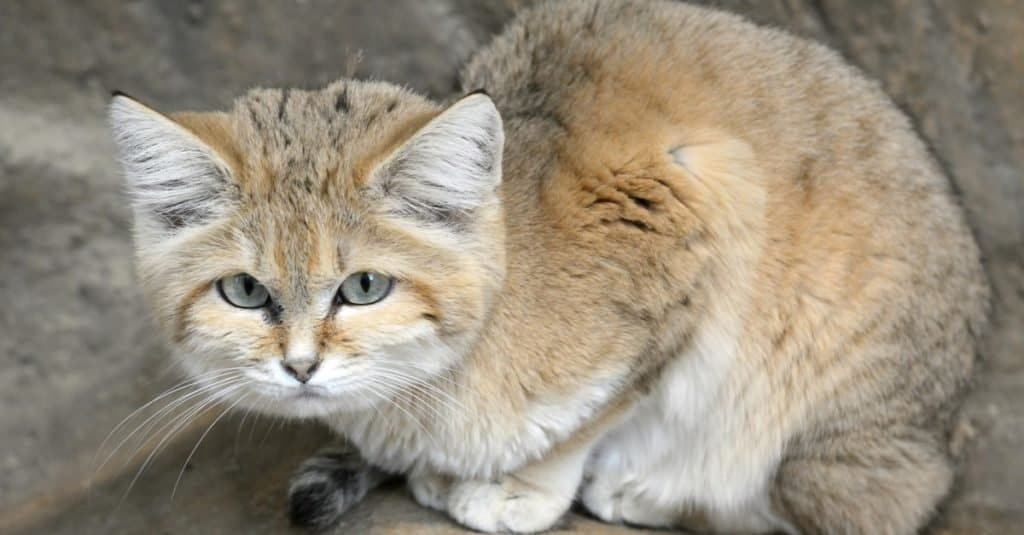
๐Ÿ‘ Sand cats have thick fur on their paws, including between their toes, which helps to insulate them from the scorching heat and brisk cold.

Sand cats have thick fur on their paws, including between their toes, which helps to insulate them from the scorching heat and brisk cold.

ยฉAlexandr Junek Imaging/Shutterstock.com

As small desert-dwellers, the Sand cat range in weight from 3.3 to 7.5 pounds. Their bodies are 15-20 inches long with a tail adding an additional 9-12 inches of length. They stand 9.4-14.2 inches at the shoulder. This is approximately the size of a domestic housecat, though housecats are generally heavier (9-11 pounds)

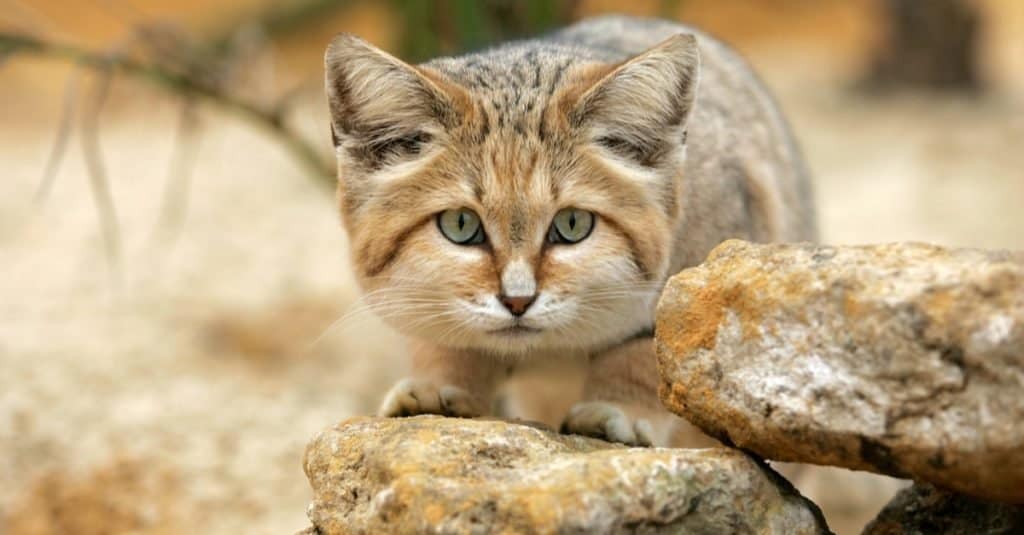
The Sand cat has short legs, a wide head, big eyes, and a long tail. It has larger ears than other small cat species. Their ear canals are twice the size of a domestic cat, allowing about 5 times more sound into their ears. It uses this exceptional hearing to detect the faint scratching sounds of small rodents underground, and to hear mating calls of other cats across vast distances. The ears are set low, which makes the head appear broad and flat.

They have thick woolly fur that can grow 2 inches long. This is useful adaptation to insulate them from the extremes of heat and cold in the desert. Their fur can be pale sandy brown to grey-brown. They are darker on their backs and paler on their bellies and sometimes have striped legs. The lower half of their face and their chest are white or pale yellow. A red streak runs from the corners of their eyes across their cheeks. Their ears and tails are black-tipped and they have a few black rings near the tip of their tails.

A unique adaptation of this species is that they have long dense hair growing between the pads of their feet that create a cushion of fur to help them walk on hot, shifting sand without burning their feet or sinking. This also means their tracks are nearly invisible, making them hard for biologists to track in the wild.

Sand Cat Behavior

In the Sahara, sand cats are called โ€œthe cat that digs holes.โ€ They love to dig, both to construct burrows and unearth rodents burrowing under the sand. They are not found in areas where the soil is tightly compacted. Their claws are not fully retractable. The front claws are short and sharp, adapted to hunting, while the back claws are small and blunt for digging.

During the scorching desert days, sand cats shelter in deep burrows beneath a sand dune or shrub. Sometimes they will use another animalโ€™s empty burrow, even those of other sand cats, but will not sleep together with another cat. When sand cats become too overheated, they sometimes lay outside on their backs to release heat from their chests and bellies.

Sand cats are nocturnal. After dark, they sit by their den opening and use their senses to survey the surrounding area for about 15 minutes. They spend the evening hunting and can travel long distances in search of prey. Typically they roam about 3.4 miles each night. When they return to their den in the evening they perform the same 15-minute vigil before going to bed when the sun comes up.

They have a unique running pattern: they are able to move at a fast run with their bellies close to the ground, with occasional leaps. They can sprint at speeds of 19-25 miles per hour. This is less than that of domestic cats who have longer legs and achieve speeds of up to 30 mph.

Biologists have some difficulty studying sand cats in the wild because of their nearly-invisible tracks, their habit of meticulously burying their feces in the sand, and their clever behavior of closing their eyes when a light is shone on them at night so that their eyes will not reflect in the darkness. Yet, sand cats in some locations are not afraid of humans and reportedly can even be picked up out of their dens without defending themselves.

Sand cats can be tamed easily and are often sold as pets in North Africa and the Middle East. However, when taken to colder and more humid countries they need to be vaccinated and kept in heated indoor facilities to combat respiratory infections. As a wild species, their natural instincts are stronger and their behavior may be more unpredictable than a domestic cat. Capturing cats for the pet trade threatens their continued viability in the wild. It is preferable to enjoy these animals in zoos that are equipped to give them optimal conditions.

Sand Cat Habitat

The sand cat prefers to live in rolling desert terrain with some grasses and small shrubs where more prey can be found and not in bare, shifting sand dunes. In desert habitats where rainfall is sparse, daytime temperatures are extraordinarily hot, reaching up to 124 degrees F. During night, there is no humidity or cloud cover to trap heat and after dark the temperature plunges as low as 31 degrees F. The sand catsโ€™ body and behaviors are adapted to these extreme conditions.

Sand cats inhabit unconnected areas of North Africa, Arabia and other parts of the Middle East, and Central Asia. Sand cats were detected in the border areas of southern Israel and Jordan in the late 1980s but have been considered extinct in that region since 2002, largely due to agricultural cultivation. Thus far, attempts to reintroduce them in that area have not been successful.

Sand Cat Diet

Sand cats hunt birds, insects, rabbits and small rodents such as jerboas and gerbils. They are also fierce snake-killers, feeding even on venomous vipers. Their technique for killing this dangerous prey is to stun it with rapid blows to its head before pouncing on it with a fatal neck bite.

They drink water when it is available but can survive without it for weeks at a time, absorbing moisture from their food instead.. Sand cats have raided human camps at night to steal fresh camelโ€˜s milk.

They hunt at night, slinking close to the ground and listening for any faint sounds their prey might make. If they hear the sounds of burrowing, they quickly dig up their prey. If a kill is too large to eat all at once they will cover it with sand and return later to feed.

Sand Cat Predators, Threats, and Conservation Status

Although sand cats do stalk and kill venomous snakes, these dangerous reptiles are also one of their main predators. Other threats are jackals, large owls, caracals and wolves. Domestic and feral cats and dogs also attack them, compete for the same prey, and transmit diseases. Respiratory infections commonly cause death for domesticated sand cats, especially ones not vaccinated or not kept in a low-humidity environment.

Sand cats were classified as โ€œnear threatenedโ€ until 2016. In that year, the IUCN Red List downgraded their status to โ€œleast concern.โ€ Their numbers in the wild are unknown, but estimates and their wide geographic distribution mean they are no longer considered in danger of extinction.

A major long-term threat to the species is habitat loss. Some areas of their habitat have sparse vegetation that nomadic people use for livestock grazing and for gathering firewood. When depleted, it removes the ground cover and food sources for the smaller animals the sand cat feeds upon.  

Sand cats are sometimes killed by shepherd dogs, poisoned, or caught in traps intended for foxes or jackals (which threaten domesticated poultry). They are sometimes trapped to be sold in the pet trade. Warfare and movement of human refugee populations through wild areas has affected sand cat habitats in several countries, including Mali, Syria, and Iraq.

Although hunting Sand cats in Algeria, Iran, Israel, Kazakhstan, Mauritania, Niger, Pakistan, and Tunisia is prohibited, they are not protected in Egypt, Mali, Morocco, Oman, Saudi Arabia, or the United Arab Emirates. Israel has tried unsuccessfully to reintroduce them into the Arabah Desert.

Sand Cat Reproduction, Babies and Lifespan

Sand cats are solitary animals, widely dispersed over a large area. To help them find other cats across great distances, they have a loud mating call that can sound like a small barking dog. Otherwise, they communicate with the same kinds of vocalizations as domestic cats. They also spray urine and use scents and scratch marks to identify territory.

The breeding season for sand cats differs with their location, climate, and resources. In the Sahara it usually lasts from January to April. In captivity they may breed more than once a year.

Gestation for sand cats takes 59-67 days. They can have anywhere from 1-8 kittens, but the usual litter size is 2-4. Kittens weigh about an ounce at birthโ€”the weight of a slice of bread. Their eyes open at 2 weeks and they first eat solid food at 5 weeks. They can strike out independently at 3-4 months and are sexually mature at 9-14 months.

The sand catโ€™s lifespan in the wild is unknown, but in captivity, they can live up to 18 years old.

Sand Cat Population

The global sand cat population is estimated at over 27,200 adults. This is considered to be a conservative estimate. The long-term trend in sand cat population is unknown.

View all 385 animals that start with S

Sources

  1. Smithsonian's National Zoo and Conservation Biology Institute / Accessed September 15, 2022
  2. Wikipedia / Published September 14, 2022 / Accessed September 15, 2022
  3. International Society for Endangered Cats (ISEC) Canada / Accessed September 15, 2022
  4. Cats for Africa / Accessed September 15, 2022
  5. Sand Cat International Studbook Vol. 21 / Published January 31, 2013 / Accessed September 15, 2022

About the Author

Drew Wood

Drew is a college professor and freelance writer who graduated from the University of Virginia. His travels have taken him to 25 countries and 44 states, where he has enjoyed learning about wildlife in a wide range of environments. In addition to his love of animals, he enjoys scary movies, landscaping, strategy games, and philosophical discussions over a cup of coffee. He is also an emotional support human to a neurotic Spanish Water Dog and a hyperactive Chihuahua mix.

Thank you for reading! Have some feedback for us?

Contact the AZ Animals editorial team

Related Articles You May Find Interesting


Sand Cat FAQs (Frequently Asked Questions)

Sand cats are not aggressive to humans and can be easily domesticated. They are sold as pets in some parts of North Africa and Southwest Asia, but this threatens their population in the wild. To survive in captivity they need warm, very low-humidity environments; otherwise they are prone to respiratory infections that are often fatal. This is a species better enjoyed in the wild and in zoos.

It is a small species of desert cat that lives in North Africa, the Middle East, and Central Asia.

Their numbers in the wild are estimated at about 27,200. They are not considered an endangered species because they are found in many countries over a wide geographical area.

Insects, birds, small animals such as rodents, and snakes, including poisonous vipers.