
S
Species Profile

Snail

Gastropoda

One class, a thousand ways to snail.
Andrey Armyagov/Shutterstock.com

Snail Distribution

Click a location to explore more animals from that region

Invasive Species

This map shows coastal regions where Snail are found.

Loading map...

Size Comparison

Human 5'8"
Snail 1 in

Snail stands at 1% of average human height.

At a Glance

Class Overview This page covers the Snail class as a group. Stats below are general traits shared across the class.
Also Known As Escargot, Periwinkle, Winkle, Sea snail, Land snail, Conch
Activity Nocturnal+
Lifespan 3 years
Weight 14 lbs
Status Not Evaluated
Did You Know?

Gastropoda is the most species-rich class of mollusks, spanning marine, freshwater, and terrestrial "snails."

Scientific Classification

Class Overview "Snail" is not a single species but represents an entire class containing multiple species.

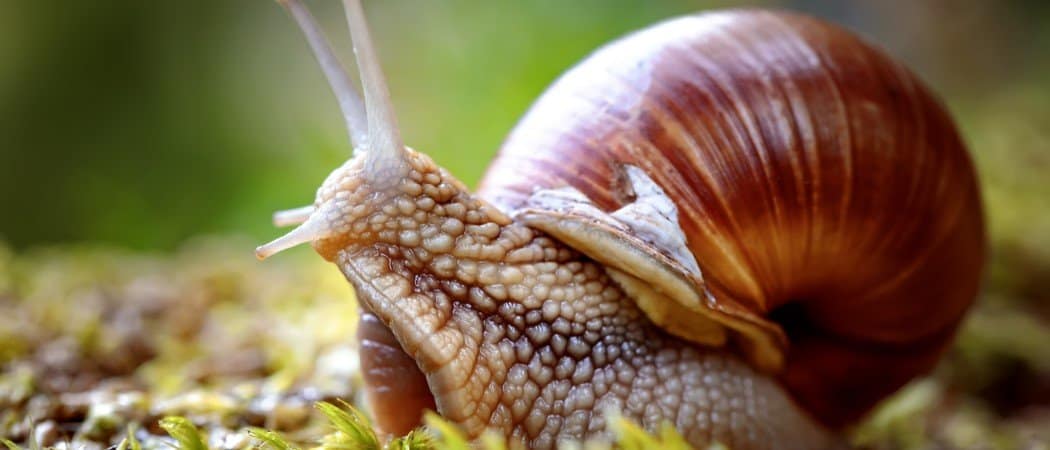
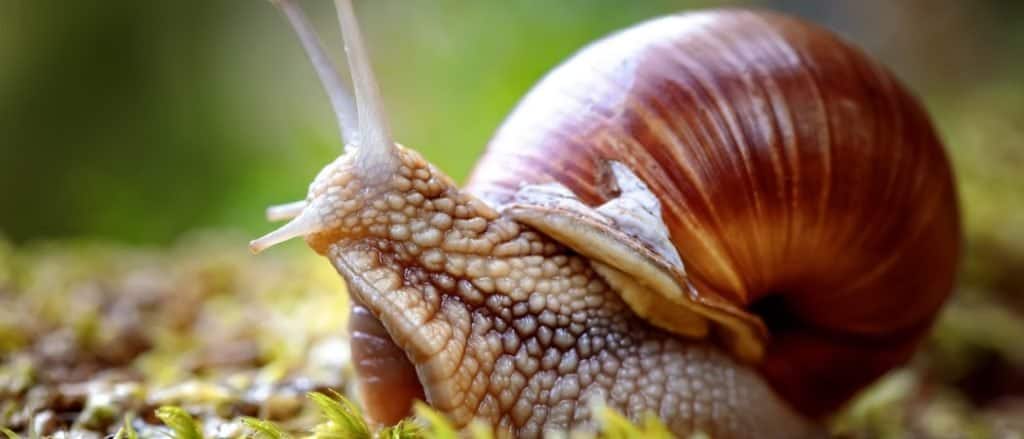
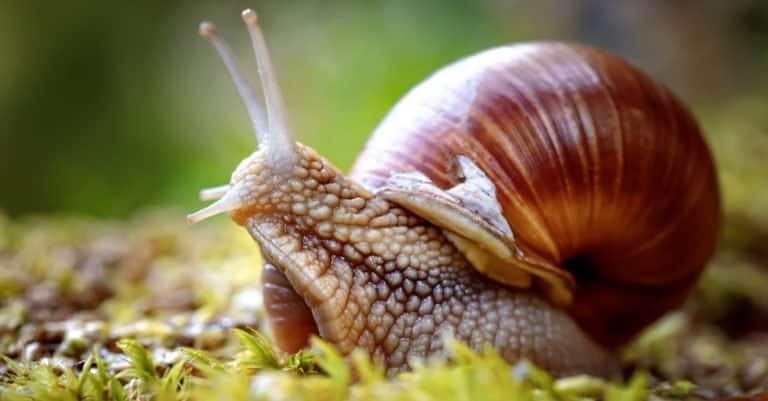
Snails are gastropod mollusks typically characterized by a single (often coiled) shell, a muscular foot for locomotion, and a head with sensory tentacles. They occupy marine, freshwater, and terrestrial environments and include herbivores, detritivores, scavengers, and predators.

Kingdom
Animalia
Phylum
Mollusca
Class
Gastropoda

Distinguishing Features

  • Single, usually coiled shell (reduced or absent in some gastropods)
  • Muscular ventral foot that secretes mucus for gliding
  • Head with tentacles bearing sensory organs (often eyes on upper tentacles in land snails)
  • Radula (rasping tongue-like structure) in most species for feeding
  • Torsion during development (a hallmark of gastropod body plan)

Physical Measurements

Height
1 in (0 in โ€“ 2 ft 12 in)
Length
2 in (0 in โ€“ 2 ft 12 in)
Weight
0 lbs (0 lbs โ€“ 40 lbs)
Top Speed
0 mph
crawling

Appearance

Skin Type Soft-bodied mollusk with moist mantle and muscular foot; body often mucus-coated; shell usually calcareous and external (often coiled), sometimes reduced/internal; many marine species have an operculum closing the aperture.
Distinctive Features
  • Measurements (range across Gastropoda): shell/body length from <1 mm microgastropods to ~90 cm in the largest marine snails; mass from milligrams to several kilograms.
  • Lifespan (range): months to 30+ years across species; many small snails live ~1-3 years, while some large marine/freshwater taxa can persist decades (occasionally longer).
  • Core anatomy: muscular crawling foot, mantle forming the shell, head with 1-2 pairs of tentacles (eyes often on tentacle tips or bases), and a radula used for grazing, rasping, or predation.
  • Shell diversity: high-spired, globose, flattened, or limpet-like forms; apertures may have lips/teeth; thickness varies from fragile to very robust; some lineages show reduced shells (shell-less relatives exist but are not typical snails).
  • Locomotion/behavior: mostly slow crawling via muscular waves and mucus; many marine species cling strongly; some can burrow, float/raft, or briefly swim (varies widely).
  • Ecology/habitats: marine (intertidal to deep sea), freshwater (streams, lakes, wetlands), and terrestrial (forests, grasslands, deserts); activity often tied to moisture/temperature, with hibernation/aestivation common in land snails.
  • Diet roles (highly variable): herbivores/algal grazers, detritivores, scavengers, filter-feeding specializations in some, and active predators in others (including drilling snails and venomous cone snails).
  • Human relevance: important grazers and bioindicators; include crop pests and invasive species, edible/harvested taxa, and medically significant venomous marine snails (e.g., cone snails).

Sexual Dimorphism

Often subtle or absent externally; many terrestrial snails are simultaneous hermaphrodites. In separate-sex lineages, males may be smaller or show reproductive structures (e.g., penis), while females may be larger-bodied with greater reproductive capacity; differences vary widely among families.

โ™‚
  • In some separate-sex groups, presence of penis or modified right tentacle (rare, lineage-specific).
  • Males sometimes smaller or with proportionally narrower shells in certain taxa (not universal).
โ™€
  • Females sometimes larger-bodied/shell-larger, reflecting egg production (varies by lineage).
  • In separate-sex groups, female reproductive anatomy differs internally; external cues often minimal.

Did You Know?

Gastropoda is the most species-rich class of mollusks, spanning marine, freshwater, and terrestrial "snails."

Smallest snails can be under 1 mm long, while the largest sea snails have shells approaching ~90 cm.

Many snails use a rasping tongue called a radula; in different lineages it's tuned for algae, wood, sponges, carrion, or prey.

Some marine snails (cone snails) hunt with a harpoon-like tooth and potent venom-among the most powerful known in nature.

Mucus isn't just slime: it helps snails stick to surfaces, reduces abrasion, can deter predators, and enables movement across rough ground.

Several groups have an "operculum," a door-like plate that seals the shell opening to reduce drying out or block predators.

Land snails commonly exchange sperm as simultaneous hermaphrodites, but across Gastropoda reproduction ranges from separate sexes to live-bearing.

Unique Adaptations

  • Torsion (a hallmark gastropod developmental twist) rearranges the body plan; its consequences are handled differently across lineages.
  • Shell diversity: from high-spired, coiled shells to flattened forms; some groups reduce or lose the shell entirely (slug-like lineages within Gastropoda).
  • The muscular foot is a versatile organ-adapted for creeping, clinging in surf zones, burrowing in sand/mud, or even swimming in some sea snails.
  • Respiration spans gills (many marine snails), lung-like pallial cavities (most land snails), and combinations in amphibious or intertidal species.
  • Operculum "trapdoor" in many groups helps resist predators and drying; other snails instead rely on thick shells, tight apertures, or mucus sealing.
  • Chemical defenses are widespread: from distasteful compounds in some sea snails to sophisticated venoms in cone snails delivered by disposable, dart-like teeth.
  • Life-cycle flexibility: many marine snails have free-swimming larvae for dispersal, while many land snails develop directly in eggs to avoid drying out.

Interesting Behaviors

  • Mostly slow, but not simple: many land snails are nocturnal or crepuscular to avoid heat and dehydration; others are active in rain or fog.
  • Trail-following is common-snails can track mucus trails to find food, mates, or return routes, though how strongly this occurs varies by species.
  • Grazing and "micro-gardening": many snails scrape algae, biofilms, and fungi from rocks, leaves, or reefs, shaping what grows there.
  • Predation styles vary widely: some drill into shells of clams or other snails; others ambush; cone snails actively envenomate fish, worms, or other mollusks.
  • Home-site fidelity occurs in several marine limpets and some snails, which return to a specific scar or refuge on a rock after foraging.
  • Dormancy strategies are widespread but variable: land and freshwater snails may aestivate in drought/heat or hibernate in cold, often sealing themselves in with mucus.
  • Reproductive behaviors differ across the class: from egg masses on seaweed or rocks, to gelatinous freshwater clutches, to land-snail courtship that can last hours.

Cultural Significance

Across cultures, snails (Gastropoda) and their shells are food, tools, art, and symbols. Land snails and marine gastropods (like whelks) are eaten; shells are ornaments, conch trumpets, money, and signs of patience, home, and cycles.

Myths & Legends

China's "Snail Girl" folktale tells of a mysterious girl who emerges from a snail shell to secretly help a poor man with household work; kindness ultimately brings them together.

In Japanese folklore, the "sazae-oni" (named for a turban snail) appears as a supernatural sea spirit that sometimes tricks people before revealing a monstrous form.

In Hindu tradition, the sacred conch shell is closely linked with Vishnu and is blown in ritual as an auspicious sound said to dispel negativity and mark sacred beginnings.

In ancient Greek myth and art, the sea-god Triton uses a conch shell as a trumpet to calm or stir the waves, making the shell a symbol of oceanic power and divine announcement.

Across parts of West Africa, cowrie shells (from marine gastropods) became deeply embedded in spirituality and divination traditions and also served historically as currency in wide trade networks.

In Mesoamerican traditions, conch shells were used as powerful symbols and ceremonial instruments; in Aztec and Maya contexts they appear in ritual and iconography tied to water, wind, and the underworld.

Conservation Status

NE Not Evaluated (class-level hub). Gastropoda is extremely diverse and not assessed as a single IUCN unit; species statuses span LC to EX (many island land snails and freshwater spring snails are CR/EW/EX). Size ranges from <1 mm microgastropods to ~0.9 m shell length in the largest marine species; lifespans range from weeks/months to decades (some long-lived marine taxa >30-50 years). Ecology varies widely across marine, freshwater, and terrestrial habitats; many are slow-moving grazers/detritivores, but includes active predators; activity may be nocturnal/seasonal, and reproduction ranges from broadcast spawning with larvae to direct-developing, often hermaphroditic land snails.

Has not yet been evaluated against the criteria.

Population Unknown

Protected Under

  • Varies by species and country; many threatened land and freshwater snails are legally protected under national endangered-species laws and site-based protected areas.
  • CITES: some gastropods are regulated in international trade (e.g., queen conch Strombus gigas listed in Appendix II).
  • EU Habitats Directive: select threatened land snails are listed on Annexes (e.g., Vertigo moulinsiana, Vertigo angustior) requiring habitat protection and management.
  • United States Endangered Species Act: multiple endemic land and freshwater snails are listed (e.g., Hawaiian tree snails and various spring/river snails), with critical habitat designations in some cases.

Looking for a specific species?

Common garden snail

Cornu aspersum

In everyday English, "snail" (especially in gardens/terrestrial contexts) most often refers to this widespread land snail, historically also known as Helix aspersa.

  • Air-breathing terrestrial gastropod common in gardens, farms, and urban greenspaces.
  • Feeds primarily on plant material and detritus; can be an agricultural/horticultural pest.
  • Uses mucus for locomotion and moisture retention; activity often peaks in humid, cool conditions.
  • Hermaphroditic; mates reciprocally and lays eggs in soil.
  • Not representative of all Gastropoda: the class also includes marine and freshwater forms, shell-less slugs, and highly specialized predators (e.g., cone snails).

You might be looking for:

Common garden snail

22%

Cornu aspersum

A widespread land snail commonly found in gardens; often what people mean by "snail" in temperate regions.

Giant African land snail

14%

Lissachatina fulica

Very large invasive land snail in many tropical/subtropical regions; important pest/vector concerns.

View Profile

Roman snail

12%

Helix pomatia

Large European land snail, famous as an edible escargot species.

Common periwinkle

10%

Littorina littorea

Intertidal marine snail common on North Atlantic rocky shores.

Geography cone snail

8%

Conus geographus

Venomous marine snail; notable for medically significant conotoxins.

Life Cycle

Birth 100 hatchlings
Lifespan 3 years

Lifespan

In the Wild 0.1โ€“40 years
In Captivity 0.2โ€“50 years

Reproduction

Mating System Hermaphroditism
Social Structure Solitary
Breeding Pattern Transient
Fertilization Internal Fertilization
Birth Type Internal_fertilization

Across Gastropoda, mating is often transient and promiscuous, with many species being simultaneous hermaphrodites that copulate reciprocally and may store sperm from multiple partners. Some major lineages have separate sexes, but pair bonds are typically brief.

Behavior & Ecology

Social Aggregation Group: 3
Activity Nocturnal, Crepuscular, Cathemeral, Diurnal
Seasonal Hibernates

Temperament

Generally non-aggressive; relies on withdrawal, shell/cover use, and mucus defenses
Low sociability; interactions are brief and context-dependent (mating, food, shelter)
Resource-driven tolerance: crowding increases at moist refuges or rich feeding patches
Some taxa show territoriality or site fidelity (e.g., homing/space defense in certain marine forms)
Predatory species may be more assertive; cannibalism/scavenging occurs in some lineages
Risk-avoidant and disturbance-sensitive; activity often reduced by desiccation, heat, salinity shifts

Communication

none No specialized vocal communication
chemical signaling via mucus trails and pheromones for mate finding and trail following
tactile contact using tentacles and body during courtship, recognition, and displacement
mechanosensory cues (substrate vibrations/water movement) indicating predators or nearby individuals
contact chemoreception (tasting surfaces/conspecific mucus) to assess mates, rivals, and habitat
visual cues are limited; some respond to shadows/light changes, varying by habitat and eye complexity

Habitat

Biomes:
Tropical Rainforest Tropical Dry Forest Savanna Desert Hot Desert Cold Mediterranean Temperate Grassland Temperate Forest Temperate Rainforest Boreal Forest (Taiga) Tundra Alpine Freshwater Marine Wetland +9
Terrain:
Mountainous Hilly Plateau Plains Valley Coastal Island Riverine Volcanic Karst Rocky Sandy Muddy +7
Elevation: Up to 18044 ft 8 in

Ecological Role

Ecologically diverse consumers in marine, freshwater, and terrestrial systems, functioning as primary consumers (grazers), decomposers/detritus processors, scavengers, and predators depending on lineage and habitat.

control of algal growth and biofilms on rocks, plants, and reefs breakdown and recycling of organic matter (detritus processing) and nutrient cycling regulation of benthic invertebrate populations via predation (including on bivalves and worms) carrion removal and local sanitation (scavenging) sediment mixing/bioturbation and benthic energy transfer bioerosion and reef/shoreline material turnover in some grazing/drilling forms key prey base for fishes, birds, mammals, and invertebrates, supporting food webs

Diet Details

Main Prey:
Annelid worms Gastropods Bivalves Barnacles and other sessile crustaceans Small crustaceans Cnidarians Sponges and bryozoans Fish Carrion +3
Other Foods:
Microalgae, diatoms and biofilm Seaweeds Living plant tissues Decaying plant litter and wood Fungi and fungal mats Detritus and organic-rich sediments Lichen +1

Human Interaction

Domestication Status

Wild

Gastropoda are not domesticated like dogs or chickens, but some have been kept and bred by people. Land snails are farmed in heliciculture for food, and abalones and other species are raised in aquaculture or sold for aquariums. Snail farming dates to ancient Mediterranean times; escaped snails often become invasive.

Danger Level

Moderate
  • Parasites and pathogens: some gastropods act as intermediate hosts for human/animal parasites (notably rat lungworm/angiostrongyliasis from ingestion of raw/undercooked snails or contaminated produce; freshwater snails are key hosts in schistosomiasis transmission cycles in endemic regions).
  • Venomous stings: a minority of marine predatory gastropods (e.g., cone snails) can deliver medically serious, rarely fatal envenomations; risk is mostly from handling live specimens.
  • Allergies/irritation: contact with mucus or handling can trigger dermatitis or allergy in sensitive individuals; aquarium exposure can contribute to irritation in some settings.
  • Food safety: eating raw/undercooked snails can transmit parasites; improper handling/storage can cause gastrointestinal illness.
  • Indirect hazards: invasive/pest species can cause significant agricultural damage, and some freshwater species contribute to harmful algal/biofouling dynamics; risk is economic/ecosystem-focused rather than direct physical harm.

As a Pet

Suitable as Pet

Legality: Rules vary by place and species. Many common freshwater and captive-bred land snails are legal locally. Import, interstate transport, release, wild collection in protected areas, and some marine snails may be restricted to stop invasive species and crop damage.

Care Level: Moderate

Purchase Cost: Up to $100
Lifetime Cost: $20 - $1,000

Economic Value

Uses:
Food and aquaculture Agriculture and horticulture (both pests and biocontrol/management) Aquarium and ornamental trade Public health and veterinary relevance Research and education Materials and cosmetics
Products:
  • edible snails (markets for edible land snails; regional cuisines)
  • abalone and other farmed marine gastropods (meat; sometimes shells as byproducts)
  • aquarium "cleanup crew" snails for algae/biofilm control
  • snail shells for crafts/ornaments and collector markets
  • snail mucus/mucin used or marketed in cosmetics (variable evidence/claims depending on product)
  • laboratory and classroom use (development, neurobiology, ecotoxicology; some taxa are common model organisms)
  • economic impacts as crop pests (leaf/seedling damage; contamination; quarantine costs)
  • biomonitoring/ecotoxicology indicators (some species accumulate pollutants)

Relationships

Predators 10

Song thrush Turdus philomelos
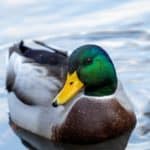
Ducks Anatidae
Hedgehog Erinaceus europaeus
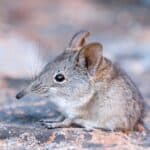
Shrew Soricidae
Ground beetles Carabidae
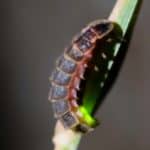
Firefly larvae Lampyridae
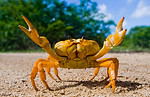
Crabs Brachyura
Sea star Asteroidea
Pufferfish Tetraodontidae
Land planarians Geoplanidae

Related Species 8

Slugs Limacidae Shared Family
Pond snails Lymnaeidae Shared Family
Periwinkles Littorinidae Shared Family
Cone snails Conidae Shared Family
True limpets Patellidae Shared Family
Abalone Haliotidae Shared Family
Sea hares Aplysiidae Shared Family
Apple snail Ampullariidae Shared Family

Ecological Equivalents 6

Animals that fill a similar ecological role in their ecosystem

Chitons Polyplacophora Marine rock-grazing mollusks that scrape algae and biofilm, occupying a similar niche to many intertidal snails despite being in a different class.
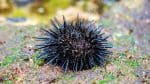
Sea urchin Echinoidea Many are strong algal and biofilm grazers on reefs and rocky shores, overlapping with herbivorous marine gastropods in food resources and habitat use.
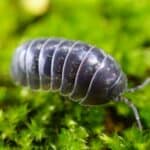
Woodlouse Oniscidea Terrestrial detritivores that often share moist microhabitats with land snails and overlap in decomposition and leaf-litter processing roles.
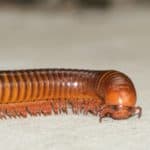
Millipede Diplopoda Leaf-litter and detritus feeders occupying similar forest-floor niches; both are moisture-dependent and contribute to decomposition.
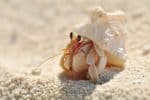
Hermit crab Paguroidea Scavengers and omnivores that frequently occupy empty snail shells and can overlap with snails in coastal scavenging and shelter dynamics.
Planarian flatworms Geoplanidae Land planarians. Moist-soil predators that commonly hunt land snails and slugs, exerting strong trophic impacts in many regions, including as invasive predators.

Types of Snail

9

Explore 9 recognized types of snail

Common garden snail Cornu aspersum
Roman snail Helix pomatia
Giant African land snail Lissachatina fulica
Common periwinkle Littorina littorea
Geography cone Conus geographus
Red abalone Haliotis rufescens
Common limpet Patella vulgata
Leopard slug Limax maximus
Apple snail Pomacea canaliculata
๐Ÿ‘ Image

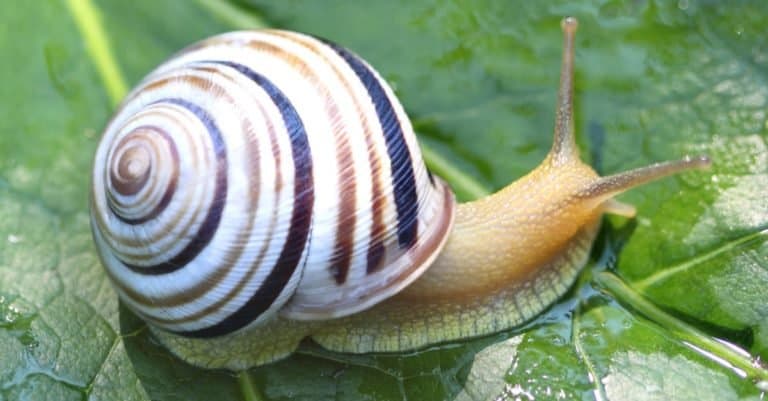
Slow-moving but always fascinating, the snail is one of the most ecologically diverse animals on the planet.

Belonging to the phylum of Mollusca, itโ€™s found almost everywhere in the world, from high mountains to simple botanical gardens to deep undersea rocks. In some parts of the world, these animals are kept as pets. Check out these cool names for snails if you have one of these and you need a name for it.

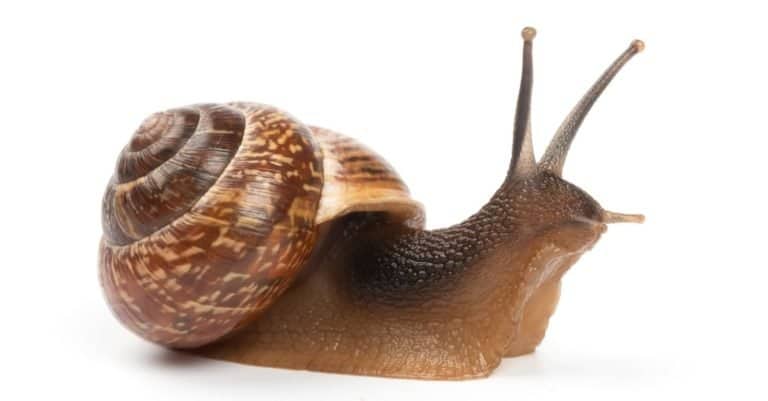
The shell is the defining feature of the snail. This is the one thing that separates them from the closely related slugs and sea slugs (although many slugs still have internal shell plates within their bodies). Since the shells contain most of the internal organs, snails cannot survive without shells.

5 Incredible Snail Facts!
๐Ÿ‘ Image

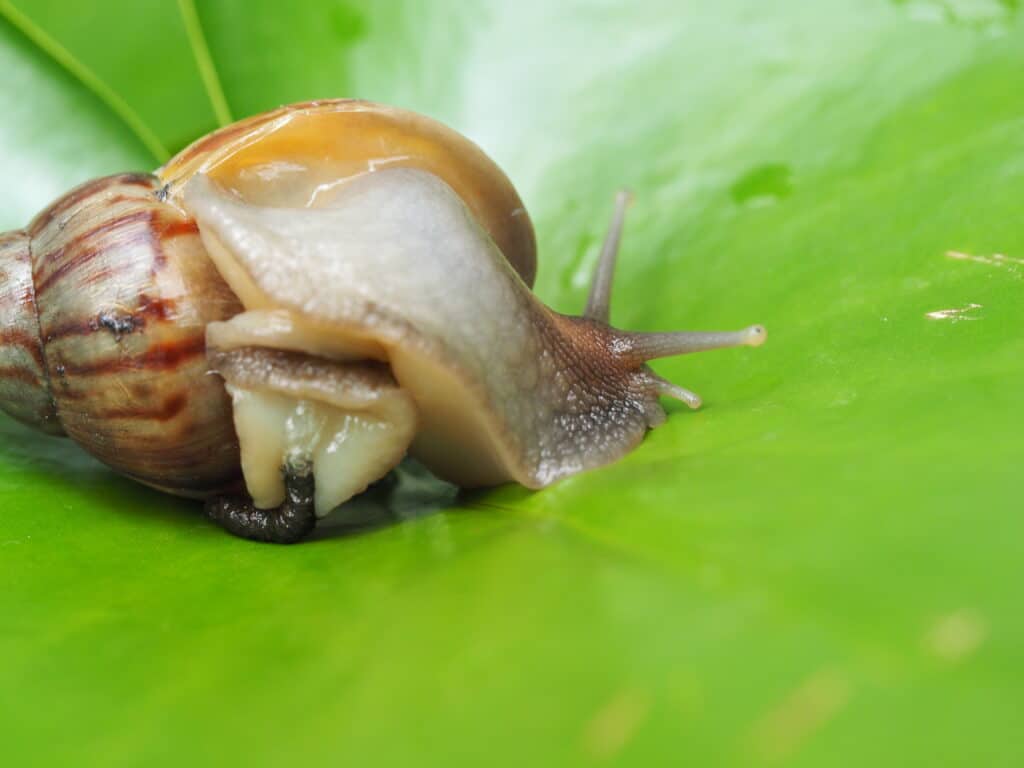
Snails poop, just like most creatures.

ยฉHuaykwang/Shutterstock.com

  • These animals contain only rudimentary eyes and no ears at all. Instead, they interact with the environment around them through their sense of touch and their ability to detect vibrations.
  • One of the more unusual facts is that many species are hermaphroditic, meaning that they possess both male and female reproductive organs. After mating, snails bury their eggs below the ground. Depending on the climate conditions, these eggs will hatch a few weeks later. The young snails are so eager for food that they may consume the unhatched eggs from the same parents. During development, they undergo a process called torsion in which their mass is rotated to one side, meaning the anus is actually located close to the head.
  • Snails can survive the harsh winter by living off their fat reserves. They have multiple lines of defense to protect their soft bodies as they hibernate: first, they dig a small hole in the ground, then they retreat into their shell, and finally, they seal off the entrance of the shell from potential predators. This process of hibernating is called estivation. It is also known as summer sleep but it is different from how snails sleep daily.
  • Some aquatic snails (like the nerites) have gills to breathe underwater; others retain both lungs and gills. The apple snail has a breathing tube that reaches the surface of the water.
  • The sea snail has a natural adhesive that allows them to stick to rocks without being carried away by the surf. This has inspired some researchers to develop a kind of experimental medical glue for use in repairing heart defects.

Evolution and Origins

The snail evolved on the planet over 150 million years ago. Gastropods, cephalopods, and bivalves were thought to represent a group of species that coexisted throughout the Cambrian epoch.

The earliest land snail is considered to have arisen around 350 million years ago when land plants first started to demand extremely moist circumstances. Being able to survive on land required the snail, whose body is still primarily made of water, to endure periods of unfavorable circumstances.

Furthermore, in shallow seas, the earliest snail species first appeared. This way of existence was made possible by gills, and many freshwater and saltwater animals still rely on them. The Late Cambrian Era, or roughly 500 million years ago, is when the earliest gastropods were unquestionably discovered.

Species, Types, and Scientific Names
๐Ÿ‘ Assassin snail in aquarium

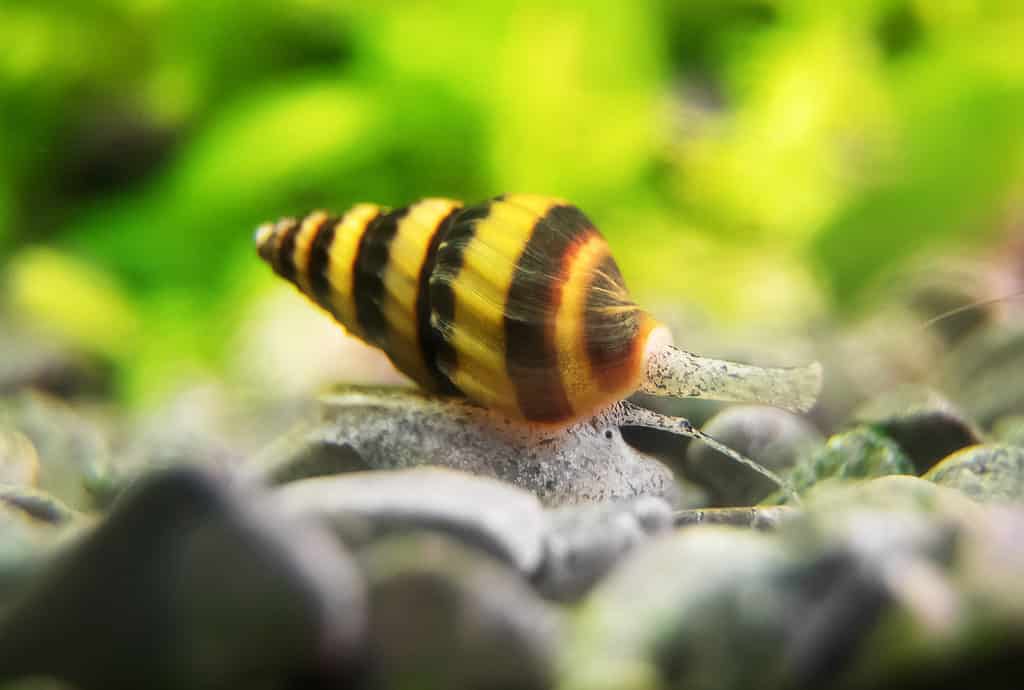
Assassin snail in aquarium.

ยฉM-Production/Shutterstock.com

The scientific name of the snail is Gastropoda. This is derived from two Greek words meaning โ€œstomachโ€ and โ€œfoot.โ€ The scientific name refers to the position of the foot below the gut. Gastropods belong to the phylum of Mollusca.

In terms of the number of species, they are the largest class within the phylum. About 24,000 species have so far been subject to classification, but there may be 85,000 or more species of gastropods in the world. These can be divided into a few general classifications:

  • Land Snails โ€“ These are the most well-known and the most likely to interact with people. The majority of land snails fall within the sub-class of Heterobranchia, along with the slugs.
  • Freshwater Snails โ€“ Represented by thousands of different species, including the apple snails and nerites, freshwater species primarily occupy rivers, lakes, and streams.
  • Sea Snails โ€“ Elusive and rarely seen, most gastropods actually inhabit the deep seas and near coasts, an entire underwater world secluded from people. Sea snails are divided into a few different classifications such as the Vetigastropoda and Caenogastropoda.

Here are the most common, representative species of snail types:

  • Garden snail
  • Burgundy snail
  • Monachoides vicinus
  • Paralaoma servilis
  • Neverita didyma
  • Decollate snail
  • Callistocypraea aurantium
  • Cerithium echinatum
  • Clypeomorus batillariaeformis
  • Cerithium tenellum
  • Cerithium scabridum
  • Gastrocopta servilis
  • Cerithium pacificum
  • Cerithium africanum
  • Cerithium browni
  • Scutalus
  • Cerithium acuticosta
  • Cerithium atromarginatum
  • Cerithium alutaceum

Appearance

๐Ÿ‘ giant snail

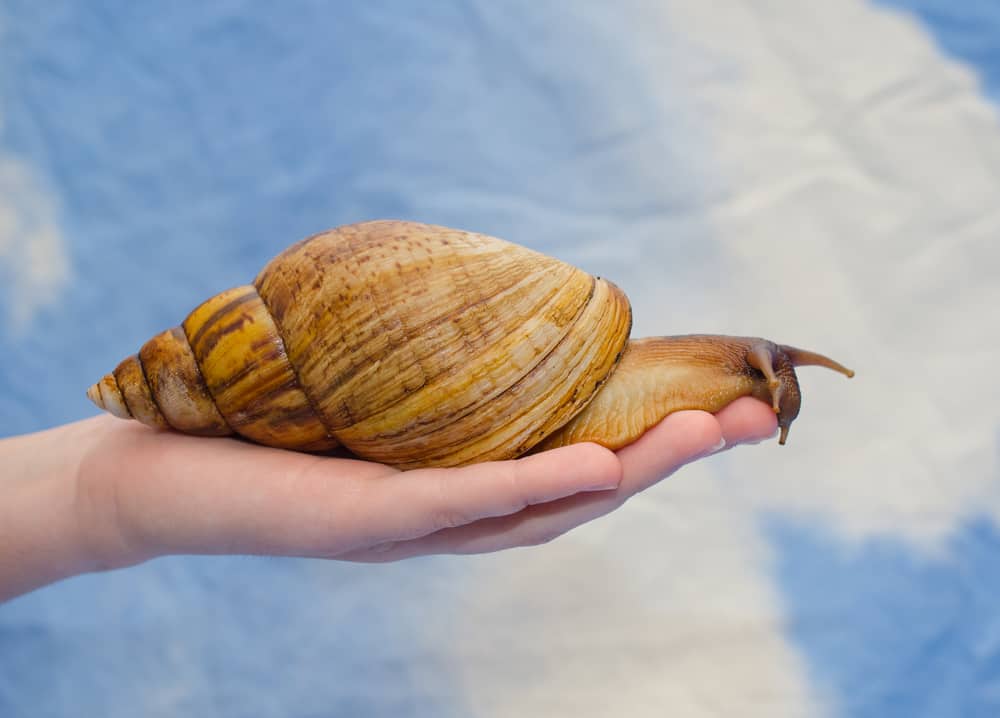
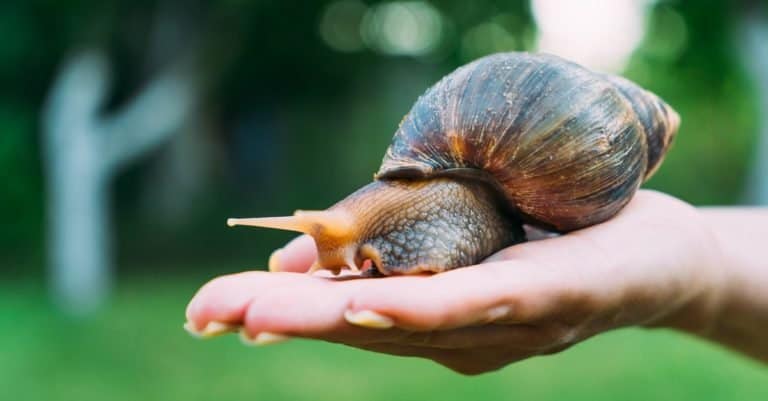
Giant African snail on a human hand (against a bright blue background)

ยฉOlena Kurashova/Shutterstock.com

While most people are familiar with the basic garden snail, the entire gastropod class contains an immense diversity of different appearances and forms. Apple snails, nerites, ramshorn snails, etc all have their unique characteristics.

In terms of their diversity, gastropods are second only to the insect class. However, snails are not insects. Most snails possess a soft, tube-shaped body, a muscular foot for locomotion, one or more pairs of tentacles emerging from the head, and small eyes at the top of the base of the main stalks.

The most conspicuous feature that all species share is the spiral shell. It is attached directly to the body and cannot be removed without killing the snail, since it contains most of the internal organs.

The shell consists of three different layers attached to the mantle. The hypostracum is the innermost layer, situated directly against the body. The ostracum, which consists of calcium carbonate crystals and organic material, is the middle layer. The periostracum, which consists of several organic compounds, is the top layer and also gives the shell its color. Shells come in many different shapes, including cones, ears, spindles, and even completely unique patterns found nowhere else.

The largest known species is the Giant African Snail, which grows up to a foot long. The smallest ever species identified, which comes from southern China, is no more than a millimeter. Most species measure a few inches in size between these two extremes.

Is a Slug a Snail?

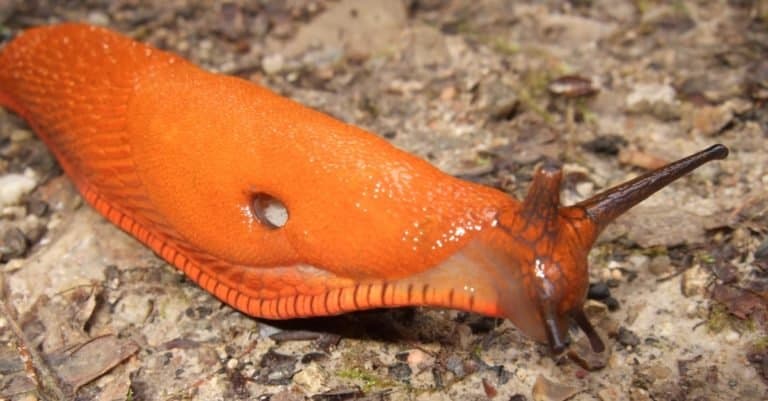
A slug isnโ€™t a snail. Slugs are the closest animals that look like snails; however, both animals are not the same. Slugs are the only gastropods that live without shells at all. Their habitats and habits differ from snails. Since most slugs lack a shell, they tend to squeeze into tight places like under tree bark and rocks. These habitats help protect them from predators and are great places to lay eggs.
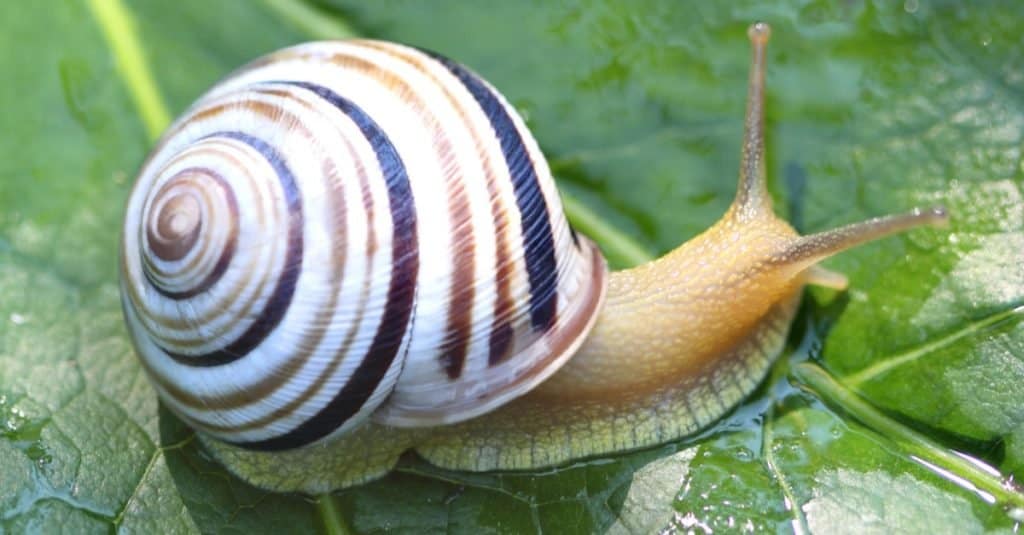
๐Ÿ‘ A beautiful multi-colored snail in the garden after the rains.

A beautiful multi-colored snail in the garden after the rains.

ยฉbmaki/Shutterstock.com

Habitat

These animals are found almost everywhere on the planet, including oceans, rivers, lakes, forests, mountains, deserts, and even botanical gardens. The thickness of the shell is directly related to the local climate conditions. In drier regions, snails have thicker shells to help them retain moisture. In wetter regions, they tend to have thinner shells.

Diet
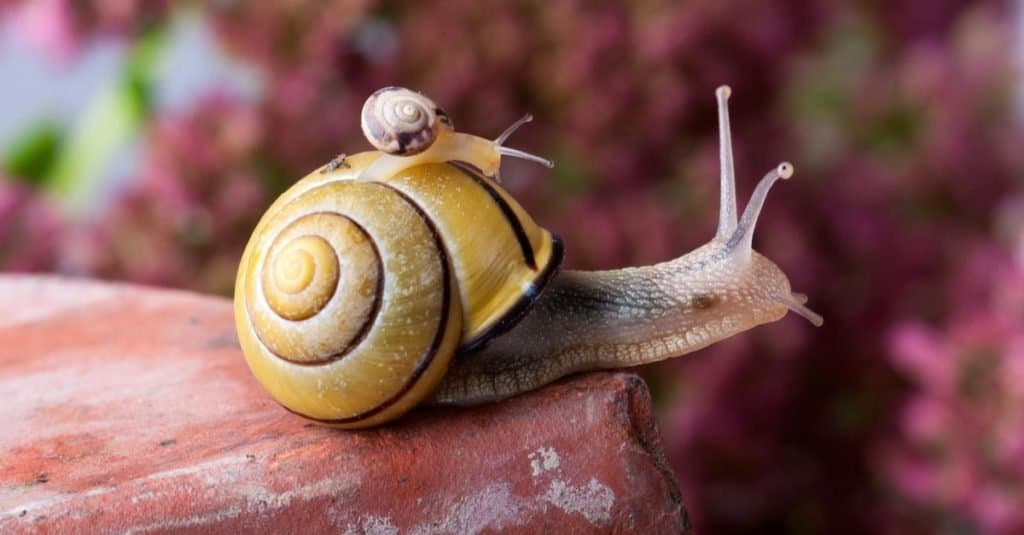
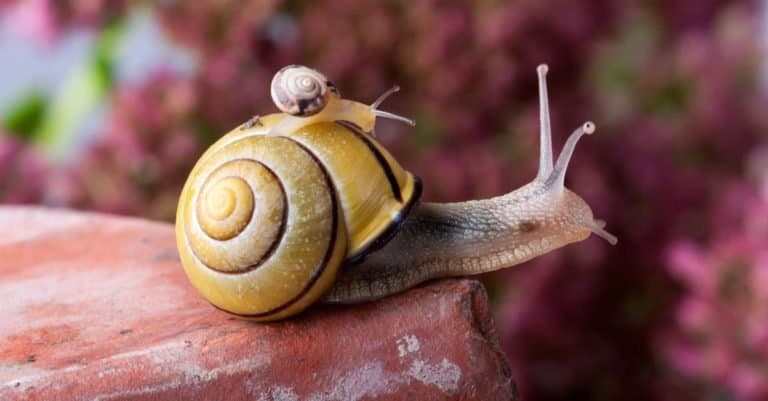
๐Ÿ‘ Closeup af a Yellow and Black banded Snail carrying a tiny snail on her back

Closeup af a Yellow and Black banded Snail carrying a tiny snail on her back

ยฉNailia Schwarz/Shutterstock.com

One of the most interesting facts about the animal is the sheer diversity of different feeding strategies. Depending on the species, they run the gamut between an herbivorous, carnivorous, or even a parasitic lifestyle. Marine species are more likely to be carnivorous or omnivorous, while land snails tend to feast exclusively on plant matter. Most species have rows of small teeth and a rough tongue called a radula to consume food.

Garden snails eat mostly leaves, vegetables, and flowers. However, they may also eat organic matter like dead worms or even other snails.

What eats the snail?

The animal provides a stable food source for all kinds of hungry birds and mammals. It is also raised and eaten by humans across many different cultures and places. In France, for instance, the edible snail is considered to be a delicacy called escargot.

What does the snail eat?

Most of these animals are herbivorous; they feed on leaves, stems, bark, fruits, and even algae. Carnivorous snails (mostly of the marine variety) also happily consume worms, fish, and even other snails. These animals obtain calcium from dirt and rocks to build their impressive shells.

For a complete analysis of what snails eat, make sure to read โ€˜What Do Snails Eat? Their Diet Explained.โ€™

Prevention

For most people, these animals are simply an intrinsic part of the environment, easy to ignore. But anyone whoโ€™s ever tried to maintain a botanical lawn or garden knows that they sometimes cause immense damage to plants, especially since snails live up to 10 years in the wild! Short of calling a professional, there are several things you can do to get rid of them.

The most humane solution is to put up a copper mesh barrier to repel them or try to remove them by hand. You should also try to eliminate any dark, shaded areas which might attract snails. If youโ€™re not invested in a specific type of plant, then you might want to consider using snail-resistant plants like lavender, rosemary, and sage. Salt is another effective method to get rid of snails, but it also might increase the salinity of the soil, which can damage plants.

Snails as Food
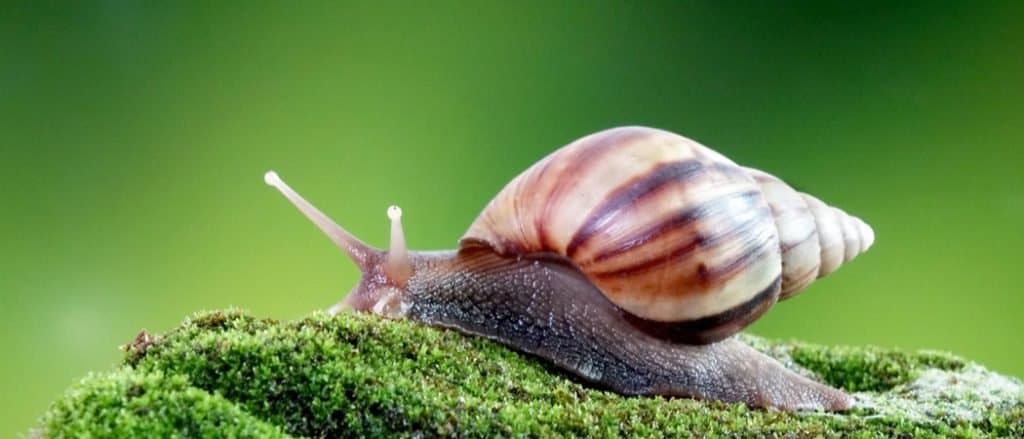
๐Ÿ‘ Giant African snail or giant African land snail

Giant African Land Snail

ยฉMark Brandon/Shutterstock.com

It is very common for humans to eat snails. In French cuisine, edible snails are served as a delicacy. The practice of raising snails for food is called heliciculture. Snails are often kept in a dark place in wire caged with dry wood or straw. Once ready, the snails are prepared for cooking. Once cooked, their texture becomes chewy yet tender.

Snails are often considered gourmet food and several different species of land snails can provide a hearty amount of protein to disadvantaged communities around the world. A variety of snails are valuable because they can feed a large number of people with little cost. In fact, in some countries, giant African land snails are produced commercially for food.

Land snails, freshwater snails, and even sea snails are all eaten in many countries. In some parts of the world, snails are fried as satay which is a dish called sate kakul. Even snail eggs of some snail species are eaten in a similar way caviar is eaten. Additionally, in Bulgaria, snails are cooked in an oven with rice or fried in a pan with vegetable oil.

View all 385 animals that start with S

Sources

  1. Thought Co / Accessed June 6, 2021
  2. Lloyd Pest Control / Accessed June 6, 2021
  3. Mentalfloss / Accessed June 6, 2021

About the Author

Rebecca Bales

Rebecca is an experienced Professional Freelancer with nearly a decade of expertise in writing SEO Content, Digital Illustrations, and Graphic Design. When not engrossed in her creative endeavors, Rebecca dedicates her time to cycling and filming her nature adventures. When not focused on her passion for creating and crafting optimized materials, she harbors a deep fascination and love for cats, jumping spiders, and pet rats.
Connect:

Thank you for reading! Have some feedback for us?

Contact the AZ Animals editorial team

Related Articles You May Find Interesting

A Mysterious Giant Phantom Jellyfish Appears in Rare Deep Sea Encounter


Snail FAQs (Frequently Asked Questions)

Depending on the species, snails run the gamut between an herbivorous, carnivorous, or even a parasitic lifestyle.

Snails belong to the Kingdom Animalia.

Snails belong to the phylum Mollusca.

Snails belong to the order Achatinoidea.

Snails are covered in shells.

Snails are found worldwide.

Snails live in well-vegetated areas.

Snails eat leaves, fruits, and stems.

Predators of Snails include rodents, frogs, and birds.

Snails have armored shells with long, thin eye stems.

The average number of babies a Snail has is 200.

There are nearly 1,000 different species of Snail!

The scientific name for the Snail is Achatinoidea.

There are 1,000 species of Snail.

The vast majority of snails are completely harmless. But there is one marine group called the cone snails that can inject dangerous venom into anything that threatens it. The smallest cone snails arenโ€™t too dangerous; they only deliver a painful sting like a bee. But the largest species can actually kill a person with their potent venom. Fortunately, these species are not usually encountered by people.

Snails possess a single muscular foot and not a leg. By making a wavy motion with this foot, they can push against a surface to move forward.

Snails are easy to identify from their long, tube-like bodies, sinewy tentacles, and the spiral shell on the back. In fact, most true snails cannot live without shells.

Some of the best strategies to get rid of snails include setting traps and barriers, removing them by hand, using drip irrigation methods on your plants, replacing your current plants with snail-resistant ones, and eliminating all potential hiding places. Salt can also work to repel them.

A few species of marine cone snail can inject dangerous venom via a harpoon-like apparatus (essentially, a modified tooth), but only a few dozen deaths have ever been recorded from cone snails.

A snail can sense basic lightness and darkness with its eyes but not much more.

Most species only live for a few years, but some of the larger snails may live up to 10 years in the wild.

Yes, they have rows of small teeth in their mouths.

Snails can make good low-maintenance pets for anyone invested in their care, but owners will need to simulate their natural environment as much as possible. Theyโ€™re also short-lived even by the standards of most pets.

The key differences between nerite snails and mystery snails are taxonomy, size, color, health issues, and lifespan.

The differences between male and female mystery snails are physical characteristics, behavior, and shell color.

The key differences between apple snails and mystery snails are taxonomy, appearance, and diet.

The key differences between Trochus snails and Astrea snails are appearance, reproduction, and lifespan.

The key differences between pond snails and bladder snails are appearance, lifespan, and adaptability.