

S
Species Profile

Spider Ball Python

Python regius

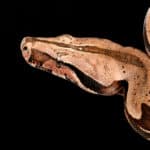
Webbed beauty-handled with care.
fivespots/Shutterstock.com

Spider Ball Python Distribution

Domesticated Species

Found Worldwide

At a Glance

Domesticated
Also Known As Ball python, Royal python, BP
Diet Carnivore
Activity Crepuscular+
Lifespan 12 years
Weight 3 lbs
Status Not Evaluated
Did You Know?

"Spider" is a color/pattern morph of the Ball Python (Python regius), not a separate species-taxonomy is unchanged.

Scientific Classification

The Spider morph Ball Python is a captive-bred genetic morph of the Ball Python characterized by a reduced/โ€œwebbedโ€ pattern and lighter overall coloration compared with wild-type animals. It is widely kept in the pet trade.

Kingdom
Animalia
Phylum
Chordata
Class
Reptilia
Order
Squamata
Family
Pythonidae
Genus
Python
Species
Python regius

Distinguishing Features

  • Captive-bred โ€˜Spiderโ€™ pattern: high-contrast, reduced side patterning often described as web-like
  • Typically lighter ground color with cleaner pattern edges than many wild-type individuals
  • Same adult size and general biology as Ball Python (Python regius)

Physical Measurements

Males and females differ in size

Length
โ™‚ 3 ft 5 in (2 ft 11 in โ€“ 4 ft 5 in)
โ™€ 4 ft 7 in (3 ft 7 in โ€“ 5 ft 11 in)
Weight
โ™‚ 2 lbs (2 lbs โ€“ 4 lbs)
โ™€ 4 lbs (3 lbs โ€“ 8 lbs)
Tail Length
โ™‚ 6 in (5 in โ€“ 8 in)
โ™€ 6 in (4 in โ€“ 8 in)
Top Speed
2 mph
slithering

Appearance

Primary Colors
Secondary Colors
Skin Type Smooth, glossy overlapping scales typical of Python regius; same texture as wild-type.
Distinctive Features
  • Captive-bred genetic morph of Ball Python (Python regius), not a separate species or subspecies.
  • Pattern reduction: bold side striping and "webbing" replaces classic wild-type alien-head blotches.
  • Often appears lighter overall, with brighter creams/golds and less solid dark coverage.
  • Common associated neurologic issue ("wobble"/head tremor, corkscrewing in severe cases); consider welfare implications before acquiring/breeding.
  • Care is the same as Ball Python: secure enclosure, warm side ~31-33ยฐC, cool side ~26-28ยฐC, appropriate hides, moderate humidity, and correctly sized prey.

Sexual Dimorphism

Sexual dimorphism matches typical Ball Pythons: females are usually thicker-bodied and heavier as adults, while males tend to have longer tails with more prominent spurs. Color and pattern do not reliably differ by sex in the Spider morph.

โ™‚
  • Generally smaller adult mass with a more slender overall build.
  • Relatively longer tail past the vent; spurs often more noticeable.
  • Same spider webbing pattern; no consistent male-specific color shift.
โ™€
  • Typically larger and heavier-bodied adults with greater girth.
  • Relatively shorter tail past the vent compared with males.
  • Same spider webbing pattern; no consistent female-specific color shift.

Did You Know?

"Spider" is a color/pattern morph of the Ball Python (Python regius), not a separate species-taxonomy is unchanged.

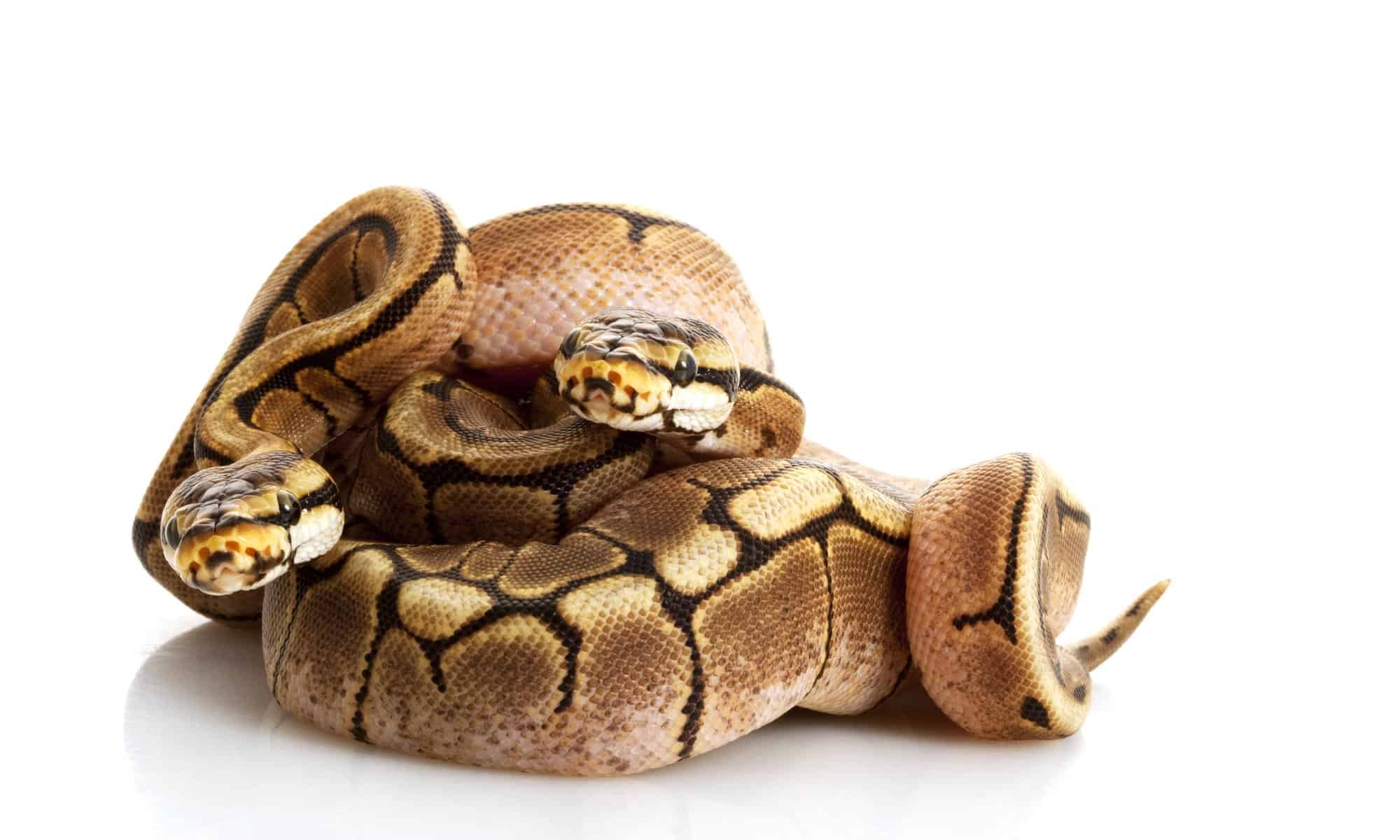
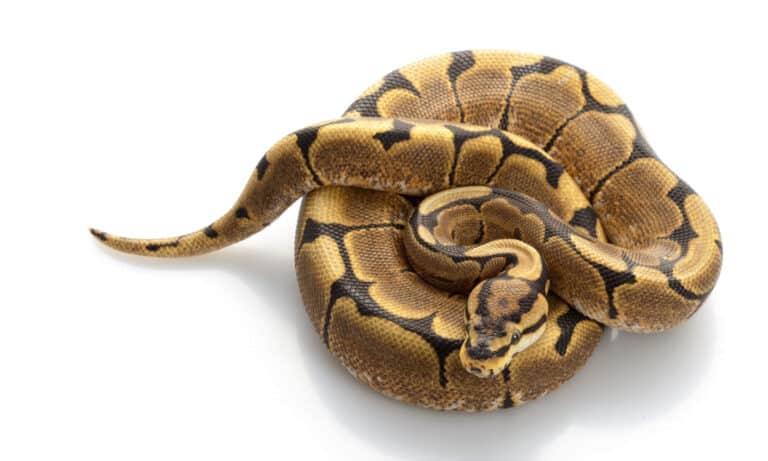
Its hallmark look is a lighter overall color with a reduced, web-like pattern and thin "spidering" lines.

The morph is inherited as a dominant trait (often described as incompletely dominant in breeding outcomes).

Spider morphs are widely used in designer combinations (e.g., Bumblebee = Spider ร— Pastel).

Ball pythons get their common name from their defensive habit of curling into a tight ball with the head tucked in.

Like all ball pythons, Spider morphs are nonvenomous constrictors that rely on heat-sensing labial pits to locate warm prey.

The Spider morph is strongly associated with a neurologic issue called "wobble," which is a major welfare and ethics discussion in the hobby.

Unique Adaptations

  • Heat-sensing labial pits along the lips detect infrared radiation from warm-blooded prey.
  • Highly flexible jaws/ligaments allow swallowing prey larger than the head.
  • Efficient metabolism supports long intervals between meals-common in healthy ball pythons.
  • Cryptic coloration in the wild-type species; in Spider morphs, the altered pattern is a captive-bred aesthetic adaptation (not a wild survival trait).
  • "Balling" defense reduces exposed vulnerable surfaces and protects the head.

Interesting Behaviors

  • Balling up tightly when stressed; often hides the head under body coils.
  • Nocturnal/crepuscular activity: more alert at dusk and night.
  • Ambush feeding: may "lock on" and strike from cover rather than actively chase.
  • Climbing and perching, especially juveniles, despite being considered mostly terrestrial.
  • Tongue-flicking to sample airborne chemicals (Jacobson's organ) when exploring.

Cultural Significance

Ball pythons (Python regius), native to West and Central Africa, have long been part of local human life. The Spider morph is a captive-bred color form prized for its pattern but linked to a neurologic โ€œwobble,โ€ raising welfare concerns.

Myths & Legends

In parts of Benin, especially around Ouidah, pythons are linked to Vodun beliefs. Sacred pythons are protected and honored; hurting them is taboo, and they are seen as spiritual messengers and guardians.

Across West Africa, folktales treat pythons and great snakes as powerful beings linked to fertility, rain, and the border between people and spirits, seen as village protectors, rule enforcers, or respected beings.

In many myth stories, sacred snakes are cosmic figures: the Nฤgas of South and Southeast Asia (serpent beings tied to water and protection) and the Ouroboros (a snake biting its tail, meaning endless renewal).

Many modern snake keepers call Python regius the "royal python." Short, mixed stories link it to royalty, and these tales helped make the species popular in the pet trade.

Conservation Status

NE Not Evaluated

Has not yet been evaluated against the criteria.

Population Stable

Life Cycle

Birth 6 hatchlings
Lifespan 12 years

Lifespan

In the Wild 5โ€“20 years
In Captivity 10โ€“40 years

Reproduction

Mating System Polygynandry
Social Structure Managed Domestic
Breeding Pattern Transient
Fertilization Internal Fertilization
Birth Type Internal_fertilization

In captivity, solitary adults are paired briefly during the cool-season to stimulate courtship; males may service multiple females and females can accept multiple males. Copulation is internal; females incubate eggs alone with no social bonds.

Behavior & Ecology

Social Solitary Group: 1
Activity Crepuscular, Nocturnal
Diet Carnivore Appropriately sized rats (commonly frozen-thawed in captivity)

Temperament

Generally calm, shy, and defensive rather than aggressive; commonly curls into a tight ball.
Captive-bred Spider morphs often tolerate handling but may stress easily with overstimulation.
Morph-distinguishing trait: reduced banding replaced by a thin, high-contrast web-like pattern; often brighter overall coloration than wild-type.
Breed-specific health concern: heritable neurologic "wobble" (head tremors, tilt, corkscrewing, poor righting).
Care requirement: provide low-stress enclosure with tight hides, clutter, and minimal visual/handling stimulation.
Care requirement: avoid tall climbing setups; wobble can impair coordination and increase fall risk.
Care requirement: offer stable temperatures and consistent routine; stress may worsen wobble and feeding responses.
HUBS: across Spider morphs, wobble severity varies from subtle to severe; many remain manageable pets.
HUBS: feeding behavior varies; some are strong ambush feeders, others may refuse during stress or frequent handling.

Communication

Hissing when threatened or handled roughly
Occasional short puff/exhale sounds during defensive displays
Tongue-flicking to sample scent chemicals Prey, predators, mates
Pheromone detection for mate-finding; males follow female scent trails
Defensive body postures: balling, head withdrawal, tight coiling
Subtle tactile interactions during breeding alignment and courtship
Cloacal secretions and scent marking on surfaces while exploring

Habitat

Biomes:
Savanna Tropical Dry Forest Tropical Rainforest Wetland Freshwater
Terrain:
Plains Hilly Valley Riverine
Elevation: Up to 3937 ft

Ecological Role

Wild ball pythons are mesopredators that regulate small-vertebrate populations; the Spider morph is primarily a captive pet/trade animal and does not typically contribute to wild ecosystem function.

Rodent population control (reduces crop and household pest pressure) Energy transfer within savanna/grassland and forest-edge food webs (predator of small mammals/birds; prey for larger predators)

Diet Details

Main Prey:
Small rodents Other small mammals Small birds Mice or rats

Human Interaction

Domestication Status

Wild

Spider morph Ball Python (Python regius) is a captive-bred color and pattern morph of a wild African snake kept as pets. It has lighter color, thin webbed pattern and a head stamp. Human links include pet keeping, breeding, vets, education, rescues, and rules. Spider breeding raises concern because of a wobble nerve problem.

Danger Level

Low
  • Minor bites/scratches (typically superficial; risk increases with improper handling or feeding response)
  • Zoonotic risk (e.g., Salmonella) from contact with the animal, feces, or enclosure surfaces-mitigated by hygiene
  • Allergic reactions to bedding/feeder rodents
  • Escape risk if enclosure is insecure (nuisance/safety concern, though the species is not typically dangerous to people)
  • Breed-specific handling risk: Spider-associated neurological impairment ("wobble," corkscrewing, poor righting reflex) can increase stress and unpredictability during handling/feeding, raising the chance of defensive bites or feeding accidents

As a Pet

Not Suitable as Pet

Legality: Spider morph Ball Python (Python regius) are usually legal where ball pythons are allowed, but laws vary by country, state, or city. Local exotic pet rules, import or transport limits, and welfare concerns may restrict salesโ€”check laws and permits.

Care Level: Moderate

Purchase Cost: $100 - $350
Lifetime Cost: $2,500 - $7,000

Economic Value

Uses:
Companion animal (pet trade) Captive breeding/morph genetics market Education/outreach animals Veterinary/exotics services demand Rescue/rehoming services
Products:
  • Live animals (Spider morph and related morph offspring)
  • Enclosures/racks, thermostats/thermometers, heat sources
  • Frozen-thawed feeder rodents
  • Substrate, hides, water bowls, humidity control supplies
  • Veterinary services (wellness exams, parasite testing, treatment of feeding/respiratory issues)

Relationships

Predators 5

Mongoose Herpestes spp.
Monitor lizard Varanus
Large Birds of Prey Accipitridae
Secretarybird Sagittarius serpentarius
Human Homo sapiens

Related Species 5

Burmese Python Python bivittatus Shared Family
Reticulated Python Malayopython reticulatus Shared Family
African Rock Python Python sebae Shared Genus
Indian Python Python molurus Shared Genus
Boelen's Python Simalia boeleni Shared Family

Ecological Equivalents 4

Animals that fill a similar ecological role in their ecosystem

Boa Constrictor Boa constrictor Similar ecological role as a medium-to-large ambush constrictor that targets small mammals and birds. Also commonly kept in captivity with broadly comparable feeding and thermal needs, though boas generally tolerate slightly lower humidity swings than ball pythons.
Kenyan Sand Boa Eryx colubrinus Largely nocturnal, rodent-eating ambush constrictor often kept as a pet. Overlaps in husbandry themes (secure hides, steady heat gradient), though sand boas are more fossorial and typically require drier substrates.
Corn Snake Pantherophis guttatus Captive-kept, rodent-eating constrictor occupying a similar small-mammal predation niche. Often compared in the pet trade as a beginner-friendly feeder on mice and rats; husbandry goals overlap, though corn snakes are typically more active and less secretive than ball pythons.
Kingsnakes Lampropeltis spp. Generalist predators often kept in captivity; overlap in enclosure security needs and rodent-based feeding in captivity, although kingsnakes are typically more active and may prey on other reptiles in the wild.

โ€œThe spider ball python is known for having a head wobble.โ€

Adult spider ball pythons are between two and four and a half feet in length. Though they are ball pythons these snakes are known as morphs. They are morphs because their scale patterns vary from the typical ball python. These snakes have neurological problems that take the form of a head wobble. These snakes can have a lifespan of up to 50 years if they are cared for in captivity.

4 Spider Ball Python Amazing Facts

  • Its name comes from the spider web pattern on its scales
  • All of these morphs have a head wobble or tremble due to genetic neurological problems
  • The price of this snake can go up depending on the intricacy of its pattern
  • They are friendly pets if handled in a gentle way

Where to Find a Spider Ball Python

Ball pythons are native to western and central Africa. They live in grasslands, forests, and scrublands. The spider is a type of ball python bred in captivity since 1999.

These snakes are kept as pets need an enclosure that maintains a temperature around 75-95 degrees Fahrenheit. Also, a 50% to 60% level of humidity is necessary to keep this snake healthy.

In the wild, ball pythons hide beneath leaf debris and inside hollow logs. So, putting cypress mulch or aspen shavings in the enclosure of a spider ball python gives it the material it needs to burrow, hide or both.

Pet pythons donโ€™t brumate in the winter like snakes in the wild. Brumation is the reptile equivalent of hibernation in mammals. However, they may become less active during the winter season. These snakes are active in the spring and summer months.

Types of Ball Python Morphs

The spider is not the only morph of a ball python. Far from it! In fact, there are thousands of ball python morphs that belong to the Pythonidae family.

All ball python morphs have a head wobble or tremble to a greater or lesser degree. The spider ball python has the strongest head wobble of all the morphs. Sometimes their head wobble is so pronounced it prevents them from eating and resting. This can lead to malnutrition or illness.

These morphs share the scientific name (Python regius) of the ball python.

  • Banana ball python-A very popular morph of the ball python due to its bright yellow blotch pattern atop a tan background. They were first bred in 2003. Their original price back then was $25,000.
  • Pied ball python-Originally bred in 1997, this morph has dark brown and tan scales along with a blotchy pattern of brilliant white scales. The price for these morphs is between $300 and $400.
  • Bumblebee ball python-These morphs have yellow scales featuring black spots or stripes. They are available at a price of around $200.

Spider Ball Python Scientific Name

Python regius is the scientific name of the ball python and its morphs including the spider ball python. The Latin word regius means regal. The word regal relates to the legend that Queen Cleopatra used to wear ball pythons as bracelets because they were such docile snakes.

This snake belongs to the Pythonidae family and class Reptilia.

Population & Conservation Status

The population size of these snakes is unknown. The continued breeding of this snake has become controversial because of its genetic neurological problems. Furthermore, these morphs are no longer permitted at various yearly reptile expositions. But there are still breeders and snake owners interested in this snake with its intricate patterns.

How to Identify a Spider Ball Python: Appearance and Description

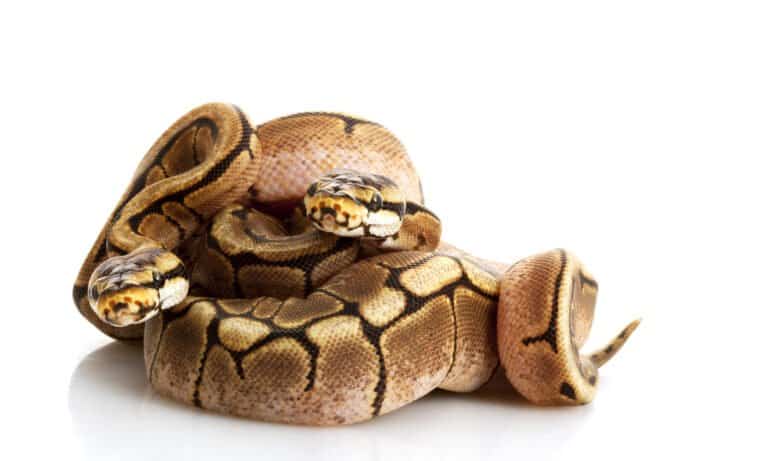
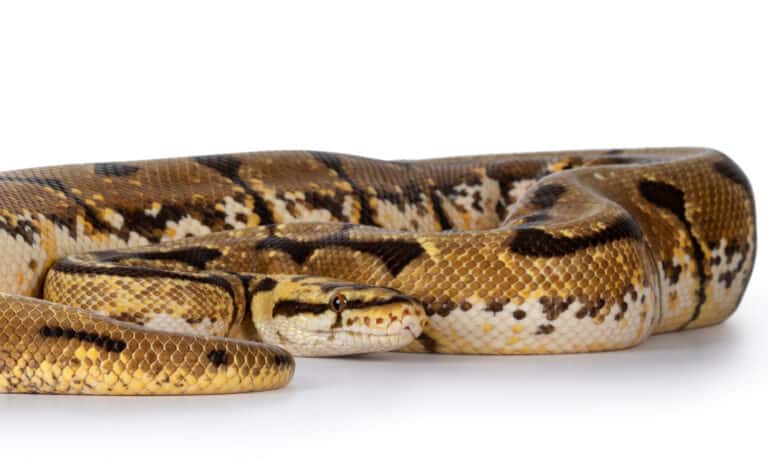
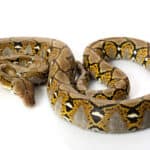
These ball python morphs have dark brown or tan scales with a pattern featuring narrow black lines that look similar to spider webs. They have dark greenish eyes with a yellow or tan belly sprinkled with dark spots.

Male spider ball pythons measure three to four feet long. Females are larger in size at up to four and a half feet. Occasionally, a female spider ball python reaches five feet in size. An adult spider ball python weighs five to six pounds.

This snakeโ€™s head wobble or head tremble is an (involuntary) behavior that lets you know itโ€™s a ball python morph. Out of all of the thousands of ball python morphs with these neurological issues, the spider ball python is the snake with the most pronounced wobble.

How to identify this type of python:

  • Tan or dark brown scales with a pattern of black lines similar to spider webs
  • Dark, greenish eyes
  • Wobble or tremble of its head

Spider Ball Python Pictures
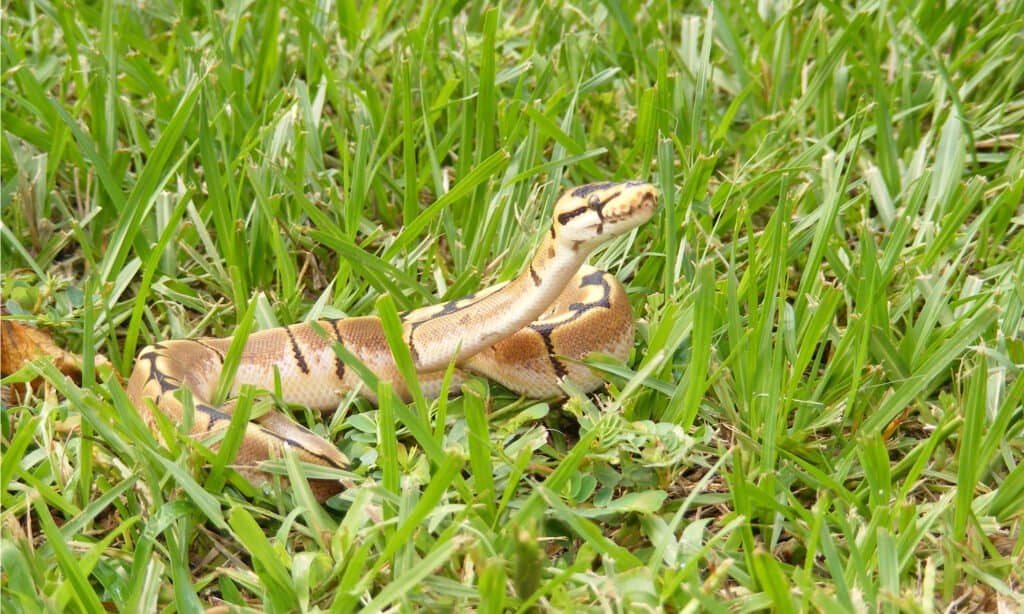
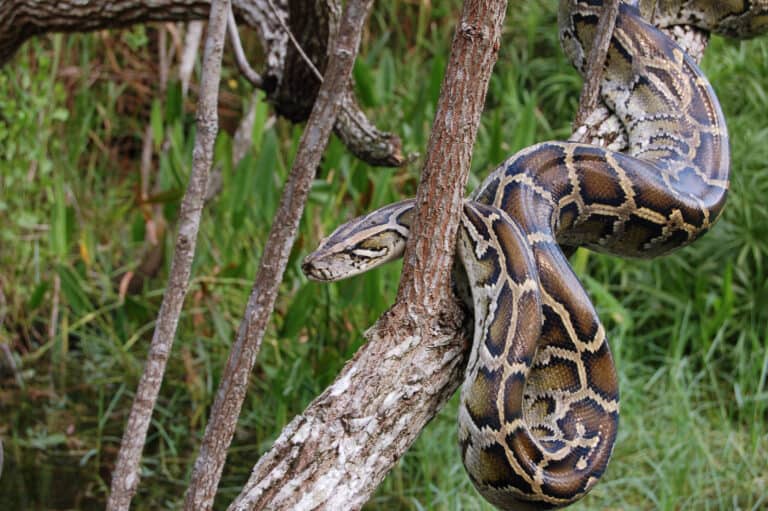
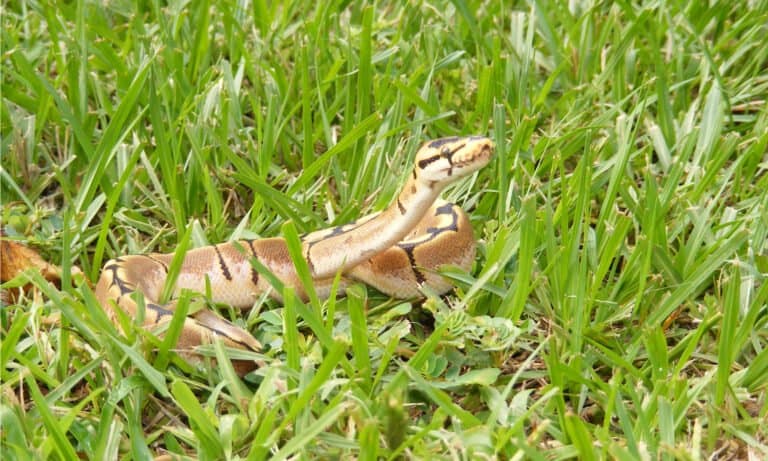
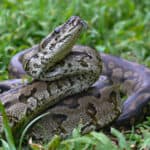
๐Ÿ‘ spider ball python in the grass

Spider ball pythons are known for having a head โ€œwobble.โ€

ยฉCharles B. Cardell/Shutterstock.com

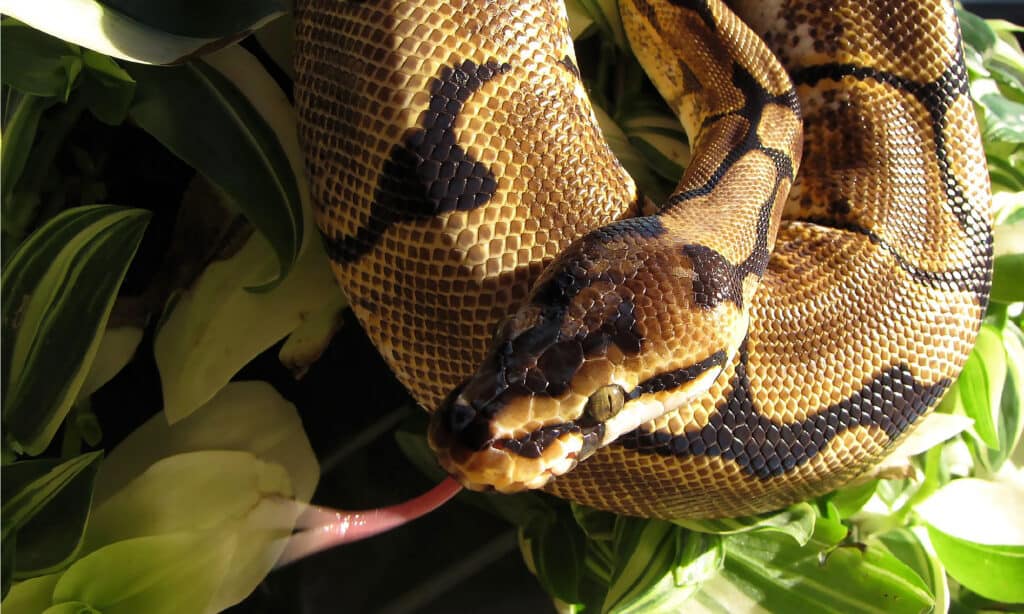
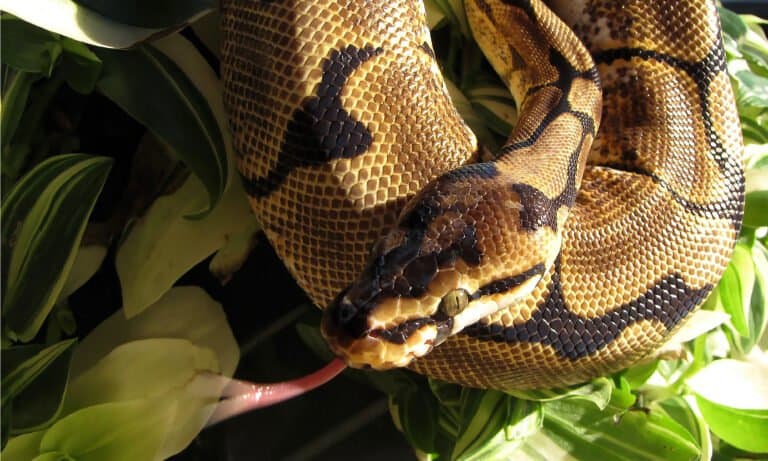
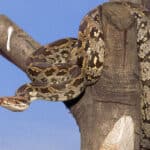
๐Ÿ‘ Spider ball python on plant

This type of snake feeds on rodents.

ยฉSusImage/Shutterstock.com

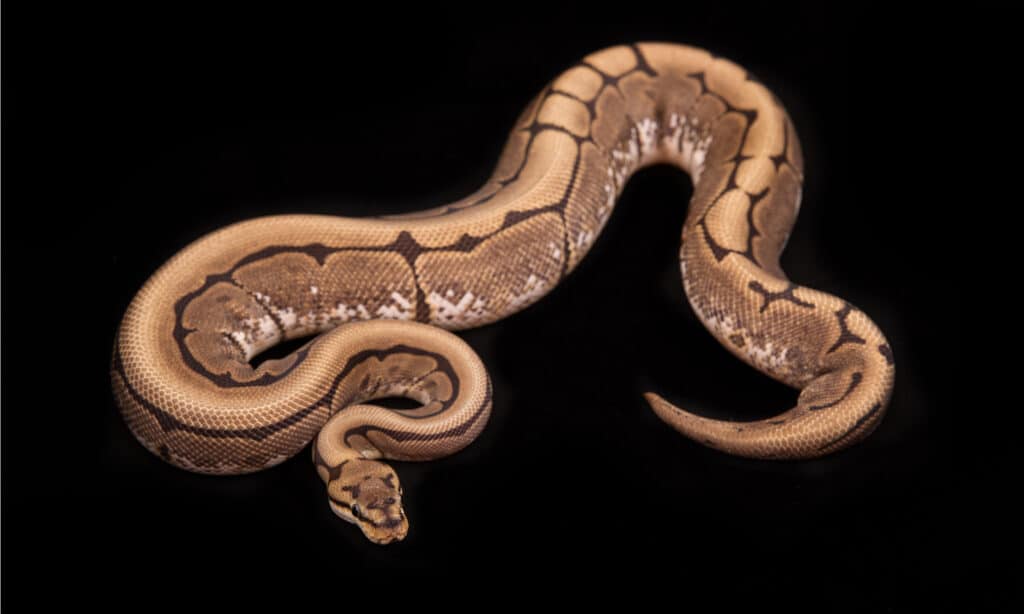
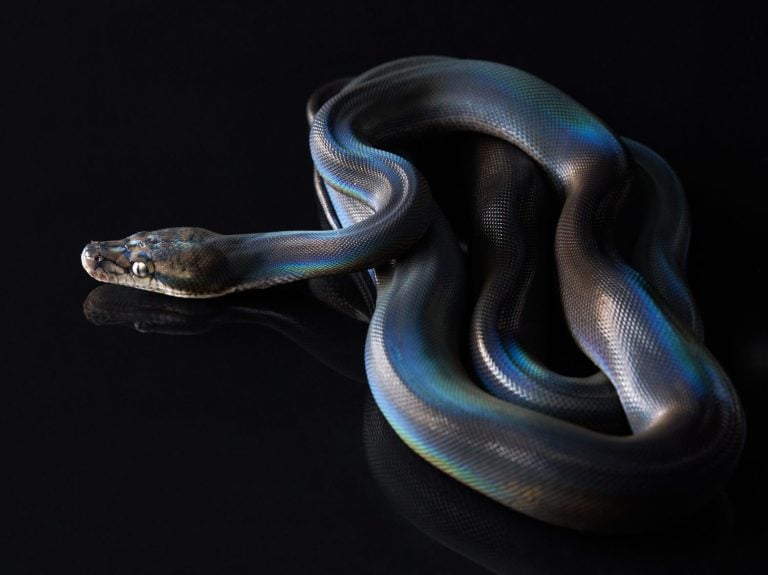
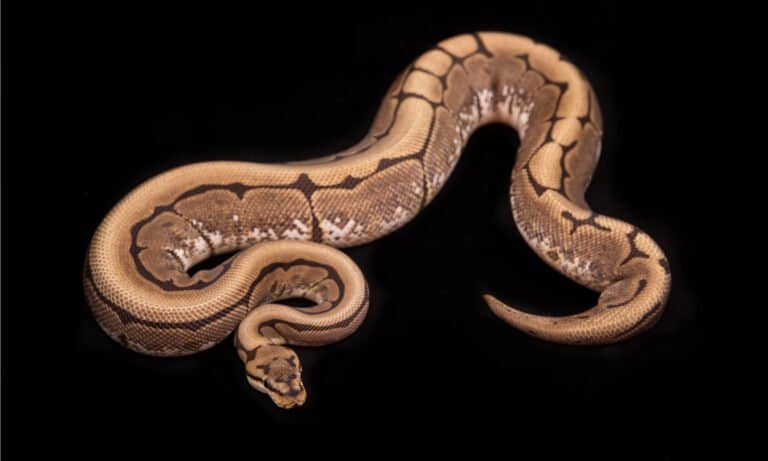
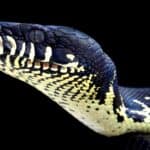
๐Ÿ‘ Spider ball python on black background

Spider ball pythons can live up to 50 years.

ยฉSanne Romijn Fotografie/Shutterstock.com

Spider Ball Python: How Dangerous Are They?

This is a non-venomous snake. Plus, since they kill their prey by wrapping around it and squeezing it, these snakes donโ€™t have fangs like a rattlesnake. But these ball python morphs do have teeth and they can bite.

These are timid snakes and unlikely to bite unless they feel cornered or are stressed out. For instance, a female that is molting or shedding her skin may bite someone who tries to pick her up. This is because a snake feels particularly vulnerable when molting. In addition, this snake may become stressed out and bite if someone is holding it in a way that makes the snake feel it is going to fall. Snakes can be seriously hurt if dropped onto the floor.

Most of the time, when a spider ball python feels threatened or frightened it will curl its body into a shape that looks like a ball. Thatโ€™s the second reason behind this snakeโ€™s name.

Washing the injured area with soap and warm water is the best course of action if someone is bitten. Also, be sure to use first-aid cream to lessen the possibility of infection. See a doctor is the skin begins to look red or irritated.

Behavior and Humans

These snakes are bred and kept as pets, so they are fairly popular in the community of reptile owners. They are docile and curious snakes, so they can make good pets if treated with care. Remember the lifespan of this snake can go up to 30 years, so this pet requires a long-term commitment.

Similar Animals

View all 385 animals that start with S

Sources

  1. https://www.monaconatureencyclopedia.com/python-regius/?lang=en / Accessed February 27, 2022
  2. https://en.wikipedia.org/wiki/Ball_python / Accessed February 27, 2022
  3. https://reptilepetsrock.com/snakes/spider-ball-pythons-controversy / Accessed February 27, 2022
  4. https://pethaver.com/spider-ball-python/ / Accessed February 27, 2022
  5. https://emborapets.com/spider-ball-pythons-15-cool-facts/ / Accessed February 27, 2022
  6. https://www.allthingsnature.org/what-is-a-spider-ball-python.htm / Accessed February 27, 2022

About the Author

Ashley Haugen

Ashley Haugen is the editor of A-Z Animals. She's a lifelong animal lover with an affinity for dogs, cows and chickens. When she's not immersed in A-Z-Animals.com (her favorite editorial job of her 25-year career), she can be found on the hiking trails of Middle Tennessee or hanging out with her family, both human and furry.
Connect:

Thank you for reading! Have some feedback for us?

Contact the AZ Animals editorial team

Related Articles You May Find Interesting


Spider Ball Python FAQs (Frequently Asked Questions)

Spider ball pythons are not venomous snakes.

If an owner puts a live mouse in this snakeโ€™s enclosure, it will stalk the rodent, wrap its body around it and suffocate it. Once the mouse is dead, the spider ball python swallows it whole.

No, these snakes are docile and timid.

Spider ball pythons are kept as pets. They can live in an aquarium or plastic enclosure as long as there is ample space, adequate humidity and a temperature maintained at around 80 degrees Fahrenheit.

Mice, rats, and other rodents. Some pet owners feed their snakes live rodents while others buy frozen ones to feed this reptile. Sometimes it depends on how much the snake eats.

This snakeโ€™s head wobble or tremble are a result of neurological issues. These neurological issues are due to a particular gene they carry. This same gene gives them the spider web pattern. In short, these morphs are born with neurological problems.

They like to be held if the person supports all of their weight in a secure and even way. If the snake feels itโ€™s not being supported, it will become stressed and possibly bite. This is true with any type of snake regardless of its size.

It is possible to breed them, but their head wobble is genetic. So, breeding a spider ball python means the babies will have the same issue. This is why some in the reptile community consider it irresponsible to breed spider ball pythons. They donโ€™t want to continue a population of snakes with these inborn neurological issues.

They have this issue due to neurological problems they carry in their genes.

They have a lifespan from 20 to 50 years.