





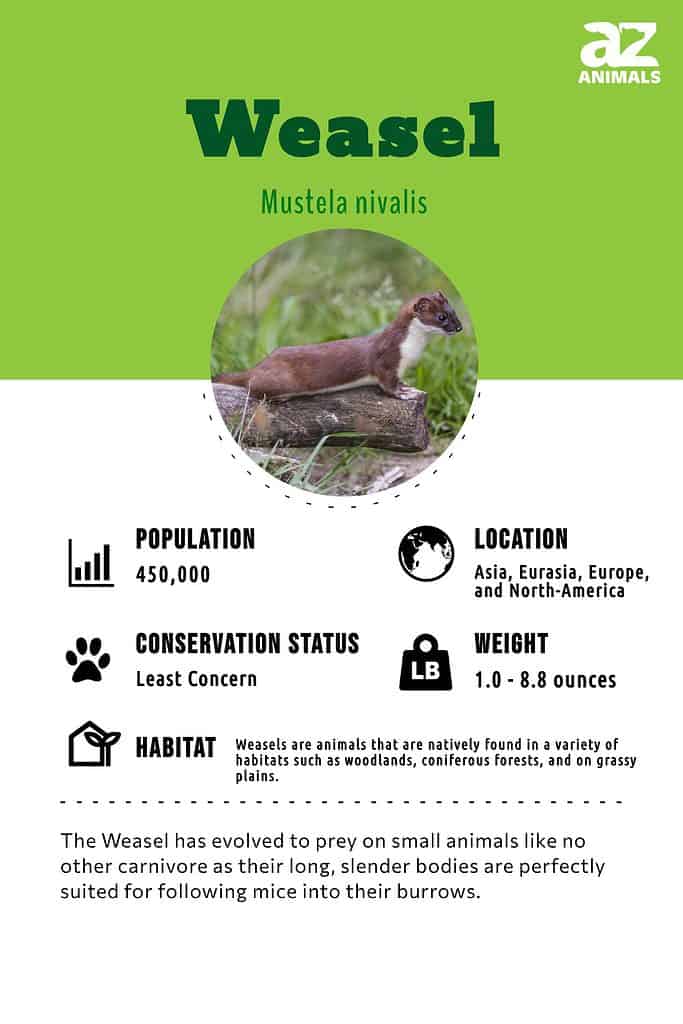
W
Species Profile

Weasel

Mustela

Small body, fearless hunter
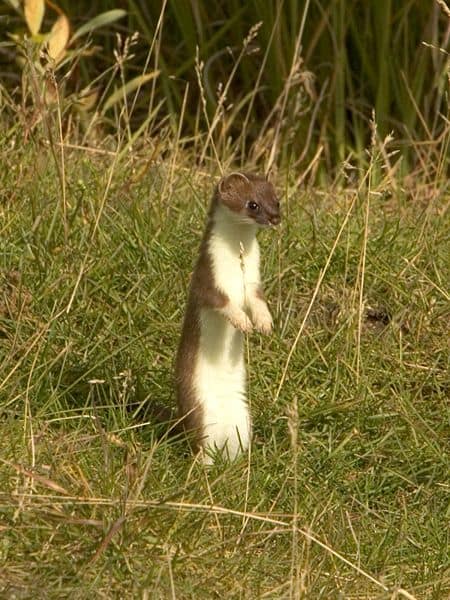
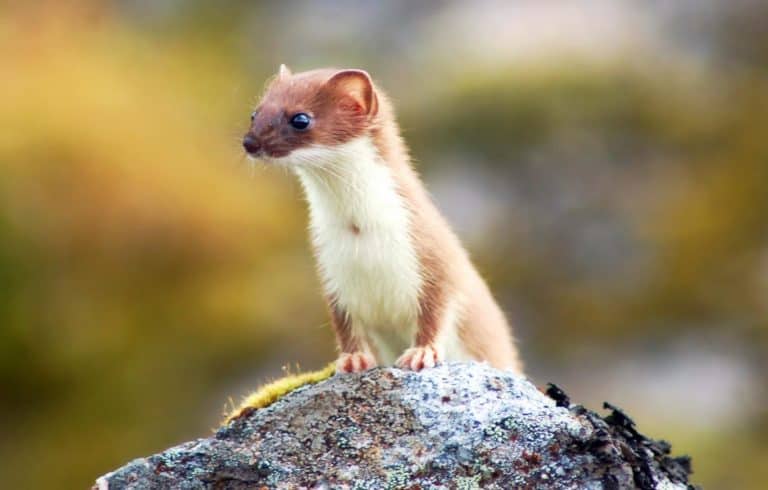
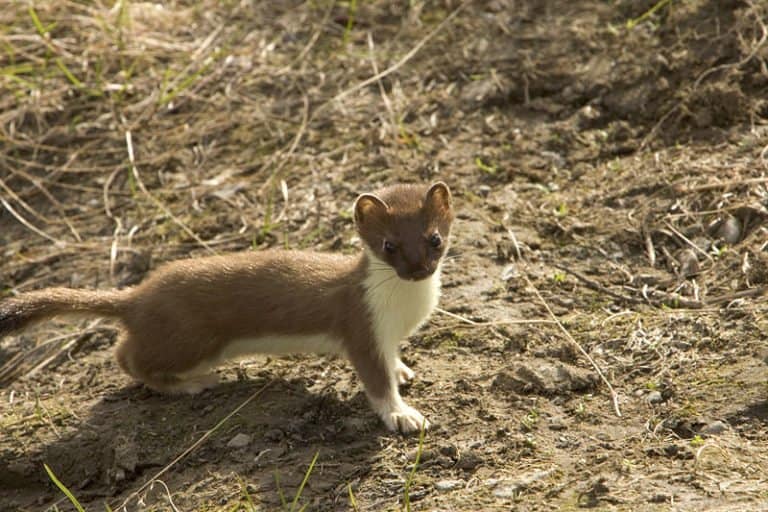
Steve Hillebrand - Public Domain by U.S. Fish and Wildlife Service

Weasel Distribution

Click a location to explore more animals from that region

Invasive Species
Loading map...

Found in 62 countries

๐Ÿ‡ฆ๐Ÿ‡ฒ Armenia ๐Ÿ‡ฆ๐Ÿ‡น Austria ๐Ÿ‡ฆ๐Ÿ‡ฟ Azerbaijan ๐Ÿ‡ง๐Ÿ‡ช Belgium ๐Ÿ‡ง๐Ÿ‡ฌ Bulgaria ๐Ÿ‡ง๐Ÿ‡พ Belarus ๐Ÿ‡จ๐Ÿ‡ฆ Canada ๐Ÿ‡จ๐Ÿ‡ญ Switzerland ๐Ÿ‡จ๐Ÿ‡ณ China ๐Ÿ‡จ๐Ÿ‡ด Colombia ๐Ÿ‡จ๐Ÿ‡ท Costa Rica ๐Ÿ‡จ๐Ÿ‡ฟ Czech Republic ๐Ÿ‡ฉ๐Ÿ‡ช Germany ๐Ÿ‡ฉ๐Ÿ‡ฐ Denmark ๐Ÿ‡ฉ๐Ÿ‡ฟ Algeria ๐Ÿ‡ช๐Ÿ‡จ Ecuador ๐Ÿ‡ช๐Ÿ‡ช Estonia ๐Ÿ‡ช๐Ÿ‡ธ Spain ๐Ÿ‡ซ๐Ÿ‡ฎ Finland ๐Ÿ‡ซ๐Ÿ‡ท France ๐Ÿ‡ฌ๐Ÿ‡ง United Kingdom ๐Ÿ‡ฌ๐Ÿ‡ช Georgia ๐Ÿ‡ฌ๐Ÿ‡ท Greece ๐Ÿ‡ฌ๐Ÿ‡น Guatemala ๐Ÿ‡ญ๐Ÿ‡บ Hungary ๐Ÿ‡ฎ๐Ÿ‡ฉ Indonesia ๐Ÿ‡ฎ๐Ÿ‡ช Ireland ๐Ÿ‡ฎ๐Ÿ‡ฑ Israel ๐Ÿ‡ฎ๐Ÿ‡ณ India ๐Ÿ‡ฎ๐Ÿ‡ถ Iraq ๐Ÿ‡ฎ๐Ÿ‡ท Iran ๐Ÿ‡ฎ๐Ÿ‡ธ Iceland ๐Ÿ‡ฎ๐Ÿ‡น Italy ๐Ÿ‡ฏ๐Ÿ‡ด Jordan ๐Ÿ‡ฏ๐Ÿ‡ต Japan ๐Ÿ‡ฐ๐Ÿ‡ฌ Kyrgyzstan ๐Ÿ‡ฐ๐Ÿ‡ท South Korea ๐Ÿ‡ฐ๐Ÿ‡ฟ Kazakhstan ๐Ÿ‡ฑ๐Ÿ‡น Lithuania ๐Ÿ‡ฑ๐Ÿ‡ป Latvia ๐Ÿ‡ฒ๐Ÿ‡ฆ Morocco ๐Ÿ‡ฒ๐Ÿ‡ณ Mongolia ๐Ÿ‡ฒ๐Ÿ‡ฝ Mexico ๐Ÿ‡ฒ๐Ÿ‡พ Malaysia ๐Ÿ‡ณ๐Ÿ‡ฑ Netherlands ๐Ÿ‡ณ๐Ÿ‡ด Norway ๐Ÿ‡ต๐Ÿ‡ฆ Panama ๐Ÿ‡ต๐Ÿ‡ช Peru ๐Ÿ‡ต๐Ÿ‡ฑ Poland ๐Ÿ‡ต๐Ÿ‡น Portugal ๐Ÿ‡ท๐Ÿ‡ด Romania ๐Ÿ‡ธ๐Ÿ‡ช Sweden ๐Ÿ‡ธ๐Ÿ‡ฐ Slovakia ๐Ÿ‡น๐Ÿ‡ญ Thailand ๐Ÿ‡น๐Ÿ‡ฏ Tajikistan ๐Ÿ‡น๐Ÿ‡ฒ Turkmenistan ๐Ÿ‡น๐Ÿ‡ณ Tunisia ๐Ÿ‡น๐Ÿ‡ท Turkey ๐Ÿ‡บ๐Ÿ‡ฆ Ukraine ๐Ÿ‡บ๐Ÿ‡ธ United States ๐Ÿ‡บ๐Ÿ‡ฟ Uzbekistan ๐Ÿ‡ป๐Ÿ‡ช Venezuela

Size Comparison

Human 5'8"
Weasel 3 in

Weasel stands at 5% of average human height.

At a Glance

Genus Overview This page covers the Weasel genus as a group. Stats below are general traits shared across the genus.
Also Known As Stoat, Ermine, Short-tailed weasel, Ferret, Polecat, Mink
Diet Carnivore
Activity Crepuscular+
Lifespan 2 years
Weight 2 lbs
Status Not Evaluated
Did You Know?

Across Mustela, head-body length spans ~11-46 cm, and body mass from ~25 g to about 1.5-1.7 kg.

Scientific Classification

Genus Overview "Weasel" is not a single species but represents an entire genus containing multiple species.

Weasels (genus Mustela) are small, elongate mustelid carnivores known for hunting rodents in tunnels and dense cover. They have short legs, high metabolic demands, and rapid, agile movements. Several species show seasonal coat changes and are widespread across the Northern Hemisphere.

Kingdom
Animalia
Phylum
Chordata
Class
Mammalia
Order
Carnivora
Family
Mustelidae
Genus
Mustela

Distinguishing Features

  • Elongated body with short legs
  • Carnivorous dentition; sharp canines
  • Very agile, rapid hunting behavior
  • Often black tail tip in some species
  • May change coat color seasonally

Physical Measurements

Males and females differ in size

Height
โ™‚ 5 in (3 in โ€“ 8 in)
โ™€ 4 in (2 in โ€“ 7 in)
Length
โ™‚ 1 ft 4 in (5 in โ€“ 2 ft 5 in)
โ™€ 1 ft 2 in (5 in โ€“ 2 ft 2 in)
Weight
โ™‚ 1 lbs (0 lbs โ€“ 4 lbs)
โ™€ 1 lbs (0 lbs โ€“ 2 lbs)
Tail Length
โ™‚ 4 in (1 in โ€“ 7 in)
โ™€ 4 in (1 in โ€“ 6 in)
Top Speed
20 mph
running

Appearance

Primary Colors
Secondary Colors
Skin Type Dense fur
Distinctive Features
  • Elongate, cylindrical body with very short legs.
  • Adult head-body length roughly 11-45 cm across genus.
  • Typically 30-450 g; some close relatives exceed this.
  • Short, rounded ears; pointed muzzle; bright, alert eyes.
  • Tail often 3-20 cm; many species with black tip.
  • Seasonal coat change common: brown summer to white winter.
  • Dense, fine underfur for insulation; surface guard hairs add gloss.
  • Highly flexible spine enabling rapid turns in tunnels and brush.
  • Dentition specialized for carnivory; strong bite for small prey.
  • Lifespan commonly ~1-10 years, varying widely by species and conditions.
  • Hunt rodents in burrows, dense cover, and snow; tactics vary by habitat.
  • Ranges span much of Northern Hemisphere; habitat use highly variable.

Sexual Dimorphism

Sexual dimorphism is common: males are typically larger, heavier, and broader-headed than females, influencing prey size and space use. The degree varies among species and populations, and is often strongest in smaller-bodied weasels.

โ™‚
  • Larger body mass and thicker neck.
  • Broader skull and more robust jaws.
  • Often longer tail and larger feet.
โ™€
  • Smaller, slimmer body suited to tighter burrows.
  • Narrower head and lighter build.
  • Often higher relative agility in confined spaces.

Did You Know?

Across Mustela, head-body length spans ~11-46 cm, and body mass from ~25 g to about 1.5-1.7 kg.

Many Mustela species are strongly sexually dimorphic, with males often much larger than females within the same species.

Diet is rodent-heavy across the genus, but ranges from prairie-dog specialists to generalists taking birds, eggs, or amphibians.

Northern populations of several species turn white in winter; the familiar "ermine" look is seasonal, not a separate animal.

Wild lifespans are often short (commonly ~1-3 years), but some reach ~7-10 years, especially in captivity.

Several species use strong anal scent glands for defense and communication, leaving scent marks along travel routes.

Unique Adaptations

  • Elongate body, short legs, and flexible spine allow efficient pursuit of prey in narrow tunnels and dense cover.
  • Very high metabolism and heat loss from small size drive frequent feeding and active hunting schedules.
  • Seasonal molt to white coats in snowy regions improves camouflage; in some, the tail tip stays dark year-round.
  • Keen senses (especially smell and hearing) support detecting prey under vegetation, snow, or within burrow systems.
  • Some Mustela show delayed implantation (embryonic diapause), timing births to favorable seasons despite earlier mating.

Interesting Behaviors

  • Solitary, territorial living is common, but territory size varies with prey density and habitat complexity.
  • Many hunt by "threading" through grass, rock piles, and burrows, using rapid turns to pursue rodents underground.
  • Some species cache surplus prey, especially in cold seasons or during breeding when energy demands spike.
  • Polecat-like members can be more nocturnal and opportunistic, while smaller weasels often hunt day or night as needed.
  • A fast, twisting "dance" or bouncing display is sometimes seen during excitement or play, and is reported across multiple mustelids.

Cultural Significance

Mustela weasels shaped human culture through rodent control and fur. Ermine pelts became European symbols of royalty and office, while polecats/ferrets were historically used for hunting rabbits and managing pests around farms.

Myths & Legends

In Greek myth, Galanthis (Alcmene's helper) was transformed by Hera into a weasel and sent to live in the shadows.

Japanese folklore tells of the "sickle weasel", a weasel-like supernatural creature said to ride whirlwinds and leave mysterious cutting wounds.

Medieval European bestiaries claimed weasels conceived through the ear and birthed through the mouth, a widely repeated moralized tale.

Aesop's fables include weasels as crafty figures, such as stories where a weasel uses trickery to approach wary mice.

Conservation Status

NE Not Evaluated (genus-level; IUCN assesses most Mustela at the species level)

Has not yet been evaluated against the criteria.

Population Unknown

Protected Under

  • CITES Appendix I
  • Bern Convention
  • EU Habitats Directive
  • ESA

Looking for a specific species?

Least weasel

Mustela nivalis

Often meant by the plain common name "weasel" across much of its range.

  • Across Mustela, body size ranges from very small to polecat-sized.
  • Many species hunt rodents in tunnels using long, flexible bodies.
  • Seasonal coat whitening occurs in some, but not all, northern populations.
  • Diet is mainly small mammals, with birds, eggs, reptiles, and insects variably taken.
  • Widely variable habitat use: tundra to farmland to forests, sometimes near water.

You might be looking for:

Least weasel

22%

Mustela nivalis

Smallest carnivoran; widespread in Eurasia and North America; short tail without black tip distinguishes it from stoats.

Stoat / Ermine

20%

Mustela erminea

Northern weasel with black tail tip; turns white in winter (ermine) in many populations; common in temperate-boreal zones.

View Profile

Long-tailed weasel

18%

Mustela frenata

Common North American weasel; longer tail with black tip; adaptable across grasslands, forests, and agricultural areas.

European polecat

12%

Mustela putorius

Larger Mustela species in Europe; ancestor of the domestic ferret; darker body with pale facial mask.

View Profile

American mink

10%

Neogale vison

Often called a weasel colloquially; semi-aquatic mustelid valued for fur; now placed in genus Neogale.

View Profile

Life Cycle

Birth 5 kits
Lifespan 2 years

Lifespan

In the Wild 0.5โ€“8 years
In Captivity 3โ€“12 years

Reproduction

Mating System Polygynandry
Social Structure Solitary
Breeding Season Late winter through summer; latitude dependent
Breeding Pattern Seasonal
Fertilization Internal Fertilization
Birth Type Internal_fertilization

Across Mustela, adults are largely solitary; males range widely and overlap multiple females, and females may mate with more than one male. Pair bonds are brief during the breeding season; females typically rear altricial young alone.

Behavior & Ecology

Social Boogle Group: 1
Activity Crepuscular, Nocturnal, Diurnal, Cathemeral
Diet Carnivore small rodents

Temperament

Bold
Curious
Aggressive
Wary
Restless

Communication

squeaks
chirps
hisses
growls
screams
scent marking
anal gland scent
urine marking
body postures
tactile contact

Habitat

Biomes:
Tropical Rainforest Tropical Dry Forest Mediterranean Temperate Grassland Temperate Forest Temperate Rainforest Boreal Forest (Taiga) Tundra Alpine Freshwater Wetland Desert Hot Desert Cold +7
Terrain:
Mountainous Hilly Plateau Plains Valley Coastal Island Riverine Rocky Sandy Muddy +5
Elevation: Up to 17060 ft 5 in

Ecological Role

Mesopredators regulating small-vertebrate populations across diverse northern ecosystems

rodent control trophic regulation energy transfer scavenging leftovers

Diet Details

Main Prey:
Small rodents Rabbit Small birds Bird eggs Amphibians Reptiles Fish Large insects +2

Human Interaction

Domestication Status

Wild

Most Mustela species remain wild (11-60+ cm, ~25-2000 g; ~1-10+ year lifespans), interacting with humans via pest control, fur taking, and conflict near poultry. Only the ferret (a Mustela lineage) was domesticated in Europe >2,000 years ago for hunting.

Danger Level

Low
  • Painful defensive bite
  • Rabies exposure risk
  • Leptospirosis/parasite transmission
  • Poultry killing near coops
  • Musky odor from anal glands

As a Pet

Not Suitable as Pet

Legality: Usually restricted; ferrets legal in many areas, banned in some.

Care Level: Experienced

Purchase Cost: $75 - $500
Lifetime Cost: $2,000 - $12,000

Economic Value

Uses:
Agriculture Research Tourism Pet trade Fur trade
Products:
  • pelts
  • pets
  • pest control
  • research models

Relationships

Predators 8

Eagle Aquila
Hawk Buteo
Owl Strigidae
Red fox Vulpes vulpes
Coyote Canis latrans
Bobcat Lynx rufus
Marten Martes
Domestic cat Felis catus

Related Species 5

Mink Neogale vison Shared Family
Fisher Pekania pennanti Shared Family
American marten Martes americana Shared Family
European badger Meles meles Shared Family
Wolverine Gulo gulo Shared Family

Ecological Equivalents 5

Animals that fill a similar ecological role in their ecosystem

Mongoose Herpestidae Small, agile predators that hunt rodents and reptiles in cover.
Polecats and ferrets Mustela putorius, Mustela furo Elongate mustelids that specialize on small mammals taken from burrows.
Small wildcats Felis spp. Opportunistic hunters of small prey that use stealth in dense vegetation.
Red fox Vulpes vulpes Rodent-focused mesopredator that overlaps in habitat, prey base, and seasonal activity.
Garter snakes Thamnophis Use ground cover and holes to pursue small vertebrate prey.

Types of Weasel

12

Explore 12 recognized types of weasel

Least weasel Mustela nivalis
Stoat (ermine) Mustela erminea
Haida ermine Mustela haidarum
Siberian weasel Mustela sibirica
Mountain weasel Mustela altaica
Yellow-bellied weasel Mustela kathiah
Malayan weasel Mustela nudipes
Striped-backed weasel Mustela strigidorsa
Japanese weasel Mustela itatsi
European polecat Mustela putorius
Steppe polecat Mustela eversmanii
European mink Mustela lutreola
๐Ÿ‘ Image

Weasel Classification and Evolution

The Weasel is a small-sized carnivorous mammal that is found on every continent with the exception of Australia and its surrounding islands, along with the more hostile polar regions.

There are numerous Weasel animal species that all vary in size, color, and slightly with their behaviors depending on where in the world they live.

The Common Weasel (also known as the European Weasel and the Least Weasel) is the most widespread and can be found across much of the northern hemisphere. These tiny but vicious predators are the smallest carnivorous mammals in the world growing to no more than 6 inches from their nose to the tip of their tail.

Weasels belong to the mustelid family of carnivores and are most closely related to similar species such as Stoats which are larger in size and have a black tip at the end of their brown tail.

Although Weasels are fairly common animals throughout much of their natural range, populations in certain areas have been affected by habitat loss and they are often seen as pests by farmers.

To know if weasel animals are rodents or not, read here.
๐Ÿ‘ mink vs weasel

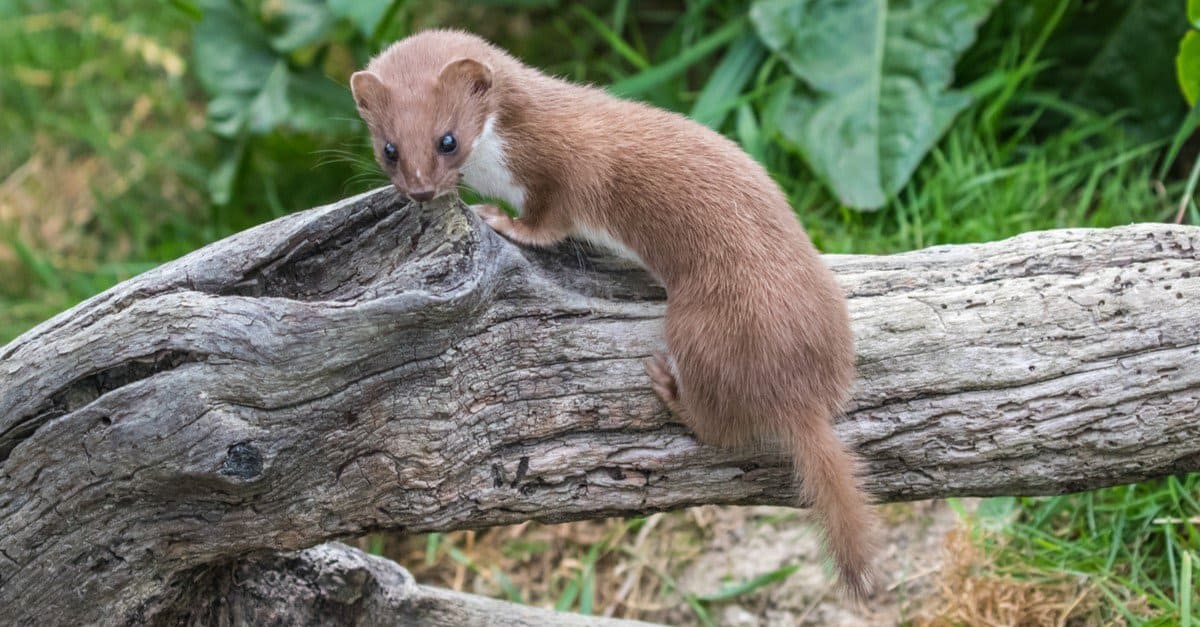
Weasels are carnivores, having very sharp teeth and claws. While older children may understand to be careful around weasels, they are not suitable pets if you have younger children.

ยฉStephan Morris/Shutterstock.com

Anatomy and Appearance

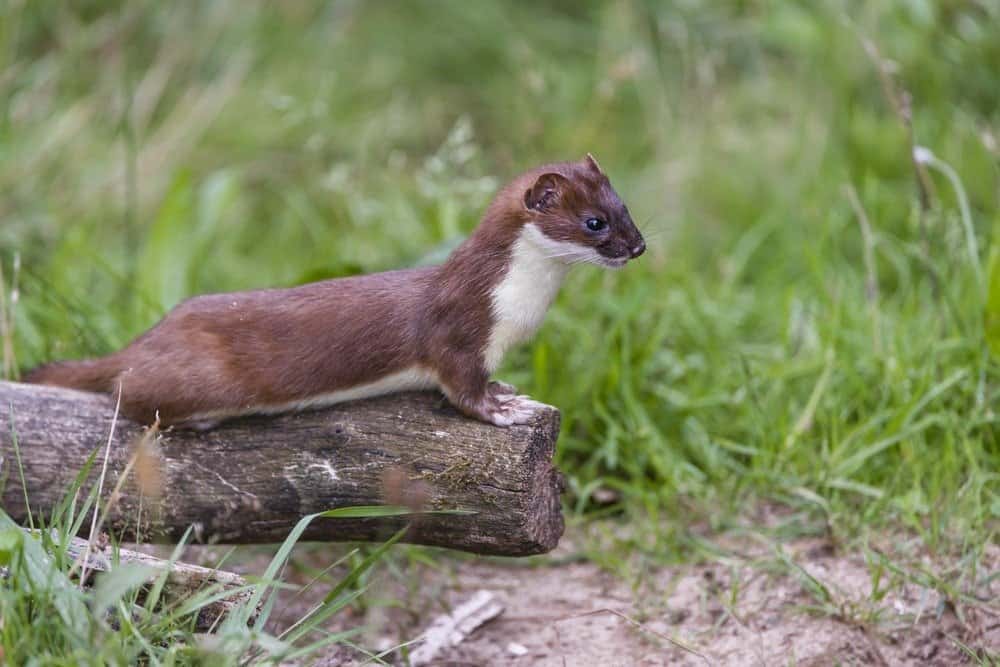
The Weasel has evolved to prey on small animals like no other carnivore as their long, slender bodies are perfectly suited for following mice into their burrows.
๐Ÿ‘ mink vs weasel

The Weasel has evolved to prey on small animals like no other carnivore as their long, slender bodies are perfectly suited for following mice into their burrows.

ยฉBildagentur Zoonar GmbH/Shutterstock.com

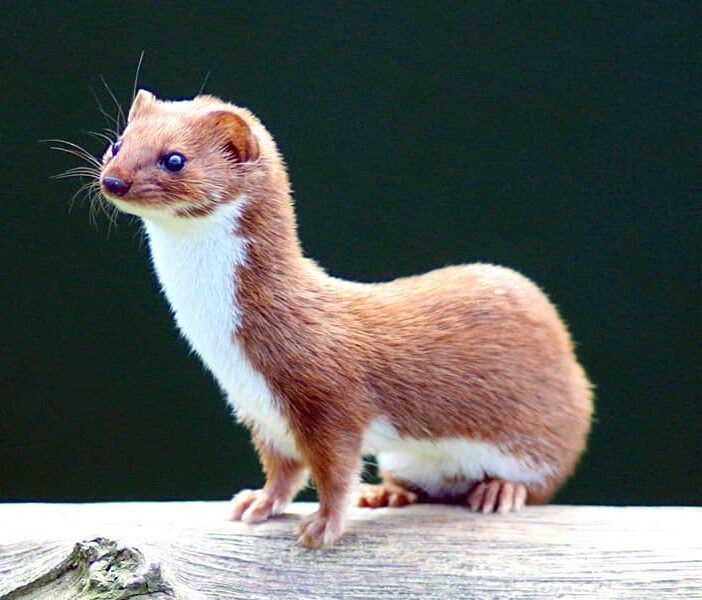
Weasels are animals with small and narrow heads that are not much thicker than their necks and their short legs and flexible spines mean that they are able to easily maneuver themselves around in small, confined spaces. The Weasel animal has a sharply pointed snout and triangular head, small rounded ears, and black eyes.

Their coat is dark or light brown in color on their head, back, legs, and tail and white on their underside and molts twice a year from the darker winter coat to the flatter, lighter one in April, and again from the summer to the winter coat in August or September.

This not only ensures that by November the Weasel is as warm as possible but in areas further north, individuals will often change from brown to white in color so that they are camouflaged amongst the snow.

Different Types of Weasels

  • Ferret
  • Stoat
  • Least weasel
  • European mink
  • Black-footed ferret
  • Siberian weasel
  • Long-tailed weasel
  • Japanese weasel
  • Mountain weasel
  • Polecatโ€“ferret hybrid
  • Polecatโ€“mink hybrid
  • Steppe polecat
  • Colombian weasel
  • Egyptian weasel
  • Putorius
  • Amazon weasel
  • Yellow-bellied weasel
  • Back-striped weasel
  • Malayan weasel
  • Indonesian mountain weasel

Distribution and Habitat
๐Ÿ‘ stoat vs ferret

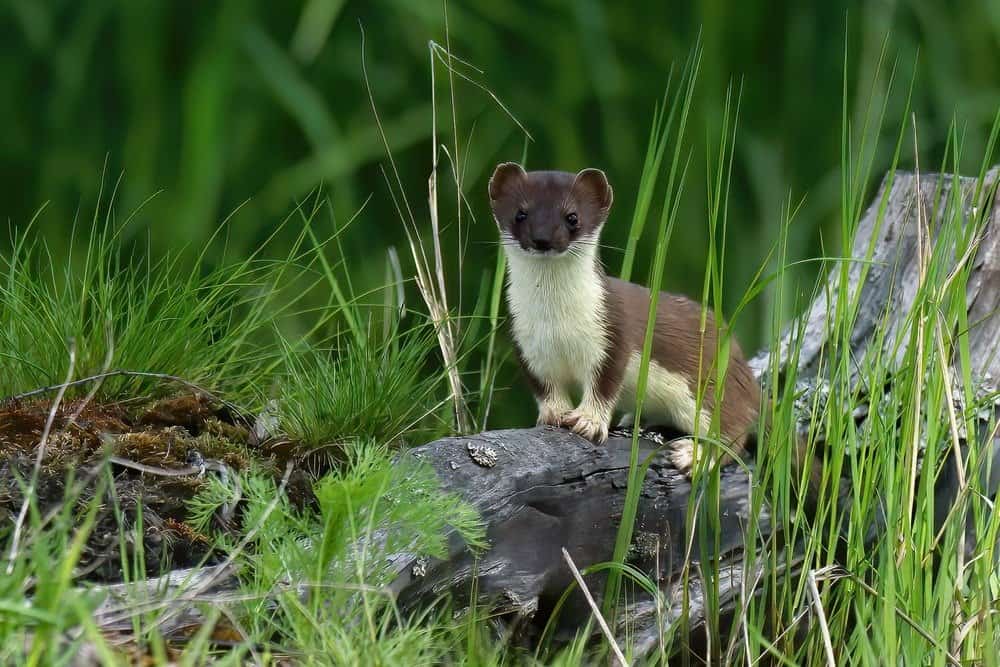
Stoat (Mustela erminea), also called ermine or short-tailed weasel standing on a log among grasses

ยฉAgami Photo Agency/Shutterstock.com

Weasels are animals that are natively found in a variety of habitats such as woodlands, coniferous forests, and on grassy plains in North America, Europe, Asia, and in northern parts of Africa.

Like their larger cousin the Stoat, Weasels have also been introduced to other countries (mainly as a form of pest control) like New Zealand and a number of other islands.

However, like the introduction of a number of small predators to such isolated places, Weasels have had a profound effect on native wildlife which has evolved in the same way for millions of years without the threat of small, terrestrial carnivores.

Weasel animals are opportunistic predators and can also be found in more urban areas and particularly close to farms where there is a varied and tempting supply of food. Despite their adaptability, Weasels are threatened by habitat loss in parts of their natural range.

Behavior and Lifestyle

๐Ÿ‘ Image

The Weasel is a solitary animal that spends a great deal of its life hunting for small mammals on the ground.

ยฉSteve Hillebrand โ€“ Public Domain by U.S. Fish and Wildlife Service

The Weasel is a solitary animal that spends a great deal of its life hunting for small mammals on the ground during both the day and night.

Weasels are territorial animals that patrol home ranges that vary in size depending on the habitat and the availability of food and although the home ranges of males and females are known to overlap, the two tend to avoid each other except when mating.

Within their territory, Weasels are known to make nests in crevices, tree roots, and abandoned burrows which are lined with grass and fur and are where the Weasel is able to safely rest.

Weasels are incredibly strong and powerful for their size and are able to catch and kill animals that are much larger than themselves, before carrying them back to their burrow. In order to make sure that they have the best view of their surroundings, Weasel animals are known to sit up on their hind legs exposing their white underside.

Reproduction and Life Cycles
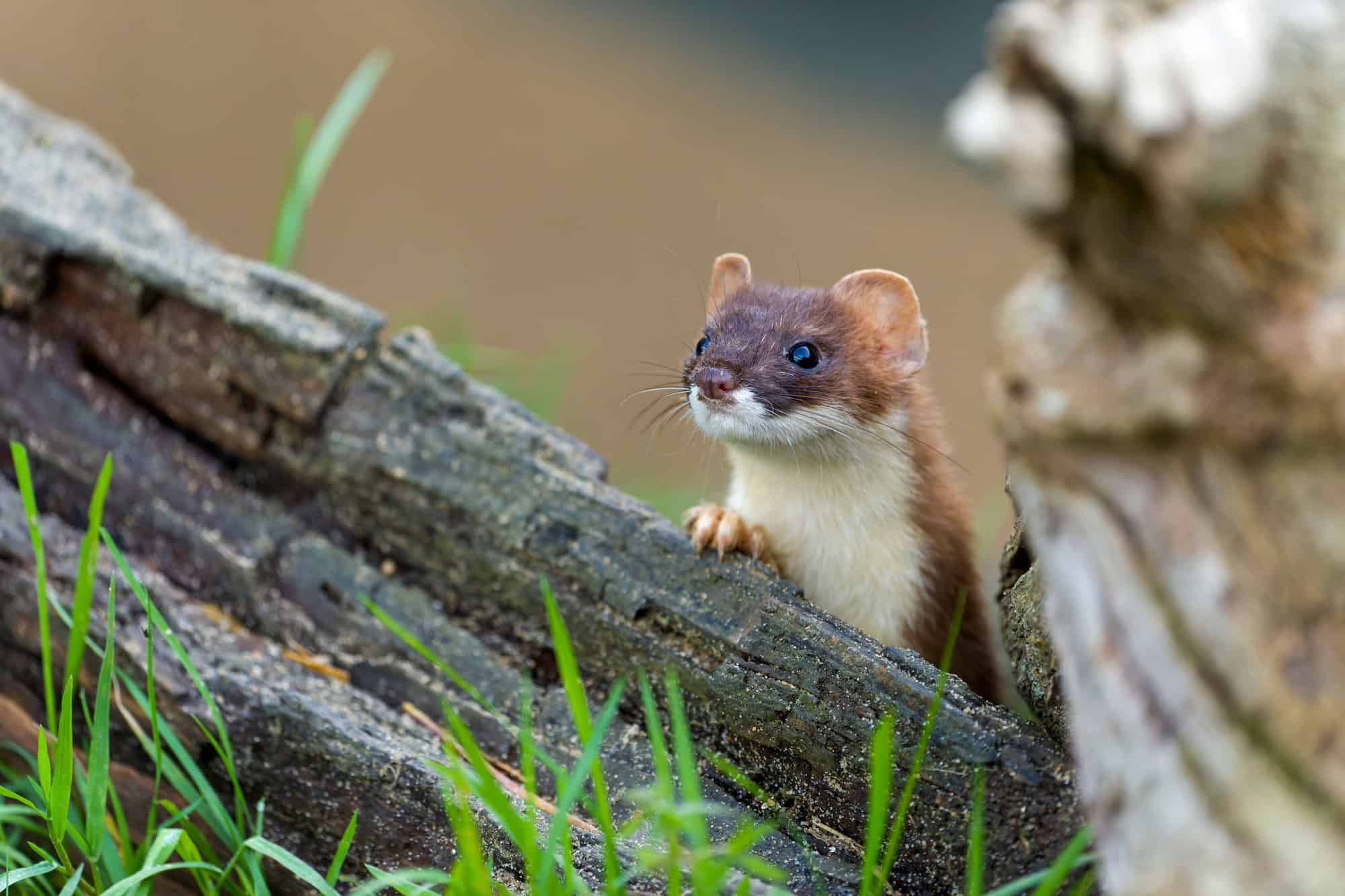
๐Ÿ‘ Baby Ermine ATTRIBUTION NOT FOUND

Weasels are animals that are natively found in a variety of habitats such as woodlands, coniferous forests, and on grassy plains

ยฉiStock.com/MikeLane45

The only time Weasels will tolerate one another is when a male and female meet to mate. After a gestation period that lasts for around five weeks, the female Weasel gives birth to a litter of between one and seven kittens in her burrow.

Weasels are also able to hunt small prey and will leave their mother within the next few weeks to establish a territory of their own.

Although female Weasels tend to live for around three years, they are not able to successfully breed until their second and third years. Males, however, will rarely reach their first birthday as their inclination to roam further in search of a mate means that they are often more vulnerable to numerous predators.

Diet and Prey
๐Ÿ‘ Image
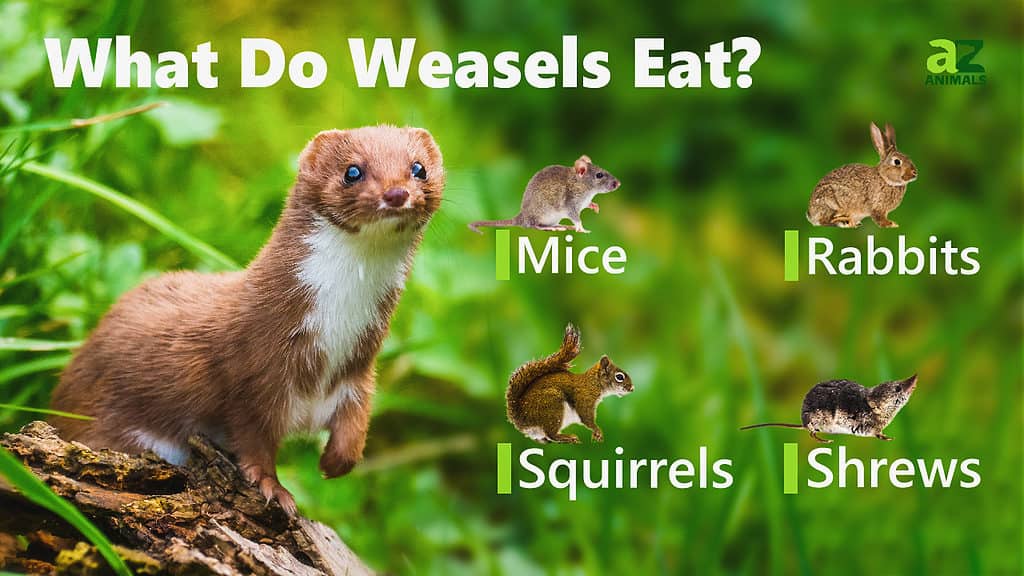
Weasels eat mice, rabbits, squirrels, and shrews.

The Weasel is a skilled and ferocious hunter that is able to actually enter the burrows of its prey which is something that most predators are unable to do.

By tracking small mammals using the tunnels that they make through the undergrowth and even under the snow, the Weasel is able to follow its victim back to its burrow and then catch it inside. Rodents such as Mice and Voles, along with Lemmings further north, make up the bulk of the Weaselโ€™s diet along with the occasional bird.

They are also known to eat eggs and are able to kill animals larger than themselves such as Ducks and Rabbits. Although the Weasel may be the perfect shape to get into small burrows, their long body covers a relatively large surface area and so loses a lot of body heat.

In order to ensure that they have enough energy, Weasels must eat around a third of their body weight every day to survive leading to them being such prolific hunters.
๐Ÿ‘ Weasel

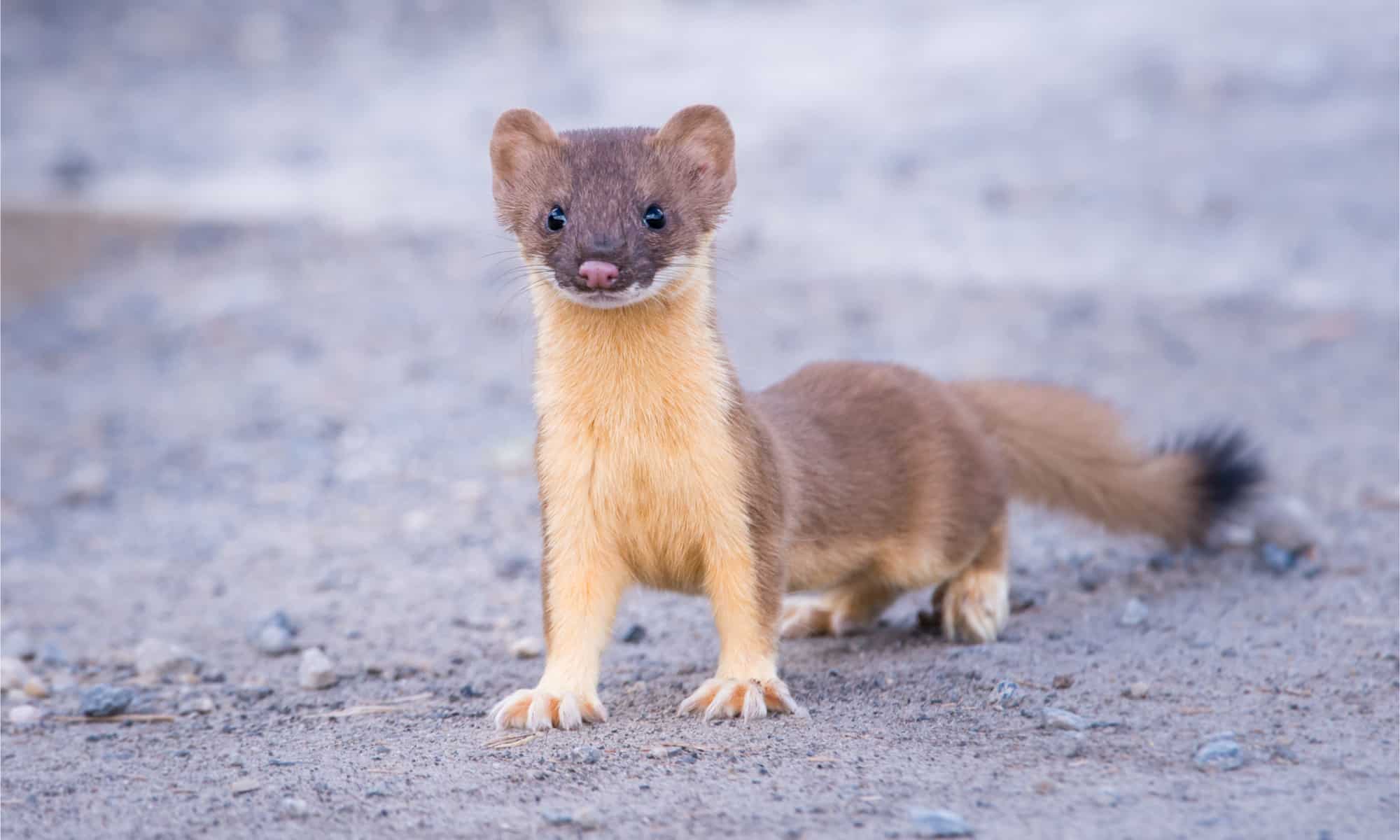
Natural predators to the Weasel animal include birds of prey, foxes, snakes, and domestic cats and dogs.

ยฉGhost Bear/Shutterstock.com

Predators and Threats

Despite their fast and dexterous nature, the small size of Weasels means that they are preyed upon by a number of different predators throughout their natural range. Birds of Prey such as Owls, Hawks, and Eagles that are able to spot them from high in the sky are the most common predators of the Weasel, along with Foxes and Snakes.

Weasels are also preyed upon by domestic Cats and Dogs in areas where they exist close to Human settlements. Their opportunistic nature though also means that they are seen as pests by farmers and are often persecuted for stealing livestock, mainly poultry and eggs. In some areas around the world, Weasels are threatened by habitat loss and a lack of their prey species can also have devastating effects on local populations.

Interesting Facts and Features

The Weasel is a carnivorous animal that has sharp, pointed canine teeth which are used for biting and shearing flesh. Although small, their teeth are incredibly sharp and are capable of delivering a fatal bite to animals more than double their size. Weasels have five toes on each of their paws that are tipped with small, non-retractable claws.

Although these are primarily used for holding onto prey, their claws also help Weasels to burrow into the ground surprisingly quickly. Although males and females have similar coat colors and markings, males are actually substantially bigger with a body length a quarter longer than that of females and weighing nearly double.

Relationship with Humans

The ferocious and greedy nature of the Weasel has led to them getting a bad reputation amongst farmers, particularly those who trap and kill them to prevent further loss of livestock.

They have, however, been introduced to countries where they are not naturally found due to their versatile and dominant nature as a form of natural pest control. Along with a number of native British species, Weasels are often found as characters in books and appear in childrenโ€™s songs.

Conservation Status and Life Today

Today, the Weasel is listed by the IUCN as an animal that is of Least Concern of becoming extinct in its natural environment in the near future.

Although they are considered widespread but rare in North America, they are common throughout Europe and Asia, and introduced populations to other countries are also stable. Some isolated populations however are becoming increasingly vulnerable.

View all 405 animals that start with W
How to say Weasel in ...
Bulgarian
ะะตะฒะตัั‚ัƒะปะบะฐ
Czech
Lasice kolฤava
Danish
Brud_(dyr)da
German
Mauswiesel
English
Least Weasel
Spanish
Mustela_nivalises
Finnish
Lumikko
Japanese
ใ‚คใ‚คใ‚บใƒŠ
Dutch
Wezel_(dier)nl
English
Snรธmus
Polish
ลasica
Swedish
Vessla
Turkish
BayaฤŸฤฑ gelincik

Sources

  1. David Burnie, Dorling Kindersley (2011) Animal, The Definitive Visual Guide To The World's Wildlife / Accessed November 10, 2008
  2. Tom Jackson, Lorenz Books (2007) The World Encyclopedia Of Animals / Accessed November 10, 2008
  3. David Burnie, Kingfisher (2011) The Kingfisher Animal Encyclopedia / Accessed November 10, 2008
  4. Richard Mackay, University of California Press (2009) The Atlas Of Endangered Species / Accessed November 10, 2008
  5. David Burnie, Dorling Kindersley (2008) Illustrated Encyclopedia Of Animals / Accessed November 10, 2008
  6. Dorling Kindersley (2006) Dorling Kindersley Encyclopedia Of Animals / Accessed November 10, 2008
  7. David W. Macdonald, Oxford University Press (2010) The Encyclopedia Of Mammals / Accessed November 10, 2008
  8. Weasel Information / Accessed November 10, 2008

About the Author

Rebecca Bales

Rebecca is an experienced Professional Freelancer with nearly a decade of expertise in writing SEO Content, Digital Illustrations, and Graphic Design. When not engrossed in her creative endeavors, Rebecca dedicates her time to cycling and filming her nature adventures. When not focused on her passion for creating and crafting optimized materials, she harbors a deep fascination and love for cats, jumping spiders, and pet rats.
Connect:

Thank you for reading! Have some feedback for us?

Contact the AZ Animals editorial team

Related Articles You May Find Interesting


Weasel FAQs (Frequently Asked Questions)

Weasels are Carnivores, meaning they eat other animals.

Weasels belong to the Kingdom Animalia.

Weasels belong to the class Mammalia.

Weasels belong to the phylum Chordata.

Weasels belong to the family Mustelidae.

Weasels belong to the order Carnivora.

Weasels are covered in Fur.

Weasels belong to the genus Mustela.

Weasels live in the Northern Hemisphere.

Weasels live in forests and open woodlands.

Predators of Weasels include hawks, foxes, and snakes.

The average number of babies a Weasel has is 5.

Weasels are the smallest carnivorous mammal in the world!

The scientific name for the Weasel is Mustela nivalis.

Weasels can live for 1 to 3 years.

A baby Weasel is called a kitten.

There are 10 species of Weasel.

The biggest threat to the Weasel is the lack of prey species.

The Weasel is also called the common weasel, European weasel, or least weasel.

A Weasel can travel at speeds of up to 15 miles per hour.

Minks differ from weasels in their preferred habitats, diet, and appearance. Read all about their differences here!

Weasels differ from stoats in their sizes, dietary preferences, and reproductive cycles. Read all about their differences here!

One is a member of the โ€˜dog-likeโ€™ carnivores, caniforma, while the other is a member of the feliforma, or โ€˜cat-likeโ€™ carnivores. But, thatโ€™s not all- read all about their differences here!

The greatest differences between an ermine and a weasel are their size and morphology.

The differences between pine martens and least weasels include size, appearance, diet, distribution, reproduction cycle, and lifespan.