




W
Species Profile

Whippet

Canis lupus familiaris

Speed on the track, snuggles at home
Dora Zett/Shutterstock.com

Whippet Distribution

Click a location to explore more animals from that region

Origin Location

This map shows the native origin of the Whippet. As a domesticated species, they are now found worldwide.

Loading map...

Found in 1 country

Size Comparison

Human 5'8"
Whippet 1 ft 7 in

Whippet stands at 27% of average human height.

At a Glance

Domesticated
Also Known As Snap dog, Whippit, Poor man's racehorse, Small sighthound
Diet Omnivore
Activity Diurnal+
Lifespan 13 years
Weight 19 lbs
Status Not Evaluated
Did You Know?

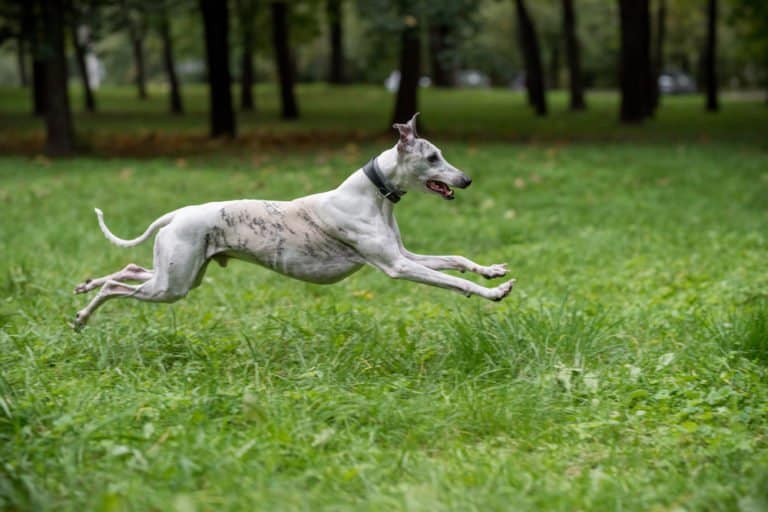
Whippets can hit about 56 km/h, sprinting faster than most dog breeds their size.

Scientific Classification

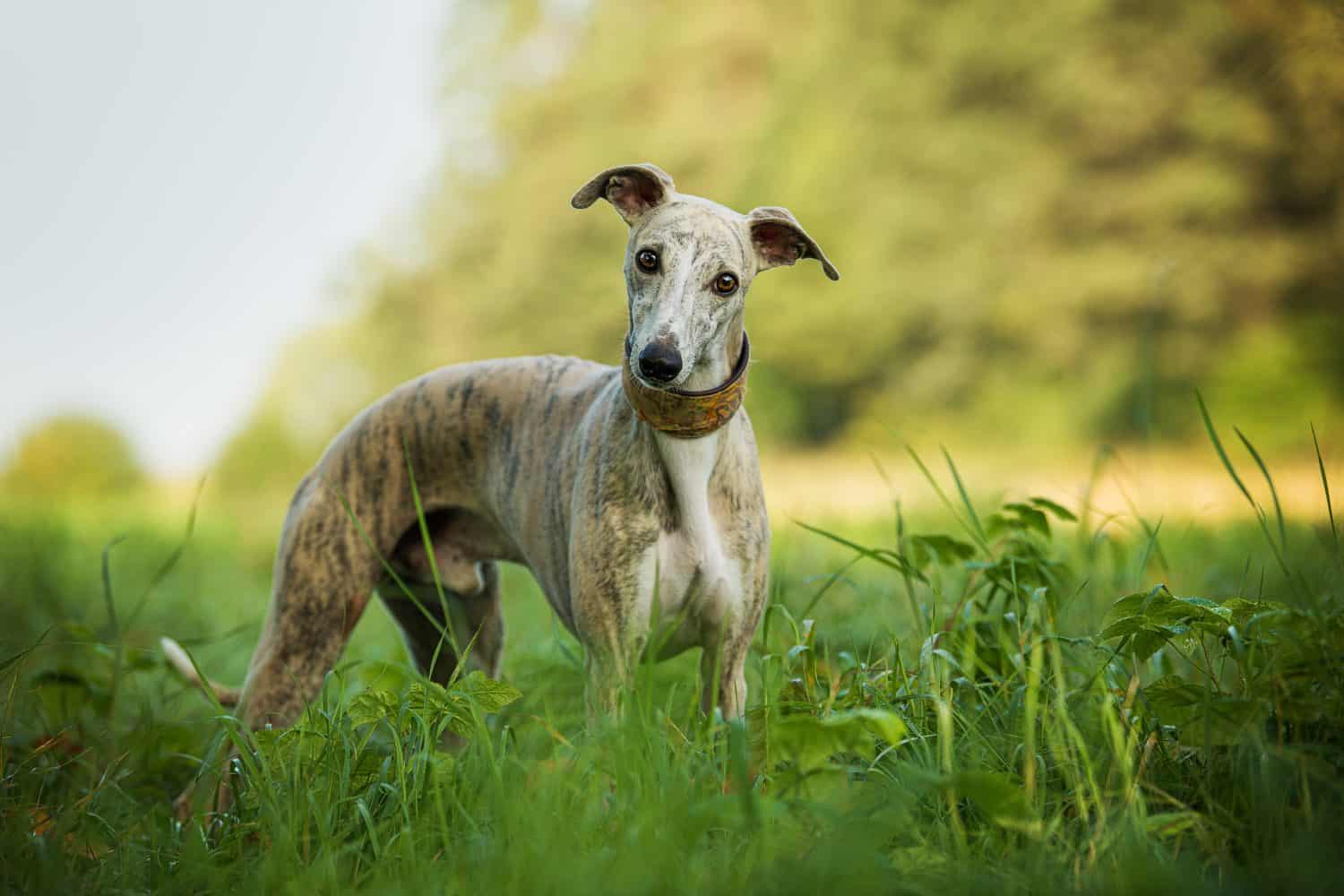
The Whippet is a medium-small sighthound dog breed developed in Britain for racing and rabbit coursing. It is known for extreme sprint speed, a lean aerodynamic build, and a gentle, affectionate temperament as a companion animal.

Kingdom
Animalia
Phylum
Chordata
Class
Mammalia
Order
Carnivora
Family
Canidae
Genus
Canis
Species
Canis lupus

Distinguishing Features

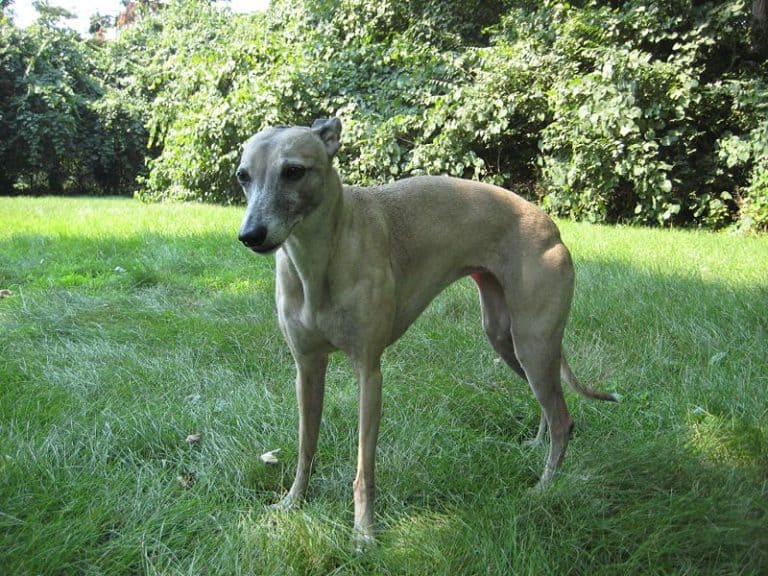
  • Lean sighthound build with deep chest
  • Very fast sprinter; bursts of speed
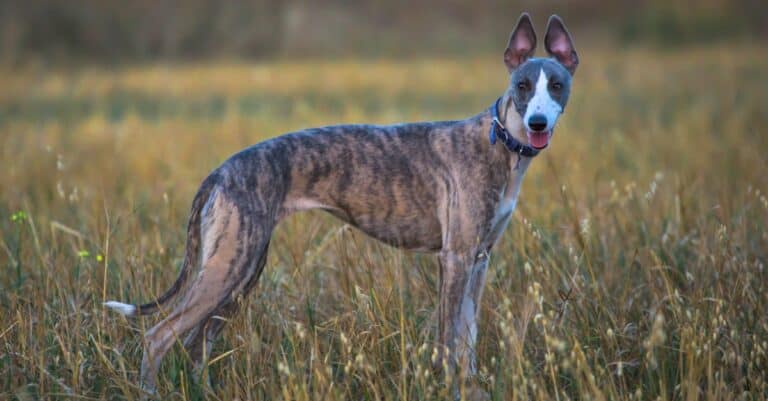
  • Narrow head, rose-shaped ears
  • Short, smooth coat with many colors
  • Calm indoors; energetic when running

Physical Measurements

Males and females differ in size

Height
1 ft 7 in (1 ft 7 in – 1 ft 8 in)
1 ft 6 in (1 ft 5 in – 1 ft 7 in)
Length
3 ft 4 in (3 ft 1 in – 3 ft 7 in)
3 ft 3 in (2 ft 11 in – 3 ft 7 in)
Weight
30 lbs (24 lbs – 35 lbs)
24 lbs (20 lbs – 29 lbs)
Tail Length
1 ft 2 in (1 ft 1 in – 1 ft 4 in)
1 ft 4 in (1 ft 2 in – 1 ft 6 in)
Top Speed
35 mph
running

Appearance

Primary Colors
Secondary Colors
Skin Type Short smooth coat
Distinctive Features
  • Lean sighthound silhouette with extreme tuck-up and narrow waist
  • Deep chest and prominent sternum to support large heart and lungs
  • Long, fine-boned legs and flexible spine for explosive sprinting
  • Small rose ears folded back; alertly lift when focused
  • Long, tapering tail carried low; curves slightly when moving
  • Short, thin coat and low body fat; needs warmth in cold weather
  • Thin skin prone to scrapes during high-speed running
  • Often wears protective coat indoors due to limited insulation
  • Compared with typical dogs, more aerodynamic build and faster acceleration
  • Sensitive temperament; thrives on gentle handling and quiet companionship

Sexual Dimorphism

Sex differences are subtle: males are typically slightly taller and more muscular through neck and shoulders, while females often appear finer-boned with a narrower head and lighter overall build.

  • Slightly broader chest and more pronounced forequarter musculature
  • Thicker neck with more defined shoulder mass
  • Head appears a bit broader with stronger jawline
  • Finer bone structure and more slender neck
  • Narrower head with softer facial contours
  • Often slightly lighter frame while retaining deep chest

Did You Know?

Whippets can hit about 56 km/h, sprinting faster than most dog breeds their size.

Developed in 19th-century Britain for rabbit coursing and straight-track racing, earning the nickname "poor man's racehorse."

As sighthounds, they hunt primarily by vision, locking onto moving targets and chasing with rapid acceleration.

Many Whippets are calm indoors, but erupt into "zoomies" when given a safe space to run.

A myostatin gene variant can produce rare "bully Whippets" with unusually heavy musculature.

Their short coat and low body fat make them prone to chilling; many happily wear coats in cold weather.

Like other sighthounds, some Whippets may be more sensitive to certain anesthetics than many breeds.

Unique Adaptations

  • Deep chest and large heart/lung capacity support high oxygen delivery during short, powerful sprints.
  • Flexible spine and long limbs increase stride length, echoing the cursorial build of wolf ancestors but optimized for speed.
  • High proportion of fast-twitch muscle fibers for rapid acceleration rather than endurance tracking.
  • Wide visual field and motion sensitivity typical of sighthounds, prioritizing sight over scent work.
  • Lean body and thin skin reduce drag but increase risk of scrapes; secure, hazard-free running areas matter.

Interesting Behaviors

  • "Roaching" while resting-arching the back into a relaxed curve, common in sighthounds.
  • Intense visual "lock-on" to squirrels or rabbits, followed by a sudden, straight-line chase.
  • Burrowing under blankets and seeking warm, soft surfaces due to low insulation.
  • Explosive sprint-play with abrupt stops and sharp turns, then long periods of lounging.
  • Gentle, people-focused bonding; many prefer close contact and lean into trusted humans.

Cultural Significance

Whippets rose from working-class Britain into organized racing and lure coursing, symbolizing accessible sport. Today they're celebrated as affectionate companions that showcase the sighthound tradition of speed and grace.

Myths & Legends

Victorian and Edwardian Britain popularized the Whippet as the "poor man's racehorse," with mining towns holding informal races and wagers.

Early Whippet lore credits purposeful crossings of small Greyhound types with terriers or local lurchers to create a fast, agile rabbit dog.

Traditional "rag" or lure racing stories describe crowds cheering Whippets sprinting after a fluttering cloth-an enduring pastime that shaped the breed's image.

The breed name is often linked in historical anecdotes to old slang for something that moves quickly and "whips about," fitting its sudden acceleration.

Conservation Status

NE Not Evaluated

Has not yet been evaluated against the criteria.

Population Stable

Life Cycle

Birth 6 pups
Lifespan 13 years

Lifespan

In the Wild 12–15 years
In Captivity 10–16 years

Reproduction

Mating System Polygynandry
Social Structure Managed Domestic
Breeding Season Year-round; females cycle 1-2 times yearly
Breeding Pattern Serial
Fertilization Managed Selective
Birth Type Managed_selective

Whippets, a British sprinting sighthound with low body fat and cold sensitivity, are typically bred under human-controlled pairings rather than stable bonds. Selected males may sire multiple litters across females; mating is internal, with short-term, heat-cycle pairings.

Behavior & Ecology

Social Pack Group: 4
Activity Diurnal, Crepuscular, Cathemeral
Diet Omnivore rabbit

Temperament

Gentle
Affectionate
Reserved
Sensitive
Playful
Calm-indoor
Prey-driven
Sprinter

Communication

quiet barks
whines
yips
grumbles
sighs
body language
ear position
tail carriage
play bow
chase invitations
leaning contact
pawing
scent marking
freezing-stare
zoomies bursts

Habitat

Biomes:
Temperate Forest Boreal Forest (Taiga) Tundra Temperate Grassland Mediterranean Desert Hot Desert Cold Alpine Wetland Freshwater +4
Terrain:
Plains Hilly Coastal Valley
Elevation: Up to 16404 ft 3 in

Ecological Role

Lean sighthound; high prey drive; cold-sensitive; anesthesia- and bloat-risk aware care.

rabbit control sport racing human companionship therapy support

Diet Details

Other Foods:
Berries Grasses Vegetable scraps

Human Interaction

Domestication Status

Domesticated

Domestic dogs diverged from wolves 15,000-30,000+ years ago via human association. The Whippet was developed in 18th-19th century Britain from sighthound/terrier-type crosses for rabbit coursing and sprint racing, later popular as a gentle companion.

Danger Level

Low
  • rare defensive bite if startled
  • knockdowns during high-speed zooms
  • high prey drive toward small pets

As a Pet

Suitable as Pet

Legality: Generally legal; subject to local dog licensing/leash laws.

Care Level: Moderate

Purchase Cost: Up to $2,000
Lifetime Cost: $12,000 - $28,000

Economic Value

Uses:
Companionship Sport Breeding Rescue
Products:
  • racing
  • stud
  • training
  • boarding

Relationships

Predators 4

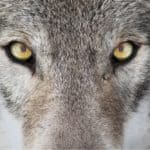
Gray wolf Canis lupus
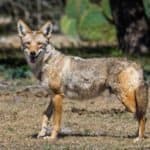
Coyote Canis latrans
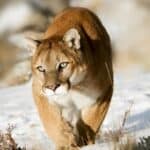
Mountain lion Puma concolor
Golden eagle Aquila chrysaetos

Related Species 7

Gray wolf Canis lupus Shared Species
Coyote Canis latrans Shared Genus
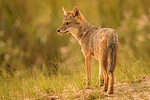
Golden jackal Canis aureus Shared Genus
Ethiopian wolf Canis simensis Shared Genus
Dhole Cuon alpinus Shared Family
African wild dog Lycaon pictus Shared Family
Red fox Vulpes vulpes Shared Family

Ecological Equivalents 5

Animals that fill a similar ecological role in their ecosystem

Greyhound Canis lupus familiaris Specialized sighthound sprinter adapted for high-speed chase.
Saluki Canis lupus familiaris Sighthound coursing hunter that relies on vision and speed.
Borzoi Canis lupus familiaris A pursuit hound adapted for open-country visual hunting.
Italian Greyhound Canis lupus familiaris Small sighthound with similar sprinting ability and prey-drive niche.
Cheetah Acinonyx jubatus Extreme sprint specialist predator of open habitats.

The medium-sized breed is also called the “Poor Man’s Racehorse” and “Lightning Rag Dog.” Although it is thought of as a small Greyhound, it has a unique deep chest and slim waist, and it is not known which breed was used to create the Whippet. Bred in Victorian England for coursing in rabbit hunting, the Whippet was later used for lure coursing, amateur racing, and dog shows, and eventually made its way with the coal miners to New England. The quiet, gentle, affectionate, and intelligent breed makes an excellent family pet or city companion.

3 Pros and Cons of Owning Whippets

Pros!Cons!
They’re good watchdogs. Also called a Snap Dog, its name comes from the older English word “whappet,” meaning “a small dog that yaps.” While the breed is quiet, it does have a hunting instinct that will cause it to bark and alert its owner to creatures outside or the doorbell ringing.They have a strong prey drive. As sighthounds, their natural instinct is to chase anything moving on sight. They shouldn’t be taken off their leads, even if they have had obedience training.
They are very friendly and affectionate. They are so easygoing that they get along with children, visitors, and other dogs. The exception is cats unless they’ve been raised with one.They are quiet but need exercise. Don’t let the couch-potato habit fool you; this breed needs a yard to run around in. If bored, they will become destructive.
They don’t shed much. Whippets are one of the lowest-shedding breeds around. Although their fur is short and fine, regular vacuuming of furniture and carpet is all an owner needs to do.They are thin-skinned. Not personality-wise, but literally. Not only do they get cold easily, but their short coat offers no protection against abrasions.

Evolution and Origins

👁 Whippet (Canis familiaris) - running through grass

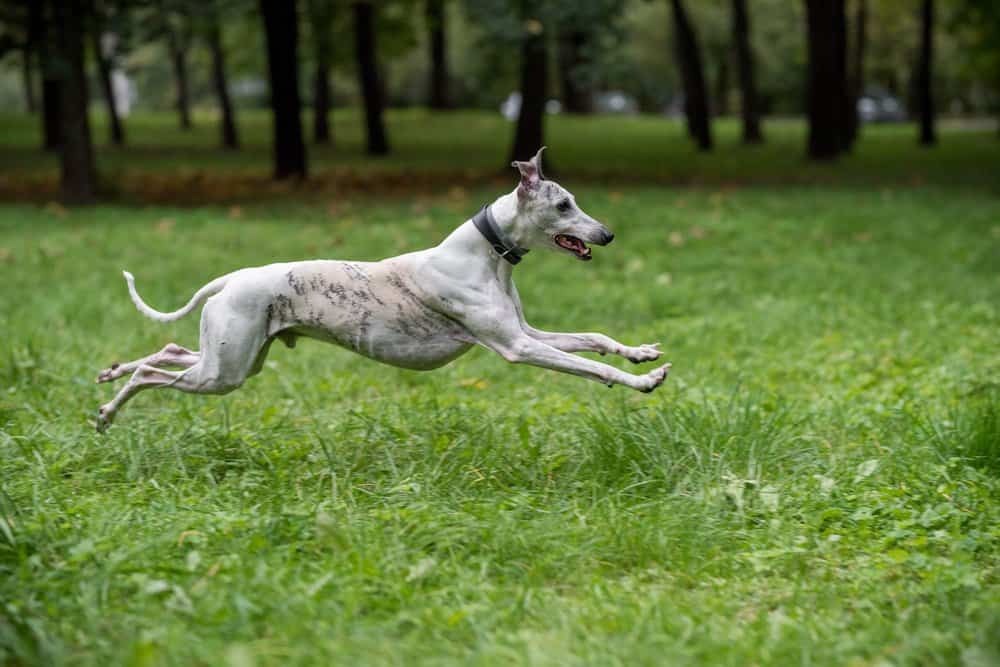
Whippets are capable of reaching speeds of up to 35 mph.

©photosounds/Shutterstock.com

For centuries, the Greyhound has been the model for other fast-running sighthounds, and the gentle Whippet is a successful descendant. The breed originated in England during the Victorian era, when coal miners in the north of the country enjoyed dog racing and rabbit hunting in their free time. Since they could not afford to maintain large Greyhounds or have the room to exercise them properly, the miners developed a smaller version of the breed. The exact breeds used to produce the Whippet are unknown, but the result was effective: it can run at speeds up to 35 miles per hour, making it the fastest breed of its size.

In the past, the Whippet breed was called the “Poor Man’s Racehorse” and the “Lightning Rag Dog” because they would chase a rag along a straight track. The name Whippet likely came from the word “whappet,” which means a small barking dog. At the start of the 20th century, textile workers from Lancashire moved to New England and brought their Whippets with them, and this breed quickly became popular in America. People from all backgrounds enjoyed racing Whippets for fun or money, and the American Kennel Club registered its first Whippet in 1888. Nowadays, lure coursing is used to satisfy the Whippet’s need for speed.

Size and Weight
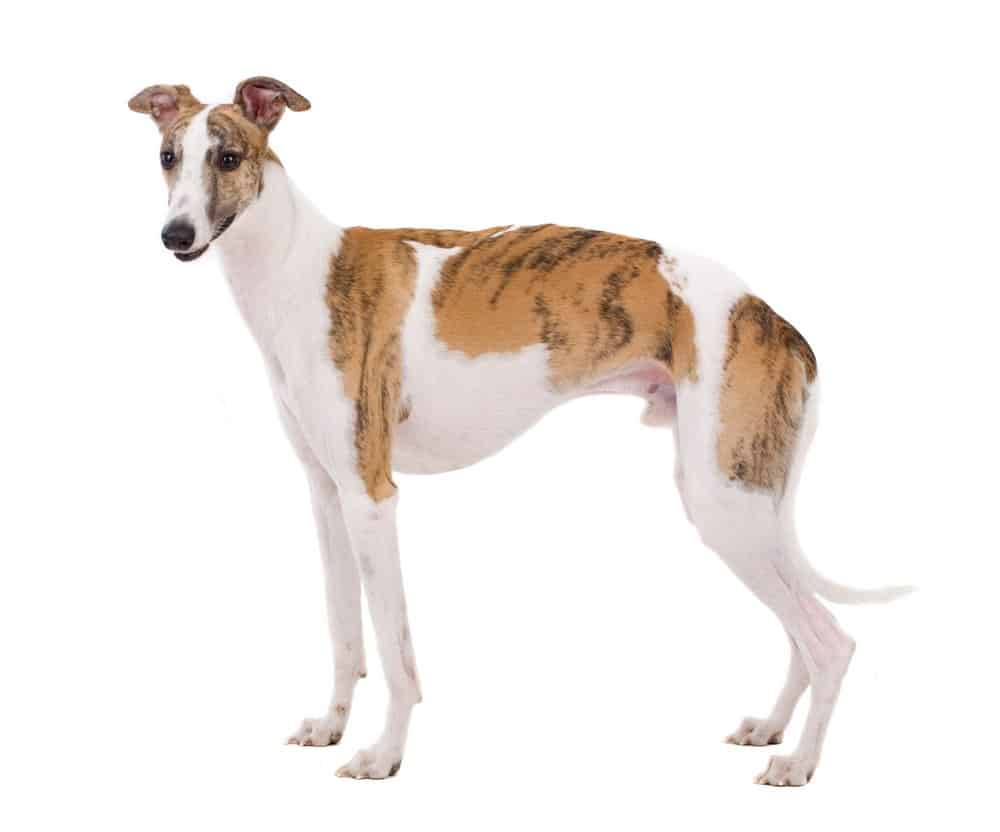
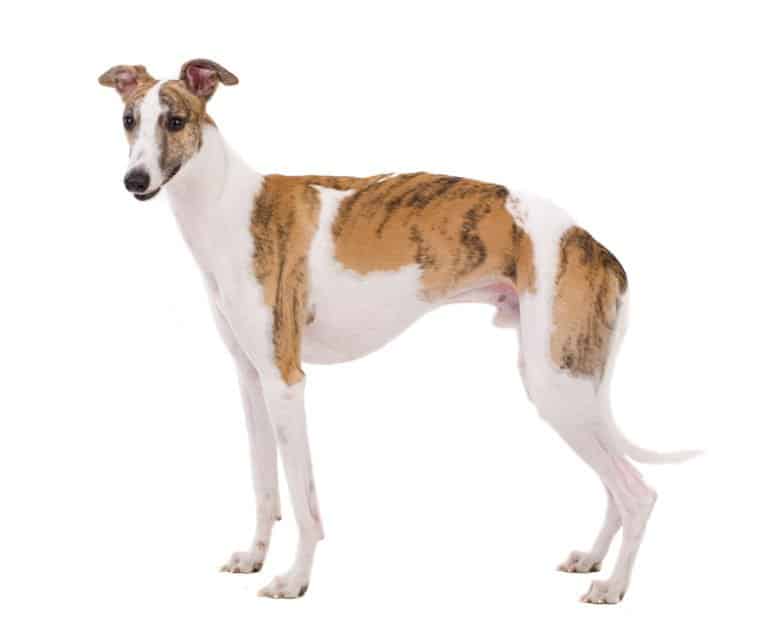
👁 Whippet (Canis familiaris) - standing against white background

Whippets reach their full size between 8 and 12 months of age.

©Lebedinski Vladislav/Shutterstock.com

The Whippet is a medium-sized short-haired dog with an average height of 22″ for males and 21″ for females. Males weigh about 40 pounds fully grown, while females weigh 35 pounds fully grown. Whippet puppies weigh 5.5 pounds on average at 12 weeks of age and are considered fully grown at 12 months.

Health Issues
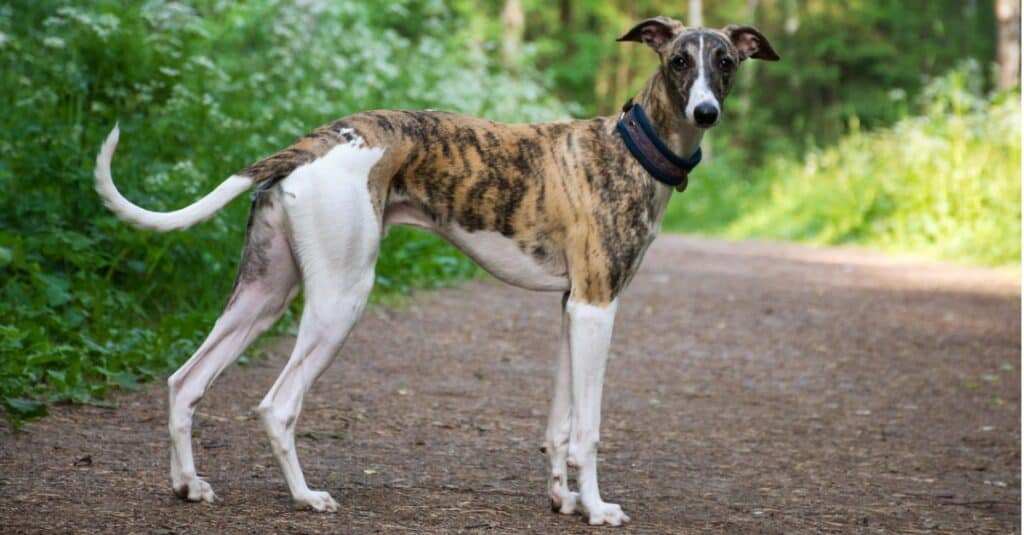
👁 greyhound standing tall on path outside

Whippets are known to enjoy robust health but are prone to cardiac issues.

©iStock.com/Natalia Timchenko

These dogs have excellent health due to their breeding for coursing, working, and racing, activities that combine to provide well-rounded physical exertion. As a result, they are not prone to many of the conditions that the Greyhound and other sighthounds and purebreds have. Genetic eye defects, hip dysplasia, congenital deafness, and hypothyroidism rarely occur.

Cancer and cardiac problems are the two leading causes of death, followed by epilepsy and autoimmune hemolytic anemia. Whippets are also prone to chronic diarrhea due to stress, food intolerance, colitis, or bloat. All sighthounds have low body fat and are extra sensitive to anesthesia, particularly barbiturates, and require an experienced vet to follow the Sighthound Anesthesia Protocol.

Temperament
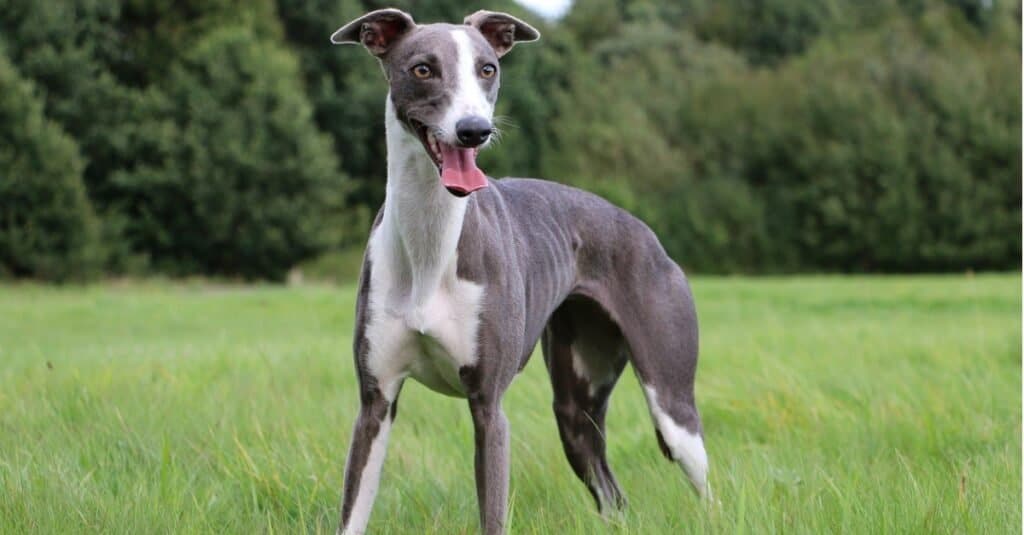
👁 Gray Dog Breeds

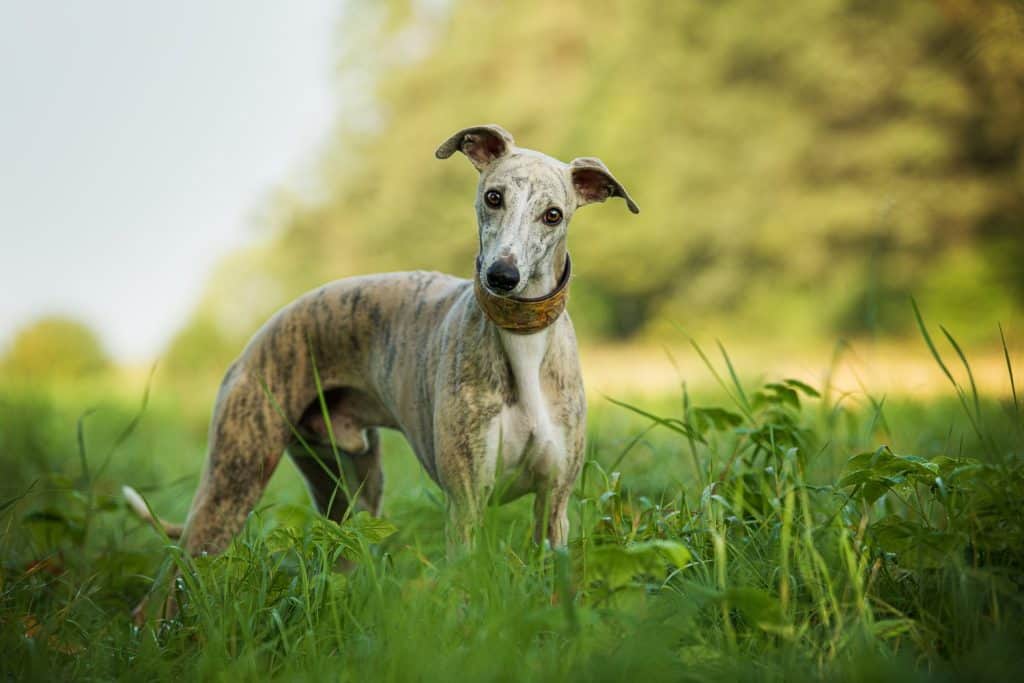
Whippets are laidback, patient, and easygoing.

©iStock.com/BiancaGrueneberg

The temperament of these dogs is laidback and nonobtrusive. It has an affectionate personality. As a snap dog bred by the English to have similar traits to the Greyhound without the large size, its intelligence, obedience, and athletic body enabled it to learn a variety of tasks. It is relatively easy to train, but with an independent streak and a strong prey drive, which makes it given to chasing.

In the home, however, it only needs moderate amounts of exercise and stimulation to avoid boredom and destructiveness. It also enjoys the company of other dogs, and as it can experience separation anxiety, it is helpful to have another dog for its company while the family is gone. The Whippet only barks as a warning and rarely whines, sighs, or growls.

Care
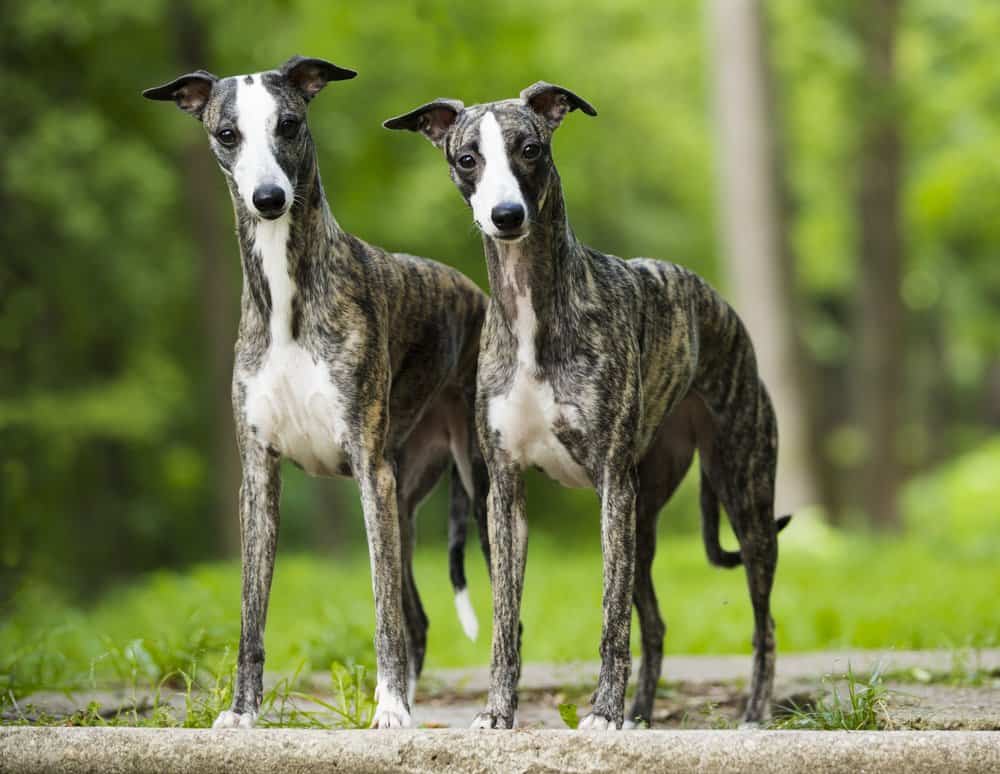
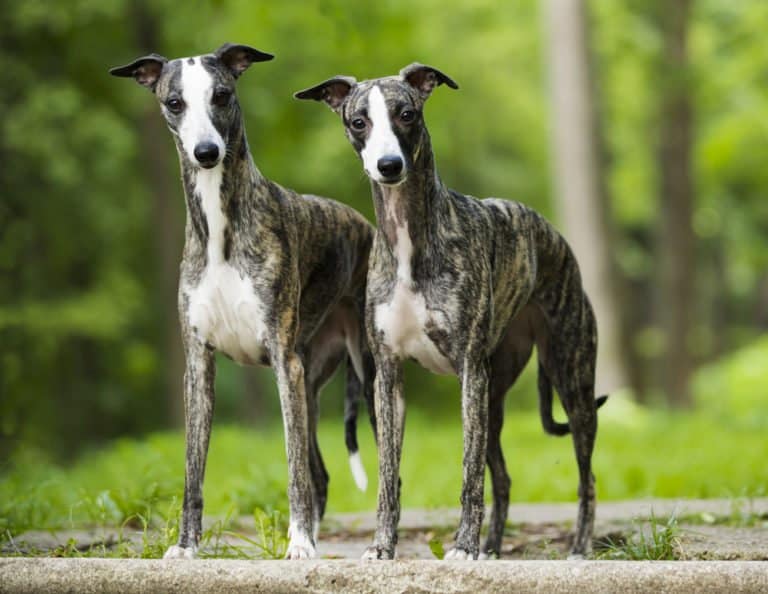
👁 Whippet (Canis familiaris) - standing side by side in woods

Whippets are an excellent choice for first-time dog owners.

©Liliya Kulianionak/Shutterstock.com

These are medium-sized dogs who are unique in their skin sensitivities and emotional and physical needs. They make great dogs for first-time dog owners or families, as they are very social and seem to grow more quickly than many other breeds. They are also good for people who live in apartments or small houses.

The Best Dog Food

The puppies are as active and demanding as puppies of other breeds, but with more sensitive digestion. When they mature, they calm down and have different dietary needs. Remember that whippets are naturally thin dogs, so weight gain is harmful to their lean frame.

Whippet puppy food: If you’re getting your puppy from a breeder, you should gradually change it to the new food within a week. It will need high-quality puppy food made specifically for the breed. Dry or wet food is fine, but during puppyhood, whippets should be fed 3 to 4 meals a day for a total of 990 calories. Continue to feed them puppy food until they reach 90% of their adult size.

Whippet adult dog food: When the dog has reached a year old, you should feed them twice a day. It needs an ounce of food for every two pounds of weight, for a total of 894 calories. As older whippets remain active, seek out an active adult dog food or an adult dog food made just for whippets. Grain-free, gluten-free, and raw diets are possibilities for reducing digestive issues.

Maintenance And Grooming
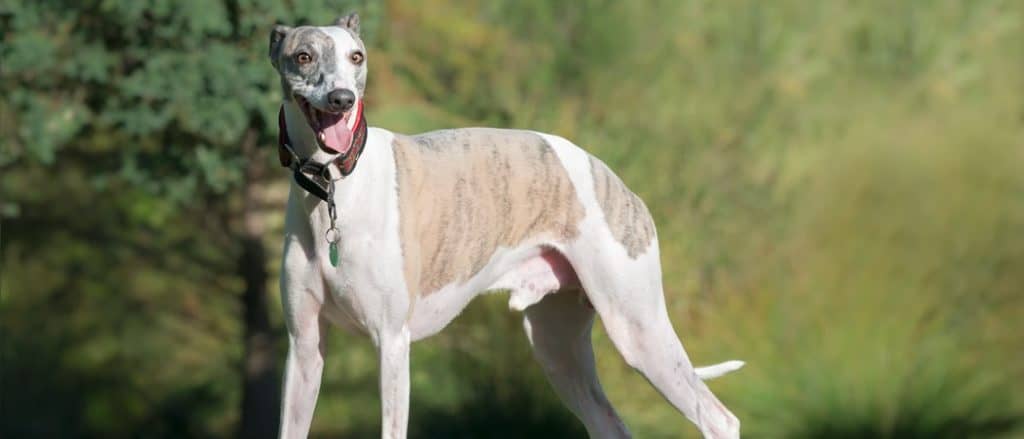
👁 Dog in Martingale Collar

Whippets are low-maintenance but require additional warmth during cold periods.

©tsik/Shutterstock.com

Whippets do not shed much except during spring and autumn when they change their coats. They only need a weekly brushing. For the home, you only need to keep up with regular cleaning as usual to remove the fur left behind. They are very low-maintenance, but during the winter or for older dogs with arthritis, they need sweaters for warmth and comfort. Although they are not hypoallergenic, they do not tend to trigger people with asthma or allergies.

Training

Whippets are very intelligent, but they do have an independent streak, so you can expect some rebellion. Being sighthounds, they have a strong prey drive to chase anything moving that they see, so even with obedience training, they shouldn’t be taken off their leads. They also see cats as prey animals to chase unless they are mature or have been raised with a cat. Compared to other breeds, they are very obedient and intelligent and relatively easy to train. They are very sensitive and a little stubborn, so they respond well only to positive, calm training methods that focus on praise and food.

Exercise

Whippets can do with an apartment or small home as long as they have a fenced-in yard to run around in. They also need toys and games. When left alone for hours at a time, they need to be kept stimulated, so they don’t become destructive or have separation anxiety. Barring that, they need another dog for companionship. They are given to bouts of sprinting, after which they will happily collapse onto the sofa or bed with the family. The adult Whippet needs about 40 minutes of exercise with several chances to run. The breed also enjoys mental stimulation with games.

Puppies

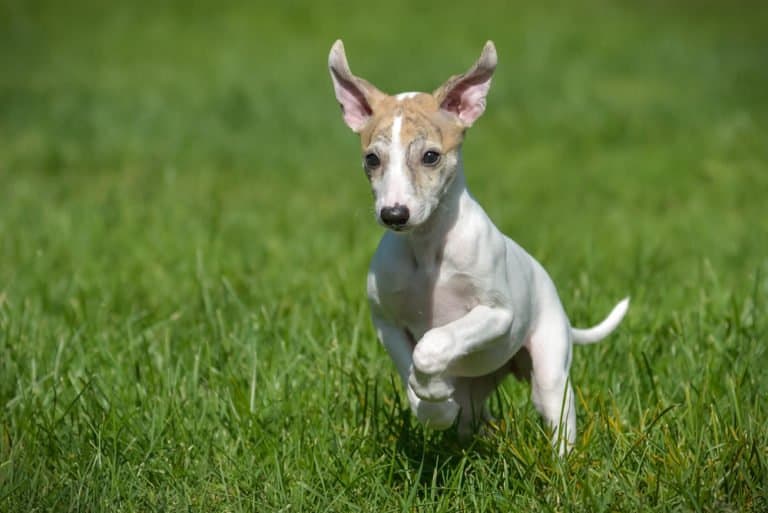
Whippet puppies need free play like any other puppy, meaning that it shouldn’t be too strenuous while they’re still growing. A 3-month-old needs 15 minutes of play twice a day. Puppyhood is also a great time to start obedience training and socialization. Without enough early socialization, whippet puppies can become fearful and timid.
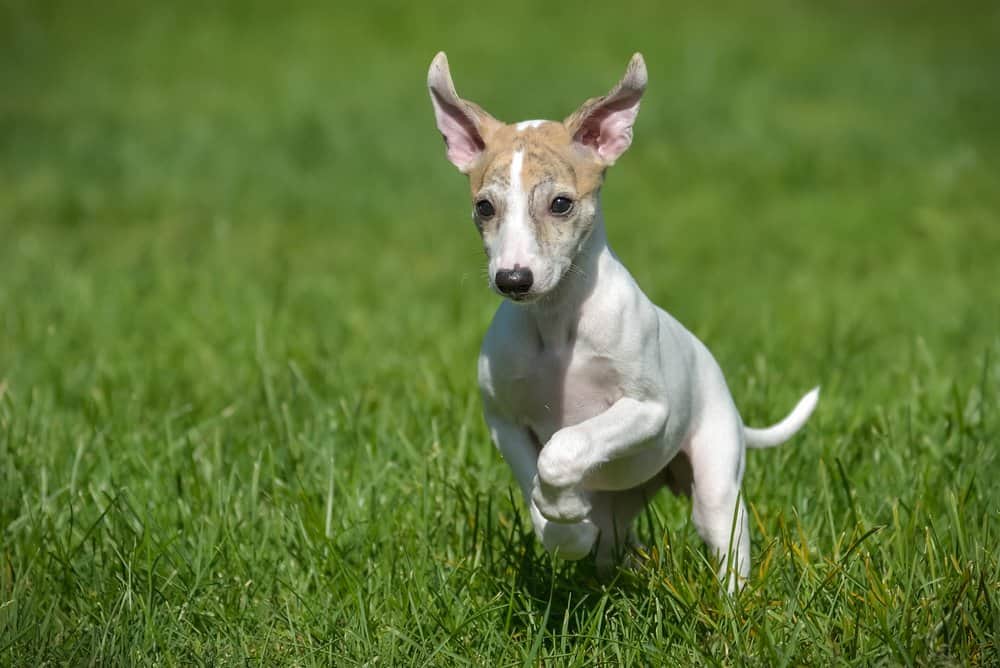
👁 Whippet (Canis familiaris) - puppy running in grass

Whippet puppies need early socialization; otherwise, they can become fearful.

©Radek Havlicek/Shutterstock.com

With Children

Whippets are excellent with children. Perhaps the most important trait Whippets have that allows them to get along so well with children is patience. The dogs are also gentle, quiet, and calm. They also get along well with other dogs and even strangers.

Similar Dogs

  • Greyhound: The larger ancestor of the Whippet, the Greyhound runs faster and has a shorter lifespan.
  • Italian Greyhound: The smallest compared to the Greyhound and Whippet, the Italian Greyhound is a toy breed meant for companionship rather than hunting.
  • Whippet Hound Mix: The mix is commonly a cross between a Whippet and Doberman (called the Whipperman), but other hybrids include Labrador Retriever (Whipador), Golden Retriever (Golden Whiptriever), Pit Bull (PitWhip), Pit Bull Terrier (Pippet), and many other purebred mixes.

Whippet vs. Greyhound

There are a few key differences between the Whippet and Greyhound. The first is size, with the Whippet being medium-sized and the Greyhound large. Another is running speed; the Whippet can reach 35mph, while the Greyhound can reach 40 to 45mph. Lastly is lifespan; the Whippet lives 12 to 15 years, while the Greyhound lives 10 to 12 years.

Famous Whippets

A Whippet named Jim had a central role in a canal travel book trilogy by Terry Darlington in which he was described as a “narrow dog.” Hence, his name was in the books’ titles of Narrow Dog to Carcassonne, Narrow Dog to Indian River, and Narrow Dog to Wigan Pier.

View all 405 animals that start with W

Sources

  1. Wikipedia / Accessed November 29, 2020
  2. Officially Pets / Accessed November 29, 2020
  3. American Kennel Club / Accessed November 29, 2020
  4. Rusalka Hounds / Accessed November 29, 2020
  5. Terrific Pets / Accessed November 29, 2020
  6. The Whippet / Accessed November 29, 2020
  7. Whippet Central / Accessed November 29, 2020
  8. Your Pure Bred Puppy / Accessed November 29, 2020
  9. 101 Dog Breeds / Accessed November 29, 2020

About the Author

Heather Hall

Heather Hall is a writer at A-Z Animals, where her primary focus is on plants and animals. Heather has been writing and editing since 2012 and holds a Bachelor of Science in Horticulture. As a resident of the Pacific Northwest, Heather enjoys hiking, gardening, and trail running through the mountains with her dogs.

Thank you for reading! Have some feedback for us?

Contact the AZ Animals editorial team

Related Articles You May Find Interesting


Whippet FAQs (Frequently Asked Questions)

A Whippet is essentially a smaller version of a Greyhound.

A whippet can reach a speed of 35mph.

Whippets are excellent pets that suit a variety of homes.

Whippets can be left alone without fear of destructiveness as long as they have toys to play with or another dog for companionship.

Whippets have bursts of high energy followed by downtime. They alternate between sprinting and resting.

Whippets cost between $1,200-2,000 with a ballpark of $800-1,500 in the eastern U.S. They cost less through adoption rather than from a breeder.

Whippets are excellent with kids, but should not be left unsupervised in the event of children causing unintentional injury to the dogs.

Whippets are usually not good with cats, which they consider to be small prey animals. The exception is if they are mature and have been socialized well, or are used to cats.