
W
Species Profile

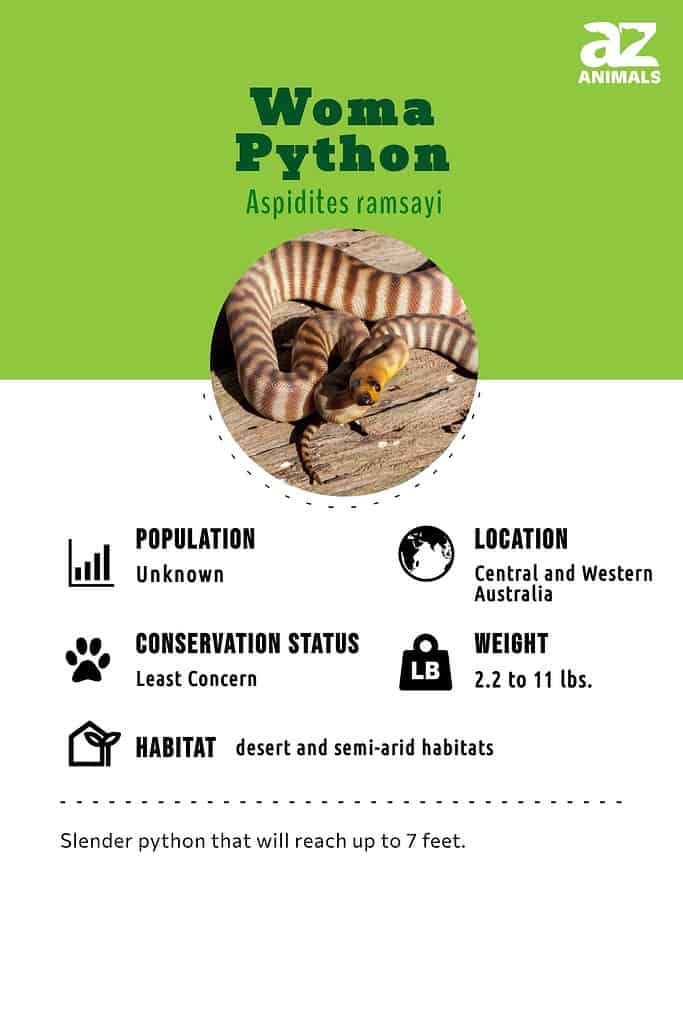
Woma Python

Aspidites ramsayi

Burrow-dwelling snake-eater of the outback
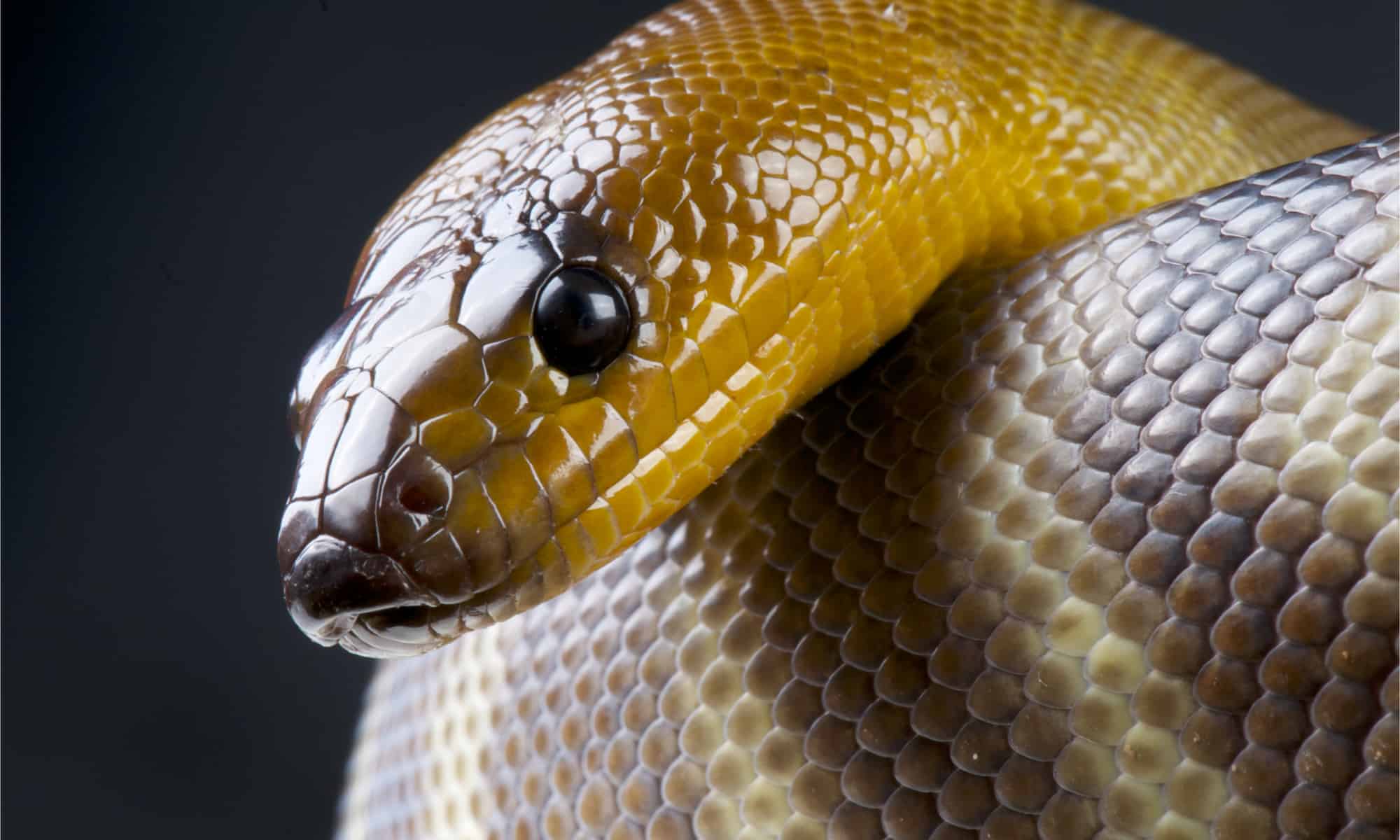
reptiles4all/Shutterstock.com

Woma Python Distribution

Click a location to explore more animals from that region

Endemic Species
Loading map...

Found in 1 country

At a Glance

Wild Species
Also Known As Ramsay's python, Sand python
Diet Carnivore
Activity Nocturnal+
Lifespan 15 years
Weight 7 lbs
Status Least Concern
Did You Know?

Adults are typically 1.5-2.0 m long; the largest reliably reported individuals reach about 2.7 m.

Scientific Classification

The Woma Python is a medium-to-large, nonvenomous Australian python adapted to arid and semi-arid environments. It is a terrestrial constrictor that shelters in burrows and preys on small mammals, birds, and reptiles, including other snakes.

Kingdom
Animalia
Phylum
Chordata
Class
Reptilia
Order
Squamata
Family
Pythonidae
Genus
Aspidites
Species
Aspidites ramsayi

Distinguishing Features

  • Broad head; lacks strong heat-sensing labial pits
  • Pattern often forms bands or blotches; variable coloration
  • Robust, ground-dwelling build; strong burrow use
  • Nonvenomous constrictor; relatively calm disposition

Did You Know?

Adults are typically 1.5-2.0 m long; the largest reliably reported individuals reach about 2.7 m.

A nonvenomous constrictor, it kills prey by coiling and restricting breathing and blood flow.

It often uses mammal burrows and soil cracks as day shelters in hot, arid landscapes.

Diet includes rodents, birds, lizards, and other snakes-including venomous elapids reported in stomach-contents studies.

Females lay roughly 5-20 eggs per clutch and coil around them to incubate and protect them.

Captive longevity commonly exceeds 20 years; records around 25-30 years are reported with consistent care.

It's often confused with the Black-headed Python; both can have dark heads, but Womas are usually less sharply black-headed and are more often found in arid interiors.

Unique Adaptations

  • Arid-environment tolerance: water-conserving reptile physiology suits semi-desert regions where free water is limited.
  • Sand-and-soil camouflage: banded pattern breaks up the outline against spinifex, dunes, and gibber plains.
  • Burrow use reduces heat stress, predation risk, and dehydration during daytime temperature extremes.
  • Robust constriction and flexible jaws allow handling diverse prey, from rodents to other snakes.
  • Relatively smooth, glossy scales help it move through tight burrows and sandy substrate efficiently.

Interesting Behaviors

  • Mostly terrestrial: it actively forages on the ground rather than climbing or ambushing from trees.
  • Burrow association: shelters in abandoned mammal burrows and crevices, especially during daytime heat.
  • Seasonal activity shifts: more nocturnal/crepuscular during extreme heat, more active by day in cooler periods.
  • Snake predation: will seize and constrict other snakes, an uncommon but well-documented python feeding strategy.
  • Egg brooding: females coil around clutches, guarding them and stabilizing temperatures during incubation.
  • Defensive posture: may coil tightly and hide the head, relying on camouflage banding in sandy habitats.

Cultural Significance

Australian pythons are prominent in Aboriginal traditions, often linked to powerful serpents shaping land and water. The Woma-an inland, burrow-using python-also features in wildlife education as an emblem of arid-zone biodiversity.

Myths & Legends

Rainbow Serpent traditions across Australia describe a great snake creating rivers and waterholes, punishing lawbreakers and sustaining life where water persists.

Western Desert stories of the water serpent tie sacred waterholes to a powerful snake-being that must be respected to avoid drought or danger.

The species name ramsayi honors Australian zoologist Edward P. Ramsay; this naming history is often retold in museums and herpetology circles.

Conservation Status

LC Least Concern

Widespread and abundant in the wild.

Population Unknown

Protected Under

  • CITES Appendix II
  • State wildlife acts

Life Cycle

Birth 12 hatchlings
Lifespan 15 years

Lifespan

In the Wild 10–20 years
In Captivity 15–30 years

Reproduction

Mating System Polygynandry
Social Structure Solitary
Breeding Season Late winter to early spring (Aug-Sep)
Breeding Pattern Transient
Fertilization Internal Fertilization
Birth Type Internal_fertilization

Solitary adults; males actively search for receptive females and may compete, with both sexes mating multiple times during the breeding season. Copulation is internal; females lay ~5-20 eggs and brood them alone until hatching (~50-55 days).

Behavior & Ecology

Social Solitary Group: 1
Activity Nocturnal, Crepuscular, Diurnal
Diet Carnivore small rodents
Seasonal Hibernates

Temperament

Secretive
Defensive
Tolerant

Communication

hissing
pheromone cues
scent trailing
tactile contact
body postures
cloacal rubbing

Habitat

Biomes:
Desert Hot Savanna Temperate Grassland
Terrain:
Plains Plateau Valley Rocky Sandy
Elevation: Up to 3280 ft 10 in

Ecological Role

Mid-to-upper-level predator regulating arid-zone small vertebrate populations

rodent population control mesopredator regulation energy transfer scavenger support

Diet Details

Main Prey:
Small rodents Marsupials Lizard Ground birds Other snakes

Human Interaction

Domestication Status

Wild

Wild species; never domesticated. Adults commonly 1.5-2.0 m TL, max 2.7 m (Wilson & Swan 2021). Kept in herpetoculture since mid-20th century for education and pets; captive longevity ≥20 years reported.

Danger Level

Low
  • Defensive bite; curved teeth cause lacerations
  • Constrictor-unsafe around small children
  • Salmonella from handling feces
  • Mites/allergens from poor husbandry

As a Pet

Suitable as Pet

Legality: Permits in Australia; US/Europe legality varies by jurisdiction.

Care Level: Experienced

Purchase Cost: $250 - $900
Lifetime Cost: $5,000 - $18,000

Economic Value

Uses:
Pet trade Education Research Tourism Pest control

Relationships

Predators 6

Wedge-tailed Eagle Aquila audax
Brown Falcon Falco berigora
Dingo Canis lupus dingo
Feral cat Felis silvestris catus
Perentie Varanus giganteus
Sand Goanna Varanus gouldii

Related Species 6

Black-headed Python Aspidites melanocephalus Shared Genus
Carpet Python Morelia spilota Shared Family
Water Python Liasis fuscus Shared Family
Olive Python Liasis olivaceus Shared Family
Children's Python Antaresia childreni Shared Family
Ball Python Python regius Shared Family

Ecological Equivalents 5

Animals that fill a similar ecological role in their ecosystem

Black-headed Python Aspidites melanocephalus Terrestrial arid-zone constrictor that shelters in burrows and hunts mammals and reptiles.
Carpet Python Morelia spilota Overlaps in prey and habitat. Ambushes mammals, birds, and reptiles near cover.
Stimson's Python Antaresia stimsoni Arid to semi-arid python that uses rock crevices and burrows and feeds on small vertebrates.
Pygmy Python Antaresia perthensis Arid-zone constrictor that forages nocturnally on small lizards and rodents.
Mulga Snake Pseudechis australis Arid terrestrial predator that preys on reptiles and mammals, including other snakes.

Woma pythons are effective hunters that are just as good at squishing their prey as they are constricting it.

Also known as Ramsay’s python, the woma is a nonvenomous constrictor that used to be common throughout western Australia; however, it is endangered in some areas and the subject of reintroduction attempts.

Amazing Facts About Woma Pythons

👁 Image

Where to Find Them

Woma pythons tend to prefer desert and semi-arid habitats and are often found in sandy areas. They also occur in grassland, acacia and eucalyptus woodlands, and other non-sandy areas. The general habitat type doesn’t seem as crucial to their survival as having appropriate shelter.

During the day, they take shelter in rock crevices, hollow logs, animal burrows, and under thick vegetation. Woma pythons’ activity levels are dependent on the outside temperatures. During the summer heat, they are active at night (nocturnal), and during the winter, they are diurnal.

While this species is generally terrestrial and sometimes fossorial, it’s also opportunistic and will climb trees, hunt in burrows, and take whatever prey it can. The woma’s diet is varied; they feed equally on mammals and reptiles, with birds and eggs thrown into the mix.

Hunting for this snake sometimes adds new scars. It’s primarily nocturnal and catches at least some of its prey in burrows. It doesn’t just bite and constrict; however, some of these burrows are too small for the woma to wrap multiple coils around its prey. So, it uses a loop of its body to pin its prey against the side of the burrow. This method, while effective, doesn’t kill as quickly as constriction. Adult snakes are usually covered in scars because the prey goes down fighting.
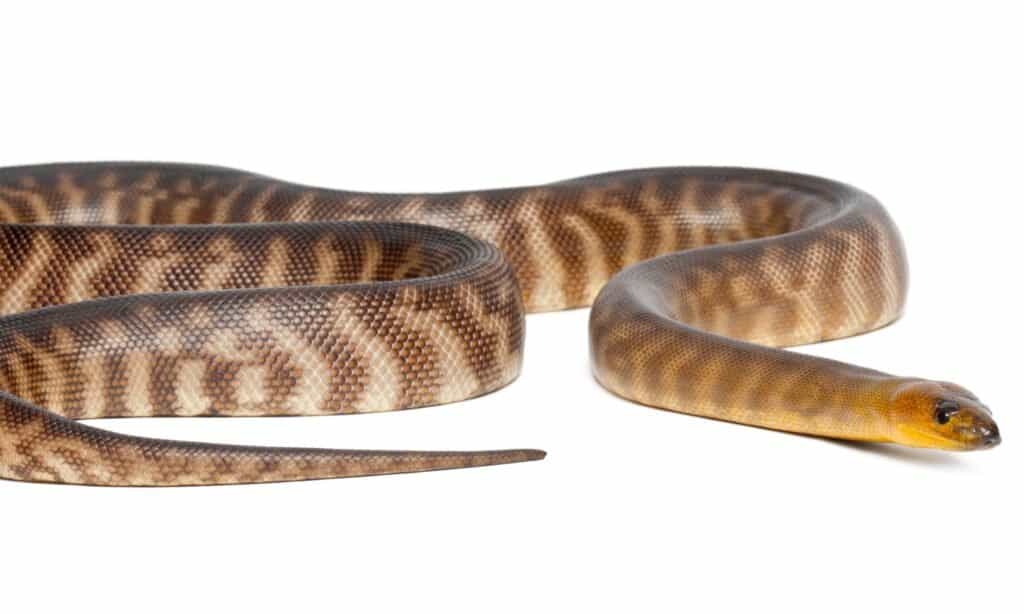
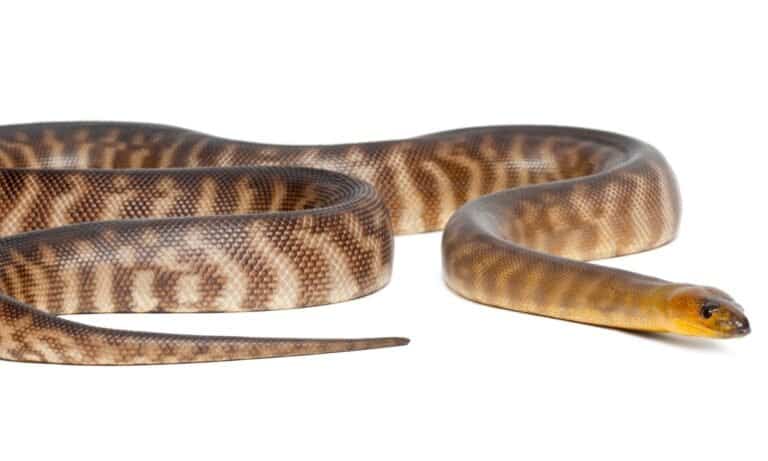
👁 woma python on white background

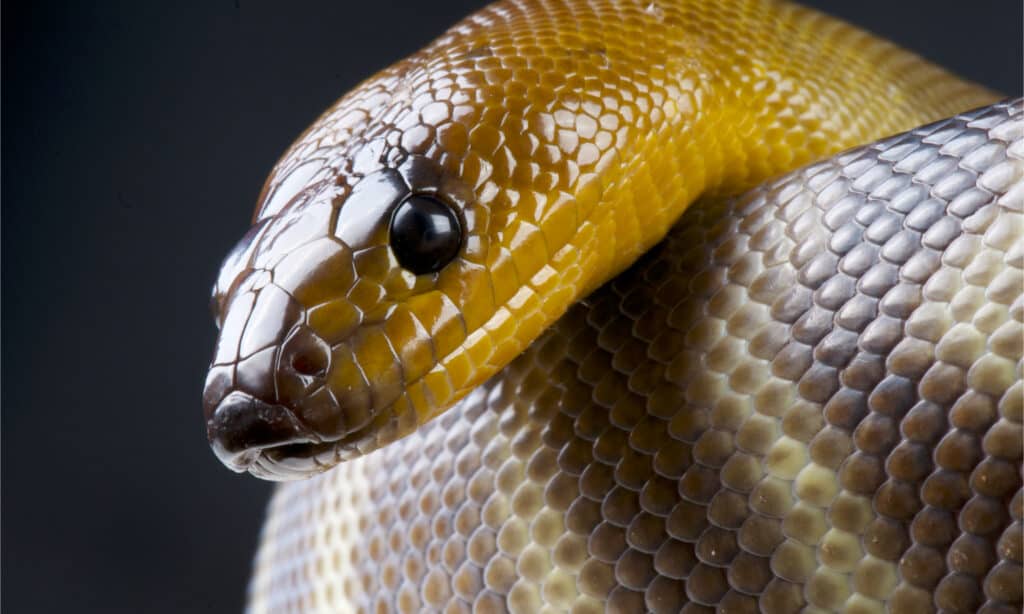
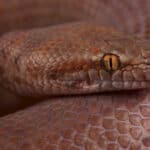
This snake is also called Ramsay’s python, it has an orange to yellow-orange head.

©iStock.com/GlobalP

Reproduction

This species’ mating season occurs from May to August in the wild. A female lays anywhere from 5-20 three-inch long eggs and stays coiled around them for the next two to three months, protecting and incubating her eggs until they hatch. She shivers to create a little more heat if the temperature drops too far. After the babies hatch, they’re on their own. At hatching, woma pythons average 12 inches long; they are voracious eaters able to take their first bit of prey within a couple of days after hatching.

Scientific Name

Their scientific name is Aspidites ramsayi; Aspidites originates in Greek and means “shield-bearer,” after the symmetrically-shaped large scales on their head. William John Macleay named the snake named in honor of Edward Pierson Ramsay, an Australian zoologist, and ornithologist. This species goes by a few names: Ramsay’s sand python, sand python, or the woma.

There are only two species within the genus Aspidites, the other is the black-headed python. This genus is endemic to Australia, and the snakes’ ranges overlap a little bit.

👁 woma python

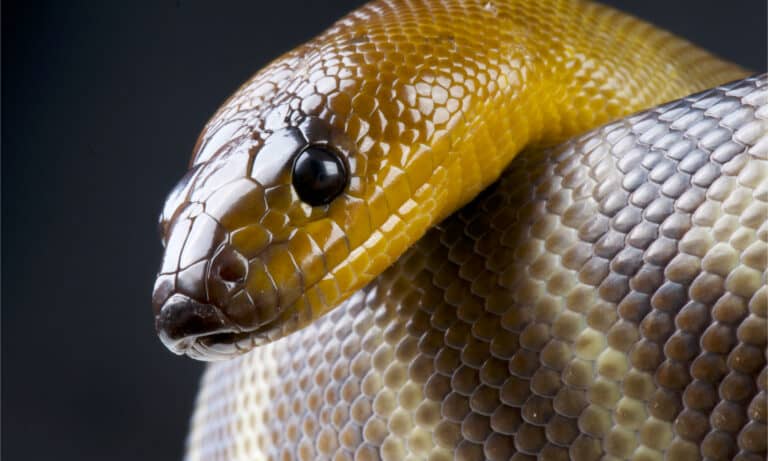
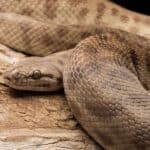
Woma pythons are docile and easy to handle.

©reptiles4all/Shutterstock.com

History and Evolution

What makes the Woma Python different from other pythons is that it lacks heat-sensing pits like other pythons. Scientists believe that this may not have evolved due to most of their historical hunting being executed in underground burrows. They do, however, have the vomeronasal organ that does help them smell their prey.

While they are normally considered burrowing snakes, there is some evidence that they spend more time tree-dwelling than researchers previously believed. They are known to feed and prey upon other snakes. This is due to them being resistant to other snakes’ venom.

Population and Conservation Status

The IUCN Redlist of Endangered Species lists the woma as “least concern” because it has an extensive range. It also doesn’t appear to be declining fast enough, on the whole, for them to include the snake in a higher threat category. However, this isn’t a complete picture, as it is endangered in some areas. Because of this, it’s listed on Schedule 4 (Specially Protected Fauna) of the Western Australian Wildlife Conservation Act.

The Department of Environment and Heritage is working to mitigate the threats posed by invasive species, habitat degradation, and illegal pet trade collection. However, the mulga, a highly venomous brown snake species, eats the young pythons before they mature enough to breed. Other threats include attempts to control invasive rabbits by destroying ground burrows. Animals that rely on these burrows for shelter are most likely affected by the burrows’ destruction.

Appearance and Description

The woma is slender for a python and can reach seven feet long; on occasion, an outlier manages eight feet, but that’s not the norm. Like most pythons, they move slowly forward in a straight line instead of the elegant movement other species exhibit. It’s called rectilinear progression, and it isn’t the fastest mode of transportation – they only move at about one mile per hour. It’s pretty cool, but this snake adds one neat feature to their locomotion over hot surfaces: it lifts its body off the ground and reaches forward as far as possible before pushing off the ground again. This method allows it to keep most of its body off the ground and only a few inches touching the ground at a given moment.

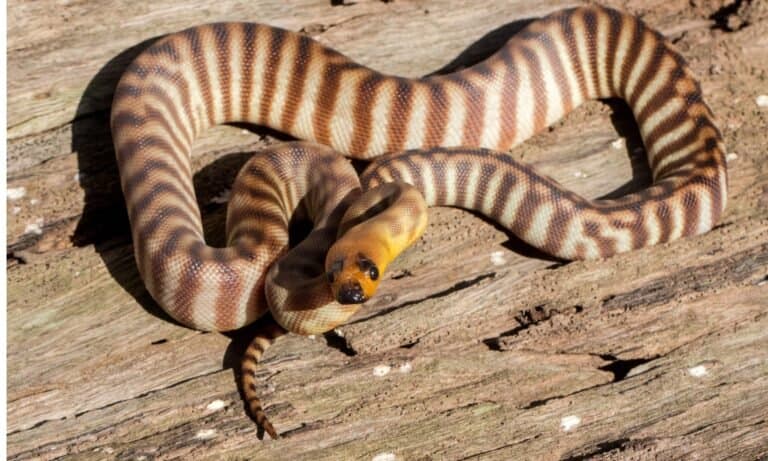
This snake often has an orange head with dark markings over its eyes that look sort of like eyebrows. Instead of heat-sensing pits on its lip scales, it has a similar organ at the tip of its snout, right at the opening of its mouth. The woma has a narrow head and small eyes, with a somewhat flattish body and thin tail that it uses as a lure for prey. Its scales are smooth and glossy with a creamy yellow belly, while its body is yellow, reddish, gray, or olive-brown with dark brown to black bands down the length of its body.
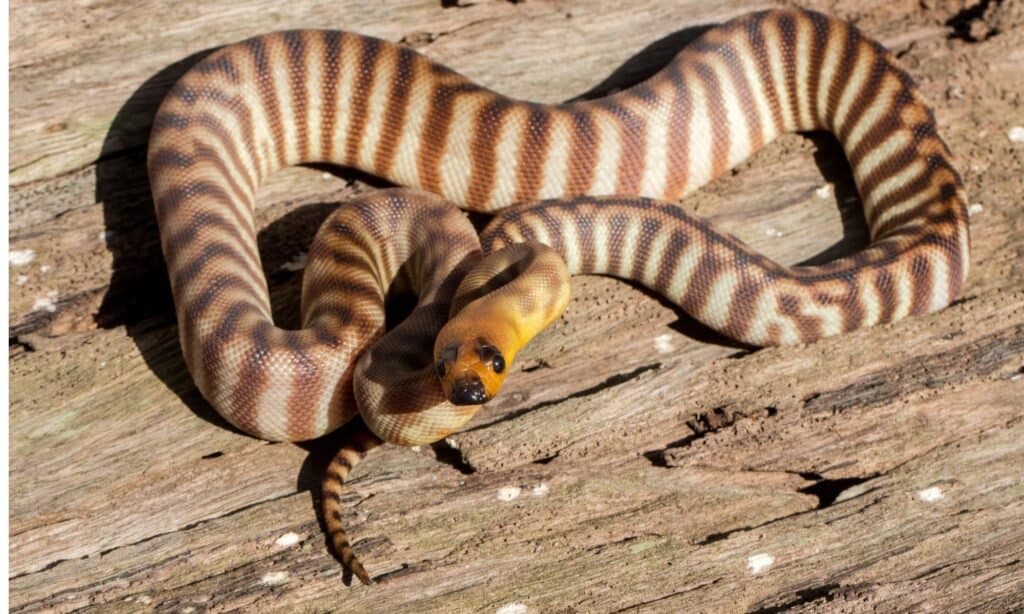
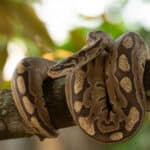
👁 Woma python on log

The woma has dark spots that look like eyebrows.

©iStock.com/Ken Griffiths

Video

How Dangerous are They?

Woma pythons aren’t dangerous and, thanks to their docile nature, are popular pet snakes, with many available from breeders. They don’t attack people, and would rather be left alone. Captive-bred pet snakes are easy to handle and often seem to enjoy some attention. If you corner one, it will hiss and try to intimidate you, but it isn’t likely to bite. They eat a variety of small animals that, if left unchecked, would overrun the environment – snakes are nature’s rodent control, after all!

Behavior and Humans

These snakes sometimes dig their burrows, and wild populations frequently use self-dug burrows or enlarge an existing one left behind by another animal. They are pretty resilient, and surface vegetation changes don’t affect them much; however, some agricultural activities and grazing animals may destroy some of the burrows they depend on.

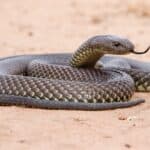
The woma’s narrow pointy head is different than most pythons. Its shape is similar to that of the brown snake, so people sometimes mistake them for that highly venomous snake. As a result, they’re sometimes killed out of fear because of the brown snake, but this harmless python is great to have around.

View all 405 animals that start with W

Sources

  1. Woma Python | San Diego Zoo / Accessed June 3, 2022
  2. IUCN Redlist of Threatened Species / Published February 23, 2017 / Accessed June 3, 2022
  3. Woma | Department of Environment and Heritage / Accessed June 5, 2022

About the Author

Gail Baker Nelson

Gail Baker Nelson is a writer at A-Z Animals where she focuses on reptiles and dogs. Gail has been writing for over a decade and uses her experience training her dogs and keeping toads, lizards, and snakes in her work. A resident of Texas, Gail loves working with her three dogs and caring for her cat, and pet ball python.
Connect:

Thank you for reading! Have some feedback for us?

Contact the AZ Animals editorial team

Related Articles You May Find Interesting


Woma Python FAQs (Frequently Asked Questions)

Womas are endemic to Australia, and cover the central 2/3s of the continent, extending to the northwest coast; with a population on the southwest coast.

These pythons eat mammals, reptiles, and birds. They’re generalist carnivores that will eat anything they can overpower and swallow.

They’re ambush predators that use their tails to lure prey to them.

No! While a large snake could be difficult to handle, they only grow to about 7 feet, aren’t venomous, and are very docile.