X
Species Profile

Xiaotingia

Xiaotingia zhengi

A near-bird from Jurassic Liaoning

Xiaotingia Distribution

Click a location to explore more animals from that region

Endemic Species
Loading map...

Found in 1 country

Size Comparison

Human 5'8"
Xiaotingia 8 in

Xiaotingia stands at 12% of average human height.

At a Glance

Wild Species
Diet Carnivore
Activity Cathemeral
Lifespan 6 years
Weight 1.5 lbs
Status Not Evaluated
Did You Know?

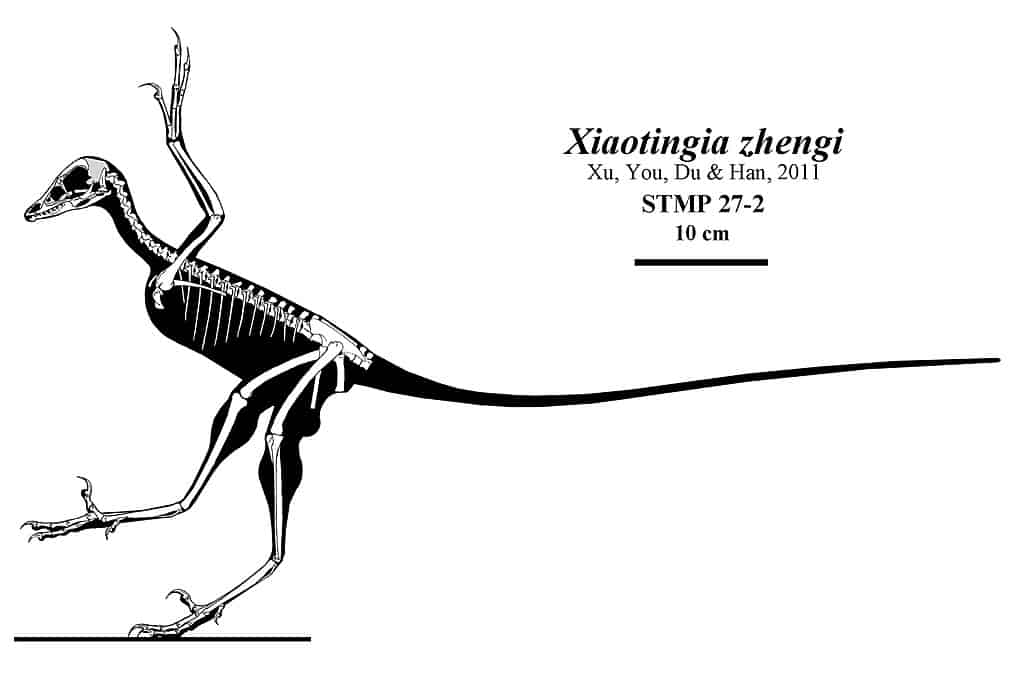
Known from a single articulated skeleton (holotype STM 27-2) from the Tiaojishan Formation, western Liaoning (Xu et al., 2011).

Scientific Classification

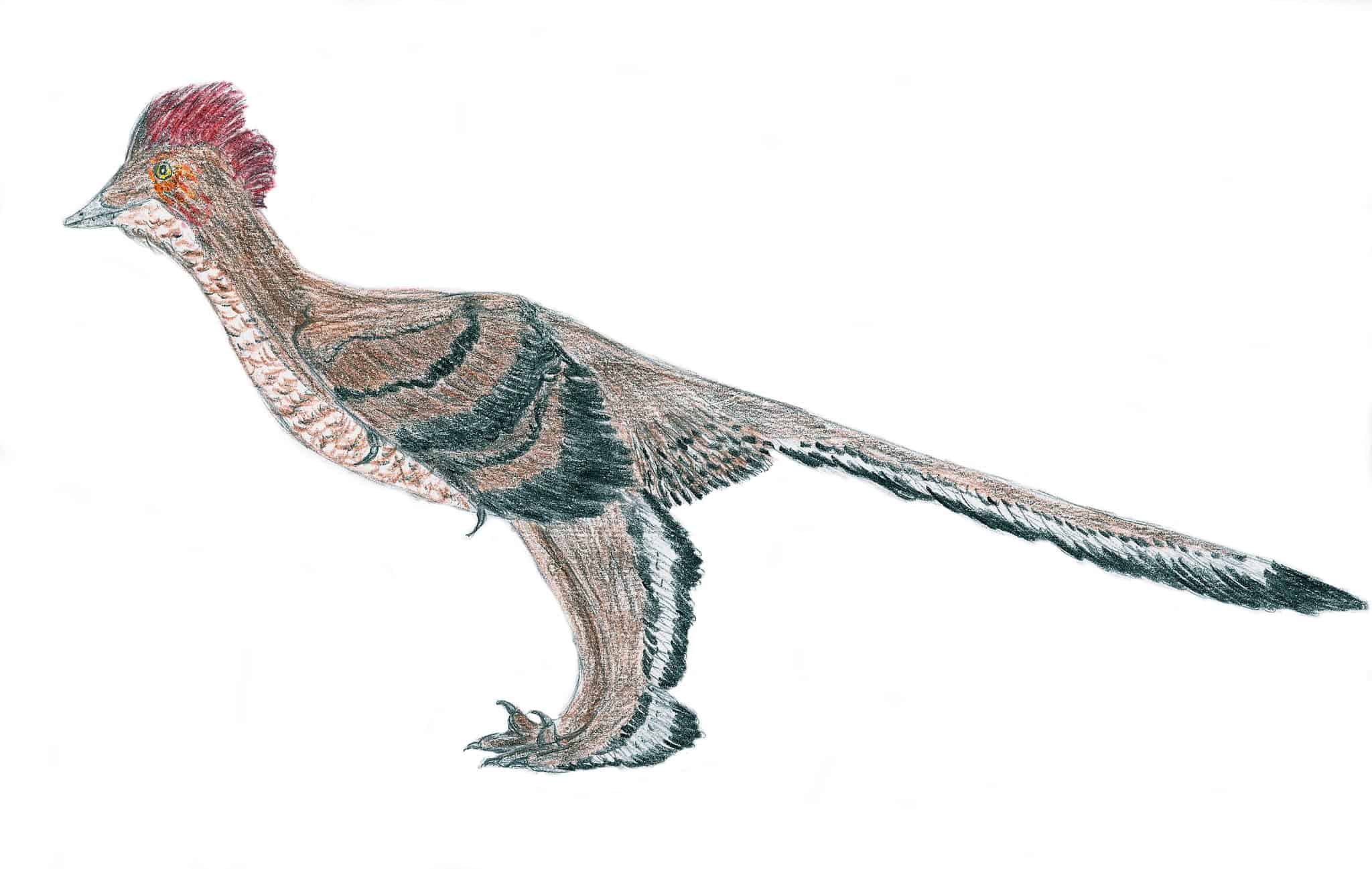
Xiaotingia zhengi is a small, feathered paravian theropod dinosaur from the Late Jurassic of Liaoning, China. It is closely related to early bird-like dinosaurs (anchiornithids) and is often discussed in relation to Archaeopteryx and the origin of birds.

Kingdom
Animalia
Phylum
Chordata
Class
Reptilia
Order
Theropoda
Family
Anchiornithidae
Genus
Xiaotingia
Species
zhengi

Distinguishing Features

  • Small-bodied, feathered paravian theropod
  • Long forelimbs with wing-like plumage
  • Bird-like shoulder and forelimb anatomy
  • Late Jurassic Liaoning fossil provenance

Physical Measurements

Height
8 in (6 in โ€“ 10 in)
Length
1 ft 12 in (1 ft 10 in โ€“ 2 ft 2 in)
Weight
2 lbs (1 lbs โ€“ 3 lbs)
Tail Length
1 ft 1 in (11 in โ€“ 1 ft 2 in)
Top Speed
16 mph
running

Appearance

Primary Colors
Secondary Colors
Skin Type Pennaceous feathers
Distinctive Features
  • Four-winged plan: long feathers on forelimbs and hindlimbs.
  • Long bony tail bearing paired rectrices forming a feather fan.
  • Small toothed skull with lightly built snout, Archaeopteryx-like profile.
  • Three-fingered hands with curved claws for grasping branches or prey.
  • Asymmetrical-looking flight feathers on arms suggest aerodynamic surfaces.
  • Dense body plumage likely provided insulation in Late Jurassic climates.

Did You Know?

Known from a single articulated skeleton (holotype STM 27-2) from the Tiaojishan Formation, western Liaoning (Xu et al., 2011).

Estimated total length about 60 cm; mass and lifespan are not directly measured for this species in published studies.

Described in 2011; its anatomy helped spark re-analyses of whether Archaeopteryx is a bird or non-avian paravian.

Has a "bird-like" shoulder and forelimb proportions, but also many classic small-theropod traits (Xu et al., 2011).

Preserves pennaceous feathers, adding to evidence that complex feathers were widespread among Jurassic paravians.

Its family Anchiornithidae includes several small, feathered taxa from the same region, highlighting a diverse Jurassic "near-bird" fauna.

Unique Adaptations

  • Pennaceous wing feathers indicate aerodynamic surfaces evolved before powered flight, a key point in paravian evolution studies.
  • A mix of bird-like and dinosaur-like wrist/shoulder traits suggests incremental assembly of the flight apparatus.
  • Light, small-bodied build (about 60 cm long) fits the miniaturization trend often linked to the origin of birds.
  • Feather coverage implies insulation and potential color/display functions, as widely inferred for closely related Liaoning paravians.

Interesting Behaviors

  • Likely hunted small prey on the ground and in low vegetation, inferred from theropod teeth and grasping hands.
  • Probably used feathered forelimbs for display and balance during running or leaping, as suggested for close anchiornithid relatives.
  • May have climbed using curved claws and light body size, consistent with many paravians from the Tiaojishan ecosystem.
  • Feathered tail likely aided maneuvering and stability during quick turns, based on tail stiffness and feathering patterns in paravians.

Cultural Significance

As a Liaoning "feathered dinosaur," Xiaotingia became part of a globally influential fossil story linking Chinese Jurassic deposits to debates about Archaeopteryx and the dinosaur-bird transition.

Myths & Legends

The Chinese phoenix is a mythic bird symbolizing virtue, harmony, and auspicious renewal in traditional Chinese folklore.

A winged dragon appears in ancient Chinese myth as a helper of heroes; winged, feathered creatures remain a familiar mythic motif.

Its name records modern discovery culture: Xiaotingia honors the Xiaotingzi locality, and zhengi honors a contributor named Zheng (Xu et al., 2011).

Conservation Status

NE Not Evaluated (fossil taxon; IUCN generally does not assess non-extant Jurassic dinosaur species)

Has not yet been evaluated against the criteria.

Population Unknown

Protected Under

  • Regulations on the Protection of Paleontological Fossils (State Council of the PRC, 2011)

Life Cycle

Birth 0 hatchling
Lifespan 6 years

Lifespan

In the Wild 3โ€“10 years

Reproduction

Mating System Data Deficient
Social Structure Solitary
Breeding Season Unknown; likely seasonal
Breeding Pattern Seasonal
Fertilization Internal Fertilization
Birth Type Internal_fertilization

No direct evidence (e.g., nests, eggs, brooding adults, sexual dimorphism) is known for Xiaotingia zhengi. Like other theropods/archosaurs, reproduction is inferred to involve internal fertilization and likely seasonal pairing, but the mating system remains unknown.

Behavior & Ecology

Social Flock Group: 2
Activity Cathemeral
Diet Carnivore insects

Temperament

Wary
Opportunistic
Territorial
Agile

Communication

inferred chirps
inferred hisses
contact calls inferred
feather display Xu 2011
body postures
tail-fan signaling
tactile nudges

Habitat

Forest Coniferous Forest Deciduous Forest Woodland Wetland Lake River/Stream +1
Biomes:
Temperate Forest Wetland Freshwater
Terrain:
Mountainous Hilly Valley Riverine Muddy
Elevation: 984 ft 3 in โ€“ 3937 ft

Ecological Role

Small mesopredator in Late Jurassic forested lake-margin ecosystems

insect population control small-vertebrate control energy transfer

Diet Details

Main Prey:
Insects Small lizards Small vertebrates

Human Interaction

Domestication Status

Wild

Extinct Late Jurassic (~160 Ma) anchiornithid from Liaoning (Tiaojishan Formation), described by Xu et al. 2011 from holotype STM 27-2 (~60 cm long estimate). Never domesticated; modern human interactions are limited to fossil excavation, research, and museum display.

As a Pet

Not Suitable as Pet

Legality: Not possible; extinct; fossil ownership/export tightly regulated.

Care Level: Expert Only

Purchase Cost:
Lifetime Cost:

Economic Value

Uses:
Research Museums Tourism Education
Products:
  • fossils
  • replicas
  • publications

Relationships

Predators 2

Theropods Theropoda
Small-bodied carnivorous mammals

Related Species 6

Xiaotingia Xiaotingia zhengi Shared Genus
Anchiornis Anchiornis huxleyi Shared Family
Aurornis Aurornis xui Shared Family
Eosinopteryx Eosinopteryx brevipenna Shared Family
Serikornis Serikornis sungei Shared Family
Caihong Caihong juji Shared Family

Ecological Equivalents 4

Animals that fill a similar ecological role in their ecosystem

Archaeopteryx Archaeopteryx lithographica Small feathered paravian. Similar in size; likely climbed and glided and occupied an insectivorous/carnivorous niche.
Anchiornis Anchiornis huxleyi Co-occurred in the same forests and were similar in size; feathered and likely arboreal predators of small prey.
Aurornis Aurornis xui Has a similar paravian body plan; likely scansorial, foraging on insects and small vertebrates.
Microraptor Microraptor gui Feathered small paravian. Arboreal, gliding predator that captured small vertebrates and insects.

Birds are the closest thing to a dinosaur we can find around. While giant dinosaurs like the T. rex may not look anything like modern-day birds, smaller dinosaurs like the Xiaotingia are more similar to their descendants. Pronounced as โ€œzhow-tin-gee-ah,โ€ this genus of bird-like theropod dinosaur lived from the middle to late Jurassic Period in the western Liaoning region of China

Description and Size

The Xiaotingia is a genus of extinct dinosaurs that lived during the Late Jurassic in an area that is now present-day China. Only one species, Xiaotingia zhengi, is known. This dinosaurโ€™s generic name and specific name are in honor of paleontologist Zheng Xiaoting. 

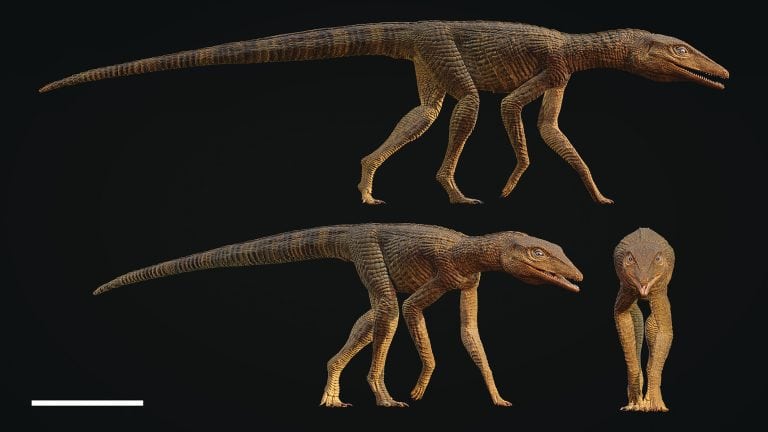
The Xiaotingia was a relatively small primitive dinosaur. It was similar in size and structure to the popular Archaeopteryx. With an average length of about 23.6 inches (60 cm) and an average weight of 1.8 lbs (0.8 kg), Xiaotingia would be about the same size as present-day pigeons or hens. 

Like birds, most of this dinosaurโ€™s body, especially the head, forelimbs, hindlimbs, and nape, were covered in feathers. The feathers were up to 2.16 inches long. Long pennaceous feathers were also present on the dinosaurโ€™s tibia and metatarsus. Due to the abundance of long feathers, experts think this dinosaur was capable of short-distance flights, using its hindlimbs as a type of wings. 

Xiaotingia had a long femur and a shorter humerus. This means their forelimbs were longer than their hindlimbs. They were bipedal, using only their hindlimbs to stand and walk. Experts think their forelimbs were similar to that of modern birds, and they used them for flapping. Xiaotingia had long feathers on its femur. They had less than 10 teeth in their mouth, with a dentary formula similar to that of basal birds. 
๐Ÿ‘ Xiaotingia

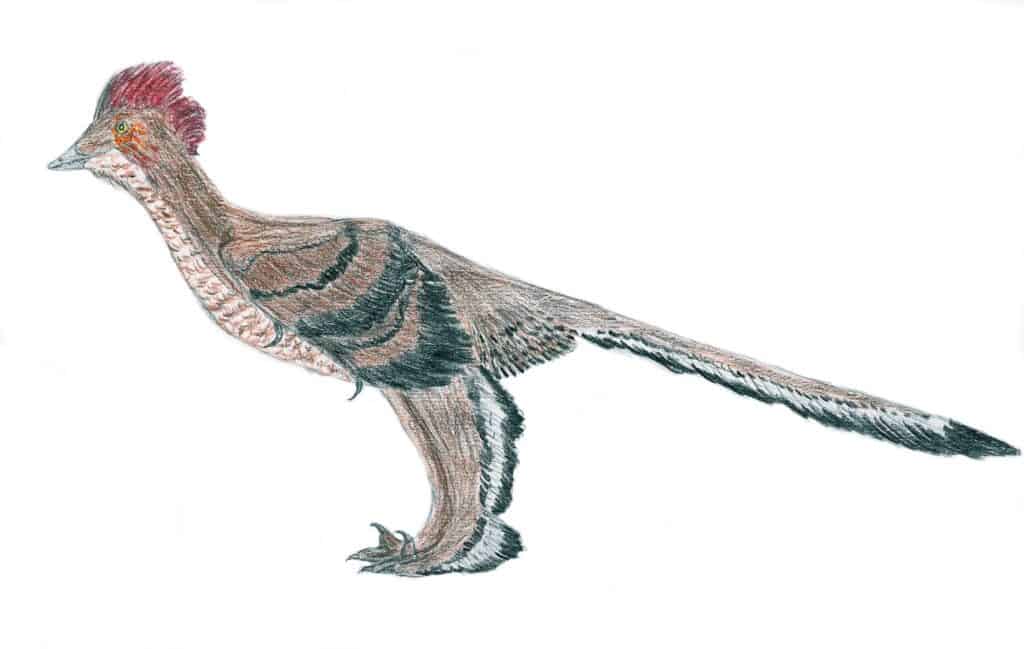
Xiaotingia was a small dinosaur, averaging around 23.6 inches in length and less than two pounds.

ยฉ โ€“ Original / License

Diet โ€” What Did Xiaotingia Eat?

Scientists believe present day-birds are descendants of deinonychosaurs. This group of Jurassic Period dinosaurs had a predominantly carnivorous diet. Since Xiaotingia was related to them, they probably also had a carnivorous diet. Insects would have made up the bulk of this dinosaurโ€™s diet. 

Habitat โ€” When and Where It Lived

Xiaotingia lived during the Middle Jurassic to Late Jurassic period in the western Liaoning region of China. This dinosaur most likely had a partly terrestrial and partly arboreal lifestyle, meaning they spent significant amounts of time in trees. However, thereโ€™s no evidence that they could fly long distances, meaning they would have preferred shorter trees to taller ones. 

Threats and Predators

Xiaotingia was a relatively small dinosaur and had no notable defense mechanism. To protect its eggs and evade predators, Xiaotingia lived in trees. This would have made it difficult for the land-dwelling, predatory dinosaurs to reach it. Also, the fact that the dinosaur could fly over short distances using its limbs as wings means it would have been able to avoid some predators. Thus, it was a relatively easy prey for larger predator dinosaurs that lived around the same time. 

Discoveries and Fossils โ€” Where Xiaotingia was Found

Xiaotingia is known from a single specimen that scientists collected from the Tiaojishan Formation, located in the Linglongta area in Jianchang, China. The specimen was a fairly complete and articulated skeleton. In 2011, paleontologist Xing Xu and his team published a detailed description of the dinosaur and gave it the specific name Xiaotingia zhengi

Extinction โ€” When Did Xiantingia Die Out?

Xiaotingia lived between 150-155 million years ago. This means they were around for approximately 5 million years before becoming extinct. The exact cause of this dinosaurโ€™s extinction is unknown. 

Similar Animals to the Xiaotingia

Similar dinosaurs to the Xiaotingia include

  • Archaeopteryx โ€” This is an extinct genus of bird-like dinosaurs that lived about 150 million years ago during the late Jurassic. It lived around the same time as Xiaotingia. Many experts think this dinosaur was the ancient ancestor of modern-day birds. 
  • Velociraptor โ€” This is a genus of small carnivorous dinosaurs native to the Asian continent. They lived during the Late Cretaceous period. This dinosaur belongs to the Dromaeosauridae family, a group of bird-like reptiles found across different locations all over the world. 
  • Anchiornis โ€” The Anchiornis is a small four-winged dinosaur that lived in China about 160 million years ago. It is known from hundreds of well-preserved specimens, making it one of the most fully-known dinosaurs in the world. 
Up Next 

View all 13 animals that start with X

Sources

  1. Dinosaur a Day / Accessed October 27, 2022
  2. Prehistoric Wildlife / Accessed October 27, 2022
  3. Wikipedia / Accessed October 27, 2022

About the Author

Abdulmumin Akinde

Abdulmumin is a pharmacist and a top-rated content writer who can pretty much write on anything that can be researched on the internet. However, he particularly enjoys writing about animals, nature, and health. He loves animals, especially horses, and would love to have one someday.
Connect:

Thank you for reading! Have some feedback for us?

Contact the AZ Animals editorial team

Related Articles You May Find Interesting


Xiaotingia FAQs (Frequently Asked Questions)

Xiaotingia lived between the Middle and Late Jurassic periods in the western Liaoning province of China. It lived between 155 to 150 million years ago.

Xiaotingia was a small-sized feathered dinosaur. It is similar in size to a modern hen or chicken. The size of this dinosaur is often compared to that of the Archaeopteryx, another popular theropod dinosaur. This dinosaur had an average weight of about 1.8 lbs (0.8 kg) and was 23.6 inches long.

Xiaotingia lived in terrestrial habitats but spent a significant amount of time in trees. This means it was partly arboreal as well. However, since this dinosaur was not a strong flier like present-day birds, this dinosaur probably avoided tall trees.

Fossils of this bird-like dinosaur were discovered in the  Tiaojishan Formation. This Jurassic age formation is located in the western Liaoning province of China. Their distribution was most likely localized  to this location and some other parts of Asia.