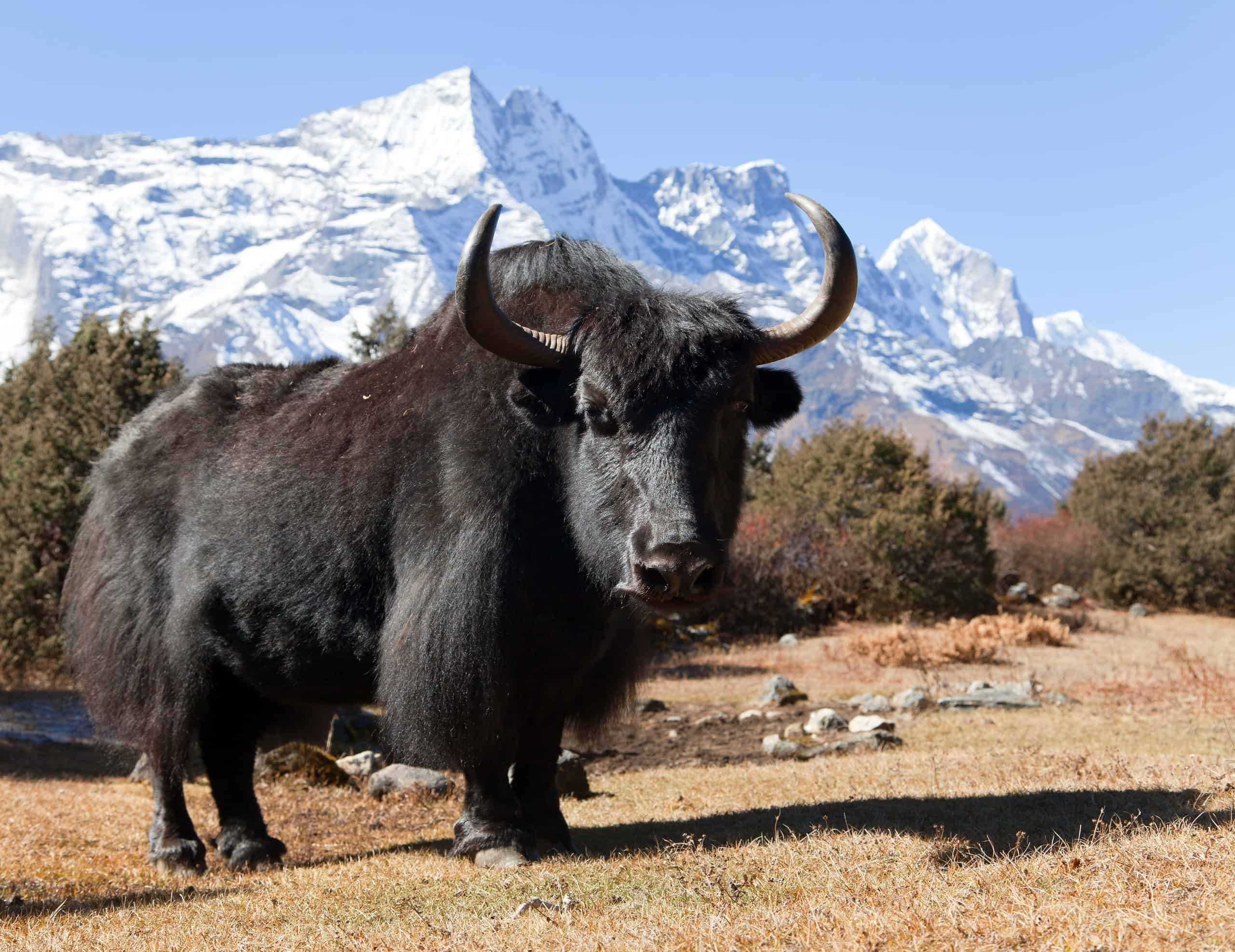
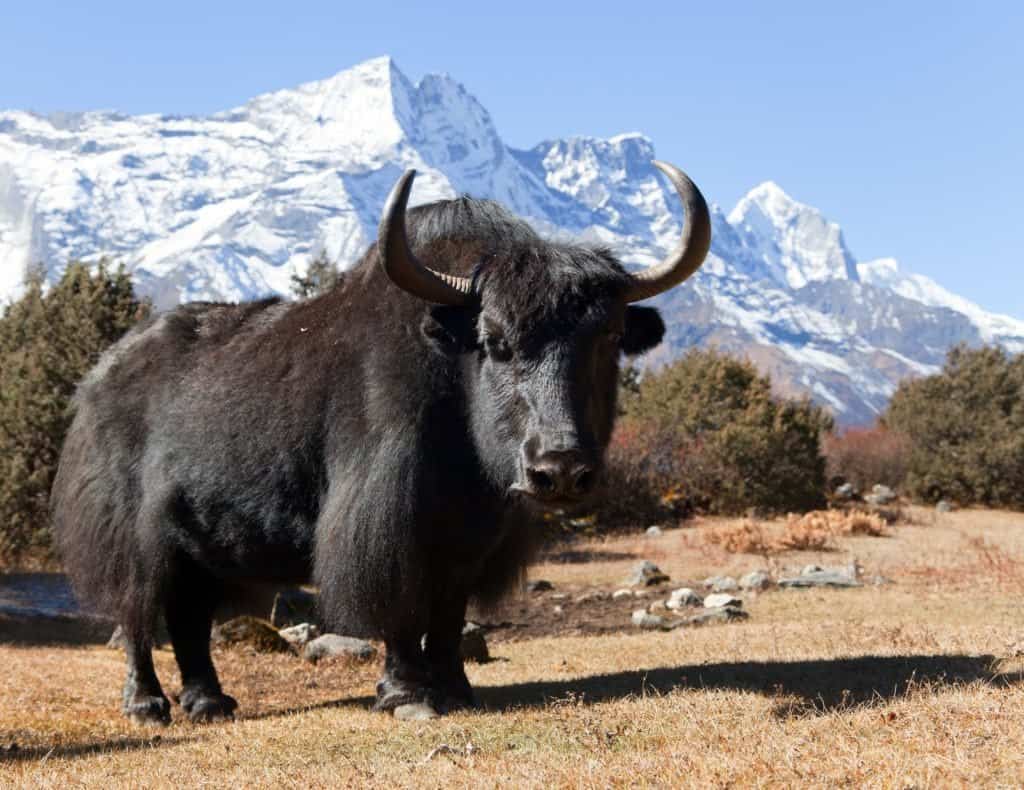
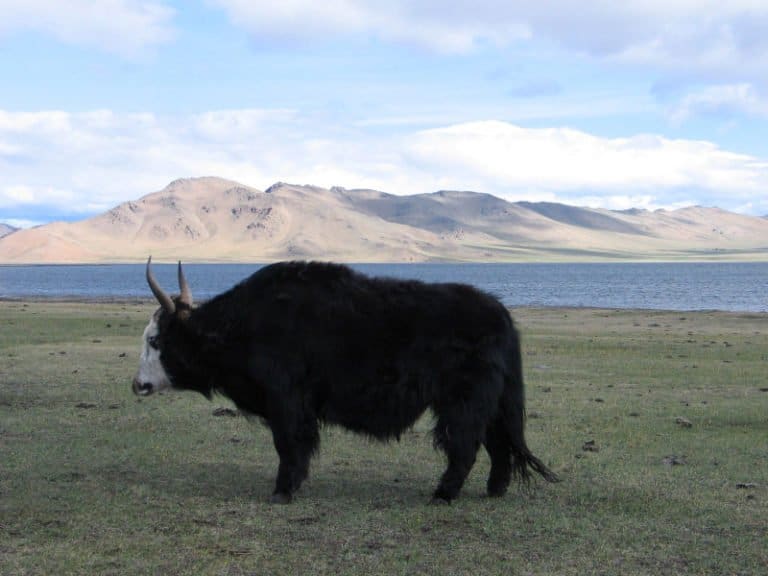
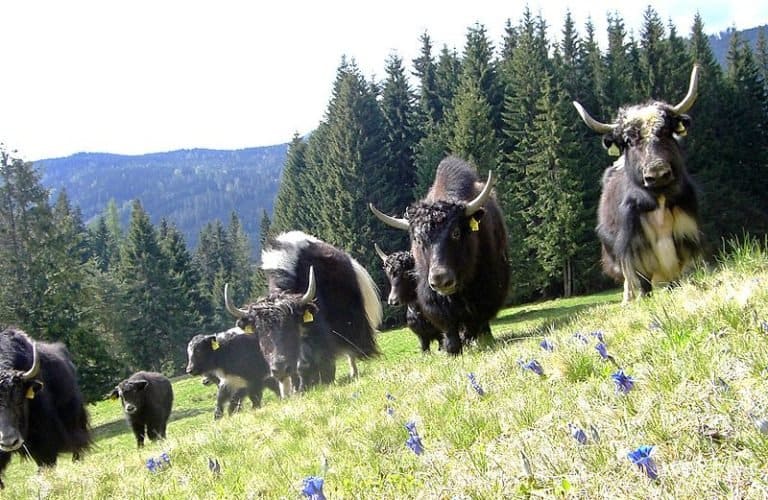
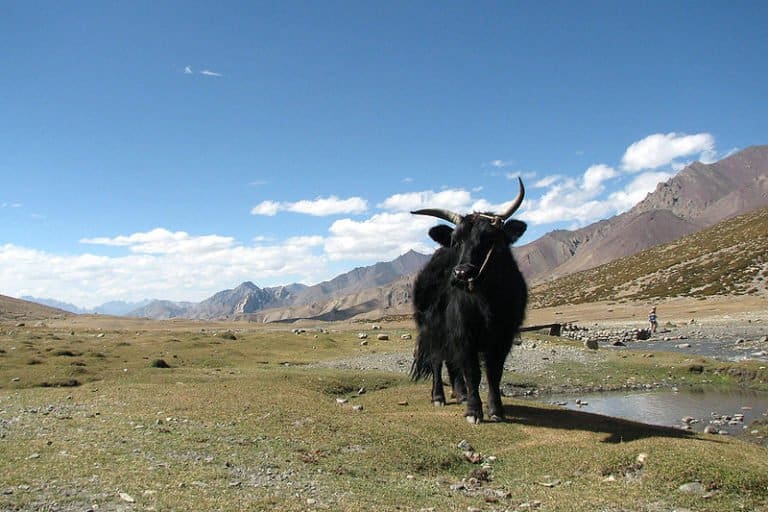

Yaks are heavily built animals with a sturdy frame that have long, thick hair.
Yaks are animals that are native to Tibet and China but are also found in Mongolia, Nepal, and Central Asia. Scientists believe that Qiang tribespeople domesticated yak animals at least 5,000 years ago, a claim supported by genetic evidence. However, some Tibetan peoples may have possibly domesticated yaks as long as 10,000 years ago. Domestic yaks far outnumber wild ones and are bred for their tractability for plowing and threshing, high milk production, meat, hides, and fur.
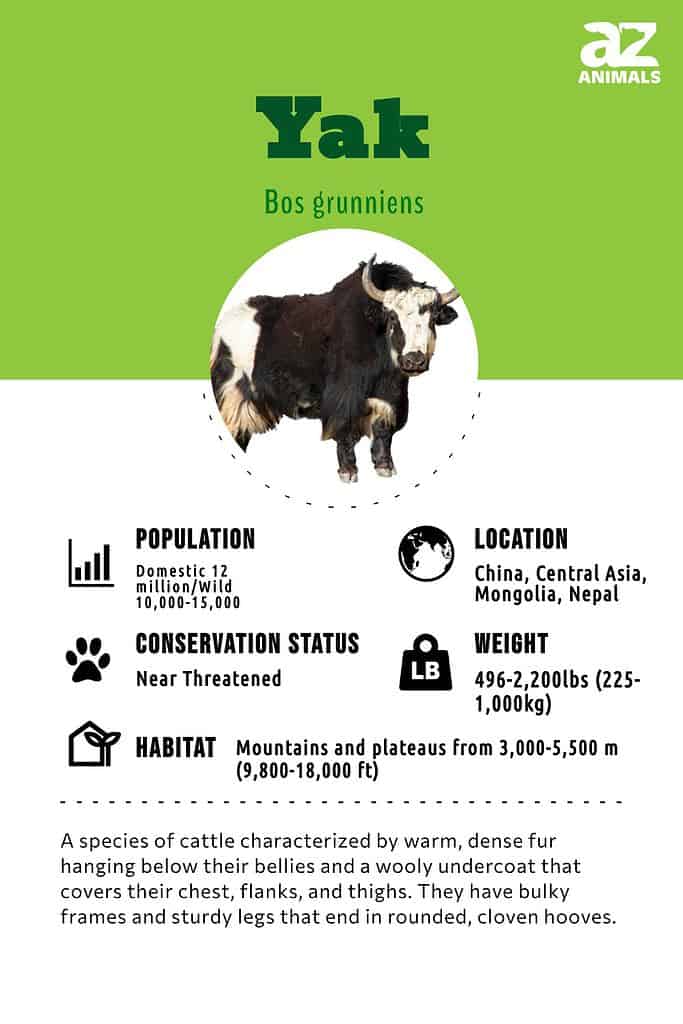
Incredible Yak facts!
- Domestic yak, unlike their counterparts in the wild, often make grunting noises, leading to the nickname, “The Grunting Ox.”
- Yaks are animals with three times the lung capacity of cows and have more and smaller red blood cells, which allows them to transport oxygen more efficiently.
- They can withstand frigid temperatures that can reach as low as -40 degrees Fahrenheit.
- Yaks have trouble thriving at lower altitudes and become prone to heat exhaustion when temperatures are above 59 degrees Fahrenheit.
- When a yak animal dies of natural causes, its bones find new life as jewelry and tent fastenings per Buddhist teachings.
Scientific Name
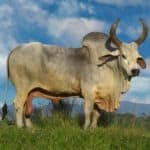
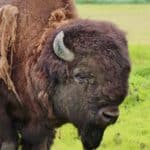
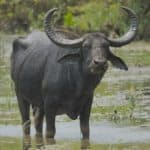
Yaks are members of the bovine family and are related to cows and buffalo, all of which are likely descended from aurochs, an extinct species of cattle. Yak animals split from aurochs sometime between one million and five million years ago. Scientists classify the wild (Bos mutus) and domestic yaks (Bos grunniens) as two distinct species. The English word yak derives from the Tibetan word “yag.” The scientific name of both species refers to the sounds or lack thereof that these animals make. Bos mutus, means mute ox, while Bos grunniens means grunting ox. They belong to Bovidae, the same family as the Asian water buffalo, the African buffalo, and the American bison. The key difference between the two species is size, with wild males weighing up to two times more than their domestic counterparts. Domestic yaks are descended from wild species.
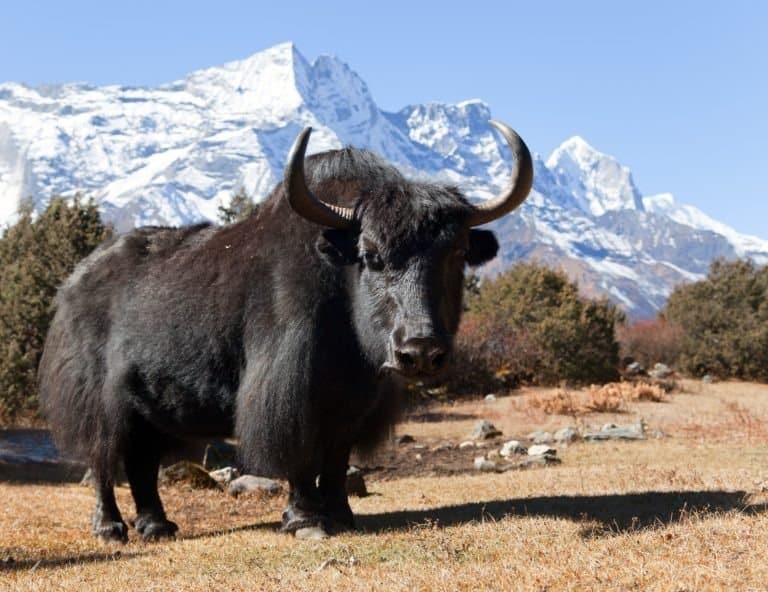
Yaks are related to cows and buffalo, all of which are likely descended from aurochs, an extinct species of cattle.
©Daniel Prudek/Shutterstock.com
Evolution
It’s generally believed that aurochs (Bos primigenius) are the extinct ancestors of the modern yak. They originated as members of the Pleistocene megafauna (2,580,000 to 11,700 years ago), and flourished during the Holocene Era, sporting huge broad horns up to 31 inches in length. The aurochs, which probably evolved in Asia, spread to the north and west during warmer interglacial periods. This species became extinct in 1627 due to habitat loss and hunting.
One theory suggests yaks are more closely related to bison. If that’s the case, yaks could have diverged from cattle from 1-5 million years ago. Either way, wild yaks became domesticated in central Asia 7,000-10,000 years ago.
Types of Domestic Yak
The domestic yak (Bos grunniens) has several dozen recognized sub-species, whereas the wild yak (Bos mutus) is it’s own species, but there’s little data on sub-groups. Of the known domestic yaks, here’s a list of 36:
- Afghanistan Yak – Native to Afghanistan. They thrive in high altitudes with low atmospheric pressure and low oxygen.
- Altai Yak – Native to Mongolia. Alpine type with long black or white coat.
- Arunachali Yak – Native to India. Medium sized, compact body with black coat.
- Batang Yak – Native to China. Used for their milk.
- Bazhou Yak – Native to China. Large, rectangular frame with solid black or black and white.
- Chour-gau Yak – Native to India. They thrive in high altitudes, low atmospheric pressure and low oxygen content of air.
- Datong Yak – Native to China. Developed at Datong yak farm (1983-86) by crossing wild yak bulls with the Huanhu yak.
- Gannan Yak – Native to China. Strong body, muscular, and black in color.
- Guoluo Yak – Native to China. Used for milking.
- Haapa Yak – Native to Bhutan. Originated in Tibet and usually has a black coat.
- Hangai Yak – Native to Mongolia. Inhabit Hangai mountains and woodland pastures at elevations of 1800-3000 meters. Large-framed with varied coat colors.
- Heihe Yak – Native to China. Used for milking.
- Huanhu Yak – Native to China. Small frame with most having a black-brown coat.
- Indian Yak – Native to India. Four breeds: Ladakhi or Changthang, Himachali, Garhwali, Arunachali. Coat colors and patterns vary.
- Jiali/Alpine Yak – Native to China. Coloring varies with spotted, pure black, or white, brown or gray.
- Jinchuan Yak – Native to China. They provide a high quality milk and a high yield of meat, and are hearty.
- Jiulong Yak – Native to China. They have tall, large bodies that are typically all black or black and white.
- Khainag Yak – Native to Mongolia. Breed has long legs with wide steps, easy to train for transport, calm, persistent and can be used to lead the herd to cross water and snowdrifts.
- Kyrgyz Yak – Native to China. Known for high quality meat.
- Maiwa yak – Native to China. Medium-sized with black or black and white coloring.
- Merakpa Yak – Native to Bhutan. Smaller size and colored black and white or brown.
- Muli Yak – Native to China. Large frame with all black or black with white spots.
- Nepal Yak – Native to Nepal. They are raised in 3000 meters above sea level in trans-Himalyan region.
- Niangya Yak, Liangya – Native to China. Most are pure black, used for milking.
- Pakistan Yak – Native to Pakistan. Inhabit altitudes higher than 3000-7000 meters above sea level.
- Pali Yak – Native to china. Rectangular, strong body, mostly all black.
- Plateau Yak of Qinghai – Native to China. Genes of wild yak mixed into this breed, so has some characteristics of the wild yaks.
- Russian Federation Yak – Native to Russia. They thrive in high altitudes, low atmospheric pressure and low oxygen content of air.
- Sarlag Yak – Native to China. They thrive in high altitudes, low atmospheric pressure and low oxygen content of air.
- Shandang Yak – Native to China. Known for it’s milk.
- Sibu Yak, Tibetan High Mountain Yak – Native to China. Large, rectangular body and horns.
- Tajikistan Yak – Native to Tajikistan. They thrive in high altitudes, low atmospheric pressure and low oxygen content of air.
- Tianzhu White Yak – Native to China. Pure white coat.
- Zhongdian Yak – Native to China. Vigorous and beefy constitution with cuneiform body types.
- Tibet High Mountainous Yak – Native to China.
- Xingjiang Yak – Native to China. Adaptable to alpine areas at the altitude of 2400-4000 meters.
Appearance and Behavior
All yaks are similar in appearance, although, as previously mentioned, wild yaks are larger. Wild yaks generally have darker, blackish-to-brown hair, while domestic species have wider color variations that include rusty brown and cream. All have warm, dense fur that hangs below their bellies and a wooly undercoat that covers their chest, flanks, and thighs. They have bulky frames and sturdy legs that end in rounded, cloven hooves. Their firm horns are also used for defense, allowing them to break through the snow in winter to find food buried beneath. Both males and females have short necks with a pronounced hump over the shoulders, although this characteristic is more pronounced in males. They have tails that are long and look more like those of horses than of cable.
Domesticated yaks are smaller as males generally weigh 600 to 1,100 pounds, while females range from 400 to 600 pounds. Wild males can weigh as much as 2,200 pounds. The height of domestic males varies, but they generally top out at 44 to 54 inches at the withers, while females are 41 to 46 inches at the withers. Females have four teats with an udder that is small and hairy. The same can be said of the male scrotum. The size and hairy coverings are protection against the cold.
Wild yak animals live in herds of several hundred animals, comprised primarily of females and their young with only a few males. Most males live on their own or live in smaller bachelor groups of about six until just before mating season when they will typically rejoin the larger herd. They generally avoid humans and may flee, although they can become aggressive when defending young or when in a rut when males regularly fight amongst themselves to establish dominance. Typical rut behavior includes non-violent displays, along with attacks such as bellowing and scraping the ground with their horns. Bulls will also repeatedly charge at one another with their heads lowered or will spar with their horns. Males often wallow in dry soil during rut and scent-mark with urine or dung.
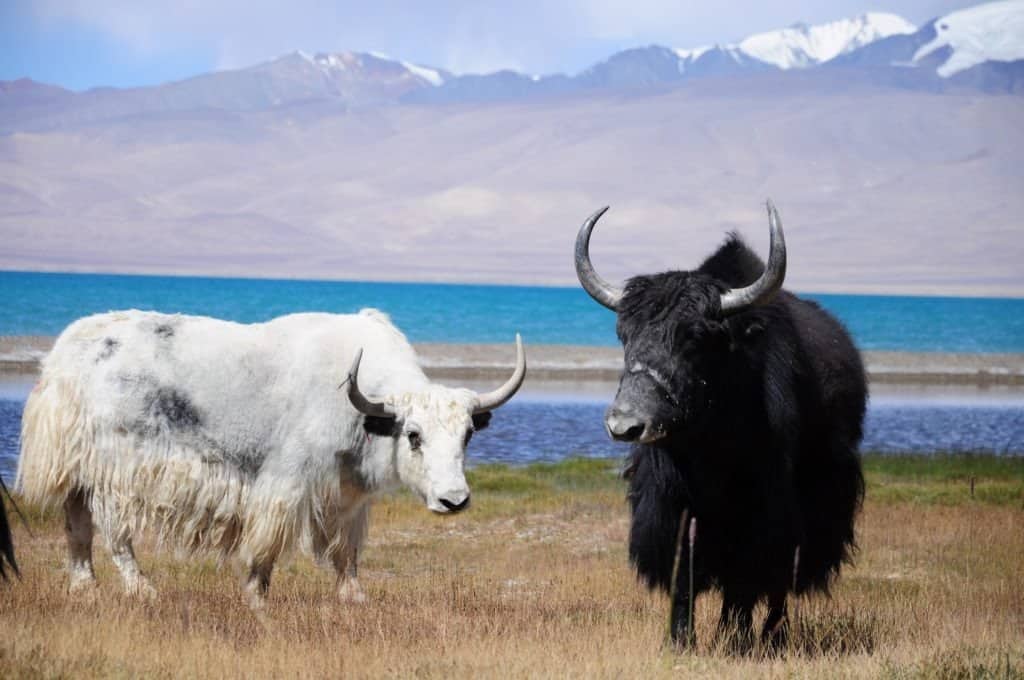
Yaks have bulky frames, sturdy legs that end in rounded, cloven hooves, and firm, rounded horns.
©Olga Eromenko/Shutterstock.com
Habitat
Wild yaks are animals that live primarily in northern Tibet and the western Chinese province of Qinghai. Some populations extend into the southernmost parts of Xinjiang and India. Isolated populations of these animals are also spread throughout central Asia. Primary habitats are the treeless uplands of central Asia between 9,800 and 18,000 feet in mountain meadows and plateaus. They are commonly found in alpine tundra with thick grasses and sedges that provide their food. Some herds will migrate seasonally in search of food. They eat early in the morning and evening and don’t move about much, often sleeping most of the day. During blizzards, these animals turn their tails into the storms and may remain motionless for hours.
In addition to being bred for their milk, domestic yaks are raised for their butter, which is turned into po cha, or Tibetan butter tea. Tibetans make this tea by adding yak milk, butter, and salt to black tea from Pemagul to make the traditional drink, which fortifies drinkers against the Himalaya Mountains’ thin, cold air. The tea is generally consumed by those living on plateaus above 17,000 feet.
Yak butter plays a central role in the Butter Lamp Festival held during the first month of the Tibetan calendar in Lhasa. Monks spend months carving sculptures out of yak butter, while lamps burning the butter line the streets during the festival.
Every summer, Tibetan nomads comb and process the soft, downy undercoat that yak animals shed at this time of year. Coarse outer hair is turned into ropes, tents, and wigs. The inner cashmere-like fibers are turned into textiles that have begun to rival traditional cashmere, made from Himalayan goat hair.
Yak dung is the only fuel on the high Tibetan plateau, but using it presents a biohazard as burning it produces annually 1,000 tons of black carbon, the second leading cause of global warming.
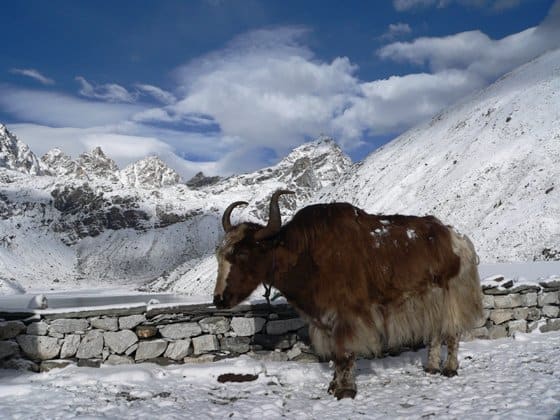
The primary habitats for yaks are the treeless uplands of central Asia in mountain meadows and plateaus.
Diet
Yaks are herbivores, meaning they only eat plants. They spend a great deal of time in mountain meadows, grazing on grasses and other low-lying plants like sedges. Carex, Stipa, and Kobresia are among their favorite grasses. They also consume herbs, winter-fat shrubs, moss, and lichen. Females like to graze on higher slopes than males, especially if they have young. They frequently drink during the summer and eat snow in the winter to stay hydrated. Like cows, they have two stomachs to efficiently extract all the nutrients out of the plants they eat.
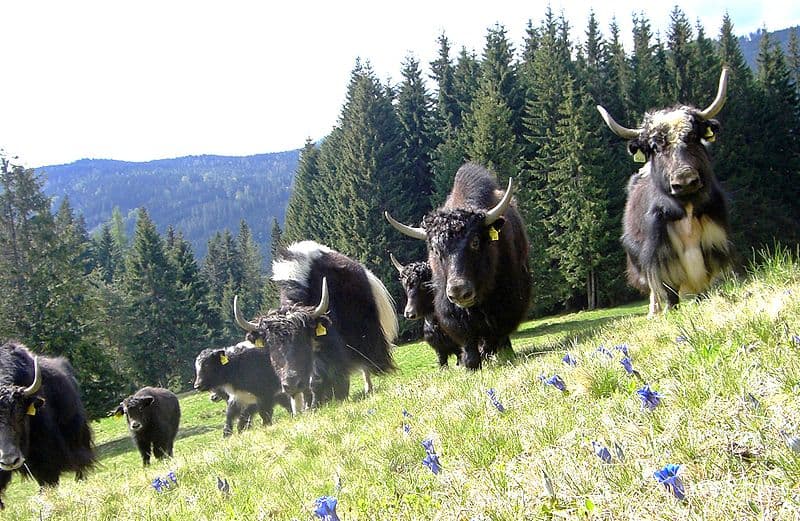
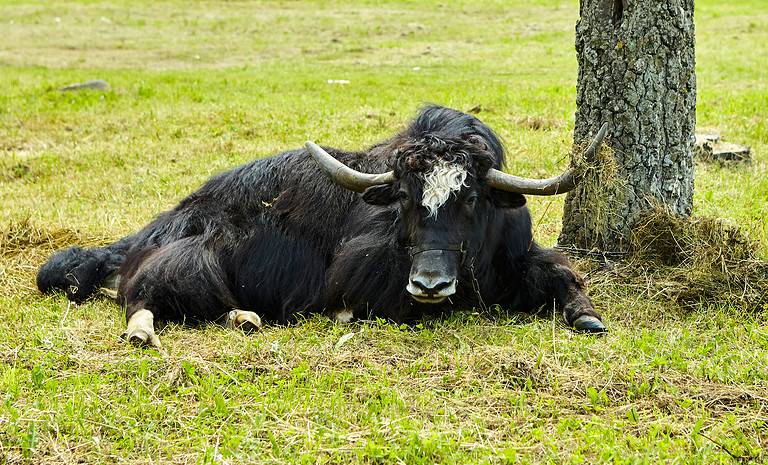
Yaks spend a great deal of time in mountain meadows, grazing on grasses and other low-lying plants like sedges.
©Pongratz, CC BY-SA 3.0, via Wikimedia Commons – Original / License

Predators and Threats
Although domestic yaks are plentiful, the global population of yaks is dwindling and officially listed as vulnerable to extinction by the International Union for Conservation of Nature. In the early 1900s, wild yaks were hunted extensively by Tibetan and Mongolian herders and military personnel. Whereas only 50 years ago, as many as one million wild yaks roamed the Tibetan plateau, only about 10,000 remain today due to interbreeding with cows, loss of habitat, and poaching attacks by humans. Solitary males are particularly vulnerable to poaching. Disturbance by domestic livestock brings disease as well as interbreeding.
The Himalayan wolf is the yak’s natural predator, although in some areas snow leopards and brown bears have been known to prey upon young or infirm yaks.
Reproduction, Babies, and Lifespan
Females enter estrus up to four times a year, yet mating typically occurs in late summer, sometimes even into September depending on the local environment. Gestation lasts between 257 and 270 days, resulting in the birth of a single calf in May or June. Double births are rare. Females find a secluded place to give birth, but soon rejoin the herd as calves can generally walk within 10 minutes of birth. Most females only give birth every other year, although more frequent births can occur if food is plentiful. They begin giving birth at about three to four years of age, with peak fertility at approximately six years.
Calves are weaned at a year old and become independent shortly thereafter. These animals have a lifespan of approximately 20 to 25 years, although some wild yaks may have a shorter life span.
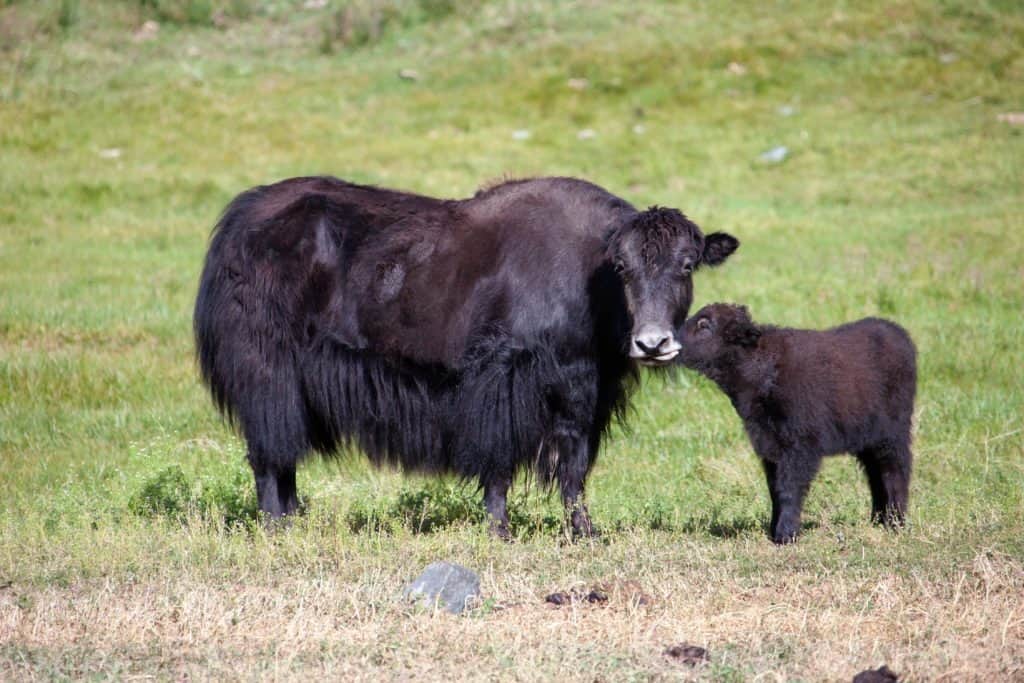
Female yaks typically give birth to a single calf. Twin calves are a rare occurrence.
©Okyela/Shutterstock.com
Population
Domestic yaks number between 14 million and 15 million in Asia. Yak ranching is also on the rise in North America, with about 5,000 currently being raised in the United States. They have been traditionally used as pack animals for caravans as well as for plowing and threshing. Yak dung is the only fuel available on the treeless Tibetan tundra. As late as the mid-1800s, wild yaks extended from Lake Baikal in Siberia to the Ladakh steppe in India. The Chinese Golden Yak, an endangered subspecies of the wild yak, only has about 170 individuals left in the wild. India and China have officially protected wild yaks, with the latter even creating special reserves where many herds of the wild population are located.
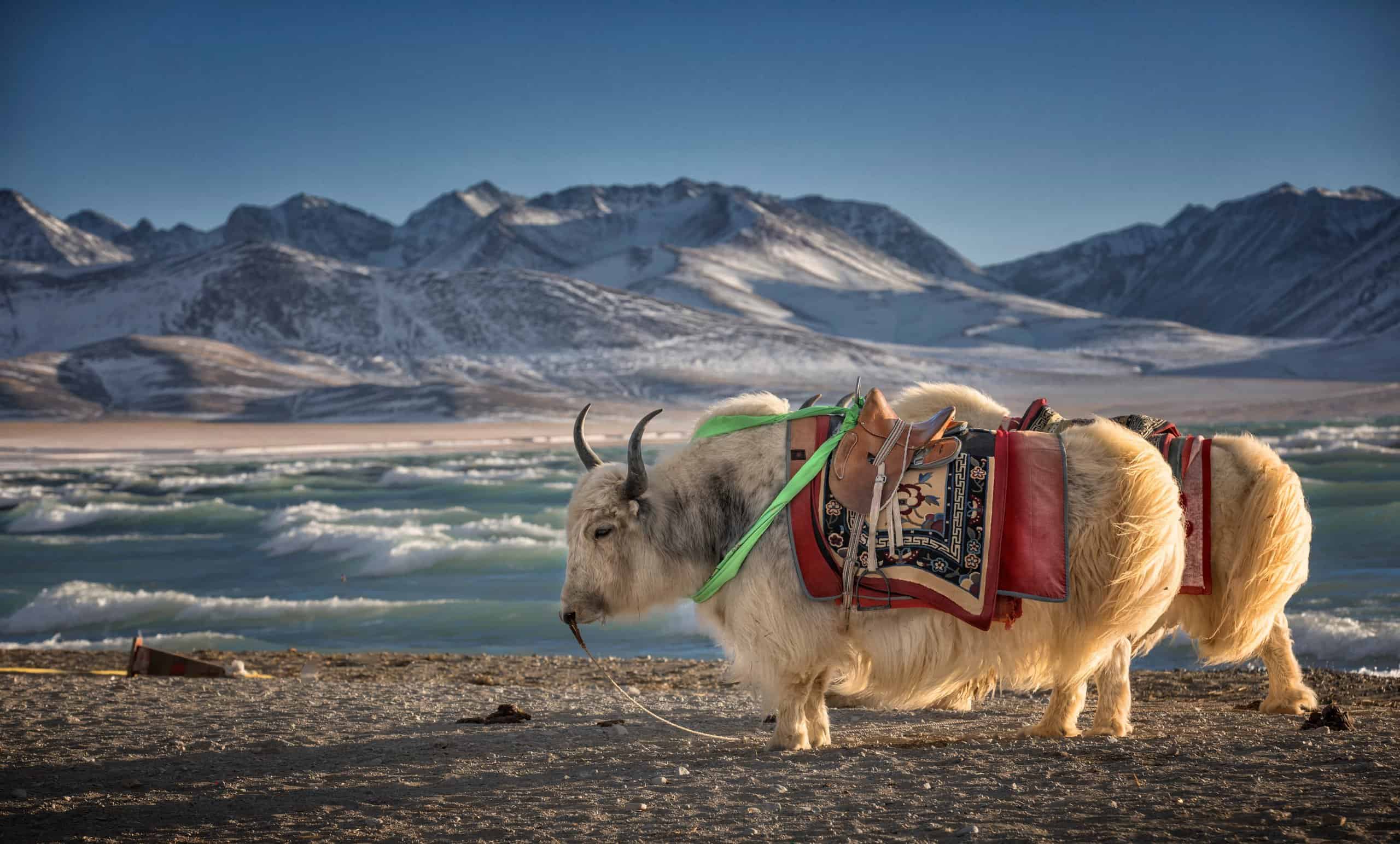
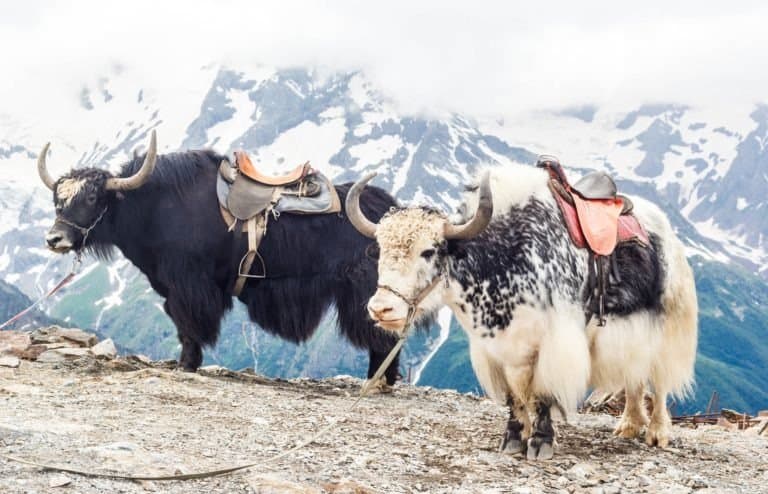
Yaks have been traditionally used as pack animals for caravans as well as for plowing and threshing.
©Michail_Vorobyev/Shutterstock.com
Racing
In many traditional festivals that feature music and sport in Tibet, Mongolia, Kazakhstan, Kyrgyzstan, Gilgit-Baltistan, and Ladakh, Yak Racing is a popular sport that allows yak riders to show off their prowess. The competitors dress in colorful, ornate costumes and adorn their yaks’ heads and horns with ribbons and cloths, and place ornamented saddles on their backs. Riders race in sets of 10-12 on a field track that is typically 2000 meters in length. Yaks can run up to max speeds of 25mph, so these races are exciting events. The winner usually wins a khatag (Tibetan scarf) and a cash prize.
Yaks In the Zoo
Most zoos only have room for one type of wild cattle species, so they choose buffalo, bison, or yak. San Diego Zoo‘s Wildlife Park is one exception where visitors can see these animals as well as other species. San Diego Zoo has a careful, dedicated breeding program for endangered species, although most zoos do not.