Y
Species Profile

Yellowhammer

Emberiza citrinella

Hedgerow gold with a looping chorus
WildMedia/Shutterstock.com

Yellowhammer Distribution

Click a location to explore more animals from that region

Loading map...

Found in 36 countries

๐Ÿ‡ฌ๐Ÿ‡ง United Kingdom ๐Ÿ‡ซ๐Ÿ‡ท France ๐Ÿ‡ง๐Ÿ‡ช Belgium ๐Ÿ‡ณ๐Ÿ‡ฑ Netherlands ๐Ÿ‡ฑ๐Ÿ‡บ Luxembourg ๐Ÿ‡ฉ๐Ÿ‡ช Germany ๐Ÿ‡จ๐Ÿ‡ญ Switzerland ๐Ÿ‡ฆ๐Ÿ‡น Austria ๐Ÿ‡ฎ๐Ÿ‡น Italy ๐Ÿ‡ช๐Ÿ‡ธ Spain ๐Ÿ‡ต๐Ÿ‡น Portugal ๐Ÿ‡ฉ๐Ÿ‡ฐ Denmark ๐Ÿ‡ณ๐Ÿ‡ด Norway ๐Ÿ‡ธ๐Ÿ‡ช Sweden ๐Ÿ‡ซ๐Ÿ‡ฎ Finland ๐Ÿ‡ช๐Ÿ‡ช Estonia ๐Ÿ‡ฑ๐Ÿ‡ป Latvia ๐Ÿ‡ฑ๐Ÿ‡น Lithuania ๐Ÿ‡ต๐Ÿ‡ฑ Poland ๐Ÿ‡จ๐Ÿ‡ฟ Czech Republic ๐Ÿ‡ธ๐Ÿ‡ฐ Slovakia ๐Ÿ‡ญ๐Ÿ‡บ Hungary ๐Ÿ‡ธ๐Ÿ‡ฎ Slovenia ๐Ÿ‡ญ๐Ÿ‡ท Croatia ๐Ÿ‡ง๐Ÿ‡ฆ Bosnia and Herzegovina ๐Ÿ‡ท๐Ÿ‡ธ Serbia ๐Ÿ‡ฒ๐Ÿ‡ช Montenegro ๐Ÿ‡ท๐Ÿ‡ด Romania ๐Ÿ‡ง๐Ÿ‡ฌ Bulgaria ๐Ÿ‡บ๐Ÿ‡ฆ Ukraine ๐Ÿ‡ฒ๐Ÿ‡ฉ Moldova ๐Ÿ‡ง๐Ÿ‡พ Belarus ๐Ÿ‡น๐Ÿ‡ท Turkey ๐Ÿ‡ท๐Ÿ‡บ Russia ๐Ÿ‡ฐ๐Ÿ‡ฟ Kazakhstan ๐Ÿ‡ฎ๐Ÿ‡ท Iran

At a Glance

Wild Species
Also Known As Eurasian yellowhammer, European yellowhammer, Yellow-hammer, Yellow bunting, Common yellowhammer
Diet Omnivore
Activity Diurnal+
Lifespan 3 years
Weight 0.036 lbs
Status Least Concern
Did You Know?

Adults measure 16-17 cm long with a 23-29 cm wingspan; typical mass is about 0.025-0.036 kg.

Scientific Classification

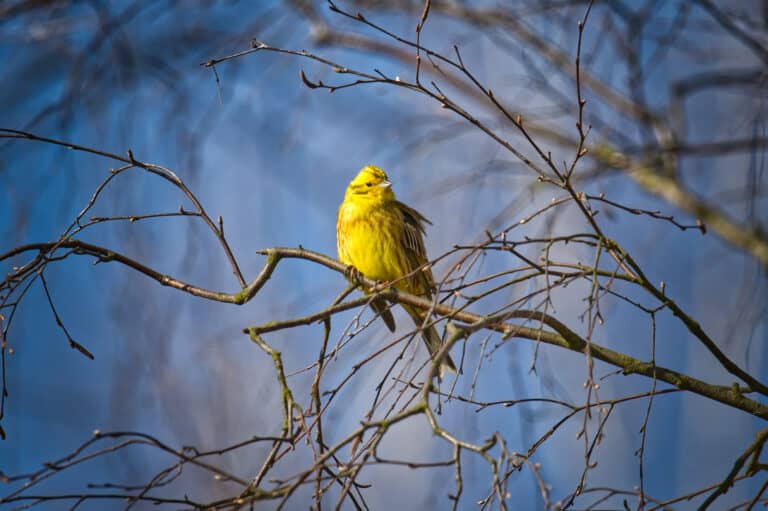
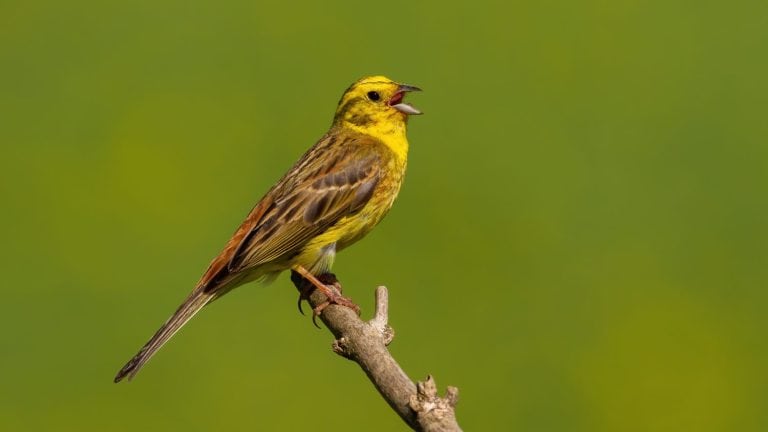
The Yellowhammer is a small Old World bunting known for bright yellow plumage in males and a distinctive, repetitive song. It is widespread across much of Europe and parts of western Asia, often associated with open countryside and farmland edges.

Kingdom
Animalia
Phylum
Chordata
Class
Aves
Order
Passeriformes
Family
Emberizidae
Genus
Emberiza
Species
citrinella

Distinguishing Features

  • Male has bright yellow head and underparts
  • Brown-streaked back and flanks
  • Thick conical bunting bill
  • Simple, repetitive song pattern

Physical Measurements

Length
6 in (6 in โ€“ 7 in)
Weight
0 lbs (0 lbs โ€“ 0 lbs)
Tail Length
3 in (2 in โ€“ 3 in)
Top Speed
29 mph
flying

Appearance

Primary Colors
Secondary Colors
Skin Type Feathers
Distinctive Features
  • Conical seed-eating bill, typical bunting profile.
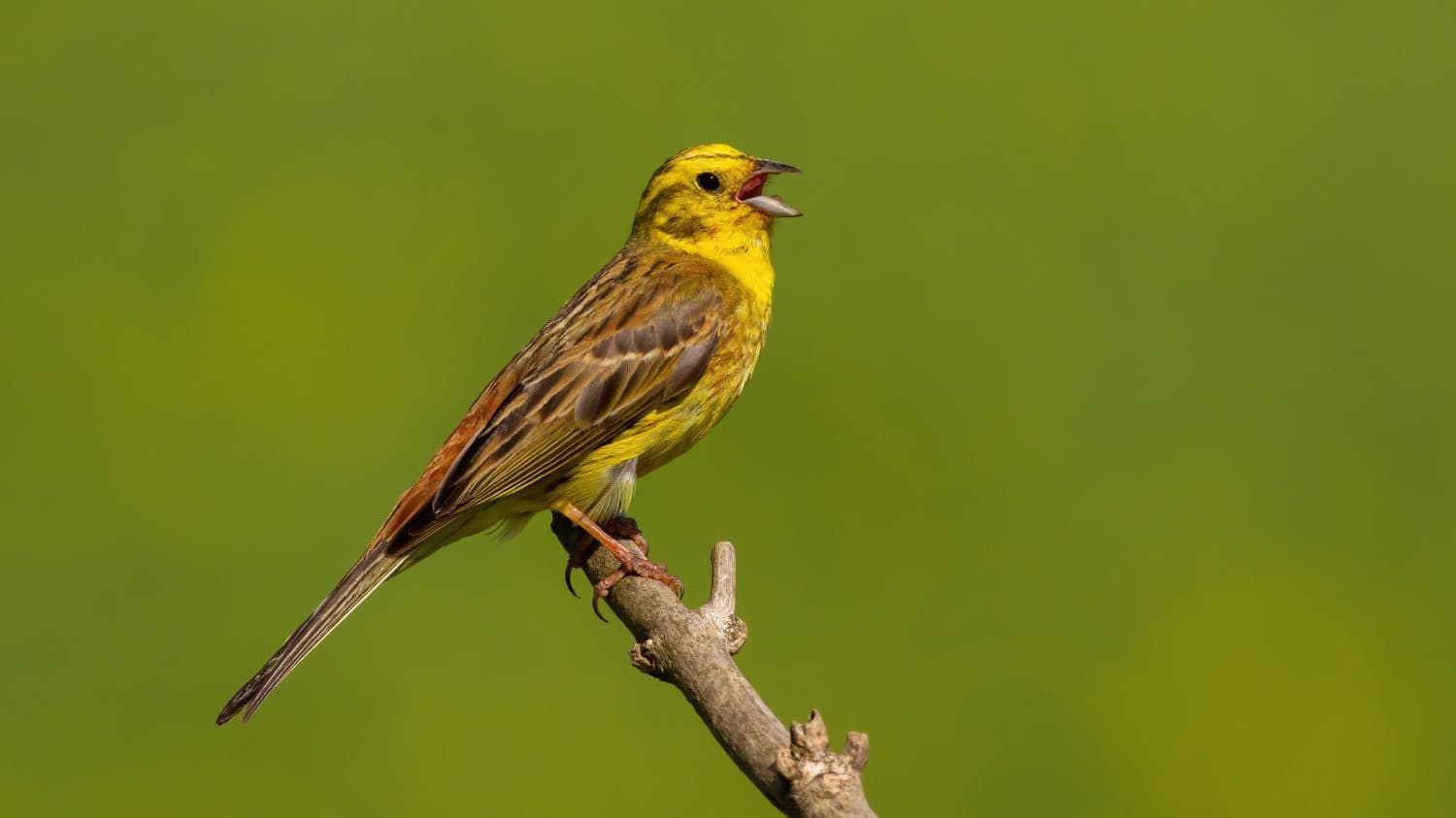
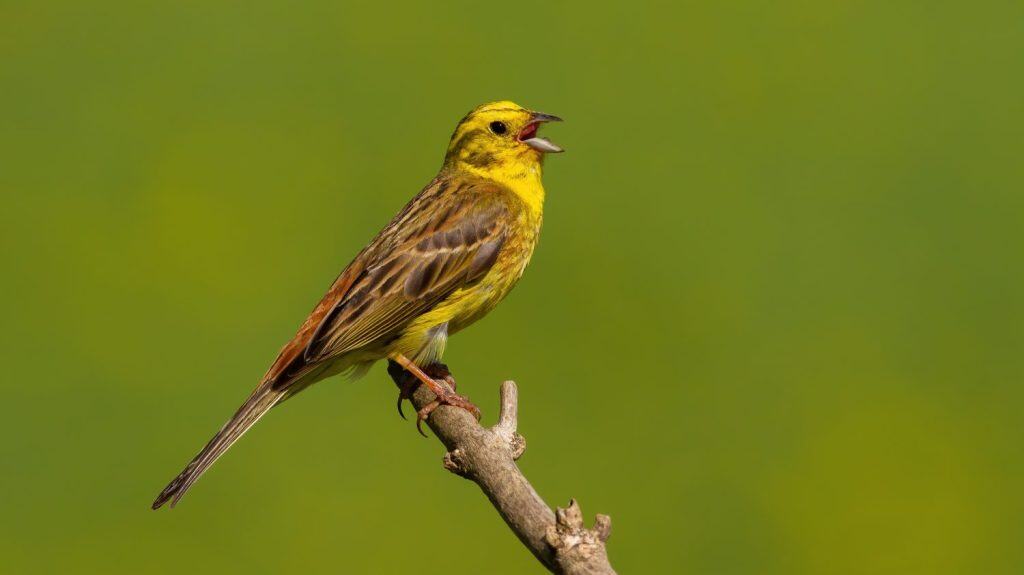
  • Male: yellow head with darker crown and cheek lines.
  • Rump often warm brown/chestnut, contrasting with streaked back.
  • Two subtle pale wingbars from feather edging.
  • Flanks and breast show brown-black streaking, variable by sex/season.
  • Tail shows pale outer edges, noticeable during short bounding flight.

Sexual Dimorphism

Males are markedly brighter, with a vivid yellow head and underparts; females are duller buff-tan with heavier streaking. In winter, males appear less yellow due to brownish feather fringes.

โ™‚
  • Breeding male: vivid yellow head, throat, and breast.
  • Cleaner yellow underparts with comparatively reduced flank streaking.
  • Stronger contrast between yellow front and streaked brown back.
โ™€
  • Overall buff-tan head with limited yellow, especially in winter.
  • Heavier dark streaking on breast and flanks.
  • Less contrast between underparts and upperparts; more uniformly brown.

Did You Know?

Adults measure 16-17 cm long with a 23-29 cm wingspan; typical mass is about 0.025-0.036 kg.

Males are brightest in spring; winter plumage looks duller because fresh feather fringes partly hide yellow.

Typical clutch size is 3-5 eggs; incubation is about 12-14 days, with fledging around 11-13 days.

Song is a short series of notes ending with a drawn-out final note-often remembered as "a little bit of bread and no cheese."

Diet shifts seasonally: seeds dominate in winter, but adults collect many insects and larvae for nestlings.

Ring-recovery data show a maximum recorded lifespan of at least 13 years in the wild.

Unique Adaptations

  • Strong conical bill efficiently cracks tough grass and cereal seeds common in farmland and hedgerow habitats.
  • Seasonal feather wear and edging create noticeable plumage change without a full color shift, aiding winter camouflage.
  • Powerful gizzard helps grind hard seeds, letting the species exploit grains and wild seedheads through winter.
  • Females' heavily streaked brown plumage blends with grasses and leaf litter, reducing detection at ground nests.
  • Flexible habitat use-hedges, field margins, heaths, and open woodland edges-supports survival across varied countryside mosaics.

Interesting Behaviors

  • Sings persistently from exposed hedgerows, fences, or small trees to advertise territory and attract a mate.
  • Forms loose winter flocks, often mixing with other buntings and finches while foraging on stubble and field margins.
  • Builds a cup nest low in vegetation or on the ground, commonly at hedge bases, banks, and grassy field edges.
  • Uses repeated foraging hops and short pecks, selecting and husking seeds; in breeding season, switches to insect hunting.
  • Shows local song "dialects"; neighboring males often share similar song patterns within the same landscape.

Cultural Significance

In Britain and Ireland, its song is famously rendered as "a little bit of bread and no cheese," making it a classic countryside sound. The Yellowhammer also appears in European poems and local nature writing as a symbol of farmland spring.

Myths & Legends

British folk tradition preserves the Yellowhammer's song as the phrase "a little bit of bread and no cheese," repeated in children's lore.

In parts of Scotland and northern England, Yellowhammers were sometimes linked with witchcraft folklore, especially around their eggs and nests.

In British folklore, its song is heard as "a little bit of bread and no cheese," a rustic rhyme used to identify it in spring.

Conservation Status

LC Least Concern

Widespread and abundant in the wild.

Population Decreasing

Protected Under

  • EU Birds Directive
  • Bern Convention II

Life Cycle

Birth 4 chicks
Lifespan 3 years

Lifespan

In the Wild 0.1โ€“13.75 years
In Captivity 1โ€“15 years

Reproduction

Mating System Monogamy
Social Structure Socially Monogamous
Breeding Season April to August (peak May-July)
Breeding Pattern Seasonal
Fertilization Internal Fertilization
Birth Type Internal_fertilization

Yellowhammers are primarily socially monogamous: territorial males pair with a female for the breeding season and defend a song territory. Extra-pair copulations can occur, but parental care is mainly by the pair (female incubates; both feed chicks).

Behavior & Ecology

Social Flock Group: 20
Activity Diurnal, Matutinal, Vespertine
Diet Omnivore weed seeds
Seasonal Migratory 497 mi

Temperament

Territorial
Wary
Gregarious

Communication

repetitive song
contact calls
alarm calls
flight calls
begging calls
song perches
visual displays
posture
wing flicking
aerial chases

Habitat

Biomes:
Temperate Grassland Temperate Forest Mediterranean Boreal Forest (Taiga)
Terrain:
Plains Hilly Valley Plateau Coastal Island
Elevation: Up to 6561 ft 8 in

Ecological Role

Farmland seed-and-invertebrate consumer; important prey for raptors and corvids

weed-seed removal insect population control supports predator food webs

Diet Details

Other Foods:
Cereal grains Grass seeds Weed seeds

Human Interaction

Domestication Status

Wild

Not domesticated. Yellowhammers are 16-17 cm long, 23-29 cm wingspan, 24-36 g. Historically trapped locally as cagebirds; today mainly interact with humans via farmland-edge breeding, winter flocking on stubbles, and monitoring (longevity record 13y 1m, EURING).

Danger Level

Low
  • minor scratches from handling
  • rare salmonella exposure from droppings
  • mite/allergen exposure during handling
  • vehicle/window collision cleanup hazards

As a Pet

Not Suitable as Pet

Legality: Generally illegal to keep wild-caught under EU Birds Directive; permits required.

Care Level: Experienced

Purchase Cost: $50 - $200
Lifetime Cost: $3,000 - $7,000

Economic Value

Uses:
Agriculture Tourism Research Conservation
Products:
  • birdwatching
  • indicator

The yellowhammer (Emberiza citrinella) is a large bunting native to Eurasia. It inhabits dry, open country areas with clusters of trees and wide-ranging vegetation. This species is rather social, forming monogamous pair bonds during breeding and foraging in large, mixed-species flocks. They sing their songs in their unique regional dialects as they sit perched on tree branches. Discover all the exciting facts about the yellowhammer, including where it lives, what it eats, and how it behaves.

5 Amazing Yellowhammer Facts

  • Yellowhammers hide their nests in low bushes to prevent nest predation.
  • It is closely related to the pine bunting and will interbreed. Their songs also sound almost identical to each other.
  • They feed their chicks cereal grains to prepare them for a seed diet.
  • Males listen for the distinctive calls of their rivals.
  • Their population is decreasing due to habitat destruction.

Where to Find the Yellowhammer

The yellowhammer lives in Europe and Asia in at least 50 countries, including Germany, France, Poland, Russia, and Italy. While they are the most widespread bunting in Europe, they are absent from the Arctic regions and the high mountains. Most populations spend winters in their breeding range, except those in the northern part of the range, which migrate south. Some yellowhammer populations have also been introduced to South Africa, New Zealand, and the Falkland Islands. This species lives in dry, open country with some vegetation and trees. You can find them in farmlands, shrublands, grasslands, and forest clearings. Look for them singing in trees or foraging for food in large flocks on the ground. 

Yellowhammer Nest

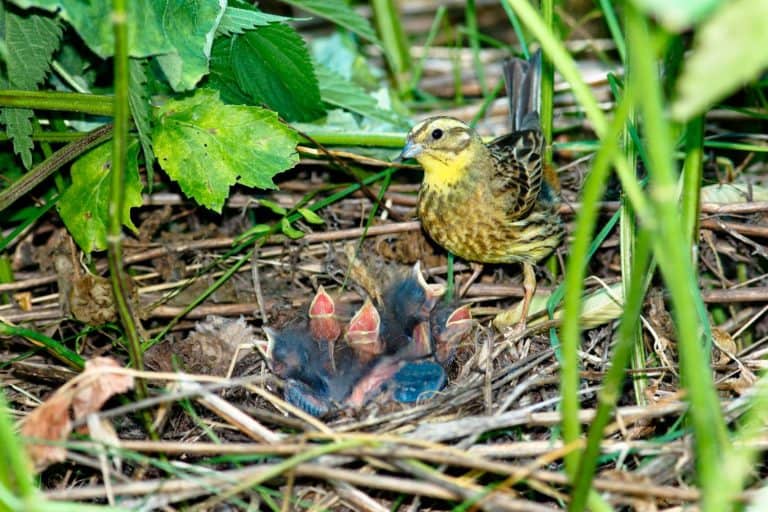
Females build their nests on or near the ground, hiding them in low bushes or other foliage. She forms a cup using plant material, such as leaves and dry grass, and lines it with soft grass and animal hair.
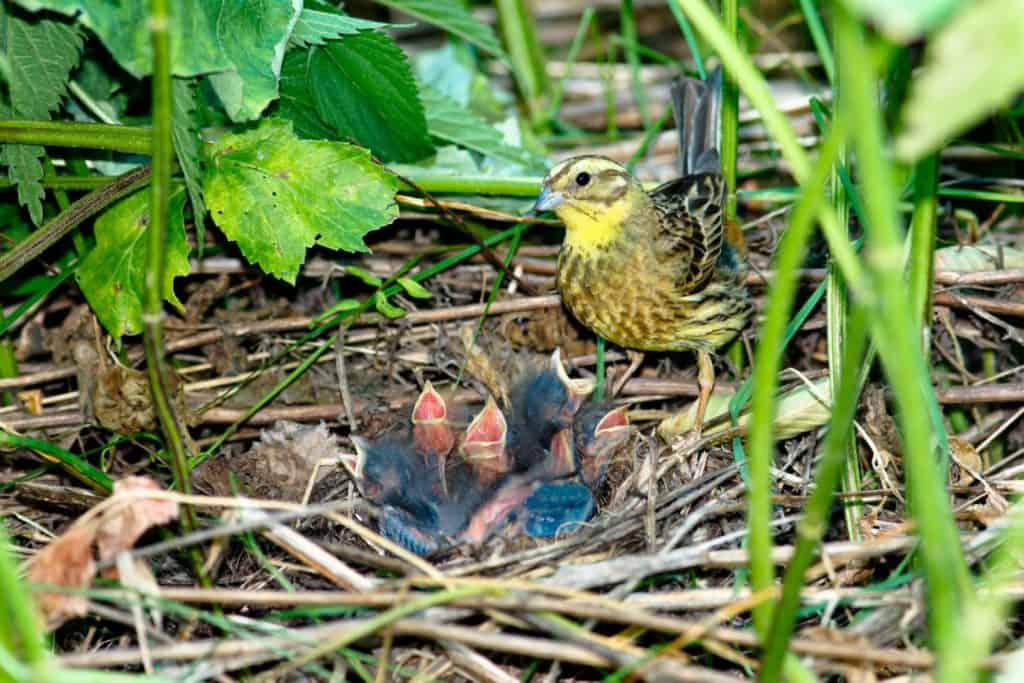
๐Ÿ‘ Yellowhammer, Emberiza citrinella. Nest of a bird with nestligs in the nature.

Nest of Yellowhammer with nestlings.

ยฉVishnevskiy Vasily/Shutterstock.com

Scientific Name

The yellowhammer (Emberiza citrinella) is from the Emberizidae family, which includes the buntings, a group of Old World passerine seed-eating birds with conical bills. Its Emberiza genus also contains the 45 species of buntings. The specific name, citrinella, is the Italian word for a small yellow bird. There are three recognized subspecies of the yellowhammer.

Size, Appearance, & Behavior

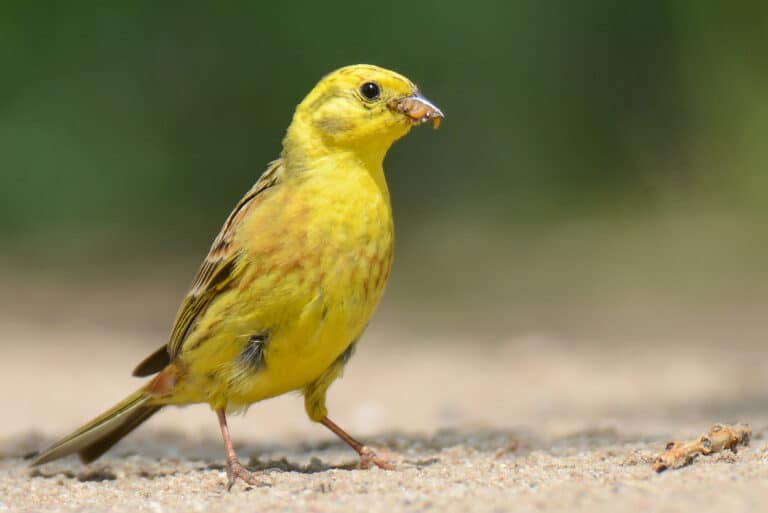
The yellowhammer is a large bunting, measuring 6.3 to 6.5 inches long and weighing 0.7 to 1.3 ounces, with a 9 to 11.6-inch wingspan. This bird is rotund with a thick neck, a short beak, and a long tail. Adult males have bright yellow heads and heavily streaked brown backs, rump, and wings. Its undersides are yellow with white outer tail feathers. Females are a dull yellow with heavier streaks on their crowns, breasts, and flanks. Juveniles are lighter in color than both sexes and have pale rumps. 

This species is relatively social, forming pair bonds during breeding and foraging in large, mixed species flocks. Males learn songs from their fathers and develop a regional dialect, but all dialects are mutually recognized. They produce a series of short notes which increase in volume and end in one to two protracted notes; their songs are almost identical to a pine bunting. Their flight is slightly jerky, followed by long, smooth soaring. Their speed is unknown but may reach up to 25 mph.

Migration Pattern and Timing

Yellowhammers are resident to partially migratory in their range. The European species winter in their breeding range, with only the far northern regions evacuating during winter. The Asian species breeds in Russia and migrates south to winter in Iraq, Iran, and parts of Central Asia.

Diet

Yellowhammers are omnivores who forage in flocks.

What Does the Yellowhammer Eat?

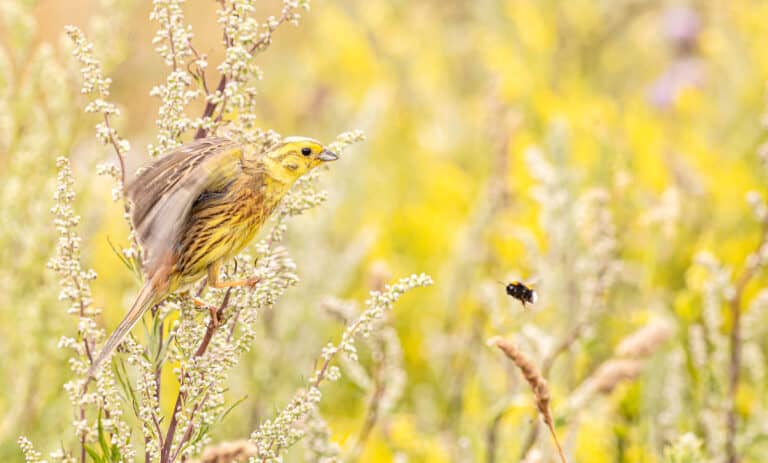
These birds forage on the ground in large flocks, sometimes numbering in the hundreds and containing buntings and finches. Their diet consists primarily of starchy seeds, plant material, and insects. They feed their chicks invertebrates and cereal grains to prepare them for their heavy-seed diet. They consume plant materials, such as nettle, knotgrass, chickweed, and yarrow. And they will eat a wide range of insects like grasshoppers, flies, beetles, spiders, snails, caterpillars, and worms.

Predators, Threats, and Conservation Status

The IUCN lists the yellowhammer as LC or โ€œleast concernโ€. Due to its extensive range and substantial population, this species does not meet the โ€œthreatenedโ€ status thresholds. However, they are suspected of being in decline in Europe. Their most significant threat is habitat destruction from the agricultural industry, which includes a reduction in the cultivation of cereal crops and the intensification of farmland management. 

What Eats the Yellowhammer?

Yellowhammer predators include sparrowhawks, lesser spotted eagles, falcons, and northern goshawks. This bird is a ground nester whose eggs and young are vulnerable to small mammals like mice and other rodents. Crows, jays, and magpies are also known for raiding yellowhammer nests. These birds use hedges or bushes as protective nesting sites, and males listen for the distinctive songs of potential threats and rivals. 
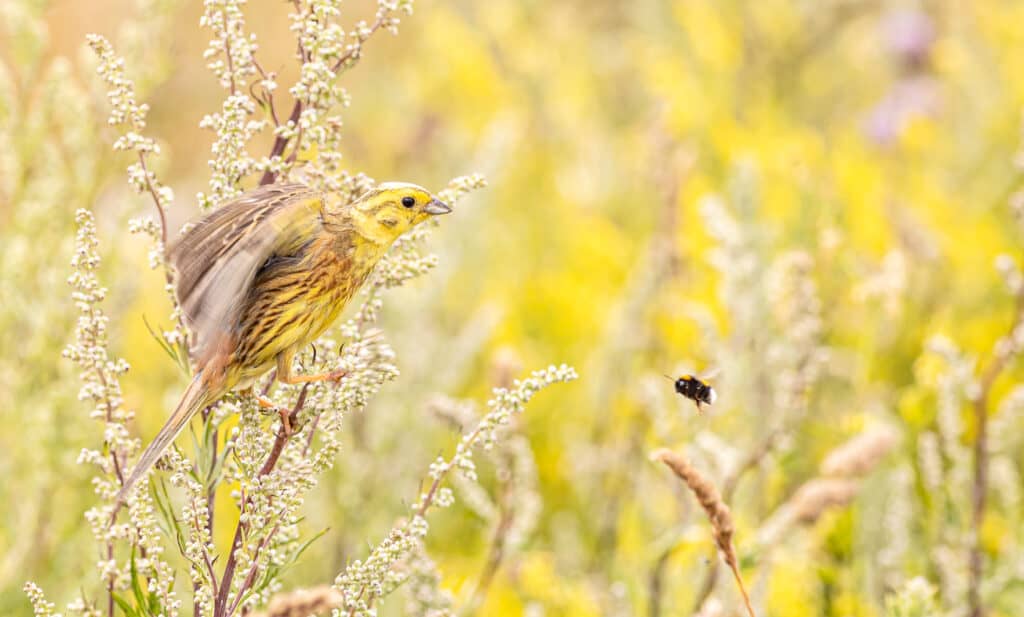
๐Ÿ‘ Yellowhammer

The yellowhammer population is decreasing due to habitat destruction.

ยฉMichael Schnetz/Shutterstock.com

Reproduction, Young, and Molting

Their breeding season begins in April or May, and they can reproduce when they reach one year old. Yellowhammers form monogamous pair bonds, and males perform courtship rituals, such as raising their wings and running toward the females. Yellowhammers also interbreed with the pine bunting, their closest relative. Females lay three to five white eggs with dark lines and incubate them for 12 to 14 days. Both parents assist in feeding the chicks until they fledge the nest around 11 to 13 days after hatching. Adult yellowhammers produce two to three broods per year. This species has an average lifespan of 3.7 years, but can live more than 13 years. 

Population

The global yellowhammer population is estimated to number 65 to 90 million mature individuals. Europe encompasses 60% of its global range, and its breeding population includes 12.8 to 19.9 million pairs. Despite its large population, its numbers are decreasing at a moderate rate. Habitat destruction is thought to be the reason for its decline.

View all 41 animals that start with Y

Sources

  1. Journal of Ornithology, Springer Verlag / Thibaud Gruber, Laurent Nagle / Accessed October 9, 2022
  2. IUCN Red List / BirdLife International / Accessed October 9, 2022

About the Author

Niccoy Walker

Niccoy is a professional writer for A-Z Animals, and her primary focus is on birds, travel, and interesting facts of all kinds. Niccoy has been writing and researching about travel, nature, wildlife, and business for several years and holds a business degree from Metropolitan State University in Denver. A resident of Florida, Niccoy enjoys hiking, cooking, reading, and spending time at the beach.
Connect:

Thank you for reading! Have some feedback for us?

Contact the AZ Animals editorial team

Related Articles You May Find Interesting


Yellowhammer FAQs (Frequently Asked Questions)

Yellowhammers live in the Eurasia region in at least 50 countries. They inhabit dry, open areas like grasslands, shrublands, farmlands, and forest clearings.

The yellowhammer is a large bunting, measuring 6.3 to 6.5 inches long and weighing 0.7 to 1.3 ounces, with a 9 to 11.6-inch wingspan.

This species is relatively social, forming pair bonds during breeding and foraging in large, mixed species flocks.

They produce a series of short notes which increase in volume and end in one to two protracted notes. Their songs are almost identical to a pine bunting.

Their speed is unknown but may reach up to 25 mph.

The Asian species breeds in Russia and migrates south to winter in Iraq, Iran, and parts of Central Asia.

Their diet consists mainly of seeds. They also consume plant materials, such as nettle, knotgrass, chickweed, and yarrow. And they will eat a wide range of insects like grasshoppers, flies, beetles, spiders, snails, caterpillars, and worms.