
Purpose
This document describes how Red Hat provides support for different combinations of underlying container technologies. This policy builds upon the Red Hat support policy on third party software and is specific to the technologies shipped with two main products:
- Red Hat OpenShift - a full enterprise distribution of Kubernetes & Linux delivered as a solution. Red Hat Enterprise Linux CoreOS is included as a fully managed component within the Kubernetes cluster.
- Red Hat Enterprise Linux (RHEL) - a fully customizable Container Host including Container Engine, Container Runtime, Container Images, and Linux kernel built and tested together.
OpenShift is designed and deployed as a solution for clustered ( orchestrated or distributed systems) use cases, while Red Hat Enterprise Linux is a solution for stand-alone nodes or as part of an OpenShift cluster. This document focuses on individual underlying technology combinations. For information on the total clustered solution, please review the OpenShift Container Platform Support Policy.
Support Policy Overview
Red Hat provides support for a number of underlying component technologies. Combinations of these technologies can be used by customers to run and manage a fully supported container infrastructure. Red Hat supports these technologies within the following contexts:
- Container Orchestration - delivered with Red Hat OpenShift as a container platform integrating Kubernetes for orchestration with Linux (RHEL CoreOS or RHEL) as well as management and application services.
- Container Hosts - RHEL and RHEL CoreOS
- Container Engines - CRI-O, docker1, Podman, and Buildah.
- Container Runtimes - runc and crun
- Container Images - based on Red Hat Enterprise Linux or Red Hat Universal Base Image (UBI), Red Hat provides four main options (standard, micro, minimal, multi-service) as well as full applications and layered products built on these base images.
The underlying technology can be thought of as layers in an integrated and tested software stack. The level of support is determined by the underlying components used in each layer of the stack. Following these guidelines will ensure that customers have a supportable container environment - including orchestration, hosts, and images. By engineering, testing, delivering and supporting a complete stack, Red Hat ensures our customers can use this technology with confidence throughout the committed product life cycle.
👁 This image shows the levels of support as a stack.
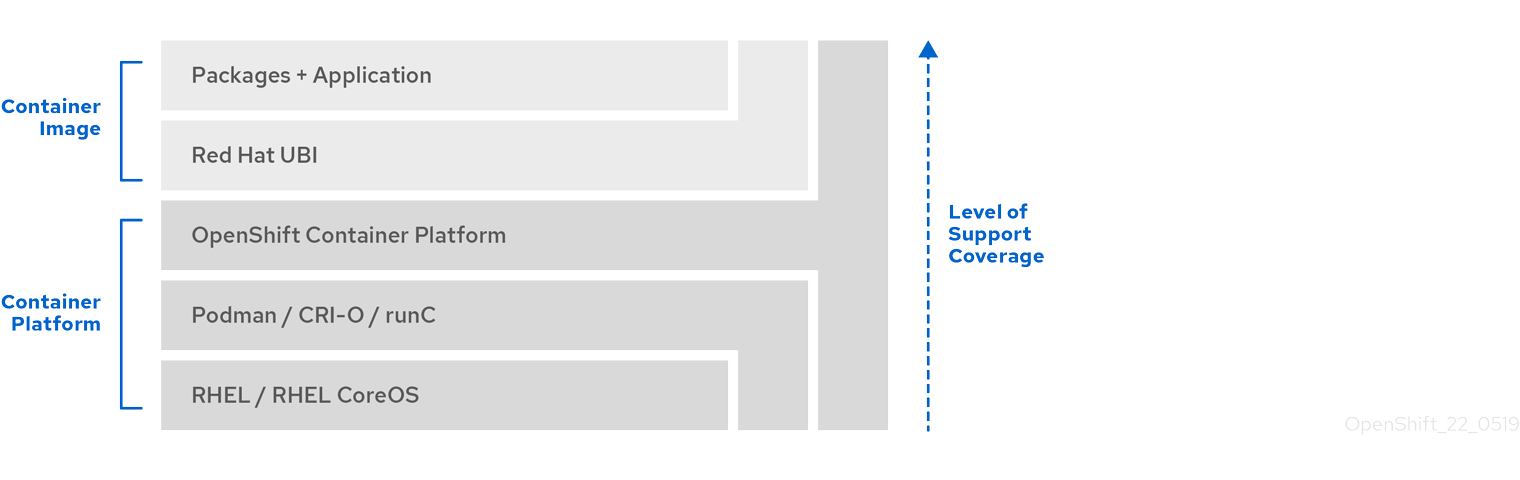
For readability, this document is organized into sections based on Container Image & Container Platform (Container Orchestration, Container Hosts).
How Red Hat Supports Your Container Images
Red Hat provides a variety of Container Images suited to be used as a base, middleware, and application Container Images available through the Red Hat Container Catalog:
- Base Images - used solely for the purpose of being a foundation to build on. The Red Hat Universal Base Image (UBI) is available in four flavors - standard, micro, minimal, and multi-service.
- Language Runtimes & Frameworks - prebuilt Container Images such as PHP, Python, Ruby, NodeJS, and others. These can be used directly by developers to build applications without the installation of additional software. While not technically base images themselves, this category of Container Images incorporates the base image and can be built upon.
- Application Images - prebuilt Container Images which are not themselves a base image. This category of Container Images incorporates the base image and provides an application or service as part of a Red Hat or an ISV product.
To be eligible for the support of Container Images outlined in this policy, customers are required to operate a supported Container Platform, covered with appropriate support subscriptions. Container Platform support details can be found in the following section.
👁 This image shows the levels of support as a stack.
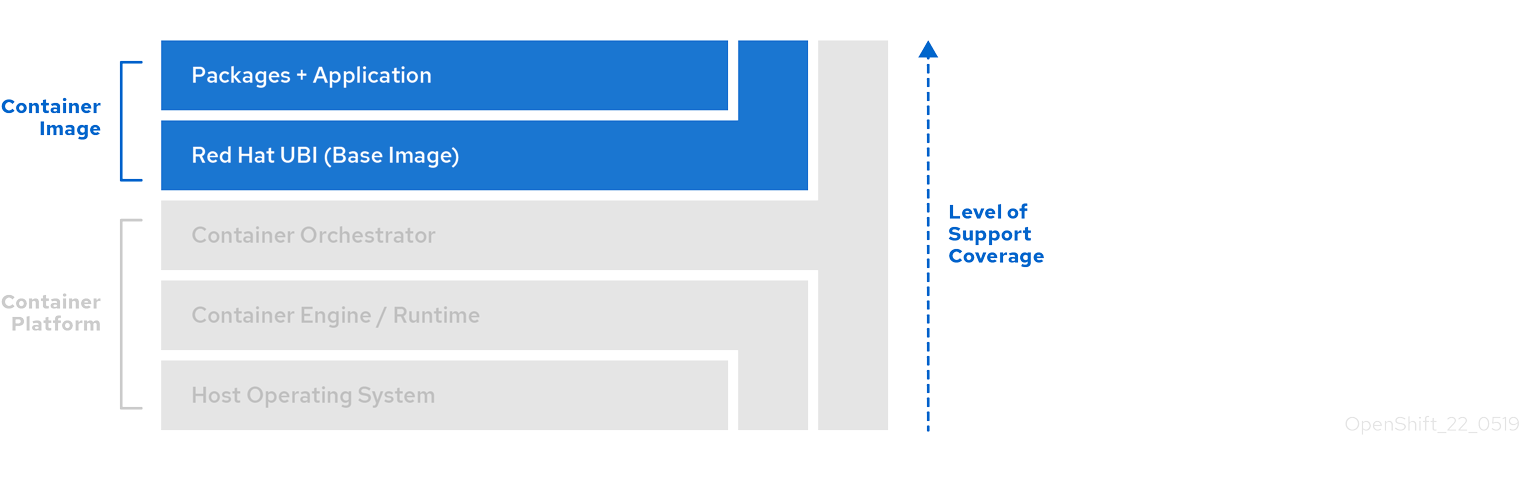
Support for Container Base Images
Red Hat provides customers with a Universal Base Image (UBI) which has been specifically engineered and tested to be the foundation for building application images. In addition, Red Hat provides tooling to allow customers to extend these base images as well as create a custom base or application images. Red Hat recommends using the Red Hat Universal Base Image for all future needs, but continues to offer and support Red Hat Enterprise Linux 7 base images to meet ABI/API exceptions until the end of the RHEL 7 lifecycle. UBI 7 and RHEL 7 deliver identical technical functionality and package content. This section applies to both UBI and the Red Hat Enterprise Linux 7 base images.
Red Hat fully supports the use of UBI images, or Container Images based on UBI, when running a supported Container Platform along with a valid support subscription. The level of support provided is subject to documented usage guidance and in accordance with the Red Hat Enterprise Linux product life cycle 2 3. The container support policy applies to all varieties of Red Hat Universal Base Image, regardless of the variant: standard, micro, minimal or multi-service. For Container Images based on UBI, Red Hat support is limited to the Red Hat components included in the combined Container Image.
All images shipped as part of UBI are OCI compliant, redistributable per the terms of our EULA, and are capable of running on non-Red Hat platforms. Red Hat provides updates for UBI which can be accessed without the need for a product subscription, this content is a subset of the current packages available in RHEL and Software Collections (SCL). Customers with an appropriate support subscription continue to have access to all RHEL life cycle content which can be added into their images in accordance with the guidance below.
Extending Container Images
Base Container Images provide an immutable foundation which can be built upon for packaging and shipping applications and services. Red Hat supports extending UBI base images through the addition or upgrading of packages from the publicly available Red Hat UBI, or RHEL-entitled software repository. The UBI content availability article outlines which content is made available as part of UBI, this is governed by the RHEL Enterprise Lifecycle.
This table provides examples of operations which may be carried out on a base image, and what Red Hat does or does not support.
Support for Application Images
For the purpose of this policy, application images are those which are not solely a base Container Image and have been built to provide specific functionality by a vendor, which could include Red Hat, an ISV or the community.
Application Container Images are conventionally engineered, built, and shipped to be immutable. As such it is not always desired to extend the contents of these Container Images, but instead request from a provider an updated Container Image which will include required enhancements, security or bug fixes.
Specific scenarios may determine the need for modifications of an application Container Image. Red Hat supports the extension of UBI images with Red Hat content; this is limited to the scope outlined in the previous section, it requires the Container Image is built using UBI as the base Container Image, and can be identified as such using the Container Image metadata. Modification of a Container Image may void your entitlement to support from the supplying third party vendor. Always check before proceeding with changes.
The scope of support for running and modifying application Container Images is subject to the supplying vendor. The following table outlines how Red Hat supports the use of Container Images when built on UBI.
How Red Hat Supports Your Container Platform
Red Hat provides the software required for use as a Container Platform. This is available and can be deployed in two variants; as a non-orchestrated container stack (single node), or as an orchestrated container stack (multiple nodes or cluster).
- Red Hat provides a supported standalone, non-orchestrated stack with the Red Hat Enterprise Linux subscription. This includes RHEL, a Container Engine & runtime.
- Red Hat provides a supported Container Orchestration stack with the OpenShift subscription, or an add-on subscription to RHEL, which includes Container Host (operating system, Container Engine & runtime), Container Images, registry server and Container Orchestration.
Whether an orchestrated or non-orchestrated deployment, the level of support coverage for the Container Platform and Container Image is additive, this means it is determined up to the point to which non-Red Hat shipped software is introduced to provide functionality for a given layer; Container Host, Container Engine & Runtime, and Container Orchestration. The following outlines how the Container Platform stack is composed of the technologies shipped by Red Hat.
👁 This image shows the levels of support as a stack.
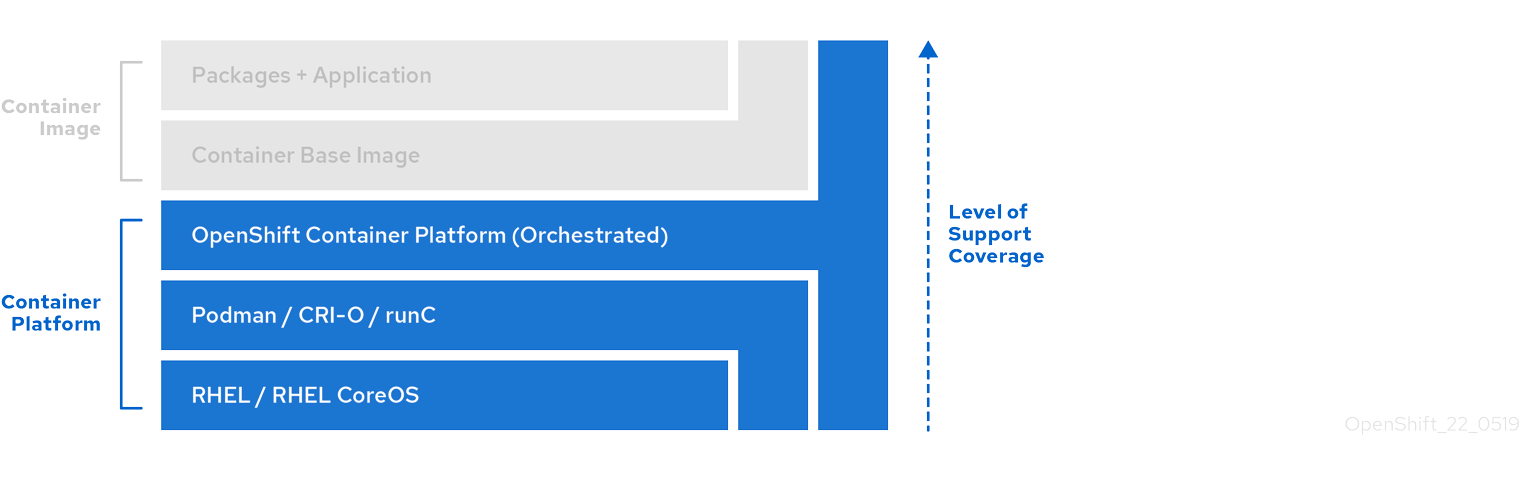
-
Support for the docker package shipped in RHEL Extras remains for Red Hat Enterprise Linux 7, per the extras support and life cycle policy ↩︎
-
Red Hat UBI repositories are available and supported for use only with Red Hat UBI based containers ↩︎
-
Red Hat UBI is governed by the Red Hat Enterprise Linux life cycle. Content made available through Red Hat UBI is outlined in the following article. ↩︎
Comments