|
VOOZH | about |
|
VOOZH | about |
The number of websites linking to this post.
This post's estimated monthly organic search traffic.
Below are a few simple search engine optimization (SEO) tips to help you do that.
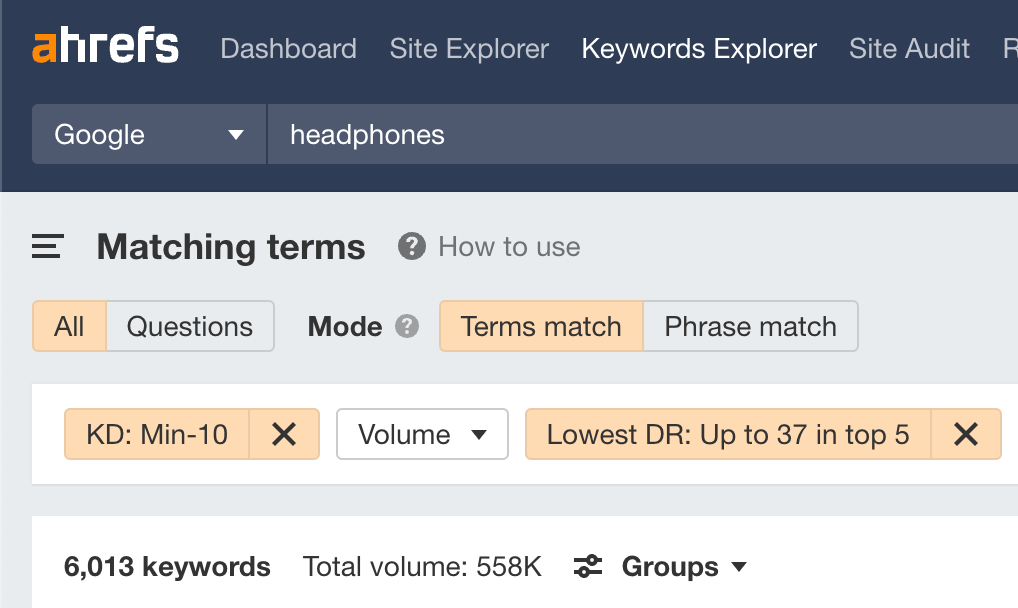
Many things affect ranking difficulty. But if you see pages from similar caliber sites in the top five with few backlinks, that’s usually a sign of a keyword that’s easy to rank for.
Here’s how to find these keywords:
For example, the top-ranking page for “ski helmet headphones” has one website linking to it and lives on a DR 19 website:
Internal links can pass PageRank, which can help boost a page’s rankings.
Here’s how to find internal linking opportunities for free using Ahrefs Webmaster Tools (AWT):
You’ll see a list of contextual internal linking opportunities.
For example, here’s a suggestion to link from our list of content marketing tools to our post about building a content marketing strategy with “content marketing strategy” as the anchor text.
FAQ sections answer popular questions about a topic. Adding them to your page can help you rank higher for long-tail keywords.
For example, our guide to H1 tags answers how long they should be in the FAQ section.
As a result, it ranks high for a related long-tail search:
Here’s how to find frequently asked questions to answer:
Featured snippets are quick answers in Google search results pulled from a page ranking in the top 10. You can often “shortcut” your way to the top of Google by winning them.
Here’s how to find the easiest opportunities:
For example, the snippet for “google operators” is a definition:
To stand a chance at winning the snippet, we’ll need to define the term on our page.
Backlinks can only help you rank higher if they point to working pages.
Here’s how to find dead pages with backlinks:
Here’s how to fix them:
People are usually looking for one of these types of content when they search Google (and other search engines):
To stand the best chance of ranking, you should align your content with search intent.
You can find this out by looking at the top-ranking pages.
For example, interactive tools dominate the first page for “days between dates.” But videos dominate the first page for “excel for beginners”:
Title tags are a small but confirmed ranking factor, and Google often uses them for search snippets in the results.
Here’s our advice for writing a compelling one:
Get a free Ahrefs Webmaster Tools (AWT) account, crawl your website with Site Audit, and go to the Content report.
Rankings rarely last forever, so you need to refresh content periodically to maintain them.
Here’s how to find declining content with Google Search Console:
From there, look for pages where searchers would expect fresh information and update them.
For example, take our list of the top Google searches. This page’s rankings almost certainly declined because searchers want an up-to-date list.
Platforms that connect journalists with expert sources can help you earn mentions and backlinks from high-authority publications.
The original HARO (Help a Reporter Out) shut down in December 2024 but was relaunched by Featured.com in April 2025. Here are your best options:
You can also monitor journalist requests on X and Bluesky using hashtags like #journorequests and #prrequest.
The key is to respond quickly with genuinely useful expertise.
For example, here’s a journalist from Apartment Therapy (DR 87) requesting insights from landlords:
Here’s the link a landlord earned by replying to this request:
Core Web Vitals are site speed metrics Google uses to measure user experience as part of its Page Experience signals.
They’re not a super strong ranking factor, but they can still impact rankings.
The three Core Web Vitals are:
INP replaced the old FID metric in March 2024 and is now the most commonly failed metric—43% of sites don’t meet the 200ms threshold.
To check if your Core Web Vitals need work, use the Core Web Vitals report in Google Search Console or the Performance report in Ahrefs’ Site Audit.
Backlinks are a ranking factor, so it makes sense to combine very similar pages to consolidate authority and create a page with more “ranking power.”
For example, in 2017, we had two similar guides to broken link building that ranked in positions #5 and #6:
Here’s what we did:
The page shot to position #1 almost immediately, and it’s been in the top three ever since.
If your content covers more relevant subtopics, it’ll likely rank for more search queries and get more traffic. Thorough content is high-quality content.
Here’s how to find the best subtopics to cover:
If we do this for the keyword “affiliate marketing,” we can see that the top-ranking pages also rank in the top 10 for these:
By covering these subtopics in a piece about “affiliate marketing,” we can potentially rank for them and get more traffic.
AI Content Helper takes this further by analyzing top-ranking pages for your target keyword and identifying the core topics you need to cover. As you write, it scores your content against competitors and highlights gaps—ensuring your content is comprehensive without manual SERP analysis.
Bloggers and journalists often quote statistics in their content. If you can be the source of these statistics, you can earn backlinks to your website.
Here’s how to find statistics keywords to target:
For example, there are an estimated 600 monthly searches in the U.S. for “seo statistics”:
If you were to curate and publish some SEO statistics on a page and rank for this term, chances are that bloggers and journalists would find your page when searching for statistics. They’d also be likely to link to your page as the source.
This is what we did back in 2020. Our page now has backlinks from 1,900 other sites.
E-E-A-T stands for experience, expertise, authority, and trust.
It’s not a direct ranking factor, but Google says it uses “a variety of signals as a proxy to tell if content seems to match E-E-A-T.”
Backlinks are one of these signals, and including expert quotes may help you get more of them.
For example, here’s a backlink we earned to our hreflang tags guide, thanks to quoting John Mueller:
Google says to use words that are relevant to your site’s content in your URL. The easiest way to do this is to set the URL slug as your target keyword.
For example, our main keyword for this post is “seo tips,” so that’s our URL slug:
If your URLs have subfolders, use common sense to keep them short and relevant.
For example, the target keyword for our backlinks definition is “what are backlinks.” But as we already have /seo/glossary/ in the URL, we just used /backlinks/ as the slug because it’s clear from the rest of the URL that it’s a definition.
If visitors can’t easily scan and understand your content, they’ll bounce. Readability affects both user engagement and how well search engines and AI models understand your page.
Here are quick wins for better readability:
This post you’re reading uses all these techniques. Short sections. Lots of bullets. Clear headings. That’s not an accident.
Meta descriptions don’t directly affect rankings, but they influence whether searchers click your result.
Here’s how to write one that earns clicks:
Google sometimes rewrites meta descriptions, but AI platforms like ChatGPT and Claude use page information like titles and meta descriptions to evaluate the relevance of your page—so the effort is probably still worthwhile.
To find pages missing meta descriptions, run a Site Audit crawl and check the Content report for the “Pages without a meta description” issue. (You can even use Site Audit’s Patches feature to automatically write thousands of meta descriptions for you.)
Images can drive traffic through Google Images and help your pages rank better by improving user experience.
Quick image optimization wins:
For product pages and how-to guides, unique images often outperform stock photos. They give searchers a reason to click your result in Google Images.
Site Audit can automatically flag missing alt text and oversized images across your entire site:
Video can increase time on page, and for some queries, video results dominate the SERP.
You don’t need to create video for every page. Focus on:
If you already have YouTube videos, embed them in relevant blog posts. This gives the video more exposure and makes your page more comprehensive.
Keep video loading fast by using lazy loading and hosting on YouTube or Vimeo rather than self-hosting large files.
Technical SEO sounds intimidating, but many fixes are straightforward.
Start with these quick wins:
Site Audit catches most of these issues automatically. Run a crawl and work through the issues sorted by importance.
Get started with technical SEO by reading our beginner’s guide: The Beginner’s Guide to Technical SEO.
Watch the video below or take our free SEO course for beginners to learn more tips and ideas for improving your SEO strategy and ranking higher.
There are also lots of little SEO tactics you can do to boost search traffic. Examples include optimizing your page title and meta description (take inspiration from Google Ads), optimizing images to get more traffic from Google Images, and more.
Copy link