Computer Use Agents: Benchmark & Architecture

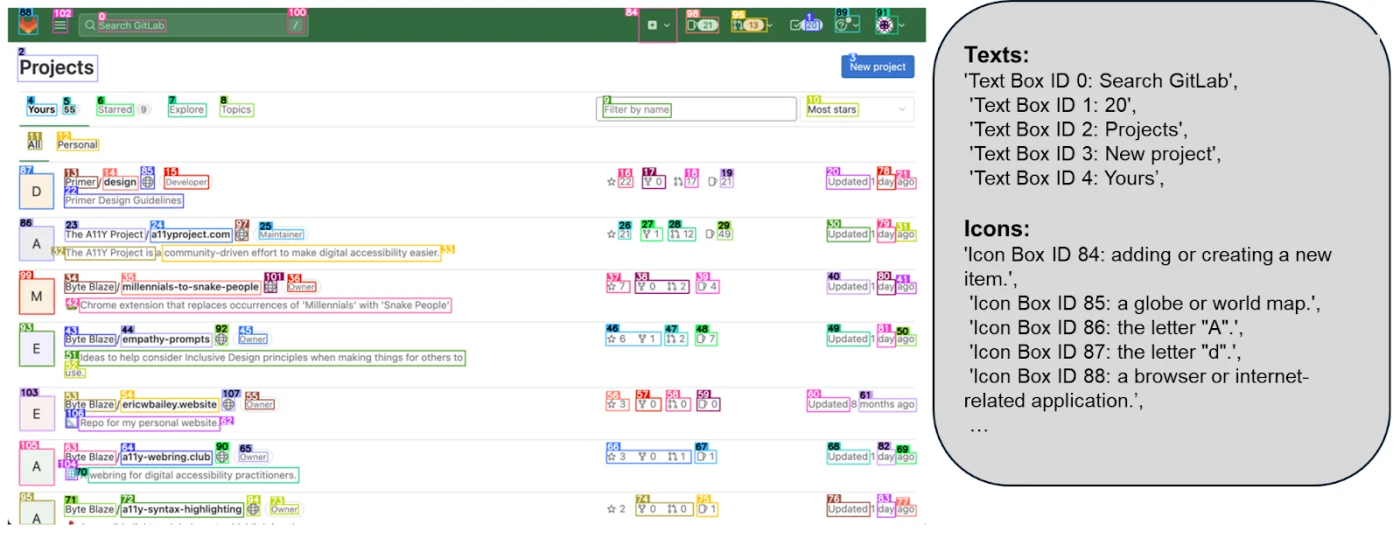
Computer-use agents operate real desktops and web apps. Their designs, limits, and trade-offs are often unclear. We break down how leading systems work, how they learn, and how their architectures differ. We also reference a focused UI-grounding benchmark on 100 desktop screenshots, across 4 task types and 5 runs per sample. It isolates the quality of visual perception and shows why strong vision-language models matter even for composed agents.
UI grounding benchmark results
For benchmark methodology details, read the benchmark details.
- Qwen3-VL models reach ~90% accuracy, with low error (≈7–9 px).
- UI-specialized models like UI-TARS perform worse (~38% accuracy) and show high variance and large errors, especially on state-dependent and dense interfaces.
- State-dependent and dense UIs are the hardest cases for most models.
Top computer use agents
See the features section for features in the table, and examine the architectural approaches section for the details of the computer use agents’ architecture.
OpenAI Computer Use Preview
OpenAI’s computer use-preview is a specialized model built to understand and execute computer tasks via the Responses API. It focuses on text input and output, with optional image input, but does not support audio or video.
Anthropic Claude Computer Use
Claude Computer Use is a beta feature that enables Claude to interact with a desktop or windowed computer environment, like a person would. It works by seeing the screen, moving the mouse, and typing on the keyboard.
Claude cannot act on its own without a developer’s setup. It does not automatically access your real computer; it interacts with the sandbox you provide.
Open Interpreter (OS Mode)
Open Interpreter is an open-source terminal agent. It runs code and interacts with the operating system. Open Interpreter runs on the local machine, so it reaches local files, programs, and the browser directly. A user gives instructions in plain language, and the agent turns them into code. Before any code runs, Open Interpreter shows the planned command and waits for approval.
Simular Agent S/S3
Simular Agent S3 is a computer use agent that works by observing screens, planning actions, and controlling the mouse and keyboard to complete complex tasks. It is part of the open Agent S framework for autonomous GUI interaction.
Behavior Best-of-N (bBoN) is a core method that enables Agent S3 to generate multiple possible action sequences (“rollouts”), rather than a single run. It turns each rollout into a behavior narrative, which is a simple summary of what happened. A separate judgment step then chooses the best run.
Cua AI
Cua AI is an open-source framework that enabler to build, run, and test computer use AI agents across desktop environments by tying vision models, reasoning models, and sandboxed OS environments into one system. Cua can run agents in the cloud using remote sandboxes. It also lets you run them locally if you want more control or privacy.
Cua also helps you generate UI screenshots and agent action logs. You can record multi-step interactions, make training data, and run benchmarks to see how well agents perform.
Claude Cowork
Claude Cowork brings Claude Code’s agentic design to people who do not write code. It runs in the Claude desktop app, in a tab next to Chat and Code. A user points it at a folder, and Claude reads, edits, and creates files there to finish a task.
Cowork follows a clear order: connector first, browser second, screen last. It reaches for an MCP connector such as Slack or Google Drive when one exists. It falls back to Claude in Chrome for web pages with no API. It controls the screen directly when no other path works. Screen control is a research preview and asks permission before each app.
Cowork can split a task across sub-agents that run in parallel, then merge the results. It can also run scheduled tasks on a set cadence, such as a weekly status draft saved to a folder.
Reach and limits:
- Generally available on macOS and Windows across paid plans, after a January 2026 research preview.
- Sonnet 4.6 is the default model. Opus stays selectable for harder tasks.
- Sessions stay on the local machine. Chat sharing, artifact sharing, and Memory do not work in Cowork.
- A single persistent thread on iOS and Android can assign work to the desktop, which must stay awake.
OSWorld benchmark
Results for computer use agentic AI
Disclaimer: The same model may appear at different ranks because OSWorld lists results by full evaluation configuration (agent framework, grounding or planning model, Best-of-N setting, run count, and step limit), and even small changes in these settings are treated as separate entries with different performance outcomes.
Methodology
The benchmark includes 369 real-world tasks (or 361 excluding Google Drive tasks that require manual setup). Tasks span web and desktop applications, OS file operations, and multi-app workflows. Each task starts from a reproducible initial state and is paired with a custom execution-based evaluation script, ensuring reliable scoring.
Evaluation process
Agents interact with a live OS environment. Success is measured by what the agent actually does, not by text outputs. Environments support parallel and headless execution, enabling scalable testing.
Benchmark scope
OSWorld supports open-ended tasks across arbitrary applications, multimodal inputs, cross-app workflows, and intermediate starting states. Compared to prior benchmarks, it offers broader coverage and more realistic conditions.
Baselines and analysis
The benchmark evaluates general models, specialized models, and agentic frameworks across LLM and VLM families. Results show a large gap between human performance (~72%) and current agents, highlighting challenges in GUI grounding and operational knowledge. OSWorld also enables detailed analysis across task types, UI complexity, inputs, and operating systems.
Two architectural approaches to computer use models
Today, most computer use agents fall into one of two design patterns:
- End-to-End (E2E) Agents
- Composed Agents
Both aim to complete tasks on a computer. They differ in how they divide perception, reasoning, and action.
End-to-End (E2E) agents
End-to-end agents use one vision-language model to handle the entire loop. The model receives a screenshot and a task description. It then outputs the next action directly.
There is no clear boundary between seeing, reasoning, and acting. These processes are learned together inside the same model.
How E2E agents work
Screenshot + Task → Unified Representation → Action
The model reasons directly over pixels and text. It does not build an explicit list of buttons or fields. Instead, it learns associations between visual patterns and actions during training.
Strengths
- Simpler system design
- Fewer integration points where errors can occur
- Often more stable over long tasks
Limitations
- Limited visibility into why an action was chosen
- Harder to debug when something goes wrong
- Less control over intermediate reasoning steps
Practical implications
Because perception and planning are tightly linked, small visual errors are less likely to cascade into full failures. When an action does not work, the agent can re-evaluate the updated screen and adapt.
Trade-off: It is difficult to inspect intermediate decisions or isolate the source of failures.
Composed agents
Composed agents divide the interaction loop into separate stages. Each stage is handled by a different model or subsystem.
How composed AI agents work
A typical pipeline looks like this:
- Grounding: Detect graphical user interface elements from the screenshot
- Planning: Decide what to do next
- Execution: Perform tasks on the system
This design makes each step explicit.
Strengths
- Clear separation of responsibilities
- Easier to inspect intermediate outputs
- Better suited for research and controlled experiments
Limitations
- Higher system complexity
- Errors can propagate between components
- Often less reliable in real desktop environments
Practical implications
Composed agents rely on structured representations of the screen, such as detected buttons or text fields. This improves transparency but adds fragility. If grounding is inaccurate, planning decisions are likely to fail.
Trade-off: Long tasks are especially challenging. Small mismatches between perceived and actual screen state can accumulate.

Add as preferred source
Core building blocks of computer-using agents (CUAs)
Modern computer use agents are built using three main components:
1. Vision-language models (VLMs)
Single VLMs form the core of most end-to-end agents. They process screenshots and instructions together and output actions directly.
Screenshot + Task → Joint Vision-Language Space → Action
The model encodes visual and textual inputs into a shared internal space. In this space, it learns how visual patterns relate to actions without explicit labels.
There is no separate grounding step. UI understanding and task planning occur implicitly and simultaneously.
Practical implications: Single VLMs reduce architectural complexity and limit the propagation of errors. They favor robustness and simplicity over transparency and fine-grained control.
2. Grounding models
Grounding models focus solely on perception and play a crucial role in the composed agents. Their job is to translate raw screenshots into structured descriptions of the computer interface. They do not reason about goals or select actions.
Screenshot → Grounding Model → Structured UI Representation
Outputs often include:
- Detected UI elements
- Spatial locations (bounding boxes)
- Semantic labels (button, input field, text)
- Extracted text
This representation is passed to a planning model.
Strengths
- Clear and inspectable perception
- Easier to log and analyze failures
- Improved transparency
Limitations
- Errors propagate downstream
- Sensitive to visual changes and dynamic layouts
- Difficult to maintain consistency over many steps
Practical implications: Grounding is often the weakest link in composed systems. Missing or outdated elements can mislead planning models and cause repeated failures.
UI Grounding benchmark: Why vision quality matters
To isolate the role of visual perception, we reference a focused UI grounding benchmark that evaluates how well models identify the exact pixel location of a UI element from a natural-language instruction.
Benchmark setup
- 100 desktop screenshots
- 4 task types: simple, relational, state-dependent, dense UI
- 5 runs per sample to measure consistency
- Fixed resolution: 2560×1440
For a more detailed dataset and methodology, visit AIMultiple UI Grounding on HuggingFace.
Takeaway
Accurate UI grounding remains a major bottleneck. Current evidence shows that robust visual perception and implicit UI understanding matter more than narrow UI specialization, especially for reliable computer-use agents operating real desktops.
Planning models
Planning models determine the next steps. They work with structured UI data, task goals, and interaction history. They do not process raw images. These models play a crucial role in the composed agent architecture.
Structured UI + Task Goal → Planning Model → Next Action
Planning models can:
- Break tasks into steps
- Track progress
- Apply rules or heuristics
- Log reasoning explicitly
Challenges in practice
- High sensitivity to input errors
Incorrect grounding leads to faulty plans. - State drift over time
UI changes can invalidate earlier assumptions. - Limited failure recovery
Without strong feedback, planners may loop or stall. - Execution mismatches
Timing, focus, or coordination errors can break plans.
Practical implications: Planning models add structure and transparency, but their effectiveness depends heavily on accurate perception and reliable execution.
Explanation of key computer use agent features
Runtime environment
It defines where the computer-use agent runs and how it controls the operating system (cloud VM, local machine, or container-based runtime).
Local system access
This shows whether the agent can read or write files on the user’s actual machine, not in a remote sandbox. Local access is useful for personal workflows but raises higher security concerns.
How agents reach the computer: screen vs terminal
Computer use now splits along a second line: how the agent reaches the system.
Screen-grounding agents read the screen as an image. They locate buttons and fields, then click and type at specific coordinates. OpenAI Computer Use, Claude Computer Use, Simular Agent S3, and UI-TARS work this way. The strength is a broad reach, since the agent can drive any app a person can see. The weakness is grounding. A misread element breaks the step, and long tasks drift as the screen changes.
Terminal-and-connector agents skip the screen when a cleaner path exists. They run shell commands, call APIs through connectors, and edit files directly. OpenClaw, Open Interpreter, and Claude Cowork sit here. Cowork states the order plainly: connector first, browser second, screen last. The strength is reliability, because a command or an API call does not depend on pixel detection. The weakness is coverage, since an app with no API or command line still needs screen control.
Many systems now mix both. They prefer connectors and commands for speed and accuracy, then fall back to screen grounding for apps that expose no other interface.
What is the overall trade-off between E2E and composed agents?
End-to-end agents are currently more reliable for direct use on personal computers. Their unified design reduces coordination issues and failure points.
Composed agents are not inherently weaker. They offer greater flexibility, customization, and interpretability. However, they require stronger grounding, tighter state management, and careful integration to perform well in real environments.
The core trade-off is not capability, but robustness versus control.
What are computer use agents?
Computer use agents are systems designed to operate a computer in a manner similar to a human. They look at the screen, decide what to do, and interact through actions such as clicking, typing, and scrolling.
At first glance, this sounds simple. In practice, it is difficult. Desktop environments are dynamic. Interfaces change often. There are no fixed APIs or stable structures to rely on. These agents must work from what they see on the screen and reason about it in real time.
Despite different implementations, most computer use agents follow the same basic loop:
Observe → Interpret → Decide → Execute
How this loop is implemented determines how stable, flexible, and reliable an agent is in real use.
Cite this benchmark
Pick the format that matches where you're publishing. Pasting the link version into your CMS preserves the backlink.
@misc{dilmegani2026,
 author = {Dilmegani, Cem},
 title = {{Computer Use Agents: Benchmark & Architecture}},
 year = {2026},
 month = jun,
 howpublished = {\url{https://aimultiple.com/computer-use-agents}},
 note = {AIMultiple. Retrieved June 22, 2026}
}Cem's work has been cited by leading global publications including Business Insider, Forbes, Washington Post, global firms like Deloitte, HPE and NGOs like World Economic Forum and supranational organizations like European Commission. You can see more reputable companies and resources that referenced AIMultiple.
Throughout his career, Cem served as a tech consultant, tech buyer and tech entrepreneur. He advised enterprises on their technology decisions at McKinsey & Company and Altman Solon for more than a decade. He also published a McKinsey report on digitalization.
He led technology strategy and procurement of a telco while reporting to the CEO. He has also led commercial growth of deep tech company Hypatos that reached a 7 digit annual recurring revenue and a 9 digit valuation from 0 within 2 years. Cem's work in Hypatos was covered by leading technology publications like TechCrunch and Business Insider.
Cem regularly speaks at international technology conferences. He graduated from Bogazici University as a computer engineer and holds an MBA from Columbia Business School.
Be the first to comment
Your email address will not be published. All fields are required. Comments are left in their original language.