|
VOOZH | about |
|
VOOZH | about |
The enterprise knowledge graph for entity 360-views has emerged as one of the most useful graph database technology applications when buttressed by W3C standard semantic technology, modern artificial intelligence, and visual discovery tools. |
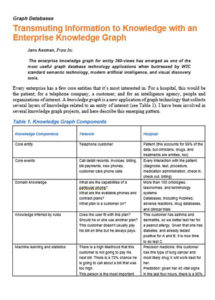
Every enterprise has a few core entities that it’s most interested in. For a hospital, this would be the patient; for a telephone company, a customer; and for an intelligence agency, people and organizations of interest. A knowledge graph is a new application of graph technology that collects several layers of knowledge related to an entity of interest.
Not all knowledge graphs are the same; there seem to be three distinct categories:
The granular customer data from the customer knowledge graph supplies an interesting data source rife for exploitation when analyzed -and acted on- in conjunction with data from the other two graphs. This fact is especially convincing when linking the external customer data with the internal operations data.
Linked enterprise data is the nucleus of the aforementioned knowledge graphs. This technology borrows its fundamental concepts from the notion of linked open data. The chief distinction between the two is that the latter involves external, publicly available sources, whereas the former typically revolves around more internal and proprietorial data. Thus, linked open data functions as a precedent of sorts for linked enterprise data.
The fundamental difference between the linked data approach and the more commonly found relational methodology becomes manifest with a cursory comparison between the two. The linked data methodology readily ameliorates these concerns by giving every object in a semantic graph a universally identifiable URL. This URL is the same wherever data is located throughout the enterprise – whether dumped in a data lake or located in a particular repository for a certain purpose.
The queryable nature of URLs, which is the crux of the linked enterprise data approach of knowledge graphs, is directly attributable to their ability to transmute insight into established knowledge. The principal way such graphs transform data into proven facts is by taking analytics a step beyond its conventional utility. Most organizations predominantly view the output of analytics as information or “answers” to questions, which are ends in themselves. The highly queryable nature of knowledge graphs, however, surpasses this utility by enabling users to input the results of analytics back into their stacks. In this case, those analytic results are the foundation of concrete knowledge, which is then further used to pinpoint accuracy for additional analytics. Each subsequent wave of analytics only furthers this knowledge, which contributes to the expedient, targeted results provided, for example, by search engines or other applications.
Overall, enterprise knowledge graphs and their requisite linked enterprise data methodology are swiftly gaining credence throughout the data landscape. The utilitarian nature of these technologies, however, is far too pervasive to be reserved exclusively for the largest, most well-funded organizations in the IT space (such as those identified at the Sunnyvale conference). Small and midsized organizations can significantly enhance their ROI on data-driven technologies by leveraging these graphs to improve their operations, products and services, and overall cognizance of customers. This reality signifies the true utility of the underlying linked data approach at the core of these graphs – they are applicable to any organization and create the same value regardless of the scope or focus of the company deploying them.
| 👁 Image Purchase the article from IEEE | 👁 Image Read the Manuscript |